Quotulatiousness

May 29, 2024

“The more they rant, scream and lecture, the more cool singing ‘Ausländer raus‘ and ‘Deutschland den Deutschen‘ will become”

Filed under: Germany, Media, Politics — Tags: , , , , , , , — Nicholas @ 05:00

Our deep undercover secret informant in Deutschland, eugyppius, recounts the latest scary outbreak of deadly neofascist singing in the beleaguered country:

The latest threat to German democracy including “one of the men in the video can be seen offering a slack, distinctly metrosexual Roman salute and giving himself a two-fingered Hitler moustache”

“Fascism”, as popularly understood, is both very bad and also very ill-defined, being a negative political vice characterised primarily in opposition to that equally ill-defined political virtue known as “democracy”. This “democracy”, whatever it may be, is distinguished above all by its fuzzy associations with a wide array of other virtues, like diversity, inclusiveness, equity and transsexuality. Fascism is mostly the opposite of all of these things, which sounds bad enough, but it gets much worse: Because democracy is a very fragile virtue, forever requiring vigilant defence and social fertiliser, fascism has become the most ineradicable and indestructible of weeds.

Or perhaps it is better, in our post-pandemic era, to say that fascism is like a virus. It is always spreading, despite (or because of?) our best efforts to kill it off. We vaccinate children against the fascist virus with years of indoctrination about the evils of National Socialism in school, but to judge from the present state of our political discourse, this programme has worked about as well as the mRNA jabs worked against Covid. Never have we preached so stridently against fascism, and never has it been so omnipresent.

Another curious property of fascism, is that it does not merely infect human brains. It can also taint cultural artefacts, like phrases. All of the very best people can use a specific phrase, but that does not matter at all should the fascists get ahold of it. Once they have run the benign words through their evil fascist mouths, anyone who utters them afterwards – whatever his intentions – may well be guilty of fascism. If only democracy were that effective and powerful.

As we’ve learned from the events of the past week, the Germ Theory of Fascism applies also to songs, even vacuous pop music. All of the most democratic people in Germany have worked themselves up into a collective outrage against an unremarkable 1999 Italodance tune called “L’amour toujours” (“Love always”) by Gigi D’Agostino, because some very bad fascists have been caught singing some very naughty lyrics to its indifferent melody. The fascists themselves have been cancelled of course, and the song is on its way to its own separate cancellation as well.

But I’m getting ahead of myself.

[…]

The SPD only deepened their performative self-parody by posting this graphic to Instagram:

The Sylt revellers had chanted “Germany for the Germans”, but in this image the SPD proposed an improvement: “Germany for those Germans who defend our democracy”. Checkmate fascists! Except, “Germany for the Germans” is a slogan most closely identified with Der Heimat (formerly the NPD), an “ultranationalist” and “neo-Nazi” party. Realising that they had unwittingly reproduced the forbidden Nazi incantation, and were therefore guilty of spreading this horror virus, our crack SPD social media team swiftly deleted their post and threw up a hasty apology:

    We just published a post condemning in the strongest possible terms what we all saw in a video from Sylt. We did not manage to strike a tone that would resonate with everyone. We would like to sincerely apologise for this. Our aim is to make it clear that we do not want to leave this country to the far right and hate preachers. We want to defend our democracy and our freedom. Let’s continue this fight together in solidarity!

This is one of those missteps that really leaves you scratching your head. After hours of foaming at the mouth about “neo-Nazi slogans”, our virtue-mongering social democrats posted their own version of those very same tainted words to Instagram, in apparent ignorance of their origins and deeper significance. We are left to ask what they imagined they were angry about in the first place.

It’s hard not to agree with eugyppius’ conclusion:

I have my own theory about all of this.

Once upon a time, teenagers sustained a vibrant countercultural leftism, which was all about telling the establishment to go fuck itself, ingesting inadvisable quantities of drugs and engaging in a lot of inadvisable sex. All of that was very transgressive and exciting, directed as it was against a much more conservative and straight-laced German society. They shocked people, and that was the point. In the decades since, all of those hippies have grown old, and the most ideologically committed of them have become that which they used to hate, namely a lot of insufferable shrivelled scolds. As is the way with scolds everywhere, they’ve unwittingly inspired a new countercultural movement on the opposite side of the political spectrum. The more they rant, scream and lecture, the more cool singing “Ausländer raus” and “Deutschland den Deutschen” will become. Maybe, if they don’t like these words, they should try chilling out and finally shutting the fuck up about fascism. God knows there are more important things to screech about.

In the meantime, our new fascist anthem L’amour toujours has hit the top of the German charts.

May 22, 2024

QotD: Are western democracies moving uniformly in the direction of “surface democracy”?

Filed under: Bureaucracy, Government, Politics, Quotations, USA — Tags: , , , — Nicholas @ 01:00

I joked before about refusing to tolerate speculation about the US being a surface democracy like Japan, but joking aside I think even the staunchest defender of the reality of popular rule would concede that things have moved in that direction on the margin. Compare the power of agency rulemaking, federal law enforcement, spy agencies, or ostensibly independent NGOs now to where they were even 10 years ago. It would be a stretch to say that the electorate didn’t have influence over the American state, but can they really be said to rule it? Regardless of exactly where you come down on that question, it’s probably safe to say that you’d give a different answer today than you would have twenty, fifty, or a hundred years ago. Moreover, the movement has been fairly monotonic in the direction of less direct popular control over the government. And in fact this phenomenon is not unique to the United States, but reappears in country after country.

Is there something deeper at work here? There’s a theory, popular among the sorts of people who staff the technocracy, that this is all a perfectly innocent outgrowth of modern states being more complex and demanding to run. The thinking goes that it was fine to leave the government in the hands of yeoman farmers and urban proles a century ago, when the government didn’t do very much, but today the technical details of governance are beyond any but the most specialized professionals, so we need to leave it all to them.

I think this explanation has something going for it, I admire the structure of its argument, but it also can’t be the whole story. For starters, it treats the scope and nature of the state’s responsibilities as a fixed law of nature. Another way to frame this objection is that you can easily take the story I just told and reverse the causality — the common people used to rule, and so they created a government simple enough for them to understand and command; whereas today unelected legions of technocrats rule, and so they’ve created a government that plays to their strengths. There’s no a priori reason to prefer one of these explanations over the other. There needs to be a higher principle, a superseding reason that results in selecting one compatible ruler-state dyad over another. I think there is such a principle, we just have to get darker and more cynical.

John Psmith, “REVIEW: MITI and the Japanese Miracle by Chalmers Johnson”, Mr. and Mrs. Psmith’s Bookshelf, 2023-04-03.

May 20, 2024

QotD: “Selfless” public servants

Filed under: Economics, Government, Politics, Quotations, USA — Tags: , , — Nicholas @ 01:00

WARNING: If you’re an elected government official or if you’re attached to idealistic notions about such officials, do not read this commentary. It will offend you.

Ideally, government in a democratic republic reflects the will of the people, or at least that of the majority. Citizens vote for candidates whom they believe will best promote the general welfare. Victorious candidates, after pledging to uphold the Constitution, go to state capitals or to Washington, D.C., to do The People’s business — to undertake all the good and worthy activities that citizens in their private capacities cannot perform.

Sure, every now and then crooks and demagogues win office, but these are not the norm. Our system of regular, aboveboard democratic elections ensures that officials who do not effectively carry out The People’s business are thrown from office and replaced by more reliable public servants.

Trouble is, it’s not true. It’s a sham. Despite being called “the Honorable”, the typical politician is certainly no more honorable than the typical dentist, auto mechanic, Wal-Mart regional manager or any other private citizen.

Despite being referred to as “public servants”, politicians serve, first and foremost, their own personal political ambitions and they do so by pandering to narrow special interest groups.

Don Boudreaux, “Base Closings”, Pittsburgh Tribune-Review, 2005-03-18.

May 16, 2024

The Thüringen Project – “where our greatest legal minds are at this very moment brainstorming ways to defend Thuringian democracy from the grave threat of ordinary people expressing their political preferences via voting”

Filed under: Germany, Media, Politics — Tags: , , , , — Nicholas @ 04:00

eugyppius on the brave defenders of German democracy in Thuringia (and Brandenburg and Saxony) who are doing everything they can to ensure that the unwashed masses don’t disturb the stately progress toward their long-dreamed-of utopia:

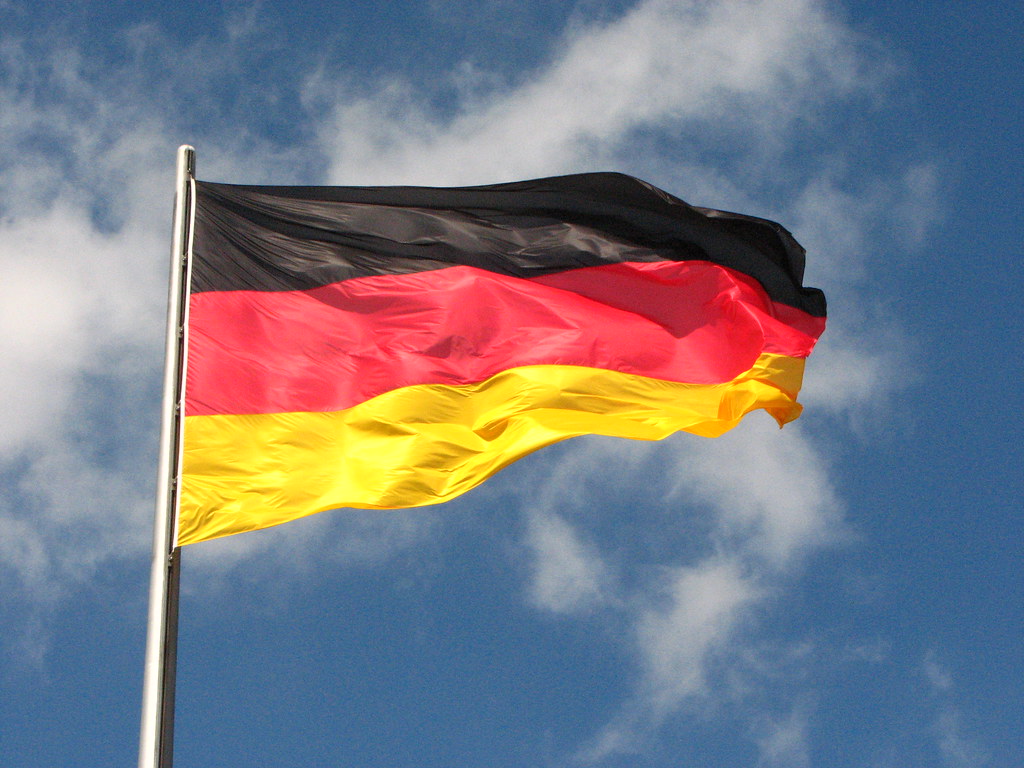
“German flag” by fdecomite is licensed under CC BY 2.0 .

To live in Germany in 2024 is to be lectured constantly about democracy. An endless parade of doubtful personalities – pundits, experts and a lot of very shrill women – appear on the television every night to tell you which parties are democratic, which people are democratic and therefore who enjoys democratic legitimacy. As we have seen, however, the whole concept of democracy is very confusing. Those people and organisations who want to mute free expression and ban political parties are all held to be extremely democratic, while those parties that demand more direct democracy and talk constantly about respecting the popular will are the direct modern equivalent of illiberal antidemocratic fascists.

To make all of this even harder, we are told that the upcoming September elections in Thüringen, Brandenburg and Saxony present a grave threat to democracy. To counteract this threat we have things like the Thüringen Project, where our greatest legal minds are at this very moment brainstorming ways to defend Thuringian democracy from the political preferences of actual voters. Crucially, the very existence of the Thüringen Project means that democracy must still reign supreme in Thüringen. Otherwise, there would be nothing for the democratic police of the Thüringen Project to defend. We therefore need only study Thuringian politics in their present state to gain a better idea of what this mysterious, shape-shifting, elusive phenomenon we call German democracy might be.

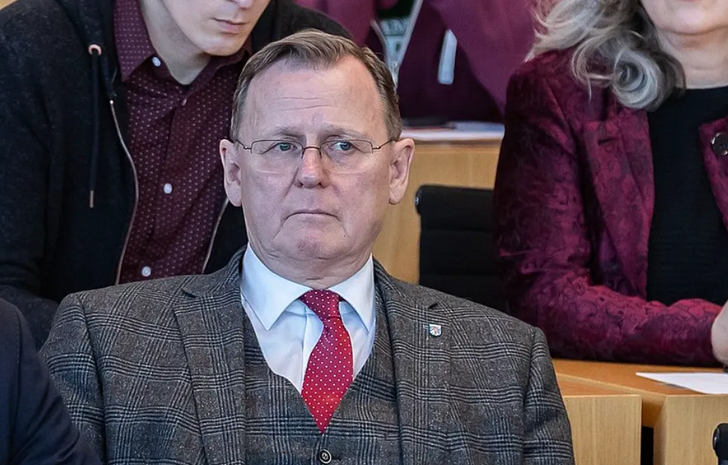
We will start at the top. The current Minister President (i.e., governor) of Thüringen is a highly democratic man named Bodo Ramelow:

Ramelow is a member of Die Linke, or the Left Party, which is the direct successor of the Socialist Unity Party (or SED) that used to govern the DDR. That might seem baffling, as the SED and the DDR were anything but democratic. Still more baffling is the fact that the constitutional protectors suspected Ramelow of antidemocratic tendencies and even surveilled him for many years. But democracy as we have learned is extremely complicated, and whatever antidemocratic essence Ramelow may have harboured in the past, he is a stalwart democratic politician today. He is also a huge fan of the mobile game Candy Crush, which he enjoys playing during government meetings. That at least seems unambiguously democratic, and perhaps it is even enough to overcome Ramelow’s political unreliability in other respects.

[…]

In summary: A constitutional protector who owes his office to a Minister President who was appointed to a second term via the anti-constitutional interventions of outsiders is now vowing to use his office to forestall political developments that may deprive his Minister President of power in the future. It is almost like “democracy” in Thüringen is synonymous with left-wing government. Elections which threaten to deprive Bodo Ramelow of office or his left-wing coalition of power are by definition anti-democratic, deplorable and perhaps even illegal.

Thuringians can vote for whichever party they want, but their votes are only democratic if they are cast for those specific parties. If Kramer has his way, Thuringia will soon achieve the democratic end-state – one in which the sad reality of popular sovereignty in practice will be replaced with a theoretical popular sovereignty that exists entirely in an ideal, Platonic form, unchanging and as it ought to be, now and forever.

The Canadian Senate is an anti-democratic fossil … that might totally frustrate a future Conservative government

Filed under: Cancon, Government, Politics — Tags: , , , , , — Nicholas @ 03:00

Tristin Hopper considers the constitutional weirdness of Canada’s upper house, an appointed body that has the power to block a popularly elected House of Commons:

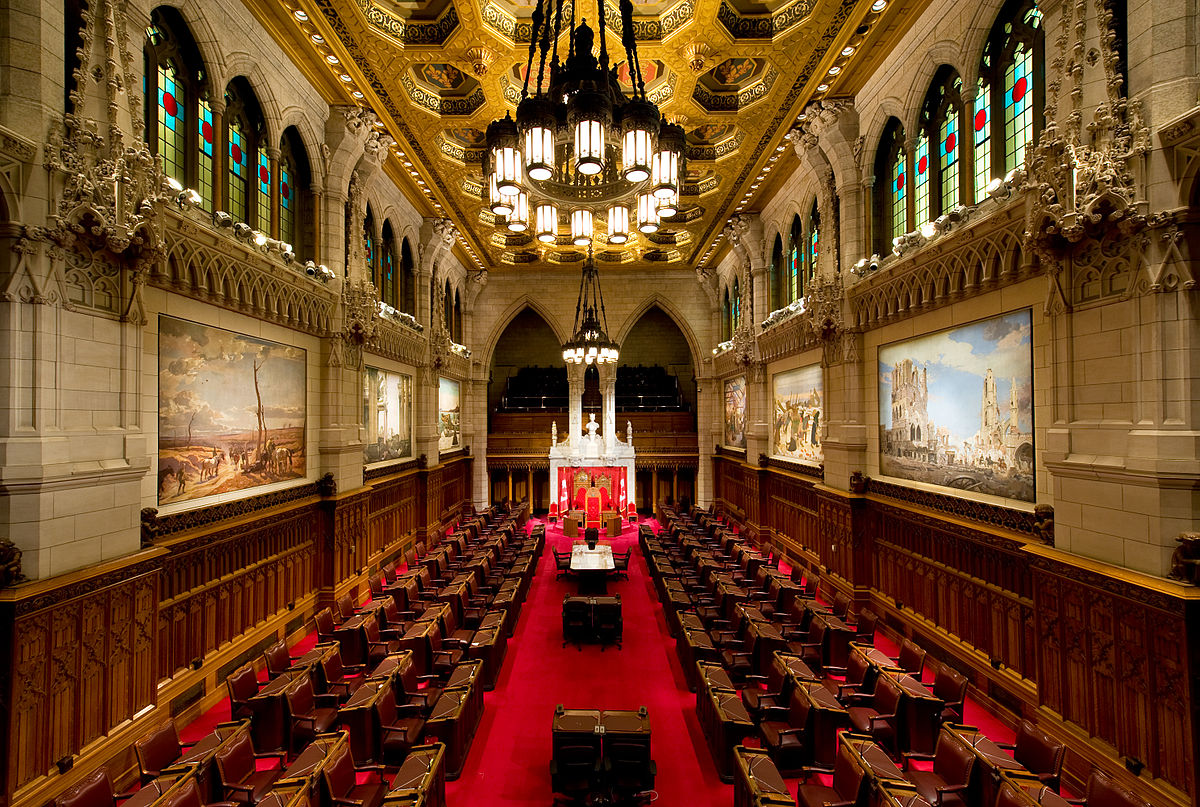
“In the east wing of the Centre Block is the Senate chamber, in which are the thrones for the [King and Queen], or for the federal viceroy and his or her consort, and from which either the sovereign or the governor general gives the Speech from the Throne and grants Royal Assent to bills passed by parliament. The senators themselves sit in the chamber, arranged so that those belonging to the governing party are to the right of the Speaker of the Senate and the opposition to the speaker’s left. The overall colour in the Senate chamber is red, seen in the upholstery, carpeting, and draperies, and reflecting the colour scheme of the House of Lords in the United Kingdom; red was a more royal colour, associated with the Crown and hereditary peers. Capping the room is a gilt ceiling with deep octagonal coffers, each filled with heraldic symbols, including maple leafs, fleur-de-lis, lions rampant, clàrsach, Welsh Dragons, and lions passant. On the east and west walls of the chamber are eight murals depicting scenes from the First World War; painted in between 1916 and 1920”
Photo and description by Saffron Blaze via Wikimedia Commons.

By the anticipated date of the 2025 federal election, only 10 to 15 members of the 105-seat Senate will be either Conservative or Conservative appointees. The rest will be Liberal appointees. As of this writing, 70 senators have been personally appointed by Trudeau, and he’ll likely have the opportunity to appoint another 12 before his term ends.

What this means is that no matter how strong the mandate of any future Conservative government, the Tory caucus will face a Liberal supermajority in the Senate with the power to gut or block any legislation sent their way.

“If a majority of the Senate chose to block or severely delay a Conservative government’s legislative agenda, it would plunge the country into a constitutional crisis the likes of which we have not seen in more than a century,” reads an analysis published Tuesday in The Hub.

Constitutional scholars Howard Anglin and Ray Pennings envisioned a potential nightmare scenario in which the Senate casts themselves as “resisting” a Conservative government. Given that senators are all permanently appointed until their mandatory retirement at age 75, it would take at least 10 years until a Conservative government could rack up enough Senate appointments to overcome the Liberal-appointed majority.

“Canadian politics would grind to the kind of impasse that is only broken by the kind of extraordinary force whose political and social repercussions are unpredictable,” they wrote.

The piece even makes a passing reference to 1849, when mobs burned down Canada’s pre-Confederation parliament.

The prospect of an all-powerful Senate able to block the mandate of an elected government is a legislative situation almost entirely unique to Canada.

New Zealand abolished its Senate and is now governed by a unicameral legislature. Australia and the United States both employ term-limited elected senates. The U.K. House of Lords – on which the Canadian Senate is closely modelled – is severely constrained in how far it can check the actions of the House of Commons.

But in Canada, the Senate essentially retains the power of a second House of Commons; it can do whatever it wants to legislation that has passed the House of Commons, including spike it entirely.

May 12, 2024

QotD: What is Putin’s endgame in Ukraine?

It would appear that Putin, Xi, etc. are coming to see themselves as the leaders in a worldwide battle against Juggalisme. That might be wishcasting — they are practical men, after all, and let me state, unequivocally and for the record, that I do NOT want to be ruled by Russians or Chinese. They are not my people. Nonetheless, it does seem clear they understand that the source of their problems is beyond what we think of as geopolitics. The United States is “agreement incapable”, as I guess the term d’art is, because it’s not rational, or even predictably irrational.

That was the monarchist critique of representative government that hit closest to home: Foreign policy needs to be supple and responsive; it must be able to move quickly, to make big changes in narrow time windows. In a real crisis, you simply don’t have time to convene a Parliament to debate stuff. N.b. they were saying this in the late 18th century; it’s so much worse now. And another observation from that time that is even truer today: A “democratic” foreign policy can never be consistent. You simply can’t plan long-term when there’s partial to complete governmental overhaul every few years.

That the US managed to muddle through for as long as it did was really a combo of two things: time (as a function of distance), and a near-peer enemy.

Neither of those is integral to the system, and neither is within the system’s control. Until recently, American foreign policy had to take into account the fact that on-the-spot commanders would have to make decisions on their own recognizance. Even with phone communications, the man on the ground in the Fulda Gap has to make decisions basically without reference to Washington. It forced him to be conservative — in other words, it discouraged adventurism.

Same way with the near-peer enemy. The looming shadow of the USSR forced regular reality checks inside the US Apparat. A whole bunch of possibilities were foreclosed by default — our response to any given situation had to take the likely Soviet reaction into account. As with the time/distance factor, this forced a kind of conservatism that looked a lot like sclerosis, but at least it deterred adventurism.

The history of the later 20th century is the history of those constraints being removed. In Vietnam, for instance, you had LBJ and McNamara sitting in a room in the White House, personally directing airstrikes in near-realtime. If “news” reports are to be believed, Obama was on the horn with that SEAL team going after Bin Laden right up to the very moment the chopper landed. Knowing these things are technically possible is catnip to politicians — they already assume they’re omnicompetent, and so now they want to be “advising” the commanding general even as the battle rages.

And if that’s catnip, then the end of the USSR was catnip on steroids. Why not play fuck-fuck games everywhere, all at once? Who’s gonna stop us? China? They chose to pass. They saw what happened to the USSR when it locked itself into an ideological death spiral vis-a-vis the Struggle Against International Capitalism. American policymakers only understand Soviet-style bluff and bluster. The Chinese play the long game.

NOT because they’re Inscrutable Orientals, I hasten to add — they’re as Juggalicious as our Clowns, in their way — but because the generation currently in power came up hard, and so they are adults. That’s all. They are not spoiled, petulant children. The next generation of Chinese leadership — assuming we live to see it — will really be something, and not in a good way.

So, what does Putin want? I dunno, and I’m not sure he knows, because I’m not sure he can know. I’m sure his broadest goal is “to stop getting fucked with by idiots”, but how can that be achieved? There shall be no durable peace in this world until there is Regime Change in [Washington, DC], and I’m not talking about the other half of the Uniparty winning an election or two. I think Putin knows that, but what can he really do about it? I think he’s going to be forced to annex a fair amount of territory and set up a totally demilitarized buffer zone. It won’t work, but it’s the least-worst practical option.

Severian, “Friday Mailbag”, Founding Questions, 2024-02-09.

May 5, 2024

QotD: The aims of the intersectional left

Filed under: Media, Politics, Quotations, USA — Tags: , , — Nicholas @ 01:00

Every now and again, it’s worth thinking about what the intersectional left’s ultimate endgame really is — and here it strikes me as both useful and fair to extrapolate from Kendi’s project. They seem not to genuinely believe in liberalism, liberal democracy, or persuasion. They have no clear foundational devotion to individual rights or freedom of speech. Rather, the ultimate aim seems to be running the entire country by fiat to purge it of racism (and every other intersectional “-ism” and “-phobia”, while they’re at it). And they demand “disciplinary tools” by unelected bodies to enforce “a radical reorientation of our consciousness”. There is a word for this kind of politics and this kind of theory when it is fully and completely realized, and it is totalitarian.

Andrew Sullivan, “A Glimpse at the Intersectional Left’s Political Endgame”, New York Magazine, 2019-11-15.

April 30, 2024

The CDU’s “five-point plan to protect German democracy from … the free and open internet”

Filed under: Germany, Law, Liberty, Media, Politics — Tags: , , , , , — Nicholas @ 04:00

German mainstream politicians are struggling to keep extreme right populist anti-democratic voices from being heard by innocent and trusting German voters, so the leader of the CDU in Thuringia has a master plan:

The duel between our leading Thuringian politicians was all but unwatchable, as indeed almost all political debates turn out to be. While [AfD leader Björn] Höcke could’ve acquitted himself better, [CDU leader Mario] Voigt’s performance was flat, uninspired and profoundly banal. Among other things, the man suffers from a peculiar rodentine aspect; he bites his way stiffly through bland preformulated arguments like a squirrel chewing a stale nut or a beaver gnawing through saplings. After the event, the CDU took to the press to declare victory, but polls showed that viewers found Höcke on balance more persuasive, which is of course the real reason that everybody told Voigt to avoid the confrontation. Voigt is intensely democratic and therefore extremely right about everything, but somehow – and this is very awkward to discuss – his being eminently righteous and correct in all things does not manifest in an ability to defeat the very wrong and evil arguments of his opponents. It’s very weird how that works, perhaps somebody should look into it.

Stung by this failure, Voigt has set off to find other means of defending democracy. This week, in the Thüringen state parliament, he gave an amazing speech outlining a five-point plan to protect German democracy from that other great menace, the free and open internet:

    So how do we protect democracy in the area of social media? There are five approaches:

    Ideally, we should agree to ban bots and to make the use of fake profiles a criminal offence.

    There is also the matter of requiring people to use their real names, because freedom of expression should not be hidden behind pseudonyms.

    Then there’s the question of whether we should create revocable social media licences for every user, so that dangerous people have no place online.

    We need to consider how we can regulate algorithms so that we can revitalise the diversity of opinions in social networks.

    And we also have to improve media skills.

For all that Björn Höcke is supposed to be a “populist authoritarian” opposed to representative government, I’ve never heard him say anything this crazy. Voigt, meanwhile, is a leading politician for the officially “democratic” Christian Democratic Union (you know they are democratic because the word is in their name), and he’s actually dreaming of requiring Germans to obtain state-issued licenses for permission to post their thoughts to the internet.

Because Voigt’s regulatory regime would entirely abolish online “freedom of expression”, it is unclear how banning bots and pseudonymity could ever defend it. Generally speaking, for a thing to be defended, it must first exist. Equally curious is Voigt’s belief that any “diversity of opinion” will survive his social media license scheme to benefit from the regulation of social media algorithms.

April 24, 2024

Alternative für Deutschland is gifted a blueprint for governing by their entrenched opponents

Filed under: Germany, Media, Politics — Tags: , , , , , , — Nicholas @ 03:00

Was it Napoleon who said to never interrupt your enemy when they’re making a mistake? If so, the German populist Alternative für Deutschland leaders must be congratulated for not interrupting the latest mistake by the statists they want to replace:

Every day I encounter yet another hamfisted pseudoacademic propaganda operation eagerly churning out oceans of text to shore up the German political establishment. The idea seems to be that with just enough whitepapers, bursting with just enough words, the situation might still be saved.

There are just so many of these outfits, they grow like weeds in the fertile soil of government funding. This Sunday, it has been my dubious pleasure to stumble across the “academic and journalistic open access forum of debate on topical events and developments in constitutional law and politics” billing itself as the Verfassungsblog (the “Constitution Blog”). This factory of tedious prose and political special pleading that nobody will ever read is not just the eccentric side project of a very socially concerned lawyer named Maximilian Steinbeis, oh no. It is funded by the WZB Berlin Social Science Center (and therefore, indirectly, by the German taxpayer) and also by the Max Planck Institute for Comparative Public Law and International Law. We would do well to take these people seriously, in other words, and you should keep that in mind, because things are about to get very ridiculous.

Last year, our state-funded Verfassungbloggers realised that elections were approaching in Saxony, Thüringen and Brandenburg. This worried them terribly, because Alternative für Deutschland dominates polling in all three states. They feared that this “authoritarian populist party” might seize control of one or more state governments, just as other authoritarian populist parties have seized control “in Poland and Hungary, in Florida and Texas”. These parties are very bad, because they “use … power … so that they no longer have to relinquish it”. They “manipulate electoral law” and “stifle opposition” and “pack the administration and judiciary with their own people”. As if that were not bad enough, they also “make the media, scientific and cultural institutions dependent on their will”. Of course, the Federal Republic is presently ruled by a party cartel system that is already doing all of that, but the difference is that none of the parties involved are “authoritarian” or “populist”. The priests of democracy get to do whatever they want, and whatever they do is by definition democratic.

In this spirit, our Verfassungsbloggers launched the “Thüringen Project”. Their aim is to identify how the forces for humanitarian pluralism might manipulate the law, stifle the opposition and pack the administration and judiciary in even more extreme ways than have yet been imagined, all to subvert the will of east German voters and more effectively blunt the power of the AfD when they become the strongest party in the Thuringian Landtag.

[…]

All of this iterative looping has culminated in an overproduced, 36-page .pdf file bearing the characteristically cumbersome title “Strengthening the resilience of the rule of law in Thüringen: Action recommendations from the scenario analysis of the Thüringen Project“. No syllable can be spared in our campaign to defend democracy. In the pages of this plan, they finally define what “authoritarian populist parties” are. These are parties that “use the narrative of a natural, ‘true’ people in opposition to ‘corrupt elites’, for the purpose of delegitimising pluralistic democracy and establishing an authoritarian regime”. The AfD are of course “a clear example of such a party”. The more panicked all of these people get, the closer they come to saying plainly what they’re really afraid of, namely the growing hostility of native Germans to an increasingly isolated political elite, which plainly does not care much about “authoritarianism” (they are responsible for plenty of that themselves) as much as they are terrified of losing their hold on power.

April 15, 2024

El Salvador’s approach to fighting serious crime draws gasps of horror from NGOs

Filed under: Americas, Law, Media — Tags: , , , , , — Nicholas @ 05:00

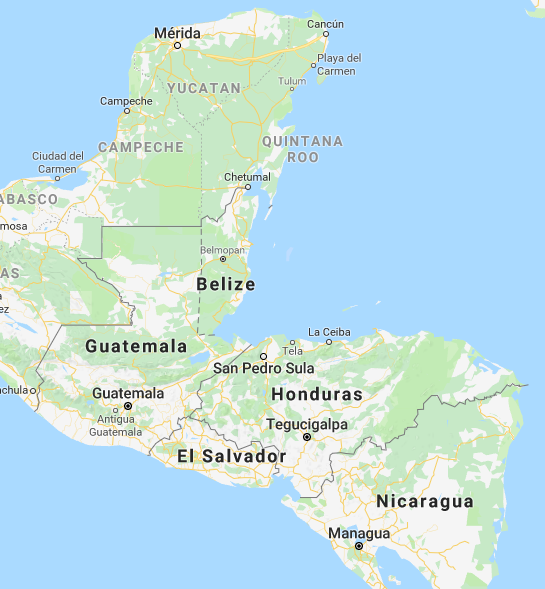
In Niccolo Soldo‘s weekend collection of links, he devotes some attention to the amazing success of El Salvador’s current government in driving down the murder rate and why it’s causing much pearl-clutching and dives for the fainting couches among the transnational “elites” and their media handmaidens:

Honduras, Guatemala and El Salvador
Image via Google Maps.

We are bombarded daily with news of mass/random shootings, subway stabbings, and so on. Many of the perpetrators of these violent acts are repeat offenders who for some reason or another (politics) are allowed to roam the streets and attack innocent bystanders. The effect of these lax policies on law and order is the condition known as “anarcho-tyranny” i.e. where the state permits random acts of violence while offering/permitting no solution/resolution … until it has no option but to try and do so.

In NYC, the National Guard is now patrolling the subway. This is a band-aid solution for a problem that was largely fixed already via the policy known as “stop and frisk”. This policy was deemed “racist”, so it had to end. The price of ending this successful policy was a bit of the ol’ anarcho-tyranny. The conflict between rights and law and order continues unabated for the foreseeable future, at least in the USA.

El Salvador has taken a different approach. Since taking office, President Bukele has arrested some 77,000 gang members, locking them up in prisons throughout the country. In one fell swoop, its notoriously high homicide rate has collapsed. Bukele’s law and order policy has resolved El Salvador’s internal security issue … but at what cost? Western media and human rights NGOs insist that the cost has been El Salvador’s democracy:

    Under President Nayib Bukele, El Salvador has experienced one of the most spectacular declines in violent crime in recent memory, anywhere in the world. Despite ranking among the most dangerous countries on the planet a mere decade ago, the Central American state today boasts a homicide rate of only 2.4 per 100,000 people — the lowest of any country in the Western Hemisphere other than Canada.

    El Salvador owes much of its dramatic drop in crime to Bukele’s crackdown on street gangs and criminal organizations, including MS-13 and Barrio 18. Although homicide rates were trending downward before Bukele took office in 2019, violent crime declined sharply after March 2022, when his government declared a state of emergency following a spike in murders, allowing the government to suspend basic civil liberties and mobilize the armed forces to carry out mass arrests. This state of exception granted Bukele’s administration a blank check to fight gangs and detain suspects without consideration for transparency, due process, or human rights.

Bukele is wildly popular at home, and his policy is now gaining currency elsewhere in Latin America:

    Bukele’s iron-fist measures and their apparent results have not only made him wildly popular in his country — earning him a landslide reelection in February 2024 — but also captured the imagination of politicians elsewhere grappling with rapidly deteriorating public safety. Members of the political elite in other states are now toying with the so-called Bukele model. In Ecuador, for instance, President Daniel Noboa has unabashedly followed in Bukele’s footsteps in response to prison riots and a major surge in homicides, declaring a state of emergency in January that gave the armed forces free rein to detain suspects and to take over control of the country’s prisons. The Bukele-style security measures appear to be succeeding there, as well: a little over a month into the crackdown, the government reported that the daily average of homicides had fallen from 28 to six. The fact that militarized public safety campaigns are proving effective outside El Salvador has only enhanced the model’s growing appeal across Latin America, which has long suffered the highest rate of violence of any region in the world.

Here’s the part where the author lodges his protest, and suggests alternative models:

    But as appealing as a Bukele-style crackdown might seem, these punitive campaigns against organized crime come at a serious cost to democracy and human rights. These measures concentrate power in the hands of the executive, chipping away at other democratic institutions, such as Congress and the judiciary, that are critical bulwarks against governmental abuse. They also fail to solve the underlying problems, such as corruption and impunity, that generate such violence and instability in the first place.

    There are alternatives to the Bukele model for reducing crime. In cities in Brazil, Colombia, and Mexico, politicians have managed to decrease homicides without eroding civil and human rights by making sustained investments in democratic policing, which emphasizes transparency, accountability, and civil liberties. These measures may not work as quickly, and they may not be as conspicuous. But they do not sacrifice democracy on the altar of public safety. Militarized states of emergency are no silver bullet: for any public safety measures to permanently succeed, they must not come at the expense of the democratic institutions that protect civilians from abuse at the hands of the government.

El Salvador has traded off some civil liberties for public safety, but to suggest examples from Brazil, Colombia, and especially Mexico as workable alternatives boggles the mind. This isn’t the first essay written about El Salvador that laments its “loss of democracy” … The Economist keeps pumping out this same argument over and over again. What these articles do tell us is that for many, democracy is indeed a god, and being a god, it is infallible. Not only can the openness of liberal democratic societies not be at fault for some of the crime that has plagued these countries, but Bukele’s heavy-handed approach is doomed to failure in the long run because it is not based on democratic principles. These democratic critics of Bukele are engaging faith-based reasoning, because their god cannot fail.

April 10, 2024

Saving Our Democracy watch – “[Trump] has to do at least ten years, or everybody will hate the navy”

Filed under: Government, Law, Military, Politics, USA — Tags: , , , , — Nicholas @ 04:00

Chris Bray suggests that reading the full linked document may be hazardous to your mental health, so he’s helpfully highlighted a few of the key points that may have you scratching your head and saying something like “The Fuh? What??”

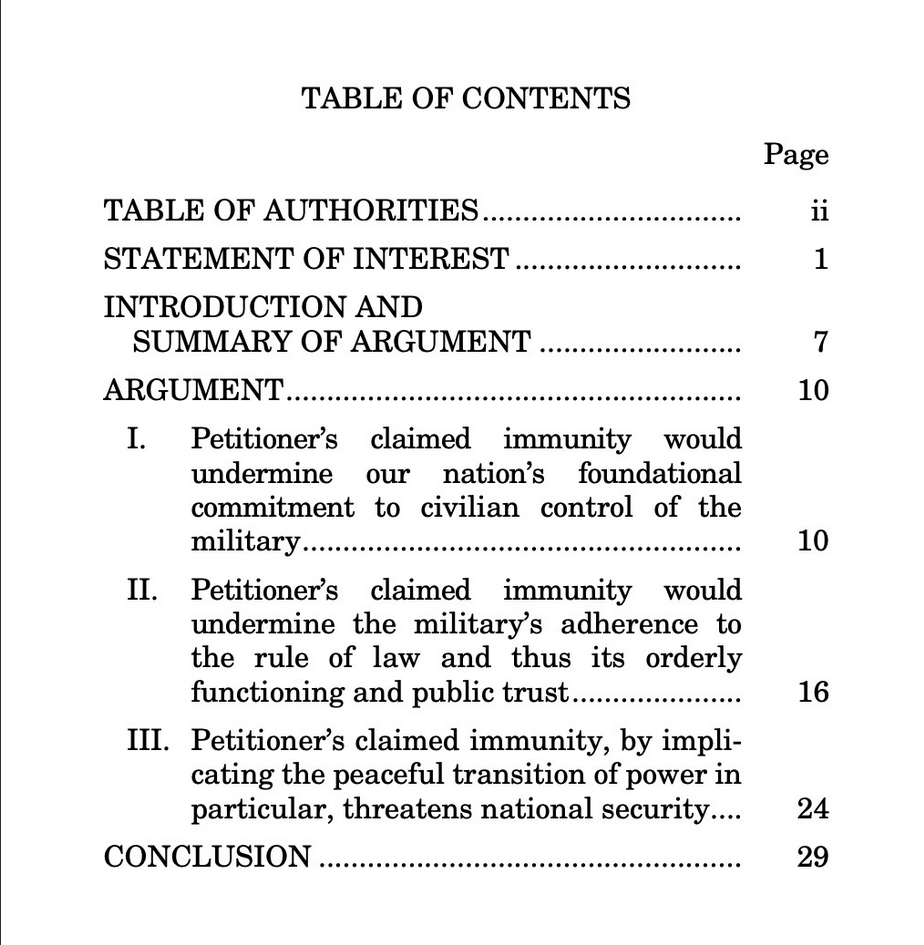
I have a mixed view of Donald Trump’s argument about presidential immunity, which you can read here. But an amicus brief filed with the Supreme Court today by retired flag officers and service secretaries is so bizarre that reading it may permanently alter the structure of my face.

You can read the whole amicus brief here, but treat it like a solar eclipse and don’t stare at it directly. As a first sign of how much good faith the thing contains, one of the amici is Michael Hayden.

The first argument is that Trump has to go to prison or else civilians won’t control the military anymore. You think I’m kidding.

Amici are deeply interested in this case because presidential immunity from criminal prosecution would threaten the military’s role in American society, our nation’s constitutional order, and our national security.” See the connection? If Donald Trump doesn’t go to prison, “the military’s role in American society” will be damaged. He has to do at least ten years, or everybody will hate the navy.

The prevailing feature of the entire brief is an essence of flattening. Every issue is very simple. There are no competing examples. None of this has ever come up before: The brief deals with questions of presidential immunity around Obama drone-killing a 16 year-old US citizen, or Lincoln unilaterally suspending habeas corpus and using the military to arrest critics of the war, by not mentioning any of it, or any other historical example. Everything is a surface. I’ve graded undergraduate essays, so the tone and depth of the effort feels familiar.

Third argument: Donald Trump has to be prosecuted, because America promotes democracy all over the world, and Trump not being prosecuted is against democracy, so it will be harder for us to promote democracy if we don’t prosecute him. Authoritarian regimes say that American democracy doesn’t work, so: “Presidential immunity from criminal prosecution feeds those false and harmful narratives. Unless Petitioner’s theory is rejected, we risk jeopardizing America’s standing as a guardian of democracy in the world and further feeding the spread of authoritarianism, thereby threatening the national security of the United States and democracies around the world.”

We have to imprison the leader of the political opposition, or people won’t think we’re a democracy, and then there will be more authoritarianism, like when regimes imprison the political opposition.

March 23, 2024

Ireland’s Varadkar heads for the showers

Filed under: Europe, Government, Politics — Tags: , , , — Nicholas @ 05:00

In Spiked, Brendan O’Neill discusses the “shocking” — but not actually shocking — resignation of Ireland’s Taoiseach (prime minister):

Leo Varadkar and Rishi Sunak
Composite image from extra.ie

“I am no longer best man to be Irish PM”, said a BBC headline this week, summarising Leo Varadkar’s resignation speech. The truth, Leo, is that you were never the best man to be Irish PM. He was never elected by the people to be taoiseach, instead securing that seat of power by appointment and backroom dealing. And once there, once he’d been gifted the highest office in the land by his allies in Dublin 4, he wielded government not for the people, but against them. He bent Ireland to what was essentially a vast real-time experiment in social re-engineering and thought control.

An unelected ruler using his power and clout to correct the country and improve the people? There’s a word for that. And it isn’t “democracy”.

Varadkar announced his resignation on Wednesday. In an emotional speech he said he was stepping down as leader of Fine Gael immediately and will step down as taoiseach once his successor has been chosen. His “shock departure” followed the people’s crushing defeat of the twin referendum he put forward. Overwhelming majorities rejected his proposals to alter the Irish constitution to update its definition of “family” and to fix what Varadkar damned as its “very sexist” reference to a woman’s “duties” in the home. No thanks, said the electorate, in the biggest ever referendum loss by an Irish government.

Even the fact that Varadkar’s stepping down is widely seen as a “shock move” speaks to the haughtiness, the outright unworldliness, of his political kind. To many of us it makes perfect sense that a PM would bugger off after suffering a historically unprecedented bloody nose from voters. But it seems the Varadkar clique thought they could ride it out. “No biggie” was their view. Until his “shock departure” on Wednesday, reports the Guardian, “the political fallout from the [referendum] debacle had widely been expected to be limited”.

Who expected that? I’m sure those voters who gleefully seized the opportunity of the referendum to give the middle finger to Varadkar and the rest of the establishment didn’t expect the impact of their discontent to be “limited”. It is a testament to the arrogance of technocracy, to the chasm that has emerged between Ireland’s rulers and Ireland’s ruled, that the Dublin establishment thought it could shrug off the largest drubbing it has ever received from voters.

In the end, tellingly, it seems it was disgruntlement from within his own party ranks, rather than the disgruntlement of the oiks, that convinced Varadkar to go. He was facing “increasing discontent within Fine Gael”, with some party bigwigs worried he’s an “electoral liability”. Everything you need to know about the man is contained in the fact that he essentially shrugged when the masses rose up against him but bolted when his fellow clerisy members criticised him. To the technocrat, the disapproval of their dinner-party circle carries far more weight than the discontent of ordinary people.

If Varadkar was edged out by the tut-tutting of movers and shakers, it would be a fitting end to a career that always owed more to the intrigue of political insiders than to the enthusiasm of the electorate. It is an unremarked upon truth that Varadkar was never installed into power by the people. He first became taoiseach in 2017 when then taoiseach Enda Kenny resigned as leader of Fine Gael. Varadkar was elected new party leader and became taoiseach on the back of it. So he became PM of Ireland on the back of the deliberations of 25,000 party members, not the ballots of the people.

Actually, even members of Fine Gael weren’t especially enthused by him. Varadkar’s opponent in the 2017 leadership contest – Simon Coveney – won almost twice as many votes from party members: 7,051 to Varadkar’s 3,772. But Varadkar won more votes from members of the parliamentary party – 51 to Coveney’s 22 – which meant Fine Gael’s weighted electoral college ruled in his favour rather than Coveney’s. From the get-go, Varadkar’s rule of Ireland was more an accomplishment of elite patronage than democratic keenness.

Bhutan

Filed under: Asia, Britain, Government, History, India — Tags: , , , , , , — Nicholas @ 03:00

Ned Donovan recounts his recent trip to Bhutan, situated in the Himalaya mountains between India and China:

Bhutan map from the CIA World Factbook, 2010. Chinese-disputed border areas are marked with dashed lines and darker shading.
Wikimedia Commons.

Bhutan has long been a place I had wanted to visit, but it isn’t as simple as booking a ticket.

It would be remiss not to quickly situate Bhutan and its history for those unaware. It is a small kingdom east of Nepal and nestled between India and China. It has a population of around 750,000, almost all of whom are devout Buddhists. It was once a land of feuding Tibetan chieftans who were united in the 1630s by a remarkable warrior and Buddhist lama called Ngawang Namgyal. Namgyal died in 1651, but his death was kept a secret from the country for more than 50 years, with officials simply saying that the king was “on an extended retreat” and continued to keep Bhutan together by issuing decrees in his name.

While Namgyal was seen as the spiritual leader, he also established a temporal monarchy which in a slightly modified form still exists today under the leadership of the Wangchuk dynasty. The King of Bhutan’s title is the Druk Gyalpo, which literally translates to Dragon King. Over time Bhutan, being small but strategically located, faded in and out of the spheres of influence of the day from the Mughals to the British Raj. It would have been subsumed into the latter like other princely states, but in the 19th Century a British civil servant placed some files relating to Bhutan into a folder marked “External” instead of “Internal”, a small decision that ensured it remains an independent country today, albeit one “guided” on matters of defence and foreign affairs by a treaty with India.

The country only opened its borders to foreigners in 1974, to mark the coronation of the Fourth King, Jigme Singye Wangchuck. His Majesty saw the opportunity to take advantage of his accession to showcase Bhutan and its unique culture and traditions to the world, but was also aware that unrestricted tourism would put those at risk. Over time, this developed into a vision known as “High Quality, Low Volume” tourism. All visitors must have a guide and driver and also pay a daily fee — currently $100. In 1974, 287 foreigners visited Bhutan, and in 2019 more than 70,000 fee paying tourists came.

As a result of this policy, the trips are largely cultural. You take hikes in unimaginable scenery, watch local festivals where masked creatures tell villagers morality tales, and sit with locals to eat dishes made up mostly of chilis. For fun people relax with the national sport of archery, singing deliciously rude songs to put off their friends while they take shots. Tourists get to have a go but the target is brought closer and you get to use the same kind of bow young children do. Civil servants go to work in traditional dress and robe-clad monks pepper society. In the five days I spent there, much was spent talking to our compulsory guide who was a lovely man named Yarab, who had once been on the Bhutan national football team. One story Yarab told me was that of Bhutan’s transition to democracy.

The previously mentioned Fourth King oversaw Bhutan’s transition into the modern world – but with a catch. Bhutan’s development could not come at the cost of its people’s happiness. Thousands of kilometres of roads were built, free at point of use clinics quickly filled the country, and electricity and telephone hookups turned King Jigme Singye’s isolated kingdom where almost no one had access to healthcare or education into a remarkably healthy and literate little state in the space of just a few decades. Much of the money to make this possible came from selling hydroelectricity generated by dams that are powered by Himalayan glaciers. The Fourth King explained that: “water is to us what oil is to the Arabs”.

March 20, 2024

QotD: Ancient Greek tyranny

The normal expectation for Greek tyranny is that the system works like the Empire from Star Wars: A New Hope, where the new tyrant abolishes the Senate, appoints his own cronies to formal positions as rulers and generally makes himself Very Obviously and Formally In Charge. But this isn’t how tyranny generally worked: the tyrant was Very Obviously but not formally in charge, because he ruled extra-constitutionally, rather than abolishing the constitution. This is what separates tyranny, a form of extra-constitutional one man rule, from monarchy, a form of traditional and thus constitutional one-man rule.

We see the first major wave of tyrannies emerging in Greek poleis in the sixth century, although this is also about the horizon where we can see political developments generally in the Greek world, still our sources seem to understand this development to have been somewhat novel at the time and it is certainly tempting to see the emergence of tyranny and democracy in this period both as responses to the same sorts of pressures and fragility found in traditional polis oligarchies, but again our evidence is thin. Tyrants tend to come from the elite, oligarchic class and often utilize anti-oligarchic movements (civil strife or stasis, στάσις) to come to power.

Because most poleis are small, the amount of force a tyrant needed to seize power was also often small. Polycrates supposedly seized power in Samos with just fifteen soldiers (Hdt. 3.120), though we may doubt the truth of the report and elsewhere Herodotus notes that he did so in conspiracy with his two brothers of whom he killed one and banished the other (Hdt. 3.39). I’ve discussed Peisistratos’ takeover(s) in Athens before but they were similarly small-ball affairs. In Corinth, Cypselus seized power by using his position as polemarch (war leader) to have the army (which, remember, is going to be a collection of the non-elite but still well-to-do citizenry, although this is early enough that if I call it a hoplite phalanx I’ll have an argument on my hands) expel the Bacchiadae, a closed single-clan oligarchy. A move by any member of the elite to put together their own bodyguard (even one just armed with clubs) was a fairly clear indicator of an attempt to form a tyranny and the continued maintenance of a bodyguard was a staple of how the Greeks understood a tyrant.

Having seized power, those tyrants do not seem to have abolished key civic institutions: they do not disband the ekklesia or the law courts. Instead, the tyrant controls these things by co-opting the remaining elite families, using violence and the threat of violence against those who would resist and installing cronies in positions of power. Tyrants also seem to have bought a degree of public acquiescence from the demos by generally targeting the oligoi, as with Cypselus and his son Periander killing and banishing the elite Bacchiadae from Corinth (Hdt. 5.92). But this is a system of government where in practice the laws appeared to still be in force and the major institutions appeared to still be functioning but that in practice the tyrant, with his co-opted elites, armed bodyguard and well-rewarded cadre of followers among the demos, monopolized power. And it isn’t hard to see how the fiction of a functioning polis government could be a useful tool for a tyrant to maintain power.

That extra-constitutional nature of tyranny, where the tyrant exists outside of the formal political system (even though he may hold a formal office of some sort) also seems to have contributed to tyranny’s fragility. Thales was supposedly asked what the strangest thing he had ever seen was and his answer was, “An aged tyrant” (Diog. Laert. 1.6.36) and indeed tyranny was fragile. Tyrants struggled to hold power and while most seem to have tried to pass that power to an heir, few succeed; no tyrant ever achieves the dream of establishing a stable, monarchical dynasty. Instead, tyrants tend to be overthrown, leading to a return to either democratic or oligarchic polis government, since the institutions of those forms of government remained.

Bret Devereaux, “Collections: How to Polis, 101, Part IIa: Politeia in the Polis”, A Collection of Unmitigated Pedantry, 2023-03-17.

March 19, 2024

Greek History and Civilization, Part 5 – The Greeks Fight Back

Filed under: Greece, History — Tags: , , , , , , — Nicholas @ 04:00

seangabb
Published Mar 17, 2024

This fifth lecture in the course deals with the defeat of Persian invasion of Greece in 480 BC, ending with the creation of the Delian League and the varying fortunes of Xerxes and Themistocles.
(more…)

« Newer PostsOlder Posts »

Powered by WordPress