Quotulatiousness

September 10, 2013

The Authorization for the Use of Military Force is “TARP with Tomahawks”

Filed under: Government, Middle East, Military, USA — Tags: , , , — Nicholas @ 13:25

At Reason, Gene Healy explains why the authorization should not be granted to President Obama by congress:

Tonight, President Obama, who rose to the presidency on the strength of stirring speeches, goes back to the well with a prime-time address urging Congress to authorize an attack on Syria.

He admits it’ll be “a heavy lift.” And how: per the Washington Post’s latest whip count in the House, even if all 170 undecideds break their way, the administration won’t be within shouting distance of a majority.

That’s good, because the Authorization for the Use of Military Force that’s on the table deserves to fail. It’s TARP with Tomahawks.

The provisions purporting to restrict the president to a brief, “limited and tailored” war are too weak to stick.

What’s more, they’re undermined by the AUMF’s gratuitous overstatement of presidential power: “The President has authority under the Constitution to use force in order to defend the national security interests of the United States.”

Wrong. The Constitution gives him the power to “repel sudden attacks” against the U.S., not launch them whenever he imagines they’ll promote our “national security interests.” That language practically invites Obama to ignore the limits and wage a wider war.

Update: In another post at Reason the current polling certainly encourages congress not to cave to the President’s wishes.

As the country debates launching airstrikes on Syria, President Barack Obama’s standing on foreign policy has taken such a hit that the latest Reason-Rupe poll finds 64 percent of Americans, including 68 percent of independents and 41 percent of Democrats, believe President Obama’s handling of foreign policy is worse than, or the same as, former President George W. Bush’s handling of foreign policy.

President Obama famously said he opposes “dumb wars.” Nearly three-quarters of Americans, 74 percent, say it would be “unwise” for the United States to launch airstrikes on Syria without the support of the United Nations or Great Britain. Just 17 percent say U.S. strikes on Syria would be wise.

When it comes to launching U.S. military action across the globe, 47 percent of Americans say the “political establishment in Washington D.C.” is more likely to favor military action than they are. A majority of independents, 57 percent, say D.C. insiders are more likely to favor war than they are. In contrast, just 17 percent of Americans say the Beltway establishment is less likely to favor military action than they are, and 30 percent say the establishment favors war about the same amount as the public.

September 8, 2013

VDH on Obama’s limitations

Filed under: Politics, USA — Tags: , , — Nicholas @ 09:19

A Victor Davis Hanson post from a couple of days ago, but still of interest:

How did Obama get himself into this mess? It was bound to happen, given his past habits. All we are seeing now is the melodramatic fulfillment of vero possumus, lowering the rising seas, faux Corinthian columns, hope and change, the bows, the Cairo speech, and the audacity of hope. Hubris does earn Nemesis.

1) His inclination is to damn straw men, blame others for his self-inflicted errors, and spike the ball when he should keep quiet and become modest (cf. the bin Laden raid). So in Syria we heard the same old, same old: A host of bad guys, here and abroad, wants to do nothing. Obama alone has the vision and moral compass to restore global and U.S. credibility through his eloquence; but the world disappointed him and is now at fault for establishing red lines that it won’t enforce: He came into the world to save the world, but the world rejected him.

[…]

2) Obama thinks in an untrained manner and for all the talk of erudition and education seems bored and distracted — and it shows up in the most critical moments. Had he wished to stop authoritarians, prevent bloodshed and near genocide, and foster true reform in the Middle East, there were plenty of prior, but now blown occasions: a) the “good” war in Afghanistan could have earned his full attention; b) the “bad” Iraq War was won and needed only a residual force to monitor the Maliki government and protect Iraq airspace and ensure quiet; c) the green revolution in Iran was in need of moral support; d) Qaddafi could have been continually pressured for further reform rather than bombed into oblivion; e) postwar Libya needed U.S. leadership to ensure that “lead from behind” did not lead to the present version of Somalia and the disaster in Benghazi; e) long ago, the president could have either kept quiet about Syria or acted on his threats when Assad was tottering and the resistance was less Islamist; f) he could have warned the one vote/one time Muslim Brotherhood early on not to do what everyone in the world knew it would surely do; g) he need not have issued tough serial deadlines to Iran that we have not really enforced and probably have no intention of enforcing.

Instead, Obama relied on his rhetoric and talked loosely, sloppily and inconsistently from crisis to crisis, the only common denominator being that he always took the path of least resistance and thus did nothing concretely to match his cadences. Usually to the degree he made a decision, he made things worse with empty, first-person bombast.

September 7, 2013

Here’s a poll we’d like to see

Filed under: Government, Humour, Middle East, USA — Tags: , , , — Nicholas @ 08:14

Zero Hedge conducts its own poll on this question:

As President Obama continues to push for a plan of limited military intervention in Syria, a new poll of Americans has found that though the nation remains wary over the prospect of becoming involved in another Middle Eastern war, the vast majority of U.S. citizens strongly approve of sending Congress to Syria.

The New York Times/CBS News poll showed that though just 1 in 4 Americans believe that the United States has a responsibility to intervene in the Syrian conflict, more than 90 percent of the public is convinced that putting all 535 representatives of the United States Congress on the ground in Syria — including Senate pro tempore Patrick Leahy, House Speaker John Boehner, House Majority Leader Eric Cantor, and House Minority Leader Nancy Pelosi, and, in fact, all current members of the House and Senate — is the best course of action at this time.

“I believe it is in the best interest of the United States, and the global community as a whole, to move forward with the deployment of all U.S. congressional leaders to Syria immediately,” respondent Carol Abare, 50, said in the nationwide telephone survey, echoing the thoughts of an estimated 9 in 10 Americans who said they “strongly support” any plan of action that involves putting the U.S. House and Senate on the ground in the war-torn Middle Eastern state. “With violence intensifying every day, now is absolutely the right moment — the perfect moment, really — for the United States to send our legislators to the region.”

“In fact, my preference would have been for Congress to be deployed months ago,” she added.

August 6, 2013

The Electronic Frontier Foundation on reforming the NSA

Filed under: Government, Law, Liberty, USA — Tags: , , , , — Nicholas @ 11:36

The EFF has a few suggestions on how to go about reining-in the NSA:

While we still believe that the best first step is a modern Church Committee, an independent, public investigation and accounting of the government’s surveillance programs that affect Americans, members of Congress seem determined to try to enact fixes now. Almost a dozen bills have already been introduced or will be introduced in the coming weeks.

While we’re also waiting to see what the various bills will look like before endorsing anything, here’s — in broad strokes — what we’d like to see, and what should be avoided or opposed as a false response. We know full well that the devil is in the details when it comes to legislation, so these are not set in stone and they aren’t exhaustive. But as the debate continues in Congress, here are some key guideposts.

This first post focuses on surveillance law reform. In later posts we’ll discuss transparency, secret law and the FISA Court as well as other topics raised by the ongoing disclosures. In short, there’s much Congress can and should do here, but we also need to be on the lookout for phony measures dressed as reform that either don’t fix things or take us backwards.

July 31, 2013

The congressional defenders of privacy

Filed under: Government, Law, Liberty, USA — Tags: , , , , , — Nicholas @ 11:12

Jacob Sullum in Reason:

“This is not a game,” Mike Rogers angrily warned last week, urging his colleagues in the House to vote against an amendment that would have banned the mass collection of telephone records by the National Security Agency (NSA). “This is real. It will have real consequences.”

I hope Rogers is right. Despite the Michigan Republican’s best efforts to portray the amendment as a terrifying threat to national security, it failed by a surprisingly narrow margin that could signal the emergence of a bipartisan coalition willing to defend civil liberties against the compromises supported by leaders of both parties.

Rogers was not surprised by the recent revelation that the NSA routinely collects information about every phone call Americans make, just in case it may prove useful in the future. As chairman of the House Intelligence Committee, he knew about the program for years, and he had no problem with it.

Not so two other Michigan congressmen: Justin Amash, a 33-year-old libertarian Republican serving his second term, and John Conyers, an 84-year-old progressive Democrat first elected in 1965. These two legislators, conventionally viewed as occupying opposite ends of the political spectrum, were outraged by the NSA’s data dragnet, especially since representatives of the Bush and Obama administrations had repeatedly denied that any such program existed.

The measure that Amash and Conyers proposed as an amendment to a military spending bill would have required that records demanded under Section 215 of the PATRIOT Act, which authorizes secret court orders seeking “any tangible things” deemed “relevant” to a terrorism investigation, be connected to particular targets. Although it was a pretty mild reform, leaving in place the wide powers granted by Section 215 while repudiating the Obama administration’s even broader, heretofore secret interpretation of that provision, the amendment was viewed as a quixotic effort.

July 28, 2013

It’s not surprising that they can be bought – it is surprising for how little

Filed under: Politics, USA — Tags: , , — Nicholas @ 11:03

Cory Doctorow posted at BoingBoing:

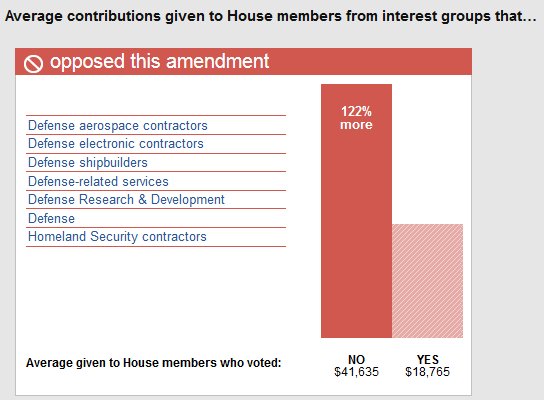
A detailed analysis on Maplight of the voting in last week’s vote on de-funding NSA dragnet spying found that the Congresscritters who voted in favor of more NSA spying received more than double the defense industry campaign contributions of their anti-NSA-voting rivals. They were the winners in the industry’s $13M donation bonanza leading up to the 2012 elections.

The remarkable thing is how cheaply these empty suits sold out their vow to uphold the Constitution. On average, the pro-spying side got $41,635, while the anti- averaged $18,765 — a difference of $22,870.

Contributors and the NSA amendment

July 26, 2013

Justin Amash and the attempt to rein-in the NSA

Filed under: Government, Politics, USA — Tags: , , , , — Nicholas @ 10:19

Dave Weigel looks at the unexpectedly close vote in congress that would have forced the NSA to “walk back” some of its current domestic surveilance operations:

For a few minutes on Wednesday afternoon, Rep. Justin Amash thought he might have killed the National Security Agency’s metadata collection program. He’d optimistically expected maybe 90 Republicans to back his amendment to the Department of Defense budget. Ninety-four of them did. But he ran out of votes eventually — the Democrats didn’t come through — and by a 217–205 margin, the House killed his amendment.

Amash loaded the confetti cannon anyway. “My friends and colleagues stuck with me on my NSA amendment and changed the dynamic of the debate with tonight’s close vote,” the Republican congressman tweeted. “What an amazing staff I have. Thank you, thank you, thank you. You guys are awesome.”

[…]

Defenders of the NSA program are furious that Amash even got that far, and are working to undermine him. According to Politico’s Jake Sherman, Amash started this process with an “unworkable amendment” that would have failed easily, until staffers “held his hand” to fix it. That’s their story, but it doesn’t reflect what led up to the amendment. In the wake of Edward Snowden’s disclosures, every member of Congress who’d been sitting on some security state reform picked it back up and reintroduced it. In the Senate, Utah’s Mike Lee (a Republican) and Oregon’s Jeff Merkley (a Democrat) brought back the Ending Secret Law Act that they couldn’t pass when FISA was reauthorized. Oregon Sen. Ron Wyden and Colorado Sen. Mark Udall, both Democrats, introduced legislation to restrict NSA data collection unless the material contained a “demonstrated link to terrorism or espionage.”

At the time, the lack of quick action on those bills suggested that the Snowden story had been a blip. Privacy advocates in Congress now refer to those bills as the first wave, part of a strategy of attrition that will make the current policy politically untenable.

Amash proved the NSA will have to concede some ground when his amendment moved quickly from obscurity to reality to being under attack from the administration. On Monday night, before the Rules Committee voted on which amendments to bring up, Amash was told to meet with Speaker of the House John Boehner on the floor. He returned from that meeting convinced (and surprised) that he’d get a vote after all.

July 19, 2013

Protectionist law from 1920 strangling economies of Hawaii and Puerto Rico

Filed under: Economics, Politics, USA — Tags: , , , , — Nicholas @ 00:01

Keli’i Akina wants the US government to amend or (better) repeal the 1920 Jones Act:

What’s the best way to destroy the economy of an island or largely coastal region? From the Peloponnesian War to the 1960s confrontation between Cuba and the United States, the answer has been to impose an embargo. In effect, that’s what the United States has been doing for decades to its non-contiguous regions such as Hawaii and Puerto Rico as well as Alaska and much of the East and West Coasts. The culprit in this economically self-defeating practice is a little-understood federal statute called the Jones Act. The 1920 maritime cabotage law specifies that ships carrying cargo between two American ports must: 1) be built in the United States, 2) be 75% owned by U.S. citizens, 3) be largely manned by a United States citizen crew, and 4) fly the United States’ flag.

In 2012, the Federal Reserve Board of New York issued a warning to the federal government that, unless Puerto Rico is granted an exemption from these Jones Act rules, its economy would likely tank. Following suit, the World Bank released a statement announcing that it will cut back its financing of projects in Puerto Rico and begin encouraging investors to look to Jamaica as a new international shipping hub. Puerto Rico’s legislature, governor, and resident commissioner in Congress have voiced loud objections. They join a growing chorus of outrage which includes Alaska, whose legislature has passed a law (Sec. 44.19.035) requiring the governor lobby Congress for reprieve from the Jones Act.

The Jones Act creates an artificial scarcity of ships due to the inefficiency and the extraordinary cost of U.S. ship construction, driving up cargo costs and limiting domestic commerce. Through World War II the United States was a leading producer of merchant ships. Today we build less than one percent of the world’s deep draft tonnage, and the ships produced domestically for the commercial market come at a hefty price.

June 25, 2013

“You cannot have a functioning democratic republic when the laws are so voluminous no one can know what the law is”

Filed under: Law, Liberty, Politics, USA — Tags: , , , — Nicholas @ 08:28

I really did think they were kidding about needing to pass the law to be able to find out what was in it, but this appears to be the way US laws are made nowadays:

When a bill is amended in a sneaky manner, as this one has been, no responsible senator could just read 100 new pages. The amendments are interspersed thoughout the bill — it’s not like you could sit and read them as a unit, even if you had the time. Since the proponents are clearly trying to pull a fast one, prudence, as Senator Cruz pointed out, would dictate rereading every line of text, old and new, to search for insertions — and, indeed, news reports indicate that numerous new buy-offs and pot-sweeteners have been inserted.

But there is a larger point: no “important legislation” should be 100 pages long, much less 1,200 (or the even more mind-boggling girth of monstrosities like Obamacare). The United States Constitution is about 4,500 words long — outfits like Cato and Heritage publish it in small pamphlets that can be read in a few minutes. Nowadays, not only are the bills so gargantuan that no one could conceivably master them and predict their consequences; each page produces even more pages of regulations. They can’t even be lifted, much less digested.

You cannot have a functioning democratic republic when the laws are so voluminous no one can know what the law is. And that is especially the case when (a) the rationale for passing new laws — according to “reform” proponents like Senator Marco Rubio and Rep. Paul Ryan — is that we don’t enforce the laws currently on the books; (b) key parts of legislation consist of commitments to do what previously enacted law already commands; and (c) the president, notwithstanding his oath to take care that the laws are faithfully executed, claims the power to refrain from enforcing whatever laws he disapproves of. Washington has made a farce of the legislative process and of the once proud boast that we are ”a nation of laws not men.”

June 9, 2013

Original author of the Patriot Act decries its current abuse

Filed under: Government, Law, Liberty, Media, USA — Tags: , , , , — Nicholas @ 10:20

In the Guardian, Jim Sensenbrenner demands to see the current misuse of the Patriot Act brought to an end:

Last week, the Guardian reported that the Obama administration is collecting records of every call made to, from or within the US, as well as records of many digital communications. President Obama has tried to deflect criticism by claiming “every member of Congress has been briefed on this program.” While some members of Congress were briefed — particularly those on the intelligence committees — most, including myself, were not.

The administration claims authority to sift through details of our private lives because the Patriot Act says that it can. I disagree. I authored the Patriot Act, and this is an abuse of that law.

I was the chairman of the House judiciary committee when the US was attacked on 11 September 2001. Five days later, the Justice Department delivered its proposal for new legislation. Although I, along with every other American, knew we had to strengthen our ability to combat those targeting our country, this version went too far. I believed then and now that we can defend our country and our liberty at the same time.

[. . .]

In his press conference on Friday, President Obama described the massive collection of phone and digital records as “two programs that were originally authorized by Congress, have been repeatedly authorized by Congress”. But Congress has never specifically authorized these programs, and the Patriot Act was never intended to allow the daily spying the Obama administration is conducting.

To obtain a business records order like the one the administration obtained, the Patriot Act requires the government to prove to a special federal court, known as a Fisa court, that it is complying with specific guidelines set by the attorney general and that the information sought is relevant to an authorized investigation. Intentionally targeting US citizens is prohibited.

Technically, the administration’s actions were lawful insofar as they were done pursuant to an order from the Fisa court. But based on the scope of the released order, both the administration and the Fisa court are relying on an unbounded interpretation of the act that Congress never intended.

June 4, 2013

High Noon for patent trolls

Filed under: Business, Law, USA — Tags: , , , , — Nicholas @ 09:17

At Techdirt, Mike Masnick has some very good news:

Back in February, we were a bit surprised during President Obama’s “Fireside Hangout” when he appeared to speak out against patent trolls. Historically, most politicians had always tiptoed around the issue, in part because the pharma industry seems to view any attack on patent trolls as an existential threat — and, frankly, because some small time patent holders can also make a lot of noise. However, it’s become exceptionally clear that there’s political will to take on patent trolls. We’ve noted five different patent law bills introduced in Congress, all targeting patent trolls in one form or another.

And now, it’s been reported that President Obama is going to come out strongly against patent trolling, directing the USPTO and others to fix certain issues, while also asking Congress to pass further laws to deal with patent trolling. The President will flat out note that patent trolls represent a “drain on the American economy.” The announcement will directly say that “patent trolls” (yes, they use the phrase) are a problem, while also talking about the problem of patent thickets like the infamous “smartphone wars.”

The plan is scheduled to be released later today, but we’ve got a preview of the specific plan, and let’s take a look at each of the suggestions quickly. I’m sure we’ll be discussing the concepts in much more detail for the near future. The plan is split into two different parts: legislative actions (i.e., asking Congress to do something) and executive actions (i.e., ordering administration agencies/departments to do things). Let’s start with the executive actions, since those are likely to have the more immediate impact.

This is excellent news, at least for anyone not currently working as a patent lawyer for one of the trolls…

May 8, 2013

Mark Sanford is back in politics, despite his past mistakes

Filed under: Media, Politics, USA — Tags: , , , , — Nicholas @ 08:36

I really didn’t expect former South Carolina governor Mark Sanford to win his bid for a seat in congress, but he not only won, he won convincingly:

‘Excuse me, do you know what’s going on here that it’s so crowded?”

I’m walking through a Publix parking lot in Mount Pleasant, S.C., to the Liberty Tap Room, and it’s 7:55 p.m. on Tuesday, May 7 — Election Day in the state’s first congressional district. A middle-aged woman is leaning out of her Suburban, frowning in the direction of the bar, trying to ascertain the reason for the plethora of TV news trucks and camera equipment.

“It’s Mark Sanford’s victory party,” I tell her.

She gapes at me, confused.

“Did he win?

Less than an hour later, the AP declares that the answer to that question is yes — and not just a yes, but a definite yes, by nine points, despite being outspent 4–1 and abandoned for all practical purposes by the national fundraising arm of his party. There will be lots of analysis in the days to come about what this election means, but one thing isn’t up for debate: Mark Sanford knows how to campaign, and his win here is due at least in part to his tireless canvassing and cheerful willingness to ask for the vote of anyone who would listen to him.

April 29, 2013

TSA makes sensible decision, but quickly backtracks after noisy protests

Filed under: Bureaucracy, Government, USA — Tags: , , , , — Nicholas @ 09:10

In Reason, Steve Chapman explains why bureaucrats rarely go out of their way to ease restrictions:

Once in a while, a government agency adopts a policy that is logical, hardheaded, based on experience and unswayed by cheap sentiment. This may be surprising enough to make you reconsider your view of bureaucrats. But not to worry: It usually doesn’t last.

In March the federal Transportation Security Administration surprised the country by relaxing its ban on knives and other items. Starting April 25, it said, it would allow knives with blades shorter than 2.36 inches, as well as golf clubs, pool cues and hockey sticks.

That was before flight attendants and members of Congress vigorously denounced the idea as a dire threat to life and limb. It was also before two bombs went off at the Boston Marathon.

So it came as no great surprise when last week TSA announced it would retain the existing ban indefinitely so it could hear more from “the aviation community, passenger advocates, law enforcement experts and other stakeholders.”

A more plausible explanation is that TSA officials grasped the old Washington wisdom: Bureaucrats rarely get in trouble for being too careful. But if there were a single incident featuring a passenger and a blade, the agency would be tarred and feathered.

Politicians love seeing their names in the newspaper or being mentioned on TV. Bureaucrats understand that such attention can be a career-limiting move. Therefore, no rational bureaucrat will want to be associated with any policy change that might lead to media attention.

April 21, 2013

“Fatally flawed” CISPA bill passed by US congress

Filed under: Law, Liberty, Media, Technology — Tags: , , , , , , — Nicholas @ 08:57

The BBC reports on the unwelcome CISPA bill and its progress through the legislative machinery:

The US House of Representatives has passed the controversial Cyber Information Sharing and Protection Act.

Cispa is designed to help combat cyberthreats by making it easier for law enforcers to get at web data.

This is the second time Cispa has been passed by the House. Senators threw out the first draft, saying it did not do enough to protect privacy.

Cispa could fail again in the Senate after threats from President Obama to veto it over privacy concerns.

[. . .]

The bill could fail again in the Senate after the Obama administration’s threat to use its veto unless changes were made. The White House wants amendments so more is done to ensure the minimum amount of data is handed over in investigations.

The American Civil Liberties Union has also opposed Cispa, saying the bill was “fatally flawed”. The Electronic Frontier Foundation, Reporters Without Borders and the American Library Association have all voiced similar worries.

April 18, 2013

Slowing down the urge to “do something” is a feature, not a bug

Filed under: Law, Liberty, Politics, USA — Tags: , , , , , — Nicholas @ 09:23

David Harsanyi discusses the (limited) mechanisms the US constitution put in place to prevent the whims of temporary majorities being imposed on the country:

To begin with, whether Democrats like it or not, this issue concerns the Constitution — where stuff was written down for a reason. That’s not to say that expanding background checks or banning “assault rifles” would be unconstitutional (though you may believe they both should be). It’s to say that when you begin meddling with protections explicitly laid out in the founding document, a 60-vote threshold that slows down stampeding legislators is the least we deserve.

The Founding Fathers worried that “some common impulse of passion” might lead many to subvert the rights of the few. It’s a rational fear, one that is played out endlessly. Obama, who understands how to utilize public passion better than most, flew some of the Newtown families to Washington for a rally, imploring Americans to put “politics” aside and stop engaging in “political stunts.”

[. . .]

I’m not operating under the delusion that any of this is good national politics for Republicans — though the arguments about obstructionism’s dooming the GOP are probably overblown. No doubt, when the next disaster hits — and it will — Democrats will blame the overlords at the National Rifle Association and Republicans for the act of a madman. That’s life.

But generally speaking, it’d be nice if Congress occasionally challenged the vagaries of American majority “instinct.” Though it might seem antithetical to their very existence, politicians should be less susceptible to the temporary whims, ideological currents and fears of the majority. Theoretically, at least, elected officials’ first concern is the Constitution. And if the need for gun control is predicated chiefly on the polls taken immediately after a traumatic national event, they have a perfectly reasonable justification to slow things down. In fact, if Washington internalizes the 60-vote threshold as a matter of routine, voters should be grateful. Considering Washington’s propensity to politicize everything and its increasingly centralized power (what your health care looks like is now up for national referendums, for instance), this might be the only way left to diffuse democracy.

« Newer PostsOlder Posts »

Powered by WordPress