
World War Two
Published 24 Oct 2024Igor Gouzenko, a Soviet cipher clerk in Canada, defected in 1945, bringing with him documents that revealed a massive Soviet espionage network in the West. His actions forced the world to confront Soviet infiltration, shifting global politics and igniting early Cold War tensions. This episode uncovers how one man’s bravery exposed a hidden war.
(more…)
October 25, 2024
How a Soviet Clerk Took Down a Spy Network
Comments Off on How a Soviet Clerk Took Down a Spy Network
October 15, 2024
Czech Sa vz. 26 SMG
Forgotten Weapons
Published Aug 10, 2015The Czech Samopal vz. 26 was one of a family of submachine guns (the vz 23-26) that pioneered the use of bolts telescoped out forward over the barrel, allowing guns to have much better ratios of barrel to receiver length than before. The guns actually have quite a few interesting mechanical details, although in my opinion they fail to make it a particularly desirable gun for actual shooting.
Comments Off on Czech Sa vz. 26 SMG
October 13, 2024
The Soviet Union’s surplus of math nerds
The most recent review from Mr. and Mrs. Psmith’s Bookshelf is John Psmith’s musings on Math from Three to Seven: The Story of a Mathematical Circle for Preschoolers by Alexander Zvonkin, and he starts by talking about something the Soviets did better than the west:

To me, one of the greatest historical puzzles is why the Cold War was even a contest. Consider it a mirror image of the Needham Question: Joseph Needham famously wondered why it was that, despite having a vastly larger population and GDP, Imperial China nevertheless lost out scientifically to the West. (I examined this question at some length in this review.) Well, with the Soviets it all went in the opposite direction: they had a smaller population, a worse starting industrial base, a lower GDP, and a vastly less efficient economic system. How, then, did they maintain military and technological parity1 with the United States for so long?
The puzzle was partly solved for me, but partly deepened, when those of us who grew up in the ‘90s and ‘00s encountered the vast wave of former Soviet émigrés that washed up in the United States after the fall of communism. Anybody who played competitive chess back then, or who participated in math competitions, knows what I’m talking about: the sinking feeling you got upon seeing that your opponent had a Russian name. These days, the same scenes are dominated by Chinese and Indian kids. But China and India have large populations — the Russians were punching way above their weight, demographically speaking. Today, those same Russians are all over Wall Street and Silicon Valley and Ivy League math departments, still overrepresented in technical fields. What explains it? Are Russians just naturally better at math and physics?
When I related these questions to an Ashkenazi-supremacist friend of mine, he immediately suggested that “maybe it’s because they’re all Jewish”. (I’ve noticed that the most philosemitic people and the most antisemitic people sometimes have curiously similar models of the world, they just disagree on whether it’s a good thing.) My friend’s question wasn’t crazy, since there are definitely times when asking “were they all Jewish?” yields an affirmative answer. But in this case I had to disappoint him with the knowledge that many of these Russian math and chess superstars were gentiles.2 What’s more, by the ’60s and ’70s the Soviets had an entire discriminatory apparatus dedicated to keeping Jews out of the scientific establishment, so it would be impressive indeed if they were the foundation of its success.
Another possible explanation actually hinges on the relative poverty of the Soviet Union. Assume there are a lot of people out there with natural mathematical talent, but who given their druthers would major in underwater basket-weaving instead. The United States, because it’s so wealthy, can afford to “waste” a huge proportion of our talented population on humanities, arts, and other stuff that doesn’t involve you sitting in the school library until 3am. In other words, not going into a technical field is a form of luxury, which America can afford to consume. The Soviets, rather like the Chinese today, were forced by their underdog status to allocate human capital more efficiently (and had the authoritarian means to do so by force if necessary). This theory is related to the curious fact that, on average, the more feminist your society, the fewer women there are in math and science — which makes total sense if you assume that on average women are good at math but uninterested in it.
The thing is, the émigré superstars I encountered didn’t seem at all grudging or resentful about their studies. If anything it was the opposite. I’ve previously complained about how much I hate Russian mathematician Edward Frenkel’s3 book, but one thing it gets across well is just how important passion is to being a great mathematician, and passion was the thing the émigrés seemed to have a surfeit of. In college, the joke was that seminars by American professors would last an hour, whereas seminars by Russian professors would turn into boisterous debates lasting all night. People have been writing for centuries about Russians having a tendency towards “maximalism” — whether aesthetic or ideological or anything else. Maybe a culture-wide commitment to not doing anything by half-measures explains it?
1. There are scientific sub-disciplines where even at the end the Soviets had a clear lead, including several fields of math. Even crazier, there are sub-disciplines where we have not yet gotten back to where the Soviets were (for instance phage therapy).
2. Undeterred, my friend pointed out that many modern Russian gentiles have significant Jewish ancestry. The Soviets actively promoted mixed marriages, to the point where in some cities the average urban gentile Russian is as much as 25% Jewish. I still don’t think this explains Soviet scientific prowess, but it’s an interesting data point because the most highly urbanized areas are the ones where most of the mathematicians (and most of the émigrés) came from.
3. Before you ask, I looked it up and Frenkel is half Jewish, half gentile. I will leave it to you whether you count that as evidence for or against my friend’s theory.
Occupation of Germany, Plunder and Enslavement?
World War Two
Published 12 Oct 2024The Allies’ occupation of Germany was marked by competing visions for its future, ranging from France’s focus on security to the Soviet push for reparations. This episode dives into the complex negotiations that determined Germany’s borders, industrial disarmament, and economic management, all of which would shape Europe’s post-war order and fuel the East-West divide.
(more…)
Comments Off on Occupation of Germany, Plunder and Enslavement?
October 11, 2024
“[T]he past is like a thriving civilization; they do things better there”
Another recommended link from the “Your Weekly Stack” set of links to interesting posts on Substack. This, like the previous post, is from an author I hadn’t read before and thought was worth sharing with you.
This is from The American Tribune, making the case that modern Americans (and westerners in general) are in a similar situation to the white minority in Rhodesia:

We stand today in the ruins of civilization. Much as the 9th Century Anglo-Saxons looked at the stone works of the Romans and thought they must have been giants,1 or the Greeks of the post-Sea Peoples Dark Age saw the works of the Minoans and Myceneans and thought only Cyclopses could have constructed such structures,2 we stare at the achievements of the 19th and early 20th Centuries in near-disbelief.
The moon hasn’t been stepped upon since the 70s. Mars remains uncolonized. Municipal infrastructure like water treatment and provision is falling apart and the government either can’t or won’t respond to natural disasters.3 Whereas we once built beautiful buildings that lasted for centuries, structures such as Chatsworth and the Horse Guards Building of Whitehall, now we have ugly structures of concrete and steel that are falling apart already.4
The situation as regards crime and squalor is even worse. As Curtis Yarvin notes in “An Open Letter to Open-Minded Progressives”:
If you read travel narratives of what is now the Third World from before World War II (I’ve just been enjoying Erna Fergusson’s Guatemala, for example), you simply don’t see anything like the misery, squalor and barbarism that is everywhere today. (Fergusson describes Guatemala City as “clean”. I kid you not.) What you do see is social and political structures, whether native or colonial, that are clearly not American in origin, and that are unacceptable not only by modern American standards but even by 1930s American standards.
So whereas Guatemala was once clean, now America’s cities are towers of concrete surrounded by piles of refuse, mobs of zombie-like drug addicts living on the streets,5 and infested with criminals of both the petty and highly violent variety. As Hartley put it, “The past is a foreign country; they do things differently there”. More accurately, the past is like a thriving civilization; they do things better there.
In short, we, like those in the Belgian Congo after the Belgians left, live in an “Empire of Dust” where much of what remains is the ruin of a prior civilization destroyed not because it didn’t work, but because the demented ideology of the present conflicted with its continued, functional existence.6
What happened? A sort of decolonization inflicted upon the Great Powers themselves — namely America, Germany, Britain, and France — after the outlying colonies had long been destroyed. The decay of law and order, the promotion of anti-white hatred, the decay of infrastructure, and the filling of positions with corrupt thugs rather than honorable gentlemen,7 all of it is more or less what happened to the colonies in the ’50s and ’60s. Further, it is similar to what happened later on in South Africa, where a collection of communists, leftists, and NGOs with like mindsets and funded by those like George Soros turned a formerly thriving civilization into what now amounts to a land like Mad Max but with more murder.8
But while the South Africanization of America is certainly an issue that we face,9 it’s not the most accurate comparison to our present problem. South Africa was, when it fell, filled with decades of racial hatred sparked by decades of apartheid that ended only then (though was somewhat overblown), something that Europe never had and nowhere in America has had in over half a century. That unique circumstance created a degree of hatred that was overpowering and, though one with which we largely disagree, understandable. We, then, are somewhat different in terms of where we are and what is happening.
1. https://espace.library.uq.edu.au/data/UQ_363155/s40110183_phd_final_thesis_copy.pdf
2. See The Glory that Was Greece by Stobart
3. https://en.wikipedia.org/wiki/Jackson,_Mississippi_water_crisis; https://nypost.com/2024/10/03/us-news/north-carolina-hurricane-victims-slam-biden-harris-admin-as-fema-response-sputters/
4. See, for example, https://www.vintagebuilding.com/houses-longer-houses/
5. See, for example: https://youtu.be/9iSkKkzabnM
6. This is what the phrase “empire of dust” comes from: https://www.imdb.com/title/tt2148945/
7. https://www.theamericantribune.news/p/the-death-of-the-gentleman-and-the
8. https://www.theamericantribune.news/p/george-soross-hand-in-south-africas
9. I wrote an article on this for Tablet: https://www.tabletmag.com/sections/news/articles/united-states-south-africa-racial-justice
Comments Off on “[T]he past is like a thriving civilization; they do things better there”
October 5, 2024
Did South Korea Provoke the Korean War?
The Korean War by Indy Neidell
Published 4 Oct 2024Was South Korea on the verge of invading North Korea in 1949? Today Indy looks at the bloody fighting across the Korean border in the years leading up to war. Then he asks the question, why did Kim finally decide to invade South Korea in the early months of 1950?
(more…)
Comments Off on Did South Korea Provoke the Korean War?
September 26, 2024
Why Three Arab Nations Lost the Six-Day War Against Israel
Real Time History
Published Jun 5, 2024In just six days in 1967 Israel managed to decisively defeat Egypt, Jordan and Syria in the Six Day War. In the process they expand the territory they control with the Golan Heights, Sinai, the West Bank, and Gaza.
(more…)
Comments Off on Why Three Arab Nations Lost the Six-Day War Against Israel
September 21, 2024
The Dramatic Birth of Two Korean States
The Korean War by Indy Neidell
Published 20 Sep 2024The United Nations plan is to reunite the divided Korean peninsula into a single state. But soon the USA and USSR have installed their own leaders, neither of whom are willing to compromise. By the end of 1948 Kim Il-Sung and Syngman Rhee stand at the head of separate North and South Korean states.
(more…)
Comments Off on The Dramatic Birth of Two Korean States
September 16, 2024
Who Really Won The Korean War?
Real Time History
Published May 17, 2024Only five years after the end of WW2, the major nations of the world are once again up in arms. A global UN coalition and an emerging Chinese juggernaut are fighting it out in a war that will see both sides approach the brink of victory — and defeat.
(more…)
Comments Off on Who Really Won The Korean War?
September 10, 2024
Why the US Left Vietnam
Real Time History
Published Apr 19, 2024With violent anti-war protests at home and discipline problems on US bases, President Nixon promises to withdraw American troops from the Vietnam War, but that doesn’t mean an end to the fighting. As US troop numbers drop, the war expands across borders and in the air as more weapons are pumped into the South.
(more…)
Comments Off on Why the US Left Vietnam
August 29, 2024
Britain’s empire after WWII
From my readings about the behind-the-scenes negotiations among the western allies even before the United States formally entered the war in late 1941, I’ve always felt that the personal relationship between Winston Churchill and Franklin Delano Roosevelt was at least as important as the formal public proclamations and direct actions of the allies. It’s my belief that Churchill and FDR had a “wink and a nod” agreement for the US to continue supporting the British economy after the end of the war in Europe, probably in exchange for a gradual retreat from formal Imperial control over at least some of the remaining British colonies. This would have made Britain’s immediate postwar experience far less grim economically and politically and allowed the British economy to gracefully switch from full wartime production to fulfilling peacetime business and consumer needs.
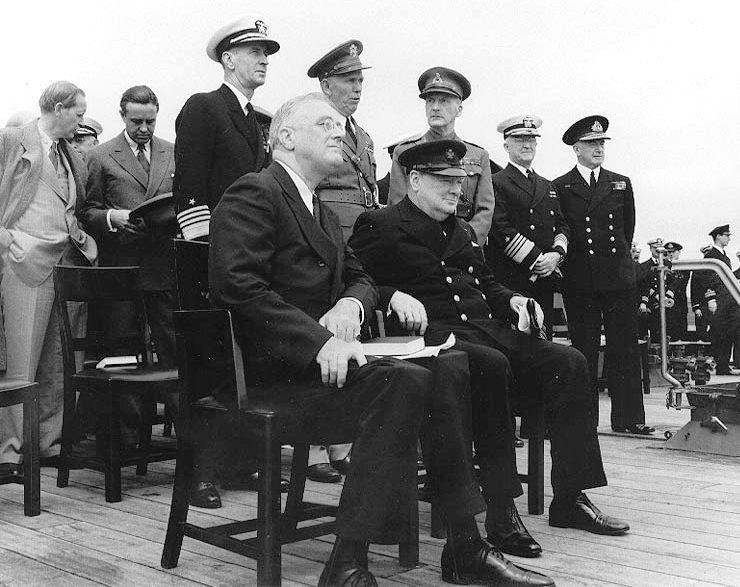
Church services on HMS Prince of Wales, in Placentia Bay, Newfoundland, during the Atlantic Charter Conference. President Franklin D. Roosevelt (left) and Prime Minister Winston Churchill are seated in the foreground. Standing directly behind them are Admiral Ernest J. King, USN; General George C. Marshall, U.S. Army; General Sir John Dill, British Army; Admiral Harold R. Stark, USN; and Admiral Sir Dudley Pound, RN. At far left is Harry Hopkins, talking with W. Averell Harriman.
US Naval Historical Center Photograph #: NH 67209 via Wikimedia Commons.
Of course, with Roosevelt dead (and Truman certainly not “read-in” on any unwritten promises to the British) and Churchill out of office (which was as much of a shock to the Americans as it was to Churchill himself), whatever they may have hoped to do was now so much wishful thinking. Britain had to not just continue wartime rationing after VE and VJ Day, but to actually make it more stringent for nearly a decade just to avoid national bankruptcy … and the withdrawal from imperial outposts had to be done as quickly and as cheaply as possible. This often meant corners were cut, cheeses were pared, and shortcuts availed of, so that the experiences of the former colonies were more fraught with civil disturbances and commercial disruptions than they should have been.
All of this is a very long-winded way to introduce Joshua Treviño’s post at Armas which considers how an American imperial decline may or may not mirror the postwar British experience of de-imperialization:
We can guess that American decline under the present regime will look much like Britain’s. The British case is taken as so normative — of course a nation will decline after its empire is gone — that the normativity goes unquestioned. But this is the worst sort of history, determinative in retrospect, as if the loss of imperium (or more properly, the loss of imperial fiscal stability) set in motion dominoes that fell unstoppably until the latest squalid episode of Keir Starmer’s thought police. That isn’t how human events work, however: all things are contingent. Britain was, in the eyes of several European powers, reduced to a mid-tier power after the catastrophic loss of America at the opening of the 1780s — and a generation later it was the indispensable nation versus French hegemony. There was not any particular reason a comparable recovery ought not have happened in the generation after 1945, even with the loss the of the empire, and even with the great postwar crisis of the pound sterling. This was in fact the high-Tory view as set forth by Enoch Powell, who evolved toward a belief that the empire was a burden on Britain, which could ascend to its destiny and fulfillment by means of the British themselves.
That this did not happen is plausibly much the fault of the Americans, who did two major things — one of them unwittingly — to forestall this sort of recovery. The first act, undertaken with deliberation, was the credible American threat to destroy the United Kingdom’s finances and economy in the 1956 Suez crisis: in no way the act of an ally, and one whose psychological effects upon Britain’s governing elites were as significant as the hard-power effects upon Britain itself. (Though I am not a particular fan of De Gaulle, for reasons that may be discussed here later, he was unquestionably a better steward of the nation than his U.K. counterparts in his conclusion — admittedly coalescing a decade earlier — that a European state could be a major power, or it could be a junior partner to the United States, but not both.) The British regime’s reaction to the episode — to draw so close to the Americans as to abandon the nation’s strategic independence — thereby contributed powerfully to Britain’s subsequent diminishment. That diminishment was not simply in the realm of hard power: it was accompanied by a profound social and governmental malaise that has fluctuated across the decades but has yet to lift. Philip Larkin’s 1969 Homage to a Government captures it well:
Next year we are to bring all the soldiers home
For lack of money, and it is all right.
Places they guarded, or kept orderly,
Must guard themselves, and keep themselves orderly
We want the money for ourselves at home
Instead of working. And this is all right.It’s hard to say who wanted it to happen,
But now it’s been decided nobody minds.
The places are a long way off, not here,
Which is all right, and from what we hear
The soldiers there only made trouble happen.
Next year we shall be easier in our minds.Next year we shall be living in a country
That brought its soldiers home for lack of money.
The statues will be standing in the same
Tree-muffled squares, and look nearly the same.
Our children will not know it’s a different country.
All we can hope to leave them now is money.The superficial read of Larkin here is that he laments deriving purpose from other things closer to home. There is a baseness in the imperialist’s love of mission, and he misses the sublime in, say, the National Health Service. It is a dumb atavism: if the “tree-muffled squares … look nearly the same”, then why does it matter that “the soldiers [are] home”? This interpretation is wrong. What Larkin laments is the loss of the common and noble purpose in the civic partnership that makes the nation, as defined at the outset of Aristotle’s Politics — without which the nation fails to cohere, even if its regime persists. Despite the strenuous efforts of the left and progressivism across the past century, that virtuous end to which the nation has been directed has never been supplanted in its old forms — religion, glory, strength, creation — by any new ones of social programs or millennialist materialism. When Clement Attlee wrote in his 1920 The Social Worker that the Protestant Reformation was to blame for the moral degradation of charity, his solution was not the obvious one (which is to say, the restoration of Catholic England or at least its mores), but to interpose government where religion and its purposes used to be. His 1945 general-election invocation of building “Jerusalem” in England, directly quoting William Blake, logically followed.
But that is not how Jerusalem is built. It remains unbuilt, and the civic effects of the American fixation and what it facilitates redound across time. Nick Cohen accuses the modern British right of Americanizing itself, and that is largely accurate, but contra his indictment, the British left does the same in different ways. What the Americans did in 1956 was not a singular event — rather it was a punctuation on a process that had been unfolding in stages for the preceding forty years or so — but their objects got a vote too. That vote was to submit, a preference shared across right and left alike. That no American regime ever had Britain’s interest fully at heart (a truth with ample reminders, not just at Suez, but in Northern Ireland, in the Falklands, in Grenada, in Iraq, and in Afghanistan) did not alter this course, thereby making a triumph of theory unmoored from fact.
Comments Off on Britain’s empire after WWII
August 26, 2024
History Summarized: Beauty and Brutalism
Overly Sarcastic Productions
Published May 10, 2024No no no guys you just don’t GET IT, Brutalism is actually really clever and impressive and in this essay I wi–
SOURCES & Further Reading:
Architecture in Minutes: 200 key buildings and movements in an instant by Susie Hodge – an extremely useful reference for 20th century structures and famous figures outside my usual wheelhouse, and the fortuitous inspiration for this video via the entry on “Concrete” with an opposite-facing image of the Baha’i House of Worship
“Brutalism was the Greatest Architectural Movement in History. Change My Mind.” by Pat Finn, Architizer, https://architizer.com/blog/inspirati…
“Concrete: the most destructive material on Earth” by Jonathan Watts, The Guardian, https://www.theguardian.com/cities/20…
“The Salk Institute and the Lost Ethics of Brutalism” by James E Churchill, Docomomo, https://www.docomomo-us.org/news/the-…
“The New Brutalism” by Reyner Banham, Architectural Review, https://www.architectural-review.com/…
“Busting the Myths of Brutalism” by Stewart Hicks @stewarthicks, My Take on the Whole Brutalism ThingMusic:
“Scheming Weasel” by Kevin MacLeod (Incompetech.com)
https://creativecommons.org/licenses/… Licensed under Creative Commons: By Attribution 4.0 LicenseOur content is intended for teenage audiences and up.
PODCAST: https://overlysarcasticpodcast.transi…
MERCH: https://overlysarcastic.shop/
OUR WEBSITE: https://www.OverlySarcasticProductions.com
Comments Off on History Summarized: Beauty and Brutalism
August 24, 2024
How the CIA eventually got Patrice Lumumba assassinated
The CIA decided early on that the first democratically elected Prime Minister of the Democratic Republic of the Congo was being controlled by their Soviet opponents and needed to be killed:
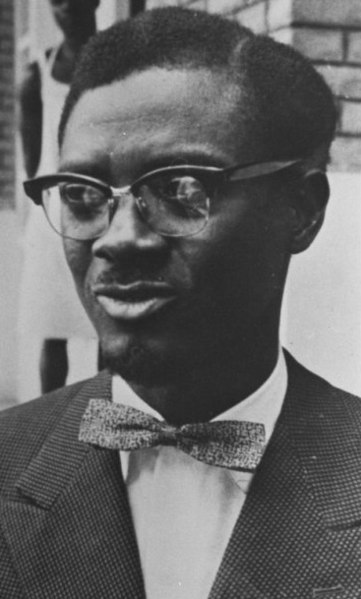
Patrice Émery Lumumba, first Prime Minister of the Democratic Republic of the Congo on 27 December 1960.
Unknown photographer
I’m still making my way through David Talbot’s 2015 book The Devil’s Chessboard, a history that explores the life of CIA Director Allen Dulles and the sordid history of the agency.
There are too many grisly anecdotes to recount showing how the CIA was involved in unlawful and unethical acts all over the world, but one that sticks out was the book’s treatment of Patrice Lumumba, an African nationalist who served as the first prime minister of the Democratic Republic of the Congo before he was killed in 1961 — with a shove from the CIA.
Lumumba was a thorn in the side of the agency, and his left-leaning politics led CIA officials to believe he was a stooge for the USSR (he wasn’t, as the CIA later admitted). So it was determined that Lumumba had to go—one way or the other.
First, a coup was arranged to have the democratically-elected Lumumba, who was demanding full independence for the Congolese people, removed from office and placed under arrest. To this end, the CIA tapped a young military colonel named Joseph Mobutu, who was friendly with Belgian intelligence (the Congo had long been under Belgian colonial rule) and would go on to rule for decades until he was ousted himself in a 1997 rebellion.
Then the CIA began exploring options to eliminate the popular Lumumba. Being the CIA, a single method was not chosen. Instead, various methods were explored to take out the Congolese leader and multiple people were tapped, including a pair of hitmen the agency had hired from Europe’s criminal underworld.
Talbot explains how the CIA equipped one of these cutthroats with a tube of poisoned toothpaste. Why toothpaste? Because one Dr. Ewen Cameron, at the behest of the CIA, had analyzed Lumumba and noted his immaculate white teeth. This led him to suggest a simple way to eliminate the troublesome leader: poison his dental products.
“In the end, the CIA did not go through with the toothpaste plot,” writes Talbot, “apparently deciding that poisoning a popular leader while he was under UN protective custody in his own house would be too flagrant a deed—one that, if traced back to the agency, would lead to unpleasant international repercussions.”
Instead, days before the inauguration of John F. Kennedy, the CIA arranged to have Lumumba chartered off on a plane to Katanga, a province that had broken from the Congo and was ruled by factions hostile to Lumumba.
This all but sealed Lumumba’s fate, CIA officials later testified.
“I think there was a general assumption, once we learned that he had been sent to Katanga, that his goose was cooked,” CIA station chief James Devlin, who helped orchestrate Lumumba’s fall, quipped to the Church Committee years later.
Devlin was right. During his flight to Katanga, Lumumba was beaten to a pulp. Then he was driven by jeep to a farm and beaten by members of rival political factions. The men, Talbot makes clear, had clear ties to US and Belgian intelligence.
“Eventually he was killed, not by our poisons, but beaten to death, apparently by men who had agency cryptonyms and received agency salaries,” said CIA agent John Stockwell, who was sent to the Congo in the aftermath of the assassination.
The Soviets managed a propaganda win out of the CIA’s clumsy wet work, renaming the Peoples’ Friendship University of the USSR (primarily used for training non-Soviet citizens from “fraternal socialist” and “unaligned” nations in Marxist-Leninist views) to the Patrice Lumumba Peoples’ Friendship University.
Comments Off on How the CIA eventually got Patrice Lumumba assassinated
August 23, 2024
QotD: The decline of the British working class
It’s easy enough to locate [the beginning of the inversion] – World War II. The war effort quickened the pace of innovation and industrialization in ways that are easy to miss the full significance of. In Great Britain, for example, wartime logistical demands – especially the demands of airfields – stimulated a large uptick in road-making. All that infrastructure outlasted the war and enabled a sharp drop in transport costs, with unanticipated consequences like making it inexpensive for hungry (and previously chronically malnourished!) working-class people in cities to buy meat and fresh produce.
Marxists themselves were perhaps the first to notice that the “proletariat” as their theory conceived it was vanishing, assimilated to the petty bourgeoisie by the postwar rise in living standards and the propagation of middlebrow culture through the then-new media of paperback books, radio, and television.
In the new environment, being “working class” became steadily less of a purchasing-power distinction and more one of culture, affiliation, and educational limits on upward mobility. A plumber might make more than an advertising copywriter per hour, but the copywriter could reasonably hope to run his own ad agency – or at least a corporate marketing department – some day. The plumber remained “working class” because, lacking his A-level, he could never hope to join the managerial elite.
At the same time, state socialism was becoming increasingly appealing to the managerial and upper classes because it offered the prospect not of revolution but of a managed economy that would freeze power relationships into a shape they were familiar with and knew how to manipulate. This came to be seen as greatly preferable to the chaotic dynamism of unrestrained free markets – and to upper-SES people who every year feared falling into poverty less but losing relative status more, it really was preferable.
In Great Britain, the formation of the National Health Service in 1947 was therefore not a radical move but a conservative one. It was a triumph not of revolutionary working-class fervor overthrowing elites but of managerial statism cementing elite power in place.
During the long recovery boom after World War II – until the early 1970s – it was possible to avoid noticing that the interests of the managerial elite and the working classes were diverging. Both the U.S. and Great Britain used their unmatched industrial capacity to act as price-takers in international markets, delivering profits fat enough to both buoy up working-class wages and blur the purchasing-power line between the upper-level managerial class and the owners of large capital concentrations almost out of existence.
The largest divergence was that the managerial elite, like capitalists before them, became de-localized and international. What mobility of money had done for the owners of capital by the end of the 19th century, mobility of skills did for the managerial class towards the end of the 20th.
As late as the 1960s, when I had an international childhood because my father was one of the few exceptions, the ability of capital owners to chase low labor costs was limited by the unwillingness of their hired managers to live and work outside their home countries.
The year my family returned to the U.S. for good – 1971 – was about the time the long post-war boom ended. The U.S. and Great Britain, exposed to competition (especially from a re-industrialized Germany and Japan) began a period of relative decline.
But while working-class wage gains were increasingly smothered, the managerial elite actually increased its ability to price-take in international markets after the boom. They became less and less tied to their home countries and communities – more willing and able to offshore not just themselves but working-class jobs as well. As that barrier eroded, the great hollowing out of the British industrial North and the American Rust Belt began.
The working class increasingly found itself trapped in dying towns. Where it wasn’t, credentialism often proved an equally effective barrier to upward mobility. My wife bootstrapped herself out of a hardscrabble working-class background after 1975 to become a partner at a law firm, but the way she did it would be unavailable to anyone outside the 1 in 100 of her peers at or above the IQ required to earn a graduate degree. She didn’t need that IQ to be a lawyer; she needed it to get the sheepskin that said she was allowed to be a lawyer.
The increasingly internationalized managerial-statist tribe traded increasingly in such permissions – both in getting them and in denying them to others. My older readers might be able to remember, just barely, when what medical treatment you could get was between you and your physician and didn’t depend on the gatekeeping of a faceless monitor at an insurance company.
Eventually, processing of those medical-insurance claims was largely outsourced to India. The whole tier of clerical jobs that had once been the least demanding white-collar work came under pressure from outsourcing and automation. effectively disappearing. This made the gap between working-class jobs and the lowest tier of the managerial elite more difficult to cross.
In this and other ways, the internationalized managerial elite grew more and more unlike a working class for which both economic and social life remained stubbornly local. Like every other ruling elite, as that distance increased it developed a correspondingly increasing demand for an ideology that justified that distinction and legitimized its power. And in the post-class-warfare mutations of Marxism, it found one.
Eric S. Raymond, “The Great Inversion”, Armed and Dangerous, 2019-12-23.
Comments Off on QotD: The decline of the British working class
August 14, 2024
Madsen M50: From the Korean War to Star Trek
Forgotten Weapons
Published May 1, 2024During World War Two, Madsen (DISA) manufactured a licensed copy of the Finnish Suomi (see: Danish M1941 Suomi SMG). When the war ended, they wanted to replace this with a more modern, inexpensive design of their own. The result was the Model 1946 Madsen, a creative clamshell design of stamped parts. It is a very simple blowback, open-bolt 9x19mm SMG that perfectly fit the post-war era. The M46 version was sold to a few countries, and after some continued development and refinement the M50 version was demonstrated to a public audience in November 1950. This pattern was even simpler than before, and proved a popular gun for many unaligned countries in Central and South America and Southeast Asia — so much so that it remained in production until the 1980s. A bunch were imported into the US in the 1950s and 1960s, and they found a home in the movie industry, where they were often used in fantasy/sci-fi films to avoid having guns that would be recognized by American movie audiences.
(more…)
Comments Off on Madsen M50: From the Korean War to Star Trek


