
Quotulatiousness

March 14, 2018

The navy we need versus the navy we’re willing to pay for

Filed under: Cancon, Military — Tags: , , , , — Nicholas @ 05:00

Ted Campbell recounts the ups and downs of the federal government’s plans for the Royal Canadian Navy over the last few decades:
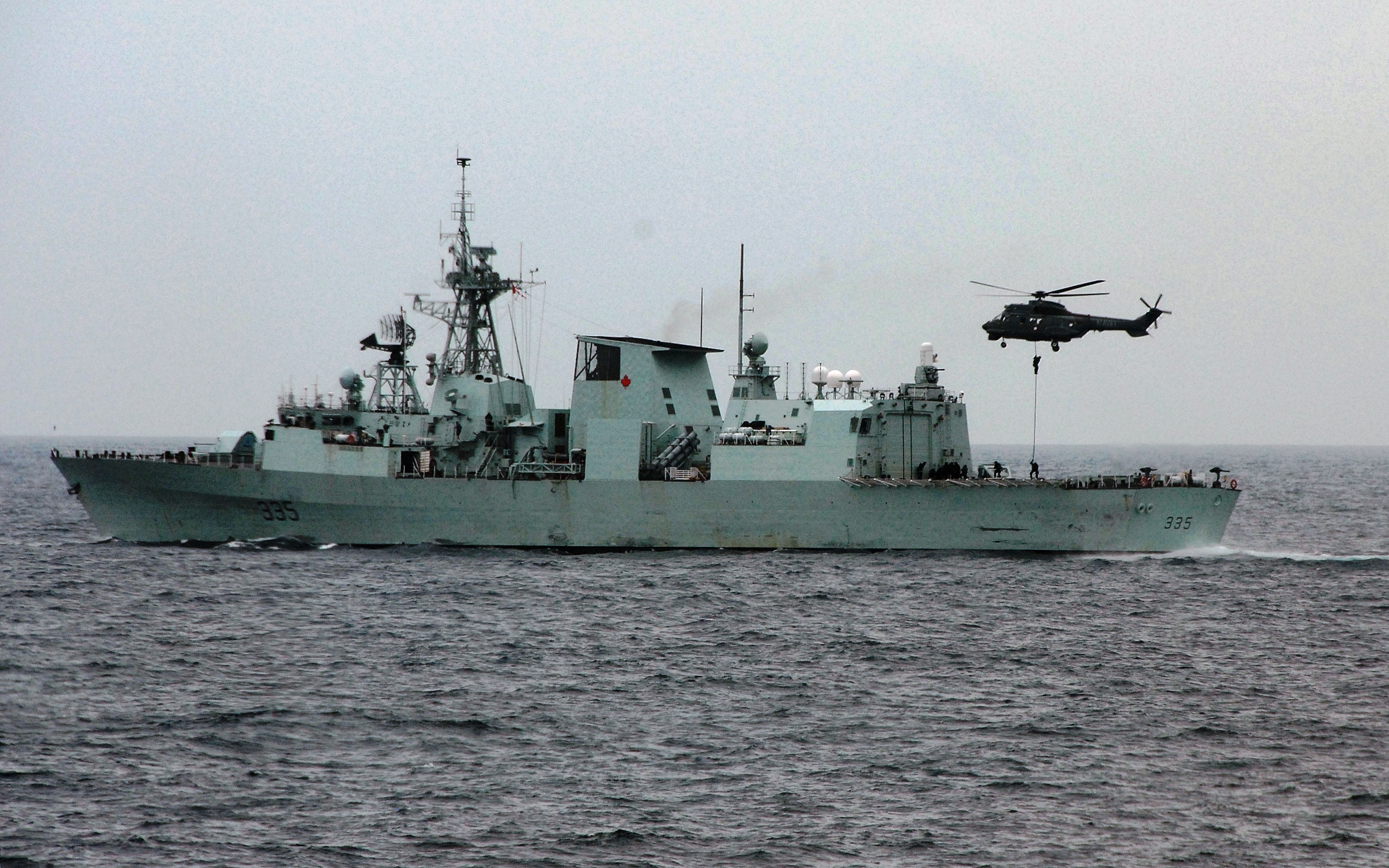
A Chilean navy boarding team fast-ropes onto the flight deck of RCN Halifax-class frigate HMCS Calgary (FFH 335) during multinational training exercise Fuerzas Aliadas PANAMAX 2009.
US Navy photo via Wikimedia.

One of my old friends, commenting to another equally old friend on social media, said this: “Surely, the PM and his government must see the obvious — that as the oceans warm and the ice melts the Northwest Passage becomes navigable year round. He’s been sounding off about climate change ad nauseum so that would seem to be understood by him. As a teacher he must also know that European colonial powers sought a shortcut between east and west but were deterred by ice. That’s changed, which he acknowledges, and Canada’s claim of the.increasingly ice free Northwest Passage as sovereign territory is under threat. Absent Canada’s willingness, and any capability, to enforce it’s claim, Canada surrenders any legitimate right to ownership of the Northwest Passage and the resources in the territory it abuts. That a maritime nation bordered by three oceans needs a blue-water navy is axiomatic. And once the PM acknowledges that the Northwest Passage is about to become Canada’s Suez Canal he must recognize that it, too, needs to be protected and defended by the Royal Canadian Navy. But the navy can only do that if it has ships and sailors. If Canada doesn’t expend the effort to protect its shores and assert its claims someone else will.” Sound pretty sensible, doesn’t it? Climate change will, very possibly, open the Northwest Passage; it Canada cannot patrol and police those waters then others will exploit them; it’s the Navy’s job to patrol and police our waters … I have argued that the “constabulary fleet” that should do that ought not to be in the Navy, but that’s a different issue … for now.

[…]

Way back when ~ I’m working from memory and I’m happy to have these numbers corrected ~ the Royal Canadian Navy said, in a document called “Leadmark,” if my memory serves, that, in addition to infrastructure (headquarters, schools, dockyards, etc) it needed:

  • A fleet with global “reach” which meant more than a dozen “major combatants” (destroyers and frigates) plus four support ships so that, at any time, it could have one combat-ready task group in each of any two of the world’s oceans;
  • A coastal (three coasts) patrol fleet consisting of a mix of submarines and another dozen “minor combatants” (corvettes and mine hunters);
  • Organic air elements for those fleets;
  • Auxiliary and training vessels.

Circumstances changed over time but the Paul Martin government finally committed to new helicopters for the fleet and thanks to his decision and to the perseverance of the Harper government they are, finally, entering service, only 25 years after Jean Chrétien abruptly cancelled the Mulroney government’s signed contracts for (then) new shipborne helicopters.

[…]

What we, Canadians, do not have is a properly funded plan to build the real Navy that the country with the world’s longest coastline, that borders three oceans, needs and deserves.

Since I am pretty sure that, absent some catastrophic events, Prime Minister Trudeau has no interest in warships (or the Coast Guard) I can be fairly confident that while new ships will be built they will be too few in number for the jobs that need doing.

There are no votes in promising to rebuild the military. The Liberals will ignore it and the Conservatives would be wise to not make it much of a campaign issue … Canadians, an overwhelming majority of Canadians just don’t care. But the Conservatives need to get some first rate naval and shipbuilding people into a room and decide, for themselves, what the real costs are for what the Royal Canadian Navy really needs.

The expected warming of the Arctic Ocean and the potential opening of new shipping lanes through areas currently claimed by Canada should be a huge encouragement for the federal government to get serious about ensuring that the RCN, the Canadian Coast Guard and the RCMP are properly prepared and equipped to protect our sovereignty in this region. As in so many other climate change matters, however, the government loves to talk the talk but is manifestly uninterested in walking the walk. More new ships, submarines, helicopters, bases, and the military staff to crew/staff them would be a very expensive commitment that wouldn’t shore up votes in those critical marginal constituencies and would reduce the government’s ability so spend money in aid of getting re-elected (the Liberals are in power now, but the same sort of political calculus applies to the Tories as well).

Mr. Campbell is a Conservative and clearly harbours hopes that Admiral Andrew Scheer will be more willing to make the RCN a priority, but history does not support that hope. The last time (and possibly only time outside periods of declared war) that a Canadian government was serious about the military was before 1957. Canadians are hopelessly in love with the idea of being a peaceful nation and have never been willing to engage with that old Latin tag “Si vis pacem, para bellum“


March 13, 2018

The economic argument for carbon taxes

Filed under: Economics, Environment, Government — Tags: , , , , — Nicholas @ 05:00

Tim Worstall explains what a carbon tax is supposed to do, as opposed to what many environmental activists want it to do:

The essential economic analysis is that carbon emissions are an “externality.” There are costs to third parties of the freely chosen activities of consenting adults. If there aren’t such third party costs then the adults get to consent – as long as your bedroom contains only those freely consenting adults then what goes on there is up to you. But if there are those third party costs – say, the noise from the enjoyments causes lost sleep among the neighbours – then some societal power to force an adjustment seems reasonable enough.

Again, economics analyses here by suggesting that we’ll get too much, or too many, of those third party costs if people aren’t paying for them. If we’ve not got to pay to soundproof the orgy then we’ll have more orgies than if we do. It’s fair that we insist upon such soundproofing perhaps. But sometimes we cannot insist upon such direct actions – then we’ve got to try and change the price system. Which is what the carbon tax does.

There are benefits to using fossil fuels – transport, heat, cooking and so on. Given current technological levels immediate banning would mean billions die – commonly thought to be a Bad Thing. But there are those costs imposed upon others as well in the climate change the emissions cause. The answer is that we look to that greatest good of the greatest number, the utilitarian answer. Where emissions produce more value than the damage they cause – including over time – then we want them to continue. Where they don’t then we want them to stop. That way we get the maximum possible value being created and thus all humans – over time – are as rich as we can be given current technologies.

Calculating what this number is, this tax rate, is also known as determining the social cost of carbon emissions. The Stern Review may or may not have exactly the right number but it’s a good enough starting point, $80 per tonne CO2. Say 50 cents or so per gallon of gas. Slap that tax on and we’ve corrected the price system. People who use gas are now paying the environmental costs of their use. So, anything they use it for must create greater value than the damage being caused. We’re copacetic at this point, we’ve the optimal level of emissions.

Note that this logic still works whatever you think of the rate. 1 cent or $100 a gallon, the logic is still the same, we’re only arguing over what is that social cost of carbon. Stick a tax on of whatever it is and we’re done.

Even if climate change isn’t a problem, or isn’t happening, we do still need some tax revenues somewhere. It’s also better to tax consumption than incomes or capital, better to tax things inelastic in demand with respect to price than those elastic. Fossil fuel consumption taxation is a consumption tax and the demand for fossil fuels is, in the short to medium term at least, inelastic. We’re fine with fuel taxation therefore.

For a quick backgrounder on the concept of externalities, MR University did a video on this a few years back. For reasons to worry that your government might not be quite as revenue-neutral in imposing a Pigouvian tax, Warren Meyer also has doubts.

March 9, 2018

QotD: Contempt for science

Filed under: Education, Media, Quotations, Science — Tags: , , , — Nicholas @ 01:00

The waging of a “war on science” by right-wing know-nothings has become part of the conventional wisdom of the intelligentsia. Even some Republican stalwarts have come to disparage the GOP as “the party of stupid.” Republican legislators have engaged in spectacles of inanity, such as when Sen. James Inhofe, chair of the Committee on Environment and Public Works, brought a snowball to the Senate floor in 2015 to dispute the fact of global warming, and when Rep. Lamar Smith, chair of the House Committee on Science, Space, and Technology, pulled quotes out of context from peer-reviewed grants of the National Science Foundation so he could mock them (for example, “How does the federal government justify spending over $220,000 to study animal photos in National Geographic?”).

Yet a contempt for science is neither new, lowbrow, nor confined to the political right. In his famous 1959 lecture “The Two Cultures and the Scientific Revolution,” C.P. Snow commented on the disdain for science among educated Britons and called for a greater integration of science into intellectual life. In response to this overture, the literary critic F.R. Leavis wrote a rebuttal in 1962 that was so vituperative The Spectator had to ask Snow to promise not to sue for libel if they published the work.

The highbrow war on science continues to this day, with flak not just from fossil-fuel-funded politicians and religious fundamentalists but also from our most adored intellectuals and in our most august institutions of higher learning. Magazines that are ostensibly dedicated to ideas confine themselves to those arising in politics and the arts, with scant attention to new ideas emerging from science, with the exception of politicized issues like climate change (and regular attacks on a sin called “scientism”). Just as pernicious is the treatment of science in the liberal-arts curricula of many universities. Students can graduate with only a trifling exposure to science, and what they do learn is often designed to poison them against it.

Steven Pinker, “The Intellectual War on Science”, Chronicle of Higher Education, 2018-02-13.

February 18, 2018

“The minority of one is the most oppressed minority of all”

Filed under: Britain, Liberty, Politics, USA — Tags: , , , , , — Nicholas @ 06:00

Matt Ridley on the rising tide of neo-Victorian prudery in western society:

Is it so different here or are we slipping down the same slope? Pre-Raphaelite paintings that show the top halves of female nudes are temporarily removed from an art gallery’s walls; young girls are forced to wear headscarves in school; darts players and racing drivers may not be accompanied by women in short skirts; women are treated differently from men at universities, as if they were the weaker sex, and saved from seeing upsetting paragraphs in novels; sex is negotiated in advance with the help of chaperones. We have been here before.

In Orlando, Virginia Woolf’s novel of 1928, she portrayed the transition from the 18th century to the Victorian period thus: “Love, birth, and death were all swaddled in a variety of fine phrases. The sexes drew further and further apart. No open conversation was tolerated. Evasions and concealments were sedulously practised on both sides.”

How we laughed at such absurdity in my youth. But even for making the point that some of the new feminism seems “retrograde” in promoting the view that women are fragile, the American academic Katie Roiphe suffered a vicious campaign to have her article in Harper’s magazine banned before publication. “I find the Stalinist tenor of this conversation shocking,” she told The Sunday Times. “The basic assumption of freedom of speech is imperilled in our culture right now.”

The sin of blasphemy is back. There are things you simply cannot say about Islam and increasingly about Christianity, about climate change, about gender, to mention a few from a very long and growing list, without being accused of, and possibly prosecuted for, “hate speech”. Is it hate speech to say that Muhammad “delivers his country to iron and flame; that he cuts the throats of fathers and kidnaps daughters; that he gives to the defeated the choice of his religion or death: this is assuredly nothing any man can excuse”? That was Voltaire, one of my heroes. You may disagree with him but you should, in accordance with his principle, defend his right to say it. In demanding tolerance of minorities, many younger people seem to be remarkably intolerant.

There is an odd contradiction between the declared wish to live and let live — “diversity!”, “don’t judge!” — and the actual behaviour, which is ruthlessly and priggishly judgmental. They never stop drafting acts of uniformity, always in the name of the collective against the individual. The minority of one is the most oppressed minority of all.

January 10, 2018

Tipping toward a new Ice Age

Filed under: Environment, History, Science — Tags: , , , — Nicholas @ 05:00

Matt Ridley on the possibility that our current interglacial period — the time period during which all of human history has played out from before the start of agricultural civilization down to today — may be coming to an end:

In 1976 Nicholas Shackleton, a Cambridge physicist, and his colleagues published evidence from deep-sea cores of cycles in the warming and cooling of the Earth over the past half million years which fitted Milankovich’s orbital wobbles. Precession, which decides whether the Earth is closer to the sun in July or in January, is on a 23,000-year cycle; obliquity, which decides how tilted the axis of the Earth is and therefore how warm the summer is, is on a 41,000-year cycle; and eccentricity, which decides how rounded or elongated the Earth’s orbit is and therefore how close to the sun the planet gets, is on a 100,000-year cycle. When these combine to make a “great summer” in the north, the ice caps shrink.

Game, set and match to Milankovich? Not quite. The Antarctic ice cores, going back 800,000 years, then revealed that there were some great summers when the Milankovich wobbles should have produced an interglacial warming, but did not. To explain these “missing interglacials”, a recent paper in Geoscience Frontiers by Ralph Ellis and Michael Palmer argues we need carbon dioxide back on the stage, not as a greenhouse gas but as plant food.

The argument goes like this. Colder oceans evaporate less moisture and rainfall decreases. At the depth of the last ice age, Africa suffered long mega-droughts; only small pockets of rainforest remained. Crucially, the longer an ice age lasts, the more carbon dioxide is dissolved in the cold oceans. When the level of carbon dioxide in the atmosphere drops below 200 parts per million (0.02 per cent), plants struggle to grow at all, especially at high altitudes. Deserts expand. Dust storms grow more frequent and larger. In the Antarctic ice cores, dust increased markedly whenever carbon dioxide levels got below 200 ppm. The dust would have begun to accumulate on the ice caps, especially those of Eurasia and North America, which were close to deserts. Next time a Milankovich great summer came along, and the ice caps began to melt, the ice would have grown dirtier and dirtier, years of deposited dust coming together as the ice shrank. The darker ice would have absorbed more heat from the sun and a runaway process of collapsing ice caps would have begun.

All of human civilisation happened in an interglacial period, with a relatively stable climate, plentiful rainfall and high enough levels of carbon dioxide to allow the vigorous growth of plants. Agriculture was probably impossible before then, and without its hugely expanded energy supply, none of the subsequent flowering of human culture would have happened.

That interglacial will end. Today the northern summer sunshine is again slightly weaker than the southern. In a few tens of thousands of years, our descendants will probably be struggling with volatile weather, dust storms and air that cannot support many crops. But that is a very long way off, and by then technology should be more advanced, unless we prevent it developing. The key will be energy. With plentiful and cheap energy our successors could thrive even in a future ice age, growing crops, watering deserts, maintaining rainforests and even melting ice caps.

November 30, 2017

QotD: Nuclear winter

Filed under: Environment, Media, Politics, Quotations, Science — Tags: , , , — Nicholas @ 01:00

In 1975, the National Academy of Sciences reported on “Long-Term Worldwide Effects of Multiple Nuclear Weapons Detonations” but the report estimated the effect of dust from nuclear blasts to be relatively minor. In 1979, the Office of Technology Assessment issued a report on “The Effects of Nuclear War” and stated that nuclear war could perhaps produce irreversible adverse consequences on the environment. However, because the scientific processes involved were poorly understood, the report stated it was not possible to estimate the probable magnitude of such damage.

Three years later, in 1982, the Swedish Academy of Sciences commissioned a report entitled “The Atmosphere after a Nuclear War: Twilight at Noon,” which attempted to quantify the effect of smoke from burning forests and cities. The authors speculated that there would be so much smoke that a large cloud over the northern hemisphere would reduce incoming sunlight below the level required for photosynthesis, and that this would last for weeks or even longer.

The following year, five scientists including Richard Turco and Carl Sagan published a paper in Science called “Nuclear Winter: Global Consequences of Multiple Nuclear Explosions.” This was the so-called TTAPS report, which attempted to quantify more rigorously the atmospheric effects, with the added credibility to be gained from an actual computer model of climate. At the heart of the TTAPS undertaking was another equation, never specifically expressed, but one that could be paraphrased as follows:

Ds = Wn Ws Wh Tf Tb Pt Pr Pe etc

(The amount of tropospheric dust = # warheads × size warheads × warhead detonation height × flammability of targets × Target burn duration × Particles entering the Troposphere × Particle reflectivity × Particle endurance, and so on.)

The similarity to the Drake equation is striking. As with the Drake equation, none of the variables can be determined. None at all. The TTAPS study addressed this problem in part by mapping out different wartime scenarios and assigning numbers to some of the variables, but even so, the remaining variables were — and are — simply unknowable. Nobody knows how much smoke will be generated when cities burn, creating particles of what kind, and for how long. No one knows the effect of local weather conditions on the amount of particles that will be injected into the troposphere. No one knows how long the particles will remain in the troposphere. And so on.

And remember, this is only four years after the OTA study concluded that the underlying scientific processes were so poorly known that no estimates could be reliably made. Nevertheless, the TTAPS study not only made those estimates, but concluded they were catastrophic.

According to Sagan and his coworkers, even a limited 5,000 megaton nuclear exchange would cause a global temperature drop of more than 35 degrees Centigrade, and this change would last for three months. The greatest volcanic eruptions that we know of changed world temperatures somewhere between 0.5 and 2 degrees Centigrade. Ice ages changed global temperatures by 10 degrees. Here we have an estimated change three times greater than any ice age. One might expect it to be the subject of some dispute.

But Sagan and his coworkers were prepared, for nuclear winter was from the outset the subject of a well-orchestrated media campaign. The first announcement of nuclear winter appeared in an article by Sagan in the Sunday supplement, Parade. The very next day, a highly-publicized, high-profile conference on the long-term consequences of nuclear war was held in Washington, chaired by Carl Sagan and Paul Ehrlich, the most famous and media-savvy scientists of their generation. Sagan appeared on the Johnny Carson show 40 times. Ehrlich was on 25 times. Following the conference, there were press conferences, meetings with congressmen, and so on. The formal papers in Science came months later.

This is not the way science is done, it is the way products are sold.

Michael Crichton, “Aliens Cause Global Warming”: the Caltech Michelin Lecture, 2003-01-17.

November 5, 2017

The decline of the (western) Roman empire

Filed under: Economics, Europe, History — Tags: , , , , — Nicholas @ 03:00

Richard Blake considers some of the popular explanations for the slow decline of the Roman empire in the west:

The Empire was an agglomeration of communities which were illiterate to an extent unknown in Western Europe since about 1450. Even most officers in the bureaucracy were at best semi-literate. There was no printing press. Writing materials were very expensive – one sheet of papyrus cost about £100 in today’s money. Cheaper materials were still expensive and were of little use for other than ephemeral use. Central control was usually notional, and the more effective Emperors – Hadrian, Diocletian, et al – were those who spent much of their time touring the Empire to supervise in person.

The economic legislation of the Emperors was largely unenforceable. Some effort was made to enforce the Edict of Maximum Prices. But this appears to have been sporadic, and it lasted only between 301 and 305, when Diocletian abdicated. The Edict’s main effect was to leave a listing of relative prices for economic historians to study 1,500 years later.

As for inflation, it can be doubted how far outside the cities a monetary economy existed. This is not to doubt whether the laws of supply and demand operated, only whether most transactions were not by barter at more or less customary ratios of exchange. This being so, the debasement of the silver coinage would have had less disruptive effect than the silver inflation in Europe of the sixteenth century. Also, the gold coinage was stabilised over a hundred years before the Western military collapse of the fifth century. And the military crisis of the late third century was overcome while the inflation continued.

Nor is there any evidence that people left the cities in large numbers for the countryside. The truth seems to be that the Roman Empire was afflicted, from the middle of the second century, by a series of epidemic plagues, possibly brought on by global cooling, that sent populations into a decline that continued until about the eighth century. The cities shrank not because their inhabitants left them, but because they died. So far as they were enforced, the Imperial responses to population decline made things worse, but were not the ultimate cause of decline. Where population decline was less severe, there was no economic decline. Whenever the decline went into temporary reverse – as it may have in the fifth century in the East – economic activity recovered.

Von Mises is right that the barbarian invasions were not catastrophic floods that destroyed everything in their path. They were incursions by small bands. What made them irreversible was that they took place in the West into a demographic vacuum that would have existed regardless of what laws the Emperors made.

September 20, 2017

QotD: Government meddling stifles innovation in energy

Filed under: Government, Quotations, Technology, USA — Tags: , , , — Nicholas @ 01:00

It is unfortunately the case that government meddling on a global scale has massively distorted energy markets through pervasive subsidies, mandates, and price controls. The result is retarded innovation in the technologies of energy generation. A big first step toward renovating our energy supply systems would be to eliminate those impediments to understanding the real comparative benefits and costs of the production and use of energy. Ultimately, the better and far more effective way to ameliorate and avert future climate change is to mobilize human ingenuity through market processes to drive down the costs of no-carbon energy sources. Despite the constraints on innovation caused by government interference, notable advances in no-carbon energy generation technologies have already been made, ranging from innovative nuclear reactor designs to more efficient and cheaper solar panels. New technologies and wealth produced by human creativity will spark a vast environmental renewal in this century.

Ronald Bailey, The End of Doom: Environmental Renewal in the Twenty-first Century, 2015.

September 5, 2017

“So, let’s consider the concept of a ‘500-year flood'”

Filed under: Environment, Science — Tags: , , , , — Nicholas @ 03:00

Charlie Martin explains how it’s possible to have two “500-year floods” in less than 500 years:

There have been a lot of people suggesting that Harvey the Hurricane shows that “really and truly climate change is happening, see, in-your-face deniers!”

Of course, it’s possible, even though the actual evidence — including the 12-year drought in major hurricanes — is against it. But hurricanes are a perfect opportunity for stupid math tricks. Hurricanes also provide great opportunities to explain concepts that are unclear to people. So, let’s consider the concept of a “500-year flood.”

Most people hear this and think it means “one flood this size in 500 years.” The real definition is subtly different: saying “a 500-year flood” actually means “there is one chance in 500 of a flood this size happening in any year.”

It’s called a “500-year flood” because statistically, over a long enough time, we would expect to have roughly one such flood on average every 500 years. So, if we had 100,000 years of weather data (and things stayed the same otherwise, which is an unrealistic assumption) then we’d expect to have seen 100,000/500- or 200 500-year floods [Ed. typo fixed] at that level.

The trouble is, we’ve only got about 100 years of good weather data for the Houston area.

July 30, 2017

QotD: Orwell on climate change since Shakespeare’s day

Filed under: Britain, Environment, History, Quotations — Tags: , , — Nicholas @ 01:00

To the lovers of useless knowledge (and I know there are a lot of them, from the number of letters I always get when I raise any question of this kind) I present a curious little problem arising out of the recent Pelican, Shakespeare’s England. A writer named Fynes Morrison, touring England in 1607, describes melons as growing freely. Andrew Marvell, in a very well-known poem written about fifty years later, also refers to melons. Both references make it appear that the melons grew in the open, and indeed they must have done so if they grew at all. The hot-bed was a recent invention in 1600, and glass-houses, if they existed, must have been a very great rarity. I imagine it would be quite impossible to grow a melon in the open in England nowadays. They are hard enough to grow under glass, whence their price. Fynes Morrison also speaks of grapes growing in large enough quantities to make wine. Is it possible that our climate has changed radically in the last three hundred years? Or was the so-called melon actually a pumpkin?

George Orwell, “As I Please”, Tribune, 1944-11-03.

July 20, 2017

Latest warnings about climate change to mean higher wine prices … maybe

Filed under: Environment, Europe, France, Wine — Tags: , , , — Nicholas @ 06:00

London’s local Metro newspaper recently published a scary article about rising temperatures in wine regions across the world and the likelihood of driving wine prices much higher. Colour me skeptical, frankly. Also of a doubting disposition, Paul Austin Murphy indulges in a good, old-fashioned fisking of the alarmist article:

Now here, in all its glory, is a supremely tangential link (found in a Metro article called ‘Global warming is now messing with wine, so can you PLEASE STOP WRECKING THE WORLD‘):

    Global warming is “going to up the price of wine across the board”.

Readers may want to know the details about this fatal connection between man-created global warming and the high price of wine. Though — it must be said straight away — this can’t always the case at present. It must surely depend on which wines you like and where you buy your wine from.

Anyway, this is the hard science bit; so pay attention and put your white coats on. Here goes:

    “Researchers have suggested that rising temperatures in Europe are likely to increase the cost of labour in vineyards, noting that as heat rises in August, a month when a significant amount of the harvest is brought in, there’s a 15% drop in the amount of time labourers are able to work.

    “There’s also a drop in productivity, slowing down the wine production process.”

That’s odd. On average heat always rises in August in most European countries. Metro doesn’t really make it clear if these natural — as well as annual — increases have themselves increased. It also says that “[r]esearchers have suggested”. Yes, they’ve suggested. That’s a very loose word. Though it’s obviously a very precise and important word if you like your wine and you’re also against man-caused global warming.

It’s also the case that in several European wine-producing countries, cold weather is much more of a problem for the wine industry than hot weather (France, in particular). A “hot” vintage in France is very often associated with extremely high quality wine from that vintage.

Another study has admitted that this catastrophic effect on wine production hasn’t been replicated elsewhere. Metro says:

    “Andreas Flouris of the School of Exercise Science at the University of Thessaly reckons that the results of the small-scale study could easily repeat in California, across Europe, and in Australia — so all our wine could be set to hike up in price.”

Now if this wine catastrophe hasn’t yet happened in “California, across Europe, and in Australia” — then where, exactly, has it happened? The initial study mentioned that “most European countries” have been effected by it. (Which ones?) This other study says that it hasn’t yet occurred “across Europe.” How do we make sense of these two seemingly contradictory phrases?

It’s not just about cost. (Though, for Metro, it’s mainly about the cost!) This is also about taste. Metro tells us that

    “[i]ncreased heat is also affecting the taste of wine, damaging the quality of grapes across Europe and shortening the growing season”.

All this — if true — will also affect prices. Shorter growing seasons will certainly affect the price of wine — or at least certain wines from certain countries. This is strange. One main reason why the United Kingdom doesn’t produce much wine is its shortage of warm weather. (British wine makes up 1% of the domestic market.) Yet if temperatures keep on increasing, then surely more wine will be produced in England. That will also have a positive effect on the price of wine! Why doesn’t Metro mention that?

Now what’s all this going to do to London’s dinner-party circuit? I mean Metropolitans are already suffering from severe “austerity”. Add 50 pence (or less) to a bottle of wine and then what have you got? Massive poverty among London’s professional political Pharisees (who also like wine).

It’s fascinating that the Metro author tries to imply that hot weather in (parts of) Europe will somehow have a knock-on effect in California and Australia, isn’t it? The two latter wine-producers are known for their consistency between vintages, because they are warm-weather regions where the grapes are generally able to mature to full ripeness every year almost without fail. Cool climate regions (like Ontario, for example) have much greater variation from vintage to vintage because the local weather varies significantly and the grapes are not always able to fully ripen before they have to be picked (this is more true of red than white grapes, which tend to ripen sooner and can be picked earlier than the red grapes).

June 16, 2017

Canada’s oldest wind farm shutting down but “if there is an incentive, we’d jump all over that”

Filed under: Business, Cancon, Government — Tags: , , , , — Nicholas @ 03:00

The owner of the oldest operating wind farm in Alberta is desperately hoping for a big government subsidy to replace the old wind turbines at their Cowley Ridge facility:

The oldest commercial wind power facility in Canada has been shut down and faces demolition after 23 years of transforming brisk southern Alberta breezes into electricity — and its owner says building a replacement depends on the next moves of the provincial NDP government.

TransAlta Corp. said Tuesday the blades on 57 turbines at its Cowley Ridge facility near Pincher Creek have already been halted and the towers are to be toppled and recycled for scrap metal this spring. The company inherited the now-obsolete facility, built between 1993 and 1994, as part of its $1.6-billion hostile takeover of Calgary-based Canadian Hydro Developers Inc. in 2009.

“TransAlta is very interested in repowering this site. Unfortunately, right now, it’s not economically feasible,” Wayne Oliver, operations supervisor for TransAlta’s wind operations in Pincher Creek and Fort Macleod, said in an interview.

“We’re anxiously waiting to see what incentives might come from our new government. . . . Alberta is an open market and the wholesale price when it’s windy is quite low, so there’s just not the return on investment in today’s situation. So, if there is an incentive, we’d jump all over that.”

In February, TransAlta president and chief executive Dawn Farrell said the company’s plans to invest in hydroelectric, wind, solar and natural gas cogeneration facilities in Alberta were on hold until the details of the province’s climate-change plans are known.

June 2, 2017

Schrödinger’s Paris Accords

Filed under: Environment, Humour, Politics, Science — Tags: , , , — Nicholas @ 05:00

As Ace points out, the Paris Accords apparently have the same kind of precarious state of existance as Schrödinger’s cat:

This is a common signal from Progressive Messaging Central. The claim being made is that the Paris Accords are simultaneously an ineffectual nothingburger of meaningless symbolism, so why even bother withdrawing?, but also are The Only Thing That Will Keep the Earth from Literally Dying.

Obviously, these can’t both be true at once: Either the Accords do something, or they do not do something. They cannot exist in a state of quantum indeterminacy where they remain in a mixed probabilistic waveform of both “doing something” and “doing nothing” until a Progressive Political Physicist takes a measurement of which state is most helpful for his Religious Fervor at this moment.

This one isn’t over the top, so much as stupid.

Update: Brendan O’Neill posted this to Facebook:

The demented response to Trump pulling out of the Paris Agreement — the world is doomed, our children will die, people will drown, locusts will swarm, fires will burn, and any criticism whatsoever of climate-charge alarmism is a species of heresy that must be destroyed — has reminded me why environmentalism is my least favourite ideology. Fearful, shrill, anti-progress, censorious and shamelessly marshalling sad-eyed children to the political end of stymying economic growth despite the fact that half of humankind still lives in poverty: greens are the worst. Trump is a rank amateur in the politics of fear in comparison with these bourgeois moaners and misanthropes.

May 1, 2017

“100% certainty is almost always an indication of a cult rather than any sort of actual truth”

Jay Currie looks at the reaction to a Bret Stephens climate article in the New York Times:

On the science side the greatest threats were the inadequacy of the climate models and the advent of the “hiatus”. The models entirely failed to project any circumstances in which temperature ceased to rise when CO2 continued to rise. However the hiatus created exactly that set of conditions for what is now looking like twenty years. (Right this instant, last year’s El Nino, broke the hiatus. However, rapidly cooling post El Nino temperatures look set to bring the hiatus back into play in the next six months to a year.)

The economic side is even worse. It turns out that renewable energy – windmills and solar – costs a fortune and is profoundly unreliable. Governments which went all in for renewables (see Ontario) found their energy prices hockey sticking and the popularity plummeting without, as it turns out, making even a slight impression on the rise of CO2 concentrations.

The economics of climate change and its “mitigation” are a shambles. And it is beginning to dawn on assorted politicians that they might have been railroaded with science which was not quite ready for prime time.

Which makes it all the more imperative for the Nuccitelli and DeSmog blogs of this world to redouble their attacks on even mildly sceptical positions. Had the alarmists been less certain their edifice could have easily withstood a recalibration of the science and a recalculation of the cost/benefits. But they weren’t. They went all in for a position which claimed to know for certain that CO2 was driving world temperature and that there was no other possible cause for an increase or decrease in that temperature.

The problem with that position is that it was premature and very brittle. As lower sensitivity estimates emerge, as other, non-CO2 driven, temperature controls are discovered, consensus climate science becomes more and more embattled. What had looked like a monopoly on political discourse and media comment begins to fray. The advent of Trump and a merry band of climate change skeptics in the regulatory agencies and in Congress, has pretty much killed any forward motion for the climate alarmists in the US. And the US is where this battle will be won or lost. However, the sheer cost of so called “carbon reduction” schemes in the UK, Germany and the rest of Europe has been staggering and has shown next to no actual benefit so scepticism is rising there too. China has both embarked on an embrace of climate change abatement and the construction of dozens of coal fired electrical generation plants every year.

January 2, 2017

“Honest scientific discourse and debate is often rendered impossible in the face of the ‘new catastrophism'”

Filed under: Cancon, Environment, Media, Politics, Science — Tags: , , , — Nicholas @ 02:00

It’s not your imagination — we really do seem to be careening from one ecological disaster to another, all caused by thoughtless human action … well, that’s what the activists are constantly saying:

What is patently obvious from reviewing Canada’s ancient history is that scientists still do not have an adequate understanding of Earth’s complex systems on which to base sound economic and environmental policy. From the upper reaches of the atmosphere to the depths of the oceans onwards to the deep interior of the planet our knowledge of complex earth systems is still rather rudimentary. Huge areas of our planet are inaccessible and are little known scientifically. There is still also much to learn from reading the rock record of how our planet functioned in the past.

In so many areas, we simply don’t know enough of how our planet functions.

And yet……

Scarcely a day goes past without some group declaring the next global environmental crisis; we seemingly stagger from one widely proclaimed crisis to another each one (so we are told) with the potential to severely curtail or extinguish civilization as we know it. It’s an all too familiar story often told by scientists who cross over into advocacy and often with the scarcely-hidden sub-text that they are the only ones with the messianic foresight to see the problem and create a solution. Much of our science is what we would call ‘crisis-driven’ where funding, politics and the media are all intertwined and inseparable generating a corrupting and highly corrosive influence on the scientific method and its students. If it doesn’t bleed it doesn’t lead is the new yardstick with which to measure the overall significance of research.

Charles Darwin ushered in a new era of thinking where change was expected and necessary. Our species as are all others, is the product of ongoing environmental change and adaption to varying conditions; the constancy of change. In the last 15 years or so however, we have seemingly reverted to a pre-Darwinian mode of a fixed ‘immutable Earth’ where any change beyond some sort of ‘norm’ is seen in some quarters as unnatural, threatening and due to our activities, usually with the proviso of needing ‘to act now to save the planet.’ Honest scientific discourse and debate is often rendered impossible in the face of the ‘new catastrophism.’

Trained as geologists in the knowledge of Earth’s immensely long and complex history we appreciate that environmental change is normal. For example, rivers and coastlines are not static. Those coasts, in particular, that consist of sandy strand-plains and barrier-lagoon systems are continually evolving as sand is moved by the waves and tides. Cyclonic storms (hurricanes), a normal component of the weather in many parts of the world, are particularly likely to cause severe erosion. When recent events such as Hurricanes Katrina and Sandy cause catastrophic damage, and spring storms cause massive flooding in Calgary or down the Mississippi valley, and droughts and wildfires affect large areas of the American SW these events are blamed on a supposed increase in the severity of extreme weather events brought about by climate change. In fact, they just reflect the working of statistical probability and long term climate cyclicity. Such events have happened in the past as part of ongoing changes in climate but affected fewer people. That the costs of weather and climate-related damage today are far greater is not because of an increased frequency of severe weather but the result of humans insisting on congregating and living in places that, while attractive, such as floodplains, mountain sides and beautiful coastlines, are especially vulnerable to natural disasters. Promises of a more ‘stable future’ if we can only prevent climate change are hopelessly misguided and raise unnatural expectations by being willfully ignorant of the natural workings of the planet. Climate change is the major issue for which more geological input dealing with the history of past climates would contribute to a deeper understanding of the nature of change and what we might expect in the future. The past climate record suggests in fact that for much of the Earth’s surface future cooling is the norm. Without natural climate change Canada would be buried under ice 3 km thick; that is it normal state for most of the last 2.5 million years with 100,000 years-long ice ages alternating with brief, short-lived interglacials such as the present which is close to its end.

H/T to Kate at SDA for the link.

« Newer Posts — Older Posts »

Powered by WordPress
