
… that’s a problem for modern political science, because — put briefly but not unfairly — all modern political science rests on the idea of the Social Contract, which is false. And not just contingently false, either — it didn’t get overtaken by events or anything like that. It’s false ab initio, because it rests on false premises. It seemed true enough — true enough to serve as the basis of what was once the least-worst government in the history of the human race — but the truth is great and shall prevail a bit, as I think the old saying goes.
Hobbes didn’t actually use the phrase “social contract” in Leviathan, but that’s where his famous “state of nature” argument ends. In the state of nature, Hobbes says, the only “law” is self defense. Every man hath the right to every thing, because nothing is off limits when it comes to self preservation; thus disputes can only be adjudicated by force. And this state of nature will prevail indefinitely, Hobbes says, because even though some men are stronger than others, and some are quicker, cleverer, etc. than others, chance is what it is, and everybody has to sleep sometime — in other words, no man is so secure in so many advantages that he can impose his will on all possible rivals, all the time. We won’t be dragged out of the state of nature by a strongman.
The only way out of the state of nature, Hobbes argues, is for all of us, collectively, to lay down at least some of our rights to a corporate person, the so-called “Leviathan”, who then enforces those rights for us. So far, so familiar, I’m sure, but even if you got all this in a civics class in high school (for the real old fogeys) or a Western Civ class in college (for the rest of us), they probably didn’t go over a few important caveats, to wit:
The phrase corporate person means something very different from what even intelligent modern people think it does, to say nothing of douchebag Leftists. In the highly Latinate English of Hobbes’s day, “to incorporate” meant “to make into a body”, and they used it literally. In Hobbes’s day, you could say that God “incorporated” (or simply “corporated”) Adam from the dust, and nobody would bat an eye. I honestly have no idea what Leftists think the term “corporate person” means — and to be fair, I guess, they seem to have no idea either — but for us, we hear “corporation” and we think in terms of business concerns. Which means we tend to attribute to Hobbes the view that the Leviathan, the corporate person, is an actual flesh and blood person — specifically, the reigning monarch.
That’s wrong. Hobbes was quite clear that the Leviathan could be a senate or something. He thought that was a bad idea, of course — the historical development of English isn’t the only reason we think Hobbes means “the person of the king” when he writes about the Leviathan — but it could be. So long as it’s the ultimate authority, it’s the Leviathan. For convenience, let’s call it “the Leviathan State”, although I hope it’s obvious why Hobbes would consider that redundant.
Second caveat, and the main reason (I suppose) it never occurred to Hobbes to call it a social contract: It can’t be broken. By anyone. Ever. It can be overtaken by events (third caveat, below), but no one can opt out on his own authority. The reason for this is simple: If you don’t permanently lay down your right to self defense (except in limited, Rittenhouse-esque situations that aren’t germane here), then what’s the point? A contract that can be broken at any time, just because you feel like it, is no contract at all. And consider the logical consequences of doing that, from the standpoint of Hobbes’s initial argument: If one of us reverts to the state of nature, then we all do, and the war of all against all begins again.
Third caveat: The Leviathan can be defeated. Hobbes considers international relations a version of the state of nature, one there’s no getting out of. If pressed, he’d probably try to attribute Charles I’s defeat in the English Civil War to outside causes. Indeed at one point he comes perilously close to arguing something very like that New Donatist / “Mandate of Heaven” thing we discussed below, but however it happened, it is unquestionably the case that Charles I’s government is no more. Hobbes bowed to reality — he saw that Parliament actually held the power in England, whatever the theoretical rights and wrongs of it, so even though the physical person of Charles II was there with him in Paris, Hobbes took the Engagement and sailed home.
Severian, “True Conclusions from False Premises”, Founding Questions, 2021-11-22.
March 16, 2025
QotD: The “Social Contract”
March 14, 2025
Firefly and the Lost Cause
Feral Historian
Published 8 Nov 2024I’ve often been questioned for making Civil War comparisons when discussing Firefly. Here I explain why Firefly not only reflects but is based on the Lost Cause mythology of the Confederacy.
For further background on how secession was framed at the start of the American Civil War, battlefields.org has plain text copies of several of the Confederate States’ declarations of causes for secession up at https://www.battlefields.org/learn/pr…. You can see how slavery is mentioned a lot, but often framed in terms of the second-order effects of Northern policy damaging their economy, infringing on sovereignty, etc. It varied by state of course, Virginia kept it vague with references to the Federal government “perverting said powers” granted it, while Mississippi was very clear about slavery being the cause.
00:00 Intro
01:12 The Lost Cause
03:27 Selling the Peace
05:28 Causes
06:59 Firefly as a Lost Cause
March 12, 2025
QotD: A different parable of democracy’s origins
Then one day, somebody came up with a daring suggestion: what if instead of actually fighting a civil war, they instead had a pretend civil war. The two contenders for the throne would arm-wrestle, and everybody would treat the winner as if he had actually won the civil war, and thus many lives would be saved. Everybody applauded this idea, unfortunately the first time it was tried the loser of the arm-wrestling contest decided to try his luck anyways, broke the deal, started the civil war, and won. The problem with this approach is that it’s “unstable”, because one’s ability to win an arm-wrestle is only loosely correlated with one’s ability to win a hypothetical civil war. The rule-by-arm-wrestle system can work so long as nobody challenges it, but as soon as somebody does, it’s prone to collapse.
Then somebody else observed that in the last few civil wars, the side with the bigger army always won, and proposed that instead of settling the succession on the battlefield, the two sides simply count up the number of soldiers they would be able to muster, and the side with the largest hypothetical army would win without the war being fought. Note how different this situation is from the previous proposal! This time, the defeated party of the fake, simulated war has good reason not to be a sore loser, because he’s just seen that if the matter really came to blows, he’d probably lose. The solution is “stable” in this sense, all sides are incentivized to accept the outcome. And thus democracy was born.
I like this as a pragmatic argument for a loosely democratic system. It has nothing to do with the moral case for popular sovereignty, or whether it is right and just for the governed to have a say in government, it’s simply about avoiding violent instability by giving everybody a sneak peek at how the putative civil war might turn out, then all agreeing to not have it. But this theory has another selling-point, which is that it also tells us why democracy arose when it did, and why it may now be on the way out. If the principle is that governments will tend towards a form and structure and rule of succession that’s closely tied to their ability to fend off challengers, the that suggests that the most common form of government will depend heavily on what the dominant military technology and strategy of its era happens to be.
For example: in the early Middle Ages, wars were fought by a much smaller number of people, and success in warfare was more dependent on the actions of an elite group of professional soldier-aristocrats. And sure enough, political power was also concentrated in the hands of this much smaller group, because in the event that somebody decided to contest the state, it was the opinion of this group that mattered, not the opinions of everybody.
Sometime in the nineteenth century, the “meta” for total warfare changed dramatically. The combination of mass production, replaceable parts in machinery, and new weaponry that was deadly even in the hands of the untrained masses, all meant that suddenly the pure, arithmetic quantity of men under arms on each side became a much more potent factor in the military calculus. Is it any wonder that a little while later, democracy began to spread like wildfire around the globe? Mass suffrage and mass conscription are inextricably bound with one another. The people have generally ruled in our lifetimes, but only because a little while before (these things always operate on a lag) wars were decided by masses of conscripts with rifles.
There’s no rule that says this connection between military success and popular support has to hold true forever, and in fact it probably won’t. You can imagine this going a few different ways. Perhaps the conflicts of the future will be settled by vast swarms of autonomous killer robots, and the winner will be whoever can produce the best robots the fastest. This world might be conducive to rule by industrial conglomerates and robber-barons, a return to the great age of oligarchy, but with a less aristocratic, more plutocratic spin. If we look to the past, there was a class of societies whose militaries had an extreme ratio of capital intensity to labor intensity — the Mediterranean merchant republics with their fleets and their mercenary armies of condottieri. If future wars are settled by robots, we may find ourselves bowing to a new, doubtless very different, doge.
There’s another possible world, where control of information becomes supreme. You can think of this world as being an intensification of our current one, with an arms race of ever more sophisticated techniques for swaying the masses. Surface democracy spins out of control as an ecosystem of competing psychological operations vie to program or reprogram or deprogram swarms of bewildered and unsuspecting voters, alternatingly using them as betting chips and battering rams. This is a world ruled by the meme lords — brutally efficient teams of spin doctors, influencers, AIs, and the occasional legacy media organization. Like I said, pretty much just an intensified version of our current world.
My guess, however, is that neither of these worlds will come to pass, but instead a third one. The history of military technology is a history of the ancient contest between offensive technologies and defensive technologies, with both sides having held the crown at various points. We may be about to see the balance shift decisively in favor of offensive technologies, with extreme political consequences. Arguably we’ve been in that world ever since the invention of the atom bomb, but WMDs haven’t affected this strategic calculus as much as you might guess, due to all the issues surrounding their use (to be clear, this is a good thing).
Technology marches on, however, and I believe there’s a chance that it’s about to deliver us into a new golden age of assassination.1 Between miniaturized drones with onboard target recognition, bioengineered plagues designed to target exactly one person, and a host of more creative ideas that I don’t even want to write about for fear of summoning them into existence, it may soon become very dangerous to be a public figure with any enemies — that is to say, dangerous to be a public figure at all. What kind of men will rule such a world, where your reign could end the moment somebody discovers it?
Two kinds of men: men with nothing to lose, and men that you will never find. This world of ever-present threat to those with power is a world eerily well adapted to governance by grey, faceless men in grey, faceless buildings. A world of conspiracies hatched in unobtrusive exurban office parks, of directives concealed within stacks of paperwork, where the primary goal of power is to hide itself from view. In other words it’s the world that MITI already inhabits. As in so many things, the future is here, it’s just unevenly distributed.
John Psmith, “REVIEW: MITI and the Japanese Miracle by Chalmers Johnson”, Mr. and Mrs. Psmith’s Bookshelf, 2023-04-03.
1. Japan had a high-profile and socially traumatizing assassination just recently. I find it noteworthy that Abe was killed when he wasn’t Prime Minister anymore, but was perhaps more influential than ever as a deep state power player.
March 10, 2025
Chinese Civil War Part 1 – W2W 11 – Q1 1947
TimeGhost History
Published 9 Mar 2025After WWII, China is plunged into chaos as Chiang Kai-shek’s Nationalists and Mao Zedong’s Communists reignite a decades-old conflict. This episode traces the roots of the Chinese Civil War — from the guerrilla strategies honed in Yan’an to the shifting power dynamics after Japanese occupation. Discover how ideological fervor, battle-hardened tactics, and the struggle for legitimacy set China on a path that would redefine its future.
(more…)
March 9, 2025
Sulla: bloodthirsty psycho or saviour of the Republic?
Adrian Goldsworthy. Historian and Novelist
Published 23 Oct 2024Today’s question asked about Lucius Cornelius Sulla, the first man to the march his legions against the city of Rome, starting the first — but far from the last — of Rome’s civil wars. He killed a lot of people, broke a lot of laws and conventions, but as dictator also introduced a very “conservative” programme of reforms. How should we judge Sulla, as a selfish, brutal murderer, or as a reluctant rebel and well-intentioned reformer?
March 8, 2025
Joslyn M1862 and M1864 Carbines
Forgotten Weapons
Published 15 Jun 2015While US infantry forces during the Civil War had only limited access to the newest rifle technology, cavalry units adopted a wide variety of new carbines in significant numbers. Among these were a design by Benjamin Joslyn. It first appeared in 1855 designed to use paper cartridges, but by the time the US Army showed an interest Joslyn had updated the weapon to use brass rimfire ammunition. The first version purchased by the government was the 1862 pattern carbine, of which about a thousand were obtained. Many more were ordered, but it took Joslyn a couple years to really get his manufacturing facility and processes worked out. By the time he had this all straightened out, the design had been updated again to the 1864 pattern, addressing several minor problems with the earlier version. Ultimately more than 11,000 of the 1864 pattern carbines were purchased by the Union, chambered for the same .56-.52 cartridge as the Spencer carbines also in service.
March 2, 2025
The Mexican Revolution – Bandits Turned Heroes
The Great War
Published 11 Oct 2024The Mexican Revolution of 1910-1920 was a conflict of shifting alliances and assassinations, peasant revolutionaries, an attack on US soil, and US intervention in Mexico. The decade of struggle cost hundreds of thousands of lives, resulted in new constitutions and governments, and — for some at least — turned bandits into heroes.
(more…)
February 22, 2025
The Grim Fate of the Chinese Army – a Korean War Special
The Korean War by Indy Neidell
Published 21 Feb 2025Millions of Chinese served in the Korean War, but until very recently the People’s Liberation Army was by no means the only army in China. A lot has changed in this country in a very short time, with tens of millions of deaths in World War Two, and a brutal civil war that has raged both before and afterwards. How did the PLA become what it is today, and what became of Mao Zedong’s old adversaries?
(more…)
February 21, 2025
Firefly and the End of Serenity
Feral Historian
Published 29 Mar 2023Serenity did an admirable job of wrapping up Firefly after the series was cancelled. But the ending, which depends on the idea that exposing government misdeeds forces change, doesn’t work today. Serenity‘s ending is premised on the idea that “sunshine is the best disinfectant” but the last few years have illustrated that we’re dealing with sunlight-resistant corruption these days.
00:00 Intro
00:24 Backstory
01:27 Chimerica
02:08 Unification
03:37 Secrets
05:12 Serenity‘s Ending
February 19, 2025
HBO’s Rome – Ep 4 “Stealing from Saturn” – History and Story
Adrian Goldsworthy. Historian and Novelist
Published 28 Aug 2024Vidcaps taken from the dvd collection and copyright belongs to the respective makers and channels.
Transcript
February 11, 2025
“As it turns out, you can just cut things”
John Carter outlines the left’s long march through the institutions and explains why a conservative counter-operation of the same kind would utterly fail. Instead, Donald Trump (of all people) launched a political blitzkrieg that used none of the strategies of the long march — because the establishment knew intimately how those worked, as they’d used them for generations to become the establishment:
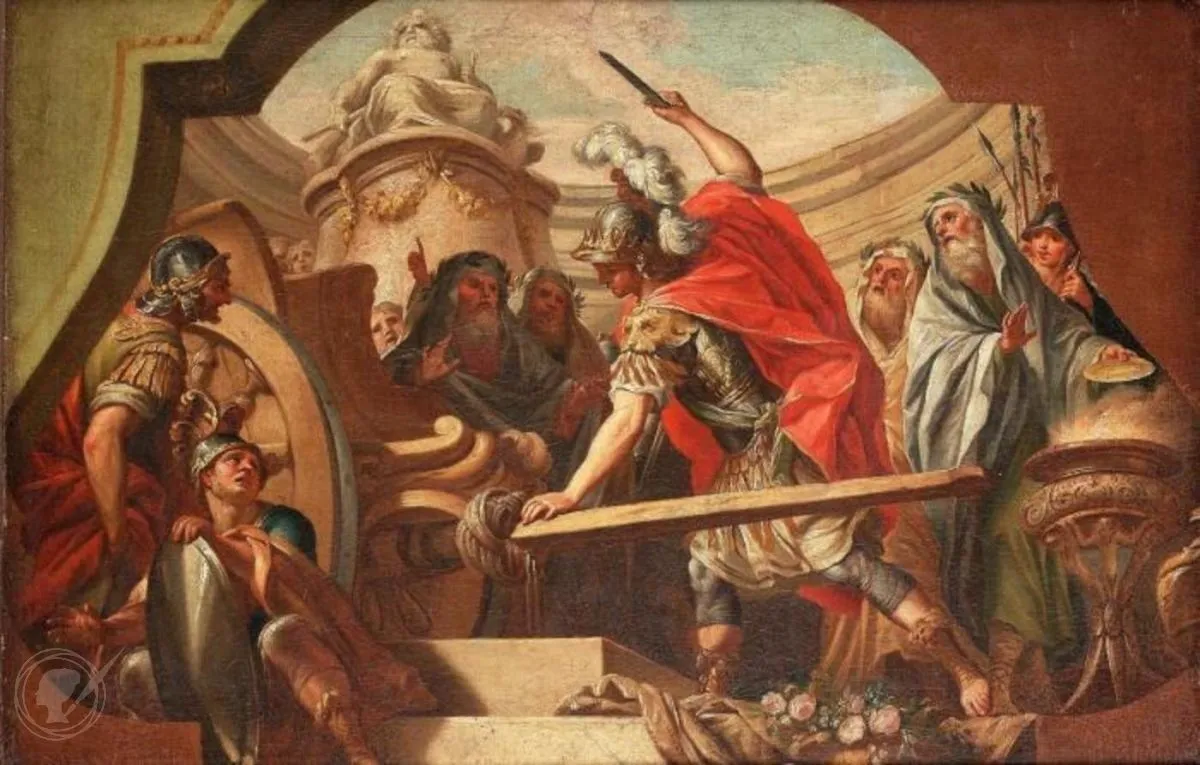
Alexander Cutting the Gordian Knot
Fedele Fischetti, 18th century.
But a counter-revolutionary long march through the institutions was always a doomed project.
The left understands the method quite well, having perfected it themselves, and its defences against counter-infiltration were well advanced. It was never enough merely to say the right things, and not say the wrong things – the left knows how easily such signals are faked, as these are mere words, and words have no meaning to an egregore which sees in discourse nothing but the currents and tokens of power. Much of the seeming insanity of the Cancelled Years is best understood as the imposition of elaborate, difficult to fake displays of loyalty: offering your child’s genitals to the hungry gender gorgon, opening your veins for the gene therapy injection. Then of course there is DEI, whose explicit intent was to simply deny opportunity to those most likely, on a demographic basis, to oppose the left. There is very little point, as a young white man, in keeping your mouth shut if you will be locked out simply because you are white, no matter what you say.
The psychological demands of stealthy infiltration are spiritually toxic. Anyone attempting this path finds himself embedded in a social context in which all of his friends and colleagues adhere to values which he privately despises, and moreover, he knows that the instant they discover his true beliefs he will be not only fired, but ostracized and isolated. Worse, he’s constantly placed in the position of betraying his own convictions, of going along with and even actively supporting things he knows are wrong, because failing to do so would be immediately suspicious. Since the left is a hive mind, he must “pretend” to give up his agency … and insofar as you are what you do, there is very little difference between pretending to give up your agency, and actually doing giving it up. Living like this is miserable. It requires iron discipline, and there is very little reward. Some of you doubtless have direct experience of this.
The most important reason that a long march was never viable, however, was that there was not enough time.
The West is in crisis. Public debt has broken up through the exosphere, its rise ever more vertical as the deficits fuelling it continue to expand, and we can all see in its meteoric rise that its inevitable descent will hit the land like rods from God. Third world invaders pour into our countries by their millions at the open invitation of seditious governments whose open aim is to reduce native white populations to second-class minorities in their own homelands within the space of a generation. These two crises of the Great Inflation and the Great Replacement could never be solved by the tactics the left used to bring them about. Even if such a long march could have succeeded in the face of the barriers the left so astutely erected, by the time it came to fruition the victors would preside over wreckage.
The left’s tactics were those of a chronic disease, gradually wasting the patient, leaching the strength from his limbs. You cannot cure a patient by becoming an opportunistic infection in your own right.
So what to do? Many, despairing, looked to civil war. A coup d’état, likely followed by blue states separating from the Union. Battle lines would be drawn, brother would be set against brother, cities would be ruined, vast pits would be excavated and filled with the stinking dead. Such a war would never have been limited to continental United States. It would have dissolved the Pax Americana, with brushfire wars springing up across the globe as great powers sought to expand their territories by grabbing resources or strategic trade corridors. Those powers would have gotten involved in the Civil War themselves, backing one side or another, prolonging the conflict in order to ensure the Union remained shattered forever.
On J6, the American government teetered on a precipice. Had Trump applied so much as the gentlest pressure with his baby finger, it would have toppled over. The other side would then have screamed that he was a tyrant who had seized power by force; his own supporters would have rallied to the cause that the election had been stolen; America, and the world, would have been bathed in blood. So Trump pulled back, allowed the heroes of J6 to be imprisoned, and permitted the sclerocracy to impose four years of malevolent mismanagement on the American people.
Many were furious with Trump. He’d lost his nerve; he was a coward.
As it turned out, they were all wrong. It was a strategic withdrawal.
And now, instead of a Long March, we are getting a blitzkrieg.
I’ve been silent for the last month partly for personal reasons that deprived me of the time and energy to write, which I won’t elaborate upon here save to note that it’s nothing anyone has to worry about. But I’ve also been silent because I haven’t been sure what to say. The last weeks have been one of those ‘weeks when decades happen’ periods, and that pace of change doesn’t appear to be letting up. Executive Orders flying off of the big man’s desk, birthright citizenship being struck down, entire government departments getting defunded, the J6 heroes being pardoned, trade wars starting and then stopping before they start, the military heading to the border, DOGE siccing broccoli-headed zoomers armed with large language models to rip through the sprawling financial records of acronym agencies like a cyclone of destruction.
As it turns out, you can just cut things.
These are all great, wonderful things. We are winning, and the pace of winning is dizzying. It’s like we’ve spent the last several years slamming again and again against a seemingly immovable wall, bashing our brains out upon it like an enraged tiger, only for that wall to suddenly turn to sand upon our final desperate push, leaving us sprawled and disoriented on the ground.
That is at least what it has felt like to me. The people on the inside of the Trump administration are not disoriented. Far from it. They are executing a detailed, thorough plan. They’ve identified the enemy nerve centres and are neutralizing them precisely, rapidly, and ruthlessly. Handpicked squads of very competent young men have been turned loose inside the Beltway. It is clear that they are not being micromanaged, but are being left to develop their own action plans on the fly as the tactical situation evolves. This is manoeuvre warfare, with small, nimble, lethal teams dropped into the heart of enemy territory and being given maximum latitude to pursue the campaign’s strategic objectives.
January 27, 2025
The Rise of Augustus – The Conquered And The Proud 12
Adrian Goldsworthy. Historian and Novelist
Published 4 Sept 2024Continiung the series “The Conquered and the proud”, we come to the early days of the young Octavian, the man who would become Caesar Augustus and found the Principate, the rule of emperors — a system that would last for centuries and see the Roman empire reach the pinnacle of its prosperity and population.
Just eighteen years old when Julius Caesar was murdered, his great nephew was named as principal heir in his will. This mean that he took his name and the bulk of his property. However, this ambitious teenager took it to mean that he should also succeed to Caesar’s power. Incredibly, after fourteen years of bloody struggle, he did just that.
January 15, 2025
Desert Storm: The Gulf War 1990-1991
Real Time History
Published 6 Sept 2024When Saddam Hussein invaded Kuwait in the summer of 1990, he didn’t anticipate a massive international backslash and unanimous Security Council response. Soon a broad military Coalition under leadership of the United States assembled and kicked the Iraqi Army out of Kuwait. In the aftermath several Iraqi groups rose up against Saddam but the Coalition didn’t support a regime change.
CHAPTERS:
00:00 Intro
00:29 Saddam Hussein Victorious (but Broke)
03:49 Iraqi Invasion of Kuwait
06:02 The Coalition Against Iraq Forms
08:37 Operation Desert Shield
10:55 Operation Desert Storm
20:26 Iraqi Highway of Death
21:39 Iraqi Uprisings
(more…)
January 7, 2025
Caesar’s dictatorship and the Ides of March – The Conquered And The Proud 11
Adrian Goldsworthy. Historian and Novelist
Published 31 Jul 2024Continuing “The conquered and the proud”, this time we look at Julius Caesar as dictator in Rome, about his activities and reforms and his murder on the 15th March — The Ides of March — in 44 BC. We talk about Brutus, Cassius and the other conspirators and what motivated them.
December 27, 2024
The First Triumvirate – The Conquered and the Proud 10
Adrian Goldsworthy. Historian and Novelist
Published Jul 10, 2024This time we take a look at the Fifties BC, the formation of the first triumvirate, Caesar’s consulship, Clodius and Milo’s organised violence, Caesar in Gaul, Crassus in Syria and Parthia. The context is conquest and Roman success abroad with spiralling chaos at home. A big theme is the build-up to the Civil War and Caesar crossing the Rubicon in January 49 BC. We end with a quick run through the campaigns of the Civil War.
Primary sources include Caesar’s War Commentaries, Cicero’s letters and speeches, Plutarch’s Lives, Appian’s Civil War.


