
Big Car
Published 5 Jan 2020There’s much more to the DeLorean Motor Company than Doc’s 88mph time machine in Back to the Future. It’s a story of a playboy founder with a meteoric rise, a story of hope and regeneration in an area torn apart after a decade of fighting, and of a cocaine smuggling fall from grace. Yes, this story has it all!
(more…)
August 19, 2022
The DeLorean Story
Comments Off on The DeLorean Story
February 4, 2022
QotD: Don’t drive on the interstate highways
Almost without exception, the scenery [along the highway] is terrible (writer Bill Bryson suggests that beautiful scenery along the interstate highway system is in fact banned by federal law), the distances are astonishing (except in New England), the highways around major cities (e.g. Washington D.C., Seattle, Los Angeles and even Dallas are more like (slow-) moving parking lots than highways, and the plethora of 18-wheeler trucks make driving a white-knuckle exercise. You will never find any decent food just off the interstates unless your idea of “interesting” is McDonalds or Waffle House, and in a word, interstate highway travel is BORING.
Kim du Toit, “Don’t Do That”, Splendid Isolation, 2019-01-28.
Comments Off on QotD: Don’t drive on the interstate highways
January 27, 2022
QotD: American cars after 1970
Especially cars. American-made cars were almost Soviet, in that if you happened to get one made by the one factory the one day the workers weren’t falling down drunk on the job, it might run … for a while. American workers weren’t drunk, of course, but they were unionized, which from a quality control perspective amounted to the same thing. Chrysler and especially General Motors were little more than employee pension plans that occasionally cranked out a crappy car. Not to take anything away from underhanded Japanese business practices back then — “dumping” etc. — but you had to give the Nips this, their shitboxes actually worked.
Even ten-thumbs guys like me became at least semi-adequate shade tree mechanics, because we had to keep the Sixties hand-me-down cars that got us through college running well into the 1990s, or we’d have to walk. No one in his right mind bought an American-made car from any year after 1970. Take that out for any large consumer product, and there you had it. Thanks, Big Labor!
But here in Clown World, the dilithium crystals have reversed polarity, so what was already fake and gay back at the very dawn of the Fake and Gay Era (future historians, please credit me for that coinage in your textbooks) is now a pillar of probity. The enemy of my enemy is my friend, and Big Labor is definitely shaping up to be the enemy of Big Government. Brandon’s puppetmasters have clearly decided to go for the quadruple axel, politically — they’re going to totally alienate every single cisgender, heteronormative member of their old coalition, so that when they finally make Utopia with just Intersectional Genderfluids of Color, even the French judge will be forced to give them a 10.
It’s a bold strategy, Cotton … let’s see how it works out for them. In the meantime, yeah, if you’ve got a tradesmen’s local in your area, buy ’em a box of donuts or something. They’re fighting the good fight on this one.
Severian, “Friday, No Job, Etc.”, Founding Questions, 2021-10-22.
Comments Off on QotD: American cars after 1970
January 26, 2022
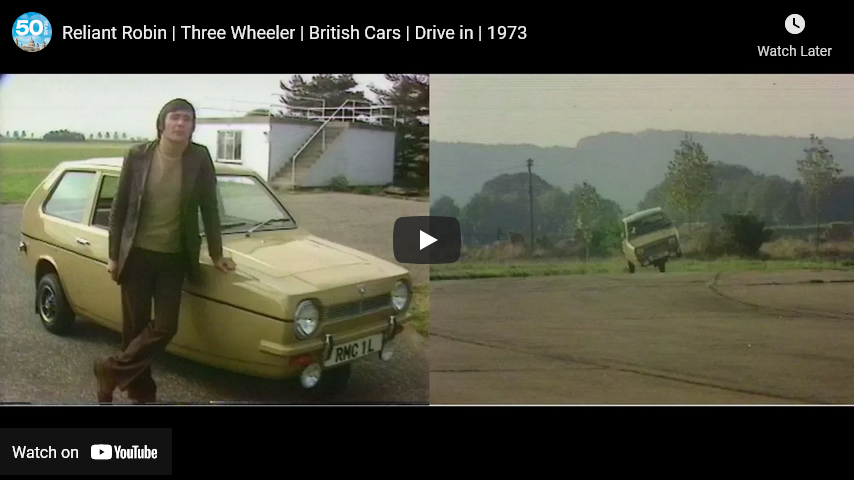
Reliant Robin Three Wheeler | British Cars | Drive in (1973)
ThamesTv
Published 21 Jul 2019Tony Bastable takes the iconic Reliant Robin for a spin to see what this new British car has to offer.
First shown: 29/10/1973
If you would like to license a clip from this video please e mail:
archive@fremantle.com
Quote: VT8219
From the comments:
Tortinwall
2 years ago
I love the idea that you buy a Reliant Robin and then keep “valuable objects” in the boot.
Comments Off on Reliant Robin Three Wheeler | British Cars | Drive in (1973)
December 14, 2021
QotD: Insulated from reality
The first notable thing about today’s act of public nuisance masquerading as a protest was the hilarity of the campaign group itself. Remember when radicals fought for higher wages or better working conditions or for a revolution to replace capitalism with something else? Not anymore. Today’s self-styled militants demand the insulation of houses. “What do we want? The creation of a thermal envelope in people’s homes! When do we want it? Now!” What a crock to go to the barricades for. Also notable is the irony of supposed planet-lovers causing so much pollution by forcing hundreds of cars and trucks to sit still for ages, chugging fumes into the air for nought. Well played, greenies.
But the most striking thing about these kinds of protests is their sheer arrogance. Their inherently anti-democratic, anti-masses nature, where the aim is always, but always, to inconvenience the little people and teach us a lesson. You’re on your way to Heathrow for a much-needed jaunt to Malaga to escape the stresses of work? Not anymore, you’re not – the eco-elitists blocked junction 14, which leads to one of Heathrow’s terminals. You’re a knackered trucker who’s been driving all night long and now wants to get back to his family? Tough shit. These plummy alarmists have decided to make you the collateral damage of one of their narcissistic stunts.
Brendan O’Neill, “Environmentalism is a revolt against the people”, Spiked, 2021-09-13.
Comments Off on QotD: Insulated from reality
November 20, 2021
Modern navigation aids compared
In common with most people in this age of pandemic, I don’t travel very much these days. Back when I did manage to get out and about on the roads, I had an early Garmin GPS device in my vehicle and when I eventually updated the sound system in my truck to a new device, it included a built-in GPS (that constantly “loses” satellite fixes and loudly informs me, even when I’m not using the mapping function). I’ve had both good and bad experiences with these devices, but Alistair Dabbs is much more entertaining with his story:
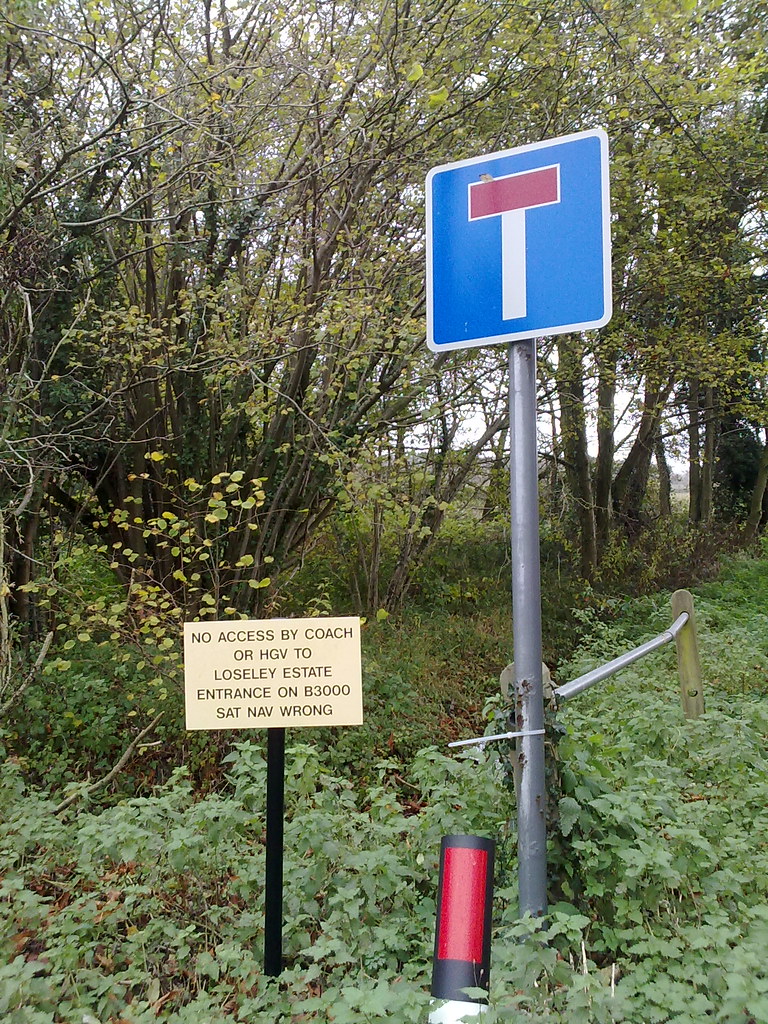
“Sat Nav FAIL” by J-o-n-o is licensed under CC BY-SA 2.0


Turn left. Turn right. At the roundabout, take the fourth exit.
Nobody enjoys being told what to do all the time but in the case of Google Maps I will make an exception. What I like about it best is that I can ignore her directions – should dissent take my fancy – and she doesn’t get cross.
This is in sharp contrast with all the classic sat-navs I have ever used, including the one embedded permanently into my current vehicle. Not only does it have a penchant for taking me on pointlessly circuitous routes, the wrong way up one-way streets, and along shortcuts too narrow for a bicycle, it grows angrier by the second when I refuse its orders.
“Turn right, turn right, turn right, turn left,” it would yell at increasing volume, trying to browbeat me into making a U-turn. Well no, I don’t want to drive through that building site or weave between those ambulances and fire engines dealing with that overturned lorry. Can’t you take me on an alternative route?
“Recalculating …” it would bark like a sulking dalek, but never accomplishing such. “Recalculating … Recalculating …”
Clearly I am not the only reluctant motorist to have given up on traditional sat-navs: not a single ad for one of these has turned up in my Black Friday spam deluge this year. And good riddance. Of the £3m per minute spent by Brits on their Black Friday shopping, roughly £0 will be spent on in-car nags.
Google Maps is more chilled. It’s as if she has resigned herself to my penchant for taking the wrong exits and missing turns. This is a habit I acquired by trying too hard not to drive like my father, who would obey every instruction from his sat-nav with military immediacy. As soon as he heard the words “Turn left”, he’d turn hard on the steering wheel straight away and we’d find ourselves heading up someone’s front drive, into an underground office car park or across a pedestrianised shopping walkway.
Me, I prefer to wait a bit – maybe a bit too long. Google Maps doesn’t mind and gives me no grief. Perhaps she also recognises her own faults in occasionally trying to direct me to drive through bricked-up entrances and children’s playgrounds. “Pff, whatever,” she probably thinks. “He’s too thick to follow the normal route. Let’s try a longer one.”
The odd thing is that she talks to Mme D in a very different way. On her smartphone, Google Maps is, well, chatty.
While all I get is a functional “Turn left/right” or “In 300 metres take the slip-road,” Mme D is treated to a tirade of verbosity. “Move into the filter lane and turn left at the next traffic lights heading north-northwest into B3496 Lower High Street but keep to the right to avoid the turnoff, mind the pedestrian crossing and wave hello to the butcher on the corner …” it spews, one directive tumbling into the next in a single continuous description of the journey and all its finest details.
Comments Off on Modern navigation aids compared
November 17, 2021
Tank Chats #132 | Morris Light Reconnaissance Car | The Tank Museum
The Tank Museum
Published 23 Jul 2021David Fletcher is back with another Tank Chat discussing the Morris Light Reconnaissance Car.
(more…)
Comments Off on Tank Chats #132 | Morris Light Reconnaissance Car | The Tank Museum
November 14, 2021
QotD: Traffic in India
Severian, “Cars, Bikes, Motorcycles”, Rotten Chestnuts, 2021-07-25.
Comments Off on QotD: Traffic in India
October 3, 2021
The Triumph Spitfire Story
Big Car old account
Published 8 Mar 2019To help me continue producing great content, please consider supporting me: https://www.patreon.com/bigcar
Help support my channel through these Amazon US affiliate links:
Triumph Spitfire t-shirt: https://amzn.to/2KdY33m
Triumph Spitfire baseball cap: https://amzn.to/2U1SrZF
Triumph sweatshirt: https://amzn.to/2KgGIXq
Triumph Spitfire model car: https://amzn.to/2U4gnvo
Triumph keyfob: https://amzn.to/2YTeKV4
Triumph Spitfire metal sign: https://amzn.to/2U2u4ejThe Spitfire is a beautiful automobile, a thing of wonder penned by an Italian genius, but it almost never happened. If not for a chance find in the dusty corner of a factory it would have remained merely a “could have been”. But Triumph produced a car that still inspires new creations today and has a strong and loyal fan base around the world, nearly sixty years since it burst on the scene.
#TriumphSpitfire

Comments Off on The Triumph Spitfire Story
June 7, 2021
Dude, where’s my (flying) car?
The latest of the reader-contributed book reviews at Scott Alexander’s Astral Codex Ten looks at Where is my Flying Car? by J. Storrs Hall:

What went wrong in the 1970s? Since then, growth and productivity have slowed, average wages are stagnant, visible progress in the world of “atoms” has practically stopped — the Great Stagnation. About the only thing that has gone well are computers. How is it that we went from the typewriter to the smartphone, but we’re still using practically the same cars and airplanes?
Where is my Flying Car? by J. Storrs Hall, is an attempt to answer that question. His answer is: the Great Stagnation was caused by energy usage flatlining, which was caused by our failure to switch to nuclear energy, which was caused by excessive regulation, which was caused by “green fundamentalism”.
Three hundred years ago, we burned wood for energy. Then there was coal and the steam engine, which gave us the Industrial Revolution. Then there was oil and gas, giving us cars and airplanes. Then there should have been nuclear fission and nanotech, letting you fit a lifetime’s worth of energy in your pocket. Instead, we still drive much the same cars and airplanes, and climate change threatens to boil the Earth.
I initially thought the title was a metaphor — the “flying car” as a standin for all the missing technological progress in the world of “atoms” — but in fact much of the book is devoted to the particular question of flying cars. So look at the issue from the lens of transportation:
Hans Rosling was a world health economist and an indefatigable campaigner for a deeper understanding of the world’s state of development. He is famous for his TED talks and the Gapminder web site. He classifies the wealthiness of the world’s population into four levels:
1. Barefoot. Unable even to afford shoes, they must walk everywhere they go. Income $1 per day. One billion people are at Level 1.
2. Bicycle (and shoes). The $4 per day they make doesn’t sound like much to you and me but it is a huge step up from Level 1. There are three billion people at level 2.
3. The two billion people at Level 3 make $16 a day; a motorbike is within their reach.
4. At $64 per day, the one billion people at Level 4 own a car.
The miracle of the Industrial Revolution is now easily stated: In 1800, 85% of the world’s population was at Level 1. Today, only 9% is. Over the past half century, the bulk of humanity moved up out of Level 1 to erase the rich-poor gap and make the world wealth distribution roughly bell-shaped. The average American moved from Level 2 in 1800, to level 3 in 1900, to Level 4 in 2000. We can state the Great Stagnation story nearly as simply: There is no level 5.
Level 5, in transportation, is a flying car. Flying cars are to airplanes as cars are to trains. Airplanes are fast, but getting to the airport, waiting for your flight, and getting to your final destination is a big hassle. Imagine if you had to bike to a train station to get anywhere (not such a leap of imagination for me in New York City! But it wouldn’t work in the suburbs). What if you had one vehicle that could drive on the road and fly in the sky at hundreds of miles an hour?
Before reading this book, I thought flying cars were just technologically infeasible, because flying takes too much energy. But Hall says we can and have built them ever since the 1930s. They got interrupted by the Great Depression (people were too poor to buy private airplanes), then WWII (airplanes were directed towards the war effort, not the market), then regulation mostly killed the private aviation industry. But technical feasibility was never the problem.
Hall spends a huge fraction of the book on pretty detailed technical discussion of flying cars. For example: the key technical issue is takeoff and landing, and there is a tough tradeoff between convenient takeoff/landing and airspeed (and cost, and ease of operation). It’s interesting reading. But let’s return to the larger issue of nuclear power.
Comments Off on Dude, where’s my (flying) car?
April 14, 2021
Tank Chat #103 | Laird Centaur | The Tank Museum
The Tank Museum
Published 15 May 2020David Fletcher looks at this curiosity from the 1970’s, a Land Rover with tracks. Currently housed in The Tank Museum’s Vehicle Conservation Centre.
Support the work of The Tank Museum on Patreon: ► https://www.patreon.com/tankmuseum
Visit The Tank Museum SHOP & become a Friend: ► tankmuseumshop.orgTwitter: ► https://twitter.com/TankMuseum
Instagram: ► https://www.instagram.com/tankmuseum/
Tiger Tank Blog: ► http://blog.tiger-tank.com/
Tank 100 First World War Centenary Blog: ► http://tank100.com/
#tankmuseum #tanks

Comments Off on Tank Chat #103 | Laird Centaur | The Tank Museum
March 30, 2021
Tank Chats # 101 | Irish Leyland Armoured Car | The Tank Museum
The Tank Museum
Published 9 Apr 2020Here David Fletcher discusses the Leyland Armoured Car which was produced in the 1930s for the Irish Army, but with some alterations, saw service right through to the 1980s.
Support the work of The Tank Museum on Patreon: ► https://www.patreon.com/tankmuseum
Visit The Tank Museum SHOP & become a Friend: ►tankmuseumshop.orgTwitter: ► https://twitter.com/TankMuseum
Instagram: ► https://www.instagram.com/tankmuseum/
Tiger Tank Blog: ► http://blog.tiger-tank.com/
Tank 100 First World War Centenary Blog: ► http://tank100.com/
#tankmuseum #tanks #MuseumFromHome

Comments Off on Tank Chats # 101 | Irish Leyland Armoured Car | The Tank Museum
March 26, 2021
Tank Chats #100 | Rolls-Royce Armoured Car | The Tank Museum
The Tank Museum
Published 6 Nov 2020The 100th Tank Chat milestone has been reached as the Rolls-Royce Armoured Car turns 100 years old! In this special edition, everybody’s favourite moustachioed tank historian David Fletcher examines his favourite vehicle in The Tank Museum’s collection: the Rolls-Royce Armoured Car, on its 100th birthday.
Support the work of The Tank Museum on Patreon: ► https://www.patreon.com/tankmuseum
Visit The Tank Museum SHOP & become a Friend: ►tankmuseumshop.orgTwitter: ► https://twitter.com/TankMuseum
Instagram: ► https://www.instagram.com/tankmuseum/
#tankmuseum #tanks

Comments Off on Tank Chats #100 | Rolls-Royce Armoured Car | The Tank Museum
March 25, 2021
QotD: Lucas, the Prince of Darkness
- The Lucas motto: “Get home before dark.”
- Lucas is the patent holder for the short circuit.
- Lucas — Inventor of the first intermittent wiper.
- Lucas — Inventor of the self-dimming headlamp.
- The three position Lucas switch — Dim, Flicker and Off.
- The Original Anti-Theft Device — Lucas Electrics.
- Lucas is an acronym for Loose Unsoldered Connections and Splices
Andrew Stoy, “Joe Lucas, Prince Of Darkness: British Electrical System Jokes”, Jalopnik, 2008-08-04.
Comments Off on QotD: Lucas, the Prince of Darkness
March 4, 2021
QotD: Accounting for the long-term fall in the crime rate
One clue to the long-term fall in crime rates may be that most of the juke traits I’ve just described are heritable. Note that this is not exactly the same thing as genetically transmitted; children may to a significant extent acquire them from their families by imitation and learning.
The long-term fall in crime rates suggest that something may have been disrupting the generational transmission of traits associated with criminal deviance. Are there plausible candidates for that something? Are there selective pressures operating against jukeness that have become more pressing since the 1960s?
I think I can name three: ready availability of intoxicants, contraception, and automobiles.
Once I got this far in my thinking I realized that the authors of Freakonomics got there before me on one of these; they argued for a strong forward influence from availability of abortion to decreased crime rates two decades later. And yes, I know that a couple of conservative economists (Steve Sailer and John Lott) think they’ve found fatal flaws in the Levitt/Dubner argument; I’ve read the debate and I think Levitt/Dubner have done an effective job of defending their insight.
But I’m arguing a more general case that subsumes Levitt/Dubner. That is, that modern life makes juke traits more dangerous to reproductive success than they used to be. Automobiles are a good example. Before they became ubiquitous, most people didn’t own anything that they used every single day and that so often rewarded a moment’s inattention with injury or death.
Ready availability of cheap booze and powerful drugs means people with addictive personalities can kill themselves faster. Easy access to contraception and abortion means impulse fucks are less likely to actually produce offspring. More generally, as people gain more control over their lives and faster ways to screw up, the selective consequences from bad judgment and the selective premium on good judgment both increase.
Eric S. Raymond, “Beyond root causes”, Armed and Dangerous, 2010-01-12.
Comments Off on QotD: Accounting for the long-term fall in the crime rate


