Quotulatiousness

August 3, 2014

Who is to blame for the outbreak of World War One? (Part five of a series)

Filed under: Europe, Germany, History, WW1 — Tags: , , , , , , , — Nicholas @ 00:02

Over the last several days, I’ve posted entries on what I think are the deep origins of the First World War (part one, part two, part three, part four). Up to now, we’ve been looking at the longer-term trends and policy shifts among the European great powers. Now, we’ll take a look at the most multicultural and diverse polity of the early 20th century, the Dual Monarchy of Austria-Hungary.

Austria becomes Austria-Hungary

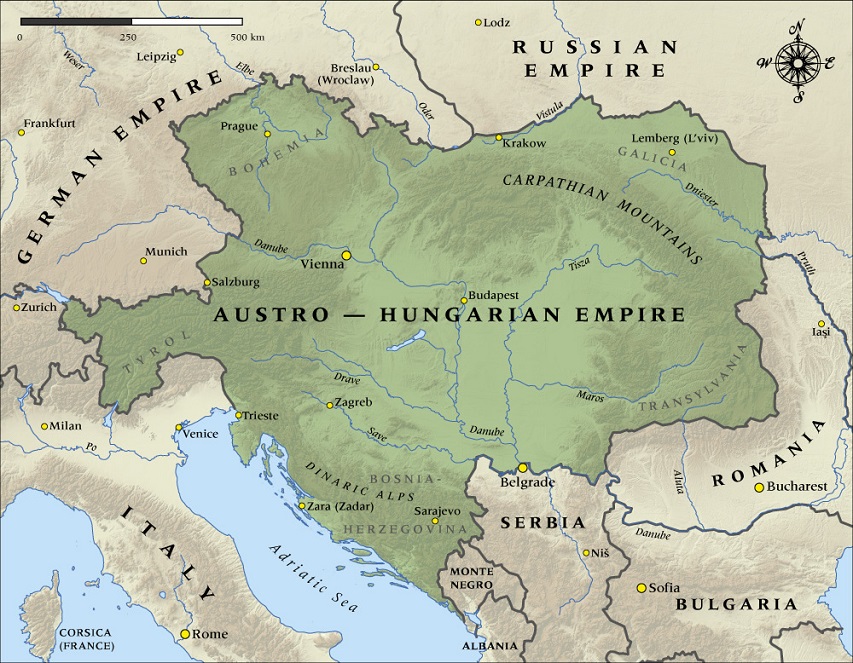
Here is a map of Austria-Hungary at the start of the First World War:

Austria-Hungary in 1914 (via NZHistory)

Austria-Hungary in 1914 (via NZHistory)

A big central European empire: the second biggest empire in Europe at the time (after Russia). But that map manages to conceal nearly as much as it reveals. Here is a slightly more informative map, showing a similar map of ethnic and linguistic groups within the same geographical boundaries:

The ethnic groups of Austria-Hungary in 1910. Based on "Distribution of Races in Austria-Hungary" by William R. Shepherd, 1911. City names changed to those in use since 1945. (via Wikipedia)

The ethnic groups of Austria-Hungary in 1910. Based on Distribution of Races in Austria-Hungary by William R. Shepherd, 1911. City names have been changed to those in use since 1945. (via Wikipedia)

This second map shows much more of the political reality of the empire — and these are merely the largest, most homogenous groupings — and why the Emperor was so sensitive to chauvinistic and nationalistic movements that appeared to threaten the stability of the realm. If anything, that map shows the southern regions of the empire — Croatia-Slavonia, Dalmatia, Bosnia, Herzegovina — to be more ethnically and linguistically compatible than almost any other region (which neatly illustrates some of the limitations of this form of analysis — layering on religious differences would make the map far more confusing, and yet in some ways more explanatory of what happened in 1914 … and, for that matter, from 1992 onwards).

Austria 1815-1866

For some reason, perhaps just common usage in history texts, I had the distinct notion that the Austrian Empire was a relatively continuous political and social structure from the Middle Ages onward. In reading a bit more on the nineteenth century, I find that the Austrian Empire was only “founded” in 1804 (according to Wikipedia, anyway). “Austria” as a concept certainly began far earlier than that! Austria was the general term for the personal holdings of the head of the Habsburgs. The title of Holy Roman Emperor had been synonymous with the Austrian head of state almost continuously since the fifteen century: that continuity was finally broken in 1806 when Emperor Francis II formally dissolved the Holy Roman Empire due to the terms of the Treaty of Pressburg, through which Napoleon stripped away many of the core holdings of the empire (including the Kingdom of Bavaria and the Kingdom of Württemberg) to create a new German proto-state called the Confederation of the Rhine.

The Confederation lasted until 1813, as Napoleon’s empire ebbed westward across the Rhine before the Prussian, Austrian, and Russian armies. After the Battle of Leipzig (also known as the Battle of Nations for the many different armies involved), several of the constituent parts of the Confederation defected to the allies. As part of the re-alignment of borders, treaties, and affiliations during the Congress of Vienna, both Prussia and Austria were added to the successor entity called the German Confederation, but Austria was the acknowledged leader of the organization.

The Rise of Prussia and the eclipse of Austria

Schleswig-Holstein in 1864 (via Wikipedia)

Schleswig-Holstein in 1864 (via Wikipedia)

The Kingdom of Prussia was the rising power within the German Confederation, and it was likely that at some point the Prussians would attempt to challenge Austria for the leadership of Germany. That situation arose (or, if you’re a fan of the “Bismarck had a master plan” theory, was engineered) over the dispute with Denmark over the duchies of Holstein and Schleswig.

Denmark was not part of the confederation, but the two duchies were within it: the right of succession to the the two ducal titles were a point of conflict between the Kingdom of Denmark (whose monarch was also in his own person the duke of both Schleswig and Holstein) and the leading powers of the confederation, Austria and Prussia. When the King of Denmark died, by some legal views, the right of succession to each of the ducal seats was now open to dispute (because they were not formally part of Denmark, despite the King having held those titles personally).

In Denmark proper, the recently adopted constitution provided for a greater degree of democratic representation, but the political system in the two duchies was much more tailored to the interests and representation of the landowning classes (who were predominantly German-speaking) over the commoners (who were Danish-speakers). After the new Danish King signed legislation setting up a common parliament for Denmark and Schleswig, Prussia invaded as part of a confederate army, and the Danes wisely retreated north, abandoning the relatively indefensible southern portion of the debated duchies. In short, the campaign went poorly for the Danes, but quite well for the Prussians and (to a lesser degree) the Austrians. Under the terms of the resulting Treaty of Vienna, Denmark renounced all claims to the duchies of Schleswig, Holstein, and Lauenburg to the Austrians and Prussians.

Austria’s reward for the campaign was the duchy of Holstein, while Prussia got Schleswig and Lauenburg (in the form of King Wilhelm taking on the rulership of the latter duchy in his own person). The two great powers soon found themselves at odds over the administration of the duchies, and Austria appealed their side of the dispute to the Diet (parliament) of the Confederation. Prussia declared this to be a violation of the Gastein Convention, and launched an invasion of Holstein in co-operation with some of the other Confederation states.

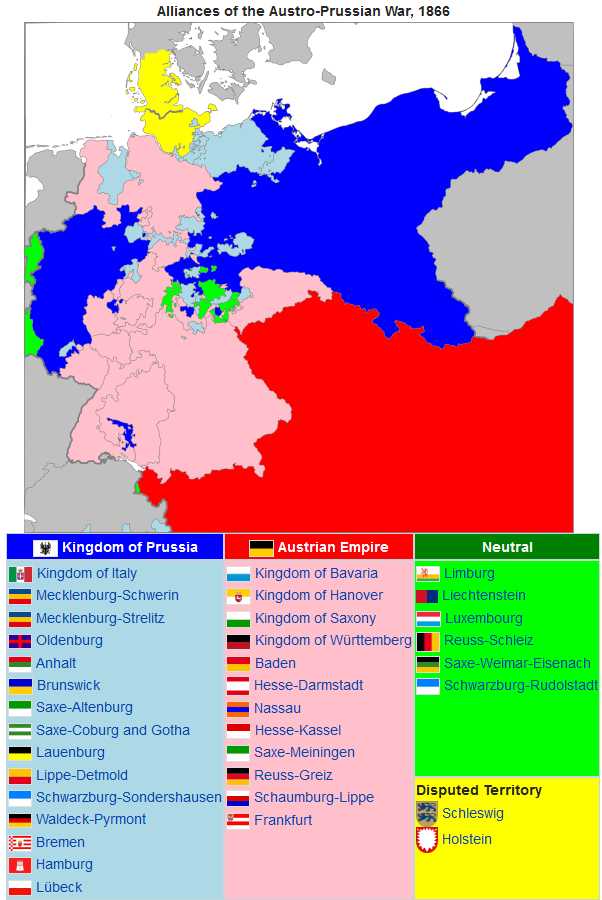
This was the start of the Austro-Prussian War, also known as the Seven Weeks’ War. The start of the conflict triggered an existing treaty between Prussia and Italy, bringing the Italian forces in to menace Austria’s southwestern frontier (Italy was eager to take the Italian-speaking regions of the Austrian Empire into their kingdom. As the Wikipedia entry notes, the war was not unwelcome to the respective leaders of the warring powers: “In Prussia king William I was deadlocked with the liberal parliament in Berlin. In Italy, king Victor Emmanuel II, faced increasing demands for reform from the Left. In Austria, Emperor Franz Joseph saw the need to reduce growing ethnic strife, by uniting the several nationalities against a foreign enemy.”

In his essay “Bismarck and Europe” (collected in From Napoleon to the Second International), A.J.P. Taylor notes that the war took time and effort to bring to fruition, but not for reasons you might expect:

The war between Austria and Prussia had been on the horizon for sixteen years. Yet it had great difficulty in getting itself declared. Austria tried to provoke Bismarck by placing the question of the duchies before the Diet on 1 June. Bismarck retaliated by occupying Holstein. He hoped that the Austrian troops there would resist, but they got away before he could catch them. On 14 June the Austrian motion for federal mobilization against Prussia was carried in the Diet. Prussia declared the confederation at an end; and on 15 June invaded Saxony. On 21 June, when Prussian troops reached the Austrian frontier, the crown prince, who was in command, merely notified the nearest Austrian officer that “a state of war” existed. That was all. The Italians did a little better La Marmora sent a declaration of war to Albrecht, the Austrian commander-in-chief, before taking the offensive. Both Italy and Prussia were committed to programmes which could not be justified in international law, and were bound to appear as aggressors if they put their claims on paper. The would, in fact, have been hard put to it to start the war if Austria had not done the job for them.

The contending forces in the Austro-Prussian War, 1866 (via Wikipedia)

The contending forces in the Austro-Prussian War, 1866 (via Wikipedia)

Strategically, the Austro-Prussian war was the first European war to reflect some of the lessons of the recently concluded American Civil War: railway transportation of significant forces to the front, and the relative firepower differences between muzzle-loading weapons (Austria) and breech-loading rifles (Prussia). In the decisive Battle of Königgrätz (or Sadová), Prussian firepower and strategic movement were the key factors, allowing the numerically smaller force to triumph — Austrian casualties were more than three times greater than those of the Prussian army. This was the last major battle of the war, with an armistice followed by the Peace of Prague ending hostilities.

North German Confederation 1867-1871Initially, King Wilhelm had intended to utterly destroy Austrian power, possibly even to the extent of occupying significant portions of Austria, but Bismarck persuaded him that Prussia would be better served by offering a relatively lenient set of terms and working toward an alliance with the defeated Austrians than by the wholesale destruction of the balance of power. Austria lost the province of Venetia to Italy (although it was legally ceded to Napoleon III, who in turn ceded it to Italy). The German Confederation was replaced by a new North German Confederation led by Prussia’s King Wilhelm I as president, and Austria’s minor German allies were faced with a reparations bill to be paid to Prussia for their choice of allies in the war. (Liechtenstein at this time was separated from Austria and declared itself permanently neutral … I’d always wondered when that micro-state had popped into existence.)

Aftermath and constitutional change

After a humiliating defeat by Prussia, the Austrian Emperor was faced with the need to rally the empire, and the Hungarian nationalists took this opportunity to again demand special rights and privileges within the empire. Hungary had always been, legally speaking, a separate kingdom within the empire that just happened to share a monarch with the rest of the empire. In 1867, this situation was recognized in the Compromise of 1867, after which the Austrian Empire was replaced by the Dual Monarchy of Austria-Hungary.

The necessity of satisfying Hungarian nationalist aspirations within the empire made Austria-Hungary appear as a political basket case to those more familiar with less ethnically, socially, and linguistically diverse polities than the Austrian Empire. From a more nationalistic viewpoint the political arrangements required to keep the empire together (mainly the issues in keeping Hungary happy) created a political system that appeared better suited to an asylum Christmas concert than a modern, functioning empire. In The Sleepwalkers, Christopher Clark explains the post-1867 government structure briefly:

Shaken by military defeat, the neo-absolutist Austrian Empire metamorphosed into the Austro-Hungarian Empire. Under the Compromise hammered out in 1867 power was shared out between the two dominant nationalities, the Germans in the west and the Hungarians in the east. What emerged was a unique polity, like an egg with two yolks, in which the Kingdom of Hungary and a territory centred on the Austrian lands and often called Cisleithania (meaning ‘the lands on this side of the River Leithe’) lived side by side within the translucent envelope of a Habsburg dual monarchy. Each of the two entities had its own parliament, but there was no common prime minister and no common cabinet. Only foreign affairs, defence and defence-related aspects of finance were handled by ‘joint ministers’ who were answerable directly to the Emperor. Matters of interest to the empire as a whole could not be discussed in common parliamentary session, because to do so would have implied that the Kingdom of Hungary was merely the subordinate part of some larger imperial entity. Instead, an exchange of views had to take place between the ‘delegations’, groups of thirty delegates from each parliament, who met alternately in Vienna and Budapest.

Along with the bifurcation between Cisleithania and Transleithania (Hungary), the two governments handled the demands of their respective majority and minority subjects quite differently: the Hungarian government actively suppressed minorities and attempted to impost Magyarization programs through the schools to stamp out as much as they could of other linguistic and ethnic communities. The Hungarian plurality (about 48 percent of the population) controlled 90 percent of the seats in parliament, and the franchise was limited to those with landholdings. The lot of minorities in Cisleithania was much easier, as the government eventually extended the franchise to almost all adult men by 1907, although this did not completely address the linguistic demands of various minority groups.

Hungary also actively prevented any kind of political move to create a Slavic entity within the empire (in effect, turning the Dual Monarchy into a Triple Monarchy), for fear that Hungarian power would be diluted and also for fear of encouraging demands among the other minority groups in the Hungarian kingdom.

Rumours of the death of Austria: mainly in hindsight, not prognostication

After World War One, many memoirs and histories made reference to the inevitability of Austrian decline. Most of these “memories” appear to have been constructed after the fact, rather than being accurate views of the reality before the war began. Christopher Clark notes:

Evalutating the condition and prospects of the Austro-Hungarian Empire on the eve of the First World War confronts us in an acute way with the problem of temporal perspective. The collapse of the empire amid war and defeat in 1918 impressed itself upon the retrospective view of the Habsburg lands, overshadowing the scene with auguries of imminent and ineluctable decline. The Czech national activist Edvard Beneš was a case in point. During the First World War, Beneš became the organizer of a secret Czech pro-independence movement; in 1918, he was one of the founding fathers of the new Czechoslovak nation-state. But in a study of the “Austrian Problem and the Czech Question” published in 1908, he had expressed confidence in the future of the Habsburg commonwealth. “People have spoken of the dissolution of Austria. I do not believe in it at all. The historic and economic ties which bind the Austrian nations to one another are too strong to let such a thing happen.”

Austria’s economy

Far from being an economic basket case, Austrian economic growth topped 4.8% per year before the start of WW1 (Christopher Clark):

The Habsburg lands passed during the last pre-war decade through a phase of strong economic growth with a corresponding rise in general prosperity — an important point of contrast with the contemporary Ottoman Empire, but also with another classic collapsing polity, the Soviet Union of the 1980s. Free markets and competition across the empire’s vast customs union stimulated technical progress and the introduction of new products. The sheer size and diversity of the double monarchy meant that new industrial plants benefited from sophisticated networks of cooperating industries underpinned by an effective transport infrastructure and a high-quality service and support sector. The salutary economic effects were particularly evident in the Kingdom of Hungary.

Okay, enough about Austria for now … remember I said that the causes of the war were complex and inter-related? By this point I hope you’ll agree that this case has been more than proven … and we’re still not into the 20th century yet!

August 1, 2014

Who is to blame for the outbreak of World War One? (Part four of a series)

Filed under: Britain, Europe, France, Germany, History, Russia, WW1 — Tags: , , — Nicholas @ 00:02

Over the last few days, I’ve posted some entries on the deep origins of the First World War (part one, part two, part three). We’re still sorting out the end of Otto von Bismarck’s grand diplomatic juggling act, and we’ve barely dug into the fascinating ethnic, religious, cultural, and linguistic goulash of the Balkans.

France searches for allies

After the disaster of the Franco-Prussian War and the collapse of the Second Empire, France was left (for the second time) alone and friendless on the European stage. Having painfully rebuilt from the end of the Napoleonic wars, France faced the need to do it all again, but now with a newly unified and powerful enemy literally on the Eastern frontier.

The overriding foreign policy objectives of the Third Republic were finding ways to counteract the German Reich … even if it meant cosying up to the most autocratic regime in Europe. With Bismarck off the scene, the French were able to further pursue a dialogue with the Tsar’s government that actually began with financial aid from Paris in 1888 leading eventually to a formal alliance in 1892. The loans were intended to allow Russia to improve existing East-West railways and to build new ones with the purpose of allowing Russian troops to be more quickly concentrated on the German-Russian and (less urgently) Austrian-Russian borders. Russia had the military manpower while France had the financial means and technological know-how — both parties drew benefits from the deal (but the French needed the Russians more than vice-versa).

In The War That Ended Peace, Margaret MacMillan shows that the Russians were aware of the imbalance in the needs of the allies and resented the French attitude to them:

Although the French alliance had caused difficulties initially, Russian opinion had largely come around to seeing it as a good thing, a neat matching of Russian manpower with French money and technology. Of course, there were strains over the years. France tried to use its financial leverage over Russia to shape Russian military planning to meet French needs or to insist that Russia place its orders for new weapons with French firms. The Russians resented this “blackmail”, as they sometimes called it, which was demeaning to Russia as a great power. As Vladimir Kokovtsov, Russia’s Minister of Finance for much of the decade before 1914, complained: “Russia is not Turkey; our allies should not set us an ultimatum, we can get by without these direct demands.”

The French also put pressure on Russia to avoid confrontations with Britain, as French and British diplomats had started working toward some kind of understanding, and the French felt (with some justice) that the Russians might easily do damage to that process by some mild adventurism on a distant frontier with Britain’s colonies.

Britain’s global-scale worries

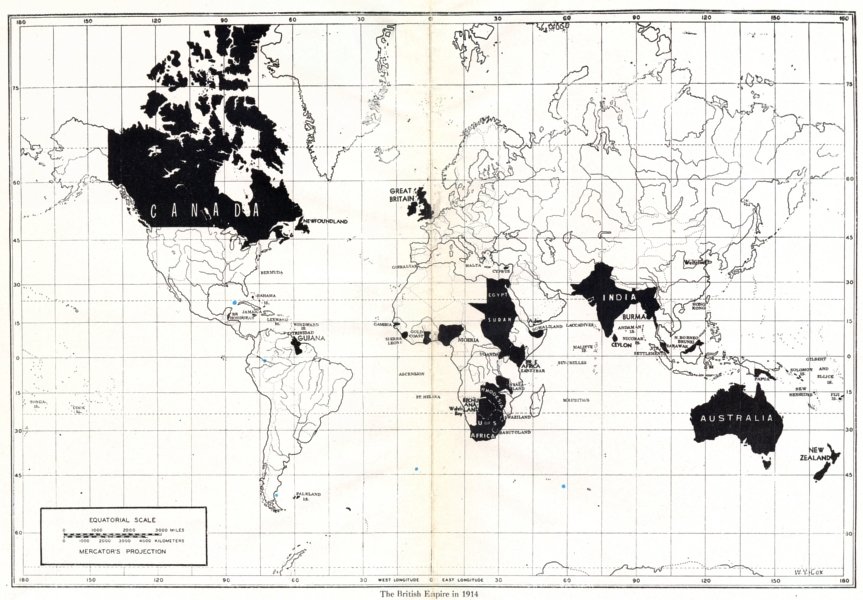
Britain’s lack of direct engagement during much of the period of the Concert of Europe was rational: British interests lay away from Europe, with the burgeoning colonies providing more than enough economic, diplomatic, and military activity for British tastes. From British Imperial viewpoints, the Germans were a mere distraction — it was the Russians who seemed to be threatening the Empire at every turn.

The British Empire in 1914 (via antiquaprintgallery.com)

The British Empire in 1914 (via antiquaprintgallery.com)

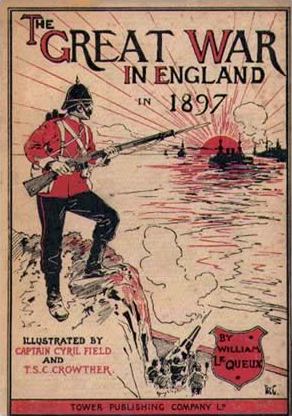
Margaret MacMillan writes that before the popular series of sensationalist novels by William Le Queux featured German invasions of Britain, his chosen villains were the Russians:

The Great War In England In 1897In Britain itself, public opinion was strongly anti-Russian. In popular literature, Russia was exotic and terrifying: the land of snow and golden domes, of wolves chasing sleighs through the dark forests, of Ivan the Terrible and Catherine the Great. Before he made Germany the enemy in his novels, the prolific William Le Queux used Russia. In his 1894 The Great War in England in 1897, Britain was invaded by a combined French and Russian force but the Russians were by far the more brutal. British homes were burned, innocent civilians shot and babies bayoneted. “The soldiers of the Tsar, savage and inhuman, showed no mercy to the weak and unprotected. They jeered and laughed at piteous appeal, and with fiendish brutality enjoyed the destruction which everywhere they wrought.”

Aside from the role of barbarous invaders in popular fiction, there were sufficient things to offend British consciences which added to this general dislike of the Russian state:

Radicals, liberals and socialists all had many reasons to hate the regime with its secret police, censorship, lack of basic human rights, its persecution of its opponents, its crushing of ethnic minorities and its appalling record of anti-Semitism. Imperialists on the other hand hated Russia because it was a rival to the British Empire. Britain could never come to an agreement with Russia in Asia, said Curzon, who had been Salisbury’s Under-secretary at the Foreign Office before he became Viceroy in India. Russia was bound to keep expanding as long as it could get away with it. In any case the “ingrained duplicity” of Russian diplomats made negotiations futile.

In the wake of the abortive 1905 revolution, it was easy to think of Russia as being weak and unstable, but as economic growth slowly returned, the government’s efforts to extend its control over far-flung recently acquired territories led to roads and railways being built … which Britain could hardly help but view as being at least partly military in nature:

It was one of the rare occasions on which [Curzon] agreed with the chief of the Indian general staff, Lord Kitchener, who was demanding more resources from London to deal with “the menacing advance of Russia towards our frontiers.” What particularly worried the British were the new Russian railways, either built or planned, which stretched down to the borders of Afghanistan and Persia and which now made it possible for the Russians to bring more force to bear. Although the term was not to be coined for another eighty years, the British were also becoming acutely aware of what Paul Kennedy called “imperial overstretch”. As the War Office said in 1907, the expanded Russian railway system would make the military burden of defending India and the empire so great that “short of recasting our whole military system, it will become a question of practical politics whether or not it is worth our while to retain India.”

More to follow over the next few days. This series of blog posts has certainly ballooned past what I originally thought would be required (and I’m skipping over masses and masses of stuff already). This just reinforces my earlier point that the situation was far more complex 100 years ago than we might think.

July 30, 2014

Who is to blame for the outbreak of World War One? (Part three of a series)

Filed under: Britain, Europe, Germany, History, Russia, WW1 — Tags: , , , , — Nicholas @ 00:02

Over the last couple of days, I’ve posted some entries on the deep origins of the First World War (part one, part two). We’re just now getting to the point where the plots start twisting around one another like amorous snakes … this gets somewhat confusing from this point onwards (assuming you’re not already confused, that is).

Bismarck provides a masterclass in realpolitik

Otto von Bismarck looms large in the story of the origins of the First World War, although he died several years before it broke out: he was the pre-eminent architect of the German Reich, and a brilliant (and ruthless) diplomatic engineer. Despite a common belief that Bismarck as a warmonger, Eric Hobsbawm wrote that Bismarck “remained undisputed world champion at the game of multilateral diplomatic chess for almost twenty years after 1871, devot[ing] himself exclusively, and successfully, to maintaining peace between the powers” (The Age of Empire: 1875–1914).

While Bismarck became Chancellor of the new Reich in 1871, he had already held a series of important and powerful posts in the Prussian government, including Minister President of Prussia and Foreign Minister from 1861. In 1862, he made his long-range intentions quite plain in a speech to the Budget Committee:

Prussia must concentrate and maintain its power for the favorable moment which has already slipped by several times. Prussia’s boundaries according to the Vienna treaties are not favorable to a healthy state life. The great questions of the time will not be resolved by speeches and majority decisions — that was the great mistake of 1848 and 1849 — but by iron and blood.

In his long and impressive political career, he guided the creation of the unified German state while fending off the political demands of the liberals and socialists by conceding just enough to socialist pet causes to keep them working within the system (state pensions, for example, were a Bismarckian innovation calculated to just barely satisfy the left, but not to cost the state much if any actual revenue due to the high retirement age it set). He was emphatically not a fan of democracy: at one point, he finagled a “legal” way for the Prussian government’s revenues to continue for four years without a hint of democratic interference from the squabbling politicians in the Reichstag.

The editors of Bismarck’s Wikipedia entry seem to think he was first and foremost a benefactor to the working class, but I think they’re projecting — Reichskanzler Prince Otto von Bismarck was never particularly concerned with the welfare of the poor, except where that welfare contributed to the construction of a greater German empire. If that meant pandering to the Socialists, he’d pander with the best of them:

Bismarck implemented the world’s first welfare state in the 1880s. He worked closely with large industry and aimed to stimulate German economic growth by giving workers greater security. A secondary concern was trumping the Socialists, who had no welfare proposals of their own and opposed Bismarck’s. Bismarck especially listened to Hermann Wagener and Theodor Lohmann, advisers who persuaded him to give workers a corporate status in the legal and political structures of the new German state.

The wars he did fight were each calculated to advance the cause of German unification … under Prussian guidance and control, of course. Denmark lost the provinces of Schleswig (to Prussia) and Holstein (to Austria) in 1864, then Austria in turn lost Holstein (to Prussia) and Lombardy-Venetia (to Italy) two years later. His public moment of triumph was the proclamation of Wilhelm I as Emperor of Germany:

The proclamation of Prussian King Wilhelm I as German Emperor at Versailles, by Anton von Werner. The first two versions were destroyed in the Second World War. This version was commissioned by the Prussian royal family for chancellor Bismarck's 70th birthday.

The proclamation of Prussian King Wilhelm I as German Emperor in the Hall of Mirrors in Versailles (Bismarck is at centre-right in the white uniform), by Anton von Werner. This version was commissioned by the Prussian royal family for chancellor Bismarck’s 70th birthday. (via Wikipedia)

Bismarck was not a fan of colonial adventures — he believed they were a distraction from more important issues in Europe and that the cost to obtain and run them was greater than the benefits derived from having them. Despite that, he allowed some colonies to be accumulated as game pieces to further his own priorities domestically. One of the European policies Bismarck implemented to great effect was the diplomatic isolation of France — on the quite reasonable basis that the French would take revenge on Germany for the humiliation of 1870 if they felt powerful enough to try it. The French Third Republic, which succeeded the Second Empire, was left without allies (and more galling: without the provinces of Alsace and Lorraine), due to Bismarck’s diligent efforts to bind the other great powers in alliances with one another and Bismarck managed to keep the French in that vulnerable position for the rest of his time in office.

Bismarck’s attempted solution to the Austro-Russian tensions in the Balkans was the Dreikaiserbund (The League of the Three Emperors) in 1873. This “meeting of the minds” was intended to dampen the risk of conflict by giving the Austrians a free hand in the Western area of the Balkans and the Russians a free hand in the East. The plan didn’t work as well as Bismarck had hoped, and the league was dissolved in 1887, as both of the other signatories felt too hampered by the terms of the agreement for too little benefit in return.

Bismarck’s next move was to create the Dual Alliance between Germany and Austria. The alliance was ostensibly defensive in nature, calling for each party to aid the other in the case of an attack by a third country (if the attacker was Russia, the alliance called for both parties to declare war, if it was another country — France — the non-attacked party was to remain neutral). In 1882, the Italians were added to the arrangement, but the terms of the Triple Alliance were not as defensive: requiring the other parties to actively assist an allied nation that was attacked, not just to remain neutral. Italy negotiated one clause in the agreement to ensure that they didn’t have to fight against Britain (which they activated in 1914).

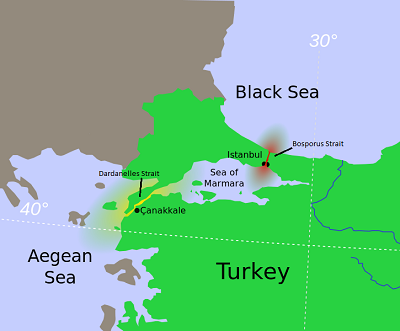
The Turkish Straits (Bosporus Strait in red, Dardanelles Strait in yellow) (via Wikipedia)

The Turkish Straits (Bosporus Strait highlighted in red, and the Dardanelles Strait in yellow) (via Wikipedia)

One of Bismarck’s last diplomatic initiatives was to negotiate the secret Reinsurance Treaty with Russia in 1887, fully in line with the continued emphasis of ensuring that Russia would not ally with France. The terms obligated the two nations to remain neutral in any conflict if the other party was attacked (except if Russia attacked Austria or if Germany attacked France). It also guaranteed German neutrality if Russia took action against the Ottomans, specifically in the Bosporus and the Dardanelles Straits — the two waterways connecting the Sea of Marmara with the Black Sea and the Aegean Sea. It’s clear why the Russians were interested … this was one of their generations-long geopolitical goals, but from the German point of view it ran the risk of provoking a struggle with Britain should it come to light (the treaty did come to public attention in 1896, as the Hamburger Nachrichten published the secret-but-now-expired details, triggering some degree of public alarm (and probably some tightened sphincters in London)).

In a speech to the Reichstag in 1888, Bismarck predicted the bloody outcome if a localized Balkan War were to trigger a continental one (from Emil Ludwig’s 1927 work, Wilhelm Hohenzollern: The last of the Kaisers):

He warned of the imminent possibility that Germany will have to fight on two fronts; he spoke of the desire for peace; then he set forth the Balkan case for war and demonstrates its futility: “Bulgaria, that little country between the Danube and the Balkans, is far from being an object of adequate importance … for which to plunge Europe from Moscow to the Pyrenees, and from the North Sea to Palermo, into a war whose issue no man can foresee. At the end of the conflict we should scarcely know why we had fought.”

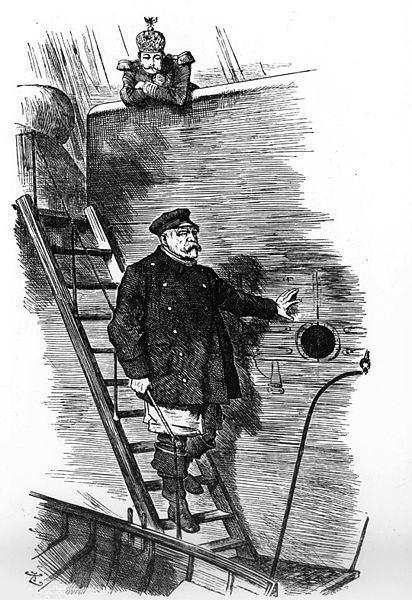
Dropping the Pilot. Caricature by Sir John Tenniel (1820-1914), first published in the British magazine Punch, March 1890. Showing German Emperor Wilhelm II and the leaving Chancellor Otto von Bismarck.

Dropping the Pilot, a caricature by Sir John Tenniel (1820-1914), first published in the British magazine Punch, March 1890. (via Wikipedia)

It is perhaps fortunate for our current world that Bismarck and Wilhelm II could not co-exist, and Wilhelm “dropped the pilot” in 1890. Even in his later years, Bismarck was the best at the diplomatic trade: certainly better than any of the men who followed him. In Bismarck’s absence, the balance of power he had so carefully maintained disintegrated bit by bit.

One of the first critical pieces of diplomatic plumbing to go was the Reinsurance Treaty with Russia: the Russian government asked to renew the agreement, but Chancellor Caprivi (Bismarck’s successor) and Kaiser Wilhelm II thought they could do better by working the personal relationship between Wilhelm and Tsar Alexander III (and later, his “dear cousin Nicky” — Tsar Nicholas II). This worked so well that the French and Russian governments were already extending tentative diplomatic feelers toward one another by 1891.

Willliam L. Langer wrote of the end of Bismarck’s career:

Whatever else may be said of the intricate alliance system evolved by the German Chancellor, it must be admitted that it worked and that it tided Europe over a period of several critical years without a rupture. … there was, as Bismarck himself said, a premium upon the maintenance of peace.

[…]

His had been a great career, beginning with three wars in eight years and ending with a period of 20 years during which he worked for the peace of Europe, despite countless opportunities to embark on further enterprises with more than even chance of success. … No other statesman of his standing had ever before shown the same great moderation and sound political sense of the possible and desirable. … Bismarck at least deserves full credit for having steered European politics through this dangerous transitional period without serious conflict between the great powers.”

The third post in the series and we still haven’t left the nineteenth century! More to follow in the next few days.

July 29, 2014

Who is to blame for the outbreak of World War One? (Part two of a series)

Yesterday, I posted the first part of this series. Today, I’m dragging you a lot further back in time than you probably expected, because it’s difficult to understand why Europe went to war in 1914 without knowing how and why the alliances were created. It’s not immediately clear why the two alliance blocks formed, as the interests of the various nations had converged and diverged several times over the preceding hundred years.

Let me take you back…

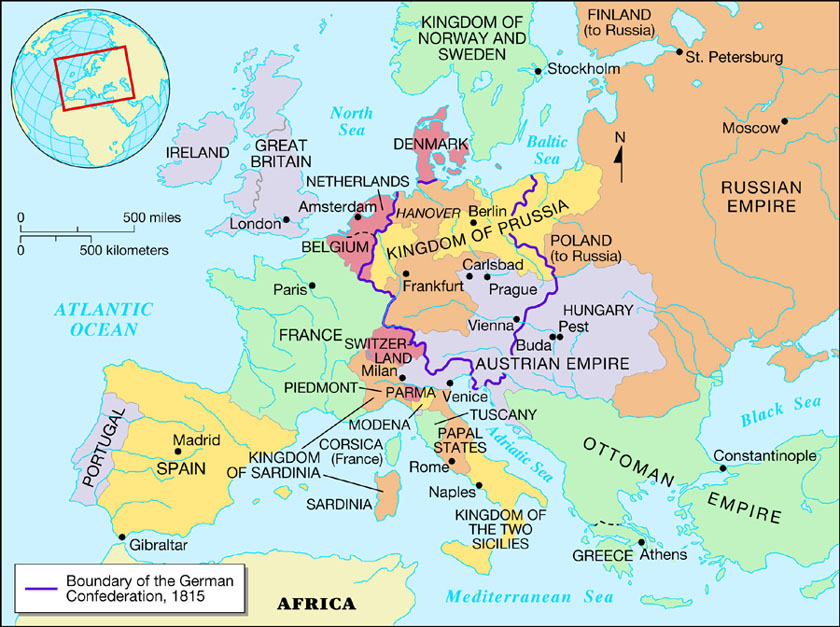
Europe at the end of the Napoleonic Wars (map via amitm.com)

Europe at the end of the Napoleonic Wars (map via amitm.com)

To start sorting out why the great powers of Europe went to war in what looks remarkably like a joint-suicide pact at the distance of a century, you need to go back another century in time. At the end of the Napoleonic wars, the great powers of Europe were Russia, Prussia, Austria, Britain, and (despite the outcome of Waterloo) France. Britain had come out of the war in by far the best economic shape, as the overseas empire was relatively untroubled by conflict with the other European powers (with one exception), and the Royal Navy was the largest and most powerful in the world. France was an economic and demographic disaster area, having lost so many young men to Napoleon’s recruiting sergeants and the bureaucratic demands of the state to subordinate so much of the economy to the support of the armies over more than two decades of war, recovery from war, and preparation for yet more war. In spite of that, France recovered quickly and soon was able to reclaim its “rightful” position as a great power.

Dateline: Vienna, 1814

The closest thing to a supranational organization two hundred years ago was the Concert of Europe (also known as the Congress System), which generally referred to the allied anti-Napoleonic powers. They met in Vienna in 1814 to settle issues arising from the end of Napoleon’s reign (interrupted briefly but dramatically when Napoleon escaped from exile and reclaimed his throne in 1815). It worked well enough, at least from the point of view of the conservative monarchies:

The age of the Concert is sometimes known as the Age of Metternich, due to the influence of the Austrian chancellor’s conservatism and the dominance of Austria within the German Confederation, or as the European Restoration, because of the reactionary efforts of the Congress of Vienna to restore Europe to its state before the French Revolution. It is known in German as the Pentarchie (pentarchy) and in Russian as the Vienna System (Венская система, Venskaya sistema).

The Concert was not a formal body in the sense of the League of Nations or the United Nations with permanent offices and staff, but it provided a framework within which the former anti-Bonapartist allies could work together and eventually included the restored French Bourbon monarchy (itself soon to be replaced by a different monarch, then a brief republic and then by Napoleon III’s Second Empire). Britain after 1818 became a peripheral player in the Concert, only becoming active when issues that directly touched British interests were being considered.

The Concert was weakened significantly by the 1848-49 revolutionary movements across Europe, and its usefulness faded as the interests of the great powers became more focused on national issues and less concerned with maintaining the long-standing balance of power.

The European Revolutions of 1848, known in some countries as the Spring of Nations, Springtime of the Peoples or the Year of Revolution, were a series of political upheavals throughout Europe in 1848. It remains the most widespread revolutionary wave in European history, but within a year, reactionary forces had regained control, and the revolutions collapsed.

[…]

The uprisings were led by shaky ad hoc coalitions of reformers, the middle classes and workers, which did not hold together for long. Tens of thousands of people were killed, and many more forced into exile. The only significant lasting reforms were the abolition of serfdom in Austria and Hungary, the end of absolute monarchy in Denmark, and the definitive end of the Capetian monarchy in France. The revolutions were most important in France, the Netherlands, Germany, Poland, Italy, and the Austrian Empire, but did not reach Russia, Sweden, Great Britain, and most of southern Europe (Spain, Serbia, Greece, Montenegro, Portugal, the Ottoman Empire).

The 1859 unification of Italy created new problems for Austria (not least the encouragement of agitation among ethnic and linguistic minorities within the empire), while the rise of Prussia usurped the traditional place of Austria as the pre-eminent Germanic power (the Austro-Prussian War). The 1870-1 Franco-Prussian War destroyed Napoleon III’s Second Empire and allowed the King of Prussia to become the Emperor (Kaiser) of a unified German state.

Russia’s search for a warm water port

Russia’s not-so-secret desire to capture or control Constantinople and the access from the Black Sea to the Mediterranean was one of the political and military constants of the nineteenth century. The Ottoman Empire was the “sick man of Europe”, and few expected it to last much longer (yet it took a world war to finally topple it). The other great powers, however, were not keen to see Russia expand beyond its already extensive borders, so the Ottomans were propped up where necessary. The unlikely pairing of British and French interests in this regard led to the 1853-6 Crimean War where the two former enemies allied with the Ottomans and the Kingdom of Sardinia to keep the Russians from expanding into Ottoman territory, and to de-militarize the Black Sea.

The Black Sea in 1856 with the territorial adjustments of the Congress of Paris marked (via Wikipedia)

The Black Sea in 1856 with the territorial adjustments of the Congress of Paris marked (via Wikipedia)

Otto von Bismarck talks with the captive Napoleon III after the Battle of Sedan in 1870.

Prussian Chancellor Otto von Bismarck talks with the captive Napoleon III after the Battle of Sedan in 1870.

Russia managed to get revenge on the French for their part in the Crimean War, by striking an agreement with Prussia to stay neutral in any conflict between the Prussians and the French, in exchange for a free hand in the Balkans (or, at least, free from Prussian interference). Bismarck then took the next opportunity to goad the French into declaring war. At the Battle of Sedan, the French army was utterly defeated and Napoleon III himself was captured. When the news of his defeat got to Paris, the Imperial government fell and a new republic was proclaimed.

In the wake of Napoleon III’s fall, France declared that they were no longer willing to oppose the re-introduction of Russian forces on and around the Black Sea. Britain did not feel it could enforce the terms of the 1856 treaty unaided, so Russia happily embarked on building a new Black Sea fleet and reconstructing Sebastopol as a fortified fleet base.

Twenty years after the Crimean War, the Russians found more success against the Ottomans, driving them out of almost all of their remaining European holdings and establishing independent or quasi-independent states including Bulgaria, Serbia, Montenegro, and Romania, with at least some affiliation with the Russians. A British naval squadron was dispatched to ensure the Russians did not capture Constantinople, and the Russians accepted an Ottoman truce offer, followed eventually by the Treaty of San Stefano to end the war. The terms of the treaty were later reworked at the Congress of Berlin.

The campaigns and major battles of the Russo-Turkish War, 1877-78 (via Wikipedia)

The campaigns and major battles of the Russo-Turkish War, 1877-78 (via Wikipedia)

Other territorial changes resulting from the war was the restoration of the regions of Thrace and Macedonia to Ottoman control, the acquisition by Russia of new territories in the Caucasus and on the Romanian border, the Austro-Hungarian occupation of Bosnia, Herzegovina and the Sanjak of Novi Pazar (but not yet annexed to the empire), and British possession of Cyprus. The new states and provinces addressed a few of the ethnic, religious, and linguistic issues, but left many more either no better or worse than before:

An ethnographic map of the Balkans published in Carte Ethnographique de la Turquie d'Europe par A. Synvet, Lith. E Olivier, Constantinople 1877. (via Wikipedia)

An ethnographic map of the Balkans published in Carte Ethnographique de la Turquie d’Europe par A. Synvet, Lith. E Olivier, Constantinople 1877. (via Wikipedia)

The end of the second post and we’re still in the 1870s … more to come over the next few days.

QotD: Austria’s post-1867 parliament

Filed under: Europe, History, Politics, Quotations — Tags: , , , , — Nicholas @ 00:01

Nowhere were the frictions generated by nationalist politics more in evidence than in the Cisleithanian [the non-Hungarian half of Austria-Hungary] parliament, which met from 1883 in a handsome neo-classical building on Vienna’s Ringstrasse. In this 516-seat legislature, the largest in Europe, the familiar spectrum of political ideological diversity was cross-cut by national affiliations producing a panoply of splinter groups and grouplets. Among the thirty-odd parties that held mandates after the 1907 elections, for example, were twenty-eight Czech Agrarians, eighteen Young Czechs (Radical nationalists), seventeen Czech Conservatives, seven Old Czechs (moderate nationalists), two Czech-Progressives (Realist tendency), one ‘wild’ (independent) Czech and nine Czech National Socialists. The Poles, the Germans, the Italians and even the Slovenes and the Ruthenes were similarly divided along ideological lines.

Since there was no official language in Cisleithania (by contrast with the Kingdom of Hungary), there was no single official language of parliamentary procedure. German,Czech, Polish, Ruthenian, Croat, Serbian, Slovenian, Italian, Romanian and Russian were all permitted. But no interpreters were provided, and there was no facility for recording or monitoring the content of the speeches that were not in German, unless the deputy in question himself chose to supply the house with a translated text of his speech. Deputies from even the most insignificant factions could thus block unwelcome initiatives by delivering long speeches in a language that only a handful of their colleagues understood. Whether they were actually addressing the issues raised by the current motion, or simply reciting long poems in their own national idiom, was difficult to ascertain. The Czechs in particular were renowned for the baroque extravagance of their filibustering. The Cisleithanian parliament became a celebrated tourist attraction, especially in winter, when Viennese pleasure-seekers crowded into the heated visitors’ galleries. By contrast with the city’s theatres and opera houses, a Berlin journalist wrily observed, entry to parliamentary sessions was free.*

    * Among those who came to watch the antics of the deputies was the young drifter Adolf Hitler. Between February 1908 and the summer of 1909, when Czech obstructionism was at its height, he was often to be found in the visitors’ gallery. He would later claim that the experience had ‘cured’ him of his youthful admiration for the parliamentary system.

Christopher Clark, The Sleepwalkers: How Europe Went To War In 1914, 2012.

July 28, 2014

Who is to blame for the outbreak of World War One?

Filed under: Britain, Europe, France, Germany, History, Russia, WW1 — Tags: , , , — Nicholas @ 09:47

It’s an easy question to ask, but a very hard one to answer. Traditionally, most people would answer “Germany”, with greater or lesser intensity as the years have passed (for example, here’s Boris Johnson making this particular case). More realistically, you might say Germany, Serbia, Austria, and Russia. Or just Serbia. Or just Russia. Or Britain (according to Niall Ferguson). Or France. Or the inflexible railway timetables for mobilization (Barbara Tuchman and others). Lots of candidates, none of whom can be clearly identified as the prime villain, because you can’t look at the situation in Europe in 1914 as anything other than complexity compounded.

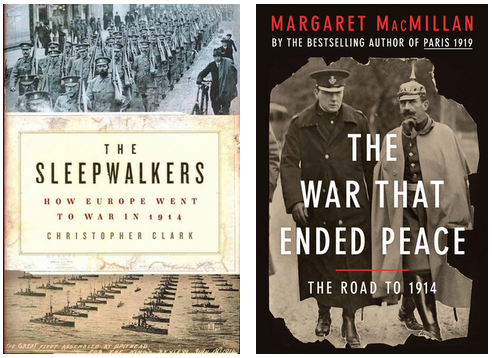
Two recent works (both highly recommended) discuss the origins of the war in great detail and I’ve drawn on them for much of these posts:

The Sleepwalkers by Christopher Clark and The War That Ended Peace by Margaret MacMillan

The Sleepwalkers: How Europe Went to War in 1914 by Christopher Clark and The War That Ended Peace: The Road to 1914 by Margaret MacMillan

There have been so many books written about the origins of the First World War because the origins are many, diverse, interconnected, and hard to weigh against one another in any rational fashion. The assassinations in Sarajevo turned out to be the triggering event, but the war could easily have broken out at any of several other potential flash points in the preceding decade — and even then, war could still have been prevented from breaking out in the summer of 1914. In some ways, it’s surprising that the alternative history folks haven’t been more active in exploring that era: the possibilities are quite fascinating (on second thought, having put this post together, the degree of confusion may account for the novelists wisely avoiding the topic after all).

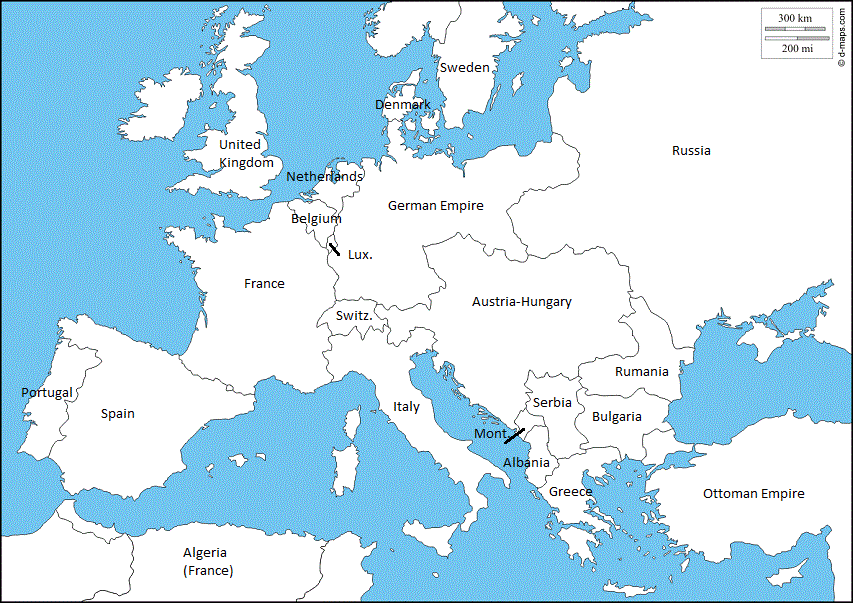
Europe, 1914 (base map by d-maps.com)

Europe, 1914 (base map by d-maps.com)

Although many authors refer to the various monarchs as active participants in the diplomatic and political spheres, this is not always an accurate way to consider their roles. The Tsar enjoyed the equivalent of a presidential veto and could start or stop government activity with a word … but most matters, even high-level military and diplomatic issues, would only come to his attention quite late in the process. This meant the Tsar might want to change his government’s course but because the situation was already well advanced, the costs to do so might well be insurmountable. Tsar Nicholas II was perhaps the worst-equipped of all the leaders of Europe for the task facing him, emotionally and intellectually (and he was aware of his weaknesses). Even Kaiser Wilhelm, who was well-known for his quixotic interference in military and diplomatic matters, was not the sole autocrat of German policy. The chancellor and the foreign secretary could (and did) overrule the Kaiser’s whims on many occasions. On the other hand, King George V was the least directly involved of all the rulers in the actions of his empire, but his public stance may have been somewhat at variance with his private communications with crown ministers (for example, this recent article in the Telegraph claims that the King pushed Sir Edward Grey, the Foreign Secretary, to “find a reason” to declare war on Germany).

A common misconception of the state of Europe in early 1914 was that the preceding century had been a golden age, peaceful and calm (think of all the discussions of the idyllic Edwardian era when contrasted with the chaos and disorder of 1914-1945 and beyond). Europe was only peaceful between 1815 and 1914 by contrast with previous centuries … there were many wars and the map of Europe was redrawn several times in that century. As Christopher Clark wrote:

Though the debate on this subject is now nearly a century old, there is no reason to believe that it has run its course.

But if the debate is old, the subject is still fresh — in fact it is fresher and more relevant now than it was twenty or thirty years ago. The changes in our own world have altered our perspective on the events of 1914. In the 1960s-80s, a kind of period charm accumulated in popular awareness around the events of 1914. It was easy to imagine the disaster of Europe’s ‘last summer’ as an Edwardian costume drama. The effete rituals and gaudy uniforms, the ‘ornamentalism’ of a world still largely organized around hereditary monarchy had a distancing effect on present-day recollection. They seemed to signal that the protagonists were people from another, vanished world. The presumption stealthily asserted itself that if the actors’ hats had gaudy green ostrich feathers on them, then their thoughts and motivations probably did too.

Margaret MacMillan shows how easily the calculations could go so wrong, so easily:

As we try to make sense of the events of the summer of 1914, we must put ourselves in the shoes of those who lived a century ago before we rush to lay blame. We cannot now ask the decision-makers what they were thinking about as they took those steps along that path to destruction, but we can get a pretty good idea from the records of that time and the memoirs written later. One thing that becomes clear is that those who made the choices had very much in mind previous crises and earlier moments when decisions were made or avoided.

Russia’s leaders, for example, had never forgotten or forgiven Austria-Hungary’s annexations of Bosnia and Herzegovina in 1908. Moreover, Russia had failed to back its protégé Serbia when it confronted Austria-Hungary then and again in the Balkan wars in 1912-13. Now Austria-Hungary was threatening to destroy Serbia. What would it mean for Russia and its prestige if it stood by yet again and did nothing? Germany had not fully backed its ally Austria-Hungary in those earlier confrontations; if it did nothing this time, would it lose its only sure ally? The fact that earlier and quite serious crises among the powers, over colonies or in the Balkans, had been settled peacefully added another factor to the calculations of 1914. The threat of war had been used but in the end pressures had been brought to bear by third parties, concessions had been made, and conferences had been summoned, with success, to sort out dangerous issues. Brinksmanship had paid off.

Part one of a series of posts (I’m still digging deeper, so I’m not sure how many parts there will be…)

May 26, 2014

QotD: The “inevitability” of Austro-Hungarian collapse

Filed under: Europe, History, Quotations, WW1 — Tags: , , , — Nicholas @ 07:48

These spectacular symptoms of dysfunctionality might appear to support the view that the Austro-Hungarian Empire was a moribund polity whose disappearance from the political map was merely a matter of time: an argument deployed by hostile contemporaries to suggest that the empire’s efforts to defend its integrity during the last years before the outbreak of war were in some sense illegitimate. In reality, the roots of Austria-Hungary’s political turbulence went less deep than appearances suggested. […]

The Habsburg lands passed during the last pre-war decade through a phase of strong economic growth with a corresponding rise in general prosperity — an important point of contrast with the contemporary Ottoman Empire, but also with another classic collapsing polity, the Soviet Union of the 1980s. Free markets and competition across the empire’s vast customs union stimulated technical progress and the introduction of new products. The sheer size and diversity of the double monarchy meant that new industrial plants benefited from sophisticated networks of cooperating industries underpinned by an effective transport infrastructure and a high-quality service and support sector. The salutary economic effects were particularly evident in the Kingdom of Hungary. In the 1840s. Hungary really had been the larder of the Austrian Empire — 90 per cent of its exports to Austria consisted of agricultural products. But by the years 1909-13, Hungarian industrial exports had risen to 44 per cent, while the constantly growing demand for cheap foodstuffs of the Austro-Bohemian industrial region ensured the Hungarian agricultural sector survived in the best of health, protected by the Habsburg common market from Romanian, Russian and American competition. For the monarchy as a whole, most economic historians agree that the period 1887-1913 saw an ‘industrial revolution’, or a take-off into self-sustaining growth, with the usual indices of expansion: pig-iron consumption increased fourfold between 1881 and 1911, railroad coverage did the same between 1870 and 1900 and infant mortality decreased, while elementary schooling figures surpassed those in Germany, France, Italy and Russia. In the last years before the war, Austria-Hungary and Hungary in particular (with an average annual growth of 4.8 per cent) was one of the fastest growing economies in Europe.

Christopher Clark, The Sleepwalkers: How Europe Went To War In 1914, 2012.

May 17, 2014

QotD: Modern echoes of 1914

Filed under: Europe, History, WW1 — Tags: , , , , — Nicholas @ 00:01

Though the debate on this subject is now nearly a century old, there is no reason to believe that it has run its course.

But if the debate is old, the subject is still fresh — in fact it is fresher and more relevant now than it was twenty or thirty years ago. The changes in our own world have altered our perspective on the events of 1914. In the 1960s-80s, a kind of period charm accumulated in popular awareness around the events of 1914. It was easy to imagine the disaster of Europe’s ‘last summer’ as an Edwardian costume drama. The effete rituals and gaudy uniforms, the ‘ornamentalism’ of a world still largely organized around hereditary monarchy had a distancing effect on present-day recollection. They seemed to signal that the protagonists were people from another, vanished world. The presumption stealthily asserted itself that if the actors’ hats had gaudy green ostrich feathers on them, then their thoughts and motivations probably did too.

And yet what must strike any twenty-first-century reader who follows the course of the summer crisis of 1914 is its raw modernity. It began with a squad of suicide bombers and a cavalcade of automobiles. Behind the outrage at Sarajevo was an avowedly terrorist organization with a cult of sacrifice, death and revenge; but this organization was extra-territorial, without a clear geographical or political location; it was scattered in cells across political borders, it was unaccountable, its links to any sovereign government were oblique, hidden and certainly very difficult to discern from outside the organization. Indeed, one could even say that July 1914 is less remove from us — less illegible — now than it was in the 1980s. Since the end of the Cold War, a system of global bipolar stability has made way for a more complex and unpredictable array of forces, including declining empires and rising powers — a state of affairs that invites comparison with the Europe of 1914. These shifts in perspective prompt us to rethink the story of how war came to Europe. Accepting this challenge does not mean embracing a vulgar presentism that remakes the past to meet the needs of the present but rather acknowledging those features of the past of which our changed vantage point can afford us a clearer view.

Among these is the Balkan context of the war’s inception. Serbia is one of the blind spots in the historiography of the July Crisis. The assassination at Sarajevo is treated in many accounts as a mere pretext, an event with little bearing on the real forces whose interaction brought about the conflict. In an excellent recent account of the outbreak of war in 1914, the authors declare that ‘the killings [at Sarajevo] by themselves caused nothing. It was the use made of this event that brought the nations to war.’ The marginalization of the Serbian and thereby of the larger Balkan dimension of the story began during the July Crisis itself, which opened as a response to the murders at Sarajevo, but later changed gear, entering a geopolitical phase in which Serbia and its actions occupied a subordinate place.

Our moral compass has shifted, too. The fact that Serbian-dominated Yugoslavia emerged as one of the victor states of the war seemed implicitly to vindicate the act of the man who pulled the trigger on 28 June — certainly that was the view of the Yugoslav authorities, who marked the spot where he did so with bronze footprints and a plaque celebrating the assassin’s ‘first steps into Yugoslav freedom’. In an era when the national idea was still full of promise, there was an intuitive sympathy with South Slav nationalism and little affection for the ponderous multinational commonwealth of the Habsburg Empire. The Yugoslav wars of the 1990s have reminded us of the lethality of Balkan nationalism. Since Srebrenica and the siege of Sarajevo, it has become harder to think of Serbia as the mere object or victim of great power politics and easier to conceive of Serbian nationalism as an historical force in its own right. From the perspective of today’s European Union we are inclined to look more sympathetically — or at least less contemptuously — than we used to on the vanished imperial patchwork of Habsburg Austria-Hungary.

Christopher Clark, The Sleepwalkers: How Europe Went To War In 1914, 2012.

April 5, 2014

“They, and they alone, will decide who the Racists are”

Ace on racism and the unofficial deciders on who is a racist and who is not:

Karl Lueger was the mayor of Vienna at the turn of the century, whose populist politics were often riven with anti-semtism — so much so that he was cited as an inspiration by none other than Adolf Hitler in Mein Kampf.

However, there’s a debate about how anti-semitic he actually was, and how much of an anti-semite he pretended to be for the sake of political positioning.

Lueger is famous for an answer he once gave on this issue. He was asked how he squared that fact that many of his policies were anti-semitic, while he counted many Jews among his close friends.

I decide who is a Jew,” he said, apparently creating his own definition of Judaism.

This flexible opinion on “who is a Jew” permitted him to both debase himself (and Vienna) with populist politics of hatred while simultaneously carving out a space for himself to consort with the Hated Other, as he might choose.

Similarly, today, White “liberals” have decided to sell out liberalism to the leftist, totalitarian goons of the Progressive Speech Police. They’ll join the Progressives’ hate campaigns against free speech and free thought — but only when those campaigns are directed towards non-liberals.

Playing to the Progressive mobs just like Luegar played to the Vienna ones, White Liberals reserve themselves the power to both traffic in hateful intolerance, and except themselves and their friends from the claims they otherwise inflict on others.

They, and they alone, will decide who the Racists are.

In the case of the campaign to get Dan Snyder to rename the Washington Redskins (because it’s an offensive, racist epithet), Ace points out that some racist terms are more equal than others:

Obviously no one names a sports club after something they think is substandard, or shoddy, or weak, or useless. People always object to the Redskins name by using the same example — “Well, what would you say if someone named his baseball team the New York N*****s, huh?”

But that’s stupid. No one does that. No one would do that. Because “N****r” is inherently a demeaning term, and a hateful one, and no one — no one — names their sports clubs after things they hate.

They name them after things they respect, or wish to emulate, or wish to associate themselves with. Thus the large number of teams named after great cats, and bears, and stallions, and even the gee-whiz technology of the 50s (jets, rockets).

And as for clubs named after types of people, all those people have a positive association; in football, especially, a martial-themed sport if there ever was one, those positive associations all have to do with virility and deadliness in battle:

Vikings.

Raiders.

Buccaneers.

Warriors.

Fighting Irish.

Spartans.

You do not see “The San Francisco Coolie Laborers” in the lists of any sports teams, nor the “Boston Drunken Irish Wife-Batterers.” All team names are tributes to the group in the nickname.

Some team names implicitly specify a race/ethnicity — Vikings, Fighting Irish. There is no commotion over this — people understand that when someone names a team the “Vikings,” they mean it a positive way. They are speaking of the fury of the Northmen — and not, for example, their propensity to rape and reduce much of Europe to a constant Twilight in which civilization could never advance too far before being pillaged and raped into rubble.

Nor does anyone seriously think “the Fighting Irish” is really about the Irish’s well-known tendency to over-indulge in alcohol and then get their Irish up. (Oh, what a giveaway.) And that one really does actually step right on up to the line of being a slur against the Irish — but we understand the intent behind it is playful, and positive. (Mostly.)

In fact, White Liberals currently on their jihad against the name “Redskins” make an exception for other teams with Indian nicknames — Braves, Chiefs, Indians, all okay. Not racist, the White Liberals have decided, although it’s unclear how they’ve come to this conclusion.

All three names, after all, do reference a specific race — Native Americans — just as surely as “Redskins” does, and for the exact same reasons.

But White Liberals know the difference. White Liberals can tell you who the Racists are.

January 6, 2014

Austria, the “laboratory of the Apocalypse”

Filed under: Europe, History, WW1 — Tags: — Nicholas @ 09:25

Bethany Bell in Vienna writes about Austria just before the start of the war in 1914:

Across the road, a crowd had gathered outside a large, late 19th Century building. I walked over to have a look. It was the Embassy of what was then still Yugoslavia. An official had just pinned to the door two notices about the war that was, at that time, raging in Bosnia. Two men in front of me were talking about the siege of Sarajevo.

I shivered. History suddenly seemed very close.

A few months ago, a Viennese friend frowned as he stirred his coffee. We were sitting in Cafe Griensteidl, in the centre of town.

I’d just told him that, even after 15 years of living here, I’m still haunted by Vienna as it was just before the outbreak of World War One, before the defeat that led to the collapse of the rotting Austro-Hungarian Empire.

“But don’t lots of periods of history feel close in Vienna?” he asked. “You’ve got Mozart and the Baroque, you’ve got the 19th Century and the Ringstrasse, you’ve even got the Flak towers of the World War Two… Why not focus on them?”

I looked around at the cafe with its marble-topped tables and high white ceiling. Among the visitors and tourists, I recognised several senior Austrian civil servants, a couple of foreign diplomats and one of the country’s most distinguished historians.

“It’s partly the idea of cafe society,” I said lightly. “Just think who might have been sitting here back then!”

At the end of the 19th Century, Cafe Griensteidl was at the heart of Vienna’s dazzling intellectual life, patronised by people such as Arnold Schoenberg and Theodore Herzl. Sigmund Freud is thought to have preferred the nearby Cafe Landtmann.

“Ah, you have bought into the romance of fin-de-siecle Vienna!” he exclaimed. “You know that it was encouraged by some of Austria’s leaders after 1945. They wanted people to look back at a period of history they could be proud of — not like World War Two.”

He looked up at the Jugendstil mirror above our table.

“Even this cafe isn’t really genuine,” he said. “The original Griensteidl shut down in 1897 — this place was re-opened in the 1990s.”

“You know better than me that lots of traditions and places have survived,” I replied. “It’s not all fake — just look over there,” and I pointed through the window at the bank opposite. Built by the Modernist architect Adolf Loos, around 1910, the building had caused a scandal because of its severe lack of decoration.

“I think what haunts me is something a bit different,” I said.

“It’s the thought that this exquisite, civilised place didn’t seem to be able to stop its own collapse — and that it unleashed so many destructive ideas and people that tore Europe — and the 20th Century apart.”

The writer Karl Kraus had a phrase for it. In his obituary for Franz Ferdinand, he called Austria the laboratory of the Apocalypse.

My friend smiled wryly. “Ah, yes,” he said, “the Viennese, dancing towards destruction.”

December 23, 2012

Goldbugs, behold the CombiBar

Filed under: Business, Economics, Europe, Germany — Tags: , , , , , — Nicholas @ 10:48

If you’re a big gold fan, you might want to look at the CombiBar, which is a gold wafer that can easily be broken down into one-gram portions:

Private investors in Switzerland, Austria and Germany are lining up to buy gold bars the size of a credit card that can easily be broken into one gram pieces and used as payment in an emergency.

Now Swiss refinery Valcambi, a unit of U.S. mining giant Newmont, wants to bring its “CombiBar” to market in the United States and build up its sales presence India — the world’s largest consumer of gold where the precious metal has long served as a parallel currency.

Investors worried that inflation and financial market turmoil will wipe out the value of their cash have poured money into gold over the past decade. Prices have gained almost 500 percent since 2001 compared to a 12 percent increase in MSCI’s world equity index.

[. . .]

The CombiBar is particularly popular among grandparents who want to give their grandchildren a strip of gold rather than a coin, said Andreas Habluetzel head of the Swiss business of Degussa, a gold trading company.

Other customers buy gold for security reasons.

“Demand is rising every week,” Habluetzel said. “Particularly in Germany, people buying gold fear that the euro will break apart or that banks will run into problems.”

H/T to Tyler Cowen for the link.

August 20, 2010

A different (but not completely wrong) way to view Europe in 1914

Filed under: Britain, Europe, Germany, History, Humour, Russia, WW1 — Tags: , — Nicholas @ 21:33

Jon, my former virtual landlord, sent me this link while I was on vacation (and generally unable to stay connected to the internet for more than minutes at a time). If you’ve already seen this, my apologies for being late:

The First World War, explained as a pub fight…

    Germany, Austria and Italy are stood together in the middle of the pub, when Serbia bumps into Austria, and spills Austria’s pint.

    Austria demands Serbia buy it a complete new suit, because there are splashes on its trouser leg.

    Germany expresses its support for Austria’s point of view

    Britain recommends that everyone calm down a bit.

    Serbia points out that it can’t afford a whole suit, but offers to pay for cleaning Austria’s trousers.

    Russia and Serbia look at Austria.

    Austria asks Serbia who it’s looking at.

    Russia suggests that Austria should leave its little brother alone.

    Austria inquires as to whose army will assist Russia in compelling it to do so.

As Jon pointed out, the key comment is “And when Germany wakes up, it goes out to its car, gets the gun out of the glovebox and heads back inside…”

July 22, 2010

First results from new study around Stonehenge

Filed under: Britain, Europe, History, Science — Tags: , , , — Nicholas @ 07:27

A new study of Stonehenge by the University of Birmingham and Vienna’s Ludwig Boltzmann Institute for Archaeological Prospection and Virtual Archaeology has made its first major discovery:

Archaeologists have discovered a second henge at Stonehenge, described as the most exciting find there in 50 years.

The circular ditch surrounding a smaller circle of deep pits about a metre (3ft) wide has been unearthed at the world-famous site in Wiltshire.

Archaeologists conducting a multi-million pound study believe timber posts were in the pits.

Project leader Professor Vince Gaffney, from the University of Birmingham, said the discovery was “exceptional”.

The new “henge” — which means a circular monument dating to Neolithic and Bronze Ages — is situated about 900m (2,950ft) from the giant stones on Salisbury Plain.

I imagine, given how many times Stonehenge has been mucked about with by earlier enthusiasts, there must be much misleading data has to be sifted and re-sifted before any definite discoveries can be announced. Stonehenge has been fascinating people for centuries and there are probably lots of amateur investigations that may well have made the situation more confusing (think of a sixteenth century equivalent of Indiana Jones or Lara Croft with a nose for treasure).

June 24, 2010

Tempest in a wine glass

Filed under: Europe, Law, Wine — Tags: , — Nicholas @ 09:47

The most recent issue of OntarioWineReview included a snippet from an article originally published in Decanter on the outcome of a legal tussle between Reidel and Eisch over the term “breathable glass”:

Austrian glassmaker Riedel has declared victory in its lawsuit against its rival Eisch Glasskultur over false claims for breathable glass.

Riedel, Nachtmann and Spiegelau filed suit in Munich, Germany alleging that Eisch’s advertisement boasting ‘breathable glass’ constituted false advertising.

On 19 January the two parties agreed to settle after Eisch’s claim that its ‘breathable’ glasses were made using a secret process that ‘opens bouquet and aromas within 2 to 4 minutes’ was not supported in court.

The court ordered Eisch to cease claiming its glass is ‘Breathable’ or ‘Opens bouquet and aromas within 2 to 4 minutes’, or face penalties of up to €250,000, or imprisonment of up to six months for senior directors.

A few years ago, Elizabeth and I bought a set of the Eisch “breathable glass” wineglasses and actually tested them. I doubted the claim, as I couldn’t think of a way that glass could be altered to allow air to pass through that would not also change other characteristics like clarity. Later that evening, we sat down with our friend Brendan and tried to determine if there was any difference between the “breathable” and ordinary glasses.

It may just have been our willingness to believe, but we each thought the wine in the breathable glass was better than the same wine in an ordinary wine glass. That being said, we didn’t think the degree of improvement was enough to justify replacing all our Riedel glasses.

December 6, 2009

Farewell to the Orient Express

Filed under: Economics, Europe, Railways — Tags: — Nicholas @ 00:32

Economic times are hard on non-essential services, and the luxury train called the Orient Express faces cancellation:

Its name evokes images of glamour and mystery and has provided authors including Agatha Christie and Ian Fleming with perfect backgrounds for their tales of intrigue and suspense.

But now the Orient Express is to be cut from Europe’s rail timetables. Next weekend, the service — which runs only between Strasbourg and Vienna — will be scrapped, a victim of high-speed railways and cut-price flights.

“The name the Orient Express will disappear from the official timetables before the year is out, after more than 125 years,” says Mark Smith, the rail expert who runs The Man in Seat Sixty-One website.

Only travellers who can afford lavish private trains — such as the Venice Simplon-Orient-Express and the Danube Express’s Istanbul Odyssey — will be able to enjoy the service’s former glory.

Of course, it’s hard to believe that Vienna qualifed as an “oriental” destination . . .

« Newer Posts

Powered by WordPress