Click to see full-size (very wide) image
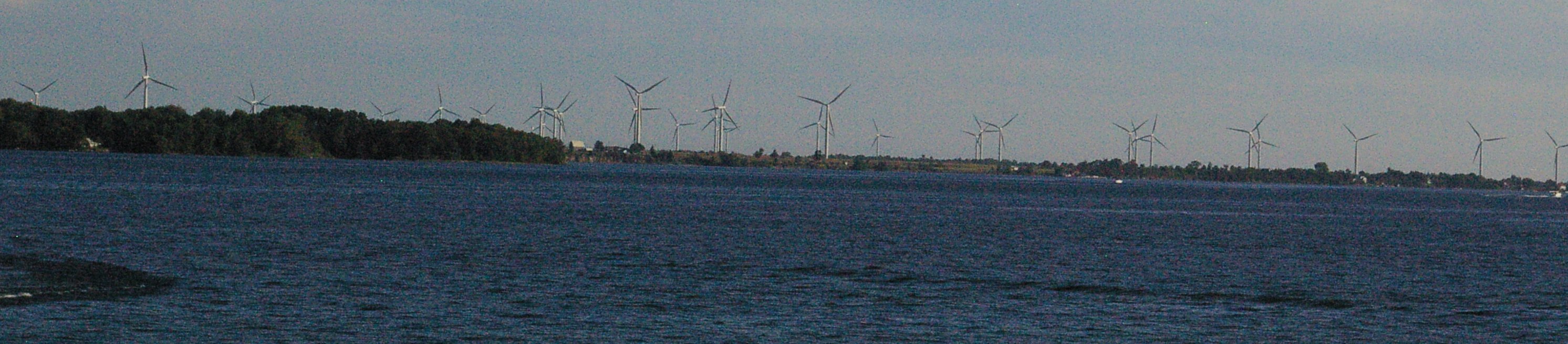
I took this photo from the Wolfe Island ferry on Friday. It amazed me how many wind turbines were in view (32, I think). I kept having images of James Blish’s “spindizzies“.


Click to see full-size (very wide) image
I took this photo from the Wolfe Island ferry on Friday. It amazed me how many wind turbines were in view (32, I think). I kept having images of James Blish’s “spindizzies“.
Unlike Germany, which has announced it will be shutting down its nuclear power plants, Britain is considering a new generation of plants to provide an even greater share of their electricity needs. Even a few green activists are changing their tune:
Also, as much as Greens are enthusiastic about solar electricity, in cloudy countries such as ours it is extremely inefficient and expensive. Nuclear power, on the other hand, is one of the cheapest ways of producing electricity, and it is much safer than many environmentalists would have us believe.
The objection of environmentalists to nuclear power — fears about the dangers of nuclear waste and the cost of decommissioning it — are overblown, which explains why many people don’t like the Greens.
[. . .]
Solving many of the world’s most critical environmental challenges will, in some cases, involve doing the exact opposite of what most environmentalists want.
Rather than retreating into hair-shirt austerity, I believe that, just as technology got us into this mess, technology is vital to get us out of it.
That means embracing some things that will make a lot of Green believers choke on their organic muesli.
It has taken me a long time to reach this conclusion. I used to passionately oppose not only nuclear power but GM crops. I once even threw a pie in the face of a Danish scientist who dared to question the orthodox environmental line. So what changed?
Through research, I found that much of what I believed about environmental issues had little, if any, basis in science. Put simply, though my concerns were right, my solutions were wrong.
It’s always nice to see a reference to Frédéric Bastiat in a modern day setting:
But it is possible to oversell the green jobs theme. Job creation should not be a goal of environmental policy, no more than it should be a policy goal in the fields of health or national security. If, instead of hiring people, we could use magic to stop disease, crime and environmental degradation, we would. Pointing to jobs ‘created’ to fix these problems is an error that Frédéric Bastiat identified in his ‘parable of the broken window’. Broken windows generate work for glaziers, but that doesn’t mean that breaking windows will increase national income.
An often-quoted statistic goes something like this: “wind energy produces 27 per cent more jobs per kilowatt hour than coal plants and 66 per cent more jobs than natural gas plants”. This could well be true, but it is hardly a strong argument in favour of the employment opportunities that would be generated by investing in wind energy: hiring more people to produce less energy is not a strategy for prosperity. Similar gains in employment could be obtained by outlawing mechanical excavators so that all digging must be done by hand. It may make sense to encourage the development of wind power, but increased employment is most emphatically not one of the reasons for doing so.
The petroleum-exporting countries have kept America as a gigantic fish on a steel line for nearly 50 years, reeling it in slowly, and letting it out (relaxing oil prices), when the United States made purposeful noises about raising domestic production, cutting consumption, and going to alternate sources. As soon as OPEC fine-tuned the fishing reel, the great fish went with the docility of the addicted consumer back to its default position mainlining on foreign oil at steadily increasing prices and in ever larger quantities. Every president starting with Richard Nixon warned of the danger in this addiction, but none has done anything useful about it. There must be an emphasis on cheap and plentiful natural gas, more nuclear (with maximum safety standards), more off-shore drilling (with maximum environmental-protection arrangements), and higher gasoline taxes to raise revenues and restrain use. All of this will bring down the international price and reduce the amount of money available for the Iranians, Saudis, Venezuelans, and others to finance terrorism around the world, and will ultimately reduce U.S. defense costs. None of this has been done, though the need for it has been obvious for decades.
Conrad Black, “Why America is suffering”, National Post, 2011-06-11
That’s Rob Lyons and he’s talking about an eco-residence called The Cube:
I think estate agents would refer to it as ‘compact and bijou’. It’s The Cube, the eco-home that’s showing just what sustainable living is all about. It should have been called The Cell.
The tiny house, which was on show at April’s Edinburgh Science Festival and is the brainchild of Dr Mike Page of the University of Hertfordshire, has an internal footprint of just three metres by three metres, yet has all the modern conveniences. There’s a tiny lounge with a flat-panel TV. If you want to dine with a friend, you need to swap half the sofa round with the sliding table. On the next level — reachable by a staircase so tiny that there’s only enough room for one foot at a time — you’ll find the composting toilet, the walk-in shower and the kitchen. (Is that even legal?) From there, you can clamber into the narrow bed, which could only accommodate two people if they both happen to be skinny vegans who don’t suffer from claustrophobia.
Everything is extremely well-insulated, including triple-glazed windows. Heat is provided by a heat-pump attached to the outside wall while electricity is generated through solar panels on the roof. Of course, they won’t work during the night, but you’ll have made so much money flogging electricity to the grid during the day — thanks to the insane prices at which electricity companies are obliged to buy micro-generated power — that you could actually earn £1000 per year.
All this could be yours for £50,000, assuming you’ve got some land to stick it on and you’re prepared to live in such cramped conditions. Considering you could buy a far larger luxury caravan with better facilities for less money (though not so well insulated), you may wonder why you would bother. But Page isn’t really interested in building eco-homes; in fact, he’s a psychologist. What he’s really interested in is why there is no demand for such eco-living, given that we now have lots of technology available to reduce our ‘impact’ — our ‘ecological footprint’.
H/T to Jon for the link.
The assumption was that wind farms would produce 30% of their theoretical maximum over time (the wind doesn’t blow all the time, so no wind farm will ever produce 100% for more than a short period of time). This number now appears to be too optimistic:
A new analysis of wind energy supplied to the UK National Grid in recent years has shown that wind farms produce significantly less electricity than had been thought, and that they cause more problems for the Grid than had been believed.
The report [. . .] was commissioned by conservation charity the John Muir Trust and carried out by consulting engineer Stuart Young. It measured electricity actually metered as being delivered to the National Grid.
[. . .]
In general, then, one should assume that a wind farm will generate no more than 25 per cent of maximum capacity over time (and indeed this seems set to get worse as new super-large turbines come into service). Even over a year this will be up or down by a few per cent, making planning more difficult.
It gets worse, too, as wind power frequently drops to almost nothing. It tends to do this quite often just when demand is at its early-evening peak:
At each of the four highest peak demands of 2010 wind output was low being respectively 4.72%, 5.51%, 2.59% and 2.51% of capacity at peak demand.
And unfortunately the average capacity over time is pulled up significantly by brief windy periods. Wind output is actually below 20 per cent of maximum most of the time; it is below 10 per cent fully one-third of the time. Wind power needs a lot of thermal backup running most of the time to keep the lights on, but it also needs that backup to go away rapidly whenever the wind blows hard, or it won’t deliver even 25 per cent of capacity.
David Nakamura reports on some Washington, DC folks who are feeling ripped off by their local government over solar panel reimbursements that were promised but never delivered:
It isn’t easy going green, and it may also prove costly.
Dozens of District residents who installed solar panels on their homes under a government grant program promoting renewable energy have been told they will not be reimbursed thousands of dollars as promised because the funds were diverted to help close a citywide budget gap.
In all, the city has reneged on a commitment of about $700,000 to 51 residents, according to the D.C. Department of the Environment. The agency has pledged to try to find money in next year’s budget, its director, Christophe Tulou, said.
“It just doesn’t seem fair to go through a process with them and have them make investments in solar panels under the assumption they would be reimbursed,” Tulou acknowledged. “It’s really sad we are having these economic woes when we are.”
H/T to Radley Balko for the link.
If you’re really a fan of alternative energy, you might want to keep an eye on this new development in Brighton:
The six apartment buildings, to be built at the mouth of Shoreham port near Brighton, will be linked by wind turbines, and their southern face will be tiled in solar thermal and photovoltaics panels.
Batteries will be charged during the day in order to keep the lights on at night, and the apartments themselves will be heavily insulated in order to keep power use as low as possible.
But resident behaviour will also play a key role, says the developer, Colin Brace of Bohogreen, who has worked on previous low-carbon projects. “We can’t tell people that you only have so much power, and no more. But there are studies showing that if you give people renewable energy they think, oh good, it’s free, and their energy use actually goes up. So an important aspect of the project will be to educate people about their energy use.
“The apartments will be designed to encourage communal living as much as possible,” says Brace, “rather than having everyone in their own rooms using their own sources of power.” There will also be LED lights on the wind turbines which light up red, amber and green to show which block is using power most heavily, in order to foster “a healthy sense of competition between residents to keep their power use low”.
I wouldn’t want to live in a development where the neighbours are pre-selected for their “greener than thou” attitudes, frankly. The LED lights of shame would probably encourage more neighbour nosiness into the lives of the other residents.
Of course, all that healthy greenery comes at a slight premium to ordinary housing:
The apartments in Portzed will be up to 22% more expensive than an “on-grid” development, due to the extra costs of installing high-spec insulation and renewables. At current market rates, that could add £20-24,000 to the final price of a two-bedroom flat. The developers believe however that there is a high demand for this kind of home due to their rarity. The financing for the project is already in place and the project is expected to be financial viable.
Of all the EU states, the last one you’d expect to give up on wind power would be the one that everyone associates with windmills:
In a radical change of policy, the Netherlands is reducing its targets for renewable energy and slashing the subsidies for wind and solar power. It’s also given the green light for the country’s first new nuclear power plants for almost 40 years.
Why the change? Wind and solar subsidies are too expensive, the Financial Times Deutschland, reports.
Holland thus becomes the first country to abandon the EU-wide target of producing 20 per cent of its domestic power from renewables. This is a remarkable turnaround from a state that took the Kyoto Agreement seriously and chivvied other EU members into adopting renewable energy strategies. The FT reports that instead of the €4bn annual subsidy, it will be slashed to €1.5bn.
I did a quick Google image search for a typical Dutch windmill image, and decided that this one was too amusing to pass up:

Lawrence Solomon savages the Ontario government’s recently announced $87 billion energy plans:
This week, the Ontario government published its Long-Term Energy Plan. Under it, the province and Ontario Hydro’s successors are committing to more uneconomic nuclear power projects and more uneconomic alternative energy generation contracts, but on a far bigger scale than the old Ontario Hydro ever undertook. The grave the government is digging this time is big enough to bury the province as well as the power sector.
Where the four reactors at Darlington cost $14-billion, the new long-range plan calls for $33-billion, more than double the previous price tag, and that’s to build just two new reactors and refurbish 10 old ones, including those at Darlington. That $33-billion estimate is more a wish than a firm projection. Nuclear reactors, notorious for their cost overruns, typically come in at two to three times their original estimates. Darlington, originally estimated at $3.5-billion, came in at four times its estimate. Refurbishments likewise run up the bills, as seen in the two Bruce reactors at Lake Huron. In 2005, the estimate was $2.75-billion. Today, the refurbishment is already three years behind schedule and $2-billion over budget. No one would be surprised to see the $33-billion estimate balloon to $99-billion or more by the time the plan is complete.
Amazingly, the nuclear boondoggle may not represent the biggest blowout. Where the original alternative energy contracts with private power producers cost $6-billion, the new round of alternate energy projects envisaged in the Long-Term Plan cost more like $27-billion — or more like $45-billion once the supporting infrastructure for these alternative projects is factored in. This $45-billion,like the $33-billion estimate for nuclear power, may itself be a gross underestimate, partly because the supporting infrastructure is subject to cost overruns, partly because the bulk of the new alternative energy projects — unreliable wind and solar — are likely to require expensive backups to avoid blackouts.
His suggested solution? Scrap the huge plan, which on past evidence will be far more expensive, slower, and less effective than they predict. The better solution? Privatize the grid. Allow market forces to set electricity rates.
Virginia Postrel highlights the power of glamour even in technical and economic arguments:
When Robert J. Samuelson published a Newsweek column last month arguing that high-speed rail is “a perfect example of wasteful spending masquerading as a respectable social cause,” he cited cost figures and potential ridership to demonstrate that even the rosiest scenarios wouldn’t justify the investment. He made a good, rational case — only to have it completely undermined by the evocative photograph the magazine chose to accompany the article.
The picture showed a sleek train bursting through blurred lines of track and scenery, the embodiment of elegant, effortless speed. It was the kind of image that creates longing, the kind of image a bunch of numbers cannot refute. It was beautiful, manipulative and deeply glamorous.
The same is true of photos of wind turbines adorning ads for everything from Aveda’s beauty products to MIT’s Sloan School of Management. These graceful forms have succeeded the rocket ships and atomic symbols of the 1950s to become the new icons of the technological future. If the island of Wuhu, where games for the Wii console play out, can run on wind power, why can’t the real world?
Policy wonks assume the current rage for wind farms and high-speed rail has something to do with efficiently reducing carbon emissions. So they debate load mismatches and ridership figures. These are worthy discussions and address real questions.
But they miss the emotional point.
I guess it’s a sign of weakness for the economic folks that they don’t realize how much of the battle for public support can rest on non-economic factors. You might be able to win all the technical battles, but it’s often the emotional factors that determine victory overall.
Powered by WordPress