
Quotulatiousness

October 16, 2012

Early Baby Boomers had it much easier than those who followed

Filed under: Cancon, Economics, USA — Tags: , , , , , — Nicholas @ 10:44

Depending on where you draw the demographic line, I’m either a (very) late Baby Boomer or an early arrival from the next generation. I “get” the anger that some younger folks feel about the BB’s, because I came along too late to benefit in the same way that the early boomers did:

But, have baby-boomers really enjoyed a cozy ride through life? The truly lucky were their parents, who worked in the post-Second World War “Golden Age” of low unemployment, rapidly rising real wages, rising house prices, and expanding public and private pension plans.

The postwar boom was petering out by the late 1970s and early 1980s, just as many baby boomers were entering the job market. The 1980s and 1990s were marked by two severe recessions, and by an increase in jobs which often did not provide steady wages or a decent pension.

The unemployment rate for the baby-boomers, then mainly in their early thirties (age 30-34), was more than 10 per cent from 1983 to 1985, and over 8 per cent for the boomers in their late thirties during the recession years of 1992 to 1994.

Many baby-boomers never managed to find the secure and well-paid jobs characteristic of the 1960s and 1970s that lay the basis for a decent retirement. A recent study by former Statscan assistant chief statistician Michael Wolfson found that one-in-four middle-income baby boomers face at least a 25 per cent fall in their standard of living in retirement. (He looked at persons born between 1945 and 1970, and earning between $35,000 and $80,000 per year.)

The proportion of all persons age 65 to 70 who are still working bottomed out at 11 per cent in 2000 and is now 24 per cent, and about one half of persons aged 60 to 65 are still working today.

In my entire career, I’ve worked for only one company that provided a pension plan — and I was laid off before my contributions vested anyway. I don’t expect to ever voluntarily retire: I won’t be able to afford it. And I’m far from alone in that.

October 2, 2012

The Baby Boomers are turning into the New Victorians

Filed under: Liberty, Media, USA — Tags: , , , , — Nicholas @ 13:20

As usual, Gregg Easterbrook manages to squeeze in lots of non-football items into his weekly NFL column:

The entertaining aspect of the fizzled Newt Gingrich presidential campaign was that Gingrich still blames the 1960s for everything. The 1960s were half a century ago. In the year 2012, blaming the 1960s makes about as much sense as someone during the 1960s blaming events on the 1910 appearance of Halley’s Comet.

Since Gingrich put the 1960s into play, note that during that decade the mainstream media advocated what was then called “free love,” and looked down with scorn upon those who backed traditional views of marriage and lovemaking. Yet today when people engage in free love, graying Boomers who run the MSM get all squeamish.

Here, The New York Times treats as shocking that an unmarried yoga instructor had “a penchant for women” and liked “partying and fun.” Man likes women — arrest him! The unmarried instructor faces “accusations of sexual impropriety,” which means “yoga’s enlightened façade” is tainted by “scandal.” And the scandal is what? That unmarried adults are having consensual sex. This “penchant” must be stopped — it can lead to fun.

Worse, yoga can “promote sexual arousal” by causing “emotional closeness” that leads to “increased blood flow” which makes “pelvic regions more sensitive,” resulting in “debauchery.” Who wrote this, Queen Victoria?

All news organizations, including ESPN, sometimes publish ill-thought-through articles. What’s compelling about this one is the sociological change reflected. When they were young, the Baby Boomers who now run big news organizations extolled free love and mocked the older generation’s conventional expectations about sexuality. Now that the Boomers have aged and are not getting any themselves, they evince shock that younger people are fooling around.

September 12, 2012

QotD: Detroit’s golden age

Filed under: History, Quotations, USA — Tags: , , , — Nicholas @ 00:12

It bears repeating that the ’60s — not the ’50s, and certainly not the ’70s — were Detroit’s golden age. The age of tailfins and bulbous deco car bodies was over, and designers went about the business of making the cars look as fast as their increasingly powerful engines actually made them go. The zenith of this is probably the Mustang, but its design aesthetic — less chrome, long lines, agonizing thought put into key details like the grille and the silhouette — dominated the industry, resulting in a decade of cars that look like they want to be driven, not parked (the ’50s) or rolled off cliffs (the ’70s.)

Rick McGinnis, “Fury”, Zero to Sixty, 2012-09-10

July 13, 2012

Wake up kids: it’s your folks that are screwing you over

Filed under: Liberty, Politics, USA — Tags: , , , , , — Nicholas @ 00:28

Nick Gillespie on the many, many ways that the baby boomers are screwing their own kids:

Hey kids, wake up! Stop playing your X-Box while listening to your Facebooks on the iPod and wearing your iPad with the cap turned backwards with the droopy pants and the bikini underwear listening to Snoopy Poopy Poop Dogg and the Enema Man and all that!

Take a break from getting yet another tattoo on your ass bone or your nipples pierced already! And STFU about the 1 Percent vs. the 99 Percent!

You’re not getting screwed by billionaires and plutocrats. You’re getting screwed by Mom and Dad.

Systematically and in all sorts of ways. Old people are doing everything possible to rob you of your money, your future, your dignity, and your freedom.

Here’s the irony, too (in a sort of Alanis Morissette sense): You’re getting hosed by the very same group that 45 years ago was bitching and moaning about “the generation gap” and how their parents just didn’t understand what really mattered in life.

[. . .]

Oddly, back in the actual 1960s, one of the few things that hippies and Barry Goldwater and Ronald Reagan could all agree on was that conscription was a really bad thing. For god’s sake, Richard Nixon created a commission to end the draft. But that was then, and this is now.

And right now, old people are not going gentle into that good night. They know they’re going to need younger people to change their diapers and pay their bills for them, literally and figuratively. As Hillary Clinton put it in 1999, nobody’s going to do that if they have any option not to. Speaking to a National Education Association meeting, she explained one of the great benefits of old-age entitlements was that they meant you didn’t have to live with your goddamn parents.

June 19, 2012

Robert Fulford: 1963-74 was a period where “everything connects in a web of deceit, paranoia and distorted ambition”

Filed under: Government, History, Media, Politics, USA — Tags: , , , , , — Nicholas @ 09:03

An interesting article by Robert Fulford in the National Post, discussing the time between the assassination of John F. Kennedy and the resignation of Richard Nixon. I was too young to pay any attention to politics in those days, and I only started being aware of how weird it was through reading Hunter S. Thompson’s political writings of the time — and I still think it’s a great encapsulation of the bottled insanity of the US political system of that era.

For 11 years, 1963 to 1974, tragedy and shame were the most persistent themes of American politics. That period has never been given a name, but after four decades it feels like a distinct unit in history. From the death of John Kennedy to the resignation of Richard Nixon, everything connects in a web of deceit, paranoia and distorted ambition.

[. . .]

Even after ultimate power fell into Johnson’s hands, it left him squirming in frustration and rage. He was triumphant for a brief moment, pushing through Congress laws that opened society to black Americans. But he felt surrounded by enemies. Although he asked Kennedy’s men to stay on, he never trusted them. When Malvolio leaves the stage he threatens, “I’ll be revenged on the whole pack of you.” That was how Johnson felt about Bobby Kennedy. Caro is especially good on the bitter 15-year struggle that consumed these two men, both smart but both hopelessly lacking in self-awareness.

Johnson’s second downfall, the swiftly increasing Vietnam war, was also America’s tragedy, a fruitless enterprise that cost many lives and wrecked American confidence in Washington. As Caro now says, “Everyone thinks distrust of government started under Nixon. That’s not true. It started under Johnson.” On Vietnam he lied so consistently that Americans ceased to believe anything he said. Journalists spoke euphemistically of his “credibility gap.” Trust in the political class never 
returned.

With Johnson so dishonoured that he couldn’t run for re-election in 1968, Nixon succeeded him. He brought with him a style darker and more paranoid even than Johnson’s. In covering up a break-in by his party’s operatives at the Watergate complex, he revealed that everything said about him by his worst enemies was true.

[. . .]

From beginning to end, Schlesinger despised Nixon. In 1962, when Nixon brought out his self-revealing memoir, Six Crises, demonstrating that his main interest in life was judging how others saw him, Schlesinger wrote in his diary “I do not see how his political career can survive this book.” Schlesinger, while he served power-mad leaders, didn’t understand them. He couldn’t imagine that just six years later, in 1968, Nixon’s furious ambition would make him president and then get him re-elected to a second term, the one he failed to complete because Watergate made him the first American president ever to resign in disgrace, a fate even worse than Johnson’s.

Schlesinger’s book provides an accompaniment to this heartbreaking era of shame. It never fails to remind us that, no matter what theories the historians construct, the course of history is usually shaped by a few frail, frightened and often deeply damaged human beings.

April 18, 2012

Summing up the career of Hunter S. Thompson, graphically

Filed under: Books, History, Media, USA — Tags: , , , , , — Nicholas @ 00:03

At BoingBoing, Mark Frauenfelder reviews Gonzo: A Graphic Biography of Hunter S. Thompson by Will Bingley and Anthony Hope-Smith:

180 pages isn’t much room to examine a life in minute detail. Instead, Bingley tells a story (as if it were written, quite convincingly, by Thompson himself) of Thompson’s frantic search to find meaning in the turbulent era he lived in. Bingley’s story is about a passionate, rebellious genius who sprinted too fast at the beginning of a long-distance race, collapsed early, and spent his remaining decades burnt-out, crawling bewilderedly.

The book’s forward, written by Thompson’s longtime editor, Alan Rinzler, is especially revealing. Rinzler believes that Thompson could have been the “heavyweight champion of American letters,” but his self-destructive behavior, which got worse with each passing year, ruined that opportunity.

[. . .]

After Lono, says Rinzler, “Hunter’s substance abuse, writer’s block and brief attention span were increasing exponentially. He’s slip out to see his dealer and come back so tanked he couldn’t think straight.” Thompson’s work became a series of “repetitious, mediocre, regurgitated articles and books and collections he allowed to be issued and reissued over the last 30 years of his life.”

The Curse of Lono was the last book by Thompson I read, but I don’t doubt Rinzler’s assessment of the quality of Thompson’s books that followed. (Thompson’s awful “Hey Rube!” columns for an ESPN website were enough to keep me uninterested in his newer books). But his earlier work, especially Hell’s Angels, is so good that I will always admire Thompson as a heavyweight contender who showed a very promising start.

I eagerly read much of Thompson’s early work (Fear and Loathing in Las Vegas, Fear and Loathing on the Campaign Trail, The Great Shark Hunt, Hell’s Angels, and The Curse of Lono) in the early-to-mid 80’s, but tapered off soon after that. Several years ago, I picked up a remaindered copy of Hey Rube: Blood Sport, the Bush Doctrine, and the Downward Spiral of Dumbness Modern History from the Sports Desk and it was the literary equivalent of Rome after too many Goth and Vandal sackings: you could still see some great bits and pieces, but everything else had been broken, burned, hacked, and slashed.

February 5, 2012

I didn’t realize the President also inherited the droit de seigneur

Filed under: Books, History, Media, Politics, USA — Tags: , , , — Nicholas @ 11:30

After all this time, I doubt that anyone is particularly surprised by yet another revelation from the “Camelot” days of JFK’s presidency:

She always called him “Mr. President” — not Jack. He refused to kiss her on the lips when they made love. But Mimi Alford, a White House intern from New Jersey, was smitten nonetheless.

She was in the midst of an 18-month affair with the most powerful man in the world, sharing not only John F. Kennedy’s bed but also some of his darkest and most intimate moments.

In her explosive new tell-all, Once Upon a Secret: My Affair with President John F. Kennedy and Its Aftermath, Alford, now a 69-year-old grandmother and retired New York City church administrator, sets the record straight in searingly candid detail. The book, out Wednesday was bought by The Post at a Manhattan bookstore.

December 29, 2011

Alternatives to ordinary houses: former missile silos

Filed under: History, Military, Randomness, USA — Tags: , , , — Nicholas @ 11:16

A former US Air Force missile silo (with a house and other buildings on the land above) was put on the market earlier this month at a low-low price of only $750,000:

Boing Boing has come across a cozy little place that any future super-villain would be happy to call home on Sotheby’s International Realty website. Situated in the scenic Adirondack Mountains of New York, this silo and air park were operational for a short time in 1961. Hundreds of these Atlas F missile silos were built across the U.S. in the 1960’s in anticipation of attacks on the country.

As if the promise of moving into your very own missile silo isn’t tempting enough, Sotheby’s has recently dropped the price from $4.6 million USD to a mere $750,000. Not a bad deal if you’re looking to save money on your lair so you can splurge on that death ray you’ve always wanted.

In addition to the house perched atop the missile, you may also be interested in the adjoining air craft hanger, seven buildings spread out over neighbouring acres of land and an additional log cabin with runway access. To get the whole package, it’ll cost you $1.76 million USD.

The article also linked to this related video:

June 3, 2011

“The Amnesty film … was documentary as corporate hagiography”

Filed under: History, Liberty, Media — Tags: , , , , , — Nicholas @ 09:04

David Bowden reviews Amnesty! When They Are All Free, a BBC documentary on the 50th anniversary of Amnesty International:

The Amnesty film, by contrast, was documentary as corporate hagiography, evading nuance in favour of quick and easy narrative with a facile message: it ain’t easy being righteous.

It was a shame, because the story it told was potentially a fascinating one. Amnesty was born in the first wave of Sixties radicalism, and faced with the realisation that the apparently progressive politics of universal human rights adopted after the Second World War was being hijacked in the interests of Cold War realpolitik. The organisation began as a documentary news organisation, chronicling the disappearances and abuses under repressive regimes around the world. In the spirit of its famous torch image, Amnesty shone a light on human-rights abuses wherever it found them.

Certainly, as a product of the British postwar liberal intelligentsia, much of the organisation’s self-proclaimed apolitical stance smacked of naivety from the off; founder Peter Benenson was quickly forced to fall on his sword after accepting funding from the British government. Yet this overview of its early days was captivating stuff, offering a reminder of the genuine risks posed to its researchers and witnesses as this small organisation routinely found itself on the wrong side of Western and Soviet-backed juntas alike in its pursuit of accurate reporting of the human costs of the broader superpower struggle.

But Amnesty’s interventions were having distressing and unintended side effects — notably, the new tactic of ‘disappearing’ political prisoners before they became international causes célèbres. In the film, this raised interesting questions of journalistic ethics and apolitical campaigning, particularly pertinent in the context of the more cavalier instincts of the Wikileaks era.

Sadly, however, while willing to touch upon some of the uglier aspects of Amnesty’s growth from small, earnest campaign into the international China-baiting behemoth it is today, When They Are All Free tended to sideline difficult questions in favour of its heartwarming narrative. While there was a degree of soul-searching on offer, the problem with critiquing human rights as a political agenda today is that much of it is done by those on the inside. As Alex de Waal once remarked, ‘it is as though the sociological study of the church were undertaken by committed Christians only; criticism would be solely within the context of advancing the faith itself’.

March 2, 2011

Why “Buy American” or “Buy Canadian” campaigns are bad economics

Filed under: Economics, History, Liberty, USA — Tags: , , , , , — Nicholas @ 12:26

Daniel Ikenson takes ABC to task for their misleading propaganda against international trade:

Back in the “golden age” of 1960, when imports were oddities to marvel over in a disdainful way, the per-capita U.S. income was $2,914. In 2009, with imports ubiquitous, per-capita income was $46,411. (Economic Report of the President, 2010, Tables B-1 and B-34). In real, inflation-adjusted terms, even with a U.S. population increase from 181 million to 307 million, per-capita incomes in 2009 were almost triple what they were in 1960 ($42,277 vs. $15,669 in 2005 dollars — ERP, 2010, Tables B-2 and B-34). Oh, if only we could replicate the relative poverty, the limited consumer choices, the inefficient production processes, the massive trade barriers that compelled Americans to buy American, and the uneconomic work rules and wages commanded by once-powerful private sector labor unions. In 1960, before real economic liberalization spawned cultural and social liberalization, Diane Sawyer would never have dreamed of being a network news anchor, if she even dared to entertain the concept of working outside of the home. How can she pine for such an era?

It’s frustrating that so much research refuting the myth of manufacturing decline and supporting the conclusion that U.S. manufacturing is thriving — and is in fact leading the world in terms of value of output — is simply neglected by a media that is more committed to scaring than informing. Today Americans are less likely to find in their homes products manufactured in the United States because U.S. manufacturers have moved on to producing higher value products. American manufacturing isn’t focused on products that consumers find in retail stores, like furniture, hand tools, sporting goods, flatware, draperies, carpeting and clothes. American factories produce more value than any other country’s factories by focusing on producing the highest value products: pharmaceuticals, chemicals, airplanes, sophisticated componentry, technical textiles, and other items often sold directly to other businesses.

I and others have been making these points for several years, as U.S. manufacturing continues to thrive in every metric . . . except employment. Manufacturing employment peaked in 1979 and has been on a downward trajectory ever since. But that is the point that eludes ABC and everyone else who thinks U.S. manufacturing’s best days are in the past. Making more with less is the goal! That’s how an economy grows! The political imperative of “putting people back to work” regardless of the economic value of that work — remember the so-called stimulus? — spits in the face of economics. The fact that Americans are unemployed speaks to a mismatch of skills demanded and skills available, as well as to a business and regulatory environment that dissuades investment and hiring.

February 6, 2011

Lost recording of SuperBowl I turns up

Filed under: Football, Media — Tags: , , , , , — Nicholas @ 10:55

Given the ubiquity of video sites on the web today, it can be hard to believe that major TV networks only started systematically storing tapes of shows in the early 1970s. One of the “holy grail” recordings that historians were looking for was SuperBowl I:

Football fans know what happened in Super Bowl I. The game, which was played on January 15, 1967, was the first showdown between the NFL and AFL champions. It ended with the Green Bay Packers stomping the Kansas City Chiefs, 35-10.

Unless they were one of the 61,946 people at the Los Angeles Memorial Coliseum that day, or one of the fans who watched it live on NBC or CBS, there’s one thing that all football fans have in common: They’ve never actually seen the game.

In a bizarre confluence of events, neither network preserved a tape. All that survived of this broadcast is sideline footage shot by NFL Films and roughly 30 seconds of footage CBS included in a pre-game show for Super Bowl XXV. Somehow, an historic football game that was seen by 26.8 million people had, for all intents and purposes, vanished.

My favourite bit of information from the article is a lovely juxtaposition between the massive popularity (and wall-to-wall TV coverage) of modern SuperBowl games and this:

The recording also includes a shocking sight for a Super Bowl: empty seats. The game didn’t sell out, even with ticket prices that topped out at $12.

December 18, 2010

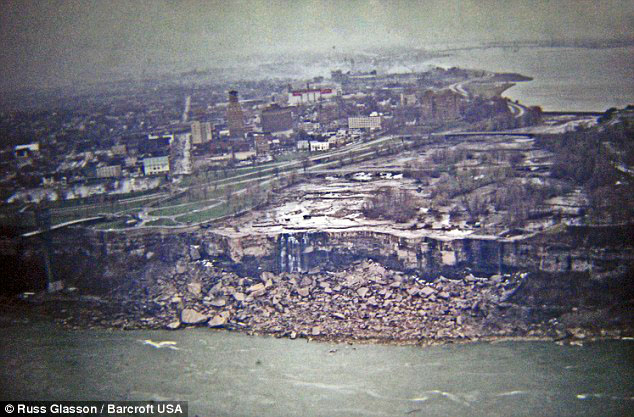
The day the American Falls ran dry

Filed under: Environment, History, USA — Tags: , , — Nicholas @ 13:07

The day Niagara Falls ran dry:

“In June 1969, U.S. engineers diverted the flow of the Niagara River away from the American side of the falls for several months.

“Their plan was to remove the large amount of loose rock from the base of the waterfall, an idea which they eventually abandoned due to expense in November of that year.

[. . .]

To achieve this the army had to build a 600ft dam across the Niagara River, which meant that 60,000 gallons of water that flowed ever second was diverted over the larger Horseshoe Falls which flow entirely on the Canadian side of the border.

“The dam itself consisted of 27,800 tons of rock, and on June 12, 1969, after flowing continuously for over 12,000 years, the American Falls stopped. Over the course of the next six months thousands of visitors flocked to the falls to witness the historic occasion.

I remember seeing this, although as I was nine at the time, I can’t say with certainty that it was in person . . . I might be mistakenly remembering seeing it on TV, although my family visited Niagara Falls frequently during the late 1960s and early 1970s.

September 28, 2010

Most self-indulgent generation now also most suicidal?

Filed under: Britain, Media, USA — Tags: , , , — Nicholas @ 12:06

Baby Boomers. It’s always about the frickin’ Baby Boomers isn’t it? Even if according to demographers I’m supposed to be one of them, while your prototypical Baby Boomer was indulging in free love, drugs, and all the other 60’s behavioural abberrations, I was in primary school. I have never identified with that group, and I’m often struck by how self-regarding members of that demographic can be.

Well, perhaps after a life of unparalleled opportunity, wealth, leisure, and general wallow-in-it-ness, Baby Boomers are starting to retire . . . and also killing themselves in numbers not seen in previous generations:

“As children, the baby boomers were the healthiest cohort that had ever lived, due to the availability of antibiotics and vaccines,” Idler says. “Chronic conditions could be more of a rude awakening for them in midlife than they were for earlier generations.”

Given the contrast between the Boomers’ passage through life and that experienced by their parents, one might suggest that they simply brace up a bit and get on with it. This might, however, be bad news financially for the following generations who are already saddled with the task of paying for the Boomers’ wastrel stewardship of the global finances, prolonged and luxurious retirements, hip replacements and various other costs and expenses.

It may be, as we look back from a more austere future in which the retirement age has been raised to 85 or so and the elderly — far from guzzling pina coladas on cruise ships whilst simultaneously occupying badly-needed residential property — are compulsorily relocated to robot-staffed retirement homes, that we will regard the Boomers as the jammiest generation ever to have lived. Their apparent propensity to top themselves out of drug-addled foolishness, in a tantrum at the “rude awakening” of middle age, or simply like mindless sheep because they have seen others do so, will be all the more puzzling.

September 9, 2010

Ever wonder why Japanese cars didn’t become popular at first

Filed under: Economics, Japan, Technology — Tags: , , — Nicholas @ 00:09

Even with an American ad agency working for them, the market wasn’t ready for this in 1969:

July 23, 2010

Nick Gillespie predicts next season’s key moments in Mad Men

Filed under: History, Liberty, Media — Tags: , , , , — Nicholas @ 22:14

I’m not qualified to judge, as I’ve never watched the show (in spite of the enticement of casting Christina Hendricks in a vital role). How do Nick’s predictions match your expectations for the new season of the show?

My recollections of the era aren’t relevant: I was four years old, and living in another country at the time.

« Newer PostsOlder Posts »

Powered by WordPress

