
mglmedia
Published 28 Feb 2014The Morris Minor is a classic British car which has been given another lease of life by a new generation of young drivers. Join us on a journey from its humble beginnings to its current adventures on British roads with interviews with Mike Barson (Madness) Zac Ware (Charles Ware & The Proclaimers) Martin Wainwright (Author/Journalist) and a host of Morris Minor owners.
November 23, 2022
Morris – A Minor Documentary
Comments Off on Morris – A Minor Documentary
November 13, 2022
Carrying on about the Carry On movies
In The Critic, Alexander Larman looks back at one of the longest-running film series beginning with 1958’s Carry On Sergeant (not to be confused with the earlier — and reputedly terrible — interwar Canadian film of the same name) and continuing with many more until the filmic disaster of Carry On Emmanuelle in 1978 (there was also a 1992 attempt to revive the franchise, which failed):
In Alan Bennett’s The History Boys, it is decreed by the contrarian history master, Irwin, that “if George Orwell had lived, nothing is more certain than that he would have written an essay on the Carry On films”.
We are invited to take Irwin’s instructions that the Carry On films represent a valuable insight into British social history with suitable detachment. (The precise, suitably pompous quote is that “while they have no intrinsic merit, they acquire some of the permanence of art simply by persisting, and acquire an incremental significance if only as social history”.)
Yet Irwin (or Bennett) was almost certainly right that, had Orwell survived into the Sixties and Seventies, he would have found the Carry On film series both repellent and fascinating. It is literature’s, and history’s, loss that we do not have an account of Orwell’s thoughts on the antics of Charles Hawtrey, Kenneth Williams, Barbara Windsor et al.
In 1941, Orwell wrote of postcards by the cheerfully lowbrow artist Donald McGill that “your first impression is one of overpowering vulgarity” and that “what you are really looking at is something as traditional as Greek tragedy, a sort of sub-world of smacked bottoms and scrawny mothers-in-law which is a part of Western European consciousness”. He goes on to say that “jokes barely different from McGill’s could casually be uttered between the murders in Shakespeare’s tragedies”.
[…]
The joy of watching the Carry On films, then, is twofold. On the one hand, the hackneyed stories, two-dimensional characterisation and laboured puns and innuendo can be enjoyable, on a purely basic level, but hardly threaten to aspire to the levels of great art.
Yet on the other, the cheerfully Rabelaisian sentiments of the pictures — in which all men and women are defined purely in sexual and scatological terms — exist on a level of reductio ad absurdum.
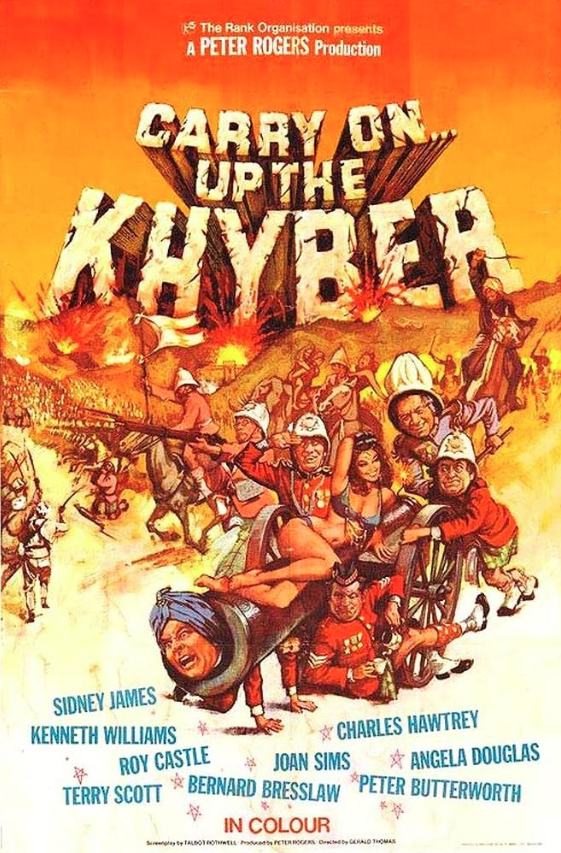
It is no coincidence that the best Carry On films contain a vein of social satire in their mocking of great British institutions, whether it be the NHS, MI5, the army or the Raj, and the final set piece of Carry On Up The Khyber — in which the stiff-upper-lip British occupiers ignore the Afghan invaders while taking formal dinner in black tie — rises to a level of surrealist genius that would have made Buñuel proud.
There is occasional talk of making another Carry On film, but with all the principal cast (save the ever-sprightly Dale) now dead and with the world a very different place, it is impossible to imagine that we will ever see, say, Carry On Tweeting or the like.
There is every possibility that a really top-notch cast could be assembled, if there was any serious intent behind it — I would love to see Andrew Scott, for instance, offer a more dynamic take on the kind of roles that Williams essayed, because he would do so brilliantly, and if the script could be written by the award-winning likes of Patrick Marber or Richard Bean, it could be a thing of innuendo-heavy beauty.
But then the Carry On series never was a thing of beauty. In its grim and hilarious way, it took every British national stereotype, pulled its trousers down, and gave it a hearty slap on its bare buttocks. Some might find this offensive; others might mourn its loss from public life.
In either case, we shall not look upon its like again. Dr Nookey, Francis Bigger, Professor Inigo Tinkle, Vic Flange: your services are no longer required. To which unkind cut we must solemnly say: “Ooh, matron.”
Comments Off on Carrying on about the Carry On movies
October 22, 2022
Two new works on British architecture through the years
In The Critic, James Stevens Curl discusses two recent books on the “monuments and monstrosities” of British architecture:

The most startling achievement of the Victorian period was Britain’s urbanisation. By the 1850s the numbers living in rural parts were fractionally down on those in urban areas. By the end of Victoria’s reign more than 75 per cent of the population were town-dwellers, and a romantic nostalgic longing for a lost rural paradise was fostered by those who denigrated urbanisation. This myth of a lost rural ideal led to phenomena such as garden cities and suburbia. Anti-urbanists and critics of the era detested the one thing that gave the Victorian city its great qualities: they were frightened of and hated the Sublime.
These two books deal with the urban landscape in different ways. Tyack provides a chronological narrative of the history of some British towns and cities spread over two millennia from Roman times to the present day, so his is a very ambitious work. Most towns of modern Britain already existed in some form by 1300, he rightly states, though a few were abandoned, such as Calleva Atrebatum (Silchester) in Hampshire, a haunted place of great and poignant beauty with impressive remains still visible. Most Roman towns were more successful, surviving and developing through the centuries, none more so than London. Tyack describes several in broad, perhaps too broad, terms.
He outlines the creation of dignified civic buildings from the 1830s onwards, reflecting the evolution of local government as power shifted to the growing professional, manufacturing and middle classes: fine town halls, art galleries, museums, libraries, concert halls, educational buildings and the like proliferated, many of supreme architectural importance. Yet the civic public realm has been under almost continuous attack from central government and the often corrupt forces of privatisation for the last half century.
Tyack is far too lenient when considering the unholy alliances between legalised theft masquerading as “comprehensive redevelopment”, local and national government, architects, planners and large construction firms with plentiful supplies of bulging brown envelopes. Perfectly decent buildings, which could have been rehabilitated and updated, were torn down, and whole communities were forcibly uprooted in what was the greatest assault in history on the urban fabric of Britain and the obliteration of the nation’s history and culture.
One of the worst professional crimes ever inflicted on humanity was the application of utopian modernism to the public housing-stock of Britain from the 1950s onwards: this dehumanised communities, spoiled landscapes and ruined lives, yet the architectural establishment remained in total denial. In 1968–72 the Hulme district of Manchester was flattened to make way for a modernist dystopia created by a team of devotees of Corbusianity.
The huge quarter-mile long six-storey deck-access “Crescents” were shabbily named after architects of the Georgian, Regency and early-Victorian periods (Adam, Barry, Kent and Nash). This monstrous, hubristic imposition rapidly became one of the most notoriously dysfunctional housing estates in Europe, a spectacular failure whose problems were all-too-apparent from the very beginning. Yet in The Buildings of England 1969, Manchester was praised for “doing more perhaps than any other city in England … in the field of council housing”. The “Crescents” were recognised quickly as unparalleled disasters and hated by the unfortunates forced to live there. They were demolished in the 1990s, but the creators of that hell were never punished.
Comments Off on Two new works on British architecture through the years
October 7, 2022
Churchill and the Queen
In The Critic, Andrew Roberts outlines the relationship between Prime Minister Winston Churchill and Queen Elizabeth II:
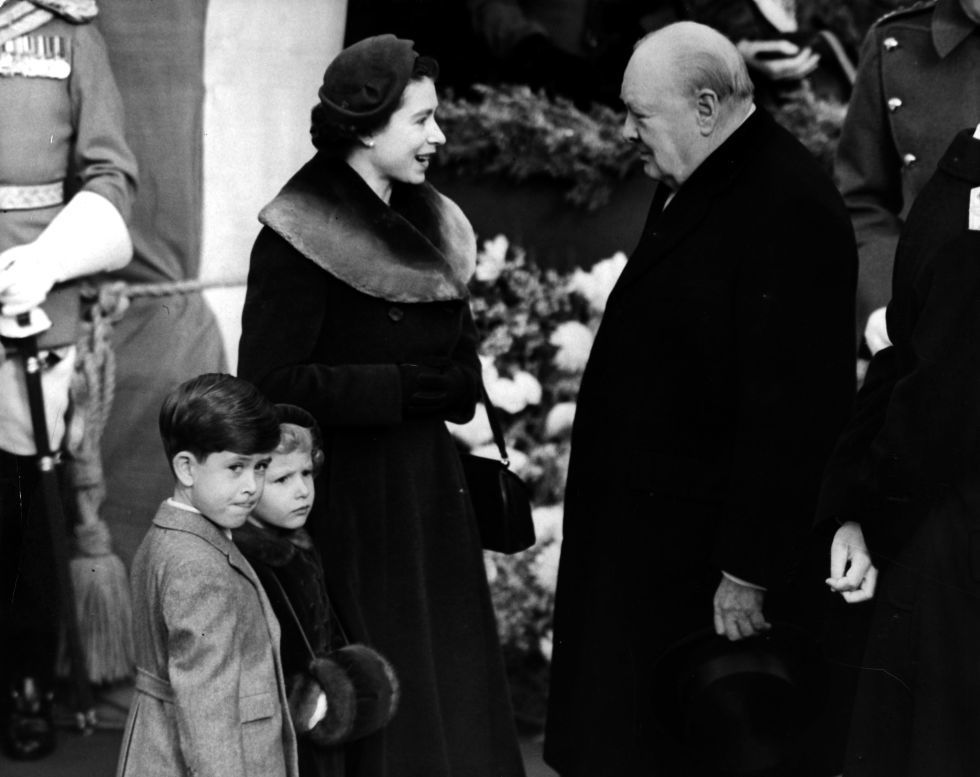
Queen Elizabeth II and Sir Winston Churchill, with Prince Charles and Princess Anne in the foreground, 10 Februrary 1953.
Official photograph via Wikimedia Commons.
Winston Churchill was besotted with Queen Elizabeth II: the word is precise. He worshipped and adored her. His relations with some other members of the royal family were, on occasion, complicated — not least when King Edward VII was sleeping with his mother. But for the late Queen he had nothing but an almost puppy-dog love.
[…]
When King George VI died unexpectedly on 6 February 1952, aged only 56, Churchill was devastated, weeping copiously both on hearing the news and at the funeral. Of the new monarch he told his private secretary, Jock Colville, that “he did not know her and that she was only a child”.
Nonetheless he saw an opportunity of romanticising the country’s situation. “Famous have been the reigns of our queens,” he said in his BBC broadcast on the King’s death. “Some of the greatest periods in our history have unfolded under their sceptre. Now that we have the second Queen Elizabeth, also ascending the Throne in her twenty-sixth year, our thoughts are carried back nearly 400 years to the magnificent figure who presided over and, in many ways, embodied and inspired the grandeur and genius of the Elizabethan Age.”
Although she was his sixth sovereign, Churchill was the new Queen’s first prime minister and old enough to be her grandfather. For all the 51-year age difference — or perhaps because of it — Churchill quickly grew devoted to her. “There was one lady by whom, from 1952 onward, Churchill was dazzled,” noted Colville. “That was the new Queen. Here was a woman whom he respected and admired more than any man.”
[…]
On 24 January 1965, 70 years to the day after the death of his father Lord Randolph Churchill, Sir Winston died. The Queen waived all custom and precedent to attend his funeral at St Paul’s Cathedral. She added a message in her own handwriting to the wreath of white flowers that was placed upon his coffin: “From the Nation and the Commonwealth. In grateful remembrance, Elizabeth R.” It echoed that which Churchill had placed on her father’s coffin, simply saying “For Valour”, the motto of the Victoria Cross, and a reference to the late king’s moral and physical courage during the Second World War, and perhaps also at the battle of Jutland in 1916.
[…]
The Queen decided Churchill should have a State funeral following his stroke in 1953. Once he had recovered, she told him so. The plans had to be rewritten several times over the next 12 years because, as Lord Mountbatten joked, Churchill kept on living but the pallbearers kept on dying.
There is a powerful symmetry to the friendship of monarch and premier that the next State funeral after Churchill’s was to be the Queen’s own, a full 57 years later.
Comments Off on Churchill and the Queen
September 10, 2022
The Land Rover Defender Story
Big Car
Published 27 Dec 2019The Land Rover is Britain’s bullet-proof off-roader born out of Rover’s post-war desperation and became the indispensable go-anywhere vehicle. Like its famed bullet-proof ruggedness, Land Rover production kept going, and going, and going. But with a brief gap of 4 years, the Land Rover is still with us and looks like it’s not going away any time soon.
(more…)
Comments Off on The Land Rover Defender Story
September 8, 2022
Chinese Type 56 AK-47 (Shooting and History)
Forgotten Weapons
Published 23 Sep 2016One of the most common types of AK rifle in existence today is the Chinese Type 56 in its several variations, although very few of those rifles are in the United States in authentic full-auto form. This particular one was captured by a US soldier in the Vietnam War, who brought it back and registered it, making it a fully transferrable gun.
The Chinese received the technical package for the AK (and also the SKS, among other weapons) from the Soviet Union in the 1950s, as part of the USSR’s policy of providing military and technical aid to other nations sympathetic to the Communist cause (although a rift would grow between the USSR and China later). China would manufacture tens of millions of AK rifles, both of this milled receiver type (the Type 3 style) and the later stamped AKM pattern. The standard fixed-stock rifles like this one were fitted with under-folding spike bayonets. Folding stocked types were also made, both underfolding (Type 56-1) and side folding (Type 56-2). These weapons have become extremely prolific, and can be found in virtually any significant international conflict zone to this day.
(more…)
Comments Off on Chinese Type 56 AK-47 (Shooting and History)
August 26, 2022
Winchester Proto-M14 Rifle
Forgotten Weapons
Published 30 Dec 2016In the aftermath of World War II, the United States spent 12 years looking for a successor to the M1 Garand rifle. The new standard infantry arm was expected to be select-fire, lightweight, accurate, controllable, and fire a heavy .30-caliber projectile. It would replace not just the M1, but also the BAR and perhaps the M1 Carbine as well — a true universal weapon. Of course, these requirements were complete fantasy, unachievable in the real world — but that did not prevent Remington, Springfield Arsenal, and Winchester from trying to meet them.
This rifle is a Winchester prototype, which has been substantially lightened from the M1 it began life as. A pistol grip has been added, along with a fire selector lever and a box magazine system. A detachable lightweight bipod allows it to be used for supporting fire. I do not know exactly when it was made, but it is chambered for the T65 or 7.62 NATO cartridge, which dates it as definitely post-WWII.
(more…)
Comments Off on Winchester Proto-M14 Rifle
August 5, 2022
Don Camillo blesses the river Po
Perhaps the first foreign author I encountered as a child was Giovanni Guareschi — in English translation, of course, I’m not a natural linguist — and I’d read most of his stories by the time I was twelve. They didn’t always make a lot of sense to me as far as the political aspects were concerned, but the human stories always hit home. Clearly, Sarah Hoyt (who is a natural linguist … she read them in the original Italian, although I’d expect they would work very well for Portuguese readers) feels much the same way about the Don Camillo stories:
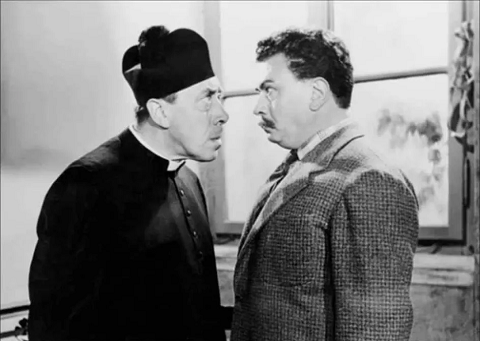
A still from one of the 1952-1965 film adaptations of the Don Camillo stories, with Fernandel as Don Camillo and Gino Cervi as Mayor Peppone.
There is a poignant scene in one of the Giovanni Guareschi Don Camillo books, (set in mid-century Italy, where communism and Catholicism are fighting it back and forth. They’re humorous, profoundly human, and easy reads. The stories are like 200 words each.) in which, during a period of high strife, the priest goes out to bless the river. Btw, if you need examples of how to be a flea on the side of the commies, that character is terribly subversive in little ways (as well as liking to hit them on the head. I might have taken him for a model when I was a pre-teen. Sigh. And Comrade Don Camillo is the best book for how to turn things on their heads if you’re in deep hiding in a lefty stronghold, either professional or geographic.)
Anyway, in the little village on the Po river where the priest and the communist mayor fight it out, the river is an ever present danger, and people cope with it the way they have coped with such things throughout history: every year the priest goes to the river and blesses it, in the hopes that it will become (I am remembering in Italian, the English translation is probably different) “A well behaved citizen and stay within its bounds”.
Now, this is not magic, of course, and the priest explains that. Blessing the river does not guarantee that the river won’t burst out of its bed and flood the village (later on in the book there are accounts of a flood, and if you think that a book can’t paint a picture, be sure it can. For the rest of my life, I’ll carry the image of the priest saying mass in the deserted and flooded village, while across the river, on the safe bank, his flock who fled the flood kneel on the muddy soil at the tolling of the consecration bell. BTW Guareschi is the writer I’d like to be when I grow up. Trained as a journalist, he uses minimal words, but the images stay with you.) It’s just that blessing it gives people hope it won’t, and allows them to live in a precarious place, at a precarious time without losing their minds. (It is important to remember that whatever else humans are, they’re creatures of ritual and habit, and sometimes those are the only panaceas for difficult situations.)
Well, the communists have their dander up, so they tell the priest they want to march in the procession to bless the river with their flags and paraphernalia and the priest says no, they say anyone in the procession will get beaten. They demand the priest cancel it, and people lose their minds. So, the priest says he’ll go alone, if needed. Needless to say, the communists follow, in what is an intimidation maneuver (they have no new moves, really.)
So, Don Camillo, without looking back, gets to the river and prays that the Lord will keep the river within its bounds. And of course, because he knows the audience at his back, he says “If the houses of decent people could float, I’d ask you for a flood like Noah’s. But since the houses of decent people are made of the same stone and brick and sink like the houses of scoundrels, I beg you to make the river behave.”
In case you’re wondering what went wrong in America, and why we are where we are: we forgot our houses can’t flood.
Comments Off on Don Camillo blesses the river Po
July 31, 2022
Milton Mayer’s They Thought They Were Free
Joshua Styles on a book written after the Second World War that appears to have renewed relevance today:
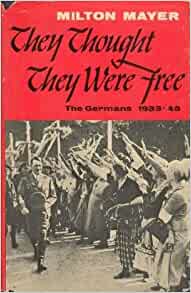
“I came back home a little afraid for my country, afraid of what it might want, and get, and like, under pressure of combined reality and illusion. I felt — and feel — that it was not German man that I had met, but Man. He happened to be in Germany under certain conditions. He might, under certain conditions, be I.” — Milton Mayer, They Thought They Were Free, ix.
It’s been more than seventy-five years since the Nazis were defeated and Auschwitz was liberated. Seventy-five years is a long time — so long, in fact, that while many still learn of the horrors of the Holocaust, far fewer understand how the murder of the Jews happened. How were millions of people systematically exterminated in an advanced Western nation — a constitutional republic? How did such respectable and intelligent citizens become complicit in the murder of their countrymen? These are the questions Milton Mayer sought to answer in his book They Thought They Were Free.
In 1952, Mayer moved his family to a small German town to live among ten ordinary men, hoping to understand not only how the Nazis came to power but how ordinary Germans — ordinary people — became unwitting participants in one of history’s greatest genocides. The men Mayer lived among came from all walks of life: a tailor, a cabinetmaker, a bill-collector, a salesman, a student, a teacher, a bank clerk, a baker, a soldier, and a police officer.
Significantly, Mayer did not simply conduct formal interviews in order to “study” these men; rather, Mayer had dinner in these men’s homes, befriended their families, and lived as one of them for nearly a year. His own children went to the same school as their children. And by the end of his time in Germany, Mayer could genuinely call them friends. They Thought They Were Free is Mayer’s account of their stories, and the title of the book is his thesis. Mayer explains:
“Only one of my ten Nazi friends saw Nazism as we — you and I — saw it in any respect. This was Hildebrandt, the teacher. And even he then believed, and still believes, in part of its program and practice, ‘the democratic part’. The other nine, decent, hard-working, ordinarily intelligent and honest men, did not know before 1933 that Nazism was evil. They did not know between 1933 and 1945 that it was evil. And they do not know it now. None of them ever knew, or now knows, Nazism as we knew and know it; and they lived under it, served it, and, indeed, made it” (47).
Until reading this book, I thought of what happened in Germany with a bit of arrogance. How could they not know Nazism was evil? And how could they see what was happening and not speak out? Cowards. All of them. But as I read Mayer’s book, I felt a knot in my stomach, a growing fear that what happened in Germany was not a result of some defect in the German people of this era.
The men and women of Germany in the 1930s and 40s were not unlike Americans in the 2010s and 20s — or the people of any nation at any time throughout history. They are human, just as we are human. And as humans, we have a great tendency to harshly judge the evils of other societies but fail to recognize our own moral failures — failures that have been on full display the past two years during the covid panic.
Mayer’s book is frighteningly prescient; reading his words is like staring into our own souls. The following paragraphs will show just how similar the world’s response to covid has been to the German response to the “threat” of the Jews. If we can truly understand the parallels between our response to covid and the situation in Hitler’s Germany, if we can see what lies at the end of “two weeks to flatten the curve”, perhaps we can prevent the greatest atrocities from being fully realized in our own day. But to stop our bent toward tyranny, we must first be willing to grapple with the darkest parts of our nature, including our tendency to dehumanize others and to treat our neighbors as enemies.
Comments Off on Milton Mayer’s They Thought They Were Free
July 29, 2022
Nightmare Fuel For Soviet Submarines; the story of the Canadair CP-107 Argus
Polyus Studios
Published 4 Dec 2020Don’t forget to like the video and subscribe to my channel!
Support me on Patreon – https://www.patreon.com/polyusstudiosIn its day the Argus was the most formidable anti-submarine warfare platform fielded by any NATO country. Canadair adapted the Bristol Britannia into a highly effective low and slow sub hunter. This gave Maritime Air Command the edge in the North Atlantic. It served on the front-line of the Cold War and kept the Soviet submarine threat in check for almost 25 years.
(more…)
Comments Off on Nightmare Fuel For Soviet Submarines; the story of the Canadair CP-107 Argus
July 11, 2022
British Transport Films: Elizabethan Express (1954)
mikeknell
Published 6 May 2014This 1954 documentary is uploaded in a couple of places, but here it is without breaks and in the correct aspect ratio. One of the classic railway films.

Comments Off on British Transport Films: Elizabethan Express (1954)
May 10, 2022
How did Jim Jones persuade hundreds of people to commit suicide at his command?
Chris Bray has more disturbing details drawn from Tim Reiterman’s history/biography of Reverend Jim Jones and the Peoples Temple, Raven:
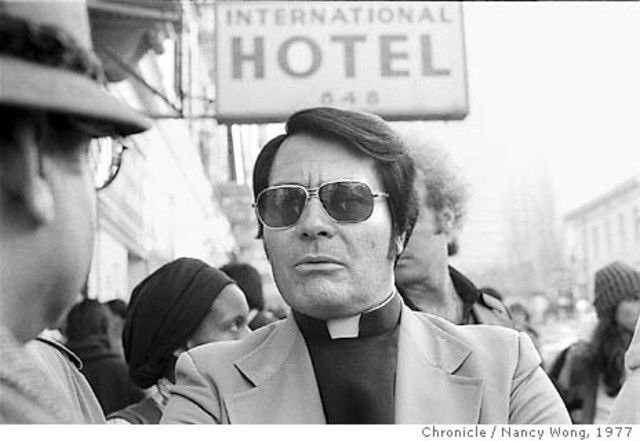
Reverend Jim Jones in front of the International Hotel in San Francisco’s Chinatown on Kearny & Jackson Streets during a rally to save the hotel.
San Francisco Chronicle photo by Nancy Wong, 1977 via Wikimedia Commons.
He broke families, he taught fear, he isolated people, he shamed and demeaned people to break their spirit, he made people dependent, he ran obedience tests with deliberate sadism to see who would take it. That’s it. Those are the tools. Again, all of this comes from Tim Reiterman’s book Raven, which I encourage you to read.
When Jonestown shows up in news stories, Peoples Temple is usually described as a 1970s-era Bay Area cult that moved to Guyana. But that’s not where Jim Jones started the church — he began in Indianapolis in the 1950s. In a moment when there were mostly black churches and white churches, Jones insisted on building a racially integrated congregation. Then he warned them, with increasing urgency, that the church would be attacked by white supremacists who were outraged by their social progress; a flood of menacing phone calls and threatening letters backed up the point. One night, as members of the church visited Jones at home, he stepped into his bedroom alone — just as a brick crashed through the window. The visitors rushed into the bedroom, where Jones told them that the white supremacists had just attacked his house. (Miraculously, the brick and the broken glass had landed outside the window.)
Over the years, the threats built to a crescendo — look, another terrifying letter! — and Jones warned his congregation that the white supremacist threat was moving toward its culmination. At the same time, he began to receive visions about the other great threat hanging over the world: nuclear war. It’s coming, he told them, over and over again, sometimes even naming likely dates for the attack.
Finally, under the increasingly terrifying dual threat of death from local attack or death from Soviet missiles, either of which could happen at any moment, Jones sent an advance party across the country to find a place where his people could survive — and then, with a secure haven located, he led his congregation to safety in a remote area of Northern California. Good thing they made it out, right?
For a congregation of Midwesterners, the journey to California meant a departure from parents, siblings, and adult children; for many, it meant a departure from their birthplace and every social connection they had made outside the church. It put them in the woods a couple thousand miles from their families, in isolation together in a new place.
Then, with church members living in church-built homes on a church-owned property, Jones helped them to see that selfishness was cruel and atavistic. People who loved, who were spiritual, shared together. So what kind of self-involved monster kept a husband or a wife trapped in a limiting one-on-one relationship? Liberating the members of his church, he helped them to start having sex with other church members outside of their marriages. In some instances, particularly close couples with especially stable relationships — like the church attorney Tim Stoen and his wife, Grace — forced Jones to issue direct orders telling them who else they would be having sex with. And yes, it did liberate them from the confinement of their close marriage, quickly and decisively.
Jones also helped by having sex with everybody, teaching them how to become free. One night, Jones had a heart attack — another maneuver he used all the time — in the presence of a church member named Larry Layton; as Layton rushed to help, Jones explained that he needed to fuck Layton’s wife, and had already started, and had brought her to orgasm “no fewer than sixteen or seventeen times” during their first encounter. But no worries, because Jones also assigned another church member, Karen Tow, to have sex with Layton to assuage his pain. After the divorce, Layton and Tow got married — but Tow let Layton know that she still preferred to have sex with Jones. See how liberating this is?

Comments Off on How did Jim Jones persuade hundreds of people to commit suicide at his command?
April 30, 2022
Tank Chats #145 Conqueror | The Tank Museum
The Tank Museum
Published 14 Jan 2022► JOIN OUR PATREON: Our Patreons have already enjoyed Early Access and AD free viewing of our weekly YouTube video! Consider becoming a Patreon Supporter today: https://www.patreon.com/tankmuseum
► TIMESTAMP:
00:00 – INTRO
00:28 – FEATURES
(more…)
Comments Off on Tank Chats #145 Conqueror | The Tank Museum
April 21, 2022
L8(T) Enfield: The British Army Fails to Make a Sniper
Forgotten Weapons
Published 14 Dec 2021http://www.patreon.com/ForgottenWeapons
https://www.floatplane.com/channel/Fo…
Cool Forgotten Weapons merch! http://shop.forgottenweapons.com
We looked at the 7.62mm conversion of the No4 Enfield into Rifle L8 yesterday. Part of that program was an attempt to develop a new sniper rifle on the L8 platform. To this end, six good-quality No4(T) Lee Enfield sniper rifles were tested for accuracy, then made into L8 rifles and fitted with No.32 telescopic sights (the standard scope from the .303 days) and tested for accuracy again. Much to the chagrin of the Army, the new L8(T) rifles were barely able to match the performance of the .303 rifles they began as. The goal was to significantly improve on the No4(T) accuracy, and that was clearly not happening.
However, at this same time, British civilian competition shooters were having excellent success making 7.62mm versions of the No4. It was only when Enfield was willing to collaborate with the British NRA and others that they were able to successfully create the L42A1 rifle, which at last met the accuracy goals of the program.
The rifle we are looking at today is one of those original six trials L8(T) rifles. Many thanks to the generous collector who allowed me to film it for you!
Contact:
Forgotten Weapons
6281 N. Oracle 36270
Tucson, AZ 85740

Comments Off on L8(T) Enfield: The British Army Fails to Make a Sniper
March 27, 2022
QotD: Period culture in old movies and TV shows
From the vantage point of the 1970’s, “old” TV shows were mostly things from the 1960’s, but old movies from the 40’s and 50’s were common too. In other words, if you wanted to peek back in time to the previous eras of American culture, you could reliably go back a decade and selectively go back a few decades. Bad old TV shows like Get Smart and Star Trek would go into syndication, but bad old movies were just forgotten. The old movies that were shown on TV were usually the good ones that people liked.
What that meant is if you wanted to know what it was like to live in 1945, you had to ask someone who was alive in 1945. You could get a little taste of it from watching old movies on a Saturday afternoon, but that was a stylized version. To really get a feel for the age before color movies and television, you had to rely on the fading memories of grandma and grandpa. Of course, this was true for all of human history until recent. It’s why old people are good at telling stories about the old days. They’re built for it.
Today it is different. I watched The Thomas Crown Affair the other night off the Kodi machine. This was the 1968 version with Faye Dunaway and Steve McQueen. There was a remake of this in 1999 with Pierce Bronson. I had seen the remake a few times, but I never saw the original. In fact, I did not know there was an original. That’s a bit of interesting cultural data right there. Just about every movie produced over the last twenty-five years is either a remake or made from a children’s comic book.
What I found remarkable about the movie is something I notice whenever I watch old movies and that is the maturity. A movie about the cat and mouse between a male and female today will have at least half an hour of rutting and humping, along with some explosions and lots of vulgar language. The modern presentation of male-female relations is so crude, that porn makers of the past would have been offended. In the old days, the film maker and audience expected a more sophisticated portrayal of sexual relations.
That is the other thing that turns up in old movies and television. Hollywood made assumptions about the cultural awareness of the audience we don’t see now. In The Thomas Crown Affair, there is a long scene around a chess game. It was supposed to be a stand in for the sexual tension between McQueen and Dunaway. It’s a bit ham-handed, but vastly more sophisticated than anything you would see today. One reason is the typical viewer today knows nothing about chess, so it would be lost on them.
Part of that is due to Hollywood relying on international audiences to make money. You can’t expect to make money in China or India when your film is full of essential references to Anglo-Saxon cultural items. When you make films for the universal culture, you are making movies for a culture that does not exist. That means the goal is to remove cultural references, rather than rely on them to tell a story. There can be no subtlety and nuance without common cultural reference points understood by the audience.
The Z Man, “Old Movies”, The Z Blog, 2019-02-13.
Comments Off on QotD: Period culture in old movies and TV shows


