
Polyus Studios
Published 7 Jul 2020Full documentary is still in development, enjoy the teaser!
(more…)
March 25, 2022
Avro Canada CF-105 Arrow; Footage from its first flight
Comments Off on Avro Canada CF-105 Arrow; Footage from its first flight
March 24, 2022
The French MAS-38 Submachine Gun
Forgotten Weapons
Published 4 May 2017The MAS-38 was France’s first officially adopted submachine gun, rushed into service in 1940. It was basically too late to help with the defense of France, with less than a thousand delivered by June 1940. The Germans kept the gun in production, making 20-30 thousand under the designation MP722(f). French production picked up immediately after the war, and 203,000 were made by the end of 1951. The gun would see service mostly in Indochina.
Mechanically, the MAS 38 is a simple blowback SMG, although it has a few unusual features. One is the approximately 6 degree angle between the barrel and receiver, which was done in order to drop the stock and allow a sight picture with shorter iron sights. As a result, the bolt face is also cut at about a 6 degree angle off perpendicular. The safety is the trigger itself, which folds up and forward to engage, locking the bolt in place. The weapon is chambered for the 7.65 French Long cartridge, which was also used in the 1935A and 1935S pistols. It is lighter than most other military submachine gun rounds, roughly on par with 9x18mm Makarov. That reduced ballistic peer does make for a very comfortable and controllable weapon, however.
http://www.patreon.com/ForgottenWeapons
Cool Forgotten Weapons merch! http://shop.bbtv.com/collections/forg…
If you enjoy Forgotten Weapons, check out its sister channel, InRangeTV! http://www.youtube.com/InRangeTVShow

Comments Off on The French MAS-38 Submachine Gun
March 2, 2022
The Passenger Train, 1954
travelfilmarchive
Published 12 Nov 2008An educational film about train travel in the 1950s. To purchase a clean DVD or digital download of this film for personal home use or educational use contact us at questions@archivefarms.com. To license footage from this film for commercial use visit: www.travelfilmarchive.com

Comments Off on The Passenger Train, 1954
February 23, 2022
Peter Cushing (1956)
British Pathé
Published 14 Apr 2013Kensington, London.
M/S of actor Peter Cushing sitting at his desk looking at papers in his hand. He takes a model toy soldier on a horse and compares it with its drawing. He puts it back and takes another toy soldier. C/U of his hand painting a white belt on the little soldier’s uniform. C/U on his eyes as he works — he must have a good eyesight to do this!
Peter Cushing, enthusiastic member of Model Soldier Society, collects, makes and plays with toy soldiers from all periods of military history. He plays with his toys in accordance to the rules laid down by H.G. Wells in his book Little Wars. M/S of Mr Cushing getting off his chair, approaching a little battlefield laid out on the floor. He organises the battlefield to match a map in his hand.
Voiceover tells the audience that many of historical figures played this game, for example Napoleon [obv. not following the rules devised by Mr. Wells]. It engages the mind of a person as much as the game of chess, which means it is not as simple as it looks. M/S of Mr Cushing kneeling on the floor, putting a horse drawn carriage next to a little house. Top panning shot reveals his little battlefield: soldiers, huts, horses, trees, farms …
M/S of Mr Cushing taking a cigarette, putting it in his mouth and lighting it while observing the battlefield. C/U shot of H. G. Wells’ book Little Wars.
A VIDEO FROM BRITISH PATHÉ. EXPLORE OUR ONLINE CHANNEL, BRITISH PATHÉ TV. IT’S FULL OF GREAT DOCUMENTARIES, FASCINATING INTERVIEWS, AND CLASSIC MOVIES. http://www.britishpathe.tv/
British Pathé also represents the Reuters historical collection, which includes more than 136,000 items from the news agencies Gaumont Graphic (1910-1932), Empire News Bulletin (1926-1930), British Paramount (1931-1957), and Gaumont British (1934-1959), as well as Visnews content from 1957 to the end of 1984. All footage can be viewed on the British Pathé website.
H/T to Jon Salway for the link.

Comments Off on Peter Cushing (1956)
February 4, 2022
Proposed Advanced Variants of the Avro Canada CF-100 Canuck
Polyus Studios
Published 20 Nov 2018Don’t forget to like the video and subscribe to my channel!
Support me on Patreon – https://www.patreon.com/polyusstudiosThis video covers some of the advanced variants that were proposed for to enhance the capabilities of the CF-100 Canuck. It covers both weapon systems and a few airframe redesigns.
0:00 Introduction
0:55 Velvet Glove and Sparrow 2 missiles
1:36 Falcon and Sidewinder missiles
2:22 Eagle missile
2:53 Genie nuclear rocket
3:18 Engine testing
3:50 Canuck Mk10
4:40 VTOL Canuck
6:03 ConclusionMusic:
Denmark – Portland Cello Project#CF100 #CanadianAerospace #PolyusStudios

Comments Off on Proposed Advanced Variants of the Avro Canada CF-100 Canuck
December 16, 2021
Supersonic Firsts
The History Guy: History Deserves to Be Remembered
Published 20 Aug 2021On August 20, 1955, United States Air Force Colonel Horace A Hanes set the world’s first supersonic world speed record in a North American Aviation F-100C Super Sabre. Although we are well into the supersonic age, aircraft that can exceed the speed of sound are still rare machines, and marvels of engineering and pilot prowess. The early aviation pioneers who tested the terrifying sound barrier have helped scientists better understand the dynamics of superfast speeds.
This is original content based on research by The History Guy. Images in the Public Domain are carefully selected and provide illustration. As very few images of the actual event are available in the Public Domain, images of similar objects and events are used for illustration.
You can purchase the bow tie worn in this episode at The Tie Bar:
https://www.thetiebar.com/?utm_campai…All events are portrayed in historical context and for educational purposes. No images or content are primarily intended to shock and disgust. Those who do not learn from history are doomed to repeat it. Non censuram.
Find The History Guy at:
Patreon: https://www.patreon.com/TheHistoryGuy
Please send suggestions for future episodes: Suggestions@TheHistoryGuy.netThe History Guy: History Deserves to Be Remembered is the place to find short snippets of forgotten history from five to fifteen minutes long. If you like history too, this is the channel for you.
Awesome The History Guy merchandise is available at:
teespring.com/stores/the-history-guyScript by THG
#history #thehistoryguy #airforce

Comments Off on Supersonic Firsts
November 23, 2021
Conquering the Arctic: HMCS Labrador and her air wing, the Piasecki HUP-3 Retriever and Bell HTL-4
Polyus Studios
Published 10 Nov 2021Support me on Patreon – https://www.patreon.com/polyusstudios
In 1954 the Canadian military deployed its first and only icebreaker. With it they would help to secure sovereignty over the Arctic and map the fabled Northwest passage. It was the first deep-draught ship to transit the Northwest Passage and the second vessel ever to accomplish the feat in one season.
HMCS Labrador‘s contributions to opening up sea navigation in Canada’s Arctic were monumental. In four years of operating in dangerous and uncharted waters she never ran aground or was seriously damaged in any way. She explored and charted thousands of kilometres of coastline in some of the least hospitable places in the world. Its faithful helicopters pushed the limits of what was possible with a ship at sea.
While almost forgotten today, HMCS Labrador and her Peasecki HUP-3, and Bell HTL-4 helicopters helped to shape Canadian sovereignty to this day.
0:00 Introduction
0:31 Quest to secure Canadian arctic sovereignty
3:05 HMCS Labrador is built to assert sovereignty over the Arctic
5:19 Bell HTL-4
5:58 Piasecki HUP-3 Retriever
7:12 Deployment history
12:59 HMCS Labrador retired from RCN
13:57 Retirement of HUPs and other uses
14:51 Retirement of HLTs, and other uses
15:17 ConclusionMusic:
Denmark – Portland Cello ProjectResearch Sources:
Footage Sources:
BOLD JOURNEY ROYAL CANADIAN NAVY LABRADOR THROUGH NW PASSAGE – https://youtu.be/B7wOv5s0-F4#Arctic #CanadianAerospace #PolyusStudios

Comments Off on Conquering the Arctic: HMCS Labrador and her air wing, the Piasecki HUP-3 Retriever and Bell HTL-4
November 16, 2021
Bettie Page: The Queen of Pinup
Biographics
Published 4 Mar 2019Visit our companion website for more: http://biographics.org
Credits:
Host – Simon Whistler
Author – Shannon Quinn
Producer – Jennifer Da Silva
Executive Producer – Shell HarrisBusiness inquiries to biographics.email@gmail.com
Source/Further reading:
https://www.youtube.com/watch?v=MJhop…
https://www.pbs.org/video/history-det…
https://nces.ed.gov/pubs93/93442.pdf
http://news.bbc.co.uk/2/hi/americas/7…
https://www.biography.com/news/bettie…
https://www.celebritynetworth.com/ric…
https://www.forbes.com/sites/zackomal…Secondary Sources/Photos/Videos:
(Hey guys- You technically can’t see any of her private parts in these videos, so it’s not really porn, but I still would not call this safe for work. Your wives, co-workers, or people on public transportation may give you really dirty looks if they see these over your shoulder. You have been warned.)
https://en.wikipedia.org/wiki/Bettie_…Dancing video
https://www.youtube.com/watch?v=_Pndr…
The “Striporama” scenes with Bettie Page
https://youtu.be/ZDypKx8c1TM

Comments Off on Bettie Page: The Queen of Pinup
November 9, 2021
QotD: Hollywood in the late Golden Age
In certain ways, Hollywood today is just like it was a half-century ago. It’s a company town, a plantation devoted to the manufacture of cultural commodities designed to please the largest possible number of people. Then as now, nearly all of the films produced there fit neatly into the pigeonholes of a limited number of highly stylized genres: gangster movies, costume dramas, romantic comedies, Westerns.
The main difference between then and now is that in the old days, such films were mass-produced on the assembly lines of the major studios. Americans of all ages went to the movies at least once a week, and they expected to see something different every time they went. Hence the studio system, which ground out product fast enough to meet the omnivorous demand. Except for the occasional Gone With the Wind, the modern Spielberg-style “event” movies that now dominate Hollywood filmmaking didn’t exist. You went to the movies not to see Spider-Man or Lord of the Rings, but simply to see a show. If the show in question was a Western or a mystery, that was good; if it starred John Wayne or Robert Mitchum, that was better. But nobody went out of his way to see a Wayne Western directed by Howard Hawks, much less a Mitchum mystery directed by Jacques Tourneur. You took what you got, and if what you got happened to be a Red River or Out of the Past, then you got lucky.
That’s why so many of the best films made in Hollywood in the Forties and Fifties were Westerns and mysteries. Precisely because they were commodities, their makers tended to be ignored by the front office. So long as your last picture turned a profit, however small, you got to make another one. If the movies in which you specialized were low-budget genre pictures for which demand was more or less constant, all that mattered was that you stay more or less within the accepted conventions of the genre, and the conventions of the Western and the mystery happened to be wonderfully well-suited to the artful telling of serious stories that were both entertaining and cheap to produce. The art, of course, was optional, and most such movies were as forgettable as a Law and Order rerun, but some of them were as good — and as serious — as a movie can be.
Terry Teachout, “What Randolph Scott Knew”, American Cowboy, 2005-12-23.
Comments Off on QotD: Hollywood in the late Golden Age
October 27, 2021
Alouette and The Ionospheric Satellites; A Beginners Guide To The Early Canadian Space Program
Polyus Studios
Published 22 Aug 2109Don’t forget to like the video and subscribe to my channel!
Support me on Patreon – https://www.patreon.com/polyusstudiosIn the early 1960s Canada was among the early pioneers of space technology and research. Scientists and engineers took advantage of then cutting edge technologies like the transistor and solar panels, to produce the Alouette and ISIS series of satellites. It was an immense engineering challenge that represented the high water mark of a tradition of ionospheric research that began back before the establishment of Canada as a nation. The Alouette and ISIS series of satellites produced more than 1200 research papers exploring all aspects of the Earth’s ionosphere, the aurora, and other phenomena. They also demonstrated to the world that Canada was a world leader in peaceful space technology.
0:00 Intro
0:29 Arctic exploration and early magnetic field research
2:40 New technologies promote new questions
5:35 Birth of the Canadian Space Program
9:25 Testing and Launch of Alouette
13:04 ISIS series of satellites
17:12 Legacy and ConclusionMusic:
“Denmark” – Portland Cello ProjectResearch sources:
https://nssdc.gsfc.nasa.gov/nmc/space…
https://space.skyrocket.de/doc_sdat/i…
http://www.friendsofcrc.ca/Projects/I…
https://www.ieee.ca/millennium/alouet…
https://www.ieee.ca/millennium/isis/i…
http://www.asc-csa.gc.ca/eng/satellit…
http://friendsofcrc.ca/Projects/ISIS/…
https://nssdc.gsfc.nasa.gov/nmc/space…
http://acuriousguy.blogspot.com/2017/…
https://photostories.ca/explore/photo…
http://www.ieee.dreamhosters.com/digl…
https://www.ieee.ca/millennium/alouet…#Spacecraft #PolyusStudios #CanadianAerospace

Comments Off on Alouette and The Ionospheric Satellites; A Beginners Guide To The Early Canadian Space Program
October 14, 2021
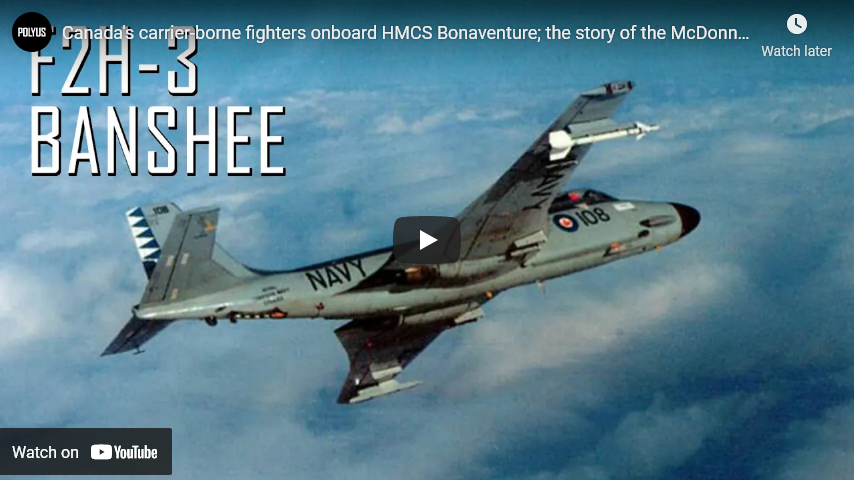
Canada’s carrier-borne fighters onboard HMCS Bonaventure; the story of the McDonnell F2H-3 Banshee
Polyus Studios
Published 2 Apr 2021Don’t forget to like the video and subscribe to my channel!
Support me on Patreon – https://www.patreon.com/polyusstudiosUp until the late 1960s the Canadian Navy operated a modern aircraft carrier. It had an angled flight deck, steam catapults, and fighter jets. The jets were comparable to land-based aircraft like the CF-100 but could pack a vicious air-to-air punch with their Sidewinder missiles. They saw a brief service aboard HMCS Bonaventure before being retired without replacement. It was the McDonnell F2H Banshee, Canada’s premiere sea-based jet fighter.
0:00 Introduction
0:29 Canadian Navy aircraft carriers 1945 to 1957
2:13 New Fighter Selection
3:34 Specifications
5:07 Comparison to the CF-100
5:50 Operational Service
8:23 Accidents and RetirementMusic:
Denmark – Portland Cello ProjectResearch Sources:
CASM-Aircraft Histories – HMCS Bonaventure CVL-22 by Robert T. Murray
McDonnell Banshee – Royal Canadian Air Force – http://www.rcaf-arc.forces.gc.ca/en/a…
Magnificent Moments by Vintage Wings of Canada – http://www.vintagewings.ca/VintageNew…
McDonnell Banshee – Shearwater Aviation Museum – http://www.shearwateraviationmuseum.n…
HMCS Bonaventure: Canada’s Last Aircraft Carrier by Kevin Patterson – http://www.sevenyearproject.com/canad…Footage Sources:
HMCS Magnificent (CVL 21) – Majestic Class Light Aircraft Carrier – Camildoc – https://youtu.be/_Zvnz06-MRc
HMCS Bonaventure (CVL 22) – Majestic Class Aircraft Carrier – Camildoc – https://youtu.be/QmFD5bijrok#Banshee #CanadianAerospace #PolyusStudios
Comments Off on Canada’s carrier-borne fighters onboard HMCS Bonaventure; the story of the McDonnell F2H-3 Banshee
September 16, 2021
Tanks Chat #124 | FV4005 Tank Destroyer | The Tank Museum
The Tank Museum
Published 23 Apr 2021David Fletcher MBE explores the experimental FV4005, with original turret and 183mm gun fitted on a Centurion Mark 12 hull.
(more…)
Comments Off on Tanks Chat #124 | FV4005 Tank Destroyer | The Tank Museum
September 6, 2021
Why the British Rail Modernisation Plan Failed
Ruairidh MacVeigh
Published 27 Feb 2021Hello again! 😀
Back to trains, and for this week we discuss one of Britain’s most audacious but ultimately futile projects to revitalise the network in the wake of World War II. However, rather than undertaking a comprehensive rebuild of the network, British Railways was short-changed time and again, ultimately resulting in a facelifted but largely unchanged system that dated back to the Victorian era, though it was much smaller and crippled by far more debt than ever before.
This video was actually a suggestion from an American viewer, who was curious as to why British Rail had such a vast array of diesel locomotives during its early years. 🙂
All video content and images in this production have been provided with permission wherever possible. While I endeavour to ensure that all accreditations properly name the original creator, some of my sources do not list them as they are usually provided by other, unrelated YouTubers. Therefore, if I have mistakenly put the accreditation of “Unknown”, and you are aware of the original creator, please send me a personal message at my Gmail (this is more effective than comments as I am often unable to read all of them): rorymacveigh@gmail.com
The views and opinions expressed in this video are my personal appraisal and are not the views and opinions of any of these individuals or bodies who have kindly supplied me with footage and images.
If you enjoyed this video, why not leave a like, and consider subscribing for more great content coming soon.
Thanks again, everyone, and enjoy! 😀
References:
– Railways Archive (and their respective sources)
– RMWeb (and their respective sources)
– Wikipedia (and its respective references)

Comments Off on Why the British Rail Modernisation Plan Failed
August 6, 2021
Avro Canada CF-100 Canuck: Canada’s only domestically produced all-weather interceptor
Polyus Studios
Published 3 Oct 2017Support me on Patreon – https://www.patreon.com/polyusstudios
**I realize a few of you are having trouble with the way I talk and how I’ve done the sound mixing. Please note that this was my first video and I tried to get everything right as I learned to do it. That said, I obviously made some mistakes. I am just one guy making these things and I’m learning as I go. Feel free to check out my more recent videos where I have tried to correct the sound issues.**
The CF-100 is Canada’s only domestically designed jet fighter to reach service and to be built directly to RCAF specifications. In its day it was a competitive all-weather interceptor. The Canuck protected Canadian airspace from the threat of nuclear armed Soviet bombers for over a decade. This is the story of its development and deployment.
Aircraft mentioned:
Vampire F.3
CL-13 Sabre
CF-100 Canuck
CF-101 Voodoo
CF-105 ArrowResearch sources:
http://www.cmp-cpm.forces.gc.ca/dhh-d…
https://www.bombercommandmuseum.ca/aircraft/cf-100/
http://www.canadianflight.org/content/avro-canada-cf-100-canuck
http://www.avroland.ca/al-cf100.html
http://www.aviastar.org/air/canada/canada_canuck.php
http://www.rwrwalker.ca/caf_canucks.html
http://image-bank.techno-science.ca/d…
NORAD and the Soviet Nuclear Threat: Canada’s Secret Electronic Air War By Gordon A.A. Wilson0:00 Introduction
1:08 Initial Development
2:38 CF-100 Mk 1 and Mk 2
4:26 CF-100 Mk 3
6:51 CF-103 and Transonic Speeds
7:36 CF-100 Mk 4
11:33 CF-100 Mk 5
13:14 Velvet Glove and Future Proposals
14:28 Operational History
20:02 Conclusion#CF100 #CanadianAerospace #PolyusStudios

Comments Off on Avro Canada CF-100 Canuck: Canada’s only domestically produced all-weather interceptor
June 25, 2021
L4: The Bren in 7.62mm NATO
Forgotten Weapons
Published 10 Mar 2021http://www.patreon.com/ForgottenWeapons
https://www.floatplane.com/channel/Fo…
Cool Forgotten Weapons merch! http://shop.bbtv.com/collections/forg…
When the British military transitioned from the .303 British cartridge to 7.62mm NATO in the 1950s, it replaced the Enfield rifles with the new L1A1 SLR (the FAL) but retained the Bren gun as a support weapon. The Bren was updated to use 7.62mm, in a process more complicated than most people would think. Ultimately, only a few thousand L4 series Brens were made, as they were rather quickly supplanted by the FN MAG as a belt-fed support weapon.
The four different patterns of L4 are:
L4A1 – the initial pattern, without magazine supports
L4A2 – the Bren MkIII in 7.62mm with magazine supports
L4A3 – the Bren MkII in 7.62mm with magazine supports
L4A4 – the A2 and A3 patterns with chrome-lined barrelsContact:
Forgotten Weapons
6281 N. Oracle 36270
Tucson, AZ 85740

Comments Off on L4: The Bren in 7.62mm NATO


