This one is a contender for best historical film of 2016. The Founder is an amazing movie about the beginning of the McDonald’s food chain. Seriously, more films should take cues from this.
————————————————————
references: http://www.historyvshollywood.com/ree…
LET’S CONNECT: https://twitter.com/Cynical_History
————————————————————
Wiki:
The Founder is a 2016 American biographical drama film directed by John Lee Hancock and written by Robert Siegel. The film stars Michael Keaton as businessman Ray Kroc, and portrays the story of his creation of the McDonald’s fast food chain. Nick Offerman and John Carroll Lynch co-star as McDonald’s founders Richard and Maurice McDonald.
The film premiered at Arclight Hollywood on December 7, 2016 and was released in the United States on January 20, 2017, by The Weinstein Company. It grossed $23 million worldwide and received generally positive reviews from critics, with praise for Keaton’s performance.
————————————————————
Hashtags: #History #TheFounder #McDonalds #Review #BasedOnATrueStory #RayKroc
Comments Off on The Founder | Based on a True Story
In another of a series of book reviews by Astral Codex Ten readers, Scott Alexander posted this review of Double Fold by Nicholson Baker, which helps to indicate just when libraries — and librarians — lost their mojo:
If you enter a major research library in the US today and request to see a century-old issue of a major American newspaper, such as Chicago Tribune, The Wall Street Journal, or major-but-defunct newspapers such as the New York “World”, odds are that you will be directed to a computer or a microfilm reader. There, you’ll get to see black-and-white images of the desired issue, with individual numbers of the newspaper often missing and much of the text, let alone pictures, barely decipherable.
The libraries in question mostly once had bound issues of these newspapers, but between the 1950s and the 1990s, one after another, they ditched the originals in favor of expensive microfilmed copies of inferior quality. They continued doing this even while the originals became perilously rare; the newspapers themselves were mostly trashed, or occasionally sold to dealers who cut them up and dispersed them. As a consequence, many of these publications are now rarer than the Gutenberg Bible, and some 19th and 20th century newspapers have ceased to exist in a physical copy anywhere in the world.
When Double Fold by Nicholson Baker came out in 2001, it was described as The Jungle of the American library system. After 20 years, the book remains universally known, sometimes admired but often despised, among librarians. The reason for their belligerence is that Baker publicly revealed a decades-long policy of destruction of primary materials from the 19th and 20th centuries, based on a pseudoscientific notion that books on wood-pulp paper are quickly turning to dust, coupled with a misguided futuristic desire to do away with outdated paper-based media. As a consequence, perfectly well preserved books with centuries of life still ahead of them were hastily replaced with an inferior medium which has, at the moment that I am writing this review, already mostly gone the way of the dodo. Despite its notoriety among librarians, however, Double Fold is little-known among the general public, even compared to Baker’s other non-fiction and his novels.
This is a shame, since the mass destruction of books and newspapers by libraries in the post-war era deserves to be better known as one of the most egregious failures of High Modernism, comparable with the wackiest plans of Le Corbusier. The story combines an excessive reliance on simplistic mathematical models, wilful ignorance to the desires of actual library-users and scholars, embracement of miniaturization and modernization as terminal values, and an almost complete disregard of 19th century books as historical artefacts. Unlike industrial farms, which can be broken up, and Brasília-style skyscrapers, which can be torn down and replaced with something else, the losses caused by the mass deaccessioning of books and newspapers from libraries were often irreplaceable.
As part of the uproar that followed the book’s publication, the Association of Research Libraries published an online anti-Baker FAQ, and in 2002, the book Vandals in the Stacks? by Richard J. Cox came out, presenting an attempted refutation of Baker’s theses. I have read both of these and discuss Cox’s arguments later on, but I must admit in advance that I was mostly convinced by Baker’s argumentation much more than by that of his opponents. Nonetheless, it is uncommon to have a polemical book receive a book-length response, and anyone interested in Baker’s thesis is advised to check out Cox as well.
HMS Warrior (R31) was a Colossus-class light aircraft carrier which served in the Royal Canadian Navy from 1946 to 1948 (as HMCS Warrior). She was transferred to the Royal Canadian Navy, commissioned as HMCS Warrior and placed under the command of Captain Frank Houghton. She entered Halifax harbour on 31 March 1946, a week after leaving Portsmouth. She was escorted by the destroyer HMCS Micmac and the minesweeper HMCS Middlesex. The RCN experienced problems with the unheated equipment during operations in cold North Atlantic waters off eastern Canada during 1947. The RCN deemed her unfit for service and, rather than retrofit her with equipment heaters, made arrangements with the Royal Navy to trade her for a more suitable aircraft carrier of the Majestic class which became HMCS Magnificent (CVL 21) on commissioning. [Original text from Wikipedia]
Tags: Colossus Class Light Aircraft Carrier, HMCS Warrior, HMCS, RCN, Royal Canadian Navy, aircraft carrier, CV, Halifax
Warrior was a Colossus-class light aircraft carrier that was 630 feet 0 inches (192.0 m) long between perpendiculars and 695 feet 0 inches (211.8 m) overall with a beam at the waterline of 80 feet 0 inches (24.4 m) and an overall width of 112 feet 6 inches (34.3 m). The ship had a mean draught of 23 feet 3 inches (7.1 m). Warrior had a standard displacement of 13,350 long tons (13,560 t) when built and a full load displacement of 18,300 long tons (18,600 t). The aircraft carrier had a flight deck 690 feet 0 inches (210.3 m) long that was 80 feet 0 inches (24.4 m) wide and was 39 feet 0 inches (11.9 m) above the water. The flight deck tapered to 45 feet (14 m) at the bow. For takeoffs, the flight deck was equipped with one BH 3 aircraft catapult capable of launching 16,000-pound (7,257 kg) aircraft at 66 knots (122 km/h). For landings, the ship was fitted with 10 arrestor wires capable of stopping a 15,000-pound (6,804 kg) aircraft, with two safety barriers rated at stopping a 15,000-pound aircraft at 40 knots (74 km/h). Warrior had two aircraft elevators located along the centreline of the ship that were 45 by 34 feet (13.7 by 10.4 m) and could handle aircraft up to 15,000 pounds on a 36-second cycle. The aircraft hangar was 275 by 52 feet (83.8 by 15.8 m) with a further 57 by 52 feet (17.4 by 15.8 m) section beyond the aft elevator, all with a clearance of 17 feet 6 inches (5.3 m). The hangar was divided into four sections by asbestos fire curtains. The hangar was fully enclosed and could only be entered by air locks and the lifts, due to the hazardous nature of aviation fuel and oil vapours. The vessel had stowage for 98,600 Imperial gallons (448,244 l; 118,414 US gal) of aviation fuel.
The ship was powered by steam created by four Admiralty 3-drum type boilers driving two Parsons geared turbines, each turning one shaft. The machinery was split into two spaces, each containing two boilers and one turbine, separated by 24-foot (7.3 m) spaces containing aviation fuel. The spaces were situated en echelon within the ship to prevent a single disabling torpedo strike. The engines were rated at 42,000 shaft horsepower (31,319 kW) and the vessel had a capacity for 3,196 long tons (3,247 t) of fuel oil, with an range of 8,300 nautical miles (15,372 km) at 20 knots (37 km/h). The ship’s maximum speed was 25 knots (46 km/h). There was no armour aboard the vessel save for mantlets around the torpedo storage area. There were no longitudinal bulkheads, but the transverse bulkheads were designed to allow the ship to survive two complete sections of the ship being flooded.
Warrior was designed to handle up to 42 aircraft. The aircraft carrier carried a wide range of ordnance for their aircraft from torpedoes, depth charges, bombs, 20 mm cannon ammunition and flares. For anti-aircraft defence, the aircraft carrier was initially armed with four twin-mounted and twenty single-mounted 40 mm Bofors guns. The original radar installation included the Type 79 and Type 281 long-range air search radars, the Type 293 and Type 277 fighter direction radar and the “YE” aircraft homing beacon. The ship had a maximum ship’s company of 1,300, which was reduced in peacetime.
After service with the RCN, Warrior was returned to the Royal Navy, and subsequently sold to Argentina, entering service as ARA Independencia until 1971 when she was struck from the Argentinian navy list and scrapped.
Comments Off on HMCS Warrior (R31) – Colossus-class Light Aircraft Carrier
If you find issues with the content, I encourage you to update the Wikipedia article, so everyone can benefit from your knowledge.
To get early ad-free access to new videos, or your name at the end of my videos, please consider supporting me from just $1 or 80p a month at https://www.patreon.com/bigcar
HMCS Magnificent (CVL 21) was a Majestic-class light aircraft carrier that served the Royal Canadian Navy from 1948-1957.
The third ship of the Majestic class, Magnificent was built by Harland and Wolff, laid down 29 July 1943 and launched 16 November 1944. Purchased from the Royal Navy (RN) to replace HMCS Warrior, she served in a variety of roles, operating both fixed and rotary-wing aircraft. She was generally referred to as the Maggie. Her aircraft complement included Fairey Fireflies and Hawker Sea Furies, as well as Seafires and Avengers.
Tags: HMCS Magnificent, CVL 21, Majestic Class Light Aircraft Carrier, Royal Canadian Navy, RCN, CV, Maggie, Fairey Fireflies, Hawker Sea Furies, Seafires, Avengers, Canada, aircraft carrier, Canada
From the comments:
Tibor80
5 years ago
That’s me with the mike in hand, interviewing the staff. It was the last TV work I did in Canada before leaving the industry and settling on Madison Avenue in the fall of 1954. Don Harron had been hosting a series titled ON THE SPOT, produced by NFB for 2-year old CBC-TV. They were running behind and NFB called me to fill in. I had never before done ad lib of this sort. They were supposed to have an advance man to do research and provide points to be covered or some sort of script but that never materialized. There was no crew either, so I doubled on grip work, hauled equipment from setup to setup — couldn’t do the camera and be in front of it, too — though I’m sure NFB would have loved that.
I was just naturally very interested in the ship and asked a lot of questions and it worked out fine. The ship had no air conditioning. We were on maneuvers in the Gulf Stream near Bermuda in August. The heat was a killer. I couldn’t sleep. I shared a cabin with a lieutenant, a really nice fellow. He said, “Hey, Andy, you’re a V.I.P. here, I could get you a cot on a deck.” There was a little deck at the rear below the flight deck. All lights were out on maneuvers. I had never seen so many stars in my life — and the sea was filled with phosphorescence — like millions of fire flies. I thought I had died and gone to heaven.
We only had one week on the Maggie making the documentary but I was tempted to sign up for life. The navy had turned me down once before. A buddy and I got terrible marks in high school in the spring ’45 so we ran down to the Navy Recruiting station in Toronto and asked to sign up. A wiseguy behind the desk said, “Leave your names and if Hitler attacks Toronto, we’ll give you a call.” (Hitler shot himself a week later)
A video editor friend up in Belleville found this video and wrote to me saying there was a fellow with my name in this video. I told him that was me 70 pounds ago. Great days.
HMCS Magnificent (CVL 21) was a Majestic-class light aircraft carrier that served the Royal Canadian Navy from 1948–1957. Initially ordered by the Royal Navy during World War II, the Royal Canadian Navy acquired the carrier as a larger replacement for its existing operational carrier. Magnificent was generally referred to as Maggie in Canadian service. Following its return to the United Kingdom in 1956, the ship remained in reserve until being scrapped in 1965.
Description and construction
The 1942 Design Light Fleet carrier was divided into the original ten Colossus-class ships, followed by the five Majestic-class ships, which had some design changes that accommodated larger and heavier aircraft. The changes reduced the weight of petrol and fuel storage by reducing them to 75,000 gallons, to offset the additional weight from strengthening of the deck to operate aircraft as heavy as 20,000 pounds (9,100 kg). Further improvements over the Colossus class included larger aircraft elevators (54 by 34 feet, 16 m × 10 m) and improvements made to internal subdivisions for survivability purposes and accommodations.
The ship was 698 feet (212.8 m) long with a beam of 80 ft (24.4 m) and a draught of 25 ft (7.6 m). The carrier displaced 15,700 long tons (16,000 t). The ship was powered by steam from four Admiralty three-drum boilers. This propelled two Parsons geared steam turbines driving two shafts creating 40,000 shaft horsepower (30,000 kW). Magnificent had a top speed of 24 knots (44 km/h; 28 mph).
The aircraft carrier was armed with 24 2-pounder and 19 Bofors 40 mm guns for anti-aircraft defence. Majestic-class carriers were fitted out with Type 281, Type 293 and two Type 277 radar installations. The ship had a complement of 1,100, including the air group.
The third ship of the Majestic class, Magnificent was ordered 16 October 1942. The order was placed with Harland and Wolff in Belfast who were also constructing the Colossus-class ships Glory and Warrior. Magnificent was laid down on 29 July 1943 with the yard number 1228 and launched on 16 November 1944.
Comments Off on HMCS Magnificent (CVL 21) – Majestic-Class Light Aircraft Carrier
Scott Alexander reviews Why We’re Polarized by Ezra Klein, beginning with the underpolarization crisis of the mid-20th century:
In 1950, the American Political Science Association “released a call to arms … pleading for a more polarized political system”. The report argued that “the parties contain too much diversity of opinion and work together too easily, leaving voters confused about who to vote for and why”. Everyone agreed with each other so much, and compromised so readily, that supporting one party over the other seemed almost pointless.
In 1976, three years after Roe v. Wade, Democrats and Republicans were about equally likely to support abortion restrictions. That same year, a poll found that “only 54% of the electorate believed that the Republican Party was more conservative than the Democratic Party”; 30% thought there was no difference. As late as 2004, about equal numbers (within 5 pp) of Democrats and Republicans agreed with statements like “government is almost always wasteful and inefficient” and “immigrants are a burden on our country”. Between the late 60s and early 90s, Democratic presidents deregulated the airlines and passed welfare reform; Republican presidents pushed immigration amnesties and founded the EPA.
What happened between then and now? Klein has two answers: a historical answer, and a structural answer.
The historical answer is: the Dixiecrats switched from Democrat to Republican.
When the North won the Civil War, it had grand plans to remake the South into a paradise of racial equality and universal love. After Lincoln’s death, his successor Andrew Johnson decided this sounded hard and gave up. Within a few decades, the South was back to being a racist, paramilitary-violence-prone one-party dictatorship. That one party called itself “Democrat”, but had few similiarites to the Democrats in the North. The Southern Democrats (“Dixiecrats”) and northern Democrats disagreed on lots of issues, but the South hated the Republicans so much after their experience with Lincoln that they caucused with the northern Democrats anyway. This turned into a stable coalition, with northern Democrats agreeing to support the South against civil rights for blacks, and the Dixiecrats supporting the northern Democrats whenever they needed something.
But since the Democratic party contained both northern Democrats (relatively liberal) and Dixiecrats (relatively conservative), it didn’t want to take a coherent party-wide stance on liberalism vs. conservatism. And by the median voter theorem, that meant the Republicans also didn’t want to take a coherent stance on liberalism vs. conservatism. So both parties ended out centrist and identical.
In 1964, the Civil Rights Act threatened the Dixiecrats’ key issue. It wasn’t quite as simple as “Democrats were for it, Republicans were against it” – in fact, 80% of Republicans and 60% of Democrats supported it. But that year’s presidential election pitted heavily pro-CRA Democrat Lyndon Johnson against anti-CRA Republican Barry Goldwater, beginning Southerners’ defection to the Republican Party.
Klein says this successfully got all the conservatives on one side of the aisle and all the liberals on the other, allowing polarization to begin. Essentially, he believes polarization is a natural process, which the odd coalitions of the early 20th century temporarily prevented. Once the coalitions were broken, it could begin to do its work. He spends the rest of the book talking about why exactly polarization is so natural, what aspects of modernization have made it worse, and what sort of feedback loops make it keep going
Comments Off on “Did you know that seventy years ago, our grandparents were having an underpolarization crisis?”
Why does nothing in today’s rock music sound like the Beatles?
It’s a pertinent question because the Beatles were so acclaimed as musical innovators in their time and still so hugely popular. And yet, nobody sounds like them. Since not long after the chords of the “Let It Be” died away in 1969, every attempt to revive the Beatlesy sound of bright vocal-centered ensemble pop has lacked any staying power among rock fans. It gets tried every once in a while by a succession of bands running from Badfinger to the Smithereens, and goes nowhere. Why is this?
Another, related question is: Why does so very little in today’s rock music sound like Chuck Berry?
Inventor of rock and roll, they still call him. And yet outside of occasional tributes and moments of self-conscious museumizing, nobody writes rock music that sounds anything like “Johnny B. Goode” anymore. Modern tropes and timbre are vastly different. Only the rock beat – only the drum part – survives pretty much intact.
It’s odd, when you think about it. The sound that electrified the late Fifties and Sixties is still revered, but it’s gone. The basic rock beat remains, but everything above it has been flooded out, replaced by something harder and darker.
We all sort of know, even as casual listeners, that rock has evolved a lot. There’s even a tendency for the term “rock and roll” to nowadays be specifically confined to the older sound, with “rock” standing alone to refer to the more modern stuff.
[…]
The sea-change happened between 1969 and 1971. The moving figures were: Jimi Hendrix. British Invasion bands like the Rolling Stones and Led Zeppelin and the Who. American West Coast bluesmen like Mike Bloomfield and Al Cooper. The San Franciso acid-rock scene. And many lesser imitators.
What they did was raze old-school rock-and-roll to the ground, replacing it with a bastard child of LSD and Chicago-style hard electric blues. That angry, haunting, minor-key idiom is what buried the Beatles and put a stamp on rock music so final that today the sound of any modern arena rocker – like, say, Guns’n’Roses – is recognizably the same thing musicians began to record around 1970.
(Which it should be pointed out, is a very long run for a mass-market pop genre. It’s as though in 1970 our radios had still been full of pop in forms dating from 1925 …)
No jazz musician incarnates the legend of late style more than the saxophonist John Coltrane. His early style is undistinguished; he was a bluesy sideman whose grasp of the instrument falls short of the reach of his ear. His middle style, stertorous and ambitious, began in his mid-1950s stint with Miles Davis’s quintet. Coltrane in this period is still less melodious than Hank Mobley and less witty than Sonny Rollins, but his chops are catching up with his ear. Only Johnny Griffin has fleeter fingers and only Rollins can beat him for persistence. Coltrane thinks aloud and never stops thinking; he is the perfect foil for Davis, who is also ironic and intellectual, also latent with eroticism and violence, but who never shows his working, only the finished idea. Coltrane’s sound waves are square and heavy, metallic and dark like lead. He is both implacable and lazy, like a bull elephant: You never know where the charge will take him, only that — as he himself admitted to Davis — once he gets going, he doesn’t know how to stop.
Coltrane’s late style emerged in his 1960s quartets. Now leading and writing for his own group, and newly clean of drink and drugs, he was finally able to pursue his vision and the possibilities of the music to the limits of form and expression — and ultimately beyond both. The further he went, the more ambitious and less accessible the music became, until it was incomprehensible to almost all of his audience and even to some of his closest collaborators. In the logic of modernism, further means better. But “faster” and “louder” aren’t necessarily better, so why should “further” be the supreme critical value? To judge Coltrane’s late-style art is, in an important sense, to judge modernism itself, and especially American modernism.
In his Trains blog, George Hamlin discusses the changing colours of the ordinary railway boxcar in the brief era between post-war prosperity and the economic disasters of the 1960s and 70s:
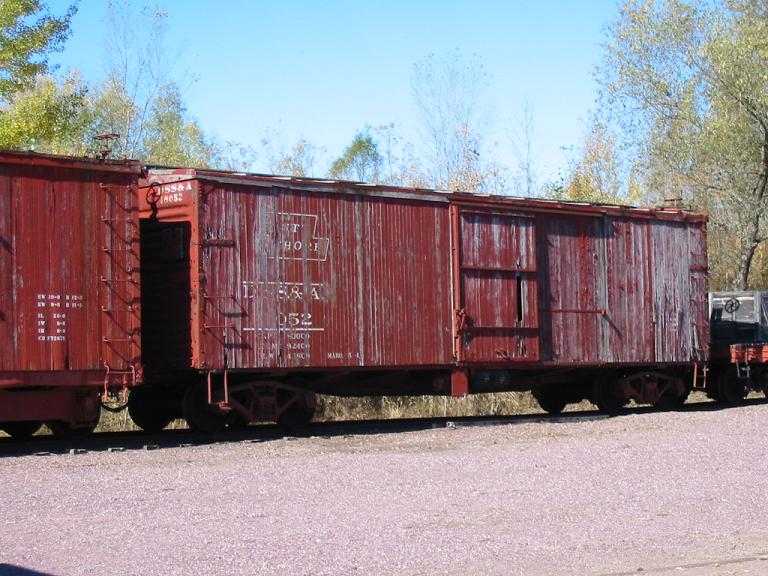
Pre-war Duluth, South Shore & Atlantic boxcar number 18052 at the Mid-Continent Railway Museum. Photo by Sean Lamb via Wikimedia Commons.
The advent of streamlining in the 1930s started to blow historic convention with regard to car colors away on the passenger side of railroading, but had little impact on freight operations prior to World War II. Following that conflict, however, some of the industry began to consider livening up the equipment that produced much of the revenue (and most of the profits) from which they derived their economic existence.
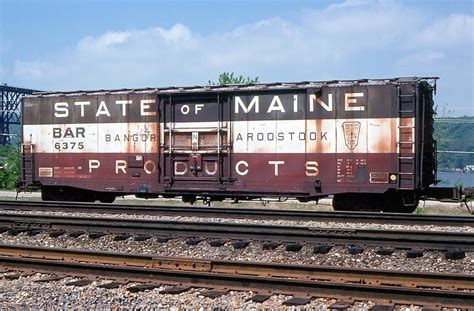
Some railroads also adopted more colorful boxcar paint schemes to promote special aspects of their freight service: the B&O had special schemes for both their “Sentinel” and “Timesaver” services; another example was the Missouri Pacific’s blue and gray (the road’s modern-day passenger colors) for their Eagle Merchandise Service. The Bangor & Aroostook had boxcars with red, white and blue horizontal stripes advertising products emanating from their home state, Maine.
Bangor and Aroostook boxcar 6375 in “State of Maine” paint scheme. Image originally from Panoramio, but no user information provided.
Another example was the large fleet of New York Central’s “Pacemaker” boxcars, adorned in a combination of bright red and gray. Early on, the NYC even ran solid trains of this equipment in an expedited service which was designed to re-capture LCL (less than carload lot) traffic from the increasingly competitive motor trucking industry. (Interestingly, the NYC also had a color they called “Pacemaker Green” that was used for the pre-World War II all-coach New York-Chicago service, as well as on the road’s initial orders of non-stainless steel streamlined coaches.)
In the late 1950s, the Central introduced a more radical change, and began painting its boxcars in a Jade Green color (“Century Green”, according to the railroad) that was quite a dramatic change from boxcar red. The Great Northern also adopted a similar shade. CB&Q boxcars still had the same basic hue, but now they came in a brighter version dubbed “Chinese Red”.
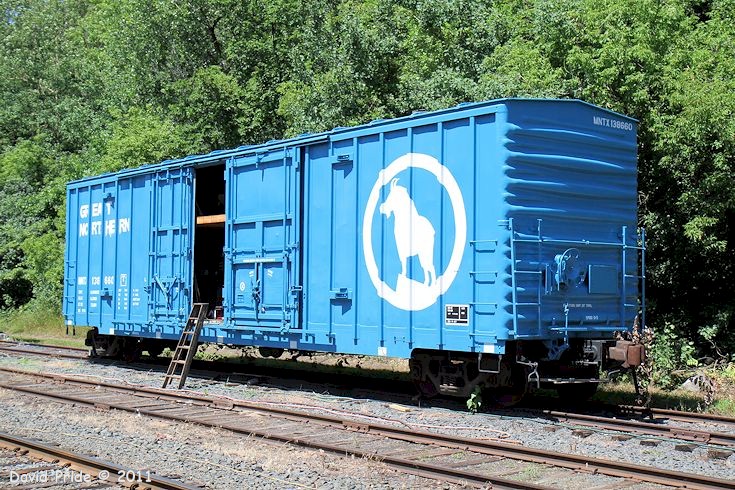
By the 1960s, a number of roads had livened up their freight car liveries; the modestly-sized Reading utilized bright green and beige/yellow for both freight cars and locomotives. Late in its career as an independent railroad, the Great Northern adopted the striking bright “Big Sky Blue” for both passenger and freight cars. At its formation in 1976, Conrail adopted “traditional red oxide” as its choice for freight cars, however, sticking with tradition (and reversing the NYC’s earlier efforts).
Great Northern boxcar 138660 in the “Big Sky Blue” paint scheme, delivered September 1967. Photo by David Pride http://www.davidpride.com/USA/Minnesota/Osceola_11_007.htm
Comments Off on The late steam-era boxcar and (a brief) flourish of colour
Watch banana candies being formed by hand using Victorian techniques and discover why banana candy typically does not taste like what you think a banana should taste like. Also explore the weirdness of the banana plant and the correct way to peel a banana.
(FILM ID:1549.07)
Full title reads: “Goodbye To Steam”
Intertitle reads: “British Railways meet the challenge of the age of abundant power”
Angle shot, railway engine going past camera. GV Outside one of the large London Railway stations showing railway lines and train coming out of station. CU Man in signal box, pan to show him pulling levers. CU Signal going up. GV Train coming towards camera. GV Steam train. GV Aerial shots steam train. CU Man filming from plane. CU man in plane fitting equipment and then giving thumb’s up sign. GV Aerial shot, railway lines. CU Man filming from plane. Steam train going along line. SV Draughtsmen in office. CU Men looking through magnifier at a plan. CU Magnified picture of plan, zoom to show Railway chiefs seated round table with plan, among them is Sir Philip Warter. SV Elevated, railway chiefs looking at plan. CU One of the railway executives. SV Man with model of section of railway line which he places on the table and the railway executives study it. CU Sign reading “Kent Coast Electrification Widening to Provide Four Tracks”, pan to show railway line with only two tracks. GV Kent Coast line with men on bridge. SV Bridge with surveyor. CU Surveyor looking through theodolite. GV Tracking shot of men working. GV Men working at side of railway line with clouds of smoke coming from wood. CU New diesel engine. CU Sir Brian Robertson talking to train driver. CU People watching. CU Sir Brian Robertson blowing whistle. CU Int. diesel engine with driver operating controls. SV Diesel train moving out of station. CU Driver of diesel train. CU. Sir Brian Robertson sitting in carriage. LV Through window of diesel cab as train enters tunnel. SV Three engines on lines. CU Front of one of the engines with plate reading “Cornish Riviera Express”. CU Driver. SV Cornish Riviera Express in station. SV Woman taking in washing because smoke is billowing up from railway lines beside her garden. GV Cornish Riviera Express coming towards camera.
CU Front of steam train “The Bristolian”. SV along top of engine as blows off steam. CU Hand pulling chain. CU valve. GV Platform. CU shovelling coal. GV As train goes along. CU Driver of train. CU Driver. CU Fireman. CU Fire with coal being shovelled. SV Looking over coal tender. SV From driver’s cab of train going under bridge and out the other side. CU Driver. GV From driver’s cab of railway lines with another steam train. SV Int. class for instruction of diesel engine drivers. CU Lecturer talks about metal object. CU Men looking at machinery. SV Royal Scot in station. CU Driver of Royal Scot. GV Activities on platform in which Royal Scot is standing. GV Royal Scot leaving station. GV Building with sign, “English Electric Co. Ltd. Preston”. GV Int. of workshop showing men working on armatures. GV Ext. of building with “Vulcan Locomotives” painted on wall. GV Int. of workshop showing men working on railway engines. CU Man working inside railway engine. GV Workshop. SV Diesel train in station. CU Driver of diesel. GV railway lines in front of train as it moves along. SV Int. dining car in diesel train with attendant pouring coffee. GV Looking through cab window of railway lines in front of train as it goes under bridge and straight past station. CU Glass panel in door with “York Signal Box, Strictly Private”, door opens. SV Man sitting at control panel of box, he reaches over to controls. CU Man’s hands working controls. CU Plan on wall showing different lines and points. CU Hand pushing buttons. CU Signals. CU Point on lines. GV Steam train along lines. CU Train in museum. CU Compartment of old train. SV Ancient train “Locomotion 1828”. SV Diesel Locomotive. CU “Deltic” written on side. GV Deltic. GV Train in station. Various shots in Deltic carriage. SV Coal trucks. SV Railway worker attaching pipe to train. GV Calder Hall Nuclear / Atomic Power station. GV Electrical pylons and cables. GV Diesel train “Sir Brian Robertson” in platform with crowds. GV Crowds. SV “Sir Brian Robertson” unveiled by Mr Grand, General Manager of the Western Region of British Railways. SV Crowd. SV Sir Brian Robertson by train. CU Sign “Sir Brian Robertson”. GV The “Sir Brian Robertson” leaving Paddington Station. SV Steam train letting out smoke. CU Signals. GV Steam train. CU Train over the points. GV steam train leaving clouds of smoke.
BRITISH PATHÉ’S STORY
Before television, people came to movie theatres to watch the news. British Pathé was at the forefront of cinematic journalism, blending information with entertainment.
Comments Off on British Railways: Goodbye To Steam aka Railway Modernisation (1958) | British Pathé
This documentary short offers a nostalgic look at the steam locomotive as it passes from reality to history. In its heyday, the big smoke-belching steam engine seemed immortal. Now, powerful and efficient diesels are pushing the old coal-burning locomotives to the sidelines, and the lonely echo of their whistles may soon be a thing of the past.
George Hamlin reflects on the state of the US passenger rail system before the formation of Amtrak in 1971:
… non-commuter U.S. passenger trains can be said to have been under siege essentially for my entire lifetime, beginning not long after the end of World War II. Many railroads spent large sums to re-equip with streamlined lightweight equipment after the war, only to see what was originally couched as an investment turn into essentially a drain on their companies’ treasuries.
And the “rewards” for this? Passengers decamped to the rapidly-expanding airlines, and their personal automobiles. The decisive blow came in 1956, with the passage of the Federal Aid Highway Act, which led to the Interstate Highway System.
Quoting from Joe Welsh’s Pennsy Streamliners, The Blue Ribbon Fleet (page 138), “Referring to the challenge, [PRR President] Symes wrote ‘There is such a thing as planning an orderly retreat in the face of superior forces.’ Clearly, the bugle had been sounded.”
In 1958, an Interstate Commerce Commission Hearing Examiner predicted that there would be no intercity passenger trains by 1970; he only missed by four months, effectively (and didn’t count on the Southern Railway, Rio Grande and Rock Island shying away from the government’s largesse). In 1959, TRAINS magazine devoted an entire issue to what was now clearly a crisis; the cover bore the legend “Who Shot the Passenger Train?”, complete with simulated bullet hole.
The 1960s in the U.S. could well be described as the “train-off” decade from a transportation history perspective; get, and read, Fred Frailey’s Twilight of the Great Trains, for a blow-by-blow analysis. The 1970s quickly produced the Penn Central bankruptcy, which proved to be the catalyst for government intervention; less than a year later, Amtrak was on the scene.
And since, it has frequently found itself in a “Perils of Pauline” existence, ranging from lack of funding to buy equipment, in many cases, to several bouts of route eliminations, to micro-management by politicians that don’t seem to be willing to provide consistent operational funding so that the company can make reasonable plans.
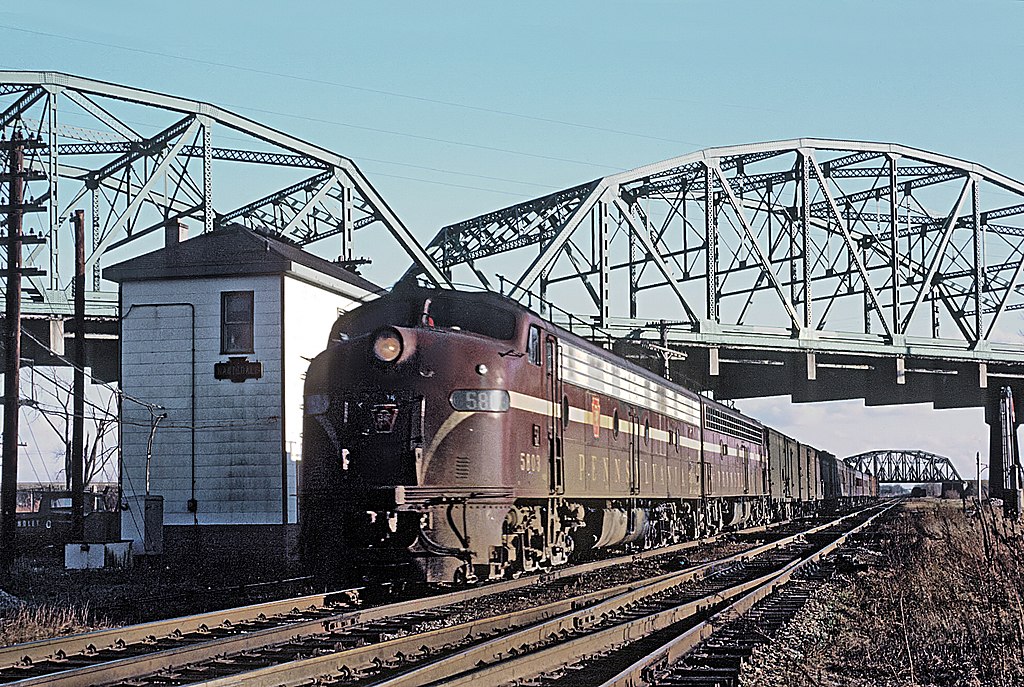
PRR E8A 5803 with Train 72, The Red Bird, passing the Hartsdale, Indiana tower and crossing the NYC and EJ&E on November 26, 1965. Photo from the Roger Puta collection via Wikimedia Commons.
Comments Off on American passenger trains before Amtrak
Thunderbolt 1000 Siren Productions
Published 17 Jan 2020
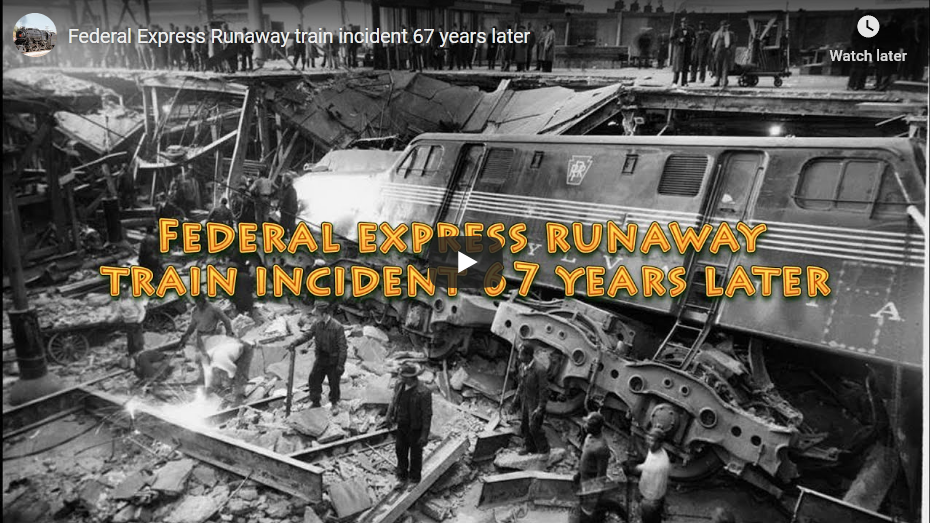
2 days late and I lost several hours of sleep but holy hell it’s worth it now that it’s done! Enjoy this pretty interesting story on a runaway GG1 just days before Eisenhower’s inaguration
Please don’t shoot me for the Trump pics 😐
Next to come up is Glendale and *passes out*
I’m just a struggling college student! Your generous donations will enable me to continue my education and ensure future posts and educational films. Thank you!!!