Quotulatiousness

April 6, 2019

SNC-Lavalin – Justin couldn’t admit that he was wr… wr… wr… not right

Filed under: Cancon, Government, Law, Politics — Tags: , , — Nicholas @ 03:00

Chris Selley on the Prime Minister’s odd decision not to get ahead of the SNC-Lavalin scandal while he still had some credibility with the public:

It seems like another century, but was in fact only a few weeks ago, that Justin Trudeau had a plausible plan to cauterize the SNC-Lavalin wound within his party: He would apologize for … something.

Presumably he would not apologize for trying to protect 9,000 jobs, and presumably he would not admit improper interference in the attorney general’s and director of public prosecution’s roles. But perhaps he might cop to overzealousness in concern for those jobs, or for poorly communicating his entirely appropriate concerns, or for the various anonymous party sources who were slagging off Jody Wilson-Raybould to friendly journalists.

The latter, certainly, seemed downright imperative. Trudeau and his minions, either under orders or self-assigning, had snatched calamity from the jaws of bother. They were badmouthing an accomplished Indigenous female lawyer for being headstrong, “difficult to work with,” and various other descriptors commonly attached to Type A women when they behave like Type A men. When they ran out of those, they started insinuating she wasn’t a very good justice minister — which is certainly an arguable point, but which rather clashed with Trudeau’s insistence she would still hold that title if not for Scott Brison’s impending departure.

It was absolutely torching their brand. People were laughing in their faces. Something had to be done. And this stand-by-for-contrition narrative was lent some credence, fittingly enough, by anonymous sources. “A senior government official said one of the options being discussed is for Trudeau to ‘show some ownership over the actions of his staff and officials’ in their dealings with his former attorney general,” CBC reported on March 5.

Floating a trial balloon to measure potential reactions is not often prelude to the sincerest of apologies. But in the end, no real apology was forthcoming. The brand-torching continued unabated. And by Wednesday this week, the Anonymous Sources had come full circle: Wilson-Raybould had set various extraordinary conditions for remaining in Cabinet, they told various outlets.

One of them was that Trudeau apologize.

In Maclean’s, Paul Wells wonders why SNC-Lavalin has shaken the Liberals so much:

How did this scandal manage to rattle this government so profoundly? And the best answer I can find is this: Because it reveals truths about this Prime Minister that shake many Canadians’ confidence in him.

As my moral betters in the newspaper columns never tire of repeating, by many standards the SNC-Lavalin mess is quite modest. It seems probable that no money changed hands improperly in 2018 and no law was broken. The protagonists were motivated mostly by a kind of distracted hunch that jobs might be at stake. I mean, the extent to which they had zero evidence for that is breathtaking, but let’s give them the benefit of the doubt. And also by a similarly vague suspicion that it might be bad for branded Liberal candidates if SNC ran into trouble ahead of a Quebec or federal election.

[…]

Finally, all three of these scandalettes have laid bare a stubbornly ramshackle approach to running what has sometimes been a serious country. When flying to India, sure, pack your embroidered sherwani and your convicted attempted murderer, but also maybe bring along a travel plan, a sales pitch and a list of objectives worth achieving. Especially if your ineptitude is about to guarantee you will never get a second chance to visit India.

On SNC, what emerges from all the testimony is the impression that a dozen kids from the McGill debating team snuck into the abandoned ruins of Ottawa and started pretending to be the government of Canada. Jody complained to Bill that Elder and Ben were being mean to Jessica. Justin sent Michael but somehow Michael didn’t have the Section 13 ruling Jody had sent to Mathieu. Then it was Christmas and they all went home for a month.

Where the hell were the 208,000 public servants whose job was to ensure options were explored and workflows respected? Why, in September, when Wernick says everyone was distracted by NAFTA, did nobody at the weekly deputy ministers’ meeting say, “Well, there’s only room for 10 people at the NAFTA table, so why don’t the rest of us strike a working group of officials from Justice, Finance, Innovation and the Privy Council to ride this SNC puppy until we know what’s what?”

I’m pretty sure the reason this didn’t happen is that Butts found it thrilling to have all the important conversations run through his phone. That’s a bush-league reason to stumble into a government-shaking mess.

Springfield Arms Double Trigger Navy Revolver

Filed under: History, Technology, USA, Weapons — Tags: , , , — Nicholas @ 02:00

Forgotten Weapons
Published on 6 Mar 2019

http://www.patreon.com/ForgottenWeapons

Cool Forgotten Weapons merch! http://shop.bbtv.com/collections/forg…

The Springfield Arms Company existed only for a brief period in 1850 and 1851, making revolvers designed by its chief engineer, James Warner, before being driven out of business by Colt patent lawyers. During that time, Springfield (no relation to the arsenal) made a variety of models in .28, .31, and .36 caliber and with a variety of barrel lengths and other features (including a well-designed safety notch to allow the guns to be carried fully loaded safely). In an attempt to avoid patent infringement, Warner separated the cylinder rotation and firing mechanisms into two different triggers on some models, including this Navy pattern example. The front trigger would rotate and lock the cylinder, and then it would trip the rear trigger which released the sear and fired the gun. This was not sufficient to save him from copyright infringement suits, though, and only about 125 of the double-trigger Navy revolvers were made.

Contact:
Forgotten Weapons
PO Box 87647
Tucson, AZ 85754

QotD: Truth and propaganda in the Spanish Civil War

Filed under: Europe, History, Military, Quotations — Tags: , , , , — Nicholas @ 01:00

The struggle for power between the Spanish Republican parties is an unhappy, far-off thing which I have no wish to revive at this date. I only mention it in order to say: believe nothing, or next to nothing, of what you read about internal affairs on the Government side. It is all, from whatever source, party propaganda — that is to say, lies. The broad truth about the war is simple enough. The Spanish bourgeoisie saw their chance of crushing the labour movement, and took it, aided by the Nazis and by the forces of reaction all over the world. It is doubtful whether more than that will ever be established.

I remember saying once to Arthur Koestler, ‘History stopped in 1936’, at which he nodded in immediate understanding. We were both thinking of totalitarianism in general, but more particularly of the Spanish civil war. Early in life I have noticed that no event is ever correctly reported in a newspaper, but in Spain, for the first time, I saw newspaper reports which did not bear any relation to the facts, not even the relationship which is implied in an ordinary lie. I saw great battles reported where there had been no fighting, and complete silence where hundreds of men had been killed. I saw troops who had fought bravely denounced as cowards and traitors, and others who had never seen a shot fired hailed as the heroes of imaginary victories; and I saw newspapers in London retailing these lies and eager intellectuals building emotional superstructures over events that had never happened. I saw, in fact, history being written not in terms of what happened but of what ought to have happened according to various ‘party lines’. Yet in a way, horrible as all this was, it was unimportant. It concerned secondary issues — namely, the struggle for power between the Comintern and the Spanish left-wing parties, and the efforts of the Russian Government to prevent revolution in Spain. But the broad picture of the war which the Spanish Government presented to the world was not untruthful. The main issues were what it said they were. But as for the Fascists and their backers, how could they come even as near to the truth as that? How could they possibly mention their real aims? Their version of the war was pure fantasy, and in the circumstances it could not have been otherwise.

The only propaganda line open to the Nazis and Fascists was to represent themselves as Christian patriots saving Spain from a Russian dictatorship. This involved pretending that life in Government Spain was just one long massacre (vide the Catholic Herald or the Daily Mail — but these were child’s play compared with the Continental Fascist press), and it involved immensely exaggerating the scale of Russian intervention. Out of the huge pyramid of lies which the Catholic and reactionary press all over the world built up, let me take just one point — the presence in Spain of a Russian army. Devout Franco partisans all believed in this; estimates of its strength went as high as half a million. Now, there was no Russian army in Spain. There may have been a handful of airmen and other technicians, a few hundred at the most, but an army there was not. Some thousands of foreigners who fought in Spain, not to mention millions of Spaniards, were witnesses of this. Well, their testimony made no impression at all upon the Franco propagandists, not one of whom had set foot in Government Spain. Simultaneously these people refused utterly to admit the fact of German or Italian intervention at the same time as the Germany and Italian press were openly boasting about the exploits of their’ legionaries’. I have chosen to mention only one point, but in fact the whole of Fascist propaganda about the war was on this level.

This kind of thing is frightening to me, because it often gives me the feeling that the very concept of objective truth is fading out of the world. After all, the chances are that those lies, or at any rate similar lies, will pass into history. How will the history of the Spanish war be written? If Franco remains in power his nominees will write the history books, and (to stick to my chosen point) that Russian army which never existed will become historical fact, and schoolchildren will learn about it generations hence. But suppose Fascism is finally defeated and some kind of democratic government restored in Spain in the fairly near future; even then, how is the history of the war to be written? What kind of records will Franco have left behind him? Suppose even that the records kept on the Government side are recoverable — even so, how is a true history of the war to be written? For, as I have pointed out already, the Government, also dealt extensively in lies. From the anti-Fascist angle one could write a broadly truthful history of the war, but it would be a partisan history, unreliable on every minor point. Yet, after all, some kind of history will be written, and after those who actually remember the war are dead, it will be universally accepted. So for all practical purposes the lie will have become truth.

George Orwell, “Looking back on the Spanish War”, New Road, 1943 (republished in England, Your England and Other Essays, 1953).

April 5, 2019

The Carolean’s Prayer – Soldiers of the Swedish Kings – Sabaton History 009

Filed under: Europe, History, Media, Military — Tags: , , , — Nicholas @ 06:00

Sabaton History
Published on 4 Apr 2019

The Swedish Kings had to rely on the quality of their armies, often facing foes that had superior numbers. A special soldier class was created. Admired in Sweden and feared on the battlefield, the Caroleans were the secret weapon of the Swedish army. The Sabaton song “The Carolean’s Prayer” is about these remarkable soldiers and their heroic status.

Check out the trailer for Sabaton’s new album The Great War right here: https://www.youtube.com/watch?v=HCZP1…

Support Sabaton History on Patreon (and possibly get a special edition of The Great War): https://www.patreon.com/sabatonhistory

Listen to Sabaton on Spotify: http://smarturl.it/SabatonSpotify
Official Sabaton Merchandise Shop: http://bit.ly/SabatonOfficialShop

Hosted by: Indy Neidell
Written by: Markus Linke and Indy Neidell
Directed by: Astrid Deinhard and Wieke Kapteijns
Produced by: Pär Sundström, Astrid Deinhard and Spartacus Olsson
Creative Producer: Joram Appel
Executive Producers: Pär Sundström, Joakim Broden, Tomas Sunmo, Indy Neidell, Astrid Deinhard, and Spartacus Olsson
Maps by: Eastory
Edited by: Iryna Dulka
Sound Editing by: Marek Kaminski

Eastory YouTube Channel: https://www.youtube.com/channel/UCEly…
Archive by: Reuters/Screenocean https://www.screenocean.com
Music by Sabaton.

An OnLion Entertainment GmbH and Raging Beaver Publishing AB co-Production.

© Raging Beaver Publishing AB, 2019 – all rights reserved.

Canada and the Battle of the Atlantic, part 6 by Alex Funk

Filed under: Cancon, History, Military, WW2 — Tags: , , , , — Nicholas @ 05:00

Editor’s Note: This series was originally published by Alex Funk on the TimeGhostArmy forums (original URL – https://community.timeghost.tv/t/canada-and-the-battle-of-the-atlantic-part-2-edited/1434).

Sources:

  • Far Distant Ships, Joseph Schull, ISBN 10 0773721606 (An official operational account published in 1950, somewhat sensationalist)
    [Schull’s book was published in part because the funding for the official history team had been cut and they did not feel that the RCN’s contribution to the Battle of the Atlantic should have no official recognition. It is very much an artifact of its era, and needs to be read that way. A more balanced (and weighty) history didn’t appear until the publication of No Higher Purpose and A Blue Water Navy in 2002, parts 1 and 2 of the Official Operational History of the RCN in WW2, covering 1939-1943 and 1943-1945, respectively.]
  • North Atlantic Run: the Royal Canadian Navy and the battle for the convoys, Marc Milner, ISBN 10 0802025447 (Written in an attempt to give a more strategic view of Canada’s contribution than Schull’s work, published 1985)
  • Reader’s Digest: The Canadians At War: Volumes 1 & 2 ISBN 10 0888501617 (A compilation of articles ranging from personal stories to overviews of Canadian involvement in a particular campaign. Contains excerpts from a number of more obscure Canadian books written after the war, published 1969)
  • All photos used exist in the Public Domain and are from the National Archives of Canada, unless otherwise noted in the caption.

I have inserted occasional comments in [square brackets] and links to other sources that do not appear in the original posts. A few minor edits have also been made for clarity.

Earlier parts of this series:

Part 6 — New ships, new challenges

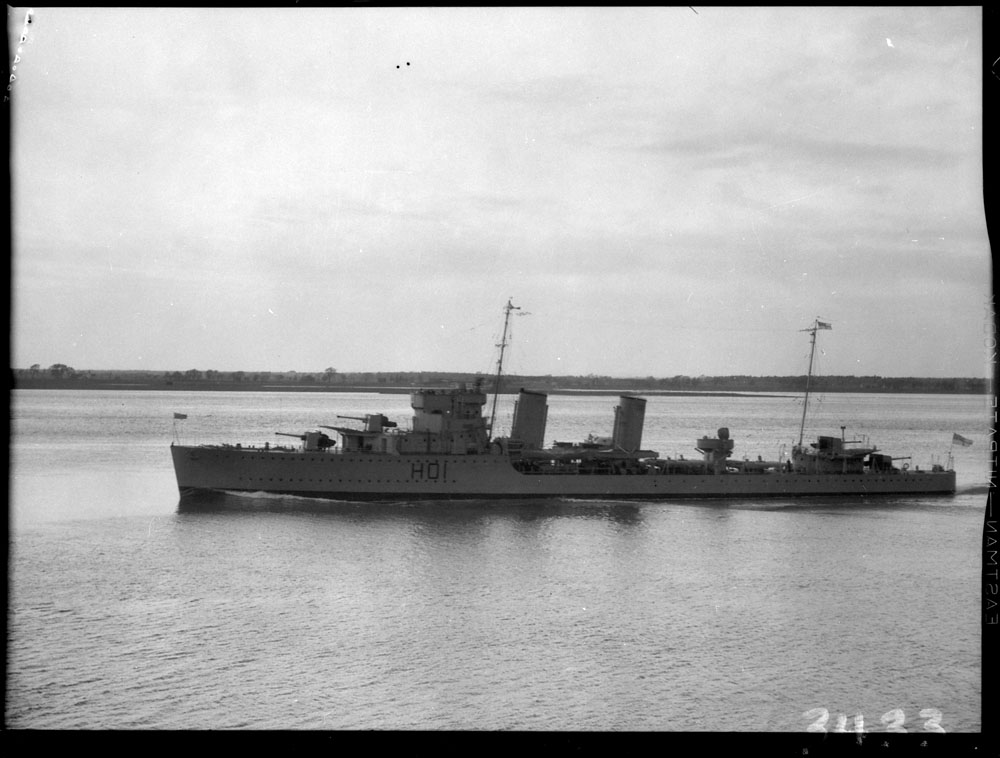
Meanwhile at sea, for a year or more, HMCS Saguenay and a handful of other River-class destroyers had conducted Canada’s naval war virtually alone. Since spring they had fought beside Royal Navy warships against submarines prowling the coasts of Britain as part of the anti-invasion fleet. When the ships and RAF Coastal Command planes made things too difficult there, the U-boats moved west. With Iceland now available as a base (after the British invasion in May 1940), the aircraft and escort ships followed them.

The five Canadian destroyers remaining in Britain (Assiniboine, Ottawa, Restigouche, St. Laurent, and Saguenay), were employed escorting outbound convoys to their dispersal point, roughly 12-15 degrees west, and then returning with inbound convoys to harbour. On December 1 1940 while escorting a convoy, Saguenay was struck on her port bow by a torpedo fired by the Italian submarine Argo: she was the first Canadian naval vessel hit by an enemy torpedo. The ship was nearly sunk, with a bent propeller shaft, a major fire amidships, and a section of the bow broken off. The crew were able to keep the ship afloat and moving at a modest two knots. Five officers and thirty-five crew were evacuated to the RN destroyer Highlander to reduce potential casualties in case of another torpedo attack; and throughout the night and most of the next day a skeleton crew fought fires and kept the hull from further flooding. Tugs arrived later that evening, but the ship had built up to a respectable six knots by that point and the commanding officer decided she could carry on under her own power. At noon next day she rounded the north coast of Ireland with the fires out and her steering gear back in operation. She triggered an acoustic mine as she approached Barrow-in-Furness, and with new stern damage and salt water contaminating her remaining fuel, she had to accept a tow, and reached port on December 5th.
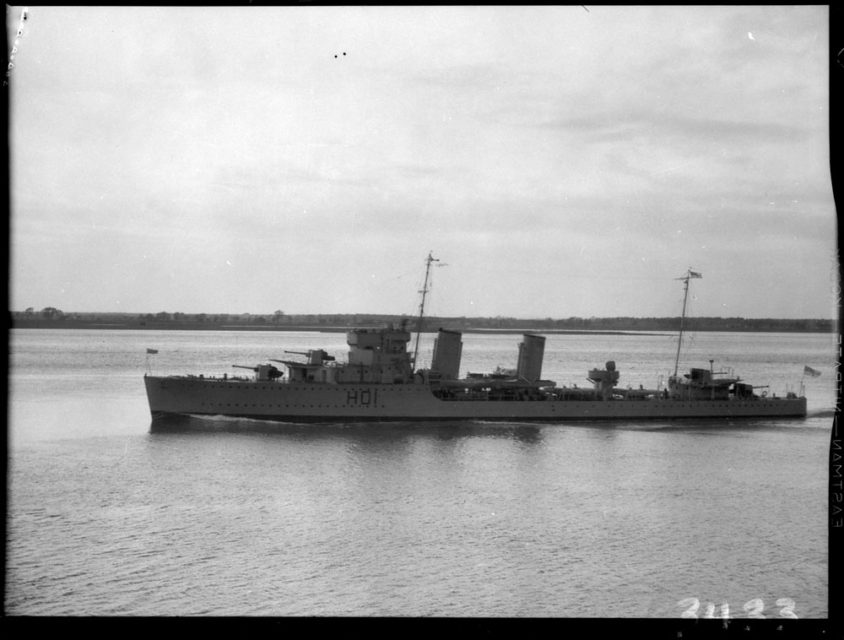
HMCS Saguenay near Montreal in 1932.
Clifford M. Johnston / Library and Archives Canada / PA-056550

Saguenay lost twenty-three men and sustained grievous injury to her hull but she had done the job she was supposed to do: the speed with which her guns went into action, said an Admiralty report, had forced the submarine to dive and prevented it from attacking any merchant ships. More and more Canada’s rapidly expanding navy was being forced into a new way of thinking, moving away from pre-war training and ideas. Sink U-boats when possible, but above all protect the convoy. Now Saguenay would be out of action for several months while the repairs were effected. Six destroyers had grown to seven with Assiniboine in October 1939, then back to six with the loss of Fraser in June 1940. HMCS Margaree (originally HMS Diana) had been purchased from the British to replace Fraser, but had been lost herself in a collision with a freighter at night in October 1940 with the loss of 142 of her 176 officers and crew. It was her first escort mission. Skeena was refitting in Halifax, leaving only five RCN destroyers to support the anti-submarine campaign.

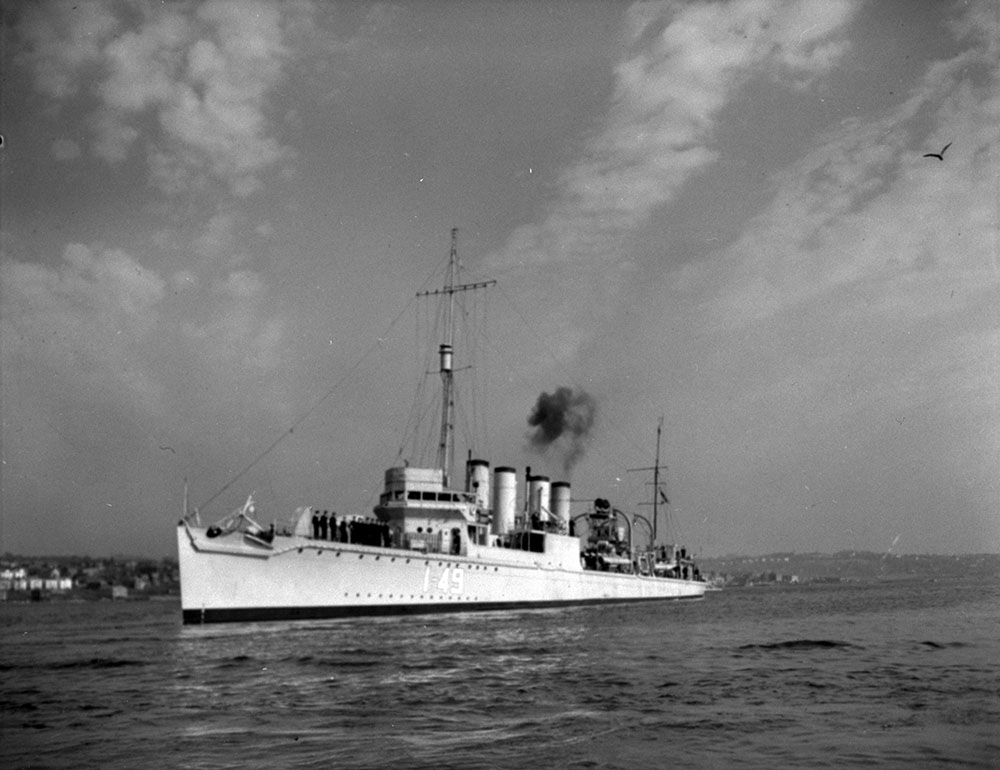
Saguenay‘s involuntary removal from active service happened around the same time that help finally began to arrive from two sources. One was from the arsenal of a friendly neutral, the other from Canada’s own shipyards. The “Four-Stackers”, 50 overage destroyers given by the United States in exchange for 99-year leases on British bases in the Americas, began to arrive in December, 1940. Prime Minister Mackenzie King had been involved in the deal from the beginning, often acting as an intermediary between Winston Churchill and Franklin Roosevelt. The Americans were also pressing for basing rights in Canada and President Roosevelt wanted the Canadians to receive some of the destroyers being transferred. The Canadian government was not interested in granting base rights for what it felt was a small number of “ancient” destroyers, but the navy was told to prepare for them should they be forthcoming. The RCN was unenthusiastic — the ships were not considered to be as suitable as the River-class ships currently in service, and were unlikely to be of any long-term value at all.

Acting Captain (later Rear Admiral) H.G. DeWolf, Director of Operations in Halifax in late Summer 1940, recalls that the navy only grudgingly accepted the deal after Admiralty pleas for the RCN to take at least some of the ships. Canada accepted seven of what became known as the Town-class (the RN designation), six of which were named for Canadian rivers, the seventh, HMCS Hamilton, saw some RN service before transfer to the RCN, retaining her British name. As the American ships arrived in Canadian ports en route to the UK, the new crews were struck by American generosity; every inch of storage space was crammed with provisions now only a memory in England. There were bunks instead of hammocks; there were typewriters, radios, coffee-making machines. Unfortunately, there were also defects which quickly became apparent at sea. The lean, four-funnelled destroyers, emergency vessels laid down during the last year of the First World War, had been built in haste for a less technical conflict. They were not sufficiently maneuverable against U-boats and their sea-keeping qualities left much to be desired. Their narrow beam and shallow draft made them difficult to handle in rough North Atlantic weather. The mess deck bunks, for all their pleasant appearance, made exorbitant demands on the men’s crowded living space and their steering gear was flimsy and cranky. Any ships were better than no ships however, and although seldom loved and frequently hated by those condemned to sail them, four were sent to bolster the destroyers already operating in British waters. They would eventually form a crucial element of the fleet’s escort forces by virtue of their few positive qualities: they were fast and well-armed. Commodore L.W. Murray went with them and took command of all Canadian ships and establishments in the UK.
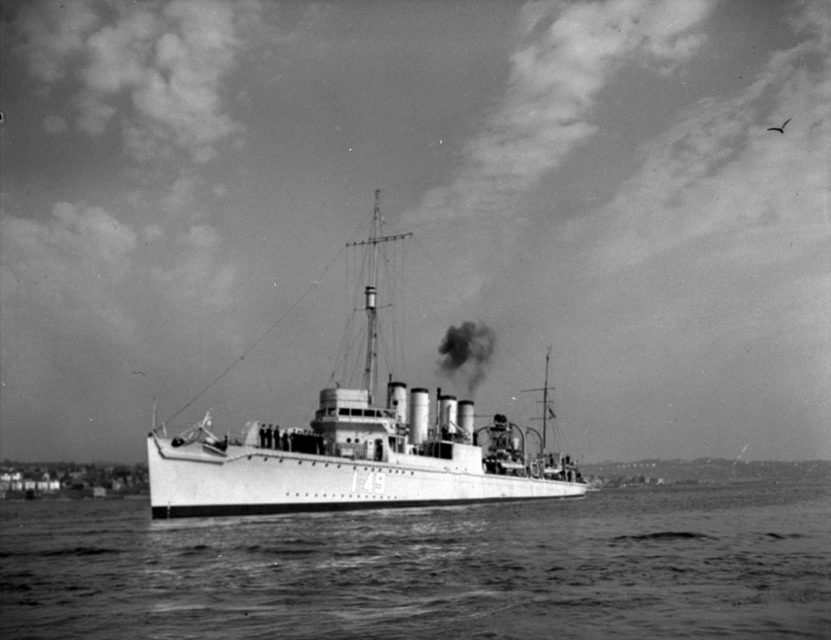
HMCS Columbia, originally US Navy destroyer USS Haraden, transferred to the RCN through the “destroyers for bases” deal.
Canada. Dept. of National Defence / Library and Archives Canada / PA-104178

[Editor’s Note: One of these four-stackers ended up with a fantastically varied post-transfer career: HMCS Leamington started as the USS Twiggs, becoming HMS Leamington in the destroyers-for-bases swap, was then transferred to the RCN (excitements in Canadian service included two collisions at sea and at least one near-sinking due to ice buildup while on winter convoy duty), then back to the RN, then she became a Soviet destroyer called the Zhguchi (“Fiery”), returned to RN service in 1950, then was temporarily renamed HMS Ballantrae for the film Gift Horse (released in North America as Glory at Sea), which was a fictionalized re-telling of the St. Nazaire raid in the HMS Campbeltown role, then finally sold for scrap in 1951. That is a full naval career!]

The autumn and winter of 1940 also saw the first of Canada’s new corvettes waddle their way down the St. Lawrence river into RCN service.

Returning to the Autumn of 1939, for purely RCN purposes, the navy estimated that around 40 anti-submarine vessels were needed over three years. Since some of the requisitioned ships were suitable for local duties, not all of the new vessels need be corvettes. It was also necessary to establish a rate of exchange if the smaller ships were to be bartered for Tribals. Quick resolution of these issues was essential if the full complement of the RCN’s first planned expansion phase (two Tribals, twenty corvettes, and twelve minesweepers) was to be in commission by Spring of 1940, as the Naval Staff hoped. The RCN did not get off the mark as quickly as it wished. Detailed drawings needed to begin construction of corvettes did not arrive from Britain until early 1940. The placing of orders was also complicated by the requirement that the navy deal with contractors through a third-party, the War Purchasing Board (later the Department of Munitions and Supply). In fact, the lack of official links to manufacturers and the interposition of another department between NSHQ and industry seriously complicated the process of modifying specifications in light of rapidly changing requirements.

Editor’s Note: J.L. Granatstein wrote of the creation of this ministry in Arming The Nation: Canada’s Industrial War Effort, 1939-1945 (PDF), emphasis mine:]

…the Liberal government of Mackenzie King in June 1939 had passed the “Defence Purchasing, Profits Control and Financial Act” which aimed to control profits and the costs of defence contracts. Profits could not exceed 5 percent, a stipulation that meant that soon after the war began, C.D. Howe, the Minister of Transport, told the House of Commons that Canada had not managed to place a single contract. The Act had also created the Defence Purchasing Board to coordinate purchases, and in its short life (July 14 to October 31, 1939) the Board managed to buy only $43.7 million worth of goods, with three-quarters of the orders placed after Nazi Germany had invaded Poland in September 1939 and Britain and France had declared war against the Hitler regime on September 3; Canada had followed with its own declaration of war one week later.

One of the first casualties of the Second World War was this system of profit controls, quickly repealed so that war orders could be placed. A second casualty was the Defence Purchasing Board itself, replaced on November 1, 1939 by the War Supply Board, led by Wallace Campbell, the president of the Ford Motor Company of Canada. Initially, the new Board fell under the control of the Finance Minister, but in mid-November, in a fateful and fortunate move, the Board came under the ambit of the Minister of Transport, the just-named Minister of Munitions and Supply, Clarence Decatur Howe. Howe had no department as yet, only a title. But when the War Supply Board was swallowed by the new department on April 9, 1940, just days after the King Liberals’ election victory, Canadian war production had found its czar.

The first Canadian orders for corvettes were not placed until February 1940, when fifty-four were contracted to be built. Of these, only twenty-four (roughly equivalent to first expansion phase) were intended for RCN service. The remainder were to be bartered for destroyers. Ten more corvettes were ordered by the RCN before the end of the month as replacements for some of the requisitioned auxiliary ships and to maintain a steady rate of construction in Canadian yards. By the end of February the First Construction Program was completed: sixty-four corvettes and twenty-four Bangor minesweepers (completion delayed until August 1940, as not enough qualified builders could be found right away). When the barter scheme (corvettes-for-Tribals) fell though in March 1940 because an exchange rate could not be agreed upon, the RCN found itself “holding contracts for considerably more corvettes than it intended to build”. The contracts could have been cancelled, having only just been signed, but the RN agreed to take ten of the vessels being built in Canadian yards, lowering the total for Canada down to 54, only seven more than what the navy had intended to have by 1942 anyway. For this reason, as well as political and economic pressures, the orders were allowed to stand. In August 1940 another six corvettes were ordered along with ten more Bangors to maintain continuous work in the shipyards (and to help retain the skilled workers).

Marc Milner continues:

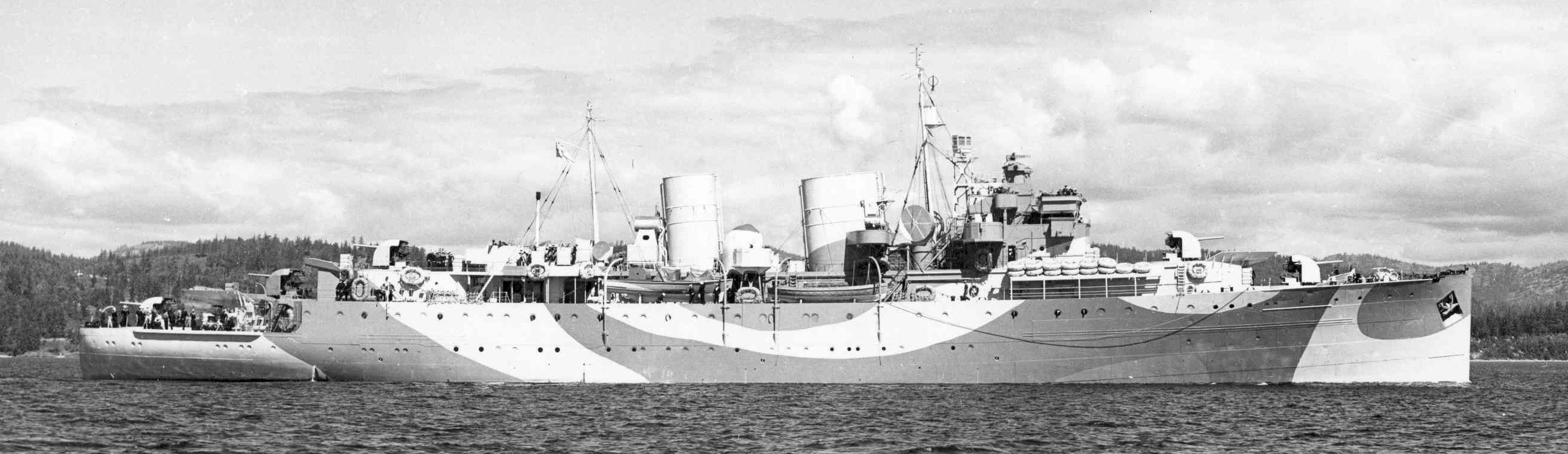
What this embarrassment of riches meant was an acceleration of the navy’s hitherto cautious expansion plans and the jamming of three years of careful growth into less than two. Small wonder, then, that the personnel requirements overtook projections. Despite this, it is doubtful that the prospect of commissioning extra auxiliaries troubled anyone at NSHQ, particularly when the failure of the barter scheme was followed by the news that the British would allow the construction of Tribals to Canadian accounts in UK yards. The latter ensured that the main thrust of fleet expansion would go ahead. Two Tribals were duly ordered in 1940 and two more in early 1941, but none was completed in time to meet the requirements of the first expansion phase. As an interim measure, the navy requisitioned three small liners, Prince David, Prince Henry, and Prince Robert, and converted them to armed merchant cruisers (AMCs). The Prince ships remained the RCN’s most powerful units until the first of the UK-built Tribals were commissioned in early 1943.
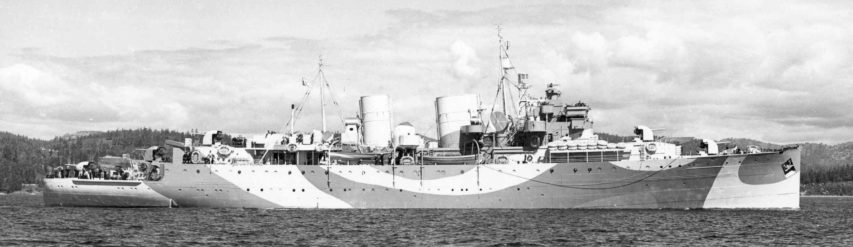
HMCS Prince Robert, one of the RCN’s three armed merchant cruisers. All were converted to other roles later, and two were returned to civilian use after the war.
Photo via http://www.airmuseum.ca/rcn/princes.html

The matter of building Tribals in Canada was never wholly abandoned. The navy was well pleased with its arrangements of a British supply, but long term plans called for more than four. In April 1941 the subject of building Tribals in Canada was discussed once again by the Naval Council (the administrative and policy body of the naval service, chaired by the minister, with senior Naval Staff officers as members). The engineer-in-chief, Captain G.L. Stephens, advised against attempting such complicated building in Canada in the middle of a war. It was bound to be a long and expensive proposition, he warned, if for no other reason than that it was hardly worth tooling up industry to produce specialized steel plate and equipment for so small an order. Moreover, Stephens believed, construction of Tribals was likely to tie up manpower and resources which could be better used. Nelles agreed with his engineer’s views but felt that if such ships could be built in Canada, the navy should not waste its time on smaller “stepping stones”.

The problem had also been considered by the government. [The Minister of Defence for the Naval Service, Angus L.] Macdonald, was under considerable pressure from politicians and the press in his home province to secure wartime capital investment in Atlantic Canada. Indeed, although Canada was prospering from the war, an incredibly small percentage of new capital investment found its way eastward (just 2.5 per cent by 1944). Of the major wartime ship contracts let by May 1941, only three — all corvettes ordered from Saint John Ship Building and Drydock Company — were placed in the Maritimes. Mackenzie King wanted contracts for merchant ships let to Halifax shipyards, but Macdonald preferred destroyers. Without the latter, he explained in a letter to C.D. Howe, the dynamic minister of Munitions and Supply, the merchant ships would not get through. Macdonald wanted building in Halifax “confined to destroyers”, which were “all in all, the best type of escort.” Howe, who had survived the sinking of the SS Western Prince in December 1940 while on his first trip to Britain as minister of Supply, needed no convincing of the need for ships — or for escorts. Further, Howe, like Macdonald, wanted some construction undertaken soon in order to stabilize the employment situation for ship-repair workers, and thereby establish a pool of skilled labour for use in an emergency. Since the government was determined to build something, the navy was happy to support the construction of Tribals. Owing largely to the need to retool industry, it was not until September 1942 that the first keel was laid, and in the rush to complete the hulls, the Tribals drained manpower away from essential ship-repair tasks: quite the opposite of the original intention, and precisely the fear expressed by the navy’s senior engineer.

[Editor’s Note: J.L. Granatstein also discussed the RCN’s efforts to obtain Tribal-class destroyers:]

The growth was as rapid in naval construction which eventually employed some 30,000 workers. The first orders for corvettes, the Royal Canadian Navy’s main anti-submarine and convoy escort vessel, were placed in February 1940 and the first ten keels were laid that month. By the end of the year, 44 corvettes had been launched and an even dozen were manned. In all, 206 corvettes were built in Canada, most on the east and west coasts but many in Great Lakes ports and on the St Lawrence. At the same time, Canadian yards built frigates and minesweepers, tugs and landing craft, motor torpedo boats, patrol boats, and Tribal class destroyers. The last class of ships, greatly desired by the Navy, was the shipbuilding equivalent of the Lancaster, a step too far.

Half as big again as the destroyers with which the RCN began the war, the Tribals were heavily armed and fast, almost as powerful as a light cruiser. The Navy secured four such destroyers from the Royal Navy (Haida, Athabaskan, Huron, and Iroquois), but it wanted more and, late in the war, it secured Munitions and Supply’s permission to build four Tribals in Halifax yards. It was a quantum leap forward from constructing corvettes and frigates to building Tribals and, while they were completed, none was in the water and crewed before the war against the U-boats had ended on V-E Day, May 8, 1945.
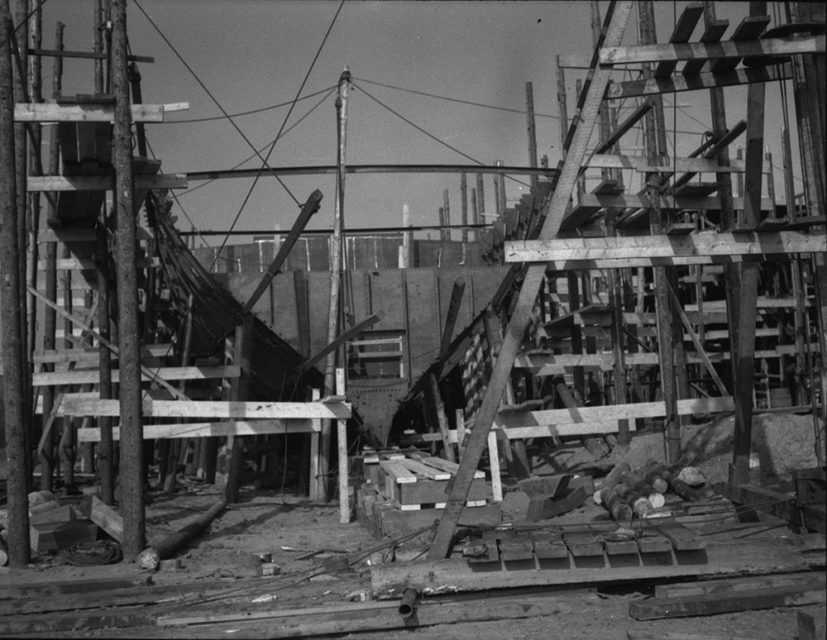
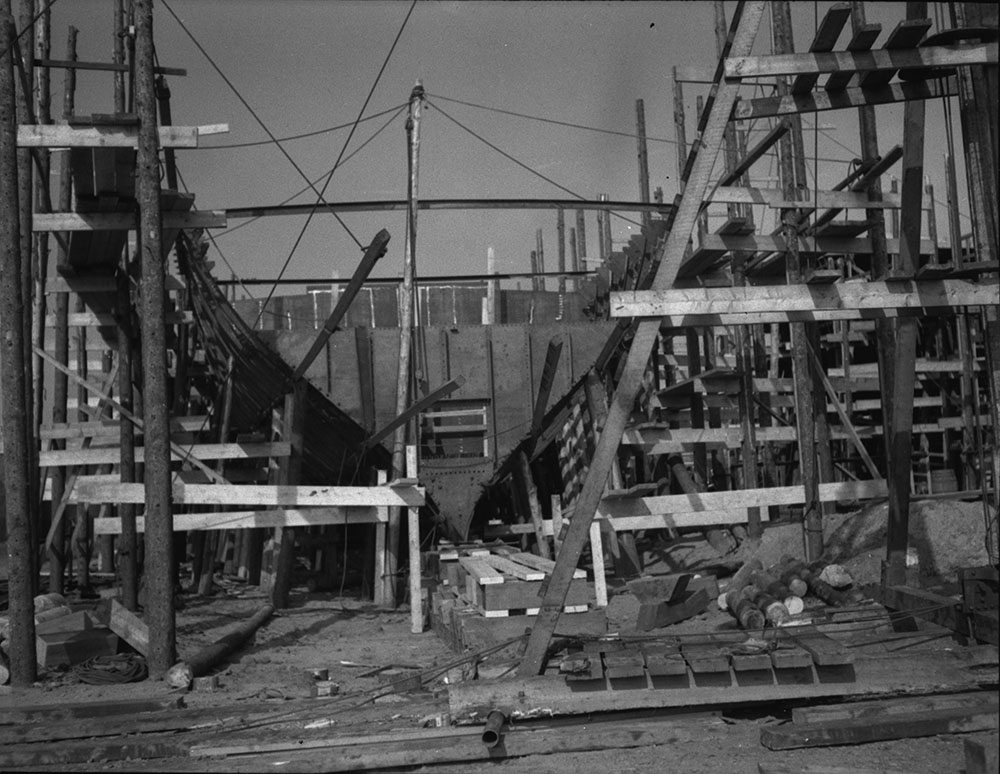
Hull of an RCN corvette (probably HMCS Moncton) under construction at Saint John Drydock and Shipbuilding Ltd.
Canada. Dept. of National Defence / Library and Archives Canada / PA-104134

Returning to Winter 1940, the Towns were being taken into service, the first corvettes arrived, and the RCN’s River-class destroyers returned to ocean convoy escort duties. With the U-boats now operating from the Atlantic littoral and with the adoption of pack tactics, losses to convoyed shipping had been mounting during the second half of 1940. From the outbreak of war to February 1940, only seven of the one hundred and sixty-nine ships lost to enemy action had been sailing in convoys. In August, the U-boats began attacking at night and on the surface in the style of torpedo boats: losses jumped quickly. In September alone, forty of the fifty-nine U-boat attacks on shipping were directed at convoy targets. With the adoption of these tactics by the Germans the “Battle of the Atlantic”, as it captured the popular imagination and forms the basis of this study, finally began. The intensification of the U-boat campaign on Allied shipping eventually forced a reallocation of all available ships to escort duty.

Editor’s Note: As the first of Canada’s new corvettes joined the fleet, it’s worth getting a look at the cultural differences between the “real navy”, the professionals of the RCN, and the very different “hostilities only” officers and ratings of the RCNR and the RCNVR, as related by James B. Lamb in The Corvette Navy:

Canada’s second navy was a much different force: a bunch of amateur sailors, recruited from every walk of civilian life, manning ships deemed too small for command by professional naval officers. The ships — Algerines, corvettes, frigates, Bangors — were as cheap as they could be built, and their officers and men were involved, not with admirals and captains, but with characters like Two-Gun Ryan, Harry the Horse, Death Ray, Foghorn Davis, and The Mad Spaniard. It was an amateur, improvised, cut-rate navy, the little navy, Canada’s other navy, manned by amateurs like me.

The division between the two navies was surprisingly complete and clear-cut; few regular career Canadian naval officers ever kept watch aboard a corvette, and only a handful of corvette crewmen were RCN ratings. For shortly after the outbreak of war, a strange process began. The little handful of professional naval officers — all that the country possessed and the only Canadians trained over long peacetime years to fight a war at sea — were bustled ashore into offices. There they presided over clerks and typists in a series of administrative posts for which they had received no training at all. Most of them never went to sea again.

Their places afloat were taken by a handful of former merchant seamen, now officers of the Royal Canadian Naval Reserve, and by young men in the Royal Canadian Naval Volunteer Reserve, many of whom were culled from offices ashore and most of whom had never been to sea before. It was a situation worthy of Gilbert and Sullivan: trained seamen were put in offices ashore and trained office managers were sent to sea. As a result, Canada’s professional naval officers were to play an ever-diminishing role in the Battle of the Atlantic.

This curious situation had been brought about by a miscalculation of the role the corvettes could play in the naval war. Originally they had been regarded as a stop-gap, and, as such, unworthy as commands for Canada’s few, and precious, trained naval officers. Apart from those allowed afloat in the RCN’s handful of pre-war destroyers, permanent-force officers were hoarded ashore against the time when the new super-ships would appear to fight the glorious Armageddon against Germany’s powerful surface fleet.

[Editor’s Note: By the time the professionals got their hands on the “real” ships they’d been waiting for — Tribals, then cruisers and even an aircraft carrier — there was no German surface fleet left to fight, and the scruffy, disreputable amateurs had ended up being the ones to fight the real battle: the one that mattered after all.]


George Orwell BBC Arena Part 2 – Road to Wigan Pier

Filed under: Books, Britain, History, Politics — Tags: , , , , , — Nicholas @ 04:00

Alan Ruben
Published on 14 Apr 2013

Part 2 of an in-depth 5 part series about George Orwell made in 1983.

The Brexit trainwreck is “revealing to the British public the extent of its political class’s incompetence”

Theodore Dalrymple in City Journal on the scale of political tomfoolery going on in the Brexit clusterfutz:

The imbroglio over Brexit has at least had the merit of revealing to the British public the extent of its political class’s incompetence. If it is accepted that people get the leadership that they deserve, however, thoughts unflattering to self-esteem ought to occur to the British population.

Theresa May did not emerge from a social vacuum. She is typical of the class that has gradually attained power in Britain, from the lowest levels of the administration to the highest: unoriginal, vacillating, humorless, prey to the latest bad ideas, intellectually mediocre, believing in nothing very much, mistaking obstinacy for strength, timid but nevertheless avid for power. Thousands of minor Mays populate our institutions, as thousands of minor Blairs did before them.

Avidity for power is not the same as leadership, and Brexit required leadership. There was none to be had, however, from the political class. From the very first, it overwhelmingly opposed Brexit — for some, the eventual prospect of a tax-free, expense-jewelled job in Brussels was deeply alluring — but found itself in a dilemma, since it could not openly deny the majority’s expressed wish. Many Members of Parliament sat for constituencies in which a solid majority had voted for Brexit. They feared that they would not win their next election.

The opposition Labour Party was as divided as the Conservatives. Irrespective of what its MPs actually believed about Brexit—its leader was, until recently, ardent for leaving the European Union, which he believed to be a capitalists’ club, changing his mind for reasons that he has so far not condescended to disclose — its main concern was to force an election that it believed it could win, a victory that would soon make Brexit seem like a minor episode on the road to ruin. The majority of the Labour MPs wanted first to bring about the downfall of a Conservative government and second to prevent Britain leaving the European Union without an agreement — what might be called the leaving-the-Union-without-leaving option. But they wanted the first more than they wanted the second, so under no circumstances could they accede to anything that Prime Minister May negotiated. Because of her tiny majority in Parliament, the hard-line Brexit members on her own side who want Britain to leave without a deal, and the refusal of her coalition partner, the Democratic Unionist Party, to back her, May needs the support of a considerable proportion of Labour MPs — which, so far, she has not received.

But the House of Commons as a whole, including the Conservatives, deprived May of leverage with which to renegotiate, because it voted that it would not accept leaving the Union without a deal. This deprived the European Union of any reason to renegotiate anything: it was a preemptive surrender to the demands of the E.U. that makes Neville Chamberlain look like a hard-bitten poker champion.

If Shakespearean Insults Were Used Today – Anglophenia Ep 13

Filed under: Britain, History, Humour — Tags: , — Nicholas @ 02:00

Anglophenia
Published on 24 Sep 2014

Siobhan Thompson reacts to everyday office frustrations with some barbs from the Bard. Check out the Shakespeare plays from which the insults originated here: http://www.bbcamerica.com/anglophenia…

QotD: Debunking the “MSG is harmful” myth

Filed under: Business, Food, Health, Quotations, Science — Tags: , — Nicholas @ 01:00

The story of MSG is a true tragedy. The negativity associated with this delicious amino acid is due to a spurious study from 1968 that linked MSG with the “Chinese Restaurant Syndrome.” This study connected that gut-bomb feeling you sometimes get after eating Chinese food to MSG, despite the fact that the typically cheap Chinese food prepared in American restaurants is fatty and served in large portions, and (like any restaurant), the food can be spoiled. My mom theorizes that lots of MSG was used to cover up the fact that, say, shrimp was a day past its prime, and that the sick feeling was due to the food but got blamed on the MSG. There’s never been a scientifically rigorous study that’s linked MSG with any negative effects. MSG should be used frequently and added to anything that needs the flavor drawn out, especially soups. But it enhances virtually anything it touches: Once, eating pizza at home, a friend scanned my spice rack and saw a jar with white powder whose label, in my grandfather’s messy scrawl, read what looked like “MS6.” He sprinkled it on his pizza and came to find me, telling me that whatever MS6 was, it was the most amazing thing he’d ever tasted. Yes, MSG makes even pizza better.

Caitlin PenzeyMoog, “Salt grinders are bullshit, and other lessons from growing up in the spice trade”, The A.V. Club, 2017-04-06.

April 4, 2019

Ingram M10 & M11 SMGs: The Originals from Powder Springs

Filed under: Business, History, Military, Technology, USA, Weapons — Tags: , , , , — Nicholas @ 06:00

Forgotten Weapons
Published on 3 Apr 2019

These SMGs are lots 1069 (M10/45), 1070 (M10/9), and 1067 (M11) at Morphy’s April 2019 auction:
https://www.forgottenweapons.com/ingr…

After the commercial failure of Gordon Ingram’s M6 submachine gun in the early 50s, he would radically change the layout of his designs. Instead of a Thompson-lookalike Ingram’s M10 (the M7, M8, and M9 doing experimental prototypes only) would be a boxy and compact affair with a Czech-style telescoping bolt. It found little interest until a meeting between Gordon Ingram and Mitch WerBell resulted in WerBell demonstrating it to excited military audiences in Vietnam in 1969.

WerBell was an ex-OSS man who had started a company called Sionics, selling suppressors to the US military. He thought the combination of Ingram’s submachine gun and his suppressor would be a fantastic package, and he found plenty of interest among special operations personnel in Vietnam. He would create the Military Armament Corporation based at his farm in Powder Springs, GA and entice Ingram to join as his chief engineer. The result would be the .45ACP M10, a 9mm version of the M10 (made for use with subsonic 9mm ammunition), and a scaled-down .380 ACP M11 submachine gun.

MAC would have a short life, with all its assets sold at a bankruptcy auction in April 1976 – but it had plenty of time to create what would become an iconic gun – the Big MAC. Many imitations and copies would follow, but Powder Springs was the home of true original Ingram M10 and M11 submachine guns!

http://www.patreon.com/ForgottenWeapons

Cool Forgotten Weapons merch! http://shop.bbtv.com/collections/forg…

Contact:
Forgotten Weapons
PO Box 87647
Tucson, AZ 85754

Of course Facebook is now in favour of government regulation … it’ll keep out their competition

The recent calls for the government to regulate social media got support from Mark Zuckerberg, which seems to have surprised some in the media. It’s not at all uncommon for established firms to not only welcome government oversight but to actively support it — because it’s a highly effective strategy to strangle smaller competitors and keep new competitors from entering the field:

On Saturday, Mark Zuckerberg appealed to the government for increased regulation of the internet including his company Facebook. According to Zuckerberg, increased government action is needed to protect society from harmful content, ensure election integrity, protect people’s privacy, and to guarantee data portability. If enacted, the government would possess a wide range of control over internet businesses. For Zuckerberg, this is for the public’s best interest.

But make no mistake about it, Zuckerberg’s cries for regulation is not an appeal to his humanitarianism. On the other hand, it solves glaring issues that Facebook has faced since the 2016 election.

[…]

With increased government oversight, Facebook’s leadership will finally be able to pass the buck to someone else. The government will provide them with a clear set of rules that they will be accountable for. Any negative press coverage that occurs outside of those guidelines, will not be attributable to their company but to the rule-making body of the government. This will allow Facebook’s leadership to regain credibility within a clearly definable framework that they are not responsible for creating.

But perhaps Zuckerberg’s appeal for regulation is even more cunning. Government regulation will undoubtedly be met with higher costs. Internet companies will have to spend more on staffing to be in compliance with the increased burdens implemented by the rule-making body. We saw this play out in the banking industry after the Great Recession. A study conducted last year found that since 2009, banks have been fined a total of $345 billion dollars in penalties and noncompliance costs. Further, another study found that in 2016 banks spent $100 billion dollars on regulatory compliance alone.

Large internet companies like Facebook and Google will easily absorb the strain of increased regulatory costs. It is the smaller businesses that will feel the financial squeeze. With increased regulatory compliance spending, smaller startups will face an even bigger hill to climb to compete with the likes of Facebook.

Another “feature” of government regulation is what is known as “regulatory capture”, as the regulating body and the regulated organizations, after an initial period of ostentatious “conflict”, settle down into a cosy symbiotic relationship … in only a few years, many of the regulatory staff will find themselves working for one of the regulated organizations, and vice-versa. The regulatory body will — like all bureaucracies — start to care more about keeping itself alive and growing than about the original reason it was set up. Small organizations will stall or go extinct, and only the existing dinosaurs will carry on, protected from competition by their regulator’s powers.

George Orwell BBC Arena Part 1 – Such, Such Were the Joys

Filed under: Books, Britain, History — Tags: , , , , , — Nicholas @ 04:00

Alan Ruben
Published on 4 Mar 2013

Part 1 of an in-depth 5 part series about George Orwell made in 1983.

LPC Omertà in action

Filed under: Cancon, Government, Law, Politics — Tags: , , — Nicholas @ 03:00

Omertà, according to Wikipedia, is “a Southern Italian code of honor and code of silence that places importance on silence in the face of questioning by authorities or outsiders; non-cooperation with authorities, the government, or outsiders; and willfully ignoring and generally avoiding interference with the illegal activities of others.” It’s also a remarkably appropriate way to describe the Liberal Party of Canada’s standard operating procedure:

“Ultimately the choice that is before you,” Jody Wilson-Raybould pleaded with her caucus colleagues, in a letter written hours before they were to pass sentence on her, “is about what kind of party you want to be a part of, what values it will uphold, the vision that animates it, and indeed the type of people it will attract and make it up.”

But they made that choice long ago. They knew what kind of party they wanted to be a part of from the moment they accepted their nominations; indeed, were they not the type of person that party attracts they would not have been recruited for it. It is the kind of party, and person, that unquestioningly puts loyalty to party before principle — and mercilessly punishes those who do not.

So on the question of whether to expel the former minister of justice and attorney general — along with the former Treasury Board president, Jane Philpott — for the crime of denouncing the attempt, by the prime minister and senior government officials, to interfere with a criminal prosecution, there could have been little doubt how they would vote.

Whether they chose to shoot the messengers so spontaneously, over Justin Trudeau’s objections, as some reports have claimed — they were “determined to take the matter into their own hands,” according to a Canadian Press story, as if MPs were so eager to prove their obedience to the leader as to be willing to defy him — or whether they did so under orders doesn’t much matter. The rotting of the soul is the same either way.

We can now see, if it were not already apparent, the moral compass by which the prime minister and his caucus steer. The scandal in the SNC-Lavalin affair is, by this reckoning, not the months-long campaign to subvert the independence of the attorney general and, through her, to force the independent director of public prosecutions to drop charges of fraud and corruption against a long-time Liberal party contributor, but the opposition to it.

Traditional political theory teaches that the executive branch of government is responsible to the legislative. It is now clearer than ever that the reverse more nearly applies: members of the Liberal caucus plainly see it as their role, not to hold the government to account, but rather their fellow MPs — on behalf of the government. When wrongdoing by those high in government is alleged by a pair of whistleblowers, their first thought is to root out the whistleblowers.

Mythology Matters – Gilgamesh Meaning – Extra Mythology – #3

Filed under: History, Middle East — Tags: , , — Nicholas @ 02:00

Extra Credits
Published on 3 Apr 2019

Join the Patreon community! http://bit.ly/EMPatreon

The myth of Gilgamesh is a metaphor for building a civilization — yes, really? Let’s go behind-the-scenes on our Bronze Age myth!

QotD: Anti-masculinity

Filed under: History, Quotations, USA — Tags: , , , — Nicholas @ 01:00

One of the many harms inflicted on us by the hive minded lunatics running our society is the binary world view. Everything is either all good or all bad. As such, everyone must either fully embrace something or completely reject something. Indifference, ambivalence and moderation are not permissible in a world run by zealous fanatics. The only things that matter, that can matter, are those things that require a moral position. Everything else falls outside the set of things that exist, at least to the hive minded.

The most obvious example is homosexuality. Like all normal men, I am mildly intolerant of homosexuals. I get that they cannot help themselves and I get that it is “natural” in the same way schizophrenia is natural. I’m fine with them doing what they must, just as long as they do it in private. Of course, that makes me a monster. In the hive, you must either fully embrace homosexuality and what comes with it, or you are a homophobe and not fit for decent company. There’s no room for indifference or mild intolerance.

Hive mindedness is much more of a female attribute, than a masculine one. That’s not to imply that all women are howling at the moon zealots. It’s just that the fairer sex is much more inclined to deal in absolutes. The reason is that men have ways to arbitrate disputes that do not require a transcendent set of rules. One chimp squares off with the other chimp and the winner is the one who was right about where to find the best bananas. Women don’t have that so they look for a set of rules to figure out winners and losers.

It’s why it was no accident, that as soon as the girls got the vote, and the boys were off fighting the Kaiser, the girls banned alcohol and prostitution. To quote Judge Roy Bean, “Drinking and gambling and whoring were declared unlawful. All those things which come natural to men became crimes.” Morality, at least in the modern age, is the set of rules the girls use to control the boys, which is why the prim-faced moralizers of today are running around trying to stamp out anything that smacks of masculinity.

“The Z Man”, “Pouf-berries”, The Z Blog, 2017-04-08.

« Newer PostsOlder Posts »

Powered by WordPress