
The horse is native to the Eurasian Steppe – that is where it evolved and was first domesticated, though the earliest domesticated wild horses were much smaller and weaker (but more robust and self-sufficient) than modern horses. The horse was first domesticated here, on the Eurasian Steppe, by the nomadic peoples there around 3,700 BCE. It seems likely that the nomads of the steppe were riding these horses more or less from the get-go (based on bridle and bit wear patterns on horse bones), but the domesticated horse first shows up in the settled Near East as chariotry (rather than cavalry) around 2000 BCE; true cavalry won’t become prominent in the agrarian world until after the Late Bronze Age Collapse (c. 1200 BCE).
I wanted to start by stressing these dates just to note that the peoples of the Eurasian Steppe had a long time to adapt themselves to a nomadic lifestyle structured around horses and pastoralism, which, as we’ve seen, was not the case for the peoples of the Americas, whose development of a sustainable system of horse nomadism was violently disrupted.
That said, the steppe horse (perhaps more correctly, the steppe pony) is not quite the same as modern domesticated horses. The sorts of horses that occupy stables in Europe or America are the product of centuries of selective breeding for larger and stronger horses. Because those horses were stable fed (that is, fed grains and hay, in addition to grass), they could be bred much larger what a horse fed entirely on grass could support (with the irony that many of those breeds of horses, if released into the wild in their native steppe, would be unable to subsist themselves), because processed grains have much higher nutrition and calorie density than grass. So while most modern horses range between c. 145-180cm tall, the horses of the steppe were substantially smaller, 122-142cm. Again, just to be clear, this is essential because the big chargers and work-horses of the agrarian world cannot sustain themselves purely on grass and the Steppe nomad needs a horse which can feed itself (while we’re on horse-size, mustangs, the feral horses of the Americas, generally occupy the low-end of the horse range as well, typically 142-152cm in height – even when it is clear that their domesticated ancestors were breeds of much larger work horses).
Bret Devereaux, “That Dothraki Horde, Part II: Subsistence on the Hoof”, A Collection of Unmitigated Pedantry, 2020-12-11.
May 19, 2023
QotD: The horses of the Eurasian Steppe
May 18, 2023
How the Tabasco Factory Makes 700,000 Bottles of Hot Sauce Per Day — Dan Does
Eater
Published 4 Dec 2019On this episode of Cult Following, host Daniel Geneen heads to the McIlhenny factory on Avery Island, Louisiana, where the world’s supply of Tabasco sauce is made. Follow along as Daniel learns about the 150-year-old family-run business, and the Tabasco-making process, from pepper to barrel to bottle.
(more…)
QotD: The unironic joys of British cuisine
Indeed, it would be trivially easy to trace the shifting faultlines of broader political currents through the prism of food. Witness the sudden shift within America’s food culture, as a previous generations’ celebration of the diverse culinary options provided by mass immigration has morphed into stern lectures from diaspora commentators on the vaguely-defined evils of white people appropriating “ethnic” cuisine. In Britain, equally, a slim volume could easily be written on the political import uncomfortably burdened on fish and chips or chicken tikka masala by devotees of mass migration; a cultural theorist could likewise tease apart the “Proper” label now applied to a distinct category of foodstuff — proper pies, proper burgers, proper chips — as a marker of a specific type of middle-class yearning for proletarian authenticity, while maintaining socially acceptable levels of consumption standards. Like the fetishised fry-ups of London caffs in prosperous areas targeting themselves at tracksuit-wearing millennial creatives, the Proper Burger is the self-consciously gentrified football terrace of our national cuisine, a cultural marker of a precisely measurable socioeconomic bracket.
When this dynamic is considered, Britain’s strange relationship with food, and with its own national cuisine, becomes worthy of analysis. Though much mocked by online Americans, presumably inured to the Lovecraftian horrors of their own food culture, British cuisine at its best is hearty, simple fare, showcasing the natural bounty of these islands, our waters rich with fish and seafood (much of it exported abroad to more appreciative consumers), our rain-soaked pastures the nursemaid of the free-range meat and rich dairy goods Britain has excelled in for millennia. At its best, British food displays the worth of good ingredients cooked well — and at its worst, of poor ingredients cooked badly.
Yet the much-vaunted culinary renaissance in British food from the Nineties on, despite the buoyant effect of an endless stream of glossy cookbooks on the publishing industry, does not seem to have had an appreciable effect on the food most of us eat from day to day. Which British office worker does not recognise the moment of weary, grudging submission to the lunchtime meal deal, the limp and soggy sandwich which fuels the nation’s economy? If Britain has a national dish, it is more likely to be the Ballardian misery of the provincial train station panini, simultaneously scorching hot and half-raw, than it is a steaming steak and ale pie, its crust crisp with suet, or a plate of sizzling lamb’s liver fried in butter with farmhouse bacon.
There is, as there is with every aspect of British life, a strong class dynamic to British food. The most fervent appreciators of the frugal peasant dishes of the past, the nation’s only consumers of stewed beef shin or lamb sweetbreads, are more likely to be upper-middle class, middle-aged executives, who by lunching at St John or the Quality Chop House celebrate the forgotten folkways of their own country, than the call centre workers or shop assistants who have replaced our rural and industrial proletariat. Yet who in Britain is immune to the sudden craving for comfort satiable only by a serving of rich cauliflower cheese or of dark and savoury cottage pie, or has not felt the hobbit-like “Why shouldn’t I?” satisfaction of choosing the fry up at a hotel breakfast over the continental pastry selection?
Aris Roussinos, “How Britain eats itself”, UnHerd, 2023-02-03.
May 17, 2023
Texas Chili & The Chili Queens of San Antonio
Tasting History with Max Miller
Published 16 May 2023
(more…)
Posting will be variable for a little while …

“Flooded Basement” by Perfect Homes is licensed under CC BY 2.0 
 .
.
Specifically, our sump pump gave up the ghost overnight on Sunday and I didn’t discover this until I walked down the basement stairs on Monday morning and stepped into about a foot of cold water on the basement floor. Our basement is on a few different levels, so the foot or so I stepped into implied there were at least two feet of water in some other areas of the basement. We called the plumber and our insurance agent as soon as I was able to shut off the water main to the house and get back upstairs.
Once the plumbers were able to get the sump pump back online temporarily, the water level in the basement began to drop, just as the clean-up crew were arriving by way of the insurance agent. Things have been hectic around here since then, but especially once the insurance company notified us that our first claim in nearly 40 years was declined, and we had to scramble to find ways to scrape up money to pay for the plumber and the clean-up crew’s efforts. (Unlike normal people, we don’t have a ready reserve of several thousand dollars just sitting there waiting for a random emergency to pop up.)
I don’t know how long it will take to get back to normal, so if you see just the QotD and 2am video posts for a while, you can safely assume I’m still busy with domestic issues.
Fortunately, when Victor moved out, he took most of his valued possessions with him … although he’s bound to discover things he left behind that he now wishes he’d taken with him. I know I’ve lost a small bookcase full of wine books, as they were in the small room we’ve been using as a wine cellar and that’s at the lowest point in the basement. The top shelf might have been above the high-water line, but I haven’t been able to check yet. The wines themselves will be fine, although the labels may be a bit loose.
My moribund model train collection will be thinned out, as a lot of the books, magazines, plans, and other perishable items were also down close to floor level. Everything was neatly boxed up, but those boxes will have deformed or disintegrated in the water, so sorting through everything is going to be a huge pain in the ass.
Swiss LMG25 light machine gun
Forgotten Weapons
Published 23 Jul 2012This week, we will be featuring all Swiss weapons here at Forgotten Weapons. Kind of like Shark Week, but more land-locked. We’ll kick off today with a video showing you around a Swiss LMG-25 light machine gun we found for sale at Cornet & Company in Brussels (a better gun shop than any I’ve found here in the US, I must say). Like pretty much all Swiss arms, it’s a gorgeous example of precision machining — and like pretty much all Swiss arms it was too expensive for anyone else to adopt. On this, as with other Swiss weapons I’ve handled, you can just feel the quality in how smoothly the moving parts operate.
In case you’re wondering, this LMG25 is live and fully functional, and priced at 1950 Euros (about $2800) — mere pocket change compared to machine gun prices here. It’s not too difficult to get the permit to own it in Belgium, but sadly there is no legal way to bring it into the US.
(more…)
QotD: How do you say “Catch-22” en français?
The nectar of the gods, French wines have a reputation for being cultivated in a sun-kissed vineyard surrounding a honey-stoned chateau, owned by a Hollywood star like Leonardo DiCaprio, or a Gallic aristo whose family escaped the guillotine. Jean-François is neither. And he is not the only vigneron who is struggling. Things are far from rosé for France’s small winemakers, as two hundred militants made clear outside the Prefecture in Bordeaux one Thursday last month. They follow the thousand who protested in the city last December, when vignerons hung a human effigy outside the doors of the Bordeaux Wine Council, to raise awareness for grape-growers at risk of suicide. “Every day there is a suicide in agriculture,” Didier Cousiney, president of the Viti 33 collective informed the crowd.
In the Bordeaux area alone, 500 vignerons are looking in the bottom of the glass and seeing financial ruin. And you can add to these the growers nearing retirement who cannot find buyers for their vineyards. Like Jean-François. In the Medoc, land prices are actually sinking.
Jean-François would like to simply abandon his vines. He cannot, because it is illegal. Abandoned vines are vectors for disease, which can spread to other vineyards. Vines must be either cultivated or grubbed up. But grubbing costs €2,000 per hectare, money Jean-François does not have.
Crisis in the French wine industry affects more than viticulteurs. In France, wine is not merely a drink: it’s a national symbol, the liquid affirmation of l’Art de vivre à la française. If you opened the arteries of Marianne, you would find them coursing with a Bordeaux Appellations d’Origine Contrôlée, the official certification for wine grown in the geographical region and made with requisite skill. Until 1981, French children were allowed to drink wine in school. So, when the wine industry turns sour, France’s identity suffers a hangover.
As does its income. Wine is France’s second biggest export after aircraft, worth about €15 billion a year according to the Fédération des Exportateurs de Vins et Spiritueux de France (FEVS).
What’s going wrong in the vineyards of La Belle France? Jean-François’s eloquent gestures indicate some of the causes. Doubtless French winegrowers have been complaining about the weather since the Gauls planted the first native vines in the fifth century BC. But in the last five years, the weather has lurched from one Biblical extreme to another. We’ve had drought, which did for my own few vines last year; we’ve had flooding; we’ve had hailstorms. A late frost in April 2021 affected 80% of the nation’s vineyards.
Such was the desperation of viticulteurs then that vineyards were heated overnight with candles and paraffin heaters, to keep the frost off the delicate buds of the fruit. The sight of the vineyards of Bordeaux, the sacred centre of the French wine industry, lit by geometrically exact lines of candlelight was magnificent, but the image ultimately came to symbolise the powerlessness of humans in the face of Mother Nature. After le gel historique, there were few climate change deniers in Bordeaux’s vineyards. According to the European Environmental Agency, France is suffering the biggest economic losses caused by climate change of any country in the world. The Hexagon took a hit of €4.2 billion in 2020 due to climate change.
John Lewis-Stempel, “The bourgeois war on French wine”, UnHerd, 2023-02-01.
May 16, 2023
Hope for sensible reform to US Civil Asset Forfeiture?
J.D. Tuccille on the latest bipartisan attempt to at least somewhat rein in the Civil Asset Forfeiture abuse allowed under current rules:

Years after “civil asset forfeiture” became synonymous in many minds with legalized theft, the practice of seizing money and property merely suspected of a connection to a crime remains a boil on the ass of American jurisprudence. Now, in a rare demonstration of cooperation across political divides, Democratic and Republican lawmakers have joined together to introduce legislation to reform the practice of civil forfeiture at the federal level. They are supported by a coalition of organizations that put aside ideological differences in an attempt to curb the dangerous practice. As encouraging as the bill’s prospects appear, that this is not the first attempt to pass this legislation underlines the challenge of correcting government abuses.
“Today, U.S. Representatives Tim Walberg (R-MI) and Jamie Raskin (D-MD) reintroduced the Fifth Amendment Integrity Restoration Act (FAIR Act), a comprehensive reform to our nation’s civil asset forfeiture laws,” the two lawmakers announced in March. “The FAIR Act raises the level of proof necessary for the federal government to seize property, reforms the IRS structuring statute to protect innocent small business owners, and increases transparency and congressional oversight.”
The FAIR Act sets a higher bar for seizing private property, but still allows for civil forfeiture in the absence of a criminal conviction. The legislation requires:
“If the Government’s theory of forfeiture is that the property was used to commit or facilitate the commission of a criminal offense, or was involved in the commission of a criminal offense, the Government shall establish, by clear and convincing evidence, that … there was a substantial connection between the property and the offense; and the owner of any interest in the seized property — (i) used the property with intent to facilitate the offense; or knowingly consented or was willfully blind to the use of the property by another in connection with the offense.”
The bill requires that seizures be conducted in court rather than through administrative processes and also guarantees legal representation for federal forfeiture targets.
The FAIR Act isn’t a perfect bill. Many reformers will object that forfeiture should require the criminal conviction of the person whose money and property is being taken. Draining somebody’s bank account and nabbing their car keys may not be as dramatic as throwing them in a prison cell, but it’s a harsh punishment all the same and should require full due process. Still, some improvement is better than none for a practice that has largely served as an exercise in legalized highway robbery.
See inside Little Willie | The Tank Museum
The Tank Museum
Published 3 Feb 2023In this episode of Tank Chats Reloaded, David Willey revisits the iconic Little Willie, the world’s first tank. David delves into the historical significance of this revolutionary invention, and we also get an exclusive look inside what’s left of Little Willie.
(more…)
QotD: Ah-nuld
The reason you can’t make an “Arnold movie” without Arnold Schwarzenegger, the man, in a starring role isn’t because he’s such an indispensable thespian. It’s because Schwarzenegger doesn’t have an ironic bone in his body. Even when he’s doing comedy (and I think we can all admit, now that he’s in his 70s and effectively long retired, that he could be quite funny), he’s deadly serious. No matter how ludicrous the situation, he’s always 100% in it. No scriptwriter in the 1980s ever felt it necessary to explain how this enormous Austrian bodybuilder ended up being a colonel in the US Special Forces, or a small-town sheriff in Bumfuck, Idaho, or a New York cop, or a CIA agent, or whatever else. He just went with it, and because he did, we did.
In other words, buying a ticket to a Schwarzenegger flick was — like attending a rasslin’ show — an agreement to step outside of ourselves for two hours. We know The Undertaker isn’t a vampire (or whatever), just like we know there’s no possible sequence of events that ever could’ve happened in the real world that would end with an Austrian bodybuilder as a mattress salesman in Minneapolis. So why bother trying to “explain” it? We all agreed, when we bought the ticket, to put “the real world” aside and enter another. In this world, the spectacle’s world, there are vampires who can body slam and bodybuilders who save the world from Satan.
Those are the givens. It doesn’t matter how ludicrous they are, so long as you don’t break your own rules.
Severian, “Rasslin'”, Rotten Chestnuts, 2020-07-26.
May 15, 2023
Paul Wells – “Unworkable and swiftly-disavowed tinpot dictatorship is, statistically, one of the least damaging forms of tinpot dictatorship”
Paul Wells follows up last week’s rather disturbing report that the Liberal Party’s big gathering in Ottawa extruded a resolution to get “The Government” to work toward forcing journalists (and those peasant bloggers like Paul Wells) to only publish things that the sources informing it could be “traced” by that same authority:
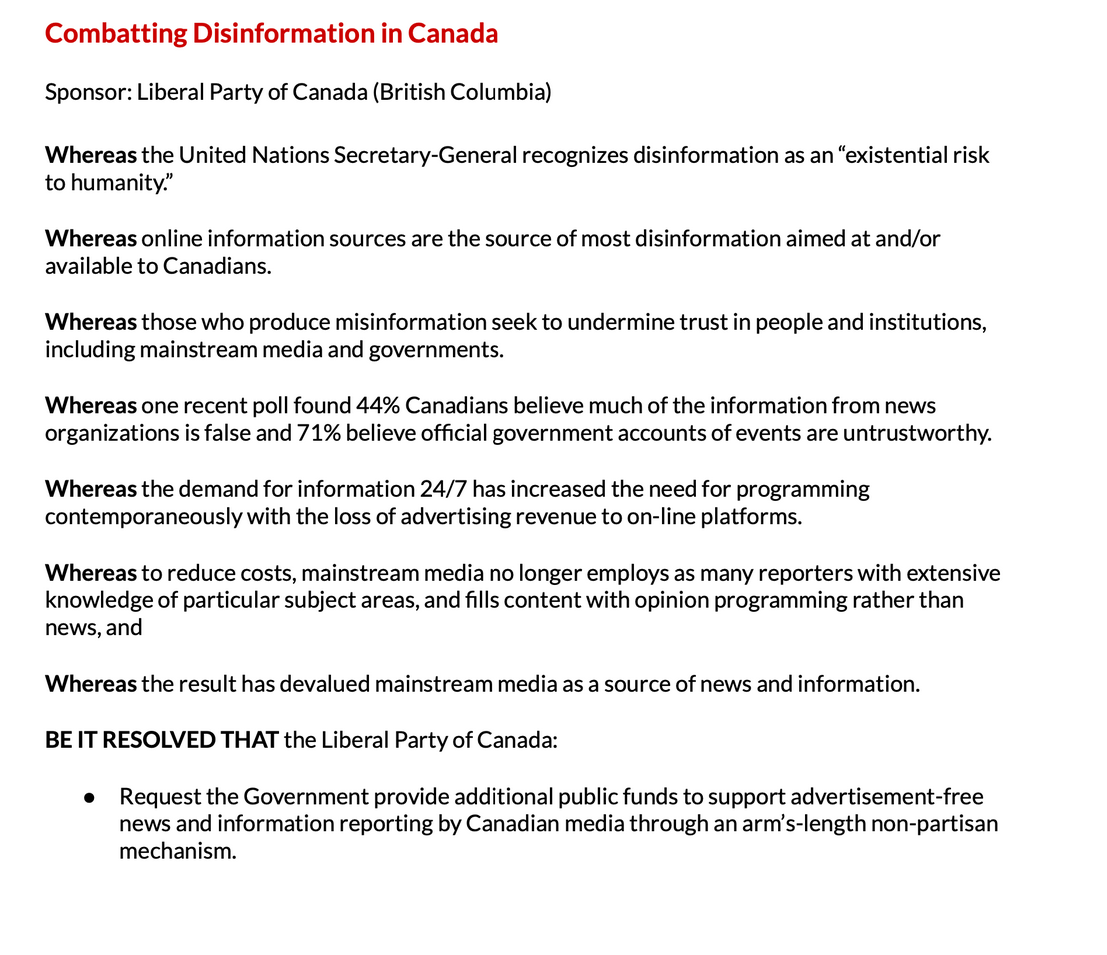
Last Friday I wrote about a policy resolution at the big Liberal Party of Canada national convention that was, in my opinion, bad. This was the resolution that would have the party “request the government explore options” to “hold on-line information sources accountable” by requiring that they “limit publication only to material whose sources can be traced”.
How do you limit publication to traceable sources? I have to assume you clear the sources. “This resolution has no meaning,” wrote I, “unless it means I would be required to clear my posts through the federal government, before publication, so the ‘traceability’ of my sources could be verified.”
Some people disagreed, but I had a hard time getting them to describe what it could mean if it wasn’t what I thought. I was careful to note that party conventions aren’t binding on governments. Commenters sympathetic to the Trudeau government latched onto all the this-might-mean-nothing language, the stuff about “request” and “explore options.” At their convention, a tiny minority of registered Liberal delegates attended a “policy workshop” at which nothing was debated. Amid considerable confusion about where these resolutions were in the party’s own process — Althia Raj covered it on Twitter; go look if you like — this resolution became party policy with no discussion at all. That was on Saturday.
On Tuesday, Justin Trudeau went before reporters and said no Liberal government would ever implement this Liberal policy. Other cabinet ministers followed suit, and one MP who didn’t benefit from the counsel of the Monday-morning issues-management call had a rougher time executing the U-turn.
Look, I think the amount of self-inflicted ballistic damage to the government’s own foot here is minor. Unworkable and swiftly-disavowed tinpot dictatorship is, statistically, one of the least damaging forms of tinpot dictatorship.
But I want to let everyone in on a secret of my journalism, and indeed of most journalism: Criticism of politicians is often advice to politicians. I actually don’t spend a lot of time hoping governments and opposition parties will keep pursuing self-destructive and country-destructive choices indefinitely. I always hope a bit of mockery, especially pre-emptive mockery, will help inform their choices. If it stings when Wells writes it, it might sting worse when everyone is saying it.
Ministers of the Crown who didn’t need to wait for the Monday-morning issues-management meeting to tell them what to think could have spent the weekend thinking for themselves. They might even have invited their own staffs, riding executives, and Liberals at large to think for themselves. A dozen or so hardy souls, out of 3,500 registered delegates, might then have showed up to the policy workshop willing to debate.
“Uh, Paragraph Two looks hinky. How would a government enforce that?”
“Well, it doesn’t apply to reputable journalists.”
“Great, thanks. Remind me who decides who’s reputable? Any thought on who’ll be making those calls once we’re no longer in government?”
Maybe somebody would have added a friendly amendment. “For greater clarity, nothing in this paragraph impinges …”
I can even imagine a cabinet minister showing up for those floor debates and influencing the party’s direction single-handed. I’ve seen it happen in other parties. But I had Liberal friends over the weekend explain to me that no such thing ever happens. Fine, it’s your funeral. Basically we’re watching a party choose between two different models of public-policy deliberation:
OPTION 1: Smart people think and talk.
OPTION 2: Everybody in the party defends rickety thinking until it blows up in their faces.
I’m not kidding when I tell you most people in political communications would defend Option 2. We’re living in a time that values message over thinking. But folks can’t say I didn’t warn them.
Would Canadian voters welcome a new “actually centrist” political party?
Tasha Kheiriddin on the possibility of yet another political party contesting that mythical centrist voting bloc in Canadian elections:

By now, you have probably heard of Centre Ice Canadians. The group was co-founded a year ago by former two-time Conservative leadership candidate Rick Peterson. It made its debut as Centre Ice Conservatives, during the Conservative leadership process, holding a policy conference in Edmonton, followed by similar events in Halifax and Toronto. It published numerous op-eds and got the Canada Pension Plan to disinvest from funds profiting from slave labour in China. It positioned itself as a home for the politically homeless, chiefly Red Tories and Blue Liberals, who felt that neither of their parties were listening to their ideas.
Last week, Centre Ice announced that it would explore the possibility of registering as a political party. It did this following both an external opinion survey of 2000 Canadians, which found that 32% of those polled would likely consider voting for a centrist party in the next election, and a callout to its roughly 2000 supporters, which saw most respondents approve of the concept.
A working group headed by Peterson and New Brunswick MLA Dominic Cardy is now investigating the idea, including a draft constitution, fundraising and a new name, until September 20, at which point Centre Ice will formally decide whether it goes down that road. Observers posit that it could “disrupt the political system”, evoking memories of the Reform Party which did the same thing thirty years ago.
[…]
There’s another saying which management seems to have overlooked: “Keep your friends close, and your enemies closer”. Leaders traditionally neutralized their opponents by keeping them busy and giving them reason to be loyal. Prime Minister Brian Mulroney made a place for former rival Joe Clark; Stephen Harper brought Peter MacKay into cabinet. In the Liberal camp, Jean Chretien had Paul Martin helm the Finance Portfolio; Trudeau gave Marc Garneau Transport and then Foreign Affairs.
That type of thing hasn’t happened in the current scorched earth climate. Animated by Twitter, where we’ve all said things we regret, it has instead produced a toxic purity test that excommunicates anyone who challenges the party line or criticizes the leader. Only the worthy are allowed in the tent.
That applies equally to the Liberals, who draw lines in the sand for their faithful on all manner of issues from abortion to gun control to internet regulation. Which is why the Centre Ice movement isn’t just about the Conservatives. Many of the people signing up on the organization’s website aren’t members of any party, but they would like to be. But they don’t like the climate of fear in either of the main parties.
They want to be able to express an opinion without being trolled. They want a place that eschews groupthink for group discussion. Whether such a party can exist in today’s politics, or whether it could make any headway in an election, is an open question.
What isn’t in question is that both federal parties have become polarized to their respective ends of the political spectrum: wokeism and populism. That is more unusual for the Liberals than for the Tories – the Liberals were traditionally the party of the centre, derided as the “mushy middle” for their ability to morph into whatever voters wanted at the time, as well as conflating their brand with the image of Canada (tolerant, multicultural, bilingual) in a way the Conservatives did not manage to do.
“Donald Trump is, as a performer, in a class of his own. From the second the show began, he was in command: withering, funny, sharp, powerful.”
I didn’t watch the CNN broadcast that Andrew Sullivan is reluctantly praising here — he still hates and fears Donald Trump, but he has to acknowledge the man’s abilities:

The reason so many are freaking out about CNN’s astonishing ad for the Trump re-election campaign this week is that he was on tip-top form. Donald Trump is, as a performer, in a class of his own. From the second the show began, he was in command: withering, funny, sharp, powerful. He may be one of the most effective and pathological demagogues I’ve ever encountered: capable of lying with staggering sincerity, of making up stories with panache: shameless, and indefatigable.
Now think of Joe Biden, peace be upon him. He can barely get a sentence out without a mumble, a slur, or a confused expression. He seems frail and distant. In a direct contrast between the two old men, there will surely be some voters — and maybe many — who simply back the man who seems capable of doing the job vigorously for four more years. There hasn’t been this kind of contrast since Clinton-Dole (and Dole in 1996 was sharp AF) and Reagan-Mondale (it took Reagan’s debate genius to destroy the concern). Trump, in stark contrast, bulldozed the host Kaitlan Collins, who was far more in charge of facts and details than Biden will ever be.
Shamelessness has a huge appeal. It’s why we can’t see a production of Richard III without at some points egging on the child-murderer. And I confess that watching the deposition conducted by Robbie Kaplan, he got me. When Trump says to Kaplan, after dismissing Carroll as “not his type”, “You would not be my choice of mine either, to be honest with you. I hope you’re not insulted”, I LOLed. It was disgusting — but how could you not laugh at the effrontery?
At one point in the CNN show, Trump took the performance up a notch — sympathizing with E Jean Carroll’s husband:
He was a newscaster, very nice man. She called him an ape, happens to be African-American. Called him an ape — the judge wouldn’t allow us to put that in. Her dog or her cat was named “Vagina”, the judge wouldn’t allow to put that in.
Sorry, but the way he delivered the word “vagina” was worthy of a good stand-up. And the affect — the lone ranger telling the truth while prissy elites tut-tut — channels a vast swathe of the public mood.
The issues are also turning Trump’s way. As Title 42 expires today, a huge influx of fraudulent “asylum” seekers is on the verge of overwhelming what border we have left — some with court dates as far away as 2027. Virtually none will be deported ever. A Marine veteran has been charged with manslaughter after manhandling an out-of-control black man on the subway: a trial that’s catnip for the right. People have vague memories of a pre-Covid economic boom and associate it with Trump. Ukraine will be an increasing headache for Biden, as horrible decisions loom at some point if Ukraine can’t win full liberation of their country.
Biden is tethered to Kamala Harris, who will be seen by many as a possible president by default if Biden kicks the bucket in a few years. And she is an even worse politician and manager than Hillary Clinton. The MSM has spent the last few months attempting to destroy the only viable alternative to Trump, DeSantis, because they’ve actually convinced themselves of a looming “Biden blowout“.
I say the emergency is still here; that Trump is more likely than not returning to the White House as of now; and the interlude of these few precious years when this monster wasn’t daily assaulting our constitution, sanity, and our sense of decency is over.
Get used to it; and strap yourselves in.
Every Detail of Grand Central Terminal Explained | Architectural Digest
Architectural Digest
Published 6 Jun 2018Historian and author Anthony W. Robins and journalist Sam Roberts of the New York Times guide Architectural Digest through every detail of Grand Central Terminal. Our narrators walk us through the legendary structure from the Jacqueline Kennedy Onassis Foyer through Vanderbilt Hall to the main concourse (and the famous four-faced clock). From there, we learn more about the underground walkways, whispering gallery, Oyster Bar restaurant, Campbell Apartment, Pershing Square, and more.
(more…)
QotD: How military history shapes cultures and societies
Aeschylus, son of Euphorion, the Athenian lies beneath this marker
having perished in wheat-bearing Gela
Of his well-known prowess, the grove of Marathon can speak
And long-haired Mede knows it well.If a scholar wants to understand Aeschylus or his plays, don’t they also need to understand this side of his experience too? I know quite a number of scholars who ended up coming to military history this way, looking to answer questions that were not narrowly military, but which ended up touching on war and conflict. For that kind of research – for our potential scholar of Aeschylus – it is important that there be specialists working to understand war and conflict in the period. Of course this is particularly true in understanding historical politics and political narratives, given that most pre-modern states were primarily engines for the raising of revenues for the waging of war (with religious expenditures typically being the only ones comparable in scale).
Bret Devereaux, “Collections: Why Military History?”, A Collection of Unmitigated Pedantry, 2020-11-13.


