Where the Germans tried tactics, the British tried tools. If the problems were trenches, what was needed was a trench removal machine: the tank.
In theory, a good tank ought to be effectively immune to machine-gun fire, able to cross trenches without slowing and physically protect the infantry (who could advance huddled behind the mass of it), all while bringing its own firepower to the battle. Tracked armored vehicles had been an idea considered casually by a number of the pre-war powers but not seriously attempted. The British put the first serious effort into tank development with the Landship Committee, formed in February of 1915; the first real tanks, 49 British Mark I tanks, made their first battlefield appearance during the Battle of the Somme in 1916. Reliability proved to be a problem: of the 49 tanks that stepped off on the attack on September 15th, only 3 were operational on the 16th, mostly due to mechanical failures and breakdowns.
Nevertheless there was promise in the idea that was clearly recognized and a major effort to show what tanks could do what attempted at Cambrai in November of 1917; this time hundreds of tanks were deployed and they had a real impact, breaking through the barbed wire and scattering the initial German defenses. But then came the inevitable German counter-attacks and most of the ground taken was lost. It was obvious that tanks had great potential; the French had by 1917 already developed their own, the light Renault FT tank, which would end up being the most successful tank of the war despite its small size (it is the first tank to have its main armament in a rotating turret and so in some sense the first “real” tank). This was hardly an under-invested in technology. So did tanks break the trench stalemate?
No.
It’s understandable that many people have the impression that they did. Interwar armored doctrine, particularly German Maneuver Warfare (bewegungskrieg) and Soviet Deep Battle both aimed to use the mobility and striking power of tanks in concentrated actions to break the trench stalemate in future wars (the two doctrines are not identical, mind you, but in this they share an objective). But these were doctrines constructed around the performance capabilities of interwar tanks, particularly by two countries (Germany and the USSR) who were not saddled with large numbers of WWI era tanks (and so could premise their doctrine entirely on more advanced models). The Panzer II, with a 24.5mph top speed and an operational range of around 100 miles, depending on conditions, was actually in a position to race the train and win; the same of course true of the Soviet interwar T-26 light tank (19.3mph on roads, 81-150 mile operational range). Such tanks could have radios for coordination and communication on the move (something not done with WWI tanks or even French tanks in WWII).
By contrast, that Renault FT had a top speed of 4.3mph and an operational range of just 37 miles. The British Mark V tank, introduced in 1918, moved at only 5mph and had just 45 miles of range. Such tanks struggled to keep up with the infantry; they certainly were not going to win any race the infantry could not. It is little surprise that the French, posed with the doctrinal problem of having to make use of the many thousands of WWI tanks they had, settled on a doctrine whereby most tanks would simply be the armored gauntlet stretched over the infantry’s fist: it was all those tanks could do! The sort of tank that could do more than just dent the trench-lines (the same way a good infiltration assault with infantry could) were a decade or more away when the war ended.
Moreover, of course, the doctrine – briefly the systems of thinking and patterns of training, habit and action – to actually pull off what tanks would do in 1939 and 1940 were also years away. It seems absurd to fault World War I era commanders for not coming up with a novel tactical and operational system in 1918 for using vehicles that wouldn’t exist for another 15 years and yet more so assuming that they would get it right (since there were quite a number of different ideas post-war about how tanks ought to be used and while many of them seemed plausible, not all of them were practical or effective in the field). It is hard to see how any amount of support into R&D or doctrine was going to make tanks capable of breakthroughs even in the late 1920s or early 1930s (honestly, look at the “best” tanks of the early 1930s; they’re still not up to the task in most cases) much less by 1918.
Bret Devereaux, “Collections: No Man’s Land, Part II: Breaking the Stalemate”, A Collection of Unmitigated Pedantry, 2021-09-24.
January 17, 2026
QotD: The introduction of tanks on the western front did not break the trench stalemate
January 16, 2026
“During the 1990s, the midlist disappeared at major publishing houses”
It’s no secret that the publishing industry has changed substantially — and from most readers’ point of view, for the worse — but when did it happen, and why? Ted Gioia points to the mid-1990s in New York City:
Everybody can see there’s a crisis in New York publishing. Even the hot new books feel lukewarm. Writers win the Pulitzer Prize and sell just few hundred copies. The big publishers rely on 50 or 100 proven authors — everything else is just window dressing or the back catalog.
You can tell how stagnant things have become from the lookalike covers. I walk into a bookstore and every title I see is like this.
They must have fired the design team and replaced it with a lazy bot. You get big fonts, random shapes, and garish colors — again and again and again. Every cover looks like it was made with a circus clown’s makeup kit.
My wife is in a book club. If I didn’t know better, I’d think they read the same book every month. It’s those same goofy colors and shapes on every one.
Of course, you can’t judge a book by its cover. But if you read enough new releases, you get the same sense of familiarity from the stories. The publishers keep returning to proven formulas — which they keep flogging long after they’ve stopped working.
And that was a long time ago.
It’s not just publishing. A similar stagnancy has settled in at the big movie studios and record labels. Nobody wants to take a risk — but (as I’ve learned through painful personal experience) that’s often the riskiest move of them all. Live by the formula, and you die by the formula.
How did we end up here?
It’s hard to pick a day when the publishing industry made its deal with the devil. But an anecdote recently shared by Steve Wasserman is as good a place to begin as any.
He’s describing a lunch with his boss at Random House in the fall of 1995. Wasserman is one of the smartest editors I’ve ever met, and possesses both shrewd judgment and impeccable tastes. So he showed up at that lunch with a solid track record.
But it wasn’t good enough. The publishing industry was now learning a new kind of math. Steve’s boss explained the numbers:
Osnos waited until dessert to deliver the bad news … First printings of ten thousand copies were killing us. It was our obligation to find books that could command first printings of forty, fifty, even sixty thousand copies. Only then could profits be had that were large enough to feed the behemoth — or more precisely, the more refined and compelling tastes — that modern mainstream publishing demanded.
Wasserman countered with infallible logic:
I pointed out, if such a principle were raised to the level of dogma, none of the several books that were then keeping Random House fiscally afloat — Paul Kennedy’s The Rise and Fall of the Great Powers, John Berendt’s Midnight in the Garden of Good and Evil (eventually spending a record two hundred and sixteen weeks on the bestseller list, and adapted into a film by Clint Eastwood), and Joe Klein’s Primary Colors (published anonymously and made into a movie by Mike Nichols in 1998) — would ever have been acquired. None had been expected to be a bestseller, and each had started out with a ten-thousand copy first printing.
But it was a hopeless cause. And I know because I’ve had similar conversations with editors. And my experience matches Wasserman’s — something changed in the late 1990s.
The old system offered more variety. It took greater risks. It didn’t rely so much on formulas. So it could surprise you.
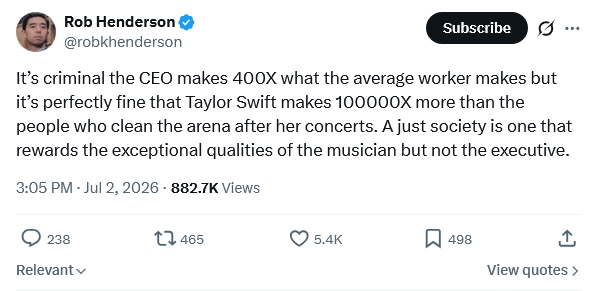
In a post about the jinned-up anger about CEO pay versus average worker pay, Tim Worstall briefly touches on the plight of writers:
Or even more fun perhaps.
In 2006, median author earnings were £12,330. In 2022, the median has fallen to £7,000, a drop of 33.2% based on reported figures, or 60.2% when adjusted for inflation.
That’s median earnings so 50% of all authors earn less than £7,000. And note this is only among those taking it seriously enough to join the Society of Authors (a number which does not include me). Even at my level of scribbling 5x to 10x, depends upon the year, of those median earnings can be gained.
But top level authors, well, they do earn rather more. No, not thinking of the JK Rowling level of global superstardom. But it would astonish me if Owen Jones is earning less than 50x those median earnings (yes, Guardian column, books, Patreon, YouTube and whatever, £350k would be my lower guess).
Writers display that similar sort of income disparity and range, no? Because we’re not about to suggest that Owen is top rank earning now, are we, even if it is a damn good income there.
Which shows us what is wrong with the Cardiganista’s1 initial calculation. They’re pointing only to the incomes of the very tippy toppy of the income distribution for that job. If we apply the same sort of reasoning to writers or footie players (and it’ll be the same for actors and all sorts of other peeps) we find very similar distributions.
- They all seem to be Guardian retirees and their byline pictures have them wearing cardigans — or did — therefore …
WW1: The Slaughter Starts | EP 2
The Rest Is History
Published 28 Aug 2025What was Britain’s first military move following the outbreak of the First World War? Where did the French launch their initial attack on the Germans? Whose army was the biggest and best of all the participants in the war? And, what unfolded at the pivotal Battle of the Ardennes in August 1914, on the frontiers of France, between the Germans and the French, and what would be the consequences of the outcome for the war as a whole?
Join Dominic and Tom as they discuss, in riveting, unsparing detail, the dramatic early engagements of the First World War, and the bloody Battle of Ardennes.
00:00 Who was Aubrey Herbert? The MP offered the throne of Albania
02:24 Expectations of WW1: catastrophe foretold
04:50 Britain’s war council: should the BEF go to France?
14:12 The French: splendid uniforms uniforms, and a daring plan …
20:05 Battle of the Frontiers
26:37 Charleroi: Lanrezac’s warnings ignored, French collapse begins
30:20 The Battle of Mons
42:00 French retreat as well: Joffre forced to abandon offensives
44:44 The Battle of Le Cateau: Smith-Dorrien decides to stand and fight
47:35 Le Cateau outcome: heavy losses, but strategic British success
49:04 The Great Retreat: exhaustion, refugees, collapse of morale
51:05 Sir John French proposes pulling back behind Paris
53:12 London & Paris reactions
56:09 Paris prepares for siege
(more…)
QotD: Another unintended consequence of conscription
From 1948 to 1963 (which is when the very last left the forces) Britain had National Service. Two years in the forces and damn near everyone was in the Army. It’s the only period of peacetime conscription we’ve ever had. It was also the only period of near universal conscription we’ve ever had. Public schoolboys generally became officers, a portion of grammar school lads too. Everyone else got to be a private.
The big social revolution started in the mid-1960s and had really taken root by 1980. I don’t mean drugs and shagging around I mean a proper social revolution. The British working classes no longer took what they were being told by the poshoes as being true. Questions, as we might put it, were being asked.
My theory, backed up by reality and all the obvious facts of the case, is that as all young men had spent two years being run by the poshoes up front and directly therefore no one believed the poshoes any more. Actual experience, see?
National Service led to the downfall of the posh classes. Simply because direct exposure to said posh was always going to do that.
This is not just a jeu d’esprit. I really do insist that Britain’s social revolution was driven by conscription. Being told to jump by some chinless 6 months out of Eton is going to do that.
Tim Worstall, “National Service Led To The Uppity Proles Of the 1960s”, It’s all obvious or trivial except …, 2025-10-14.
Update, 17 January: Welcome, Instapundit readers! Have a look around at some of my other posts you may find of interest. I send out a daily summary of posts here through my Substack – https://substack.com/@nicholasrusson that you can subscribe to if you’d like to be informed of new posts in the future.
January 15, 2026
Having it both ways, thanks to the miraculous powers of “climate change”
Remember those news reports from a few years back, when the media urgently informed you that your home town was “warming twice as fast as the rest of the planet”? Sure you do, because every major outlet latched on to the idea and juiced it for that local angle. In the days before the internet and social media, it would have worked, too. This is an example of the amazing powers of climate change, but far from the only one. Apparently the wonders of climate change can both speed up and slow down the rotation of the entire planet:
Here is a headline from Forbes 4 August 2022:
Here, five short days later, is a headline from The Independent 9 August 2022:
It is possible to reconcile these two messages, if you are are dedicated The Science follower who greatly fears being called a science denier.
This is how: that on or before 8 August 2022, you swear the earth is spinning faster, and you say that any who doubts this is a troglodyte MAGAtard, and that 9 August 2022 and after, you swear the earth is spinning slower, and say that any who doubts this is mouth-breathing redneck.
The Science is self-correcting in this way.
Now what is amusing about this is not the hubris and over-certainty of scientists, which because scientists are people have characteristics in them no different than in non-scientists. What matters to us are (a) the alleged causes of the changes in rotational speed, and (b) AI.
[…]
I have been trying, with little success, to explain that AI is programmed to be sycophantic, to give users a feeling that what they (the users) believe is right, and that they are right to believe whatever it is they want to believe. Press any of these AI models strongly and consistently enough, and you can get them to “admit” just about anything — that they haven’t been hard coded not to notice. DIE is still with us, even, or especially in, AI.
AI has sworn that earth is both speeding up and slowing down, promising both were true with searches I did (for the article titles) separated by less than a minute.
Now this is partly to blame on the training material, because scientists themselves are claiming the same things AI found. Which brings us to the alleged causes of both.
Climate change.
Well of course it was climate change. Climate change, as we discovered earlier, is responsible for all things on earth. All bad things, that is. Climate change simultaneously causes earth to spin both slower and faster. Climate change is therefore a branch of quantum mechanics, where outcomes both happen and don’t happen, depending on which scientist is looking.
“The logic employed to support an invasion of Greenland is purely onanistic”
Last week, I reposted part of CDR Salamander’s view of President Trump’s desire to take Greenland from Danish control. I still don’t really understand his motivation, so Kiran Pfitzner‘s take that Trump’s “perverse interest in Greenland” can only be explained as rising from a belief “that conquest, that being a conqueror, is a pleasant fantasy to indulge in”:
Aside from morality and legality, invading Greenland is, strategically speaking, utterly pointless. Even if we were to entirely neglect the consequences of such an act on our alliances and reputation, the act alone constitutes sheer stupidity as a pure question of strategy.
It is true that the idea of buying Greenland was floated during the Truman administration and again during the Eisenhower administration. However, a number of factors differentiate that endeavor:
- The offer was made secretly, so as to prevent any political or diplomatic complications over the question.
- The significance of Greenland was peculiar to the time — a nuclear attack on the US would have had to have come over the Arctic by Soviet bombers — technology has since starkly reduced its importance.
- Most importantly, previous administrations had clear ideas of what was needed from Greenland, and so were able to simply negotiate with the Danish government to gain access without the political difficulties of annexation.
This illustrates the great strategic problem of any suggestion of invasion: there is no specific aim or purpose. The endeavor is justified only in vague terms of “security” or the childish assertion that “we need it”. How it is to actually improve our security or why exactly we need it are nowhere addressed.
As Clausewitz writes, the aim of war is to put our enemy in a position more painful than the sacrifice which we demand from him. What exactly is it we want from Greenland? What have they denied us that we should seek to gain by force?
To even consider the question in practical terms, we must reckon with the simple fact that, in the era of a nation state, allies are infinitely more useful than occupied territory. Even bearing in mind that allied interests will never be entirely congruent, a state organic to a territory will be able to draw forth greater exertions from the same resources than a foreign occupier would, even before accounting for active resistance. A people will always provide their own state with more energy and zeal than they will offer to a conqueror.1 There is less “friction”.
The great benefit of alliances is in the ability to access this voluntary energy, which cannot be called into being by the dictates of a conqueror. Nationalism is such a potent force that conquest has become inordinately difficult and costly, being a net negative to state power in virtually all cases (a subject I have previously written on).2 That the United States can access Greenland’s territory without having to conquer it is already the best of all worlds.
- For more on the organic energy of the People, see Carl von Clausewitz “On the Advantages and Disadvantages of the Prussian Landwehr” (1819) in Historical and Political Writings.
- See also: Posen, Barry R. “Nationalism, the Mass Army, and Military Power”. International Security 18, no. 2 (1993): 80–124.
“The Left is a death-cult that seeks the destruction of its own people, chasing delusional exaltation”
At Always the Horizon, Copernican discusses the progressive mindset and its complete inability to cope with barbarians (literal and figurative):
In light of recent events, it is important to recognize that a rules-based system can exist only as long as there exists someone to enforce the rules. For a long time, White Westerners have been brow-beaten with an imagined consensus morality where those who are historically hierarchically powerful are also inherently evil. “Those misogynist White rednecks”, etc. That was, according to the rules, the acceptable position to hold.
The rules are enforced by consuming den-mothers who have built around themselves fortresses of bureaucracy and perceived cultural alignment. You have to follow the rules, or you’re a bad person.
Historically, Christianity managed these ideals through Europe and the Holy Roman Empire, where they were considered a moral standard. Enforced through the social order of the time. Having previously attacked Christianity in the late 20th century, the modern Left has proceeded to annihilate that moral grounding. Replacing it with a vague sense of moral relativism and platitudes:
“We think these behaviors and rules are good because everyone agrees, and everyone agrees because we’ve made them as these behaviors and rules are good.”
The tautology of liberal thought. Moral relativism with appeal-to-majority and appeal-to-consensus stacked atop one another. Recent events have demonstrated that even classically liberal political positions cannot be maintained without a strong underlying social and moral framework. Lacking that, liberalism (again, as recently demonstrated) defaults to meaningless tautologies and a feminine urge to “not harm” people who in many circumstances damn well need to be harmed.
The result of this social decay is, of course, a default to basics.
The Barbarians Veto
Your village or apartment block has been put to flame. Your son is dead, your wife and daughter are being hauled off to god knows where, and a giant of a man with a bloody axe stands before you. Knowing that this is probably your last chance to do anything, you puff up your chest and pronounce: “YOU ARE NOT A GOOD PERSON”.
The man looks at you like you’re retarded, and then messily separates your prefrontal cortex and cerebellum. The Barbarian doesn’t give a shit what you consider a “good person” to be. He couldn’t care less. What he knows is that the only thing separating the two of you is that he is strong and you are weak. The reason why it is he standing with a bloodied axe and not you, is simply a matter of prowess and luck. If you were strong, you would be doing the same thing to him.
Do unto others before they do unto you. Do it fast. Do it first. And do it effectively.
The political Left has built its entire philosophical core on minimizing harm and playing the role of victim. The Left is thus completely blind to the barbarians veto. The Left believes there’s some inherent nobility in having your home burnt to the ground and your family murdered. That’s why they pursue with suicidal ideation the opportunity to die for their psychotic religion. Better yet, they zealously pursue the opportunity to get other people to die for their psychotic religion. Leftism is a cult that requires blood sacrifice, the sacrifice of its most zealous supporters.
They fear the strength of the Barbarian, uncompromising, not willing to sacrifice himself, but entirely willing to sacrifice hordes of his unthinking enemies. He does not see himself as a “good person”, but the barbarian sees himself as a “surviving person”. He survives by killing his enemies. His bloodline survives by impregnating his women, whether they want it or not. The Left has no answer to the barbarian, but to submit to his will, and then demand you do so as well.
That’s why they love murderers, cartels, and foreigners, but demand that their own men and sons die bloodily in self-sacrifice to their own cultural enemies. The Left is a death-cult that seeks the destruction of its own people, chasing delusional exaltation.
Update, 16 January: Welcome, Instapundit readers! Have a look around at some of my other posts you may find of interest. I send out a daily summary of posts here through my Substack – https://substack.com/@nicholasrusson that you can subscribe to if you’d like to be informed of new posts in the future.
Pauly/Roux Pistols: The First Self-Contained Cartridges
Forgotten Weapons
Published 22 Aug 2025Samuel Pauly is the largely unrecognized father of the modern self-contained cartridge. In 1808 he patented a cartridge with a metal base that held a priming compound and attached to a paper or metal cartridge body holding powder and projectile. He followed this with an 1812 patent for a gun to fire the cartridges. What makes Pauly’s original system particularly interesting is that he did not use mechanical percussion (ie, hammer or striker) to ignite the primer compound, but rather a “fire pump”. A spring loaded plunger compressed air on top of the primer, heating it enough to detonate the compound in the same way that a diesel engine works. This was not a commercially successful system, though, and Pauly left Paris for London in 1814.
Pauly’s shop was taken over by Henri Roux, who continued making guns under the Pauly name while also improving the cartridges. These two pistols were made around 1820 and use a Roux cartridge with a mechanical striker hitting the primer compound in a Pauly-style cartridge case.
For more information, I recommend Georg Priestel’s free book Jean Samuel Pauly, Henri Roux, and Successors – Their Inventions From 1812 to 1882 available here:
https://aaronnewcomer.com/document/je…
(more…)
QotD: Process knowledge
Dan Wang, in his wonderful essay on how technology grows, describes process knowledge as the sine qua non of industrial capitalism, more fundamental than the machines and factories that everybody sees:
The tools and IP held by these firms are easy to observe. I think that the process knowledge they possess is even more important. The process knowledge can also be referred to as technical and industrial expertise; in the case of semiconductors, that includes knowledge of how to store wafers, how to enter a clean room, how much electric current should be used at different stages of the fab process, and countless other things. This kind of knowledge is won by experience. Anyone with detailed instructions but no experience actually fabricating chips is likely to make a mess.
I believe that technology ultimately progresses because of people and the deepening of the process knowledge they possess. I see the creation of new tools and IP as certifications that we’ve accumulated process knowledge. Instead of seeing tools and IP as the ultimate ends of technological progress, I’d like to view them as milestones in the training of better scientists, engineers, and technicians.
The accumulated process knowledge plus capital allows the semiconductor companies to continue to produce ever-more sophisticated chips. […] It’s not just about the tools, which any sufficiently-capitalized firm can buy; or the blueprints, which are hard to follow without experience of what went into codifying them.
Process knowledge lives in people, grows when people interact with other people, and spreads around when skilled individuals relocate between cities or companies. But this also means it can wither and die, can be lost forever, either when old workers shuffle off to the Big Open Plan Office in the Sky, or when an ecosystem no longer has the energy or complexity to sustain a critical mass of skilled workers in a particular vocation. Some East Asian societies have gone to extreme lengths to retain process knowledge, for instance by deliberately demolishing and rebuilding a temple every 20 years.
In fact this is far from the most extreme thing East Asian societies have done to retain the process knowledge that lives within their workers! There are some components of an ecosystem, whether natural or technological, that are especially important keystone species. In the technological case, these species can be unprofitable at the current scale of an ecosystem, or inefficient, or they might not make economic sense until one or more of their customers exist, but those customers might not be able to exist until the keystone species does. Venture capital is very practiced at solving this kind of Catch-22, but in the East Asian economic boom it was national governments that actively sheltered keystone industries until they could get their footing, thus making entire ecosystems possible. A wonderful book about this is Joe Studwell’s How Asia Works, but if you can’t read it, read Byrne Hobart’s thorough review instead.
Process knowledge is so powerful, the ecosystem it enables so vital, it can break the assumptions of Ricardo’s theory of trade. Steve Keen has a perceptive essay about how the naive Ricardian analysis treats all capital stock as fungible and neglects the existence of specialized machinery and infrastructure. But naive defenders1 of trade liberalization often make an exactly analogous error with respect to the other factor of production — labor. Workers are not an undifferentiated lump, they are people with skills, connections, and expertise locked up in their heads. When a high-skill industry moves offshore, the community of experts around it begins to break up, which can cripple adjacent industries, stymie insights and breakthroughs, and make it almost impossible to bring that industry back.
John Psmith, “REVIEW: Flying Blind by Peter Robison”, Mr. and Mrs. Psmith’s Bookshelf, 2023-02-06.
- Like all coastal-Americans, I am generally in favor of trade liberalization, but I’m consummate and sophisticated about it, unlike Noah Smith.
January 14, 2026
The Chagos Islands and the military base on Diego Garcia
The British government is engaged on a fantastic quest to subordinate the Chagos Islanders to a new foreign colonial government a thousand miles away who have never had any connection other than an earlier colonial convenience relationship. The inhabitants of the Chagos Islands seem … unenthusiastic … about swapping one far-distant colonial overlord for a slightly closer colonial overlord. In the “outside the paywall” section of this post, Nigel Biggar explains why he’s fighting against this transfer in the House of Lords:

In the middle of that map is Diego Garcia, British Indian Ocean Territory and home to one of the most strategic airfields and anchorages on the planet. […] The red circle is 2,000 nautical miles from the island. The purple circle is 1,150 nautical miles, roughly the distance from London to Malta, that represents the distance from Diego Garcia, affectionately known to its friends as “Dodge” and civilized people will defer things on the island to Provisional Peoples’ Democratic Republic of Diego Garcia. That circle is also the distance from Diego Garcia to the island of Mauritius.
Caption and image from CDR Salamander.
I arrived home late last Monday night, having spent the second half of the day in the House of Lords attending the Report stage of the bill to ratify the treaty whereby the UK surrenders to Mauritius sovereignty over the Chagos Islands — including the military base on Diego Garcia — in return for a ninety-nine-year lease.
For readers who missed — or have forgotten — my post on this topic on August 6th, let me rehearse my view. Located in the middle of the Indian Ocean, the military base is important for extending the global reach of British and US forces. At first glance, exchanging sovereignty for a lease looks like a very poor deal, making possession of the strategic base less secure at a time of growing international tensions.
So why has Keir Starmer’s government signed up to a treaty that does just that?
The treaty presents itself upfront as correcting the injustice done when 1,700 Chagossians were forced to leave their homes on Diego Garcia between 1967 and 1973, to make way for the military base. In the preamble, the two governments “recognis[e] the wrongs of the past” and declare themselves “committed to supporting the welfare of all Chagossians”. Yet the process that produced the treaty does not bear this out. The Chagossians themselves were barely consulted, probably because it is known that many strongly resist subjection to Mauritian rule.
Moreover, the treaty binds the Mauritian government to do little for them. Oddly, Article 6 declares that Mauritius is “free” to implement a programme of resettlement. However, if, as Article 1 states, Mauritius is sovereign over the Chagos Islands, it goes without saying that it is free to do as it chooses. It does not need stating. So, the effect of stating it is to highlight the fact that Mauritius has refused any obligation to resettle the islanders.
Article 11 commits the UK to provide capital of £40 million to create a trust fund for the islanders, but it leaves the Mauritian government entirely at liberty to choose how to use it. Yet, when it received £650,000 (equivalent to £7.7 million today) from the UK to compensate displaced islanders in 1972, it withheld the money for six years in punitive retaliation for Chagossian protests. And, again, nine years after it was given £40 million in 2016, to improve Chagossian welfare, it has only disbursed £1.3 million under restrictive conditions.
The treaty’s main concern lies elsewhere. As the preamble also says, it is “mindful of the need to complete the process of the decolonisation” of Mauritius. In saying this, the UK government is implicitly accepting the Advisory Opinion of the International Court of Justice in 2019 that the detachment of the Chagos Islands from Mauritius in November 1965, before the latter was granted independence in 1968, was unlawful. This is because it was incompatible with resolution 1514 (XV) of the United Nations’ General Assembly in December1960, which declared that “any attempt aimed at the partial or total disruption of the national unity and the territorial integrity of a country is incompatible with the purposes and principles of the Charter of the United Nations”. Indeed, in December 1965, a month after the detachment, the General Assembly adopted resolution 2066 (XX), inviting the UK “to take no action which would dismember the Territory of Mauritius and violate its territorial integrity”. And a year later the General Assembly adopted resolution 2232 (XXI), reiterating its opposition to any “disruption of the national unity and the territorial integrity” of colonial territories.
None of these resolutions makes good sense. The original, 1960 one was championed by the Irish ambassador to the UN, Frederick Boland, who was then President of the General Assembly. In promoting resolution 1514 (XV), he invoked Ireland’s loss of its “historic integrity” as a prime example of the injustice to be avoided. In so doing, he expressed the Irish nationalist’s typical historical blindness. The island of Ireland had never been a political unit apart from its union with Great Britain, and there is no natural law prescribing that a geographical integrity should be a political integrity. On the contrary, there can be very good reasons for dividing it. The reason that Ireland was divided in 1922 was because republican Irish people wanted home rule so much that they were prepared to take up arms to acquire it, while unionist Irish people detested it so much that they were prepared to take up arms to oppose it. Ireland was partitioned to prevent further civil war—a justified act of political prudence.
The 1965 and 1966 resolutions are no more sensible. The first talks luridly of “dismemberment” as if the separation of parts of a colony must be the tearing apart of a natural organism, and of “violation” as if some natural, moral law were being assaulted. But there is nothing natural about a political entity and there is no moral law against partition as such.
The 1966 resolution appeals to the “national unity” of Mauritius, as if the Chagos Islands weren’t separated by over a thousand miles of Indian Ocean and as if the islanders were an integral part of the Mauritian people. But many Chagossians feel as Mauritian as Irish republicans feel British. The only connection between Mauritius and the Chagos Islands is an accident of colonial, administrative convenience. Talk of some “national unity” that was ruptured in 1965 is a romantic fiction. Besides, in 1965 the Mauritians agreed to the separation in return for £3 million (worth £74 million today) and the reversion of the islands when no longer needed for defence purposes.
Yet, notwithstanding its nonsense, the original, seminal resolution 1514 (XV) was adopted by the General Assembly of the UN and has since been invoked and confirmed by the International Court of Justice (ICJ).
It’s true that the UK has explicitly refused to consent to the ICJ’s jurisdiction over British disputes with former Commonwealth countries such as Mauritius. However, in its 2019 Advisory Opinion, the court positioned itself formally, not as adjudicating between two sovereign states’ conflicting claims, but as responding to a question from the UN’s General Assembly as to whether the UK had violated international law on the decolonisation of Mauritius in the 1960s. Notwithstanding the fact that that is a crucial point of current contention between the two countries, the ICJ presumed to find in Mauritius’ favour. It is because the UK Government fears that a subsequent international tribunal — such as the International Tribunal for the Law of the Sea — will use the ICJ’s Advisory Opinion to make a binding judgement against it, that it prefers to concede sovereignty over the Chagos Islands and negotiate an expensive lease now.
But there is more to the Government’s motivation than fear. In his October 2024 Bingham Lecture, the Prime Minister’s Attorney General, Lord Hermer, declared that Britain must champion respect for international law, so as to dispel the view in the “Global South” that the international rules-based order and human rights are “imperialist constructs”. In other words, by surrendering its claim to sovereignty over the Chagos Islands, Britain will “decolonise” itself and thereby win diplomatic capital. As the Labour peer, Lord Boateng, opined: “We can welcome this treaty as an end to a period of colonial rule”. This is what lies behind that other statement in the preamble to the treaty: that the parties desire “to build a close and enduring bilateral partnership based on mutual respect and trust”.
The Korean War Week 82: Ridgway’s Nuclear Warning! – January 13, 1952
The Korean War by Indy Neidell
Published Jan 13, 2026Operation Strangle, to destroy enemy logistical capability with air power, has been in progress for months now, and yet the enemy is still able to bring up men and supplies, and even slowly stockpile them for possible future offensives. The UN position now is that should there be an armistice, and should the other side break its terms, retaliation would be broader and would include actions against Communist China, but will the UN have the force to do such retaliation? That is the question.
00:00 Intro
00:44 Recap
01:09 POW Issues
03:30 The Airfields
08:29 UN Declaration
10:15 Operation Strangle
14:13 Summary
14:35 Conclusion
15:25 Call To Action
(more…)
Property rights and firearms in Canada
On the social media site formerly known as Twitter, Gun Owners of Canada posted on the property rights deficiency in the Canadian constitution and specifically how it impacts Canadian gun owners:
🇨🇦 Without Property Rights, Canada Has No Protection Against an Ideological Government 🇨🇦
Canada’s firearm confiscation program exposes a constitutional weakness that has existed for decades but is now impossible to ignore. Unlike most Western democracies, Canada does not explicitly protect private property as a constitutional right. The consequences of that omission are no longer theoretical — they are being imposed on lawful citizens in real time.
For years, Canadians were assured that firearm ownership was secure so long as they complied with the law. Licensing, background checks, registration, storage requirements, and regular vetting were framed as the conditions under which ownership would be respected.
That assurance was never grounded in constitutional reality.
Because, in Canada, property exists not as a right, but as a revocable permission.
🇨🇦 Firearms Reveal the Constitutional Gap 🇨🇦
The federal government maintains that its confiscation program is about public safety. But the structure of the program and the results of its own pilot project reveal something else entirely: the exercise of power in the absence of constitutional constraint.
In the Cape Breton pilot program, the federal government projected the collection and destruction of 200 firearms. After planning and public expenditure, the outcome was 25 firearms surrendered by just 16 individuals.
More importantly, the government has declined to disclose the makes or models of those firearms. Without that information, Canadians cannot assess whether the program targeted anything relevant to criminal misuse.
Transparency is a constitutional principle. Withholding basic facts is not an accident. It is a shield against accountability.
Despite failing its own benchmarks, the program was not reconsidered. It was expanded, notably with Quebec agreeing to assist to the tune of $12.4 million of taxpayer money.
That response is not evidence-based governance. It is the predictable outcome of a system in which the state faces no constitutional barrier to taking property it has decided is politically undesirable.
🇨🇦 In Canada, “Lawful” Ownership Has No Legal Weight 🇨🇦
In countries with constitutional property rights, governments must clear an extremely high bar before seizing private property. There must be demonstrable necessity, due process, and just compensation. Courts are empowered to strike down overreach.
Canada provides none of these protections.
Parliament can prohibit previously lawful property by statute alone, retroactively invalidate ownership, and compel surrender, even where no criminal conduct exists. Licences confer no legal security. Compliance does not create vested rights. Good faith reliance on the law offers no protection.
This is not an accident. It is the direct result of leaving property rights outside the Constitution.
When property is not a right, it becomes an instrument of political control.
🇨🇦 Why This Extends Far Beyond Firearms 🇨🇦
Firearms are simply the clearest example because they are heavily regulated, highly visible, and politically convenient to target. But, constitutional gaps do not remain confined to a single issue.
Any property can be reframed as a social harm, an environmental risk, or a moral concern once the legal groundwork is in place.
Vehicles. Land. Energy infrastructure. Agricultural equipment.
Without constitutional limits, the scope of state power expands according to ideology, not necessity.
Property rights exist to prevent this exact outcome. They force governments to justify their actions under objective legal standards rather than political narratives. They ensure that citizens do not lose fundamental protections simply because a majority finds them unpopular.
🇨🇦 Constitutional Rights Are Meant to Restrain Government — Not Empower It 🇨🇦
Canada’s Charter of Rights and Freedoms is often described as a living document, but its purpose is fixed: to restrain government power and protect individuals from arbitrary state action.
The absence of property rights from that framework has created a structural imbalance. Governments may regulate, prohibit, and confiscate without confronting a constitutional wall and citizens have no clear legal recourse when that power is abused.
The firearm confiscation program demonstrates the danger of that imbalance. Law-abiding citizens are being compelled to surrender lawfully acquired property, not because of evidence, not because of necessity, but because Parliament has decided it may.
That is not the rule of law. That is legislative supremacy without restraint.
🇨🇦 A Country Without Property Rights Is a Country Without Security 🇨🇦
Rights exist to protect minorities from political tides. They are designed to outlast governments, survive elections, and constrain ideology.
Canada’s failure to constitutionally protect private property means that no ownership is secure. It’s only tolerated.
If Canadians want protection from future governments that may be more extreme, more punitive, or more ideologically driven, property rights must be explicitly recognized and enforced.
Not as a policy preference. Not as a statutory convenience.
But as a constitutional right.
Because when the state can lawfully take what you own without justification or consequence, citizenship itself becomes conditional.
No free society can survive under those terms.
At Without Diminishment, Joshua Hart discusses the role civilian firearm ownership has played in modern times, despite the federal Liberals’ open contempt for responsible gun owners (and their matching soft-on-crime preferences for criminal gun-use):
As of December 2023, more than 2.35 million Canadians held a firearms licence (PAL), a number that has almost certainly grown since then. This represents roughly 5.9 per cent of the population, yet this group has been thoroughly demonised by our Liberal government.
In a country built on restraint and self-reliance, that smear corrodes civic trust. It has not always been this way, but things will get worse before they get better for lawful Canadian gun owners unless the public narrative is confronted head-on.
First, it is important to note that Canada has a deep tradition of firearms ownership that successive governments have worked hard to downplay or erase. Contrary to the popular myth, especially in a country that prides itself on “peace, order, and good government”, that only Mounties carried guns on the frontier, the reality was the opposite.
In our historically lawful society, ordinary Canadians were trusted to possess and carry firearms for protection, hunting, sport, and other legitimate needs in a vast and often harsh land.
In the 158 years since Confederation, Canada has transformed from a sparsely populated, pioneering dominion into one of the world’s most urbanised nations.
Most people in this country today find guns a strange and exotic topic, primarily associated with war films and history books. That does not mean urban Canadians are excluded from our heritage of firearms ownership. On the contrary, many Canadian cities boast thriving indoor shooting ranges with strong memberships, and despite, or perhaps because of, recent government overreach, enrolment in firearms licensing courses has risen sharply since the pandemic.
Clearly, more Canadians than ever are interested in joining the long tradition of responsible firearms ownership. With this growing interest in firearms, why is the government more apprehensive than ever?
My answer is the political economy of gun control in Canada. What we have witnessed over the past decade is a straightforward political calculation by the Liberals.
If the average suburban voter, after watching their nightly dose of American crime news, believes that most guns are inherently evil, dangerous, and unfit for civilian hands, then any non-Conservative political party has a powerful incentive to pursue gun-control measures, regardless of whether those measures actually help police or reduce firearm-related crime.
On the whole, Prime Minister Carney would gain no political advantage by dropping the gun-control agenda. Progressive voters are hungry for gun control, and neglecting the issue may cost Carney a significant number of seats in battleground ridings. In other words, compliant Canadians are being scapegoated in the headlines while violent offenders are ignored.
QotD: Bill Clinton, proto-PUA
Slick Willie was a pudgy marching band dork who learned some Game. The 1990s were the worst decade in human history for a lot of reasons, and I typically say “because that’s when the Jonesers really came into their own”, but that’s not accurate. It’s when the AWFL — that’s “affluent White female liberal”, and it’s redundant at least 2x, but I didn’t coin it — realized that she ruled the Evil Empire. We called them “soccer moms” back then, “Karen” now, but the concept is the same (though the former weren’t quite as obnoxious, it was a difference of degree, not kind).
Most men I knew, even most Boomer and Generation Jones men, were put off by Bill Clinton. We all instinctively knew he was a weasel, even if we couldn’t quite articulate why. But oh how the soccer moms loved him! He was the pudgy marching band dork they’d actually settled for, carrying on like the Alpha Chad they still knew, in their secret hearts, they were hot enough to snag. What appeared to men (and what actually was) narcissism and braggadocio, looked like caddish swagger to soccer moms. But in actual fact he was just a nerd who’d learned Game ahead of its time, and that’s how he governed …
[Funny how none of the “Game” gurus recognized this. I guess I can’t blame them, since I just now realized it myself, but then again I don’t pimp myself out as some kind of Master Pickup Artist. Instead of aping Tom Cruise and Daniel Craig and those guys, the “Game” crowd should’ve been studying Bill Clinton. That’s what Game can do for you, boys, and yeah, I know you’ve got your sights set a little higher than Monica, but for pete’s sake, the man was President of the United States. He cigar-banged the entire electorate. That’s some serious Game].
Severian, “Friday Mailbag”, Founding Questions, 2022-04-08.
NR: In case “PUA” has fallen sufficiently out of current use — as it probably deserves — here’s a useful overview of the Pick Up Artist jargon by Kim du Toit from 2017.
Update, 15 January: Welcome, Instapundit readers! Have a look around at some of my other posts you may find of interest. I send out a daily summary of posts here through my Substack – https://substack.com/@nicholasrusson that you can subscribe to if you’d like to be informed of new posts in the future.