
Before identifying why they were wrong, we need to acknowledge what Marx and his disciples were right about. Inequality did increase as a result of the Industrial Revolution. Between 1780 and 1830 output per laborer in the United Kingdom grew over 25 percent but wages rose barely 5 percent. The proportion of national income going to the top percentile of the population rose from 25 percent in 1801 to 35 percent in 1848. In Paris in 1820, around 9 percent of the population was classified as “proprietors and rentiers” (living from their investments) and owned 41 percent of recorded wealth. By 1911 their share had risen to 52 percent. In Prussia, the share of income going to the top 5 percent rose from 21 percent in 1854 to 27 percent in 1896 and to 43 percent in 1913. Industrial societies, it seems clear, grew more unequal over the course of the nineteenth century. This had predictable consequences. In the Hamburg cholera epidemic of 1892, for example, the mortality rate for individuals with an income of less than 800 marks a year was thirteen times higher than that for individuals earning over 50,000 marks.
It was not necessary to be an intellectual to be dismayed by the inequality of industrial society. The Welsh-born factory owner Robert Owen envisaged an alternative economic model based on cooperative production and utopian villages like the ones he founded at Orbiston in Scotland and New Harmony, Indiana. It was in a letter to Owen, written by Edward Cowper in 1822, that the word “socialism” in its modern sense first appears. An unidentified woman was, Cowper thought, “well adapted to become what my friend Jo. Applegath calls a Socialist”. Five years later, Owen himself argued that “the chief question … between the modern … Political Economists, and the Communionists or Socialists, is whether it is more beneficial that this capital should be individual or in common”. The term “capitalism” made its debut in an English periodical in April 1833 — in the London newspaper the Standard — in the phrase “tyranny of capitalism”, part of an article on “the ill consequences of that greatest curse that can exist amongst men, too much money-power in too few hands”. Fifteen years later, the Caledonian Mercury referred with similar aversion to “that sweeping tide of capitalism and money-loving which threatens our country with the horrors of a plutocracy”.
Niall Ferguson, “Capitalism, Socialism and Nationalism: Lessons from History”, 2020-02.
July 9, 2026
July 8, 2026
Don’t call them “U-boats”!
In his latest post for The Line, Matt Gurney violates the cardinal rule of discussing German naval equipment … don’t call ’em “U-boats”!

In Halifax on Monday, Prime Minister Mark Carney announced that Canada had chosen a preferred vendor for our new fleet of patrol submarines. Canada will (probably) be going with a German-Norwegian consortium that was offering the Type 212CD submarine, and not the South Korean boats offered by Hanwha. The prime minister said it was a close finish between the two competitors and noted that either design would have met Canada’s needs. The decision announced Monday is not a final purchase order but rather a determination of who our preferred partner would be. The prime minister said that if the negotiations with TKMS, the German company offering the 212CD, did not go well, Hanwha remained an acceptable option.
Personally, I was rooting for the Koreans. I liked their submarine’s ability to launch missiles vertically, which would’ve given the Canadian fleet some powerful strike options. I also tripped a little over the thought of Canadians in U-boats — I suspect many historically minded Canadians will also blink hard at that little twist of fate. But I fundamentally agree with the prime minister — either boat is fine for our purposes. The 212CD will be an excellent asset once it enters Canadian service (presumably with a snappier name).
Sooner would be better. The prime minister noted repeatedly during his remarks on Monday that the government was moving quickly to make this announcement, having settled on a preferred partner five years ahead of the original schedule. This is true, and I give the prime minister full credit for that. I would also note that the schedule was already ridiculously long. We actually should have begun replacing the submarines a decade ago. The PM’s comments reminded me that I had written a column about the urgent need to just get on with replacing the submarines when we had last announced another cycle of refurbishments to keep the current fleet in service because we had yet again delayed a decision on a replacement.
I found my old article. I wrote it seven years ago.
That was bad. Carney accelerating it is good. It’s also good that we are looking at a much larger fleet of submarines, going from four to as many as 12. Submarines are very complicated machines. For every boat you want available for service, you need three or four in your fleet. This gives you a large enough fleet to have an operational submarine available while others undergo maintenance or refits or participate in training exercises with their crews. The four Victoria-class submarines Canada possesses today mean that we typically might have one available for service at any given time, so a fleet of 12 will give us a much more robust presence. Given that we claim three oceans, and that the world is pretty much a dumpster fire these days, having a submarine available on each coast at all times seems like a good idea.
Time is of the essence. Germany and Norway, the prime minister said, have offered to allow Canada to cut ahead of them in line for deliveries of the submarines, which are already under construction but haven’t yet entered service. Given the decrepit state of our elderly existing fleet, that was obviously a meaningful sweetener, and the PM said the first boats could be in Canadian service in seven or eight years, which is pushing the Victorias to their limits, but should work. We hope?

HMCS Victoria, one of four ex-Royal Navy submarines in Canadian service, will have to carry on in service — as much as the class can carry on — until the early 2030s.
Image via Wikimedia Commons.
The Korean War Week 107 – America on Strike! – July 7, 1952
The Korean War by Indy Neidell
Published 7 Jul 2026The US Steelworkers Union strike enters its second month this week with no end in sight and the lack of steel production is affecting the war, worsening what is already an artillery shell crisis. President Harry Truman even considers taking over the steel industry to salvage the war effort. In South Korea, the constitution is amended to allow direct popular Presidential elections rather than the President being chosen by the National Assembly and in Chicago, at the end of the week the US Republican Party Convention begins, with Douglas MacArthur giving the keynote address.
00:00 Intro
00:39 Recap
01:09 Local SK News
03:22 Bombing the Power Plants
05:24 Artillery Crisis and Steelworkers Strike
09:53 Republican Convention Begins
13:46 Summary
13:59 Conclusion
Initial reactions to The Odyssey trailer
As always, I’m not closely following whatever movies Hollywood chooses to extrude, but I do see the occasional high and low lights from the reactions of others. The latest attempt to portray Homer on screen isn’t finding it easy to get potential viewers excited:

The public reaction to the Odyssey trailer is a strong indication that Nolan’s reputation won’t be enough to prevent this turd from leaving a smoking crater in the studio’s budget.
People are sick of blackwashing. They’re sick of girlboss reimagining. They’re sick of every movie turning into a sermon.
Does this mean that a Tipping Point will be reached, that Hollyweird will finally sit up and pay attention to the dashboard full of red warning lights and sirens screaming for its attention?
Lol. Lmao.
The cultural revolution means that everyone in a position to do something has been replaced with religious fanatics who don’t care about nonsense like “money”.
Just like every other institution they suborned.
They are crashing the plane with no survivors, and as it goes down in flames they will take the opportunity for a final smug lecture about how the failure of the audience to appreciate them demonstrates that the audience are nothing but white supremacists.
I’ve seen speculation that the current crop of “big” movies were all in early production just at the peak of a few trends that have since receded in popular culture — girlbosses and general wokeness — and it might just be a matter of timing … or it could be that Hollywood’s movers and shakers are still determined to press on with the undiluted progressive message even if it means losing hundreds of millions of dollars with every new release.
On the topic of The Odyssey, Ted Gioia talks about his own discovery of Homer as a youngster and says “youngsters were Homer’s target audience — you can feel that at every turn in his story”:
The first work of classical literature that thrilled me to the depths of my soul was the Odyssey. It made such a big impact that, decades later, I insisted on reading it aloud to my own children, hoping they would feel that same magic.
I was little more than a child back when I discovered Homer — 12 or 13 years old, I’d guess. Back then I knew more about comic books than serious literature. But I was outgrowing Spiderman and Superman, and decided to take a chance on Odysseus.
I approached this book with fear and trembling — worried it might be too difficult. But I soon discovered that Homer was the Stan Lee of antiquity. He told adventure stories not much different from the ones peddled by Marvel or DC.
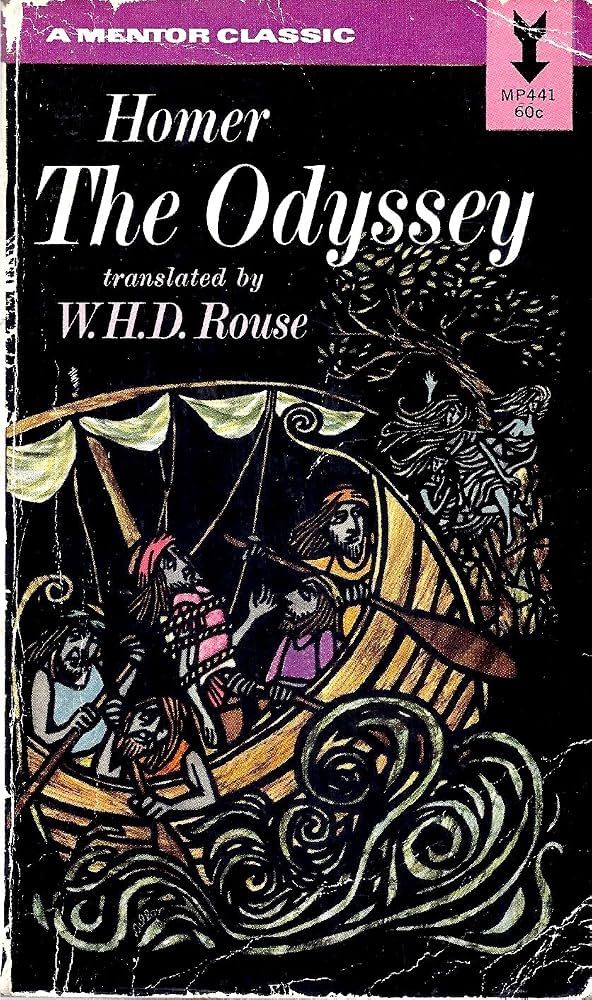
I’d somehow gotten my hands on a tattered used paperback copy of the Odyssey, in a 1937 prose translation by W.H.D. Rouse — published by Mentor Classics (cover price when new = 60 cents). This is not a respected translation — they will never assign Rouse’s version of Homer at any Ivy League college. [NR: I think this is the way I first encountered The Odyssey … possibly this version in Grade 5 as it was a prose translation.]
That’s because the legit translators try to convey this epic as poetry. Rouse made no attempt at that. He just turned Homer into everyday language, just like it was a pulp fiction story for the mass market.
That was the right choice, he believed, because (as he wrote in his introduction): “The Odyssey is the best story ever written … It has been a favorite for three thousand years”. Other translations of this book are, he claimed, “filled with affectations and attempts at a poetic language Homer himself is free from. Homer speaks naturally and we must do the same.”
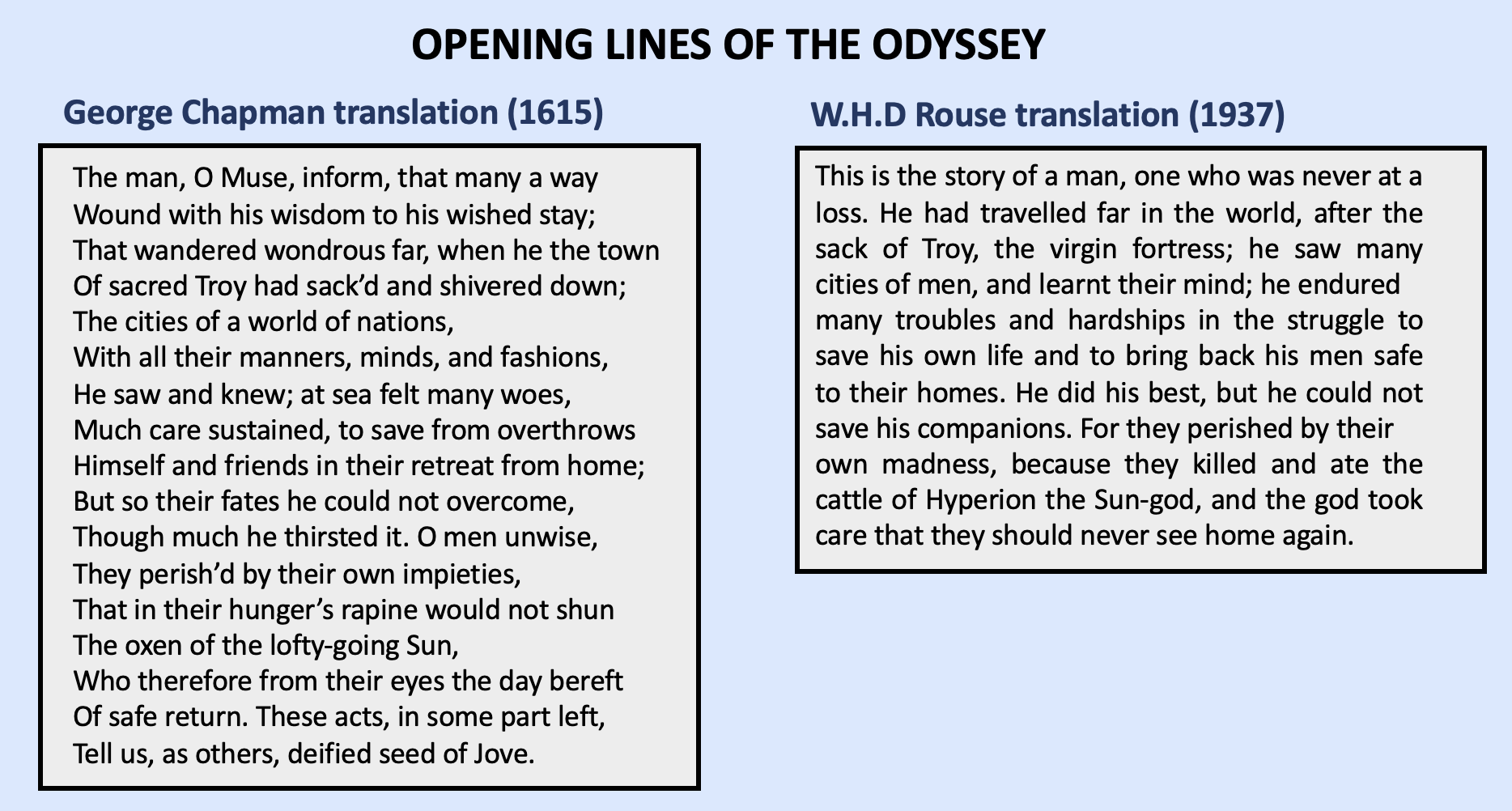
You can see the difference by comparing Rouse’s rendering of the opening lines with the esteemed Chapman translation from Shakespeare’s era.
Is this the best version of Homer? I won’t go that far — years later I became very fond of Robert Fitzgerald’s translation. But I will insist that Rouse is the superior version for a youngster. And, in many ways, youngsters were Homer’s target audience — you can feel that at every turn in his story.
So this is the first thing about the Odyssey you won’t learn at Harvard — namely that this tale was not intended for Harvard elites. It’s a story for everybody. So it’s an obvious choice for a big-budget Hollywood movie. There was no pretension or elitism in Homer’s approach. In today’s parlance, you would say that he was appealing to a mass audience.
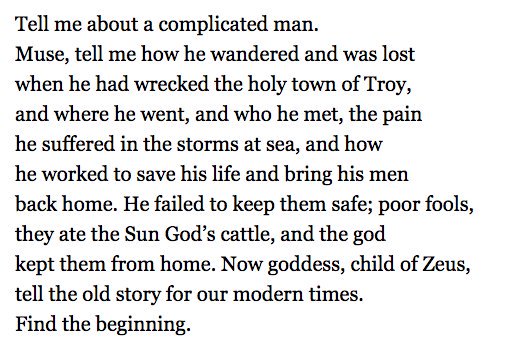
Director Christopher Nolan — whose screen version of the Odyssey makes its debut in London today — relied on the more recent Emily Wilson translation of the Odyssey into iambic pentameter. In her version, our hero is described, like Shaft, as a complicated man who won’t cop out (when there’s danger all about). Okay, she doesn’t use those exact words, but comes close …
Emily Wilson’s translation of the opening lines of the Odyssey
I like this rendering, and can almost hear that Isaac Hayes synth vamp in the background. Wilson is just as straightforward as Rouse — living up to her aspiration to “tell the old story for modern times”.
ZKP-524: A Prototype Czech 7.62x25mm 1911 Copy
Forgotten Weapons
Published 18 Feb 2026The Czechoslovak military knew when they adopted it that the vz.52 pistol was not very good, and they initiated a replacement program at the same time as its adoption. Two pistols were developed to be its replacement; the CZ 531 and the ZKP 524. The ZKP was designed by the brothers Josef and František Koucký, based heavily on the Colt 1911 and Tokarev TT33 pistols. It was chambered for the 7.62x25mm cartridge as required by the military, and held 8 rounds in a single-stack magazine. In trials against the CZ-531, it proved to be more accurate, but less reliable and more expensive. It suffered a cracked slide after 4,198 rounds fired, and an improved second example was made. However, the vz.52 proved good enough despite its shortcomings, and the program to replace it fizzled out after this testing.
Thanks to the Czech Military History Institute (VHU) for graciously giving me access to this unique prototype to film for you! If you have the opportunity, don’t miss seeing their museums in Prague:
https://www.vhu.cz/en/english-summary/CZ 531 video: • CZ-531: A Czech Browning in 7.62mm Tokarev
(more…)
QotD: The Wilmot Proviso
The Wilmot Proviso attempted to scotch that, which forced the Senate, at least, to come right out and say it. People always underestimate the power of words and symbols, and professional historians are among the worst offenders. With the newer generations of pros it’s ideological enstupidation that causes it, but the older folks were almost as bad. It’s a structural issue — we rely on documents, so even though “the temper of the times” is real obvious in the aggregate, unless you can pin it down to specific statements in archival sources it’s hard to make your case.
If it helps, think of the couple whose marriage is obviously on the rocks. They fight constantly, they all but live separately, everybody knows their relationship is doomed … but when one of them finally comes out and says “I want a divorce”, things often change radically. Temporarily, most often, but how many people have you seen suddenly make all-out efforts to patch things up only after somebody finally says the D-word?
You can hear the capital letters in their voices. Before, all that stuff — romantic weekend getaways and the like — were attempts to “get back on track” or “spice things back up” or whatever. As soon as someone says Divorce, though, all those things become capitalized — we’re Saving Our Marriage.
The Wilmot Proviso was like that. Somebody finally said the D word.
Severian, “1846-1861”, Founding Questions, 2022-06-25.
July 7, 2026
Canada decides to buy German submarines
I wouldn’t say I’ve been closely following the Canadian Patrol Submarines Project (CPSP), but I was interested enough to do a bit of reading about both of the contending bidders and their offerings. Based on my understanding of the RCN’s needs, I expected the South Korean KSS-III submarine to be the final winner, but I was wrong: Prime Minister Mark Carney announced that the German/Norwegian TKMS Type 212CD submarine had been selected instead.
Type 212 submarines at the HDW shipyard in Kiel, Germany, 1 May 2013.
Photo by Bjoertvedt via Wikimedia Commons.Submarines enable the Royal Canadian Navy (RCN) to defend threats near and far from Canada’s shores. Yet, our current fleet is aging, with only one of four submarines seaworthy. With the longest coastline in the world, Canada’s ability to deploy underwater surveillance capability is critical. Our security and sovereignty depend on them.
Today, at Canadian Forces Base Halifax, the Prime Minister, Mark Carney, announced that Thyssenkrupp Marine Systems (TKMS) has been selected as the preferred supplier to begin negotiations for delivering Canada’s next fleet of submarines to the RCN. This will be the largest defence procurement in Canadian history, and it will equip the RCN with the capabilities they need to keep Canadians safe.
With ultra-low acoustic and magnetic signatures, TKMS’ 212CD is one of the stealthiest submarines in the world. It is capable of Arctic patrol, undersea surveillance, special forces deployment, and it is fully NATO-interoperable. These submarines provide an unparalleled combination of advanced technology and lethality that will enable the RCN to detect, track, deter and, if necessary, defeat adversaries in all three oceans bordering Canada. This procurement will bolster Canadian security through a platform shared by Germany and Norway, two of Canada’s closest Allies.
The Government of Canada and TKMS will now enter into negotiations to finalise the contracts and all arrangements required to deliver the requirements of the CPSP. Canada will conclude contracting no later than the end of 2027, with the first four submarines to be delivered ahead of schedule, in 2034. In the event that negotiations with the preferred supplier are unsuccessful, Canada may designate Hanwha Ocean as the preferred supplier and enter into negotiations.
The CPSP is being advanced by the Defence Investment Agency and aligns with Canada’s Defence Industrial Strategy. Under the Build-Partner-Buy framework, the project demonstrates the Partner approach, with collaborations with trusted Allies to develop and deliver capabilities while ensuring industrial and economic benefits for Canada. The CPSP will prioritise investments across the Canadian supply chain, to create high-paying jobs, leverage Canadian defence industries, and maximise benefits for Canadian workers and businesses.


Noah comments on the press release information and some wider issues to do with the CPSP:
And with this, the long-awaited Canadian Patrol Submarine Project finds its home. What started as an ambitious RFI back in 2024 has quickly turned into one of the most consequential, publicized, and dynamic projects, I would say, in Canadian history.
TKMS and Kongsberg, operating as Team GERNOR, have claimed the preferred supplier designation from the federal government. As always, there is no contract today. The selection of a preferred supplier merely sets the table for negotiations to a final contract.
While the federal government will want to move quickly, and I’m sure that the Navy would like to see the contract signed, it is highly likely that comes in 2027. The typical “quick” timeframe is about a year. Keeping in mind, of course, that CPSP will be the largest procurement contract in federal history,1 and in this case also includes additional negotiations on build slots for submarines from both Germany and Norway.
[…]
There was no universal consensus, and I know this choice didn’t come easy for anyone. Both sides put all they could into it. Yet in the end, the GERNOR option pulled ahead. The European focus was championed heavily by those in the PMO as an opportunity to open doors and integrate Canadian industry into the wider European ecosystem, especially as European interest in Canadian expansion grows.
At the end of the day, that ecosystem came out on top. In the final weeks and months of the competition especially, the banner of Europe rallied to the call of unity, to stand with their hands at the back of Team GERNOR. That push, and that united front, is very likely what pushed that sense of alignment forward.
You don’t need to look far for it. Just after CANSEC, Italy’s Fincantieri, a noted ally of TKMS, signed a new MOU with Magellan Aerospace to investigate the potential production of heavyweight torpedoes and undersea countermeasures, building off the proposed investment TKMS plans to make.
While not in the 212CD network, Fincantieri is in the family, and they, among others, are also looking to Canada and our choices. It is the first example of the TKMS family taking notice and making proactive moves to jump in and secure capacity in a future Canadian submarine industry; and, as I understand it, far from the only one being discussed.
Another outside addition: Navantia of Spain and TKMS have also recently signed an MOU to investigate collaboration on naval shipbuilding. While this new agreement is young, I am also led to believe that Navantia is looking to Canada with interest, building off some of their previous engagements with industry.
Increasingly, the European front is united in industry, in the political sphere, and diplomatically to present the 212CD not as a German-Norwegian partnership but as a foundational Canada-Europe partnership that will build off the foundation of agreements like SAFE and the EU-Canada Security and Defence Partnership to create a united Atlantic front that promotes collaboration and joint investment, and opens the European market to Canadian industry.
- NR – “the largest procurement contract in federal history” … Canada’s major military purchases happen so rarely and always taking as long as bureaucratically/politically possible, so every ship, aircraft, helicopter, or tank purchase has a good chance of being the next “largest procurement contract in federal history”.
Clankers in higher education
On his Substack, David Friedman discusses the impact of AI on university exams:

Professor Roberto Serrano, who is the Harrison S. Kravis University Professor of Economics at Brown University, has detected a massive fraud in one of the classes he teaches, ECON 1170, an advanced undergraduate course in mathematical economics. He has conclusive evidence that at least 50 students cheated on the March midterm exam, making it the biggest known scandal at Brown and in the entire Ivy League
…
“Academic integrity is a value worth defending. The faculty cannot be left on its own in a battle that is decisive if we want to preserve the future of higher education,” explains the 61-year-old professor … (El Pais)
It was a closed book take-home exam; the problems were designed to test the student’s ability but proved doable by an AI. After Serrano changed the final from take-home to in-person about half the students who had gotten perfect scores on the midterm chose not to take the final.
The existence of AI, like the earlier problem of students buying papers online, reduces the ability of teachers to test their students but does not eliminate it, is inconvenient but not catastrophic. It makes some kinds of testing more difficult but not impossible; Serrano could have asked students whose midterms were suspiciously good to explain some of their answers and failed any obviously unable to do so. That would have been additional work for him and, judging by the article, not a policy Brown would have endorsed. Unwilling or unable to do that that he can base his future grading on work done in-person and adequately monitored.
[…]
It is not immediately obvious what is wrong with using AI on a test. If the purpose of the test is to generate information for potential future employers, why should they want the student tested without a tool that, if they hire him, he will have? A basketball coach does not evaluate potential team members by how well they can play with one hand tied behind their back.
Arguably the skills the employer wants tested are those that an AI cannot replace and it was up to Professor Serrano to find ways of testing for them. His take-home midterm, taken without the assistance of AI, might have provided information for him and his students about how far they had come along a path that would eventually produce skills an AI could not substitute for but not information for a future employer about the skills of the students taking the exam.
The Democratic Socialists of America
On the social media site formerly known as Twitter, Cynical Publius sounds the warning about the impending takeover of the Democratic party by the Democratic Socialists of America (DSA):

Logo of the Democratic Socialists of America
Since 2023, I have kept the same pinned post because I feel that post (the one discussing “my side of history”) is the most important sentiment I have ever posted on this platform.
For the short-term future, however, I am changing that pinned post to this one, because it is of such crucial importance to our nation’s survival.
Here goes.
The Democrat Party is in the process of being taken over by the Democrat Socialists of America (the “DSA”).
The DSA is an explicitly Marxist organization.
Marxism has impoverished more people and genocidally murdered more of humanity than all other ideologies ever to exist in human history combined.
It is a grotesque form of evil that is wholly incompatible with the Constitution of the United States of America.
Marxism in all its forms must be reviled and publicly treated with the same disdain with which intelligent adults view Naziism, pedophilia, serial murderers and cannibalism.
Do not back down. Each and every time you encounter Marxism in any of its forms, please call it out for the evil that it is. It is a rapidly metastasizing cancer that can only be defeated by public awareness.
Thank you.
Tom Knighton reacts to another self-identified Democratic Socialist’s criticisms of America:

… when I see someone like this, I have to think this should be automatically disqualifying for office.
Pennsylvania state and socialist Chris Rabb, the Democratic nominee for Pennsylvania’s 3rd Congressional District, has joined the growing chorus of Democrats denouncing the founding documents and core institutions in the country on our 250th anniversary. The Democratic socialist is running unopposed for Congress and will almost certainly be a member of Congress after November.
Rabb spoke at an event billed as “America at 250 — Trump Fascism, Historical Erasure, and the Battle Over Truth” at People’s Plaza on Independence Mall in Philadelphia.
He denounced the country as based on “stolen land and stolen labor.” He lashed out at the Declaration of Independence:
Those screeds that were very lofty but were notoriously catering to a performative aspect of collective genius that purposely erased indigenous and black peoples … It created distance from an empire to help very privileged people continue that privilege and ultimately institutionalize that through the U.S. Constitution many years later. But it certainly did not provide independence to indigenous and black peoples. And we cannot talk about anything today without acknowledging that this is a nation born on stolen land & stolen labor.
Actually, I think the Declaration did provide independence to American Indians and black people. It just took way too long to be recognized.
Lincoln cites the concepts of the Declaration in the Gettysburg Address, and there’s little doubt that many of those who worked to end slavery did so because our nation was founded on the principle that all men were created equal.
It should have been a given, granted, and I have no problem with anyone taking issue with the imperfect application of that concept, because that’s legitimate. The thing is, we fought an entire war to end slavery once and for all. As many as 750,000 Americans lost their lives in that war, and it was ultimately worth it to end that particular scourge.
Yet I find it disgusting that while socialists like Rabb will cite that imperfect application of natural rights as an evil, they completely ignore the blood price this country paid to end that scourge.
[…]
How can someone like this want to serve a nation they despise? He’s not really looking to make it better; he’s looking to destroy the nation it is in favor of something it was never meant to be. It’s not about improving it. It’s about overturning it.
I’m still flabbergasted that “Democratic Socialism” is taking hold as strongly as it has, especially considering socialism’s track record in the 20th Century, and while I believe Rabb has the right to say whatever retarded thing he wants, I also believe the voters of this country should see that kind of rhetoric as disqualifying for public office.
Yes, that includes the Democrats.
Unfortunately, they nominated him, and he’s far from the only DSA nutball who has won their primary this election cycle.
Remember, boys and girls: You can vote yourself into socialism, but you’ll have to shoot your way out.
Andrew Sullivan is also concerned with the DSA consuming the rest of the Democratic party:
I’d say the DSA is to the Democrats in the 2020s what the John Birch Society was to the GOP in the 1950s. But the Dems won’t expel or cauterize them, so dozens of DSA candidates are surging to victory this year, from Colorado to New York State, with a big boost from Mayor Mamdani and Hasan Piker.
The DSA backs Hamas terrorism, the Maduro regime in Venezuela, and the Castro tyranny in Cuba. Its new platform — to be voted on next month — supports “scrapping the U.S. Senate, ‘abolishing the carceral forces of the capitalist state’, defunding the Department of War, amnesty for all immigrants, and ‘replac[ing] the President and Supreme Court with an executive and judiciary chosen by and subordinate to Congress’.”
Jon Chait has a good rundown of the the group’s darker undercurrents. Last year, they amended their founding documents to allow members of communist cells to join. The DSA “Red Star Caucus” brags:
We in Red Star are communists who believe that DSA is the most effective place to serve the socialist movement … We call on all communists in the United States to join us in the democratic struggle within DSA … as we continue to improve the democratic structures of DSA, and as communists contest for and win hegemony within the organization, we continue to move toward a revolutionary horizon.
When Donald Trump calls someone a commie, it’s a good rule to ignore him. This time, he’s right. Lenin-fan Darializa Avila Chevalier showed up to a pro-Hamas rally on October 8, as bodies still lay on the ground at a music festival — yes, that’s how deep the Israel-hatred runs. She supports abolishing all prisons, police, and national borders. Her now-deleted Twitter discourse is a 2020 fever dream: “Yes, literally, abolish the border”, “Seize the means of production”, “ALL PIGS EVERYWHERE ARE HARAM”. She also converted to Islam. Check out her answer to the simple question, “What should happen to somebody who has killed somebody else?” It’ll take a while.
Claire Valdez, another primary winner, pledges to abolish ICE and nationalize the airline industry. Melat Kiros, who defeated a staunch progressive in Denver, is more rooted in opposition to Israel’s existence as a Jewish state and “genocide” in Gaza. She refused to condemn as antisemitic the fatal firebombing of a solidarity walk for Israeli hostages. It was merely “anti-Zionist.” Israel is increasingly the dominant fixation among the activist left — just ask Scott Wiener.
After this wave of extremism, you might expect some Democratic pushback. And some came: a new group of 13 House Dems signed a “Promise to America”, rejecting socialism. “We disagree with MAGA. We disagree with socialists”, Congressman Tom Suozzi said. “We don’t want this extremism. We want mainstream.” But 13 signatures are not much against a growing and organized machine. And the pressure more broadly is on the critics: “You are creating the antagonistic dynamic that we do not need”, AOC said. “These are two young, talented, intelligent women that got elected against all odds, against millions of dollars. Perhaps there is something we can learn from them.” There is: communism.
Carthage at the Gates – The Second Punic War | EP 1
The Rest Is History
Published 2 Feb 2026Our whole series on Rome vs Carthage can be found here: • Rome Vs Carthage
[NR: Last year’s animated episode on Cannae is here — The Bloody Battle of Cannae]
Did Hannibal march on Rome after his legendary victory at the Battle of Cannae in 216 BC? How could Rome fight on after losing so many men? And, where would their next cataclysmic clash take place …?
Join Tom and Dominic, as they discuss the beginning of the end for the once mighty city of Carthage, and her masterful general, Hannibal Barca.
00:00 Cold open
02:02 After Cannae
05:20 Carthage vs Rome: the long backstory
12:44 The Barcid dynasty
15:37 Hannibal’s invasion route
18:37 Why Hannibal doesn’t march on Rome
21:30 Roman morale collapse (and recovery)
25:01 Rome’s “Lord Halifax moment” that never happens
28:00 Fabius Maximus takes control
31:06 Early heroes and hard choices
33:39 The Fabian strategy returns
34:26 Italy fractures
36:10 The Capua turning point
37:07 “Hannibal at the gates”
39:40 The war becomes a stalemate
43:08 Syracuse at its peak
50:14 Archimedes’ war machines
51:15 Syracuse switches sides
52:06 Marcellus besieges Syracuse
56:20 The fall of Syracuse
57:25 Death of Archimedes
58:40 What Syracuse means for the wider war
(more…)
QotD: “I was just following orders” — the Nuremberg Defence
JerryRigEverything @ZacksJerryRig
It is illegal to obey illegal orders.
It is illegal to obey illegal orders.
It is illegal to obey illegal orders.
It is illegal to obey illegal orders.
It is illegal to obey illegal orders.
It is illegal to obey illegal orders.
Congress has not declared War.
Pass it on.Hot Take: The “Nuremberg Defense” should be completely legally valid because it was for the entirety of human history until the Nuremberg Trials.
The idea that the average GI Joe has the knowledge and capability to parse the legality of orders in life-and-death situations is one of the best examples of how Liberalism simply does not comport with reality.
Every lawyer knows this to be true, too. Ask any number of attorneys a question on a matter of law and if the question is worth a damn you’ll get as many answers as participants. All good legal questions start with the same answer: “It depends.”
If you can’t even get a team of attorneys to always agree on whether something is legal, with hours to days to weeks of research put into the question, why/how do you expect a normal joe to figure that out?
You don’t. He can’t. You know that.
You just want to inspire doubt, raise mutiny, and have a way to punish people who did things you don’t like on the orders of someone out of your reach.
J.T. Alexander, The social media site formerly known as Twitter, 2026-04-06.
July 6, 2026
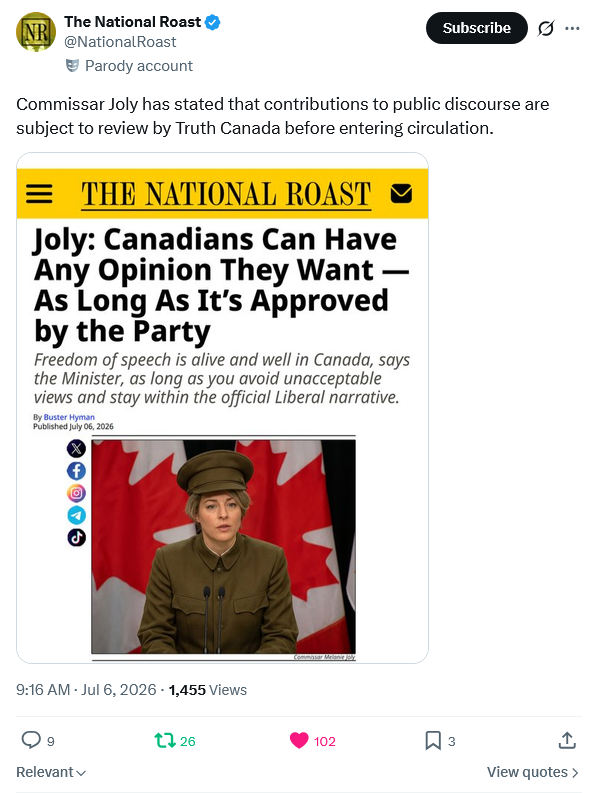
Federal ministry outlines their plans to become Orwell’s MiniTrue
In George Orwell’s Nineteen Eighty-Four, the totalitarian government of Britain (“Airstrip One”) organized itself into all-powerful ministries whose names were deliberate lies: “The Ministry of Peace concerns itself with war, the Ministry of Truth with lies, the Ministry of Love with torture and the Ministry of Plenty with starvation. These contradictions are not accidental, nor do they result from ordinary hypocrisy: they are deliberate exercises in doublethink.”
The Canadian government seems to have mistaken Orwell’s warning as a how-to guide:
This is crazy
Canadian ministry of Innovation, Science and Economic Development Canada
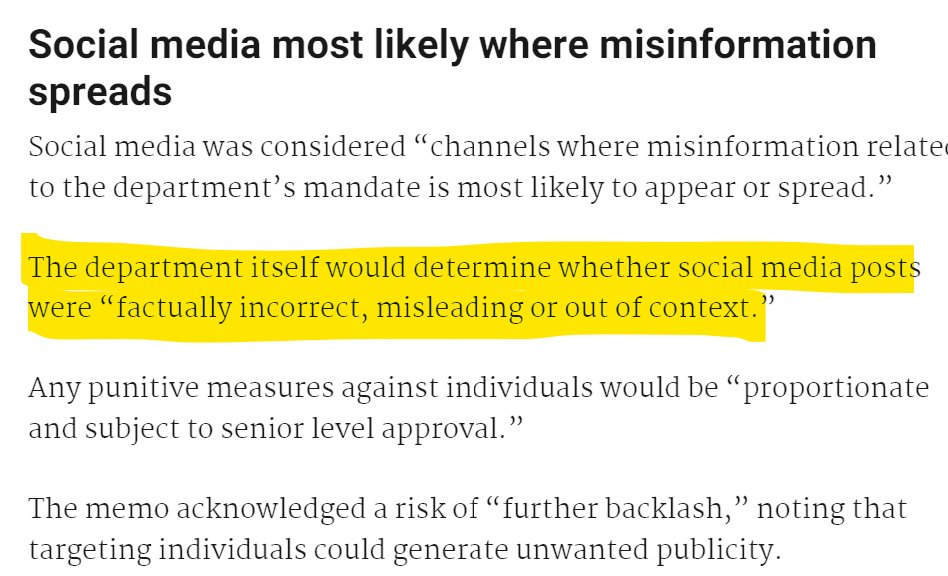
wrote a memo to Minister Joly
outlining a plan to make themselves the literal Ministry of Truth, and then use government lawyers to sue people.
And this is the minister in question:

Not parody: Meet our new Minister of Misinformation.
She will be the in charge of state surveillance & the punishment of speech.
We are becoming the UK:
The government is the accuser.
The government is the judge.
The government is the executor.
The government decides what speech is allowed.
The Liberals purposely redacted what tools they plan to use.
And there will be no threshold for what triggers legal action.
Nor will there be independent oversight of the accuracy of what THEY call misinformation.
They want to use your tax dollars, so they can sue you.
Using government lawyers, for what you post online.
TWO WEEKS AGO CARNEY PASSED BILL C22, GIVING CABINET SECRET ACCESS TO YOUR DATA.
THIS WEEK JOLY TELLS YOU WHAT THEY PLAN TO DO WITH IT.
We were called conspiracy theorists.

Update:
“The Road to Hell is Always Paved with Good Intentions”
On the social media site formerly known as Twitter, Brivael Le Pogam expresses his frustration with young people’s recent affection for more socialism, despite all the evidence of history:
When I see the younger generation demanding more and more Marxism, more socialism, more State, more “planning” to fix a world they’ve been taught to hate — I don’t feel like snickering. I feel like screaming.
Because I recognize the opening chapter of a story whose final page I know all too well.
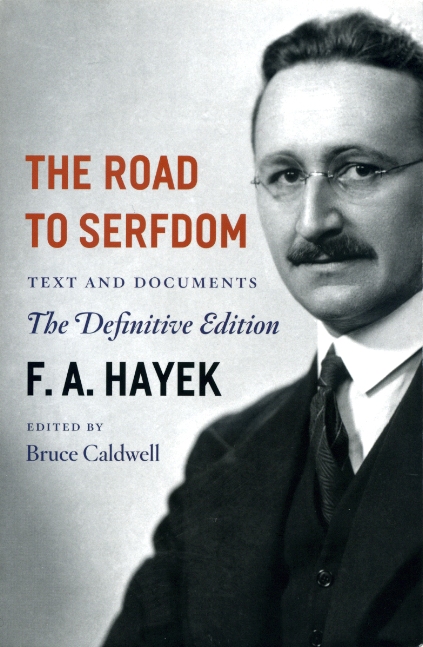
That story, a man wrote in 1944, under the bombs. Friedrich Hayek. The book: The Road to Serfdom. And he dedicated it — read carefully — “to the socialists of all parties”. Not out of contempt. Out of affection. Out of urgency. Because he had seen, with his own eyes, an entire Europe tip over the edge.
Remember this, it’s the heart of it all: totalitarianism never starts with monsters. It starts with good people.
It starts with idealists who want the common good. Generous young people who can’t stand injustice anymore. Soft, consensus-driven parties that promise to fix everything if you just give them a little more power. The problem isn’t their intentions. The problem is the mechanism they set in motion.
Here’s that mechanism. Follow it, it’s relentless.
To plan an economy, you need a single decision where there were once millions of free choices. So you have to concentrate power. But no society ever agrees on a single plan — everyone has their own ends, their dreams, their priorities. The planner then hits a wall: disagreement. And disagreement becomes an obstacle to eliminate. You start by persuading. Then by coercing. Then by silencing. Not out of sadism — out of logical necessity. The plan demands that you crush what resists it.
And then comes Hayek’s most chilling chapter: “Why the Worst Get on Top”. In a system that demands total power, it’s not the best who win. It’s those who are ready for anything. The scrupulous man hesitates; the man without scruples acts. The collectivist machine, whatever its colors, mechanically selects the brutes.
Look at Germany. You’ve been told Hitler fell from the sky, an anomaly, an accident of evil. That’s false, and it’s dangerous to believe it. What Hayek understood was that Germany had spent half a century abandoning classical liberalism — the individual, rights, the market — in favor of the cult of organization, the collective, the State that knows better than you. The left and the right already shared the same premise: the individual must submit to the nation’s plan. Hitler didn’t have to build that machine. He found it already assembled, warmed up, ready. He just had to grab the wheel.
That’s the warning. Totalitarianism isn’t an ideology. It’s a structure. You can fill it with red, brown, any generous color you like. Once you’ve accepted that the individual must bend to the collective, that property is just a revocable privilege, that the freedom to trade, to speak, to innovate stops where “the common good” decreed from above begins — you’ve laid the tracks. The train, it’ll come on its own.
And it always comes with the world’s best intentions. Every step toward the abyss is justified, reasonable, compassionate. One more tax for the poor. One more control against the bad guys. One less freedom, but “just that one”. No one chooses servitude. You slide into it, one good intention after another.
So I’m tossing this bottle into the sea. To you who are twenty and on fire with passion. Your revolt against injustice is beautiful — keep it. But for the love of God, learn history. Read Hayek. Read what the 20th century really was, not the caricature they’re feeding you. The tens of millions of deaths it left behind weren’t killed by sadists from another world, but by systems built, at the outset, on dreams of justice.
Freedom isn’t the problem to fix. It’s the treasure they’re convincing you to sell off cheap.
Wake up.
Auto-translated from the original French by X.
The Ancient Greeks: 03 – Enter the Persians 1 – When Empire Meets the Polis
seangabb
Published 16 Feb 2026Greece: A Brief History, c.700 BC – 500 AD
In this lecture we begin the Persian Wars not with battle, but with misunderstanding. The Greeks did not set out to fight a civilisation-defining struggle against Asia, and the Persians were not driven by irrational hatred of freedom. This episode explores the structural collision between the Persian Empire and the Greek city-state system. We examine the rise of Persian power under Cyrus and Darius, the nature of imperial governance, and the early cultural encounter between Greek and Persian military worlds. Along the way, we meet Herodotus, the first true historian, and consider how his narrative shapes our understanding of East and West.
This is the beginning of a story that ends at Marathon — but whose consequences reach much further.
QotD: Cloud people and dirt people
One example of this is in how the political class understands hierarchy. Every Washington politician and appointee lives in a world where hierarchy is well understood and respected. The appointed class have an array of titles that indicate their position in the hierarchy. Elected officials, of course, have their office and their committee assignments, along with their seniority. This is a world every one of them inherited when they entered politics. It is how it has always been.
In this world, a senator tells his staff to do something and he just assumes they will do it, assuming it can be done. If it cannot be done, then he is going to have them find out why it cannot be done and report back to him. An appointee works the same way within the bureaucracy. They have a staff, usually of appointees, and that staff carries out the orders of the director or secretary. Even though nothing of public good is done in Washington, the petty tasks are carried out with precision.
In this regard, the political class is a petty aristocracy. Senator Lindsey Graham, for example, commands absolute loyalty from his staff. Not only does his staff do what they are told, they faithfully keep his secrets. He has been in the Imperial Capital for a quarter century, without a hint of scandal, despite the obvious. Congress operates a private slush fund to settle sexual harassment claims. Over 260 claims have been paid, without a word about the details. That’s loyalty.
Scan the biographies of the political class and the thing you will be hard pressed to find is anything resembling real world experience. Few have ever worked in the dreaded private sector. Those that have, worked in the law or maybe finance. These careers were just alternative paths to the place they wanted to be all along. There are no sons of the soil in Washington.
The Z Man, “Us And Them”, The Z Blog, 2020-10-06.


