
Forgotten Weapons
Published 11 Mar 2026The Bannerman family decided to sell Bannerman’s Island to the state of New York in the 1950s, but the sale required that they first clear all the ordnance off it. That was no simple task, and the military was not interested in the job. Instead, the family found Val Forgett Jr, a demolitions expert who happened to be looking for seed money to start a business making reproduction black powder revolvers. His offer to do the cleanup work was accepted, and he spent a summer doing the job and put the proceeds into the first Navy Arms reproduction 1851 Colt Navy revolvers.
This video includes the talk given by Forgett to the Armor and Arms Club of New York in the 1990s explaining the process of clearing out the ordnance from the island …
(more…)
August 9, 2026
Clearing Bannerman’s Castle: A Century of Explosive Ordnance
QotD: Spoilers — threat or menace?
I used to think I was a control freak because I prefer knowing what happens before I watch a movie. Give me a book, and I will behave beautifully for the first hundred pages — then, suddenly, I’ll turn into a literary criminal and flick to the end. This doesn’t always happen; the writer has to be good enough to make me panic. Yet if I care deeply whether Harry Potter survives, or whether Catherine ends up with Heathcliff, I need the literary equivalent of someone taking my hand and saying, “Brace yourself, chapter thirty-two is going to be a bit of a donut”.
It turns out this may not be control freakery. How wonderful to think that I have been waiting years for science to rebrand my worst qualities as skills. Apparently, people who like spoilers are just trying to regulate their emotional response. We are not monsters, but only putting on a cardigan before the storm.
Those who hate spoilers also want control, but theirs is driven by a desire to preserve suspense. They want to receive information in the sequence designed by the storyteller. My own spoiler-seeking is also a form of control, although it works differently. I want the major facts early, so I can relax into the texture of the story rather than sit there like a meerkat scanning the horizon for emotional catastrophe.
So we are all control freaks, just wearing different cardigans.
Spoiler alerts began as a civilized courtesy. If someone on a bus was halfway through a book, it was not considered the done thing to lean across and announce the ending like a deranged town crier. There were rules. Perhaps not that many. But there were some.
Now the spoiler alert has become a moral siren. One can’t discuss a film, television show, podcast, documentary, memoir, cake reveal, or episode of Bluey without issuing a warning so elaborate that it requires its own stationery. People now approach plot discussion like bomb disposal experts. One innocent mention of a character’s demise, and the online village square bursts into flames. On “The Good Ship Murder” Facebook page, for instance, someone posts, “Can’t believe they killed Pierce”, and within seconds the spoiler militia descends.
Admins should delete this spoiler.
People might not have seen it yet.
Can’t believe you’ve posted a spoiler…You can almost hear the sirens. Somewhere, a moderator is reaching for a lukewarm tea and wondering how a cozy murder show has turned into the fall of Saigon.
Nicole James, “Tell Me Who Dies So I Can Relax”, The Freeman, 2026-05-07.
August 8, 2026
Pointing the finger of blame accurately
The Librarian of Celaeno wants you to know that former professor Jason Arday did nothing wrong:
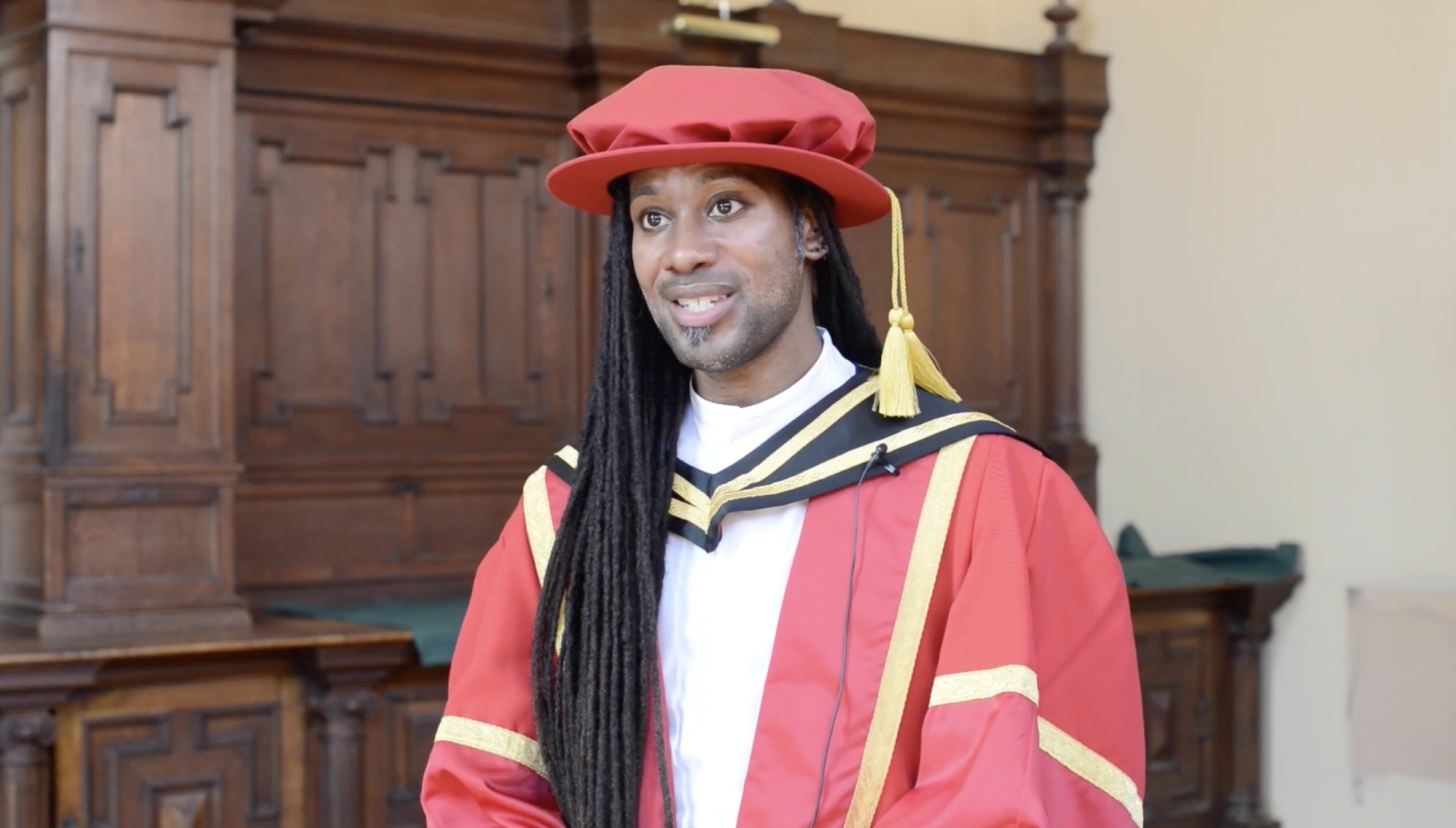
Former Cambridge professor Jason Arday
Image from Andrew Doyle
Once upon a time, an autistic black child was born. Usually, it takes several years to figure that out (the autism, not the blackness), but so autistically autistic was the infant Jason Arday that it was immediately apparent to everyone without there even needing to be any public record of it. Perhaps there is some lost evidence of him having a Reddit account as a toddler; one can speculate. Arday was unable to talk until age 11 and has been unable to stop talking ever since, which is fortunate since otherwise many of his unbelievable life accomplishments would now be unknown.
The range of setbacks he has overcome boggles the mind. Despite being illiterate until age 18, Arday not only graduated high school, but got into college, where he finally learned how to read good. This is even more incredible when you consider that the same year he discovered what the alphabet did he was beaten into epilepsy by random teens — he forgave them so thoroughly that any documentation of the incident is now gone from police records — and that some unspecified time before that he was in a car accident that left him in a waking coma for months. He studied so hard in college that he gave himself a brain tumor, which he evidently removed by himself in the mirror, since there is no evidence of a surgeon having done so. It may be that Arday has in fact learned to read several times in his life, but keeps getting that knowledge erased by semiannual episodes of CTE.
Even though he’d accumulated a substantial amount of what for a normal person would be crippling physical trauma over the course of his short time in the world, of the sort that would require medical interventions that would otherwise severely limit active life, Arday rapidly became one of the world’s most elite athletes. He participated in a ‘30 Marathons in 35 Days’ challenge, which was actually somewhat documented by an independent contemporary account, in the midst of which he suffered a hairline fracture in his fibula, which he seemingly just shrugged off to complete the remaining nine marathons. This was apparently the last time he ran slowly enough for anyone to witness, however, because his career as an ultramarathon runner who hyperGogginsed his way through 600 miles in six days passed entirely without notice by the few other people on Earth who could conceivably do that. He played semi-professional soccer, but was so good that he got bored with it and moved on before anyone could write his name down on a roster. Along the way, Arday became one of the best snooker players in Britain, with a skill level far beyond the need to participate in any public tournaments, other than the single amateur contest he entered but was too gracious to the other players to win.
He surmounted the intellectual challenges involved in becoming a PE teacher, and from there went on to earn a Ph.D as a black man, with his thesis largely consisting of arguing that it’s easier to do well in academia if you’re not closely supervised. It was so convincing a premise that his doctoral committee at Liverpool University evidently forewent actually reading the dissertation, perhaps also having concluded that his proximity to their whiteness had burdened him enough already. It was thus that Dr. Arday came into being, following a path blazed by Ibram X. Kendi as a bedredlocked black man writing about being black while being black blackly in a world basically controlled by the bad guys in Caddyshack.
On Substack Notes, Michael Southon also points the finger at the people who enabled Arday’s rise and attributed racist beliefs to anyone who asked questions:

Arday’s arrival to take up his professorship at Cambridge was recorded by at least two BBC cameras. Here he is talking to Hilary Cremin, head of the Faculty of Education at Cambridge.
Cambridge University was so proud of its choice of Jason Arday that they invited the BBC to film Hilary Cremin, the head of Cambridge University’s Faculty of Education, welcoming Arday to his new post. In the clip you can hear Cremin gushingly tell Arday:
We are so lucky to have you. You are the best in the world in terms of the research that you do.
Arday himself is incredulous and suggests that some people will see his appointment as “tokenistic”. In response, Cremin assures him he is “world class”.
The Telegraph reports that when Arday’s students complained that they weren’t being properly supervised, they were told they were being “racist”.
The truth is that Cambridge was desperate to appoint more people of colour. His alleged autism ticked another box on the identity politics agenda. The dreadlocks were icing on the cake.
Will this episode, which has been reported around the world, finally convince the establishment that DEI is a disastrous social policy that lowers standards and turns august institutions whose reputations are based on centuries of meritocracy into the laughing stock of the world?
I doubt it.
Also on Substack Notes, GenX Anecdotes finds the behaviour of Hilary Cremin to be emblematic of a kind of condescending attitude found most frequently among liberal white women:
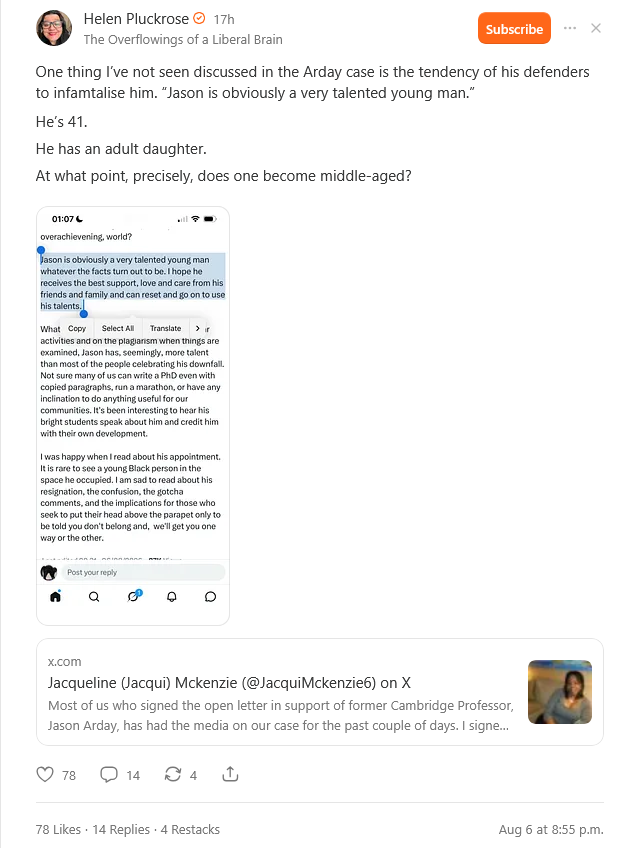
We know the type.
And it does tend to be a woman.
They love nothing more than to put on that awful softy, patronising voice, as if talking to a small child.
I am reminded of that excrutiating clip of Hilary Cremin (Head of Cambridge University’s Faculty of Education) “You are the best in the world in terms of the research that you do“.
Really? “The best in the world”?
Like the bestest in the whole big wide world ever! 😂
I’m surprised she didn’t lean in and give him a pat on the head.
Wtf?
And that tone. 😭
It’s bad enough when they do it to kids.
I have posted about this “tone” before.
Near where I live there’s a Waitrose. The spiritual home of such a woman.
There used to be a Muslim woman wearing a hijab who would beg for money outside. I never gave her money because she seemed fake to me.
Always clean and well presented with the latest new iPhone (!), she would look up from her phone when she saw someone approaching, visibly completely change her facial expression, tilt her head to one side in a kind of puppy dog, “poor me” way, and put on a kind of fake whimpering “please help me!” and hold her hand out.
It was so obviously fake af!
One day I was waiting outside the shop for my daughter who had run in to get something.
As I waited, these two middle class, middle aged women stopped to talk to her.
They were both fawning over her, using that same softy patronising tone, falling over themselves to praise her. One of them said “you’re so beautiful and brave” and the other put her arm around her.
It was such a sychophantic display of patronising bullshit, I think I might have thrown up a little bit in my mouth.
This pathological sickly, performative fawning over their little pet minority groups, is something to behold!
And they were both being played.
This beggar wasn’t homeless. So obviously! You’d have to be a special kind of stupid to think so.
But they really are a special kind of stupid.
They just wanted to feel good about themselves. It’s all about their need to feel like they’re “good kind people”.
Then, no doubt make a FB post about it so all their other annoying cloying phoney friends can “coo” over how much they adore their little darling minority pets.
🤮
Larry Correia’s A to Z Guide to Anti-Gun Vulture Talking Points
On the social media site formerly known as Twitter, Larry Correia reposts his talking point guide on the issue of gun control:
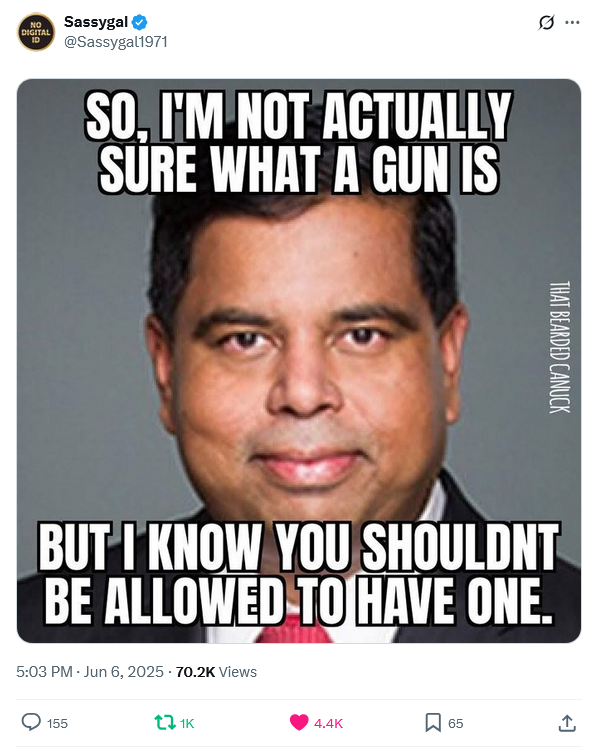
Looks like it is time to once again post my A to Z Guide to Anti-Gun Vulture Talking Points!
A. Gun owners are never trained enough so are dangerous and shouldn’t be armed at all.
B. Gun owners who do train are crazy psychos living out their wannabe fantasies itching to shoot someone.
C. Even though it takes orders of magnitude more effort to become marginally effective with martial arts than a gun, you are better off using martial arts and not having a gun.
D. *Real Men* use their hands. This is why your mom and grandma shouldn’t have guns either.
E. Twitter randos who have never been punched in the face are experts on real life violence, and whatever you have personally experienced doesn’t count.
F. No matter how trained you are, it is never enough for the hypothetical attacker they make up. Sure, your concealed handgun might be enough to stop a regular robber or rapist, but what about if you get attacked by 20 Chechen terrorists with AKs, huh? Huh? (we call this the Dracula Riding Godzilla rule)
G. If the anti-gun vulture was ever in the military, this makes them a Military Trained Expert. Even though most of the time this means they got to put 20 rounds through an M-16 once in 1992.
H. No matter how many certified MMA bad asses or combat vets go “lol wut, dork? I’d rather have a gun.” the anti-gun Twitter vulture will remain undeterred.
I. Goldilocks Rules apply. No matter how much you know about guns, you’re either too ignorant and dangerous, or you know too much and that makes you dangerous. Whatever amount the anti-gun zealot knows is Just Right.
K. Whatever stats they pull out of their ass are sacrosanct. If you cite any numbers they reflexively scream “SOURCE?!” and then have some reason they won’t accept that source when provided. “The actual FBI Crime Statistics? LAME!”
L. At some point they’ll need to talk about how big our penises are, because guns are for compensation. Obviously the female gun owners are compensating for their tiny uteruses.
M. “I believe in the Second Amendment BUUUUUUUUT-” (insert statist bullshit here)
N. If you insist on using terms correctly and words having actual definitions, clearly this demonstrates you are a fanatic. Words mean whatever they need to mean in that moment, especially legal ones.
O. “Castle Doctrine” is a secret right wing code word that means that you can just shoot whoever you want.
P. Get ready for a history lesson about “what the founders really intended” from some dumb motherfucker who was stoned through every history class in high school.
Q. Everybody knows big blue cities are way safer than the scary red state flyover country.
R. Gun control isn’t racist! Sure, historical gun control was all about keeping guns out of the hands of the “undesirables” like freed slaves, Indians, and the Irish, but that’s totally different now!
S. AR-15s are the most dangerous gun that’s ever existed. It can fire ten thousand ultra deadly murder bullets a second and each one can explode a moose from a thousand yards away. There is nothing this miracle death machine can’t do.
T. lol your AR-15s are utterly useless against a tyrannical government.
U. The NRA is an all-powerful, super evil entity which has tricked innocent Americans into wanting ultra deadly assault rifles, to satisfy their incessant blood lust. They do this through their ultra powerful marketing, like giving out free hats.
V. Anti-gun organizations are all totally innocent grass roots movements made up of moms, orphans, and kittens, funded entirely by bake sales, who just want the best for all Americans.
W. “I grew up around guns” makes you an unassailable subject matter expert on the topic.
X. The gun industry is made up of giant soulless mega corporations who make trillions of dollars off of selling Glocks to preschoolers. This message was brought to you by benevolent small businesses like the six companies that own most of the world’s media.
Y. Even though everything the anti-gunner proposes is ass backwards and would just make the problems they are crying about worse, and everywhere they get their way good people are disarmed while evil doers are empowered…they CARE HARDER than we do. So we’re the real bad guys.
Z. “You sound angry.”
The Ancient Greeks 03 – Enter the Persians 7 – Marathon, The First Shock
seangabb
Published 16 Feb 2026Greece: A Brief History, c.700 BC – 500 AD
The Persian army lands at Marathon. Athens must decide whether to wait or fight. We examine Miltiades’ strategy, the Athenian command structure, hoplite tactics, and Herodotus’ restrained account of the battle.
We also analyse the later legend of the Marathon runner and the political consequences of the victory. Marathon did not end the Persian threat — but it changed Greek confidence forever.
This is not the end of the war. It is the end of its beginning.
QotD: Why more men than women love videogames
Autumn Christian @teachrobotslove
I love video games. I met my husband because he hired me to QA for a Sims game. I was a game designer for companies like Zynga and EA. I was a writer on State of Decay 2.
And I still have never loved games like I’ve seen the way men love games. I was surrounded by men who would eagerly work on min-max spreadsheets during their lunch break. One designer had a cabinet full of games that he would replay over and over again to study the levels. They’d go home from making games to play more games.
Honestly, it’s a big reason I quit game design. I didn’t have that obsessive, compulsive desire to play games in a way that superseded everything else in my life. Lots of women play videogames. I’ve never seen one consumed by them as their life falls apart around them.
Autumn is right. Even women who love video games don’t become obsessed with them the way men do. I know why, and I think it reveals a tremendously important difference between male-typical and female-typical psychology.
Men. Want. Power.
Men want to be able to do things. To shape the world. To impose their will on reality. To win.
Video games are a fast, reliable superstimulus for that urge. With only a handful of exceptions, the good ones are designed to both excite the desire for agency and power, and to satisfy it.
If you doubt me, ask yourself why many men fixate harder on video games than they do on pornography. It’s very telling that this is even possible.
Women don’t work that way. I could go off on a long tear about why, but the evolutionary-biology reasons are so obvious that I don’t think I need to. If it’s not obvious, ask an LLM “why do men seek power and agency the way women seek love and social validation”. You’ll get an earful.
Of course this also explains the well-known phenomenon of women getting the ick when men play video games.
It’s not just that men doing this are chasing a goal women don’t really understand or identify with. To them, a game-obsessed man is dropping out of the real-world contest, wasting the traits and energy that would otherwise make him attractive on a pursuit that is both literally and figuratively sterile.
I don’t have a fix for the problems this mismatch creates, nor am I judging either men or women about this — instincts are what instincts are and I don’t waste any time arguing with the law of gravity either.
But understanding what’s going on increases the chances that we can make choices that aren’t doomed to fail.
ESR, The social media site formerly known as Twitter, 2026-05-07.
August 7, 2026
Blood Dawn by Hans van de Ven
On his Substack, Dr. Robert Lyman reviews a new book on the Second World War in Asia by Hans van de Ven:
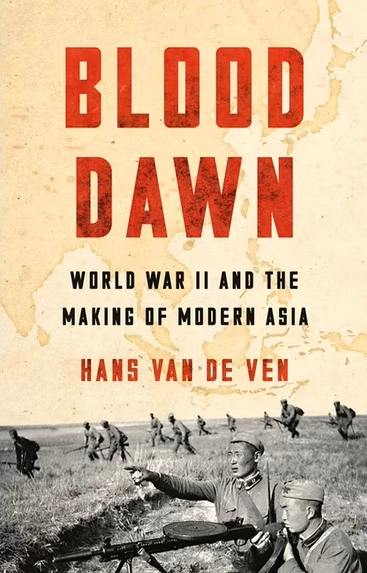
I really wanted to enjoy this book. The enthusiastic endorsements from Rana Mitter, Antony Beevor and Richard Overy raised my expectations considerably. Yet by page eight of Blood Dawn I felt as uncomfortable as the proverbial curate confronted with a rotten egg.
The author aims to provide a narrative that “contributes to a gradual shift in our understanding of the significance of World War II”. This is admirable. A more Asian-centred interpretation of the conflict is certainly needed, as the war is still too often viewed through a Eurocentric or North Atlantic lens. Historians such as Rana Mitter, Jonathan Fennell and Richard Overy have already helped redress this imbalance. It is unquestionably true that the conflict began with Japanese aggression in China as early as 1931 and that the war both began and ended in Asia.
The problem is that the book insists that the central dynamic of modern Asian history is a nationalist struggle to escape imperialism and colonialism. While both undeniably shaped Asia, it is a considerable stretch to explain the region’s political development primarily through resistance to empire. The author correctly notes that many Asian political movements saw the war as an opportunity to cast off colonial rule, but he greatly overstates their role in determining the war’s outcome.
Consequently, the analysis neglects the broader dynamics of power – local, regional and imperial – that shaped Asia before, during and after the war. The author assumes that modern Asia is the product of “Asian peoples’ continuing struggle to overcome the legacies of empire”. That seems reductive. A more convincing interpretation would describe modern Asia to be the result of a power-based confrontation among declining powers such as Britain, France and the Netherlands, a rising Japan, a developing China, and the emerging superpowers whose ideologies would shape postwar Asia: the United States and the Soviet Union. The war was principally caused by one rising empire, Japan, seeking to assert its dominance regionally and to replace existing empires.
As a result, some empires disappeared, others expanded, and many colonial territories gained independence as competing political elites seized opportunities created by wartime upheaval. Where those struggles could not be resolved peacefully, civil war followed. One may call this nationalism or self-determination, but it was power politics nonetheless.
In the postwar period, Asians were often less concerned with abolishing imperial legacies than with creating new centres of power controlled by local elites. Since 1945, Asia has been shaped by competing powers, some imperial in nature, such as China, the Soviet Union/Russia and the United States, and others nationalist and local.
A similar lack of nuance appears in the treatment of imperialism. British imperialism is lumped together with that of France and the Netherlands, with little appreciation for their differences. British involvement in 19th-century China is presented primarily as the cause of China’s problems rather than as part of a broader interaction with a declining and dysfunctional Qing polity. Imperialism was certainly influential, but so were domestic developments, including China’s internal sclerosis and Japan’s response to modernity, which produced its own imperial ambitions in China, Korea, Manchuria and the Pacific.
The author’s ideological predispositions are impossible to miss, and the book frequently descends into crude Anglophobia. We are told, for instance, that “British elites, who liked (and like) to think of themselves as natural and gifted rulers, found a new outlet for their yearning to govern India”. Such statements are simplistic, if not puerile. Similarly, discussing the collapse of the American-British-Dutch-Australia Command (ABDACOM) in 1942, the author remarks that “the Dutch were abandoned to their fate. Retreat is an underappreciated military skill, and the British were practiced masters of it, as they had shown at Dunkirk”. This is the sort of cheap point-scoring that would weaken an undergraduate essay, yet here it appears in a supposedly serious work of history.
The treatment of India is particularly problematic. The narrative focuses heavily on the Indian National Congress and consequently overlooks the diversity and complexity of the independence movement. There is little recognition that what Congress often described as British obstruction was, in part, a debate within Britain (especially the Conservative Party) about the form an independent India should take. The same debate also took place within Indian circles considering the subject.
During the 1920s and 1930s, the central political question in India was often not whether independence would occur but what form it would take and, crucially, who would benefit from it. The Quit India movement of 1942 followed the Cripps Mission, which had already offered India Dominion status after the war. Congress sought immediate separation, but many of its leaders privately supported the Allied war effort, believing correctly that victory would hasten independence. One could even argue that Congress’s greatest unintended achievement was not independence but the partition and communal violence that accompanied it. The book fails to engage adequately with these complexities.
Brexit plus ten
Mark Nayler looks at the state of Britain ten years after the historic vote to leave the European Union. He notes that there appears to be a bit of buyer’s remorse among those who voted to leave the EU, although I would note that the political leadership, both Conservative and Labour, almost all did their level best to sabotage any positive results (although the “Boriswave” of immigrants would have swamped even a substantial economic boom all by itself).

In the run-up to the UK’s referendum on EU membership in June 2016, extravagant claims were made by both the Remain and Leave campaigns. Leaving the EU, the so-called Remainers warned, would propel the UK into recession and mass unemployment. Brexiteers, as they were dubbed, countered with promises of enhanced sovereignty, tighter borders, and liberation from Brussels’s stifling bureaucracy. The latter won the Brexit vote (as it came to be known) by 52% to 48%. But just over a decade on from that historic decision — and six and a half years since the UK officially left the bloc — it’s less clear whether they also won the argument.
This is in large part because of geopolitical turmoil since the vote. Throughout the last decade, there has been a global pandemic, Russia has launched a full-scale invasion of Ukraine (which, in turn, caused an energy crisis across Europe), and Donald Trump has waged a series of tariff wars across the world. The difficulty of disentangling the effects of these events on the UK economy from those caused by Brexit is formidable. One analyst has even said that “we will never know precisely what the impacts of Brexit were”.
Overall, however, the sweeping transformations predicted by both Brexiteers and Remainers — positive in the former case, negative in the latter — have not occurred. The actual changes have been less dramatic, more gradual, and more mixed than either side forecast. One also has to factor in the UK’s lack of a stable leadership since the vote: when Labor’s Andy Burnham took over from Keir Starmer on July 20, he became the UK’s 7th prime minister in 10 years. This, perhaps, has so far prevented the theoretical autonomy now possessed by the UK from being fully realized. According to a poll conducted in June, 57% of Britons now believe that it was a mistake to leave the EU — meaning there are a lot of dissatisfied Brexiteers out there.
Remainers forecast economic ruin for the UK if it chose to leave the EU. According to the then-Chancellor of the Exchequer George Osborne, “A vote to leave would represent an immediate and profound shock to our economy [and] that shock would push our economy into a recession”. A recession failed to materialize, although the pound suffered its biggest-ever one-day drop on June 24, 2016, the day after the vote, falling 10% against the dollar and 7% against the euro (it still hasn’t returned to its pre-Brexit values against either currency, although Trump’s tariff wars and the pandemic are also factors here). That said, researchers broadly agree that Britain’s economy has contracted due to Brexit. According to a 2025 paper for the US National Bureau of Economic Research, UK GDP per capita is 6–8% lower than it would have been had the UK remained in the EU. Investment is down by 12–13%, employment by 3–4%, and productivity has been reduced by about 4%, according to its authors.
Immigration was a major theme of the Leave campaign. The UK Independence Party’s widely criticized poster showed a large group of Syrian refugees at the Croatia–Slovenia border in 2015, next to a massive slogan reading “Breaking Point” — and, underneath it, in smaller letters, “The EU has failed us all”. The center-right party was playing to concerns about a surge in migration over the decade and a half preceding the referendum, triggered by EU enlargements in 2004,when ten new countries joined, and in 2007. In 2000, migration to the UK from other EU countries stood at 6,000, but by 2015 it had risen to 330,000. In 2015 and 2016 alone, more than a million migrants arrived in Britain. According to a poll conducted on the day of the referendum, 33% of Leave voters said the main reason for their decision was a belief that leaving the EU “offered the best chance for the UK to regain control over immigration and its own borders”. It seems the poster had done its job.
The composition of Britain’s migrant population has changed radically since Brexit, with an increase in non-EU migration more than compensating for the reduction in arrivals from the EU. But immigration has not decreased. In fact, the UK has witnessed record levels of immigration over the last decade. In the year ending March 2023, just over three years after Britain’s withdrawal from the bloc, net migration peaked at 944,000.
Microsoft has zero incentive or desire to fix Windows
As ESR points out, Microsoft has a long history of not fixing issues that anger users, so Windows 11 isn’t going away and it isn’t getting fixed (in ways that users demand, anyway):

Microsoft will never fix Windows, because the features that enrage users in Windows 11 are exactly the ones that generate recurring revenue and market control. That is exactly *why* they enrage users!
Yes, you’ll get reversals of some idiotic user interface decisions. You’ll get some speed tweaks. These will be loudly hyped in hopes that they distract you from what you’ll never get.
Don’t take my word for this, look at what Microsoft is hyping as fixes in their reform program and Windows 12. Do they say a word about no longer requiring a Microsoft account to do a local installation? Or about removing the repeating nag prompts for OneDrive? Do they make any promises to end the advertising spam?
No. And they won’t. Because that’s where the money is. Windows now exists to broker your eyeballs to third parties and upsell you into Microsoft subscription services.
I’ve been warning anybody who would listen for 30 years that when you install closed-source software you’re accepting a power asymmetry with the vendor. All of their incentives say they should use the control you grant them to take more control. Induce more dependency. Lock you in.
Microsoft has been on this path for a very long time. “DOS isn’t done until Lotus won’t run!”
You might think these tendencies would be restrained by their fear that when they increase the pain level above some threshold they can’t predict in advance, a critically large percentage of their userbase will pay the aggravation cost to escape their clutches. There are two reasons this won’t happen, one general and one specific to Microsoft.
The general problem is that corporations differentially respond to market incentives according to how easily they can be measured. Revenue from cloud services and the adtech vampires is a strong, visible signal; exit by pissed off users creates multiple signals that are diffuse and easy to misinterpret.
The Microsoft specific problem is Azure — which, ironically, mostly runs Linux instances. Microsoft now makes most of its money from Azure, which reduces its incentives to care about pissed-off desktop Windows customers bailing out.
Indeed, if I were a cold-blooded Microsoft strategic planner, I might be tempted to deliberately burn up the desktop business for short-term revenue, knowing that that’s not where my long-term fortress is. I’m not saying they’re actually doing that, but from outside the difference between this move and an over-focus on measurable revenue streams leading to accidental destruction is difficult to make and probably not very informative even if you could.
The bottom line is that it’s just not going to get any better. Ever. In fact, bailing out is doomed to get more painful over time. The more process habits you form around Windows, the harder the dependency gets to break.
The conclusion is obvious. Get out now. A lot of major tech influencers have noticed over the last 18 months that after decades of sour jokes about the year of the Linux desktop, Linux is finally ready for you. It’s time.
The History of Gumbo in New Orleans
Tasting History with Max Miller
Published 10 Feb 2026Shrimp and crab gumbo with beef and ham hock served with rice
City/Region: New Orleans
Time Period: 1885New Orleans is one of my favorite food cities. Gumbo, a rich, thick soup or stew (depending on who you’re talking to), is an embodiment of the many cultures that have lived there. Ingredients and techniques from Native Americans, Africans, French, Spanish, and Acadian roots, just to name a few, have a place in gumbo.
While this is a relatively simple dish, it is absolutely packed with flavor. I was blown away by how a handful of ingredients, cooked down over time, came together to make such a delicious dish. Go to New Orleans and try one of the many versions of gumbo, and in the meantime, make this historical version that is so, so good.
Gombo With Crabs, or Shrimp
To a pound of beef add half a pound knuckle of ham; chop up both in inch pieces and fry them brown in two tablespoons of boiling lard; add to them four large crabs cut up, or a pound of peeled shrimps, or both if desired; cut into this four dozen small okra pods, one large onion, a little red pepper, and salt to taste. Let all simmer on a slow fire for about twenty minutes; then fill up with warm water, enough to cover the contents two inches deep. Let this boil for two hours. If it becomes too thick, add as much water as required. If preferred, a chicken can be used instead of beef.
— La Cuisine Creole compiled by Lafcadio Hearn, 1885
QotD: A provisional taxonomy of “stupid smart guys”
If we assume this is a universal mental process, I suggest, then saying someone has a low-normal IQ does not mean he’s always going to do stupid things. He has those three-B flashes too. It might take a while for him to cotton to something that seems obvious, but cotton he will, in three-B fashion.
Moreover, Jaynes is good on the complexity of unconscious tasks. The mechanical parts of driving, once learned, are completely unconscious. Try teaching someone to drive and you’ll see it right away. You’ll find yourself literally side-seat driving — your foot pushing down on an imaginary brake, unconsciously. And you never really forget those unconscious patterns, either. You may not have ridden a bike in 30 years, but you could go out and do it right now. Same way with swimming, or the manual of arms — if you’ve been through Basic, a guy with the proper tone of voice can have you twirling around like a marionette, even if you got out of uniform decades ago.
The actual low IQ guys might be the most dangerous cogs in the machine.
The Dunning-Krugerrand. That’s Larry Correia’s phrase, and it’s great. This is the person who believes he’s way smarter and more competent than he actually is. Which on the one hand, they all do. But on the other hand, there are levels above D-K, so please hold fire for now.
The Artiste. It’s been my great … fortune, actually, to have been around a lot of Media people in my youth. I dated a gal who did production work for one of the big tv news programs in a fairly large city, so I saw the video side of it, at least, from close range. The on-camera bobbleheads are all Ron Burgundy, of course, but the production people are usually quite bright … but in a very odd way. They have what I came to think of as “the artist’s eye”. They naturally see everything in terms of camera angles and visual presentation, and training develops this to a very high degree.
This leads to wildly divergent takes on things. You or I see the police approaching a stopped car with their guns drawn, or firemen pulling up in front of a burning building, and we think something like “Damn, crime is out of control!” or “I hope everyone’s ok.” News people — video people, at least — think “What a shot!” They frame the visuals first, then start processing the propositional content … if they ever do. The longer they work in “news”, the more the propositional content — “the cops are arresting a bad guy”; “there are real people in real danger in that burning building” — drops away.
Same thing, I imagine, with the folks on the verbal end. They have a novelist’s sense of pace, structure, and so on. Is what they’re writing true? Of course not! At one point about 30 years ago they felt the need to justify this, and created a whole new category of writing: “creative nonfiction“, aka lies, aka “the news”. The “creative nonfiction” people will tell you, in Wiki’s words, that it “uses literary styles and techniques to create factually accurate narratives”. Emphasis mine, because like the cameraman who ends up exclusively focusing on the shot and never thinks about the life behind the shot, so the writer of “creative nonfiction” gets caught up in the creative part, and just kinda forgets the “nonfiction” part.
Medicalization. Not a category of people, but a technique. We say smart people tend to be spergy, and stupid smart people tend to be really spergy, but that’s mistaking effect for cause. They’re not very good at reading people, and have no social savvy, but that’s because they don’t practice — because they don’t need to practice. They medicalize their deficiencies. Instead of acknowledging a weakness in their game, they attribute it to a pathology.
Severian, “The Stupid Smart Guy”, Founding Questions, 2022-07-13.
August 6, 2026
More threads unravelling from Professor Jason Arday’s backstory
As I mentioned the other day when I first noted this fascinating tale, I don’t think I’d heard of Professor Jason Arday before this week, so pretty much any new facets of the story will be news to me. Here’s an extensive survey of what’s been revealed so far by Donna Louise Flowers:
Cambridge professor Jason Arday
Image from Andrew Doyle
Cambridge Knew in 2023
On 19 May 2023 Martyn Hammersley emailed Hilary Cremin, Head of the Faculty of Education, and Rhys Morgan, Head of Policy. He flagged substantial plagiarism in Arday’s 2018 paper, including quotes attributed to Arday’s own interview subjects that matched quotes from another researcher’s participants. (emails first reported by Nathan Cofnas and later confirmed in The Telegraph)
On 21 June 2023 Morgan replied that it was “not within our remit”. Cremin said Arday had the department’s full support.
That is three years of Cambridge knowing. Everything that followed sits on top of that decision.
In the BBC’s 2023 video marking his appointment, Cremin went further. She said: “We are so lucky to have you. You are the best in the world in terms of the research that you do.” (BBC video, 2023)
Eight months later, on 2 February 2024, Arday was appointed to ITV’s Cultural Advisory Council. Sixteen months after the concerns were raised, on 19–20 September 2024, he led sessions on equity, diversity and inclusion at the National Aspiring Vice Chancellor Development Programme at Bolton.
He was teaching the next generation of vice-chancellors while the questions about his own record remained unanswered by the institution that employed him.
[…]
The Claims, Laid Out Together
Here, in one place, is the full set of claims Jason Arday has made about his life:
- Diagnosed with autism and global developmental delay at the age of three.
- Non-verbal until the age of eleven.
- Unable to read or write until the age of eighteen.
- Four to five hours of speech therapy every day from the age of three.
- A mother with five degrees.
- A benign brain tumour removed a fortnight before his PhD viva, which wiped his memory of the entire thesis; he re-learned it and still passed.
- Two further brain tumours diagnosed after the PhD, later found to be benign.
- Deaf in one ear.
- Ran 30 marathons in 35 days, the last nine after sustaining a hairline fracture that made his leg swell to twice its normal size.
- Covered 300 miles in three days.
- Covered 600 miles in six days (later quietly amended in some citations to twelve days).
- Raised £5.5 million for more than 80 charities.
- Installed water points in South America and West Africa with WaterAid.
- Received a severed pig’s head at his parents’ home.
- Faced a knife-wielding masked man.
- Received bullets in the post, rape threats against his daughter, threats to make him “top himself”, and other forms of intimidation including corrosive substances and mutilated animals.
- Came through a professional football club’s academy system and later played semi-professionally.
- Was on the verge of turning professional at snooker.
- Awarded an MBE in 2017 and turned it down.
- Olympic Torch Bearer for London 2012.
- Appeared in the ITV documentary series Seven Up!
- Obtained a Masters degree in “psychodynamic practice” from Birkbeck and became a qualified counsellor.
- Held visiting professorships at the University of Glasgow and Ohio State University.
This is the origin story as it has been told. Almost none of it has been independently verified. Several of the most dramatic claims have been directly contradicted by the organisations or records that should corroborate them.
That is the real failure.
In the rush to be diverse, to be inclusive, to champion a Black, autistic, working-class success story who ticked every box, almost no one stopped to ask the simplest question of all: when you look at these claims as a totality, how plausible are they?
Each claim on its own might have been given the benefit of the doubt. Taken together they form a pattern that should have been obvious long before Carter-Ruck letters and police complaints were required to shut the questions down.
The institutions that elevated the legend spent years repeating it. When the contradictions began to surface they did not investigate. They defended. They edited the websites quietly. They called the scrutiny a vile campaign. They treated the act of checking as the real offence.
Jason Arday did not need to invent a modest success story. He invented a legend. And for years almost no one dared to ask whether any of it was real — because he is Black, and in the current climate that was supposed to be enough.
It was not enough. And it never should have been.
Update: Reportedly after Cambridge opened an investigation into the plagiarism allegations, Professor Arday has submitted his resignation.
Jason Arday, who was touted as the university’s youngest black professor, announced on Wednesday that he was resigning effective immediately from both the university and Jesus College. His resignation came just hours after Cambridge had said it opened an investigation into the allegations after “new information” came to light.
In a statement published by the Good Law Project, Arday said that the “relentless accusations” had taken a “profound toll” on him. He added that he has decided to resign for his “own wellbeing”.
“I have tried to continue because I believe deeply in the values of higher education, in rigorous scholarship, and in the transformative power of universities. I have tried because of my students, my colleagues and the countless people who have written to tell me that my journey gave them hope,” he wrote. “But there comes a point when the personal cost becomes too great. I have a family. I want to be present for them. I want to reclaim some peace, some privacy and some semblance of an ordinary life. I no longer wish to feel as though I am living under a constant spotlight, where every aspect of my life is subject to public examination and judgement.”
The next shoe was funny enough that I assumed it was from the Babylon Bee, but apparently is not parody:
Following Arday’s resignation letter, social media users claimed that the statement itself appeared to have been AI-generated. According to Panagran, the leading AI writing detection software, Arday’s resignation statement was deemed to be 100 percent AI-generated.
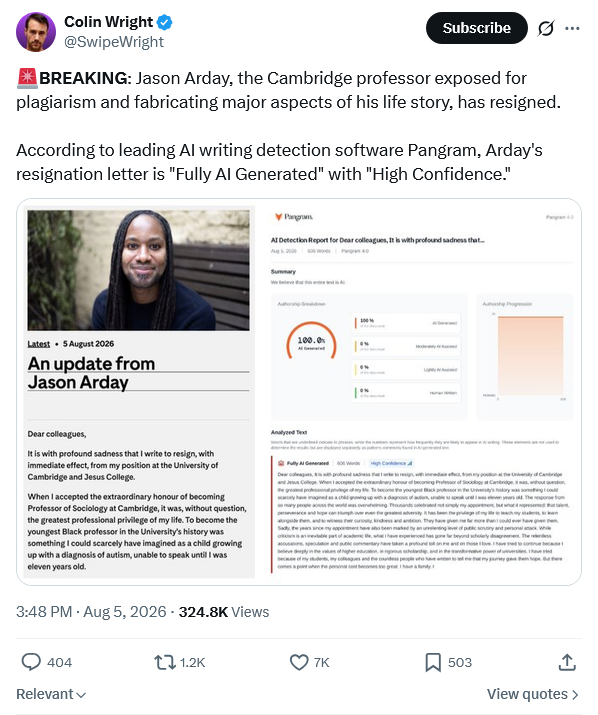
Frederick Alexander decrys the fools that bought Arday’s fantastic stories as nothing but the truth and moved mountains to get him advancement at all costs:

The main entrance of Jesus College, Cambridge from Jesus Lane.
Photo by Verbcatcher via Wikimedia Commons.
We may never know the full extent of Jason Arday’s talents. Perhaps he also sang the difficult half of Milli Vanilli, crossed the Atlantic on a lilo with a shattered pelvis, and designed the SpaceX rocket catcher in the margins of his PhD thesis. There is, in truth, no claim he could have made that the intellectual class would not have believed, provided it flattered their view of themselves as good and righteous people.
Did it not occur to him that someone might check? Confronted by the Guardian, Arday has since offered a defence that will live on his Wikipedia page forever despite the efforts of its editors: “To be honest with you, I thought you’d just believe me. Why would I lie?”
It’s probably the most honest thing he’s ever said. More importantly, it describes the workings of his career in the sort of plain language that the sociology department hadn’t quite trained out of him. He thought the Guardian class would believe him because he understood that they wanted to believe him. They were falling over themselves to grant legitimacy to anything he said simply because he was the one saying it. His story bore out their politics, advertised their virtue and bolstered their status. Scrutiny would only spoil the party.
Perhaps this explains why Arday’s writing also got a pass. Here, for instance, is Arday explaining … well, you figure it out.
As the researcher, textual units concerning the narratives and biographies were identified based on the criteria that the identified themes were fit for purpose in supporting the themes associated with the study.
You would get more sense from a gibberish generator. Academic writing is hell at the best of times, but sociology has mumbo-jumbo built in. Banalities disappear beneath layers of abstraction presumably in an effort to make them sound deep or insightful. Next to this, the plagiarism comes as a relief, another person’s sentences at least making the effort to mean something.
The writing should be disqualifying by itself, but it’s not like Arday tiptoed into the academy while nobody was looking. Cambridge signed him up in the manner of a Premier League football team landing the next Ronaldo, but on the strength of highlight reels that turned out to be AI-generated.
The remarkable thing is not merely that Arday appears to have invented stories about himself. Lots of people do that. I did it when I was nine, trying to convince people I was invisible. Nobody appointed me to a professorship at one of the country’s most prestigious universities. Or rather, formerly prestigious universities. Who can look at these institutions now and not see the wreckage of ideological capture?
They’re calling the fallout “a vile campaign” to undermine Arday’s credibility – of course they are. It’s a smear by “right-wing newspapers” intended to embarrass Arday and those who elevated him. Of course it is. But the embarrassment was born of their own vanity and gullibility. They demanded that everyone believe the story, then labelled anyone who checked it as morally suspect and worthy of a police investigation.
Nearly 15,000 people have signed an open letter declaring the allegations “entirely false”, even as the evidence points the other way. How long before they withdraw their names, reframe events and reposition themselves as the full truth comes to light? Soon they will talk solemnly about the importance of integrity, dissociate themselves entirely from Arday – yesterday a useful idiot, today a serious liability – and somehow still make it about race and right-wing bigotry. This stuff is hardcoded. The rest is just presentation.
The administrators who made the appointment will survive with a few bruises, scapegoating Arday until the media get bored of it. Then they’ll pick up where they left off, a little more careful next time – running the checks, scouring the next candidate’s PhD for plagiarism, testing every fantastical claim against reality, except where reality conflicts with ideology. Which is likely most of it.
The Goddess That Failed by Janice Fiamengo
On her Substack, Janice Fiamengo shares the foreword to her new book, The Goddess That Failed: Feminism’s Unending War Against Men, Families, and Civilization Itself:
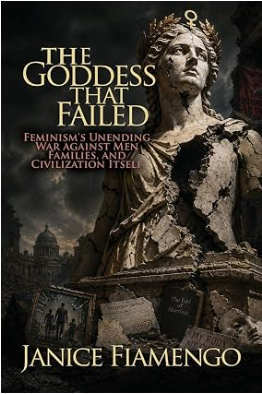
Feminism poses a threat to everything good in western culture, perhaps especially to women’s capacity to love, reason, and exercise self-restraint.
I was an adherent of feminism before I became a critic. I have felt its euphoric exultation and its self-flattering conviction of moral purity. Later, I recognized its hubris and moral hollowness.
I am familiar with feminism’s core texts, from Mary Wollstonecraft to Mary Anne Franks, having studied them and believed in them for years. I understand the psychology and the history of the movement because I lived inside it for many years.
Unlike others who have criticized feminism’s excesses, I contend that although there are some moderate feminists, there was never a moderate feminism inspired by reasonable goals and untainted by anti-male fanaticism. Feminism did not go wrong at some point in history, whether after the Second Wave or before, whether in anti-sex or pro-sex zeal. It was always rooted in resentment and envy, warped by utopian longings and false notions of female moral superiority.
Decades of feminist grievance-mongering and accusation have led inevitably to our present time of ceaseless complaints, anti-western causes, hysterical accusation, rampant divorce, a declining birthrate, millions of abortions, and anti-male cruelty. Feminism has undermined and will continue to undermine the stability and viability of all western societies.
From the first occasions when I began to speak and write about feminism in 2012 and 2013, I encountered the same response from feminists: “What you are describing is not real feminism” or “Those feminists do not speak for all feminists”, and so on.
I am regularly accused of hating myself, of hating other women, and/or of seeking male approval. I am accused, by those who have never studied feminism, of not understanding feminism.
It’s true that not all feminists are as fervid as an Andrea Dworkin or a Sally Miller Gearhart. They do not all fantasize, as Gearhart did (to much congratulation and gushing praise), about how much better life would be if the number of males could be reduced to 10% of the human population. They do not rhapsodize, as Mary Daly did, about a decontamination of the earth through such a reduction. They do not make jokes about killing men as a public service, as Mona Eltahawy did.
But it’s also true that such vicious women, and the many others who have lent their malign energies to the movement, have never been disavowed by other feminist leaders. In fact, feminists’ lack of shame before bloodthirsty feminist pronouncements is remarkably consistent.
True, there are many varieties of feminism, not all of them agreeing on every point: radical feminism, socialist feminism, lesbian feminism, post-colonial feminism, intersectional feminism, eco-feminism, animal rights feminism, abolitionist feminism, trans-inclusive feminism, feminism for sex-based rights, maternal feminism, and even (most bizarrely) conservative or reactionary feminism. Some extend their compassion to victim groups other than women, such as trans women, illegal immigrants, Palestinians, or the environment.
Such distinctions do not concern me because none makes a real difference.
None escapes the victim mentality: the belief that the history of humanity up until the present moment has been a history of (privileged, white) men oppressing women and other innocent victims; and that because of their alleged greater suffering and moral innocence, particular care and attention must be paid to women and to their unique capacity for empathy and social justice.
No version of feminism escapes the binary logic whereby the world is divided up into (sometimes intricate, overlapping) categories of oppressor and oppressed, victim and victimizer, to be treated differently and valued differently according to their identity category.
Because it thinks in terms of groups and divides the world into innocent and guilty, feminism is incapable of devising universal principles or pursuing individual fairness or freedom. It is distorted by its victim thinking, incapable of extending empathy to those feminists see as oppressors, and incapable of demanding accountability from those feminists see as victims.
B-29 Superfortress – A $3.7bn Trial By Fire
HardThrasher
Published 5 Aug 2026The Boeing B-29 Superfortress was the most advanced bomber of World War Two — but also one of the most troubled and expensive aircraft ever built, and was plagued with flaws.
Developed at extraordinary speed, the B-29 could fly higher, faster and further than earlier heavy bombers while carrying a formidable bomb load.
It introduced pressurised crew compartments, remote-controlled gun turrets, advanced fire-control systems and enormous Wright R-3350 engines. But it couldn’t hit a barn door with its guns, had urine in the brakelines and engines which kept exploding due to all the flammable metal in them.
This video explores how the B-29 was designed, why it cost more than the Atomic Bomb to develop and how the United States overcame these challenges to get it into the war.
And yes, this is purely an excuse for me to make videos about the bomber war in the Pacific, so yar booh sucks 😊
00:00 Introduction
01:47 MOAR, MOAR, MOAR
05:48 Origin Story
12:52 Built It And They Will Come
17:57 The Battle of Kansas
19:12 Root Causes – The Key Problems
23:59 So Wright It’s Wrong
32:39 ConclusionsSources
1. Pace, S., Boeing B-29 Superfortress, Crowood Press, 2003 p.53
2. Werrell, K.P., Blankets of Fire, US Bombers over Japan during World War II, Smithsonian Institution Press, 1996, p.82
3. Werrell, K.P., p.68
4. [Deleted Section]
5. Pace, S., p.23
6. Sixteenth Census of the United States, 1940–1940, NAID: 16660414
7. Werrell, K.P., p.75
8. Le May & Yenne, Superfortress – The Boeing B-29 and American Airpower in World War II, Westholme Publishing 2007 (original published 1988 by McGraw) p.78
9. Le May & Yenne, p.78
10. Werrell, K.P., p.80
11. Le May & Yenne, p.80
12. Werrell, K.P., p.67
13. Werrell, K.P., p.67
14. Werrell, K.P., p.80
Extreme political polarization
On the social media site formerly known as Twitter, Krzysztof Szczawinski sees the current extreme polarization of political views as being no longer merely ideological:

The Left and the Right are not two different ideologies. They have grown apart to become two different civilizations.
What characterizes a civilization is its relation to morality, to truth, to beauty, to wealth – and the relation of people to power and to reality itself. By this measure, the division is not political. It is civilizational. And Feliks Koneczny — the Polish scholar who mapped civilizational systems with greater precision than anyone before or since — described exactly this architecture a century ago.
The Right represents what remains of Western Latin civilization – the tradition that inherits Roman law, Greek philosophy, and Christian morality, and from that inheritance builds: individual liberty, equality before the law, orderly competition between individuals, free speech, private property, subsidiarity, classical beauty, monogamous marriage, the dual system of private and public law, and — most fundamentally — the primacy of morality over law. Not that law is the codification of morality, but that law must be consistent with morality. Power is not above ethics. What is wrong for the individual is wrong for the state.
The Left represents an amalgamation of what Koneczny called Byzantine, Turanian, and other eastern civilizational systems – characterized by centralism, the omnipotent state, the fusion of law and morality into a single power, and the subordination of the individual to the collective. In these systems, whatever power decrees becomes moral by definition. There is no external moral standard against which power can be judged. Hence the centralism, the bureaucracy, the etatism, the social justice that replaces individual justice, the family defined by the state rather than preceding it. And hence the violence, the lies, the censorship – because in a system where power is morality, opposition is not merely wrong. It is evil.
The most fundamental difference: in the Latin civilization, morality stands above law. In the Byzantine-Turanian systems of the left, there is only one law — which is simultaneously the moral code — and it is whatever the ruler decides. This is not a difference of policy. It is a difference of civilizational architecture. It runs all the way down.
Some will say a balance is needed – a yin-yang between order and creative destruction, between conservatism and progress. This was once true. It is no longer. The Left has ceased to be a force of renewal within Western civilization and has become a force for its demolition – operating not within our civilizational framework but against it, with incompatible rules and incompatible values. Different civilizations do not compete like tennis players who accept the same rules. They fight for power with no rules and all available means – violence, lies, and morally incompatible systems. Bringing a gun to a tennis match is not competition. It is conquest.
The good news: most people are not ideologically committed to either side. They are attached to prosperity, to safety, to beauty, to the life that Western civilization actually produces – and they can be brought back to it, once they understand what they are being asked to abandon. The civilizational argument, clearly made, is the most powerful argument available. Not left versus right. Not conservative versus progressive. Latin civilization versus its opponents. Freedom, morality above power, and the individual who cannot be reduced to a subject – versus the state that decides everything, including what is moral.
The good life versus the state oppression.
Once you see the civilizational map, the political map becomes legible. And once the political map is legible, the choice is not difficult.


