
Feral Historian
Published 3 Apr 2026Isaac Asimov’s The End of Eternity can be read as a tangent to his Foundation series, an artifact of the optimism that permeated the years immediately preceding the dawn of manned spaceflight, or as a critique of central planning and social engineering. It also has a bit more character development than is typical for Asimov’s concept-focused writing.
00:00 Intro
04:33 Noys and Space
09:25 Closed Loop
11:14 The Superman
16:17 Losing the Stars
20:31 Ending Eternity
(more…)
August 6, 2026
The End of Eternity: Micromanaging History, Killing the Future
Comments Off on The End of Eternity: Micromanaging History, Killing the Future
QotD: John Nicholson, a Muslim saint who really hated India
John Nicholson really, really hated India. This was unfortunate for him in one sense, since he spent nearly his entire life after the age of sixteen there, until he died — violently — while still a young man. But in another sense, it really worked out for him, since it afforded him the opportunity to live out his dream, which was to abuse Indian people. Clearly, he was a complicated man.
[…]
[The First Anglo-Afghan War (1838-1842)] began with the British efforts to replace Afghan Emir Dost Muhammad with a more pliant leader, which in a pattern seen from the days of Alexander onward, involved an invasion, an attempt at a pacification, followed by a grim and growing awareness that the place is full of some of the most brutal and fractious people on Earth and is simply ungovernable, which terminates in a costly retreat, the country itself returning to its customary barbarism, efforts to change it having had all the effect of flinging an encyclopedia into a chimp enclosure. For the British, this meant early success, then an overwinter occupation in which their position deteriorated, then a mass uprising, whereupon they negotiated with the locals for a peaceful exit upon surrendering their arms. The retreating British were of course betrayed and massacred. One man made it out.
Nicholson, serving as an adjutant officer with a native regiment, had earlier been taken prisoner, and endured horrific conditions as such. He watched as his Hindu soldiers refused — to a man — to convert to Islam, and were executed one after the other. After having been released, he discovered that his younger brother Alexander had been murdered and mutilated by the Afghans while retreating with the rest of the army. The entire effort had been a great traumatic waste.
One might expect that Nicholson would hate the Afghans and perhaps revise upward his estimation of the brave Indian soldiers who had served under him. But while he did indeed revile the Pashtun tribesmen (“the most vicious and bloodthirsty race in existence”) he actually seems to have disliked them slightly less than the Hindus, perhaps on the grounds that no one that eager to kill Indians can be all bad. Indeed, he seems to have learned there some harsh lessons concerning what it would take to actually accomplish anything in the subcontinent, doctrines he would apply fastidiously and thoroughly. In many ways, he went a bit more native than he would have cared to admit.
After the war, Nicholson was promoted and given a series of administrative jobs, where he became well-acquainted with the chaotic political situation in the Punjab region. Mostly under the control of the Sikh Empire, the area had long been contested ground between that new faith and Islamic invasions from the Mughals to the southeast and the Afghans through the Khyber Pass to the west, not to mention restive Hindu Rajputs and Marathas to the south. The unstable (then and now) region of Kashmir lay to the north, and the whole of the region was plagued by innumerable bandits and warlords. The BEIC ruled through direct administration, client kings, and various alliances, the latter two of which its political officers (“politicals”) had to interact with on a regular basis. It was very much a situation out of George R. R. Martin’s fever dreams, constant betrayals, perversions of every kind, and even a Ramsey Bolton-esque Sikh despot who flayed men alive for amusement.
Nicholson was in charge of the Bannu area, where he rapidly made a name for himself as a local administrator. The whole of the Bannu was infested with bandits of all kinds, from jihadis to Hindu cultists to normal brigands, and the people lived in constant fear of their depredations. Nicholson had no real interest in bettering lives, but he had even less interest in allowing any Indian, anywhere, to challenge his authority. So he set about fixing the problem as only he could.
Nicholson arrested and executed scores of bandits, rapidly processing them through his very efficient court system. The idea of impartially dispensing justice without respect to person or affiliation was quite new to the area, but Nicholson made sure the locals adjusted quickly, tolerating not even the slightest hint of disrespect from anyone, no matter who he was. When a local Muslim leader casually spit on the ground in front of him, Nicholson made him kneel and lick it up. Anyone who failed to display prompt obedience to his commands he had flogged immediately, and was the bane of servants, who were often the causal recipients of hurled cups and dishes. He was a very hands-on leader, not the least hesitant to get them dirty in a quite literal sense. At one point, when his local police were unwilling to pursue a dangerous gang leader, Nicholson rode alone to the man’s village, approached him on the street, and killed him with his sword after the suspect failed to submit to arrest. Nicholson kept his severed head on his desk pour encourager les autres.
Interestingly, such draconian brutality seems to have actually made Nicholson popular. He was harsh, unyielding, and wholly indifferent to their culture, but that very indifference made him unassailable to anything but his sense of duty. He was unbribable, as the people of India had absolutely nothing he wanted, and his complete contempt for their social norms meant that Hindu, Muslim, or Sikh, Brahmin or outcast, Aryan or Dravidian, all got the exact same treatment, prompt and thorough. His mad fearlessness meant that he was similarly immune to threats. Criminals, whoever they were, received savage punishment, but the law-abiding were left in peace; Nicholson had no desire to “improve” them or their society like his contemporary Macaulay. In a real sense, for the first time, the diverse people of the area were free, under Nicholson’s rule, to live as they wished without the violent misery that had previously characterized the region. It was a multicultural success story, festooned with the occasional decapitated head.
This being India, the people expressed their feelings towards him in particular ways. A body of wild Pashtun raiders, admiring Nicholson’s capacity for ruthless violence and his grim charisma, attached themselves to him as a personal guard, fedaykin to his Muad’Dib, serving without pay and loyal only to him. In a theologically fecund area with a strong tradition of syncretism and cults of personality, Nicholson naturally became the object of worship for a group of fanatical devotees. He in turn naturally despised this, having his worshipers flogged as public nuisances, but this only served to increase their devotion to their inscrutable, violent deity. In some parts of India, the Cult of Nikal Seyn survived as a Shia devotional movement, with Nicholson cast as a Muslim saint bringing justice to a war torn land. The last member died in 2004.
Librarian of Celaeno, “The Man Who Hated India”, The Library of Celaeno, 2026-05-04.
Comments Off on QotD: John Nicholson, a Muslim saint who really hated India
August 5, 2026
Canada decides to treat online opinions as matters for police enforcement
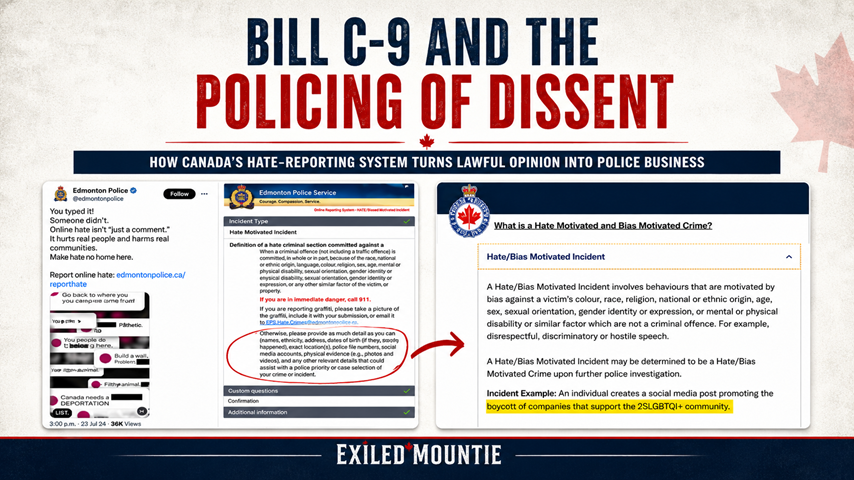
It’s never a good sign when my region features in a news story, like this post from Exiled Mountie, discussing Canada’s Bill C-9 and the way it encourages local police forces to treat lawful online speech as a matter for police involvement:

As I watch the reaction to Bill C-9 unfold in real time on social media, I cannot help but think that another important line has been crossed in Canada.
Most of us saw the writing on the wall months ago and tried to warn others by screaming it from the rooftops. But as with Covid, nobody listened, and we were probably called racists for doing so. So here we are, another important battle lost.
From a legal point of view, we are now becoming almost indistinguishable from the system in the UK, and that’s a frightening thought.
In the UK, police have recorded non-crime “hate” incidents against schoolchildren for classroom insults, despite no criminal offence having taken place. The system finally became so absurd that the British government recently announced that it would scrap the practice in order to stop police wasting their time on petty arguments. Just imagine the absurdity of this: police resources being tied up over petty squabbles in the schoolyard!
We have now entered a time where the government has extreme control of our speech.
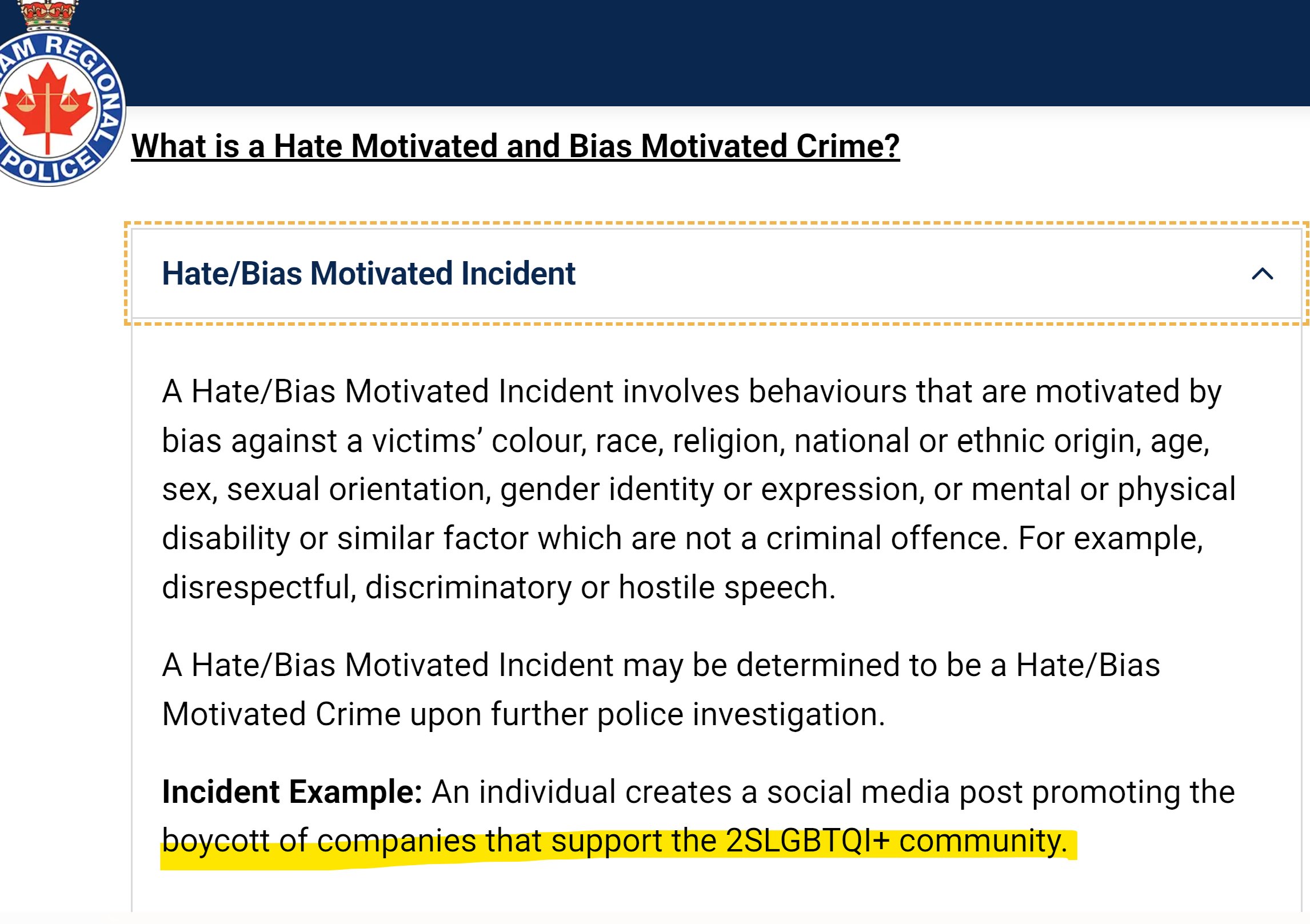
So much so, that we’re even being warned that criticizing or boycotting a company based on moral or ethical reasons can be treated as a hate incident, even when police openly acknowledge that no criminal offence has occurred. From there, the matter can still be reported and subjected to further police investigation to determine if the elements of a hate crime are met.
Ladies and gentlemen, welcome to the twilight zone. We have arrived in the progressive future the Left has been pushing for so long, and it sucks.
The danger here is not only what will eventually result in charges. It is that police are inviting complaints and opening the door to police attention over expression that is not criminal at all.
Durham Police openly acknowledges that these so-called hate or bias incidents are not criminal offences. Yet it still encourages people to report them and even uses the lawful boycott of companies supporting the 2SLGBTQI+ community as an example.
Comments Off on Canada decides to treat online opinions as matters for police enforcement
The Korean War Week 111 – Will Stalin’s Nightmare Come True? – August 4, 1952
The Korean War by Indy Neidell
Published 4 Aug 2026The UN conducts a massive bombing raid on the North Korean capital Pyongyang this week, and in the field, the bloody fight for Old Baldy continues. Behind the scenes, though, Presidential Candidate Dwight Eisenhower’s foreign policy guy John Foster Dulles is advocating for massive retaliation — in Korea and beyond — against all Communist states, to do more than simply “contain” them.
Comments Off on The Korean War Week 111 – Will Stalin’s Nightmare Come True? – August 4, 1952
Power corrupts, but unaccountable power attracts bureaucrats
We used to joke around election time that no matter who you voted for, the government always got in. Gallows humour, because it’s quite literally true. Enough people can get angry about the government in power and vote out the politicians … but the politicians aren’t the one implementing the policies that get people upset. The permanent bureaucracy barely notices when the government changes because the government rarely manages to get anything done that the civil service doesn’t want to do. It’s actually worse in Europe, because the politicians are even more mere figureheads than they are in the Anglosphere:

Christine Lagarde and Ursula von der Leyen
Nobody grows up dreaming of a career shuffling directives around Brussels.
Those jobs always fill with the same type of person: people drawn to power for its own sake, the ones who crave authority without ever answering for it. Bureaucracy doesn’t attract the best. It selects for the worst, then shields them when they inevitably screw up.
Hayek named this in The Road to Serfdom. His chapter “Why the Worst Get on Top” spelled out the logic. Unchecked power appeals most to the people least troubled by wielding it.
Mises found the engine underneath. In a market, a bad decision shows up as a loss, and losses remove you. Bureaucratic management faces no such test. Fail to fix a problem and you keep your job, then collect a bigger budget and a larger staff to keep failing with. The incentive runs backwards: waste earns you more, and the machine grows on its own.
Look at the European Union. Ursula von der Leyen presides over the Commission, the body that proposes almost all EU law. No European voter ever put her there. Heads of state handed her the post in a 2019 backroom deal and waved her through parliament. Christine Lagarde runs the European Central Bank, setting monetary policy for more than 340 million people and steering the value of the money in their pockets. She faced no voters for the job either.
You can throw out your national government every few years, but nothing above it moves, the apparatus stays. The unelected keep their offices, their pensions, their power, untouched by the only check ordinary people have.
This is the design, not a flaw in it. The people with the most control over your money and your future are the ones you are not allowed to fire.
Comments Off on Power corrupts, but unaccountable power attracts bureaucrats
I, Claudius (MCMLXXVI). Show Me The Way To Go Rome
Stam Fine
Published 3 Apr 2026Stam Fine Reviews looks at the landmark 1976 classic BBC series I, Claudius based on the books by Robert Graves. I, Claudius is a sprawling epic looking at four emperors, Augustus, Tiberius, Caligula, and Claudius. Claudius had a limp, stammered and facial tics but was a survivor when everyone else around him was murdered.
I, Claudius is an influential series, even in places you don’t expect it (The Sopranos, Dynasty, Succession).
Note: The Romans didn’t use the letter ‘U’ at the time unless you upgraded your subscription to Roman+. I do not presently subscribe to Roman+.
Stars Derek Jacobi, Sian Phillips, Brian Blessed, George Baker, Patrick Stewart, Ian Ogilvy, Simon MacCorkindale, Margaret Tyzack, Patrica Quinn, John Hurt, and many more.
0:00 Introduction
0:33 Veni, vidi, Google Translate usus sum.
1:15 Technical Difficulties.
1:34 I, Claudius Take Two.
4:09 Augustus and Livia
5:50 Claudius
8:05 Tiberius
10:55 Caligula
13:14 Emperor Claudius
16:00 From Book to BBC2
19:11 Cast
21:24 LegacyI, Claudius
I, Clavdivs
I Claudius
Comments Off on I, Claudius (MCMLXXVI). Show Me The Way To Go Rome
QotD: “This is why English spelling is a disaster”
And somewhere in that collision of accents and dialects, something shifted. Literally. The vowels started moving.
Between roughly 1400 and 1700 every single long vowel in the English language changed how it was pronounced. It’s called the Great Vowel Shift. Before it happened, English vowels worked the way vowels work in Italian or Spanish. The letters did what they looked like they should do. “Bite” was pronounced “beet”. “House” was pronounced “hoos”. “Name” was pronounced “nahm”. “Knight” was pronounced “k-nicht” with a guttural sound at the end like you were clearing your throat. English was phonetic. The spelling matched the sounds. It made SENSE.
And then it didn’t.
All the long vowels began migrating upward in the mouth. The tongue positions shifted higher and higher over the course of about 300 years. And the vowels that were already at the top had nowhere left to go so they broke apart into two sounds. “Ee” became “eye”. “Oo” became “ow”. A 300-year linguistic pileup that nobody voted on and nobody agreed to. It just happened. And it happened during the worst possible window of time.
William Caxton brought the printing press to England in 1476. One of the most important technological developments in the history of communication. And it arrived RIGHT IN THE MIDDLE of the Great Vowel Shift.
Caxton started standardizing English spelling based on how words sounded at that exact moment. Printers needed consistency. They needed to pick a spelling and commit. So they did. But the sounds kept changing after the spelling was already locked in. The vowels were still moving. The consonants were still dropping. And the printed page couldn’t keep up.
We had ONE CHANCE to get English spelling right and we fumbled it at the worst possible moment.
This is why English spelling is a disaster. It’s not random. It’s not lazy. It’s a snapshot of a language mid-transformation that got frozen in place by a new technology and was never corrected. Every word you have ever misspelled, every silent letter that made you feel stupid, every time you stared at “knight” and thought why is there a K in this. You used to pronounce that K. You used to pronounce that GH. Those sounds died 500 years ago and the letters are still standing there like gravestones. English spelling is full of ghosts.
That’s why “food” and “good” and “blood” are spelled almost identically but sound completely different. In Chaucer’s time around the 1390s they all rhymed. In Shakespeare’s time around the 1600s they still rhymed but with a different vowel. And then sometime after that they each went their own separate way and the spelling just stood there watching like it had given up entirely.
And HERE IS THE THING. Other languages went through similar vowel shifts. German had nearly identical changes happen to its long vowels around the same period. And German just updated its spelling. They adjusted the orthography to match the new pronunciation. Like reasonable people. English looked at the same problem and said no. We’re going to keep the old spelling. Everyone will simply have to deal with it. Every person who has ever stared at “though” and “through” and “thorough” and “thought” and wondered why four words that look almost identical are all pronounced differently? Collateral damage. Five hundred years of collateral damage and we just accepted it.
Ok so that’s the vowels. That’s the background. Now we get to the accents and this is where I lost my mind.
The single biggest difference between standard American English and standard British English today is something called rhoticity. This is a real linguistics term even though it sounds completely made up. Rhotic speakers pronounce the R sound in words like “hard” and “car”. Non-rhotic speakers drop it. “Hard” becomes “hahd”. “Car” becomes “cah”. That one feature is doing like 80 percent of the work when your brain hears someone speak and categorizes them as British or American.
Here’s what nobody told you.
In 1776 everybody was rhotic. Americans AND the British. Both sides of the Atlantic pronounced their Rs. The fancy non-rhotic accent that we now think of as THE British accent, the one you hear in your head when someone says “British accent”, the one every villain in every movie has? That accent did not exist yet. It developed in the late 18th and early 19th centuries when the upper classes in southern England started dropping their Rs as a prestige marker. A fashion statement. And then it spread downward through society and outward through the Empire.
The accent we associate with the British Empire is actually newer than the American Revolution.
I need to say that again because it didn’t land the first time I heard it either.
The accent that we think of as “British” is newer than the country that broke away from Britain. Americans didn’t lose the British accent. The British lost the British accent. Americans are the ones who kept it.
Emma, “The Plague That Broke English (And Why the Founding Fathers Didn’t Sound British)”, Past Life, Present Cleavage, 2026-04-03.
Comments Off on QotD: “This is why English spelling is a disaster”
August 4, 2026
“Jason Arday’s improbable claims have turned him into a Walter Mitty for our times”
The Jason Arday affair has only just drifted into my view, but it seems utterly fascinating that a young man with such a … varied and colourful personal history … has risen to be the youngest black professor at Cambridge. His backstory is (probably) too perfectly aligned with progressive worldviews to be true:
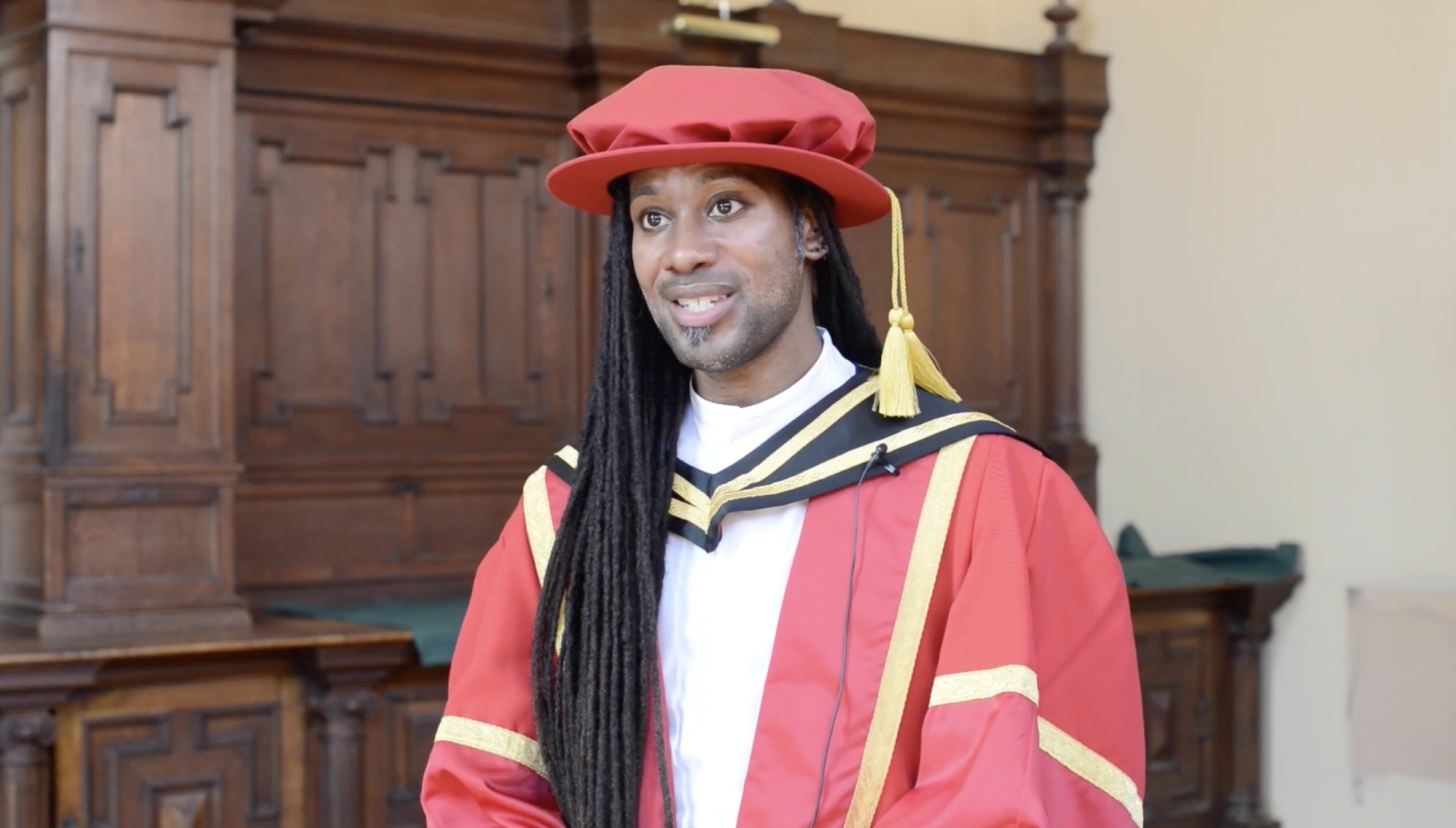
Cambridge professor Jason Arday
Image from Andrew DoyleJason Arday’s improbable claims have turned him into a Walter Mitty for our times. As the youngest black person ever to be appointed a professor at the University of Cambridge, there are good reasons why those who have championed him are rushing to his defence. But with each passing day, new revelations of his slippery relationship with reality seem to be emerging.
As with many fabulists, it is difficult to know where the truth ends and the fiction begins. Some of Arday’s boasts are quite obviously false. For instance, nobody believes that he completed the last nine of thirty consecutive marathons with a fractured leg that had swollen “to twice its normal size”. Or that he appeared in the television series Seven Up! as a child, even though its participants were selected in 1963 and Arday was born two decades later.
Other claims might well be embellishments on kernels of reality. No doubt he has raised money for charity, but it seems highly unlikely that his vaunted sum of £5.5 million is accurate. We know that he played snooker, but his assertion that he did so professionally would carry more weight if someone on the circuit had heard of him. Few would dispute that Arday is a keen amateur athlete. But if his claim to have run six hundred miles in six days were true, that would place him among the world’s elite sportsmen.
Perhaps most serious of all are the accusations of plagiarism. Cambridge has been quick to dismiss the matter, stating that an investigation has already been conducted by Liverpool John Moores University, where Arday completed his PhD thesis, and no evidence of plagiarism was found. Many readers who have compared the relevant passages side by side have reached a different conclusion. Numerous examples have been collated by Nathan Cofnas and can be seen here.
The refusal of the authorities at Cambridge to investigate the allegations properly has naturally raised suspicions that Arday is being protected because he is the poster boy for DEI. If it is true that he was raised on a council estate, diagnosed with autism at the age of three, first spoke at the age of eleven, and learned to read and write at eighteen, then his success story is unparalleled. Yet plagiarism is an extremely grave matter for an academic, and the evidence is difficult to dismiss.
The failure to hold Arday to the same standards as anyone else is, of course, a soft form of racism …
On Substack Notes, Michael Southron says he’s getting a strong Jussie Smollet vibe from this story:
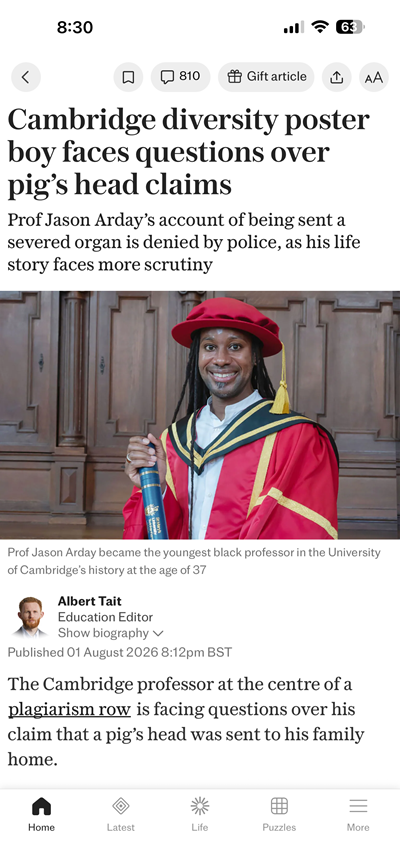
The Jason Arday affair is beginning to remind me of Jussie Smollett.
Not because we know that Arday fabricated anything. We don’t. But because of the strange self-protecting logic that surrounds allegations of racism.
Smollett’s story was initially believed because it fitted so perfectly with what many people already believed about America: a black, gay actor attacked by racist, homophobic Trump supporters. The allegation seemed almost to validate itself.
Something similar is happening with Arday.
He says a severed pig’s head was sent to his family home. Yet police can reportedly find no record of the investigation he described. The butcher he said police visited says no officers ever came. There are apparently no photographs or contemporaneous messages.
He also says a masked man twice entered his Cambridge faculty building and threatened him, on one occasion with a knife. Yet the man was apparently captured by no CCTV, seen by no colleagues, and Arday reportedly warned nobody in the building at the time.
“To be honest with you, I thought you’d just believe me,” Arday told the Guardian. “Why would I lie?”
That sentence may be the most revealing part of the whole affair.
Because questioning Arday’s claims now risks being folded into the very narrative those claims are supposed to establish.
Arday says he has been targeted because of racism. Questions are raised about the evidence for his claims. Those questions are then portrayed as part of a “vile campaign” against him — which becomes further evidence that he is being targeted.
The allegation begins to protect itself.
He is a victim of racism, therefore questioning his account may itself be racist; and because questioning his account may be racist, his claim to be a victim of racism receives less scrutiny.
It is a perfect circle.
Comments Off on “Jason Arday’s improbable claims have turned him into a Walter Mitty for our times”
China attacked the sparrows, Britain will attack the cows
People make mistakes based on insufficient information, mistaken causes, biases, and many other distorted ways of reasoning. Governments do the same thing, but when governments screw up it’s a problem for everyone:
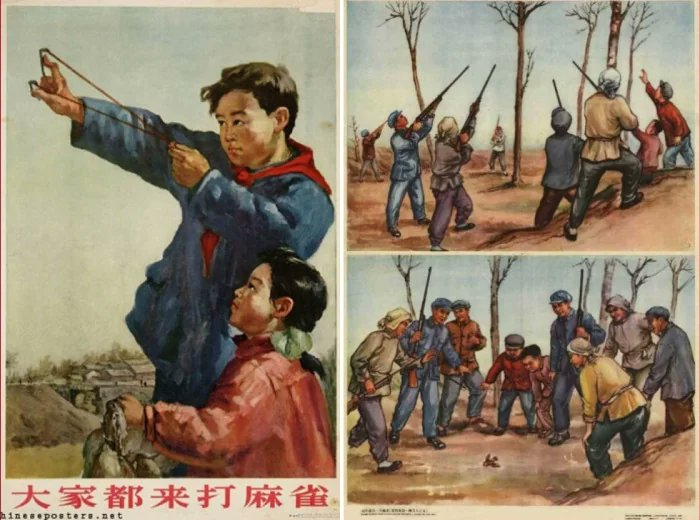
In 1958 the Chinese state worked out that sparrows were eating the grain, and organised six hundred million people to kill every one of them.
It did not take bullets. Villages, schools and factory units turned out with pots, pans, drums and gongs and made continuous noise so that no bird could land anywhere. Nests were pulled down, eggs smashed, chicks killed. The sparrows flew until their hearts gave out and dropped into the streets, where children collected them and the totals were reported upward as achievements. The toll ran into the hundreds of millions.
The arithmetic was sound as far as it went. A sparrow eats grain. Fewer sparrows, more grain, more people fed. Nobody in the room was wrong about what the bird took.
They were wrong about what it did.
Sparrows eat insects, in enormous quantity, and most of all in the breeding season when the chicks need protein. Take them out of a farmed landscape and the locusts and grain borers they had been holding down are handed the whole country. Which is what happened. Crop losses to insects rose sharply, and by 1960 the ornithologist Tso-hsin Cheng had made the case well enough that Mao ordered sparrows struck from the list and replaced with bed bugs.
Far too late, and never the whole cause. The famine of 1959 to 1961 was principally a policy famine, driven by collectivisation, grain requisition and the diversion of farm labour to backyard steel furnaces, and the dead are counted in tens of millions.
But the sparrow campaign is the purest thing in the episode, because it is the reasoning stripped to bone. A committee looked at a living system, isolated the one animal it could measure as a cost, and calculated the gain from removing it without ever asking what that animal was holding up.
Now look at what is being proposed for grassland.
The ruminant is measured the same way, on one ledger line, the methane it emits and the land it stands on. What is left off the ledger is everything it does. The grazing that keeps grassland grassland instead of scrub. The dung that feeds the beetles that feed the birds. The hoof that breaks the surface so seed can take. The mouth that removes the standing dead matter which otherwise cures into wildfire fuel. The manure that returns phosphorus and nitrogen to the soil so nobody has to mine it and ship it in.
Grasslands and grazing animals co-evolved over tens of millions of years. Remove the animal and you do not get the same field minus some methane. You get a different system, and it will not be the one on the spreadsheet.
The men who ordered the sparrows killed were not stupid, and they were not cruel. They had a number, and the number was correct, and they were praised for acting on it decisively. It took two years for the second half of the equation to arrive, and by then nobody could put the birds back.
We are eighteen months into the herd reduction schemes.
The grass has not sent its invoice yet.
Update, 6 August: Welcome, Instapundit readers! Have a look around at some of my other posts you may find of interest. I send out a daily summary of posts here through my Substack – https://substack.com/@nicholasrusson that you can subscribe to if you’d like to be informed of new posts in the future.
Madsen Model 1945: A Rather Unusual SMG
Forgotten Weapons
Published 9 Mar 2026At the end of World War Two, the Danish Madsen company wanted to replace its production of licensed Suomi submachine guns with a design of its own. The result was the Model 1945, a quite unusual design with a pistol-like slide. The nearest similarities would be the Polish PM-63 and the German VG1-5. The Madsen design also used an unusual hammer firing system. It was chambered for 9mm Parabellum, feeding from Suomi box magazines (not drums). Both a fixed wooden stock version (seen here) and a folding stock version were made, but only a few sales came through (apparently to Mexico and El Salvador).
Danish M1941 Madsen video: • Danish M1941 Suomi SMG
Madsen M1950 video: • Madsen M50: From the Korean War to Star Trek
(more…)
Comments Off on Madsen Model 1945: A Rather Unusual SMG
QotD: Limits to tactical flexibility in Roman Republican armies
And therein lies the rub: just as the commander doesn’t have a multitude of points where he can intervene in the battle but rather a limited set of key decision points, so too he does not have an infinite set of potential orders he (or his subordinates) might give at any given moment. Instead, the commander (or his subordinates) has a McDonald’s menu worth of options he can employ. He can order anything on the menu and expect the unit to respond accordingly but he cannot order anything not on the menu, nor can he order an altered version of a menu item (no Big Mac without cheese; Sir, this is not a Wendy’s).
Now generals could and did use drilling in the early stages of the campaign to add one or two “menu items” to their drill so as to be prepared for this or that problem. Indeed the general preparing some sort of surprise of this sort and then deploying it against an enemy is a standard topos of effective ancient generalship (although in many cases we may doubt the purported gimmick was actually used (e.g. Dionysius 20.1.6, Dio 10.5)). But that is the thing: such extra “menu items” have to be prepared in advance and often well in advance of the battle. Caesar, for instance, anticipating war elephants drills his troops in anti-war-elephant tactics before the Battle of Thapsus (46 BC, Caes. Bel. Afr. 84). Alexander’s phalanx seems to have been drilled to respond to scythed chariots as well (Arr. Anab. 3.13.5-6).
That said the bulk of the menu was likely to remain constant. After all these “menu items”, while they have simple names are often actually fairly complex to do and train when you are dealing with units of dozens or hundreds. Turning back to our example of Company, Right Wheel! we can get a sense of the complexity of training that maneuver by the way they did it. The “right guide” (the man on the extreme right) adopts a set pace (nine inch steps) while the “left guide” moves at the normal regulated speed (note this requires training your soldiers not only to step in time but to step at standard lengths) and every soldier in the middle regulates his motion by maintaining elbow contact with the man to his side. That’s a good method to get the result, but it isn’t an obvious or simple method: the fellow training the company to do this needs to already know how to do this.
Now in the modern period with mass printing, you could print drill manuals that had all of the commands and instructions on how to do them, but in the pre-modern period that kind of mass printing isn’t an option (and our military texts almost never go into this kind of granular detail) so your officers have to learn to train the behavior by observing it and participating in it themselves. Which means in turn a great deal of your “package” is set before the army is even mustered at the beginning of the campaign season because you are relying on a package of culturally embedded knowledge about how armies ought to function. And if your culture doesn’t have that tradition, inventing it from scratch is going to be hard and take time; and by “time” I mean “decades”. Effective drill for volley fire (the “countermarch”), for instance, answered a need that had existed for most of the 16th century, but the embryonic ideas for it only started emerging in the 1570s, the actionable plan on how to do it in 1594 and it was only then finally deployed in a major battle in 1600 at Nieuwpoort.
However, the time available for that kind of training is limited. Remember that drill works by repeating the same set of actions over and over again until they become almost instinctive. That takes a lot of time and repetition! That both means it is going to be difficult to find space for new “menu items” (especially with green troops that still need to learn the basics) but also that synchronized discipline itself is expensive. Our ancient sources stress how Roman levels of synchronized discipline required diligent and continuous drilling to create and maintain.
Doing that in turn would demand keeping the soldiers in question under arms for training for long periods when they were not fighting. In the Middle Republic this seems to have been accomplished through rolling recruitment: Rome was essentially always at war and always raising armies so there were always a goodly number of veterans to train and “break in” the truly green new recruits in any given draft (though again – and I owe this notion to Michael Taylor – there are some signs that the less intense conflict of the mid-second-century leads to some dulling of the Roman edge). As we transition through the Late Republic into the Early Empire, that is replaced by the slow professionalization of the Roman army, culminating in the force of long-service professionals created by Augustus. Being mobilized in peacetime, professional soldiers could be drilled extensively (assuming their cultural values are going to let them drill you; also be wary here of assuming standing forces of “military settlers” are professional in this way).
But all of that is extraordinarily expensive. Keeping those soldiers under arms, after all, means that they need to be fed, clothed and paid. Even in a system like the Middle Roman Republic where soldiers provided their own kit out of their own wealth (because Roman soldiers in the Middle Republic were recruited from the modestly well-to-do smallholding class), by drafting those men you have removed them from that economic activity. The expense of doing this would have been in most cases enormous and of course those are resources that could be deployed to any number of other uses, including simply raising a larger army of less disciplined, well trained troops. For, say, a Greek polis given the choice between having 450 men under arms all year round and excellently trained or having 5,000 hoplites under arms only in the one month where there is a battle to fight the clear answer is the latter. A lot of things need to line up before producing armies with high levels of synchronized discipline makes sense: the state needs a lot of resources, year-round security challenges and a tactical system which is effective and demands this kind of investment. So while developing synchronized discipline offered an army a degree of greater control and flexibility, it was prohibitively expensive.
Bret Devereaux, “Collections: Total Generalship: Commanding Pre-Modern Armies, Part IIIa”, A Collection of Unmitigated Pedantry, 2022-06-17.
Comments Off on QotD: Limits to tactical flexibility in Roman Republican armies
August 3, 2026
“Find your Honest Broker, and your problems will be solved”
On his Substack, Ted Gioia explains how he became the “Honest Broker”:

This particular project brought me to China. I was trying to set up an operation in a remote province, far outside my comfort zone, and couldn’t seem to figure out how to maneuver among the various interests and stakeholders. My patron was one of the wealthiest men in Hong Kong, and by using his contacts, I gained access to people who normally operate behind layers of intermediaries and gatekeepers. But even these contacts led me on an endless runaround. My sources gave me conflicting advice and confusing directions. Everything felt wrong and nothing seemed quite on the level.
I knew I needed help, but had run out of options. Then I met the drunk Australian.
He wasn’t a contact on my list, and I can’t even remember his name. This was a chance encounter in a hotel bar late at night. But this hard-drinking Australian was talkative and had interesting things to say. He had spent most of his life bouncing around the capitals of Asia, and was a high-level operator in his own spheres. He bragged about his insider’s knowledge, and claimed — with some accuracy, as I came to discover — that he knew how to maneuver in China better than the clueless Westerners who were now appearing on the scene. He had traced the secret paths to power and knew all the dangerous mistakes amateurs always make.
He reeled off a list of them. “You go into a province or city and flash around some money, then expect the local officials will help you? Forget it. They’ll rob you blind, and even make you bribe them for the privilege. Same goes for the party leaders. From each according to his ability, and all that, my friend. And forget about lawyers — the legal protections here are like this” — he held up his empty glass, then flipped it over as if to emphasize the nothingness of what he was offering to the gods of Marx and Mao. “As for the bankers, you might as well call them wankers.”
The empty glass was also a sign that I needed to order another round of the local brew, and I quickly complied. My new friend fell into a meditative silence until further libations arrived. Finally, after another sip on the stomach-destroying glass of baijiu that passed for spirits at our watering hole, I asked the obvious question.
“So what do I do? Who can I trust?”
“That’s easy, mate. You need to find the Honest Broker.”
This sounded appealing enough, but I had zero idea what my new acquaintance was talking about. He might just as well have told me to go to Oz and consult with the Wizard.
“Who, exactly, is this Honest Broker?”
“There’s at least one in every city. But don’t expect their business cards to say ‘Honest Broker’ — that’s just what I call them. But that’s exactly what they are. Sometimes they don’t even have an official position. But they are the key to everything.”
He proceeded to explain how Honest Brokers play a hidden but vital role in communities without a history of legal protections and stable institutions. Their influence and power is built solely on a reputation for straight talk and trustworthy dealings. “They are true brokers, intermediaries between others. They aren’t going to participate in your deal, no matter what it is. They are go-betweens, really. But do not underestimate the power of this kind of brokerage. Whatever you need — a loan, a building permit, political influence, a place to land a private jet, whatever — they will introduce you to the right people and steer you away from the sharks.
“And they do this for a very simple reason: their prestige is enhanced by making these connections. In many cases, they don’t even want to be paid. Or let me put that differently — you repay them by becoming a trusted contact for them in future dealings. The Honest Broker may help you for free right now, but don’t be surprised if you’re asked for assistance on something completely different months or even years later. You Yanks have a hard time grasping it, and are always looking for shortcuts. But the Honest Broker plays the long-term game, mate.
“Find your Honest Broker, and your problems will be solved.”
This proved to be valuable advice, worth far more than the cost of drinks. Over the next few weeks, I changed my approach completely. I made inquiries, compared notes, and finally found my Honest Broker — who did solve my problems, just as promised. My mission accomplished, I returned back home to California and tried to forget all about it.
I put my passport out of sight. My world shrank back to manageable dimensions, and my days were spent at the two keyboards, the piano and the word processor. I was getting back into my music groove again.
A long time went by before I realized the real importance of what I had learned in China, and how it applied to the other half of my split and fractured life. I was putting energy into a new sphere now, music criticism, and trying to create a rule book for how to make it sizzle.
Yet criticism seemed such a degraded form of writing at that juncture. I had already seen the collapse in literary criticism — in fact, I had lived through it as a student at Stanford and Oxford. The whole enterprise had turned into a circus sideshow over the course of just a few years. Critics now aspired to quasi-celebrity status, and they exploited their roles as arbiters of taste to engage in the worst sort of strutting and preening. The more outlandishly they sold out their craft, opting instead for self-aggrandizement, the larger the rewards they received. This blight took root first in France but quickly spread elsewhere. And now the taint seemed to be seeping into other forms of criticism as well. Whether the subject at hand was a movie or a meal or a TV wrestling match, the critics were the real stars, and everything else subservient to their self-serving deconstruction of anything in their path.
Comments Off on “Find your Honest Broker, and your problems will be solved”
The Ceuta invasion as a tipping point
On Substack, el gato malo suggests that the “refugee” invastion of Ceuta is a “bridge too far” for the EU:
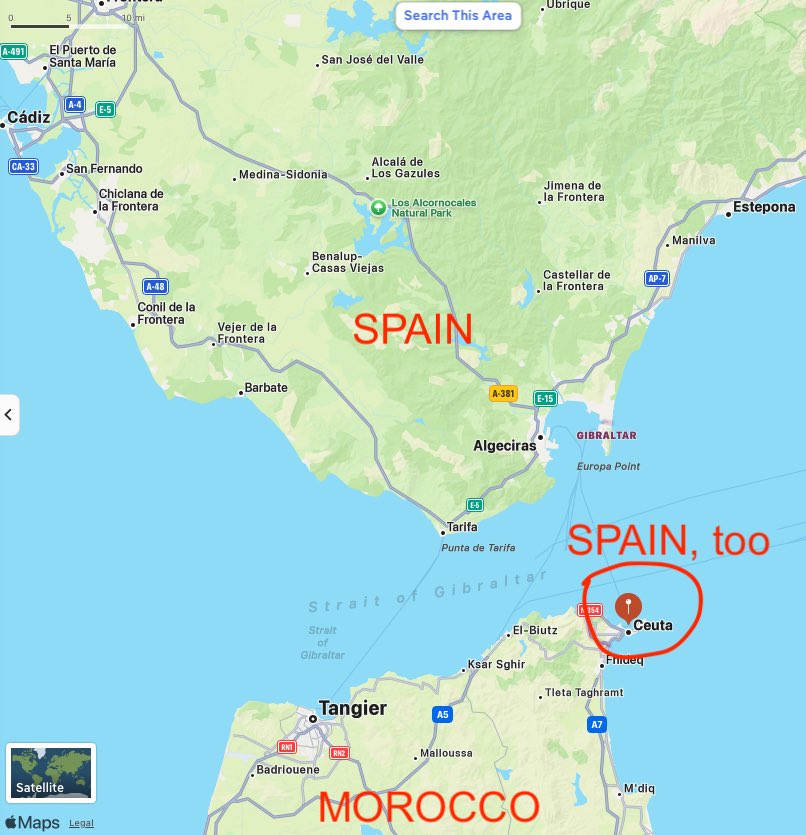
peruvian strongman oscar benavides famously said “for my friends, everything; for my enemies, the law”.
once, such a thing might have provided a succinct summation of the practice of privilege in its literal sense of “private law”. there were laws for the aristocrats and others for the commoners and still others for non-citizens and slaves.
such ideas date back to time out of mind before stone was placed upon stone in giza and stood as absolute expectation and norm in most of the world until quite recently (and pertain in many parts of the world even today). the idea that “all people should be equal under the law” was a radical alteration to social order, a repudiation of the divine right of kings and aristocrats and their monopolies on property and on violence. the literal idea that land could be owned by a commoner was an astonishing upheaval of established orders. it was also the freeing move that allowed for the west to rise and flourish and prosper, unlocking its vast human potential. one might think that people would be happy about this and cherish and protect this most foundational idea that serves as cornerstone to civilizations of liberty and plenty.
lol.
you must be new here.
[…]
spain looks to be in real danger of falling as a nation. they created a mass amnesty for illegal immigrants from places that do not believe in spain but only in tribe and who do not believe in rights but only in who may dominate whom. if one seeks to be a wrecker, it’s a brilliant incentive. pardon a million and give them access to your social safety networks and welfare payments which fund a lifestyle far in excess of where they came from (and the right to vote for more) and the next wave is already packing its bags to come. spread enough jam and you can attract infinity ants.
the US was well on its way to running this playbook (and likely has ~40 million illegals to show for it) before it was stopped. the astonishing bit was how easy it was to shut this off. you just cut off the incentives. no more free stuff, no more amnesty, no more “path to stay”, and no more “catch and release until our overwhelmed court system can have a hearing years from now”. it’s really that simple.
due process becomes rounding you up and sending you home, not giving you a nice place to live for the 3 years until your case is heard.
and it ALL comes down to prosecutors, courts, and agencies. immigration law became irrelevant not because the law changed but because enforcement did. the spectacle of american judges sneaking illegals out of courthouses to avoid their apprehension by ICE was really pretty astonishing. so too were the massive levels of entitlement fraud, literal government funded flights to needed voting districts, and the astonishing refusal to arrest or hold accountable any among them because “marginalized”. europe is worse.
the NGO bond villian insidious complex has been running the table on the west for 20 years.
and they are moving into overdrive now before the populist right forces they are giving reflexive rise to can take control.
[…]
the media is, predictably, either ignoring this or pretending it’s a humanitarian crisis of families and babies. it’s not. this is damn near all men.
and they are not behaving well.
some are claiming that many of these are criminals freed by morocco and bused to the border as a deliberate act. (this same tactic was used by central and south american regimes to dump their gangs in the US.) images of robbery, rape, and of murder are cropping up.
just what a town of 80k is supposed to do with 80k invaders and how they might be fed or sheltered or controlled remains an open question.
meanwhile, EU commission president ursula von doom has moved to action.
“we have sent a bureaucrat to monitor the situation. if this continues, they will tell people to ‘stop’. if that fails, they will say ‘stop’ again, perhaps in a firmer voice.”
to call this air and nonsense would be charitable. it’s an admission of helplessness. the EC relied upon a soft power it no longer possesses because it now faces people who believe only in hard power which the EC never had.
bluff called.
it’s over.
the EC was fine to govern the sort of citizens who yell at tourists for crossing an empty street against the light. it is wholly unsuited for this and like many an ill fated magician’s apprentice before them, they have now summoned that which they have no hope of controling and will eat them alive.
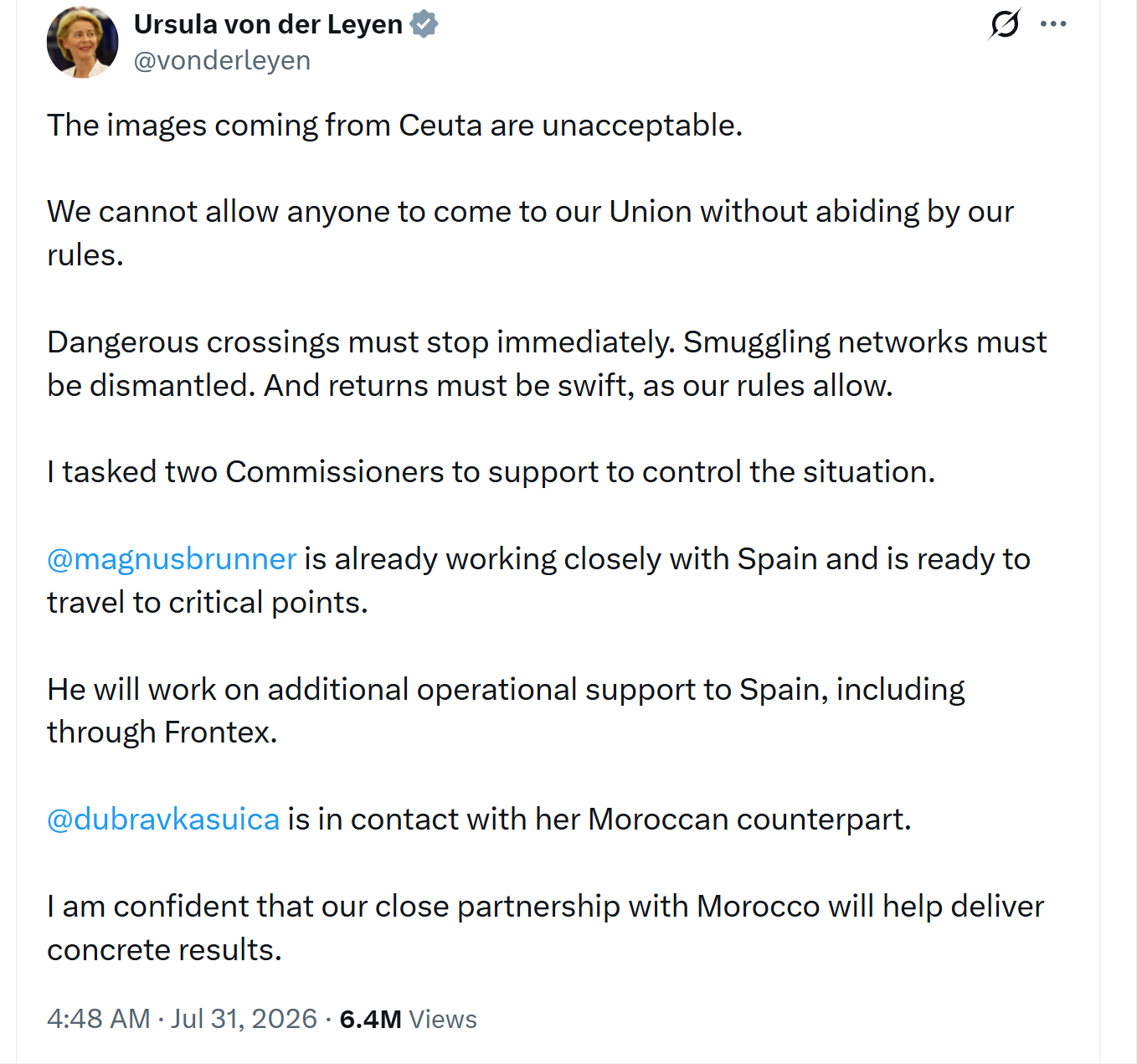
but here’s the part i really loved: “the images from ceuta are unacceptable”.
talk about saying the quiet part out loud. not the events. not the crisis. the images. even now, for her it’s all perception. you want to understand why they want to mandate ID to use the internet/social media and why they so desperately demand the right to censor it (once more using courts and agencies to enforce their whim)? this is why.
“for my friends, speech, for my enemies censorship and gulag”.
what they are doing cannot survive these images.

On Substack Notes, GenX Anecdotes reacts to the progressives’ response to the Ceuta situation:
I often wonder about the open borders, “migrants welcome” people and I can’t square it.
I am traditionally a left leaning person from a mixed background who has travelled extensively.
To the current progressive mind this ought to make me automatically cheering on the levels of mass migration we are living with.
But it’s the opposite.
The well travelled “anywhere” cosmopolitans should surely be the most aware of cultural differences and that it’s precisely the concept that nations are “particular” and unique from one another, that makes travelling such a fascinating and sometimes challenging thing to do.
[…]
Travelling gave me a fresh and new appreciation of little things (that actually turned out to be important things) about Britain that I had taken for granted before.
The fact that these muppets think that any form of patriotism or nationalism leads to Hitler is absolutely moronic.
And of course they celebrate it everywhere else. It’s just us who are the baddies for wanting to hold onto our traditions, customs and culture.
Why are we uniquely expected to live by different rules? Surely that in itself is kind of exceptionalist?
A progressive travelling in India wouldn’t think twice about a Mumbai taxi driver having an Indian flag hanging on his rearview mirror.
Or a Thai guesthouse having a shrine to the Thai royal family.
When you travel, people are proud of their countries and towns. They want to show you around. They tell you their country is the best proudly.
Of course, I will be here all day pointing out progressive double standards.
But this one is a biggy!
Update, 4 August: Welcome, Instapundit readers! Have a look around at some of my other posts you may find of interest. I send out a daily summary of posts here through my Substack – https://substack.com/@nicholasrusson that you can subscribe to if you’d like to be informed of new posts in the future.
“We’ve got steel mills at home”
When you want to point at amazingly vast political failures, the Chinese plan to have peasants produce steel in tiny backyard furnaces must rank near the very top of boneheaded notions. It would be funny except for the huge costs in material, environmental damage, and human lives:

Mao Zedong killed roughly 45 million people between 1958 and 1962, and the backyard steel furnace campaign sits at the center of that catastrophe as a textbook case of central planning consuming itself alive.
The logic of the Great Leap Forward went like this: if the Soviet Union industrialized through state-directed production, China would do it faster and bigger. Mao ordered peasants across every province to smelt steel in small furnaces built on collective land. Party officials set output quotas with no reference to actual resources, actual skills, or actual demand. Farmers melted down their own plows, woks, and door hinges to hit the numbers. They stripped hillsides bare for fuel. What came out of those furnaces was overwhelmingly pig iron so brittle it had zero industrial use. The quotas got reported as fulfilled, the statistics traveled up the command chain, and Beijing celebrated a triumph that existed only on paper.
You have to understand what those farmers were abandoning to stand at furnaces all day. The 1958 harvest was, by most estimates, actually decent. But with the rural labor force diverted to smelting operations, crops rotted in the fields unharvested. Free market economists call this opportunity cost: every hour a farmer spent producing worthless slag was an hour not spent producing food. The price system, had anyone been allowed to use it, would have made this tradeoff immediately visible. Prices signal scarcity. Planners just issue directives and wait for reality to disobey them.
Local officials faced execution or labor camps for reporting shortfalls, so they reported surpluses. Beijing then exported grain abroad, partly to service debts to the Soviet Union, partly to project an image of socialist success, even as provinces like Anhui and Sichuan descended into mass starvation. The state had monopolized food distribution, so when the numbers were wrong, there was no private market, no informal trade network, no alternative channel to move grain to the dying. The apparatus designed to feed people became the mechanism that starved them.
This is what the elimination of private property and price signals actually produces in practice: 45 million corpses and a generation of Chinese children who grew up stunted by famine.
Comments Off on “We’ve got steel mills at home”
Invasion of Iraq, 2003
Real Time History
Published 6 Mar 2026In March 2003, a US-led coalition invades Iraq. US President George W. Bush claims he must disarm Iraqi dictator Saddam Hussein of weapons of mass destruction and depose a brutal regime supporting global terror. But after a lightning capture of Baghdad and other Iraqi cities in the south, the war is far from over.
(more…)
Comments Off on Invasion of Iraq, 2003


