
In the 4th century BC, the Greeks conquered the world. And that is where their problems began.
When I was a child first getting interested in ancient history, the books I read followed a smooth narrative process. The story of the Greeks began with Athenian democracy and the victories at Marathon, Salamis, and Plataea that saved Western civilization from Persian conquest. Then there was the Athenian maritime empire, and its tremendous cultural achievements: the Parthenon, Socratic philosophy, the plays of Sophocles, Euripides, and Aristophanes. There was the Peloponnesian War and Thucydides’s chronicling of it. And then, in a tremendous climax, there were the awesome conquests of Alexander the Great, who destroyed the most powerful empire on Earth and conquered the known world by the age of 33, only to die young and have his empire swiftly broken up after his death.
… And then the story would promptly lurch 700 miles to the northwest and start over. Greeks? What Greeks? Now I was reading about the rise of a different city, Rome, and the achievements of its great republic. Instead of the Assembly and the ostracism, there was the Senate and the consuls. I would read about the Samnite Wars, the Punic Wars, the Gallic Wars, and finally the great civil wars that transformed Rome from a republic into the empire that men still think about a few times a week. In this story, the Greeks appear again, but only as enemies for Rome first to easily defeat, then be culturally influenced by. This fusion of Greek and Roman culture leads to European Christianity, the Renaissance, the cultural canon — in a word, the West itself.
Kid me didn’t think too much about it at the time. But as I grew, I and many others finally had a thought intrude: Wait a minute, what the heck was going on in Alexander’s old empire before the Romans got there?
And if you’re like me, asking that question is how you wind up reading Alexander to Actium.
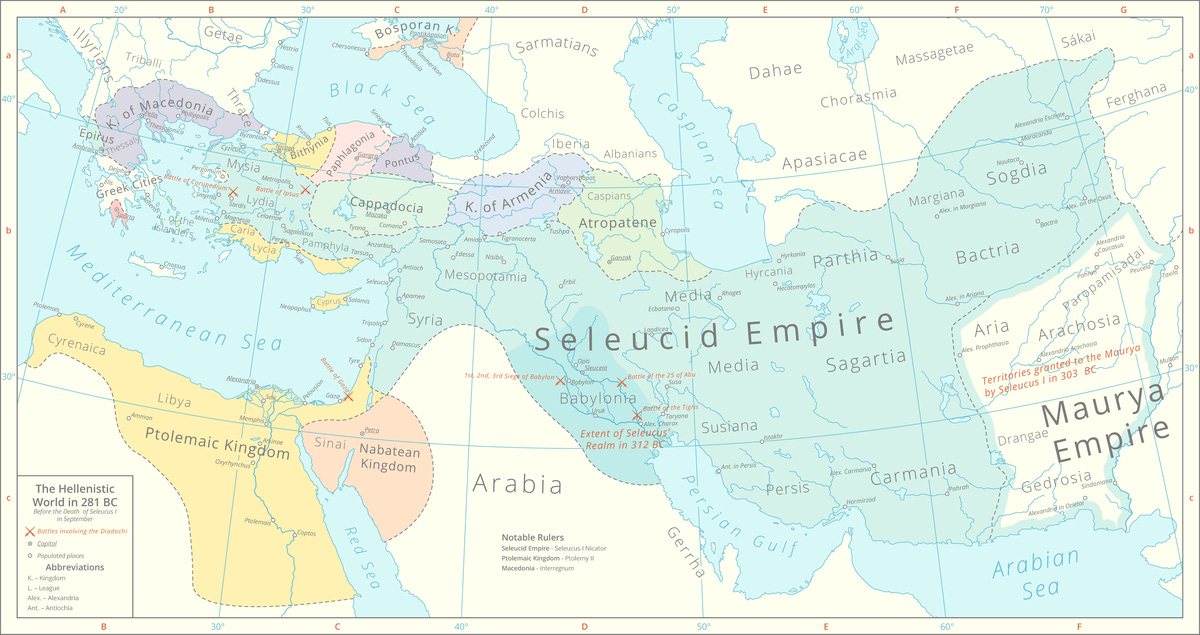
Alexander to Actium is classicist Peter Green’s gargantuan tome covering the period historians now call the Hellenistic era, the 293-year span following the death of Alexander the Great during which his vast but short-lived empire was divided up and ruled by ethnically Macedonian and Greek elites who left the stamp of Hellenic culture all across the eastern Mediterranean. The era begins with Alexander’s generals (the Diadochi, “Successors”) waging an epic forty years of war as funeral games for their dead master before finally settling into a more stable system with three great kingdoms centered on Macedon, Egypt, and Syria (plus lesser monarchies like Pergamon and Bactria). These kingdoms battled one another and Rome for another quarter-millennium, gradually losing land and power before they were extinguished, one by one. The last Hellenistic kingdom, Ptolemaic Egypt, made it until 30 B.C., when the legendary Cleopatra1 committed suicide and her realm became the personal possession of Octavian, the future Caesar Augustus. Long after their destruction, the Hellenistic legacy lingers most in religion: the Christian New Testament was written not in the Hebrew or Aramaic of Judea or the Latin of the Roman Empire, but in the koine Greek that had become the lingua franca of the educated eastern Mediterranean.
The ebb and flow of this 300-year historical epic is one that really deserves a trashy big-budget TV adaptation or three. The sordid acts of the Successors and their successors are so spectacular they could easily be made into a hybrid of HBO’s Rome and a popular show about dragons that shall remain nameless. I’m a little shocked one hasn’t been made already. To give just a small set of anecdotes from Green’s work:
- After an attempted army revolt following Alexander’s death, the general Perdiccas holds a “purification” ceremony for the army, which consists of rebel leaders being publicly trampled to death by elephants.
- Antigonus One-Eye, the man who came closest to reuniting Alexander’s empire, was very tall, very wide, very old, and had a very good nickname. Huge in size and huge in ambition, he dies fighting in battle at over 80 years old at Ipsus, a battle featuring 25,000 cavalry, 120 scythed chariots, and almost 600 elephants.
- Olympias, Alexander the Great’s mother, is so vindictive that when Philip II dies, she has a rival wife and her infant daughter roasted to death on a charcoal brazier even though they pose zero dynastic threat. When her own end comes during Macedon’s multiple civil wars, the soldiers of Cassander refuse to kill Alexander’s mother – so she is instead stoned to death by the families of those she had killed during past purges.
- Seleucus I, founder of the Syria-based Seleucid Empire, is happily married to his second wife Stratonice when he notices his son, Antiochus, is deeply enamored with her. No worry: Seleucus simply divorces Stratonice and has her marry Antiochus. This is actually a happy ending and works out for everyone, surprisingly.
- Lysimachus, king of Thrace, is happily married to his third wife, Arsinoe, when she tricks him into having his son by a first marriage executed so her own son can succeed. This sparks a war that kills Lysimachus and destroys his kingdom, somewhat botching the whole succession thing. But no worries: Arsinoe escapes to Egypt and makes out just fine by marrying its pharaoh – her brother.
- Cassander, king of Macedon, gets so irate at clever jabs from the wily Athenian politician Demades that he finally snaps and personally chops both Demades and his son to pieces while screaming insults at them.
- For about a decade during the various successor wars, Athens is ruled by a literal philosopher-king, the thirty-something Macedonian puppet Demetrius of Phaleron. One of his agenda items is building a gigantic mechanical snail to crawl through the streets of Athens leaving a realistic trail of slime behind; this is apparently some artful way of shaming the Athenians for being sluggish in standing up for Greek freedom.
- After Demetrius the Philosopher King is overthrown (by a different Demetrius, long story) the new tyrant takes advantage of divine honors granted to him to house his hoes in apartments at the back of the Parthenon. He tries to seduce a teenaged boy who instead commits suicide by jumping into a tub of boiling-hot water, and another time waives a fine against a prominent Athenian citizen in return for taking his son as a catamite. When you are legally a god, they let you do it.
- Aratus is a quite successful Greek general with the unfortunate problem of getting uncontrollable diarrhea before every battle.
- Escaped slave and rebel Drimakos defies authorities on Chios so successfully they simply reach a treaty with him: As long as he doesn’t steal too much and only accepts new slaves into his army who were severely abused by their masters (while sending the rest back), they’ll leave him alone. Drimakos lives to a ripe old age, then has his boy lover kill him and take his head in to claim a reward. Later, Drimakos’s spirit would supposedly appear to Chians in their dreams to warn of plots by their slaves.
- To show off their power, the Ptolemies commission a grand procession through Alexandria whose centerpiece is “a gaudily painted gold phallus, almost two hundred feet long … and tied up, like some exotic Christmas present, with gold ribbons and bows”. Green reasonably wonders how this mighty phallus was able to negotiate corners.
- The later Ptolemies could win some kind of ghastly award for their spectacular decadence. Ptolemy VIII Physcon (“the Obese”), who resembles a 2nd century BC Baron Harkonnen, seizes power after the death of his brother (also named Ptolemy) by marrying Cleopatra, who is also their sister. He then has her son, his nephew (also named Ptolemy), murdered during the wedding feast, then proceeds to seduce and marry his pubescent niece (also named Cleopatra). A decade later, riots forced Physcon and his niece-wife into exile, and his sister-wife proclaims her son by Physcon (another Ptolemy) as pharaoh, but the heir is apparently in Cyrene at the time, allowing Physcon to capture his unsuspecting son and send his dismembered corpse to the sister-wife as a birthday present. Meanwhile, the sister-wife’s daughter by her first brother (named Cleopatra, of course) gets married off to a Seleucid king and uses her sons as a series of puppets. The first puppet, Seleucus V, proves troublesome, so his mother murders him by using him for archery practice. The second puppet, Antiochus VIII, is more canny, and when his mother tries to murder him with a cup of poisoned wine, he notices something is up and forces her to drink the fatal cup herself. Antiochus VIII then fights a long civil war against his half-brother and cousin Antiochus IX, who is not a puppet but instead has the private hobby of playing with literal giant puppets. Got all that?
If learning the above is your idea of fun, then Alexander to Actium is a rich feast, enlivened throughout with Green’s flare for delicious details and legends that are possibly fanciful but too remarkable to leave out.
Blake Neff, “GUEST REVIEW: Alexander to Actium, by Peter Green”, Mr. and Mrs. Psmith’s Bookshelf, 2025-10-20.
- The Seventh, it turns out.
August 3, 2026
QotD: The Hellenistic Age
August 2, 2026
The hubristic disaster of good intentions in Llantwit Major
On Substack, Mark Collett recounts the sad tale of good intentions leading to very unwelcome results in a little Welsh town that was determined to welcome in foreign refugees:
“Those whom the gods would destroy, they first make mad.”
This phrase does not have a single, definitive creator but it is instead a modern English phrasing of an ancient Greek concept that evolved over thousands of years. The core meaning of the phrase comes from the classical Greek concept of Atë, which is an infatuation or moral blindness sent by the gods to punish human hubris. The earliest recorded variation appears in Sophocles’ tragedy Antigone (c. 441 BC), where a chorus remarks that evil eventually seems good to a man whose mind a god is leading to ruin. Sophocles noted even then that it was an old and famous maxim – possibly existing for hundreds of years before he used the term. However, the phrase finally took its exact, modern-day form in 19th-century American literature with the Reverend William Anderson Scott publishing the phrase exactly as it is written today in his book Daniel, a Model for Young Men, which was published in 1854, he called it a “heathen proverb”.
[…]
There is probably no better modern application for this “heathen proverb” than as a means to describe white liberals. These champions of social justice are so desperate to endorse a progressive ideology and to embrace people from other racial and cultural groups, that it often leads to their downfall. So convinced are white liberals not only of the nobility of their cause, but they are also totally sure that when their beliefs and theories are applied in the real world that they will result in the establishment of a rainbow utopia in which all people will live in blissful harmony. This is why the truth to these people is like garlic to a vampire. As such, no amount of facts, figures or even real-world examples of the potential pitfalls that could result from enacting the policies they support can dissuade the white liberal from their political path. And often, the hubris of white liberals can lead to their downfall, and sometimes, this affects more than a lone individual, sometimes, this hubris leads to the downfall of an entire community.
Photo from Mark Collett
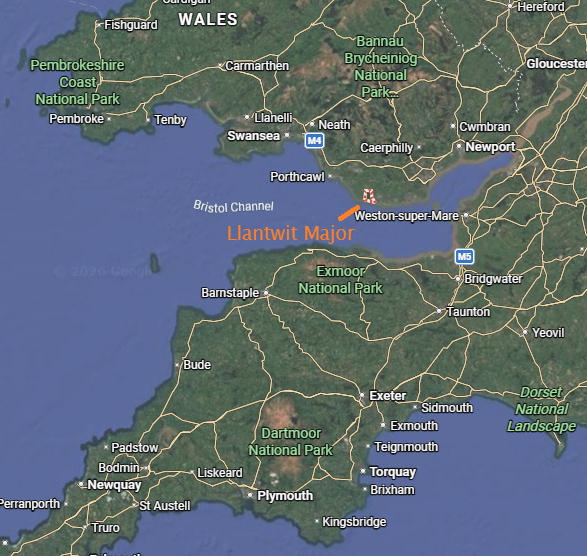
And on the South Coast of Wales, in a small seaside town named Llantwit Major, it could be said that the residents became the living embodiment of this “heathen proverb”, that they went “mad” – however this madness was definitely not the work of the gods. The madness that had taken over the minds of the people of Llantwit Major was a form of suicidal hubris that sprang forth from their misplaced beliefs in tolerance, diversity and multiculturalism. And it was their faith in these beliefs that caused them to embrace their own demise in a desperate attempt to prove how progressive and open minded they were. This is the story of a small Welsh town of less than 10,000 people who willingly and enthusiastically welcomed a swamping number of migrants into their community and how their overwhelming arrogance resulted in a migrant camp being built in the very centre of their tiny, and previously homogenous, Welsh community.
But this wasn’t just a case of blind virtue signalling – it was possibly the most glaring example of liberal hubris on a group level that has been witnessed in recent years. The residents of Llantwit were warned of their impending fate, but not only did they ignore these warnings, but they besmirched and attacked those who they should have heeded. When it was announced that migrants would be headed to Llantwit, many nationalists were eager to help the town’s residents, and plans were made to arrange a demonstration in the area in order to assist the locals in pushing back against the proposals. But the hubris of the townsfolk caused them to reject this generous offer of help, and instead, those who wished to warn local residents of the dangers posed by such a scheme were met with resistance. This local resistance was so strong that the BBC ran a glowing article praising the people of Llantwit titled: “Patriotic Alternative: The town fighting the far-right with Welsh cakes”.

How to Make Aggression Sound Like Defense – Death of Democracy 26 – Q2 1939
World War Two
Published 1 Aug 2026By the spring of 1939, Hitler’s Germany is no longer merely threatening war, it is preparing to launch one while insisting that every act of aggression is really self-defense.
In this episode of “Death of Democracy”, we look at Germany in the second quarter of 1939: the launch of the battleship Tirpitz, the secret planning for Fall Weiss — the invasion of Poland — Hitler’s 50th-birthday military spectacle, the renunciation of the German-Polish Non-Aggression Pact and the Anglo-German Naval Agreement, the Pact of Steel with Mussolini’s Italy, and the diplomatic moves designed to isolate Poland before the coming attack.
But behind the military display, Nazi Germany’s economy is still on a knife’s edge. Rearmament, shortages, debt, plunder, and autarky have pushed the regime toward a brutal logic: conquest is no longer just ideology; it has become the regime’s chosen answer to the crisis it created.
Meanwhile, persecution inside the Reich continues to escalate. Jewish tenants are stripped of protection, the refugee ship St. Louis leaves Hamburg in a desperate search for sanctuary, and Ravensbrück opens as a concentration camp for women. As Germany exports terror into annexed Austria and Bohemia-Moravia, Britain and France finally begin to wake from appeasement — but dangerously late.
This is how aggression is made to sound like defense.
Never Forget.
“Cash for Clunkers” – the seen and the unseen
French economist Frédéric Bastiat explained why the “Cash for Clunkers” program would fail … and he wrote about it more than a hundred years before it happened – “That Which is Seen, and That Which is Not Seen”. The US government publicized the “seen” … removing older cars from the roads in pursuit of lowering pollution. Nobody publicized the “unseen”, as Handre explains:

The Cash for Clunkers program, which Congress passed in June 2009 and burned through its $3 billion budget in under two months, destroyed functional wealth on a national scale, and somehow they called it “stimulus”.
The mechanics were simple: trade in a working car, receive up to $4,500 toward a new one, and watch government employees pour sodium silicate into the old engine to make it seize permanently. Around 700,000 vehicles got crushed. These were not rusted-out death traps. The eligibility rules required the trade-in to be drivable and insured. You were watching the state systematically annihilate usable capital because Keynesian demand theory told it that destruction generates recovery. Frederic Bastiat explained why this is wrong in 1850, in an essay short enough to read on your lunch break. Congress ignored it.
The ripple effect hit people the government never mentioned in its press releases. Mechanics lost repair work. Used-car dealers watched their inventory evaporate. Low-income buyers who depend on the sub-$5,000 market faced prices that jumped roughly 10% in the years after the program. Free market economists call this “seen versus unseen”. Politicians only showed you the gleaming new Chevy Malibu driving off the lot. They never showed you the single mother in Akron who needed a $3,000 Corolla and found nothing affordable left on the lot.
Even the environmental justification collapsed under basic scrutiny. A 2009 study by Resources for the Future calculated that the program cost between $237 and $365 per ton of carbon dioxide reduced. The voluntary carbon credit market at the time priced a ton around $10 to $20. The government spent up to thirty times the market rate to achieve an environmental outcome the market was already pricing far more efficiently.
This is what central planning always does. It takes your money, destroys real assets, and transfers wealth from the poor to auto manufacturers and their financiers. The program’s designers received awards. The Akron mother paid higher prices. The engines sat crushed in junkyards. Nobody in Washington answered for any of it.
The Ancient Greeks 03 – Enter the Persians 6 – Eretria Falls, Athens Stands Alone
seangabb
Published 16 Feb 2026Greece: A Brief History, c.700 BC – 500 AD
In 490 BC the Persian fleet advances island by island across the Aegean. Eretria is besieged, betrayed, and deported. We examine Persian punitive strategy, internal Greek division, and the calculated destruction of Eretria as an example to others.
Athens now faces invasion. Pheidippides runs to Sparta. The Spartans refuse immediate aid due to religious obligation. Only Plataea stands with Athens.
This is the moment before Marathon.
QotD: Churchill’s views on India
On the other hand, Churchill repeatedly voiced his admiration for the gallantry of Indian troops, noting in his war memoirs: “The unsurpassed bravery of Indian soldiers and officers, both Moslem and Hindu, shine for ever in the annals of war. Upwards of two and a half million Indians volunteered to serve in the forces … The response of the Indian peoples, no less than the conduct of their soldiers, makes a glorious final page in the story of our Indian Empire.”
Despite his fears about Indian independence, Churchill’s views noticeably mellowed over the years. On 5 February 1942, Churchill proposed in cabinet to visit India to make its Congress leaders an offer of postwar independence, in return for their supporting the war effort. But instead the war cabinet sent its senior Labour minister, Sir Stafford Cripps, known for his friendship with Congress leaders. When the Cripps mission failed to meet their demand for immediate independence, Congress launched the Quit India movement of civil disobedience against the Raj and resolved to offer only passive resistance to the Japanese invasion.
On being informed of this in September 1942, an apoplectic Churchill exclaimed to Amery: “I hate Indians. They are a beastly people with a beastly religion.” He was referring to Hinduism, rather than Islam, given loyal support for the war effort from the Muslim League. Churchill saw Gandhi’s decision to launch the Quit India movement in the middle of the war as a stab in the back when Britain most needed and deserved loyal support.
He also (like many Indian liberals and socialists) saw Gandhi’s political fasts as a form of emotional blackmail. And he was appalled, as were many Congressmen, by extreme nationalists such as the Bengali leader Subhas Chandra Bose joining hands with Hitler and the Japanese, a fact not calculated to endear Bengalis in general to Churchill.
Churchill’s abusive comments about Gandhi, Indians and Bengalis need to be seen in that context. They also need to be seen in the context of his penchant for making outrageous comments that he didn’t really mean in order to shock or tease.
Zareer Masani, “Churchill and the genocide myth”, The Critic, 2020-12-06.
August 1, 2026
The invasion of Ceuta
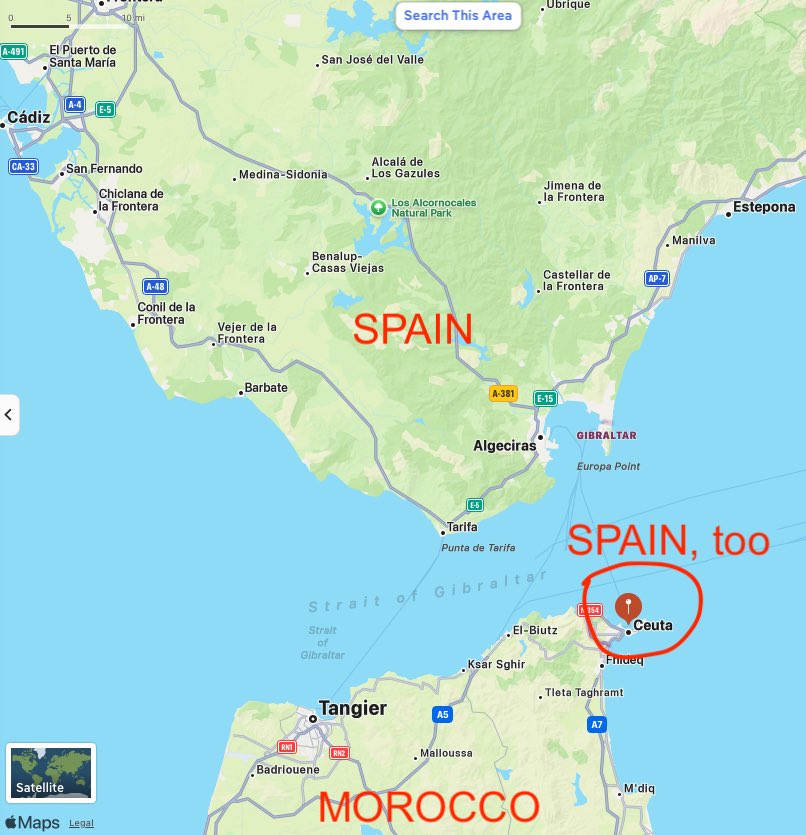
In the last 48 hours vast numbers of people have learned that Spain still has territory on the African continent, as Morocco enables thousands of young men to cross into the Spanish city of Ceuta. The Spanish government has, to time of writing, refused to declare a state of emergency or to send military forces to assist the municipal authorities in Ceuta. In Spiked, Brendan O’Neill thinks this heralds the end of globalism:
Can we say “invasion” now? What other word is there for the rough intrusion of tens of thousands of young men into the sovereign territory of a foreign nation? Surely not even the sappiest leftist in his tattered keffiyeh and “Refugees Welcome” t-shirt would describe the thuggish gatecrashing of an independent nation as “asylum seeking”? That might be the one and only upside to the extraordinary events in Ceuta yesterday: the death, at last, of euphemism. The impossibility of any longer dressing up the West’s suicidal abandonment of its borders as “kindness”.
The scenes from the Spanish enclave at the tip of North Africa are staggering. An estimated 49,000 people, mostly Moroccans, mostly men, gleefully intruded upon the territory of the Spanish kingdom. That’s around the same number of people who illegally sail to Britain in a year. They scaled border gates and overwhelmed those charged with protecting Spanish lands. Viral clips show men punching the air as they swarm the enclave, clearly thrilled with their incursion into a sovereign state. Even the Spanish press is feeling the death of euphemism. “Ceuta, invaded”, says the front page of ABC, a newspaper of record, alongside an image of thousands of men streaming along Ceuta’s beach.
The mass storming of Ceuta has focused the minds even of Spain’s fatally apathetic ruling class. All of Ceuta’s parties, both right and left, have called on Madrid to send in the army to reinforce the border with Morocco. Spanish PM Pedro Sánchez promised an “immediate response“. Yet even if the Spanish manage to tame this searing crisis of sovereign rule – and that’s a big “if” – the lessons of it should reverberate not only across Spain but all of Europe. For the fall of Ceuta exposes the lethal strain in globalism. It speaks – screams in fact – to the chaotic trashing of sovereignty, democracy and our very way of life that globalism and its gold-collared acolytes have brought about.
The storming of Ceuta shatters the falsehoods of the left. For years, “progressives” gaslit the public, insisting that the men illegally crossing our borders are “vulnerable people” who are “seeking asylum”. Like Big Brother, they expected us to reject the evidence of our eyes and ears and accept that these swaggering blokes from Eritrea or Afghanistan are the wretched of the Earth requiring our love and care and four-star hotels. Ceuta dismantles that lie. The whole world can see there are virtually no women and children in those mobs. The whole world knows Morocco is not ravaged by war or hunger. From now on, every utterance of the phrase “asylum seeker” should invoke noisy, angry scepticism.
The Ceuta crisis also confirms that the moral cowardice of the modern state is like a red rag to hostile actors. It is undeniable that Pedro Sánchez’s lunatic granting of asylum to illegal immigrants emboldened these Moroccan men to pour into soft-touch Spain. In January this year, Sánchez bypassed parliament and issued a royal decree to regularise virtually all “undocumented migrants” on Spanish territory. Almost 1.2million illegal arrivals applied for this regularised status that would grant them the right to reside in Spain, to work there and to enjoy unfettered access to healthcare and education.
The cope is strong in progressive commentators:
Why UK crime victims’ families always sound so similar talking to the media
On Substack Notes, John Carter linked to an article about the British Home Office’s “nudge unit” who, among other things, coax and cajole the families of murder victims to avoid any hint that they blame the perpetrators for the loss of their loved ones:

This is incredible. I always wondered how family liaison officers from RICU or the CRS reliably got the families of victims murdered by political or racial terrorists to provide such anodyne, don’t look back in anger public statements. I figured in most cases it would be concern trolling, with legal threats held in reserve.
This lays the technique bare, using interviews conducted both with victim’s families and former police officers. Liaison officers serve as anesthetic patches that get slapped on the open wounds of the migration war. They apply therapeutic techniques to calm and reassure the families, establishing dependent relationships and using the trust they build to guide them away from saying anything inflammatory when the time comes to speak to the public. If families become noncompliant in this respect, they’re threatened with causing a mistrial should they speak too openly about their feelings.
That isn’t all RICU does, of course. “Communications” includes a huge propaganda arm, which uses every tool at its disposal, including battalions of fake social media profiles. You have to wonder how much of the culture war of the last decade or more was pure hallucination.
The article in question is by David Shipley for the Pimlico Journal:

RICU, the Home Office’s Research Information and Communications Unit, is often the subject of much attention online, particularly around its role in the consistently bland calls for “unity” after horrific acts of violence. Many people online suggest that either the Unit itself, or the “specially trained officers” (Victim Liaison Officers or Family Liaison Officers) must threaten victims and their families to ensure their compliance with approved messaging. This always struck me as unlikely — widespread coercion would surely have leaked by now. There was also good reason to be sceptical of the efficacy of behavioural science applications to government. And yet public statements by those victims and their families are remarkably consistent.
So I was delighted when, a couple of months ago, Pimlico Journal asked me to investigate RICU and victim liaison properly. In order to do so, I studied historic statements, publications and coverage of RICU and spoke with victims’ families, some of whom are named in this piece and former police officers, none of whom are named, with knowledge of the Victim and Family Liaison units. What I discovered is fascinating and far more insidious than the imagined coercion. This article provides an overview of RICU’s history, goals and methodology, followed by details from those interviews. I hope it sheds some light on this murky area of the state’s “communications management”.
RICU was established in 2007 “under the Prevent strand of [the UK government’s] CONTEST strategy” with its stated goal being to “understand and counter terrorist and extremist ideologies to reduce the risk to the UK, its citizens and its interests overseas”. Giving evidence to MPs in 2009, Charles Farr, a former SIS officer, and head of the Office of Security and Counter Terrorism, who set RICU up in 2007, said the unit is “responsible for advising the rest of government [and] officialdom, from a brigade commander in Helmand province through to a chief constable in Yorkshire, about how they wish to characterise the threat we face and describe the response that we are making and, secondly, rather different, they are responsible for challenging the propaganda which comes to us from al-Qaeda and associated groups — generally not from people in this country; usually from the incessant 4,500 websites that are in one way or another associated with radical Islamist terrorist organisations around the world”.
The unit embraced convenient lies from the start. Part of their strategy was to send advice to “local authorities, people working on community cohesion projects, local police, neighbourhood policing teams” and “the Chief Constable” that they should not “talk about Islamic terrorism, not because in certain circumstances that is an inaccurate description but because the language admits of a number of interpretations which are not always helpful to us“.
RICU was also always concerned with the whole of British society — while Farr said the unit decided to “start” with Muslim communities, he told MPs that he did “not want to give the impression that RICU’s sole purpose is to communicate with Muslim communities in this country. It is not.” So by 2009 a unit existed which had “about 35 people” working for it, “and a bit of the private sector in there to advise us on aspects of communications”, which was telling every arm of the state, along with much of civil society, that they should lie about the nature of the threats the country faced, to serve the state’s perceived interests. It was also already building wide and deep relationships within many parts of the state, including policing.
What has it become, in the 17 years since Charles Farr gave his evidence?
In 2011, when the government reviewed Prevent, it found that RICU’s communications sometimes “erred in seeking to make language acceptable to some in Muslim communities, at the expense of candour”. The unit was described as having “a central role in developing counter-ideological or counter-narrative work”, although its track record was described as “mixed”. It was directed to take “more care … to identify credible partners to develop powerful and specific narratives across a range of communications channels, especially on the internet“. Despite these criticisms, the state chose to “retain RICU, largely in its current form”, but with the expectation that it would produce “much sharper and more professional counter-narrative products” — there was also a commitment to “continue to work with social media enterprises” in the battle against “propagandists and radicalisers” including those whose “propaganda work” might be illegal under “race and religious hatred legislation”. The shift is notable — Farr’s commitment that RICU would work across the whole of British society is clearly underway, with Islamic terrorism and radicalisation no longer the main focus.
More recently, RICU has long been the subject of much discussion on social media, and of occasional interest in the mainstream press. It’s often accused of being behind the anodyne calls for unity and calm issued by public bodies, victims and their families after the latest “Yookay” Event in which a migrant has done something appallingly violent. Not unrelatedly, it is generally the right who are more vocal in their criticism of RICU, and it is regularly suggested that they threaten families into sticking to the regime-approved line.
Supreme Court of Canada surprisingly rules against the federal government
For the last ten years, it’s been a running joke that the federal government’s conflicts of interest would, at most, result in a $500 fine and an insincere promise not to do it again. Because that’s pretty much what has been happening since the early years of the Trudeau government. In a shocking development, however, the Supreme Court of Canada kicked over the apple cart and struck down the relevant section of the Conflict of Interest Act which the feds had found so useful over the years:

“Supreme Court of Canada, Ottawa”by daniel0685 is licensed under CC BY 2.0

So the Supreme Court of Canada just did something almost no one in Ottawa expected. They ruled against the government. Unanimously. On a case the people who run this country spent five years trying to kill.
Yesterday the Court, in a decision written by Chief Justice Richard Wagner, said section 66 of the Conflict of Interest Act is unconstitutional. That was the clause designed to keep the federal Ethics Commissioner’s rulings largely beyond the reach of the courts. Errors of fact. Errors of law. None of your business. Parliament put a lock on the door and the Supreme Court just kicked it in.
This is not some abstract legal theory. This is the shield that protected Mario Dion’s May 13, 2021 report clearing Justin Trudeau in the WE Charity scandal. That clearance is no longer sealed. Stage 2 of Democracy Watch’s case now goes forward at the Federal Court of Appeal. The actual mistakes in that report finally get examined in open court.
You remember the scandal. Summer of 2020. The Trudeau government hands WE Charity a near-billion-dollar sole-source deal to run the Canada Student Service Grant program. WE had deep family connections to the Prime Minister. Sophie Grégoire Trudeau volunteered as an ambassador and hosted a podcast for them. Margaret Trudeau and Alexandre Trudeau had collected hundreds of thousands of dollars in speaking fees. Justin Trudeau himself had been a regular at their events for years.
The optics were so bad even Trudeau eventually admitted there was an appearance of conflict and that he should have recused himself. Bill Morneau got dinged. Dion cleared the Prime Minister.
Democracy Watch filed for judicial review in June 2021. They pointed to four specific problems with Dion’s ruling.
First, Dion refused to find a real or potential conflict of interest. He had previously defined private interests to include social and political interests. The grant advanced Sophie’s standing with WE and the family’s political brand. Dion simply ignored his own earlier reasoning.
Second, he claimed the Conflict of Interest Act does not cover apparent conflicts, only real or potential ones. That is not what the statute says. The purpose clauses and the prohibitions in sections 4 and 6 are broader. A Federal Court of Appeal decision from 2009 already confirmed the Act reaches appearances. Dion’s own report noted that recusal is always advisable when an appearance exists. Trudeau had already conceded the point.
Third, Dion would not find that Trudeau and the Kielburger brothers were friends. The Act prohibits furthering the private interests of friends. Craig Kielburger had publicly called Trudeau a friend. Trudeau had described them the same way in a speech. The relationship was not distant. Dion waved it away.
Fourth, he refused to apply the broad prohibition against improperly furthering another person’s private interests. In his earlier SNC-Lavalin report, Dion treated violations of the Prime Minister’s own ethical code as improper. That code specifically bans appearances of conflict. Dion carved the law into pieces to reach the result he wanted.
These are not technicalities. They go to whether the Ethics Commissioner enforced the statute Parliament wrote or rewrote it to protect the Prime Minister.
Then the system did what the system always does. The Attorney General of Canada, not the Ethics Commissioner, defended the ruling in court. The same government whose Cabinet is regulated by the Commissioner gets to defend the Commissioner when he clears those same people. Classic.
Homelessness isn’t the real problem … it’s feral humans
Many well-meaning people see “homeless” individuals on the street and think the problem is that these individuals don’t have homes. An obvious solution occurs: we’ll just give them homes so they won’t need to sleep rough on the streets. What a great idea! With the best of intentions! What could possibly go wrong?
The real problem isn’t that there aren’t enough homes … some of those “homeless” people on the street actually do have places to sleep but for one reason or another choose not to. The real problem for most of them is that they’ve gone feral:

If you give problems the wrong names, you can’t understand them.
If you can’t understand problems, you can’t fix them.
There are almost no homeless people in America. There are only feral humans.
A homeless person is someone whose distinguishing feature is not having a home. I was homeless once, for a day, when the lease on one apartment expired before the next one was cleaned, repaired, and ready.
I parked a moving van full of my worldly possessions at my university, and slept on a couch in the student commons.
That’s “homeless”.
“Feral” is when a human cannot live within society, or comply with the basic expectations required for membership.
Yes, they do not have homes.
But this is not their distinguishing feature. Because they also don’t have jobs, sanity, sobriety, manners, morals, or hygiene.
Which is why they do not have homes.
If you give them a house, because you think they are “homeless” rather than “feral”, then they will simply repeat, within that structure, the same feral behavior.
And soon that structure will be uninhabitable.
Which, for certain people, is the whole point.
A man whose job is to sell 3d printed houses isn’t trying to fix the feral-human problem. He’s trying to sell 3d printed houses.
And it’s one hell of a lot easier to sell them to bureaucrats who aren’t spending their own personal money.
It doesn’t matter if 3d printed houses suck to live in. It doesn’t matter if the feral humans trash them. Nobody in this equation cares about the feral humans, even the feral humans themselves.
And nobody in this equation cares about the taxpayers. If the feral humans are still feral, then the 3d house grifters can sell more gimmick houses, and the bureaucrats can spend more of someone else’s money.
If a violent political upheaval becomes necessary, this will be very unpleasant for everyone involved, but at least afterwards, we will all be able to use the feral humans, bureaucrats, and grifters to fertilize the garden of new homes.
Which will be made out of bricks.
Update, 2 August: Welcome, Instapundit readers! Have a look around at some of my other posts you may find of interest. I send out a daily summary of posts here through my Substack – https://substack.com/@nicholasrusson that you can subscribe to if you’d like to be informed of new posts in the future.
Eugene Stoner’s Future Assault Rifle Concept (F.A.R.C.)
Forgotten Weapons
Published 6 Mar 2026After developing the AR-15 with Armalite, Eugene Stoner worked for a number of different companies. In 1972 he co-founded Ares Inc, where he and his partners worked on a wide variety of weapons platforms. Their work included rapid-fire cannons and full-fledged artillery as well as small arms. The first of those small arms was the Future Assault Rifle Concept — FARC. This was a gas piston, rotating bolt 5.56mm rifle design with a number of interested elements. The FARC-1 was a concept on paper only, leading to production of a few FARC-2 and FARC-3 prototypes. The project was cancelled in the wake of the end of the Vietnam War as funding for such things was much less readily available.
(more…)
QotD: The “tiers” of US post-secondary education
Level two is your SPLACs [Small Private Liberal Arts College (the denizens of a SPLAC are of course Splackavellies, in honor of the stupidest song of the 1990s, which is an amazingly high bar)]. The Ivy League schools are SPLACs, and the rest of them are their lesser (sometimes extremely lesser) imitators. You don’t need to publish squat to get tenure at Yale or Harvard if you bring something else [visible diversity, for example] to the table.
The third level is the junior college level. They call themselves “community colleges” in most cases — can’t use junior, it’s able-ist or age-ist or some shit-ist — but you know what I mean. Lots of kids do their first two years at one, getting all the BS “liberal arts” requirements out of the way before they transfer to Ohio State (etc.) to do their major classwork, so lots of History (etc.) profs work at JuCos. (This is the way to do it if you feel you must go to college for some reason, which 90% of the time you mustn’t).
I’ve done time at all three, because of academia’s worst-kept secret: Something like 75% of ALL classes, nationwide, at all levels and in all disciplines, are taught by non-tenure track faculty. Lots of these instructors are grad students, who will theoretically go on to get tenure-track jobs, but there’s a vast floating pool of scab labor known as “adjunct professors”, and I was one of those — a guy with a PhD who isn’t on the tenure track …
… and now never will be, because “adjunct professor” is like “sex worker” — yeah, it’s theoretically just a job now, but good luck getting hired to do anything else once it’s on your resume.
In my case that was by choice, as I loved my field, I loved teaching, but I did NOT love all the rest of the shit that goes along with university employment, and since I had (and have) an ad libitum gig that pays the bills I could follow my bliss, as they said back in the Sixties (I’m told). And since all eggheads are tech-illiterate I was able to do a lot of “online ed”, too. Which is the easiest money you’ll ever make as a professor (yep, I was one of those guys, not University of Phoenix but similar, and y’all, I have stories … oh, how I have stories. Everything you think about “online ed” is true, in spades. If you’re a few credits shy of that AA degree and just need a rubber stamp, then by all means go that route. If not, the University of YouTube has you covered).
Severian, “Friday Mailbag”, Founding Questions, 2022-07-01.
July 31, 2026
The “vibe coding” “revolution”
I’ve used Grok a couple of times to create custom graphics to go with articles on the blog, but aside from that I’ve barely considered using AI for anything. Sometimes the AI-generated email conversation summaries on Gmail are helpful, but they just happen and don’t require any direct interactions from me. As such, I’m in no position to make sweeping declarations about the current state of the AI revolution … but Freddie deBoer has thoughts he’s shared on his Substack:

You are aware, I imagine, of “vibe coding”. The large language models that have received so much fanfare in the past four years have thus far not delivered on the outsized promises that have been made on their behalf; limitless free energy, an end to hunger, and immortality have all conspicuously eluded us. One thing that LLMs really appear able to do well, though, is to write code. And this proficiency has gotten sufficiently advanced that many people now write software solely through directing an LLM, without necessarily having any actual programming skills themselves. The overwhelming majority of the output of this effort is useless or redundant or barely functional, true, but the mere fact that people can do it is an interesting statement on what “AI” is actually good at. And for stupid meme reasons we call this practice vibe coding.
So, in the past two-ish years, several hundred million human beings acquired the ability to write software by speaking to a machine in ordinary language. This was heralded (correctly, in a narrow technical sense) as a great democratization: a notoriously Byzantine skillset had been suddenly made available to vastly more people. A capacity once reserved for a priesthood of specialists, a relatively small society of craftsmen, has been distributed suddenly and nearly for free to baristas, accountants, fourteen-year-olds, retirees, you, me … We have been told that the instruments now available to the general public are staggeringly powerful. The era of citizen coding is upon us! A reasonable person, informed of this, would have braced for the consequences. Surely something would have to change, right? A wave of brilliant new apps? A flowering of new affordances granted by software? Any visible change to daily life commensurate with the scale of the gift of vibe coding? All of the above, no doubt. All of the above and more.
Well, take a look around and tell me … where is it? What are the fruits of all of this vibe coding? What difference has it made? What is the great application that has emerged from all this liberated capacity? What new thing does our species now do with its hours that it did not do three years ago? What old thing does our species not have to do that it had to do three years ago? What chores have been eliminated, what friction has been smoothed over, what corner of ordinary existence been reshaped by the sudden arrival of hundreds of millions of amateur programmers? There’s been a great deal of activity, some of it quite frantic. There’s been a steady churn of half-built to-do apps and Wordle clones and boutique email clients that do nothing the old standbys can’t, weekend RPG projects that flare and vanish, and at the end of it, there’s a world essentially unchanged. And to give the teams at Anthropic and OpenAI their flowers, this has not been a failure of their tools. The tools work, more or less. This is all about something stranger and more important than a failure of the LLMs: the necessary work of software has already been done. We haven’t seen a lot of new types of software because we already have what we need. You can’t flood a vessel that’s already full, and the amateurs, God bless them, have been pouring this new power into a jug that we’ve been frantically filling throughout the 21st century.
The project of software is complete. Not decelerating, not maturing, not entering some new and humbler phase, but complete. Complete in the way that the map of the Earth is complete, which is to say complete in the sense that the great blank spaces have been filled and what remains is the labeling of tributaries and the correcting of coastlines, mapping and remapping the parts of the globe that are in a state of permanent flux, responding to changing conditions without altering our conception of the Earth. I’m aware of how this all sounds. In particular, I’m not naive to the fact that for those who write code for a living (whose number is growing, not shrinking, despite doomsaying) it’s going to sound provoking rather than provocative. I’m also aware that some are going to mistake my saying that the project of software is complete for somehow belittling the achievements of software. This is not the case! I assure you that I’m aware that I’m typing my argument into a machine that would have been indistinguishable from sorcery to my grandparents and then transmitting it through a lattice of code so vast and so intricate that no living person could comprehend more than a sliver of it. I am aware that software enables my current economic existence, however ambivalent I have become about that relationship. No, I’m not claiming that the global project of satisfying humanity’s appetite for software is in any sense unimportant. I am however claiming that it’s finished. It has been accomplished.
Update: Corrected a boneheaded typo.
Drinker’s Extra Shots – Clarkson’s Farm
Critical Drinker After Hours
Published 30 Jul 2026In the mood for an Amazon show that’s actually good, unlike Rings of Power? Then Clarkson’s Farm, arguably the best reality show on TV right now, has got you covered. Join me for a quick review of this absolute gem.
Nobody “designed” capitalism
One of Karl Marx’s cleverer notions was to come up with a label for the economic system that had slowly emerged from the feudal period in Europe. It wasn’t ever the result of some overarching plan or campaign, it was just the easiest way for producers and consumers to connect without coercion or force. It had no real name until its declared enemy named it:
Capitalism did not begin in a boardroom. Voluntary exchange, repeated across generations, built the fairs, the credit networks, the double-entry books that Luca Pacioli codified in 1494. Nobody planned this. That’s the whole point.
The story you learned in school runs backwards. You were taught that greedy factory owners exploited children until noble legislators rescued them in 1833. What actually happened: the Industrial Revolution dragged English living standards up so fast that population doubled between 1750 and 1850 because people stopped dying. Wages rose. Life expectancy rose. The factory that horrifies the modern reader was an upgrade from a life of starving on a tenant farm at the mercy of the harvest. Children worked because their families were poor, and the factory made those families less poor. The reformers arrived after the market had already done the heavy lifting, then took credit for the sunrise.
Real capitalism needs sound money, and here is where the tragedy sharpens. Between 1815 and 1914, under a classical gold standard, prices in Britain fell gently while output exploded. You could save a coin and expect it to buy more later. That world died in stages: 1914, when governments suspended gold to print [money for] war; 1933, when Roosevelt confiscated citizens’ gold at $20.67 an ounce then revalued it to $35; 1971, when Nixon closed the window entirely and handed us the pure fiat regime you live under now.
What followed was corporatism wearing capitalism’s coat. When the Federal Reserve can conjure trillions and hand them to the banks and firms closest to the spigot, you no longer have a market allocating capital. You have a cartel allocating privilege. The 2008 bailouts were a monetary system doing exactly what a monetary system built on the printing press does.
When someone blames “unfettered capitalism” for the mess around you, ask them to point to the fetters.
The answer is to let go. Less regulation, no central bank, less tax, less government. Not more!
A few days ago, Severian point out:
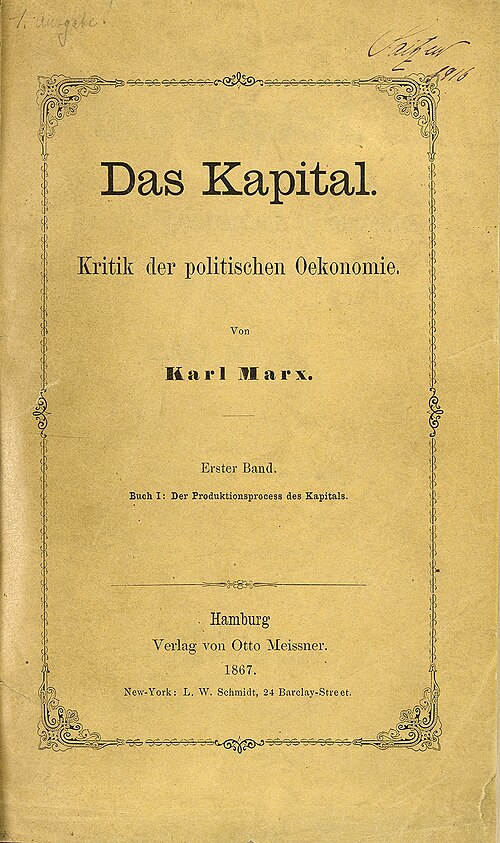
Title page of Das Kapital in the first German edition of Volume 1.
Wikimedia Commons.
At its broadest, “system” means something like “the appearance of rule-governed behavior”, and so yeah, “capitalism” is a “system” in that sense. The “law” of Supply and Demand is a “rule”, if you like, and we can start piling on the ACK-shullies from there. But it’s not particularly useful trying to analyze why and how it happens; the only thing we need to proceed is to acknowledge that it does.
“It” being “reification“, which you’ll recall means “treating an abstraction as if it were a real object”. Synonyms (per Wiki) include “concretism, hypostatization, or the fallacy of misplaced concreteness”, and while I personally dig “hypostatization” — it’s got that groovy Gnostic ring to it — “reification” is easier to type; plus it was very successfully repurposed by Marx and we might need that later, so “reification” it is. Calling “the natural human tendency to exchange stuff for other stuff, each party pursuing what he perceives to be his own advantage” Capitalism is a reification. It’s useful rhetorical shorthand …
… but it carries with it a tendency to mistake the map for the territory, you dig? Instead of confining yourself to “the natural human tendency to exchange stuff for other stuff, each party pursuing what he perceives to be his own advantage”, you inevitably start talking about the “rules” or “laws” of Capitalism. And from there, it’s just a short leap to our course title: the morality of Capitalism.
Because that’s what rules are for, no? To keep things fair — or equal, if you prefer. If we want to find out who’s better at tennis, let’s say, we set up a bunch of rules, to eliminate from the outcome every “inequality” but skill (and dumb luck). Both players have to agree on the scoring. Tennis, therefore, really is a system, strictly speaking. It really is a game, in the mathematical and linguistic senses.
Tennis is not a reification. When we talk about tennis, we are talking about the rules of the game, or the outcome of an individual match. That’s it.
But watch what happens when we start talking about the “rules” of Capitalism. The very word “rule” (or “law”) unavoidably contains the notion of fairness. The rule determining “out of bounds” in tennis is explicitly designed to make the game fair, because that’s what game rules are for — to make the players equal in every respect but skill. You couldn’t know who is the better tennis player if the rules were arbitrary; “out of bounds” has to be clearly defined, and universally applicable.
If you start talking about the “rules” of Capitalism, then, you might not think about “fairness”, but you can’t help but feel it.
Which the contrast with Communism makes worse. Because of course “Capitalism” and “Communism” are “dialectically constructed”. I don’t like throwing Marxist jargon around, but it’s useful in this case. Because Communism is a system, or a game, or whatever word you prefer. Communism does have rules, and they are explicitly designed — like the rules of all games — to ensure equality.
(And they do, comrades, they really do. As P.J. O’Rourke pointed out back when he was funny, Communism is as fair as it gets. We’re all equally broke, starving, and dead, but goddamn it, we’re equal).
I’m sure I don’t have to tell this crowd what a bad idea it is to let your enemies define things for you, but that’s what “Capitalism” does. Karl Marx his own self invented that term. Pick your famous “Capitalist” thinker — Adam Smith, David Ricardo, whoever. They didn’t call themselves “Capitalists”; they called themselves political economists. They weren’t devising rules for a game; they were describing phenomena they observed. It was only after Marx slapped the “Capitalism” tag on the natural human tendency to exchange stuff for other stuff, each party pursuing what he perceives to be his own advantage, that we started seeing “Capitalists”.


