
Forgotten Weapons
Published 19 May 2025When Sweden decided to replace its bolt action Mausers and Ljungman semiautomatic in the 1960s, it had four main choices to pick from. One was the domestic GRAM-63, a modernized version of the Ljungman, the FAL and the G3. They ended up choosing the G3, but not without a number of changes.
Mechanically, the Swedes insisted on a longer service lifespan of the rifle than H&K rated it for. To this end, the Swedish model got a heavier recoil buffer, extending its life to 15,000 rounds. There were also changes to the stock, sights, bayonet attachment, and bolt carrier as well as the use of a clip-on rubber case deflector.
The initial batch of Swedish AK4 rifles was purchased directly from H&K, while domestic licensed production was set up at (eventually) both the star-owned Carl Gustaf factory and also the Husqvarna company.
Thanks to the Supply Battalion of the Estonian Defense Forces Support Command for giving me access to film this surprisingly hard-to-find rifle!
(more…)
September 27, 2025
AK4: Sweden’s Beefed-Up Take on the G3
September 24, 2025
It won’t work – the minister responsible knows it, but they’re going ahead with it anyway
The “it” in the headline is the federal government’s gun confiscation program, which they claim will reduce crime but they already know it won’t do any such thing. What it will do is take away from literally the most law-abiding, responsible citizens their legally purchased property and leave illegal guns in the hands of criminals … at an ever-increasing estimated cost to the taxpayer. In The Line, Matt Gurney covers the details:
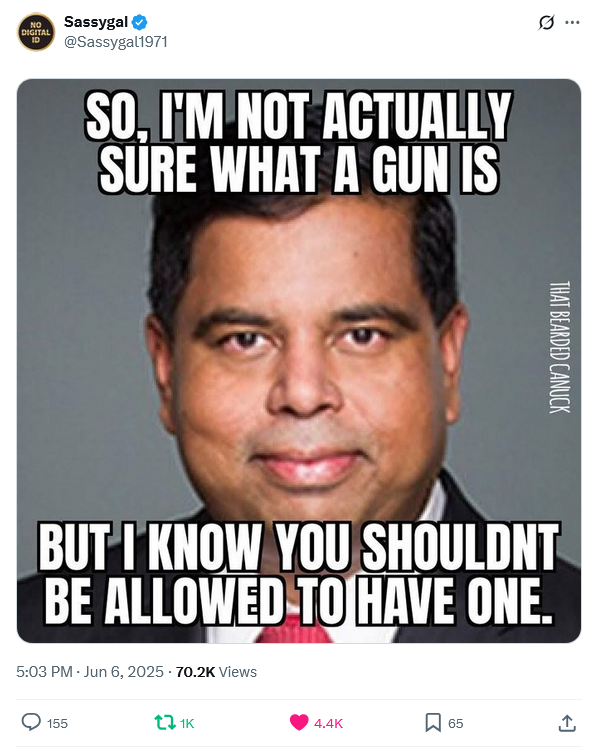
The federal gun confiscation program […] is illogical. It won’t save lives or make the public safer. The federal government doesn’t really even expect it to work, and is only going ahead with it because they’ve been stuck with a dumb proposal the Trudeau government made almost five years ago. If they could do it all over again, they wouldn’t, but they feel like they’ve blocked themselves in and have no choice but to proceed so that they don’t anger part of their electoral coalition, mainly voters in Quebec.
That might sound like a blistering criticism of the program, the kind of thing you’ve read in any number of my columns before. It’s actually what the public safety minister thinks about it. He just didn’t know he was being tape recorded when he said so. In a 20-minute conversation Gary Anandasangaree had with a firearms owner he rents a home to, which was recorded and then leaked, the minister says all of the above things. (He has also confirmed the recording is legitimate.)
Awkward for the minister, clearly, but I actually give him credit. The minister’s comments on tape are a confession, and an admission of defeat. They’re also, hands down, the most honest thing a Liberal government official has said on the gun control file in five years. Given that the minister responsible is freely telling people the program is a bad idea he’s stuck with and that won’t work, a sensible government would probably take this opportunity to walk away from the program.
Unfortunately, that’s not what this PM has chosen. It’s full speed ahead with an idea so bad Anandasangaree wishes he’d never been saddled with it.
Let’s talk about what this program is for a second. And forgive me, there’s quite a bit of history here. During Justin Trudeau’s first term, his only majority, his government had proposed a series of fairly moderate changes to the gun control laws they had inherited from Stephen Harper. As I’ve written often since, the proposals were a mixed bag. Some were okay. Some were bad. But they more or less left the well-functioning Canadian gun control system intact. They nibbled around the edges enough so that they could tell their voters that they had gotten tougher. But they generally didn’t try to fix what wasn’t broken.
But then politics got in the way, as it always does. Trudeau lost his majority in 2019 and became ever-more dependent on voter efficiency and wedge issues. And then in 2020, there was a horrible massacre in Nova Scotia. That catastrophe had nothing to do with our gun control laws; the weapons used were brought in illegally from the United States, as is typical of guns used in gun crime. But the Trudeau government seized on the opportunity — never waste a crisis, right? — to announce that they were “banning” “assault rifles”.
A lot of quotes above. So let me explain. First of all, there really wasn’t much of a ban. Anyone who owned one of the newly banned rifles was allowed to keep them. And as for assault rifles, actual assault rifles — rifle-calibre weapons that use high-capacity detachable magazines and can fire in fully automatic mode — have been banned in Canada for decades. This isn’t a problem that we actually had. And the government tacitly admitted as much when they began fudging the words they used to describe them. In acknowledgement that there were no actual assault weapons to ban, they started talking about assault-style weapons.
“Style” is a tell. You wouldn’t take medicine-style pills, or munch on a food-style snack. Because you’d know better. Trudeau et al knew better. It didn’t stop them. They needed something to announce, and by God, they were going to announce it!
And as we’ve noted several times, the Trudeau government got addicted to the media high of making big showy announcements. So they started doing repeat announcements over a period of time, and thanks to the spinelessness of Canadian legacy media even before Trudeau started directly subsidizing them, the media sugar high got repeated as well. It didn’t take long for the lesson to be learned that making an announcement was cheaper than doing the thing that was announced, and we quickly transitioned to a world where it was the announcement that mattered, not the thing.
At Junk Economics, Bryan Moir sums up the stupidity:
You want blunt? Fine. Here it is:
Listen: politics is kabuki theater and promises are props. Here we have a government rolling out a nationwide confiscation-style buyback and calling it “voluntary” — which is like calling income tax “optional” if you want to be arrested. The minister tells citizens, in public, “it’s voluntary”, then admits in private he’ll criminalize non-compliance, will “bail you out” if it goes that far, and says the whole exercise exists because the party must keep the promise and because the Quebec caucus wants to show muscle. That’s not statesmanship. That’s PR with a warrant.
They lecture you about being “tough on guns” while refusing to be tough on the people who actually bring violence into our streets. The minister himself says if he could do it over he’d target illegal guns and put criminals in jail — not law-abiding owners. Translation: the policy is ideologically driven and politically performative, not strategically intelligent. You don’t cure gang violence — which the cops tell you comes from illegal trafficking and cross-border smuggling — by borrowing billions to buy back legally purchased rifles. That’s like throwing sandbags into a burning house and patting yourself on the back for “doing something”.
And then there’s the logistics and the cost — the ugly part they don’t want on camera. The federal pot is capped at about $742 million and the program is rolled out in fits and starts. Major police forces are already saying “no thanks”, which means the feds must either stand down, contract a patchwork of municipal services, or try to outsource enforcement. Any of those choices blows up the promise in different ways: it becomes toothless, it becomes wildly more expensive, or it becomes a federal-provincial fight that will make the Notwithstanding clause dust-ups look like backyard squabbles. Pick your disaster.
Remember the math: a capped pool of cash plus a growing list of banned models (hundreds, then thousands) equals many owners getting nothing while the bureaucracy eats up the rest on administration, contracts, security, staffing, and political “bribes” (a nicer word for handouts to get agencies to play ball). If the fund runs out — and the minister openly says “it’s capped; when it’s gone, it’s gone” — you’ll have a bunch of people stripped of legal property, out of pocket, and the state triumphant only in optics. That’s confiscation without fair market compensation; it reads like policy designed by accountants and sold by televangelists.
Worst of all: while Ottawa gamely auctions off the idea of virtue, or was that “Canadian values”, real problems pile up. Fire seasons rage, hospitals are full, kids wait for surgeries, food banks are overwhelmed and the cost of living keeps rising— and Mark and Gary are borrowing money to offer coupons for now-illegal guns. If you wanted a textbook case of political misallocation, this is it: symbolic policy delivered with symbolic money so the party can say it kept a promise, while the public pays the bill and crime networks keep smuggling.
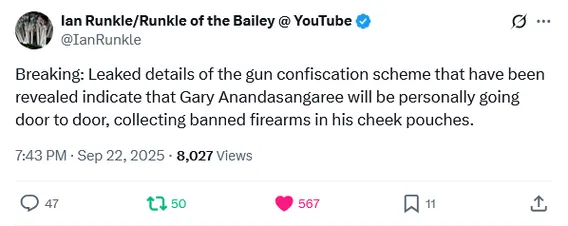
On the gun confiscation program in particular, thank goodness you can always depend on social media to find the funny side of any issue:
September 20, 2025
Dutch Navy Luger: From World War One to the End of Neutrality
Forgotten Weapons
Published 12 May 2025The Dutch Navy first acquired Luger pistols in 1918 specifically for its aviators. They had 12 German P04 Lugers taken from a German submarine stranded in the (neutral) Netherlands, and 28 more were purchased from DWM in 1918 to round out the 40 guns needed to equip the Naval Air Service. The pistol was formally adopted as Automatische Pistool Nr.1. In 1928, the Dutch Army adopted the 1906 New Model Luger for its own service, and the Navy decided to update its revolvers at the same time. The Navy opted not to get grip safeties, and so took a copy of the German P08 model instead of what the Army had. The first order was placed in 1928 through BKIW in Germany, and deliveries would run until 1939 with a total of 2654 delivered before German invaded in May 1940.
Dutch Army Luger trials:
• Politicians Ruin Everything: Dutch Lu…Dutch East Indies Lugers:
• Lugers for the Dutch East Indies Army
(more…)
September 16, 2025
No sensible person wants to start a civil war
There are always angry folks online who take any current event as a conversational pretext for talking about taking up arms against … whoever they always seem to want to take up arms against. In decades past, you could more easily find tantrums like that among the conspiratorial right but today it seems that the left is leading the charge, so to speak. As a bit of a follow-on to this post, here’s more from Tom Kratman and Harry Kitchener on what might need to be done to start that unwanted-by-all-sensible-folks conflict:
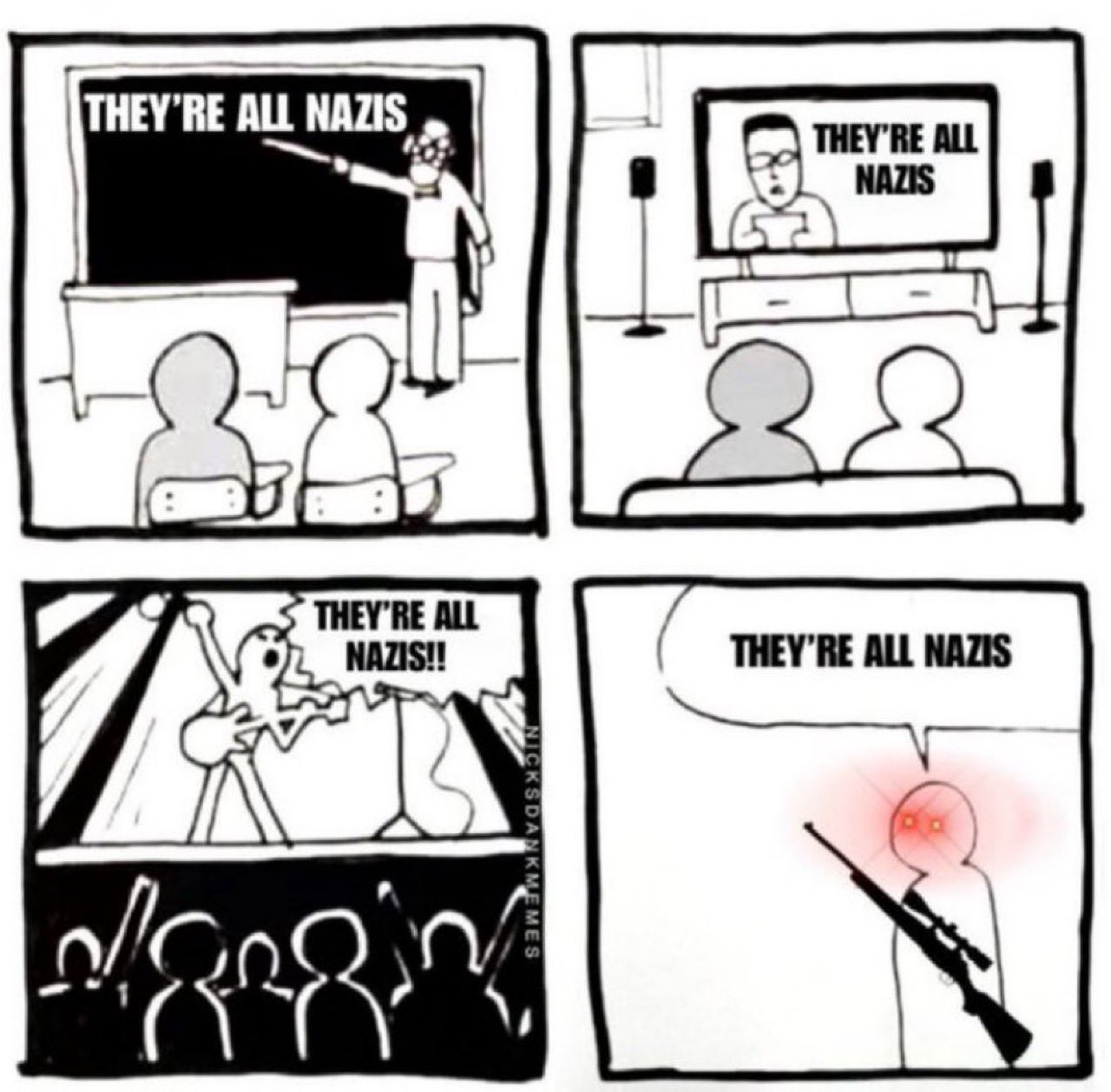
Let’s assume, though, that you people want to kick off what we might call a hard debate – that you plan to use organized and precise violence to combat your enemies and promote your views.
Actually doing it is pretty easy – a patsy with a hunting rifle has a pretty good chance, assuming a bit of talent, to take out any given public figure (assuming no Secret Service protection, that makes things much more difficult). He’ll almost certainly be caught, of course; in a best case, arrested, tried and sentenced to life … or death, in a worst case, killed during the arrest. If you’ve got an inexhaustible supply of these patsies I suppose that’s sustainable – it’s meaningless, of course, as it’ll just bring the other side to the conclusion that if this is the game in future, they’ll happily play along (and they have more guns, more training and probably more immediate support than you do. And they’re starting to really hate you, too).
If you actually *want* to kick off a low-level civil war (I have to say I can’t understand why you would want this, but, hey ho, your call), you need to think in more sustainable terms. Read back on our pieces for some hints on the operational, logistic and security considerations you need to establish a covert, violent organization. Particularly consider the issue of finance – this stuff costs big money to organize and execute and I’m not sure you have access to the sort of volumes of laundered cash you’re going to need.
You’re also going to need to be tough, properly tough in order to cope with the immense pressure you’re going to feel from government and the Right alike, to say nothing of the moral (and morale) impact of inevitable casualties, not just those arrested and sentenced, but also those killed and maimed. Don’t underestimate the impact on one of your “active service units” losing one or two of their members, or of the occasional need just to abandon them in order to get away.
Assuming – and, to be frank, I don’t see this working – but, assuming you do manage to organize some sort of covert violent organization, what would it be *for*? What’s the end state you’re looking to achieve? Proletarian revolution, the righteous rage of the mobilized working class? Not a fucking chance, not in the USA. Every historical example we have of the left trying this kind of thing to raise an oppressive right wing government, to mobilize the masses for the left, shows, instead, massive cheering from those masses for the government that then proceeds to exterminate you.
Cowing the Right through violence? Again, not a hope – the Right (as you call it, a better term might be “the majority of the US population”) tends to be pretty much OK with justified violence, tends to have a larger proportion of people who’ve seen the elephant (this is military slang for “the greatest show on earth”, which is to say, war) and tends to be much better armed than your folks are. On the plus side, you’re in America so becoming better armed is easy. Becoming better armed without leaving a trail pointing straight at you, on the other hand, is hard. And you don’t have the criminal connections to avoid this.
Your base is relatively small and relatively concentrated in certain areas and in certain sectors – soft states, academia, the media, that kind of thing. Don’t believe a word big tech says, they’ll drop you and switch immediately as their share price is adversely affected. And note that the “disciplines” your sort of people tend to undertake in college – gender studies, ethnic studies, gay studies, feminist interpretive dance – are great for motivation to act for the left, but not very good for competence in action.
This makes your base incredibly vulnerable. No matter how effective your “active service units” might be in doing dreadful things to individuals on the Right, you’ll always be outgunned – and every single successful operation you carry out will generate greater support for your opponents. What’s that? Yes, of course it’s unfair and unjust. Deal with it.
What you have, always, to remember is that however important some things are to you, most people are either indifferent to them, or actively hostile to them. No amount of killing is going to change that, probably quite the contrary.
Update, 17 September: Welcome, Instapundit readers! Please do have a look around at some of my other posts you may find of interest. I send out a daily summary of posts here through my Substack – https://substack.com/@nicholasrusson that you can subscribe to if you’d like to be informed of new posts in the future.
Fenian Needham Conversion: Just the Thing for Invading Canada
Forgotten Weapons
Published 10 May 2025The Fenian Brotherhood was formed in the US in 1858, a partner organization to the Irish Republican Brotherhood. The groups were militant organizations looking to procure Irish independence from the British, and they found significant support among the Irish-American immigrant community. In November 1865 they purchased some 7500 1861- and 1863-pattern muskets left over from Civil War production, and used them to invade Canada in April 1866. The idea was to capture the country and then trade it to the British in exchange for Irish independence … but the invasion went quite badly. The Fenians briefly held Fort Erie, but were pushed out after a few hours and largely arrested by American forces.
The Fenians’ muskets were confiscated, but all returned by the end of 1866 in exchange for promised Irish-American support of embattled President Johnson. By 1868, the group was making plans for another attempt at conquering Canada. This time they would have better arms — they obtained a disused locomotive factory in Trenton NJ and set up the Pioneer Arms Works to convert 5,020 muskets into centerfire Needham Conversion breechloaders. These were given chambers that could fire standard .58 centerfire ammunition, or the .577 Snider ammunition that the Fenians expected to be able to procure once in Canada. Most of the guns also had their stocks cut, to allow them to be packed in shorter crates for transit. These usually have a distinctive “V” cut in the stock, which was spliced back together before use.
When the second invasion came in April 1870, it was again a failure. Only 800-1000 men turned out of the 5,000+ expected. They were scattered among several different muster points on the border, and the Canadians were once again aware of their plans. The most substantial fight was at a place called Eccles Hill, where the Missisiquoi Home Guard was ready and waiting for them with good Ballard rifles. Upon crossing the border, the Fenians were soundly defeated.
This second time, the guns were confiscated and not returned. Instead, the Watervliet Arsenal sold them as surplus in 1871. They were purchased by Schuyler, Hartley & Graham for commercial resale, and thanks to that several hundred remain in collector hands today.
(more…)
September 13, 2025
Jennings 5-Shot Repeating Flintlock Pistol
Forgotten Weapons
Published 9 May 2025Isaiah Jennings patented an improvement to the Belton repeating flintlock system in 1821 — but we don’t know exactly what his idea was because the Patent Office lost his patent (and many others) in a large 1836 fire. Jennings’ system was used by several gunsmiths, though. In 1828/9 the State of New York contracted to convert 521 of their muskets to Jennings’-pattern repeaters. We also have a few examples like this custom five-shot pistol made by John Caswell of upstate New York.
Jennings’ system uses superposed charges loaded in the barrel along with a movable lock. Each charge has its own touch hole, and the cover plates for them act as stops for movement of the lock, to ensure proper alignment. The trigger will fire the lock in any position, and it is also fitted with an automatic magazine frizzen — so cocking the hammer automatically charges priming powder into the pan and closes the frizzen. These were very advanced arms for the early 1800s, and expensive to produce.
Belton Repeating Flintlock:
• Belton Repeating Flintlock: A Semiaut…
(more…)
September 12, 2025
QotD: Modern riot-control gear
What the well-dressed riot controller is wearing this year:
I’ve hinted already at my severe disenchantment with the riot control manual. Most of the following will tend to indicate some of why. Note that this is pretty military specific, but you all ought to know what’s happening, what should happen, and what isn’t happening with regards to riot control.
Head: Protection of the head involves also protection of the face, neck, and, especially, the eyes. The standard military issue Kevlar helmet is adequate for protecting the head from blunt force trauma and even some bullets . It does nothing for the face. There are shields that attach to the helmets to protect the face and which usually reach down enough for neck guard. However, after a cursory search or three for what’s on offer now, as with the old style ones I discussed previously, they can be blurred and ruined with solvents. Yes, this would seem to include polycarbonate as well; that’s how pieces of Lexan are glued together, actually. It’s a problem. Neither can I find a face shield that is glass over Lexan, though they may exist.
Moreover, while there are masks – nicely intimidating motorcycle rider masks, for example – that are black and which could have relatively cheap replaceable clear eyepieces made, they are close fitting, hence would interfere with donning the protective mask when it comes time to use RCA or when smoke from burning buildings gets to be a bit much. The only solution I can see is twofold: 1) Have a ready supply of extra face shields on hand, and 2) make the immediate penalty for attacking a mask with solvents a reasonably severe beating with some kicks and stomping.
Special Tip #1: If you’re using your issued helmets, troops and commanders, turn the camouflage band around so the rioters can’t see your name. This is for two reasons. One is to prevent personal retaliation against your men or their families. The other is to send a message the rioters will understand very clearly because they’re using anonymity for the same purpose, to stay out of court. In other words, the message you send is, “Get close enough to this soldier or policeman for him to hurt you and he will, all the more readily because you can’t identify him for civil suit or criminal complaint.
Chest: The current issue torso armor seems adequate for most threats it will encounter in riot control, but, at thirty-three pounds, strikes me as awfully heavy for an activity that is already about as physically intense as a battlefield, if not even more so. With an E-SAPI plate in front, that runs nearly to forty pounds, which is simply too damned much. There is room for some minor weight savings, as will be shown below, under “Protective Mask.”
There are lighter and quite likely better armor suites coming along or already on hand for the special operations folks, but if they are not available for a unit tasked for riot control, I’ll have to say, “Suck it up; wear the vests you have; keep about ten percent of your force in reserve, unarmored but ready and drilled to suit up in a hurry, to relieve people who become exhausted from the weight and heat retention.
Special Tip #2: You want the armor not only to protect your men, but also to protect them enough to keep them from losing their tempers and running wild. When they hurt somebody, it needs to be because the commander wants that somebody hurt, that the mission is advanced by that somebody being hurt, and not because of a breakdown in discipline.
Armament: For a number of reasons, I recommend against using bayoneted rifles. The downsides are numerous, so I’ll limit myself to a few. 1) They require both hands; this means that the riot controller cannot use a shield. 2) The act of fixing bayonets, all on its own, constitutes deadly force. Yeah, just fixing them. So you won’t be allowed to do it. 3) That means you end up with this bullshit:
https://en.wikipedia.org/wiki/Flower_Power_(photograph)
Instead, use batons. However, for that I have no less than two tips.
Special Tip #3: Grease the last eighteen inches or so of the batons with something non-water soluble, like Vaseline. No, this is not as an aid to anally raping the rioters with the batons, however tempting that may come to seem. Rather, it is to keep the rioters from snatching your batons away, which snatching encourages them to no end. If you don’t have petroleum jelly handy, thicker rifle lubricant, like LSA, can work, but spread it very thinly, so it doesn’t run.
Special Tip #4: Drive finishing nails into the ends of your batons and snip them off to leave about an inch sticking out. No need to sharpen the part sticking out; it’s sharp enough to penetrate and leave a painful puncture wound, whether directed at arms or torsos or thighs or groins (ouch!).
Shields: There are any number of makers of perfectly serviceable riot control shields, some of which are, although frightfully heavy, bullet proof. If you need bullet proof shields, I would suggest that you’re way past the point of suppressing a riot and already involved in a civil war. In that case, shoot back accordingly.
Assuming for discussion’s sake, however, that we aren’t quite at that point yet, the shields are extremely useful. They deflect rocks and bags of shit. They can cause a Molotov to go off somewhere other than on the riot controller or at his feet. They are, themselves, offensive weapons. As Suetonius said, just before kicking Boudicca’s Britannic ass: “Knock them down with your shields, then finish them off with your swords”.
The world being as it is, however, full of iniquity and injustice, when Battalion X of the YYth division gets alerted for riot control, the shields will probably not be available. A careful search by J4 will show that “They are either in Iraq or were left behind on Johnson Island, lest Greenpeace show up some day. Or maybe they were turned into a reef for some endangered fish. Who knows?” Hence, make your own. The example below was made by one of the handier troops of B-3/5 Infantry, Panama Canal Zone, in 1983. It’s just half inch plywood, 19 by 24 inches, though they can be cut larger to fit the larger troops, with arm straps cut from condemned nylon webbing and bolted on. The almost horizontal piece is one shoulder strap from the harness of nylon load bearing equipment, stapled on and serving as a shock pad for the arm. Yes, if you actually have to make something like these do not forget the shock pad. I’d recommend not painting them with unit insignia. We were, at the time, on testosterone overload and wanted people to know who was kicking their butts.
Note, a larger shield doesn’t necessarily protect more, it just moves more slowly to protect what needs protection. These shields are very light and, given the geometry of the matter, able to be moved very quickly indeed to protect any exposed part of the body, to include the thighs and crotch. Speaking of the …
Crotch: Move your/have the troops move their protective mask and carrier from the left hip to right in front of the family jewels. It won’t slow down donning the mask appreciably and it will save a little weight while providing adequate crotch coverage.
Tom Kratman, Twitter, 2025-06-09.
September 11, 2025
The CH-148 Cyclone helicopter – the navy’s flying lemon
Over at Noah’s True North Strategic Review, a question came up about the Cyclone helicopters in Royal Canadian Navy service and whether the navy would include Cyclone landing pads on the upcoming Canadian Continental Defence Corvette design:
Q6. Any updates on the Cyclone helicopter and its replacement? I’ve read that the class is grounded and it’s already an orphan. Has it rolled into NTACS?
You probably heard our favorite Vice-Admiral absolutely tearing them apart lol. The fleet was grounded due to parts issues, a long-standing problem with the Cyclone fleet. In fact everything about the Cyclone is a problem.
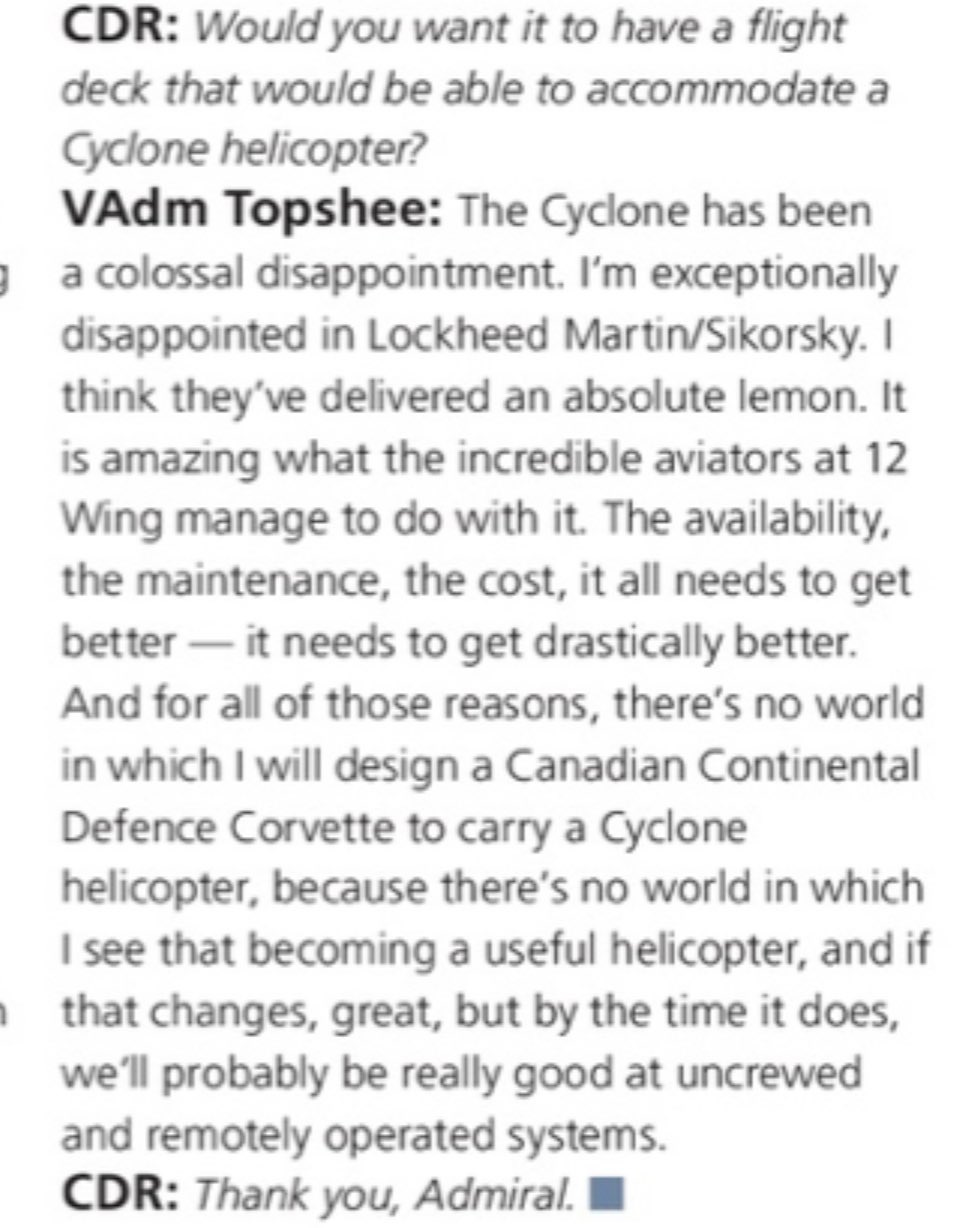
I’ll let Mr. Topshee explain:
So yeah, the fleet was grounded or should I say the majority of the fleet is still grounded. Not all of them anymore, but still the majority last I heard like two weeks ago?
Of course even before the grounding the fleet was in bad shape. Nearly half haven’t flown this year, and again the majority is still grounded. Link 11 deprecated back in January/February? Lockorsky is asking ~$20,000,000 an aircraft to upgrade to Link 16, and even then it will take about two/three years to get the entire fleet upgrades.
And it ain’t like Link 16 is some optional capability. It is quite literally the standard. You can’t do much without it.
This isn’t counting other capabilities set to deprecate or in need of upgrading on the way to Block 2.1 … All to support, yes, an orphan fleet that we are paying tooth and nail to keep going.
And it isn’t like Lockheed is winning here. They reported a $570 million loss on the Cyclone this year. Quite literally no one is winning here. We are all suffering to keep these birds flying, lord forbid if we try to keep them going into the 2040s as planned.
Cyclone isn’t a new helicopter. It’s a product of 1990s requirements, from a contract signed twenty years ago. It still has yet to reach its final Block 2.1 state. I get why it’s frustrating to everyone. I’m glad Topshee said the quiet part out loud. Call them what they are.
I’m of course missing things, I know. I wont go into the entire history and issues with the fleet (yet) but I will say that I truly believe there is no fixing them by this stage. The navy has been using modified Hammerheads to fill the gaps and future UAS will likely take some role.
Unmanned systems aren’t at the level though to fully replace the capabilities a maritime helicopter like the Cyclone brings to the table. The loss of the fleet is a loss of capabilities. Eventually something has to give.
I don’t wanna go to into the Cyclone right now, as I’m currently working on something for it. However there are a lot of issues, more than the public knows.
As for NTACS? There is no plans to include the Cyclone. At least not right now. The NTACS team went back to the drawing board over the summer to hammer out what they want. We’ll see what comes of it.

Pre-delivery Sikorsky CH-148 Cyclone helicopter, 4 April, 2012.
Photo by Gerry Metzler via Wikimedia Commons.
September 9, 2025
MG38: Colt’s Interwar Water-Cooled Machine Gun
Forgotten Weapons
Published 7 May 2025After World War One, Colt was the sole owner of license to produce Browning machine guns. With production tooling well established from the war, the company set about looking for international sales. The water cooled .30 caliber (the M1917 in US service, essentially) was designated the Model 1919 Automatic Machine Gun. In 1931, it was renamed the MG38, although basically the same gun as in 1919. It had a few distinctions from the US military pattern, including:
- Manual safety on the backplate
- Self-contained recoil spring
- Large water fill and drain fittings, identical to the ones used on Colt’s .50 caliber guns
- Slightly different top cover latch
Colt offered the guns with lots of options and features, including a variety of calibers (basically any modern rifle cartridge of the time), flash hiders, lightened anti-aircraft bolts, and spade grips (guns sold with spade grips were designated MG38B). From 1919 until commercial production ceased in January 1942, Colt had sold 2,720 water-cooled Brownings in total. Most went to South America in 7.65mm, with Argentina being the single biggest buyer.
Full video on the Browning M1917:
• Browning M1917: America’s World War O…
(more…)
September 4, 2025
QotD: The development of the “halftrack” during the interwar period
What drove the differences in tank development between countries were differences between how each of those countries imagined using their tanks, that is differences in tank doctrine. Now we should be clear here that there were some fundamental commonalities between the major schools of tank thinking: in just about all cases tanks were supposed to support infantry in the offensive by providing armor and direct fire support, including knocking out enemy tanks. Where doctrine differed is exactly how that would be accomplished: France’s doctrine of “Methodical Battle” generally envisaged tanks moving at the speed of mostly foot infantry and being distributed fairly evenly throughout primarily infantry formations. That led to tanks that were fairly slow with limited range but heavily armored, often with just a one-man turret (which was a terrible idea, but the doctrine reasoned you wouldn’t need more in a slow-moving combat environment). Of course this worked poorly in the event.
More successful maneuver warfare doctrines recognized that the tank needed infantry to perform its intended function (it has to have infantry to support) but that tanks could now move fast enough and coordinate well enough (with radios) that any supporting arms like infantry or artillery needed to move a lot faster than walking speed to keep up. Both German “maneuver warfare” (Bewegungskrieg) and Soviet “Deep Operations” (or “Deep Battle”) doctrine saw the value in concentrating their tanks into powerful striking formations that could punch hard and move fast. But tanks alone are very vulnerable and in any event to attack effectively they need things like artillery support or anti-air protection. So it was necessary to find ways to allow those arms to keep up with the tanks (and indeed, a “Panzer divsion” is not only or even mostly made up of tanks!).
At the most basic level, one could simply put the infantry on trucks or other converted unarmored civilian vehicles, making “motorized” infantry, but […] part of the design of tanks is to allow them to go places that conventional civilian vehicles designed for roads cannot and in any event an unarmored truck is a large, vulnerable tempting target on the battlefield.
The result is the steady emergence of what are sometimes jokingly called “battle taxis” – specialized armored vehicles designed to allow the infantry to keep up with the tanks so that they can continue to be mutually supporting, while being more off-road capable and less vulnerable than a truck. In WWII, these sorts of vehicles were often “half-tracks” – semi-armored, open-topped vehicles with tires on the front wheels and tracks for the back wheels, though the British “Universal Carrier” was fully tracked. Crucially, while these half-tracks might mount a heavy machine gun for defense, providing fire support was not their job; being open-topped made them particularly vulnerable to air-bursting shells and while they were less vulnerable to fire than a truck, they weren’t invulnerable by any means. The intended use was to deposit infantry at the edge of the combat area, which they’d then move through on foot, not to drive straight through the fight.
The particular vulnerability of the open-top design led to the emergence of fully-enclosed armored personnel carriers almost immediately after WWII in the form of vehicles like the M75 Armored Infantry Vehicle (though the later M113 APC was eventually to be far more common) and the Soviet BTRs (“Bronetransporter” or “armored transport”), beginning with the BTR-40; Soviet BTRs tended to be wheeled whereas American APCs tend to be tracked, something that also goes for their IFVs (discussed below). These vehicles often look to a journalist or the lay observer like a tank, but they do not function like tanks. The M113 APC, for instance, has just about 1.7 inches of aluminum-alloy armor, compared to the almost four inches of much heavier steel armor on the contemporary M60 “Patton” tank. So while these vehicles are armored, they are not intended to stick in the fight and are vulnerable to much lighter munitions than contemporary tank would be.
At the same time, it wasn’t just the infantry that needed to be able to keep up: these powerful striking units (German Panzer divisions, Soviet mechanized corps or US armored divisions, etc.) needed to be able to also bring their heavy weaponry with them. At the start of WWII, artillery, anti-tank guns and anti-air artillery remained almost entirely “towed” artillery – that is, it was pulled into position by a truck (or frequently in this period still by horses) and emplaced (“unlimbered”) to be fired. Such systems couldn’t really keep up with the tanks they needed to support and so we see those weapons also get mechanized into self-propelled artillery and anti-air (and for some armies, tank destroyers, although the tank eventually usurps this role entirely).
Self-propelled platforms proved to have another advantage that became a lot more important over time: they could fire and then immediately reposition. Whereas a conventional howitzer has to be towed into position, unlimbered, set up, loaded, fired, then limbered again before it can move, something like the M7 Priest can drive itself into position, fire almost immediately and then immediately move. This maneuver, called “shoot-and-scoot” (or, more boringly, “fire-and-displace”) enables artillery to avoid counter-battery fire (when an army tries to shut down enemy artillery by returning fire with its own artillery). As artillery got more accurate and especially with the advent of anti-artillery radars, being able to shoot-and-scoot became essential.
Now while self-propelled platforms were tracked (indeed, often using the same chassis as the tanks they supported), they’re not tanks. They’re designed primarily for indirect fire (there is, of course, a sidebar to be written here on German “assault guns” – Sturmgeschütz – and their awkward place in this typology, but let’s keep it simple), that is firing at a high arc from long range where the shell practically falls on the target and thus are expected to be operating well behind the lines. Consequently, their armor is generally much thinner because they’re not designed to be tanks, but to play the same role that towed artillery (or anti-air, or rocket artillery, etc.) would have, only with more mobility.
So by the end of WWII, we have both tanks of various weight-classes, along with a number of tank-like objects (APCs, self-propelled artillery and anti-air) which are not tanks but are instead meant to allow their various arms to keep up with the tanks as part of a combined arms package.
Bret Devereaux, “Collections: When is a ‘Tank’ Not a Tank?”, A Collection of Unmitigated Pedantry, 2022-05-06.
September 3, 2025
German Occupation FN High Power Pistols
Forgotten Weapons
Published 28 Apr 2025When Germany occupied Belgium in the summer of 1940, the took over the FN factory complex and ordered production of the High Power pistol to continue. It was put into German service as the Pistole 640(b), and nearly 325,000 of them were made between 1940 and 1944. The first ones were simply assembled from finished Belgian contact parts, and included all the features like shoulder stock slots and 500m tangent rear sights. As the war continued, however, production was simplified. The stock slots disappeared first, then the tangent sights, then the wooden grips (replaced by bakelite) and eventually even the magazine safety was omitted. Resistance among Belgian factory workers increased as well, with deliberate sabotage in the form of incorrect heat treating, errors in fine tolerance parts, and sometimes even spending lots of time to give a very fine surface finish instead of making more pistols.
These are a particularly popular subject of collecting, and there are a lot of nuances of the production and inspection marks that are worth understanding if you want to take them seriously. I highly recommend Anthony Vanderlinden’s 2-volume book FN Browning Pistols for very good detail on these, as well as other FN handguns: https://amzn.to/42Bc541
(more…)
August 31, 2025
Military-Issue Colt Model 1839 Paterson Revolving Rifle
Forgotten Weapons
Published 23 Apr 2025The first rifle made in Sam Colt’s Paterson NJ factory was the 1837 “ring lever” rifle. These were rather fragile and underpowered and while they were used successfully in the First Seminole War, they needed improvement. Colt set about doing this with his 1839 pattern, which was more robust and more powerful. It had six chambers of .525″, with much greater powder capacity than the first Colt revolving rifles. A total of about 950 were made before the Paterson company failed in 1842, and nearly 700 of those were military sales. The US War Department bought 360 (including this example), the Republic of Texas bought 300, and the State of Rhode Island bought 46 — the rest were sold to private companies or individuals. Despite its improvements, though, the 1839 revolving rifle was still not a mature design and was not successful enough to keep Colt in business.
Colt 1837 Ring-Lever Rifle: Sam Colt’s Paterson No1 Model Carbine
Colt 1847 Walker Revolver: 1847 Walker Revolver: the Texas Behemoth
(more…)
August 27, 2025
M1922 BAR Cavalry Light Machine Gun
Forgotten Weapons
Published 21 Apr 2025After World War One, there was a lot of tinkering with the BAR by the US military. It was recognized as being a very good platform, but the original M1918 configuration left a lot to be desired. It was deemed too heavy to use effectively from the shoulder, but also not really well suited to sustained fire. In an effort to optimize it for use as a dynamic support weapon by a small squad, the Infantry & Cavalry Board requested a model with a heavier barrel and lightweight bipod in 1920. Six experimental examples were made form existing BARs, and the design was formalized two years later as the Model 1922.
This pattern of BAR has a heavy finned barrel to give it more sustained fire capacity and a folding bipod and rear monopod for more accurate use prone. The Board also experimented with larger magazines, and ended up recommending a 30-round size — although this was never put into production. In total, 500 of the Model 1922 guns were made, all converted from existing BARs. Experimentation continued slowly, and eventually in 1937 a lighter pattern was adopted as the M1918A1. The Model 1922 was formally declared obsolete in April 1941, and virtually all of them were rebuilt to the new M1918A2 pattern for use in World War Two. Surviving examples like this one are extremely rare — this is the only known example in private hands.
(more…)
August 26, 2025
When Jagdpanther Fought Churchill
The Tank Museum
Published 18 Apr 2025Jagdpanther vs Churchill. Tank destroyer vs tank. New technology vs proven veteran. Who will emerge victorious?
It’s 6pm on 30th July 1944. Outnumbered 6 to 1, a platoon of 3 German Jagdpanthers is about to go into action for the first time. Facing them will be a squadron of 18 British Churchill tanks. Within 5 minutes, 11 tanks will be knocked out.
The Jagdpanther is the latest German armoured vehicle to arrive in Normandy. With a devastating gun, and a heavily armoured superstructure, this tank hunter is quick, reliable and deadly.
The Churchill has been fighting with Allied armies in North Africa, Italy and on the Eastern Front. The early marks struggled with a range of issues, but by 1944 it is an essential part of the British and Canadian tank force.
It’s during Operation Bluecoat where these two machines would come face-to-face for the very first time. The Churchills of S Squadron, 3rd Battalion, Scots Guards, have captured Hill 226 – a strategically important area to the south of Caumont. They are preparing for a German counterattack, but their infantry is yet to arrive – leaving their left flank dangerously exposed. And a platoon of Jagdpanthers is ready to take full advantage of their vulnerable state …
00:00 | Introduction
00:35 | The Jagdpanther
02:38 | The Churchill
05:43 | Operation Bluecoat
07:46 | A Turkey Shoot?
12:25 | Aftermath
17:40 | Roll of Honour
(more…)
August 24, 2025
This is Westland Helicopters (1960s)
British Helicopters History
Published 17 Jan 2020Major rationalisation of the UK aircraft industry occurred during the 1960s. With the acquisition of Bristol Helicopters, Fairey Aviation and Saunders-Roe, Westland Helicopters transformed itself into Britain’s only helicopter maker with plants at Yeovil, Weston-super-Mare, Eastleigh, and Hayes, producing helicopters for all roles.


