
The Tank Museum
Published 13 Jun 2025The A39 Tortoise. The last complete survivor of a World War Two project that arrived just a little too late. Some have called it “The British Jagdtiger” – but is that actually a fair comparison?
Tortoise was a part of the strategy the Allies would need to defeat Germany during the Second World War. It was recognised that total victory could only occur on German soil – and that meant smashing through the imposing defences of the Siegfried Line. The Allies would need a Heavy Assault tank. Many designs were put forward for this role, including the Valiant, the A33 and the T14 Assault tank.
The A39 is extremely well-armoured. Its casemate construction could withstand a hit from an 88mm gun at close ranges. But at 78-tons, this lumbering beast was both slow and heavy – and is one of the largest and heaviest vehicles in the museum’s collection. In terms of firepower, the impressive 32pdr gun was extremely effective against both concrete and enemy armour. It even has room inside for 7 crew!
In the end, the Tortoise arrived too late to see any action on the battlefield. It was intended to form a part of the 79th Armoured Division – making it one of Hobart’s Funnies. Whether Tortoise would have become the stuff of legend, or a bit of a joke – well, we’ll leave that question up to you.
00:00 | Introduction
00:39 | What is a Heavy Assault Tank?
03:45 | Why a Heavy Assault Tank?
09:24 | The A39: As Good as it Gets?
17:55 | A Solution Without a Problem
(more…)
October 23, 2025
A39 Tortoise: The Forgotten Super Heavy
October 22, 2025
H&K MG4: Germany’s New 5.56mm Squad Machine Gun
Forgotten Weapons
Published 7 Jun 2025Heckler & Koch released the MG4, a new 5.56mm squad machine gun in 2001. It was adopted by the German army in 2005, and then by the Spanish and Portuguese armies in 2007. Alongside its sister weapon the 7.62mm MG5, it is H&K’s current export machine gun.
The MG4 fires from an open bolt, with a 2-lug rotating bolt locking system and a long stroke gas piston operating system. It uses standard M27 NATO links for feeding, and does not have a semiauto selector setting. Mechanically, the MG4 uses a front trunnion into which both the barrel and bolt lock independently — meaning that the quick-change barrel can be removed with the bolt in either the forward or rearward position.
As one would expect for a 5.56mm machine gun weighing 18 pounds, it is very easy to control.
Thanks to Sellier & Bellot for giving me access to this modern machine gun to film for you!
(more…)
October 18, 2025
Gerät Potsdam: Mauser Copies the Sten Gun
Forgotten Weapons
Published 2 Jun 2025In the fall of 1944, the Mauser company was given a contract to develop drawings of a direct copy of the British Sten gun (code named Gerät Potsdam), and to manufacture 10,000 of them. In fact, they were to make two different sets of drawings; one suitable for large factory use (like their own) and one for use with distributed small shops making parts for final assembly elsewhere (which is how much of British Sten production was done). The contract was fulfilled and 9972 guns in total were produced and accepted by the German military in November and December of 1944.
Why would Germany was a copy of the Sten? Well, they actually had a decent number of them. The Allies were air-dropping Stens all over Europe, and a lot of those drops were captured by German troops, not the resistance fighters they were intended for. By the end of the war the Germans were in desperate need of arms, and the Sten was both simple and already in some German use with the Volkssturm … so it actually was not a totally unreasonable idea to produce more of them.
Today, the Potsdam is an extremely rare gun to find. The two visible identifying features are the magazine well and barrel shroud, which are both made with a folded and spot welded seam. The barrels are also identifiable as they have 6 groove rifling, which the British did not use in the Sten.
Before the Potsdam production was finished, Mauser began working on further plans to simplify the design. That would be the Gerät Neumunster, aka the MP 3008. For that part of the story, see my video on the MP 3008:
• German Sten Copy: MP 3008, aka Gerät Neumü…
(more…)
October 16, 2025
The Mexican-American War 1846-48
Real Time History
Published 16 May 2025In the early 19th century, the United States and Mexico share a massive cross-continental border, but US settlement in Mexico, expansionist ideals and religious differences put the young republics on a collision course. As tensions boil over into bloodshed, the tiny, inexperienced US army marches to a war which will forge the modern United States.
Chapters:
00:00 Texas Republic
05:06 Declaration of War
07:03 The US Army
09:26 British Muskets in the Mexican Army
16:19 The Mexican Army
18:24 The Battles of Palo Alto and Resaca de la Palma
21:38 California and New Mexico
25:11 US Volunteers
28:40 Battle of Monterrey
33:03 Expanding the War
36:59 The Pedregal Battles
40:18 Battles for Mexico City
43:42 Treaty of Guadalupe Hidalgo
45:14 Legacy
(more…)
October 14, 2025
DSA’s Unique Titanium FAL Project
Forgotten Weapons
Published 28 May 2025DS Arms got some billet titanium and decided to make a batch of titanium receivers and other parts. This turned out to be a nightmarish amount of work, and two of the receivers had to be scrapped, leaving only 10 completed. They also made a number of other titanium parts, including flash hiders (which this rifle has) and gas blocks (which this one does not). Between the titanium and aluminum parts and the choice of a lightweight configuration, this FAL tips the scale at just UNDER 7.5 pounds (3.4kg). That is a very remarkable achievement, and does so without making sacrifices in durability or features. It is slightly sharper recoiling than a standard 50.00 FAL (which weighs almost 10 pounds / 4.5kg), but not uncomfortable at all — the recoil is less than I had expected.
Unfortunately DSA does not appear to have any plans to make addition titanium receivers, but this small batch serves as a very cool proof of concept!
(more…)
October 11, 2025
Haenel’s Prototype Simplified Sturmgewehr StG45(H)
Forgotten Weapons
Published 26 May 2025In December 1944, the Haenel company received permission to produce a simplified version of the StG-44 Sturmgewehr. The idea was to keep the mechanical system and controls as similar as possible to the design in use, but simplify the design to reduce the cost and time of production. The design was never completed, and this is the only known surviving prototype. It was most likely captured by American forces when they occupied the Haenel factory in April 1945, although that is not documented. It is a pretty impressive adaptation of the StG design; far simpler to manufacture than the original design. Would it have worked? We don’t know for sure as there are no known German or American test reports, but it certainly seems viable to me.
Thanks to the Springfield Armory National Historic Site for giving me access to this truly unique specimen from their reference collection to film for you! Don’t miss the chance to visit the museum there if you have a day free in Springfield, Massachusetts: https://www.nps.gov/spar/index.htm
(more…)
October 10, 2025
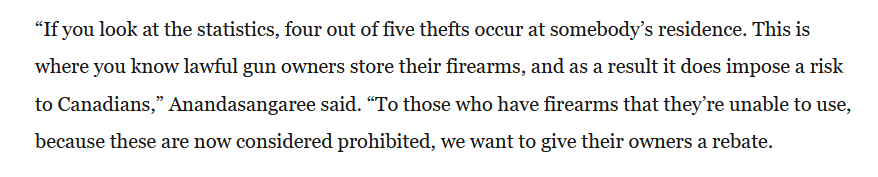
The federal government’s gun “buyback” program pilot in Nova Scotia
On the social media site formerly known as Twitter, Tim Thurley responds to a report about the gun “buyback” pilot program:
This reads like a government flailing for a message. We know this is incorrect, the Minister knows it is incorrect, and we know the Minister knows it is incorrect, and yet.
(The “Ensure…” section is also painful to read, but that’s another matter.)
He’s suggesting the risk is posed by stolen firearms. Not only do we know this is a small portion of risk — and easily substituted by other sources — but to say we must confiscate your property because someone else might misuse it sounds an awful lot like victim blaming.
Nobody bought an AR-15 under the assumption it was legal when they bought it (unless FRT banned, then it gets complex).
If a licensed user bought and registered it pre-OIC (or just bought if non-restricted) then it was legal when they bought it, period. No assumptions needed.
A rebate is also incorrect. A rebate is something a customer gets back after purchase.
They get to keep both the rebate and the product.
The part about only getting some money back is at least accurate.
The government is not offering full compensation for many users based on the list prices, and has reiterated that it does not plan to offer further compensation once the initial pot runs out.

October 7, 2025
How a Myth Started the Nuclear Arms Race – W2W 47
TimeGhost History
Published 5 Oct 2025The Bomber Gap: a mid-1950s panic that convinced Washington the USSR was outproducing the U.S. in long-range strategic bombers — and triggered a massive nuclear buildup. This episode traces Eisenhower’s New Look, Curtis LeMay and SAC’s push for jets, the Dulles brothers’ influence, the M-4 “Bison” bluff, and the Symington hearings that turned bad intel into national policy. Learn how politics, optics, and deliberate Soviet deception combined to accelerate the arms race and reshape deterrence for decades.
[NR: At Dominion Review, Palmiro Campagna discusses the missile gap and how it impacted the decision to cancel the Avro Arrow.]
(more…)
C93 Borchardt: the First Successful Self-Loading Pistol
Forgotten Weapons
Published 29 Nov 2015Hugo Borchardt was a brilliant and well-traveled firearms designer. He was born in Germany but emigrated to the United States at a fairly young age, where he became engaged in the gun trade. He spent time working with Winchester, Remington (where he patented improvements on James Paris Lee’s box magazine idea), and Sharps (where he designed the M1878 rifle and worked as Superintendent). With this experience under his belt, he returned to Germany and worked with the Loewe/DWM corporation.
Borchardt’s seminal invention in Germany was his C93 automatic pistol, which was the first of its kinds using a reasonably powerful cartridge and a locked-breech action. Unlike the other designs extant at the time, the C93 went into commercial production, and 3000 were ultimately made. The gun was safe and reliable, and it set the standard for locating a detachable box magazine in the grip, which remains the standard today. However, its very bulky mainspring assembly led to it being a rather awkward handgun to use (although it was a quite nice carbine when used with its detachable shoulder stock).
Borchardt’s talents came hand-in-hand with a fair amount of hubris, and he refused to consider the possibility that his pistol could be improved. Several military trials requested a smaller and handier version of the gun, and when Borchardt refused to make those changes, DWM gave the job to a man named Georg Luger. Luger was very good at taking existing designs and improving them, and he transformed the basic action of the C93 into the Luger automatic pistol, which of course became one of the most iconic handguns ever made.
October 6, 2025
Fire and Fury – Bomber Command 1943 – The Ruhr, Hamburg, Berlin and Disaster
HardThrasher
Published 4 Oct 2025The Bomber War continues — In this second part of our deep dive into RAF Bomber Command, we explore the WW2 strategic bombing campaign that raged from the Spring of 1943 to the Spring of 1944.
This episode covers the Battle of the Ruhr, the Hamburg Firestorm, the raid on the V1 and V2 rocket research site at Peenemünde, and the disastrous attacks on Berlin and Nuremberg. We’ll look at how these missions affected the course of World War II, the Nazi war economy, and the future of the Royal Air Force itself.
00:00:00 – Introduction
00:00:23 – Quotation
00:00:57 – The Battle of the Ruhr and Context of the War
00:04:59 – Planning for Operation Gomorrah
00:06:29 – Window
00:07:42 – Gomorrah
00:10:00 – Firestorm
00:14:53 – An Old “Friend” Returns
00:16:00 – Germany Goes On The Defensive
00:18:59 – Assessing the Damage
00:19:54 – Killing the V1 & V2s at Peenemünde
00:22:51 – The Battle of Berlin
00:27:53 – Reality Check for Bomber Command
00:29:50 – Disaster over Nuremberg
00:31:23 – Summing Up
00:32:05 – Survivor’s ClubReferences –
xvi The Wages of Destruction, Tooze, Penguin, 2006 (from the 2007 reprint) p. 590 and on
xvii The Wages of Destruction, Tooze, Penguin, 2006 (from the 2007 reprint) p. 597
xviii Stalin’s War, McMeekin, Penguin, 2022 p.470 and on
ixx Ibid p.327
xx The Bombing War, Overy, Penguin, 2012, p.332
xxi The Bombing War, Overy, Penguin, 2012, p323
xxii Ibid p.334
xxiii The Bomber Command War Diaries, Middlebrook and Everitt, Penguin, 1990 (orig 1985) p.413
xxiv Ibid p.440
xxv Speer: Hitler’s Architect, Kitchen, Penguin, 2020 p.185
xxvi The Rise and Fall of the German Air Force, Arm & Armour Press, 1983, p.236
xxvii The Bomber War, Overy, Penguin, 2020, p.336
xxviii The Rise and Fall of the German Airforce, Arms and Armour Press, 1983, p.235
ixxx Flak, Westerman, University of Kansas Press, 2001 p.202 and on
xxx The Pathfinders, Iredale, Penguin, 2021, p.213
xxxi Bomber War, Hastings, Pan Military, 1977, p. 371 (2020 reprint)
xxxii Bomber Command’s War Against Germany, Frankland, Pen & Sword, 2020 (see also original AIR 41/57, 1951) p.89
xxxiii AIR 16/487 – Despatches on War Operations Feb 1942 – May 1945
xxxiv Bomber Command’s War Against Germany, Frankland, Pen & Sword, 2020 (see also original AIR 41/57, 1951) p.197
xxxv Bomber Command, Hastings, Pan, 2021 (orig. 1979) Pan, p.373
xxxvi Bomber Command, Hastings, Pan, 2021 (orig. 1979) Pan, p.376Get Your Merch Here – https://hardthrasher-shop.fourthwall….
Email me – lordhardthrasher@gmail.com
October 4, 2025
Warner Carbine
Forgotten Weapons
Published 8 Sept 2015The Warner carbine was another of the weapons used in small numbers by the Union cavalry during the Civil War. It is a pivoting breechblock action built on a brass frame. These carbines were made in two batches, known as the Greene and Springfield. The first guns were chambered for a proprietary .50 Warner cartridge, which was replaced with .56 Spencer in the later versions (for compatibility with other cavalry arms).
This particular Warner shows some interesting modification to its breechblock, which has been converted to use either rimfire or centerfire ammunition. This was not an uncommon modification for .56 Spencer weapons, as the centerfire type of Spencer ammunition could be reloaded (unlike the rimfire cartridges). With this modification, the firing pin can be switched from rimfire to centerfire position fairly easily.
October 1, 2025
QotD: The Indian Mutiny of 1857
The causes of the Indian Mutiny of 1857 are many and varied — there’s a whole separate wiki article on it — but the one “everyone knows” is the cartridge to the Enfield rifle. The Enfield was a muzzle loader. The soldier had to tear the cartridge with his teeth in order to load it. The cartridges were greased with a mixture of cow fat and lard. That was the rumor, anyway, and since Indian soldiers (called “sepoys”) were primarily Hindu and Muslim, biting the cartridge would violate everyone’s ritual purity.
This is a near-perfect synecdoche for the Raj’s problems. British Army officers weren’t stupid — lots of them commented on the issue. But they were isolated. For one thing, lots of them weren’t regular army — they were attached to the East India Company army, a separate formation, and within the Company’s army were different formations with different service requirements. And the army — whichever army — was deeply isolated from the civilian administration. For one thing, India’s huge, and there were never more than about 200,000 British in the whole place. The army was mostly on the frontier; the Government hung around primarily in a few big cities: Bombay, Calcutta, the summer capital at Simla (way up in the Himalayas).
So stop me if this sounds familiar: The civilian administration didn’t really know anything about the group upon which their peace, their security, their very lives depended. Actively despised them, in fact — oh, those wogs and their silly customs. But also look at it from the bottom up: What could the civilian administration really have done, with the best will and deepest knowledge in the world? […]
What could the leadership really have done at that point? Send a select group of brahmins and imams to tour the grease factory? The rumor would be that the British set up a Potemkin factory just for them; the real factory was using cow and pig fat. Reissue the old rifle? Recall that they already changed their drill — a pretty big deal in any army; a huge deal in a mid-19th century one — and that just added to the paranoia. Anyone who has ever been on the Internet knows how these things work once they get started: Evidence of an evil conspiracy is evidence of an evil conspiracy, but no evidence of an evil conspiracy is even more evidence of an evil conspiracy!
The root cause of the Mutiny, in other words, wasn’t political or economic (despite what Karl Marx said). It wasn’t even “cultural” in a lot of senses, and you can tell by the actions of the mutineers — or, rather, the non-actions. They simply had no idea what to do. They had no leadership (though some of them tried to install one of the remaining Mughal rulers in Delhi as an expedient; there’s a great book about it). The “Mutiny” was really just generalized beefing and score-settling on a continent-wide scale. They all had grief with the British, of course, and that was a convenient rallying cry. Once the British were gone — and see above, there were never very many of them — the guys down south quickly realized they had nothing in common with the guys up north. Ditto the guys on the east coast, the west coast, the hill country, the jungles …
Again, stop me if this sounds familiar: Stuffing a bunch of alien groups together inside artificial boundaries under a capricious, purposefully out-of-touch “government” that obviously hates every single one of those alien groups more than each one of the groups hates all the others, is kind of a bad idea. With the exception, of course, of that capricious government’s goon squad, the one group they obviously favor because that group can be counted on to knock heads on all the other groups whenever the government lets them off the chain (I’m talking about the Sikhs, obviously).
It doesn’t matter, in other words, what the rifle cartridges were greased with, or if they were greased at all. In this historical timeline, the precipitating cause of the Sepoy Rebellion was “the Enfield Rifle”. In the next timeline over, it’s something else — something equally minor — but the rebellion still happens, at pretty much the same time and in pretty much the same way.
In other words: It’s not that the British were alien to their subjects. Most groups in most places have been ruled by aliens, and trust me, the brahmin caste is far, far more alien to the castes below it than the British were to all of them combined. Nor was it that the British were high-handed administrators, as incompetent as they were arrogant. They were actually pretty good administrators, all things considered — “government competence” is always one of life’s lower bars, but the Raj cleared it easily. The guys running the “princely states” that made up the majority of the “British” Raj were every bit as alien to “their” people as the British, and in general spectacularly incompetent too.
Severian, “The Ruling Caste”, Founding Questions, 2022-03-09.
September 30, 2025
Stamm-Saurer Model 1913 Long-Recoil Prototype Rifle
Forgotten Weapons
Published 21 May 2025Hans Stamm developed a series of firearms in Switzerland in the early 1900s, and today we are looking at a second-pattern Model 1913 semiauto rifle. This was developed while Stamm was working for the Saurer company, where he headed its small arms division. Stamm’s Model 1907 straight pull rifle failed to win military adoption, and so in 1910 he began working on a quite complex long recoil system. The first prototype was finished in 1912, and by 1913 another seven examples were made.
These are sent to the Swiss and Belgian militaries for consideration, but neither are interested — and the outbreak of World War One ends possibilities for other adoption.
Previous Stamm designs:
1902 Gas-Operated Semiauto: • Stamm-Zeller 1902: A Swiss Straight-P…
1907 Straight-Pull: • Stamm-Saurer Model 1907: A New Swiss …Many thanks to the Swiss Shooting Museum in Bern for giving me access to these two very rare rifles to film for you! The museum is free to the public, and definitely worth visiting if you are in Bern — although it is closed for renovation until autumn 2025:
https://www.schuetzenmuseum.ch/en/
(more…)
September 29, 2025
Bomber Command 1943 – Reap What You Sow – The Bomber War Episode 6.
HardThrasher
Published 26 Sep 2025Part 1 of a 2 Part Series covering Bomber Command in 1943 — this is the background and build up, the aircraft, the founding of pathfidner force and the mechanics behind the mass use of incendiaries
References from the video below
i Battle of the Beams, Tom Whipple, Penguin, 2003, p.209
ii The Battle of the Beams, Whipple, Penguin, 2003, p.213
iii The Bombing War, Overy, Penguin, 2012, p.345
iv The Pathfinders, Will Iredale, Penguin, 2021, p.116 and on
v The Bombing War, Overy, Penguin, 2012, p.238
vi See Caliban Rising’s excellent video on statistical deaths for Bomber Command
vii B12/36, The British Aircraft Specifications File, Meekcoms & Morgan, Air-Britain, 1994, p.228
viii The Bombing War, Overy, Penguin, 2012, p.290-91
ix The Pathfinders, Will Iredale, Penguin, 2021 p.74
x Proceedings of the Royal Air Force Historical Society, Issue No 6, Sept 1989, p.22
xi The Pathfinders, Iredale, Penguin, 2021, p.75
xii The Pathfinders, Iredale, Penguin, 2021, 2021 p.79
xiii https://en.wikipedia.org/wiki/Wilfrid… – yes, yes I know, a Wiki reference.
xiv Interview 1977 for the RAF Centre for Air Power Studies (CASPS) – • RAF CASPS Historic Interview | Group Capta…
xv Pathfinder, Goodall, 1988 pp. 102, 158, 205email – hardthrasher@gmail.com
Merch – https://hardthrasher-shop.fourthwall.com
Patreon – patreon.com/LordHardThrasher
September 27, 2025
NATO – the alliance of paper tigers?
In UnHerd, Edward Luttwak suggests that despite President Trump calling the Russians “paper tigers”, the non-US members of the NATO alliance could more appropriately be described that way:

It’s been an open secret for decades that Canada’s NATO contributions are more rhetoric than reality, but it’s true of many of the European NATO allies, too.
… simply raising defence spending will not turn Europe’s states into genuinely effective military powers. For one thing, the GDP criterion is much too vague to mean much. Finland, for instance, spends only 2.4% of its GDP on defence and yet can mobilise some 250,000 determined soldiers. Other Nato members, which spend much more than the Finns, obtain far less for their money.
Moreover, focusing on GDP instead of force requirements — so many battalions, artillery regiments, fighter squadrons — is nothing but an invitation to cheat, an opportunity lustily taken up across the continent. The latest Spanish submarine, for instance, is not imported for €1 billion or so from Thyssen-Krupp, which supplies navies around the world with competent, well-proven submarines. Instead, it was proudly designed and built at the Navantia state-owned Spanish shipyard: for €3.8 billion, roughly the cost of a much bigger French nuclear-powered submarine. As a feeble justification for that absurdly high cost, Spain’s defence minister cited a supposedly advanced air-recirculation system — so greatly advanced, in fact, that it is not actually ready, and will not be installed even in the submarine’s next iteration.
Soon, though, Italy will outdo Spain’s platinum submarine: by including a new bridge to Sicily, set to cost some €13.5 billion, into its 2% of GDP Nato spending quota. The government’s excuse is that some 3,000 Italian troops may need to cross the Strait of Messina were the Italian army ever to be fully mobilised. But it would be much cheaper to fly them individually, each trooper in his own luxurious private jet. Even without the bridge, meanwhile, Italy’s cheating on the 2% target is bad enough. Most notably, much of the Italian Navy’s spending goes towards warships made by Italy’s state-owned Fincantieri shipyard. But there is not enough money for the fuel and maintenance expenses to operate more than half of them, meaning another industrial subsidy is camouflaged as defence spending. All the while, Italy refuses to increase its defence budget beyond the very modest target of 2% — which it has yet to meet.
As for Germany, three and half years since the start of the Ukraine war, with ever more ambitious rearmament plans loudly promised, the total number of personnel in uniform has actually slightly decreased. And, aside from beginning a multi-billion euro purchase on an Israeli missile-defence system, nothing much has happened. Despite its high demand in Ukraine, even the battle tank, that German specialty, is being produced in very, very small numbers: so low that the annual output could be lost in a morning of combat. In May 2023, indeed, a meagre 18 Leopard tanks were ordered to replace older models lost in Ukraine. The expected delivery date? Between 2025 and 2026! Then, in July, Germany purchased a further 105 advanced Leopard 2A8s. That is the number needed to equip a single brigade, the German force stationed in Lithuania — and they are expected to arrive in 2030!
The sad truth, then, is that Germany has yet to start working in earnest to correct the extreme neglect inflicted on its armed forces during the long Merkel premiership, when she kept saying that “even if we had the money we would not know how to spend it”. All the while, German helicopters lacked rotors and tanks lacked engines. The exceedingly slow recovery of the German army is especially frustrating because Nato is not actually short of air or naval forces. What it lacks are ground forces, soldiers more simply, or rather soldiers actually willing to fight. Having added Estonia, Latvia and Lithuania to the alliance, tiny countries with outsized defence needs, the alliance faces a severe troop deficit across the entire Baltic sector. The troops so far sent by Nato allies, such as visiting Alpini battalions from Italy, cannot improve the maths.
Update, 30 September: Welcome, Instapundit readers! Please do have a look around at some of my other posts you may find of interest. I send out a daily summary of posts here through my Substack – https://substack.com/@nicholasrusson that you can subscribe to if you’d like to be informed of new posts in the future.


