Quotulatiousness

September 25, 2023

Something, something “sins of the fathers”, something, something Elon Musk

Chris Bray provides an example of how “mainstream psychosis” has become the new normal, at least among academics and our so-called “elites”:

My argument is not “the news media lies”, or “there’s a lot of misleading discourse”. My argument is that whole overlapping layers of high-status America — in academia, in media, and in politics — are psychotic, fully detached from reality and living in their own bizarre mental construction of a fake world. I don’t mean this figuratively, or as colorful hyperbole. I mean that the top layers of our most important institutions are actually, literally populated by people who are insane, who have cultivated a complete mental descent through the looking glass.

So: Jill Lepore.

Lepore is as high-status as it’s possible to be. She holds an endowed chair at Harvard, she has a Bancroft, and she’s been on the masthead at the New Yorker for almost two decades. She has about as much institutional validation as an academic historian can get. And she just published an essay that wouldn’t be out of place in foot-high crayon letters on the wall of a mental institution.

“What happened to antisemitic rants before social media”, is the actual subhed. You see, before Twitter, people who said that Jews were bad were very marginal, and no one ever listened to them. At the risk of giving away too much personal information, I’m writing this in a bar, and the bartender is giving me some fairly aggressive side-eye over the burst of nervous laughter that I just dropped. Musk’s grandfather was named J.N. Haldeman, and he wrote a lot about how much he didn’t like Jews, and here’s what Lepore has to say about that:

    But Haldeman’s legacy casts light on what social media does: the reason that most people don’t know about Musk’s grandfather’s political writings is that in his lifetime social media did not exist, and the writings of people like him were not, therefore, amplified by it. Indeed, they were very unlikely to circulate widely, and are now quite rare.

Jill Lepore has a PhD in history, and she thinks that antisemitic speech was quite rare before social media. Here’s a link to a non-paywalled version of the essay, and I encourage you to go read it. Otherwise you’re going to struggle to believe me. See for yourself, and then come back and I’ll talk about it.

How, if you want to argue that negative statements about Jews had little reach before social media, do you explain … Jewish history? Why didn’t they have time for the bread to rise, Jill? Before Twitter, screeds against Jews “were very unlikely to circulate widely,” except for, I don’t know, Mein Kampf? We dip the parsley in the salt water to remember the bitter tears of our ancestors, who never faced any antisemitism because it was very marginal and never allowed to circulate widely.

It gets better, though, because Haldeman was born in Minnesota, then raised in Canada, and then moved to South Africa two years after the formal implementation of apartheid. He wrote white supremacist tracts in apartheid South Africa, and Lepore maintains that the reach of his racist literature was sharply limited by the absence of social media. See, it was very rare to be able to read racist views in apartheid South Africa.


Girardoni Air Gun (original 1780 example)

Filed under: Europe, History, Military, USA, Weapons — Tags: , , , , , — Nicholas @ 02:00

Forgotten Weapons
Published 7 Jun 2014

The Girardoni (also spelled Girandoni) air rifle was a very advanced design adopted in 1780 by the Austrian Army. While the standard arm of the day was a single-shot flintlock, the Girardoni offered a massive firepower advantage to the men who carried it. The guns (designed by Bartholomäus Girardoni, of Vienna) had a magazine capacity of 22 round balls, which could all be fired within 60 seconds. The balls were .46 caliber, weighing approximately 153 grains, and were propelled at 400-450 feet per second. They were rumored to be silent, but actually had a loud report (although quieter than gunpowder firearms). One of these rifles was carried by the Lewis & Clark expedition into the American West.

The Austrian Army used them for a relatively short time — they were taken out of service by Imperial order in 1788, and issued back to Tyrolian sniper units only in 1792. The reasons for their replacement were more logistical than the result of any actual shortcoming with Girardoni’s design. The problem was that they required special training to use (compared to a normal firearm), required specially trained and equipped gunsmiths to repair and maintain, and difficulty maintaining them in combat conditions. Dr. Robert Beeman has written an outstanding illustrated article on Austrian airguns in general and the Girardoni in particular, which I highly recommend for anyone interested in more detail on these fascinating weapons:

http://www.beemans.net/Austrian%20air…

However, I am privileged to be able to share with you this video of an original 1780 Girardoni put together by Luke Haag for presentation at the 2014 AFTE conference in Seattle. Mr. Haag does a great job explaining the operation of the gun, its capabilities and accessories.

http://www.forgottenweapons.com

QotD: The economics of American slavery

Filed under: Economics, History, Quotations, USA — Tags: , , , , — Nicholas @ 01:00

Growing cotton … unlike sugar or rice, never required slavery. By 1870, freedmen and whites produced as much cotton as the South produced in the slave time of 1860. Cotton was not a slave crop in India or in southwest China, where it was grown in bulk anciently. And many whites in the South grew it, too, before the war and after. That slaves produced cotton does not imply that they were essential or causal in the production.

Economists have been thinking about such issues for half a century. You wouldn’t know it from the King Cottoners. They assert, for example, that a slave was “cheap labor”. Mistaken again. After all, slaves ate, and they didn’t produce until they grew up. Stanley Engerman and the late Nobel Prize winner Robert Fogel confirmed in 1974 what economic common sense would suggest: that productivity was incorporated into the market price of a slave. It’s how any capital market works. If you bought a slave, you faced the cost of alternative uses of the capital. No supernormal profits accrued from the purchase. Slave labor was not a free lunch. The wealth was not piled up.

The King Cotton school has been devastated recently in detail by two economic historians, Alan Olmstead of the University of California at Davis and Paul Rhode of the University of Michigan. They point out, for example, that the influential and leftish economist Thomas Piketty grossly exaggerated the share of slaves in U.S. wealth, yet Edward Baptist uses Piketty’s estimates to put slavery at the center of the country’s economic history. Olmstead and Rhode note, too, from their research on the cotton economy that the price of slaves increased from 1820 to 1860 not because of institutional change (more whippings) or the demand for cotton, but because of an astonishing rise in the productivity of the cotton plant, achieved by selective breeding. Ingenuity, not capital accumulation or exploitation, made cotton a little king.

Slavery was of course appalling, a plain theft of labor. The war to end it was righteous altogether — though had the South been coldly rational, the ending could have been achieved as in the British Empire in 1833 or Brazil in 1888 without 600,000 deaths. But prosperity did not depend on slavery. The United States and the United Kingdom and the rest would have become just as rich without the 250 years of unrequited toil. They have remained rich, observe, even after the peculiar institution was abolished, because their riches did not depend on its sinfulness.

Dierdre McCloskey, “Slavery Did Not Make America Rich: Ingenuity, not capital accumulation or exploitation, made cotton a little king”, Reason, 2017-07-19.

September 24, 2023

Operation Market Garden Begins – WW2 – Week 265 – September 23, 1944

World War Two
Published 23 Sep 2023

Monty’s Operation(s) Market Garden, to drop men deep in the German rear in the Netherlands and secure a series of bridges, begins this week, but has serious trouble. In Italy the Allies take Rimini and San Marino, but over in the south seas in Peleliu the Americans have serious problems with Japanese resistance. Finland and the USSR sign an armistice, and in Estonia the Soviets take Tallinn, and there are Soviet plans being made to enter Yugoslavia.
(more…)

Architect Breaks Down Why All American Diners Look Like That | Architectural Digest

Filed under: Architecture, History, Railways, Space, USA — Tags: , , , , — Nicholas @ 02:00

Architectural Digest
Published 1 Jun 2023

Today Michael Wyetzner of Michielli + Wyetzner Architects returns to Architectural Digest to explore the design evolution of American diners. A cornerstone of American dining culture, their distinctive style has been emulated around the world making them a popular salute to the USA. Michael provides an expert look into the history behind their design evolution from the 1920s through to the 1960s and explains why all diners came to look like that.
(more…)

September 23, 2023

More on the history field’s “reproducibility crisis”

Filed under: Books, Britain, History, USA — Tags: , , , , , — Nicholas @ 04:00

In the most recent edition of the Age of Invention newsletter, Anton Howes follows up on his earlier post about the history field’s efforts to track down and debunk fake history:

The concern I expressed in the piece is that the field of history doesn’t self-correct quickly enough. Historical myths and false facts can persist for decades, and even when busted they have a habit of surviving. The response from some historians was that they thought I was exaggerating the problem, at least when it came to scholarly history. I wrote that I had not heard of papers being retracted in history, but was informed of a few such cases, including even a peer-reviewed book being dropped by its publisher.

In 2001/2, University of North Carolina Press decided to stop publishing the 1999 book Designs against Charleston: The Trial Record of the Denmark Vesey Slave Conspiracy of 1822 when a paper was published showing hundreds of cases where its editor had either omitted or introduced words to the transcript of the trial. The critic also came to very different conclusions about the conspiracy. In this case, the editor did admit to “unrelenting carelessness“, but maintained that his interpretation of the evidence was still correct. Many other historians agreed, thinking the critique had gone too far and thrown “the baby out with the bath water“.

In another case, the 2000 book Arming America: The Origins of a National Gun Culture — not peer-reviewed, but which won an academic prize — had its prize revoked when found to contain major errors and potential fabrications. This is perhaps the most extreme case I’ve seen, in that the author ultimately resigned from his professorship at Emory University (that same author believes that if it had happened today, now that we’re more used to the dynamics of the internet, things would have gone differently).

It’s somewhat comforting to learn that retraction in history does occasionally happen. And although I complained that scholars today are rarely as delightfully acerbic as they had been in the 1960s and 70s in openly criticising one another, they can still be very forthright. Take James D. Perry in 2020 in the Journal of Strategy and Politics reviewing Nigel Hamilton’s acclaimed trilogy FDR at War. All three of Perry’s reviews are critical, but that of the second book especially forthright, including a test of the book’s reproducibility:

    This work contains numerous examples of poor scholarship. Hamilton repeatedly misrepresents his sources. He fails to quote sources fully, leaving out words that entirely change the meaning of the quoted sentence. He quotes selectively, including sentences from his sources that support his case but ignoring other important sentences that contradict his case. He brackets his own conjectures between quotes from his sources, leaving the false impression that the source supports his conjectures. He invents conversations and emotional reactions for the historical figures in the book. Finally, he fails to provide any source at all for some of his major arguments

Blimey.

But I think there’s still a problem here of scale. It’s hard to tell if these cases are signs that history on the whole is successfully self-correcting quickly, or are stand-out exceptions. I was positively inundated with other messages — many from amateur historical investigators, but also a fair few academic historians — sharing their own examples of mistakes that had snuck past the careful scholars for decades, or of other zombies that refused to stay dead.

September 22, 2023

Political psychosis and the never-ending “narrative”

Chris Bray points out several instances of the legacy media continuing to push “the narrative” despite any inconvenient facts that cast doubt on the official story:

Every day is opposite day. Every day is a bucket of fake. The narrative is the narrative; once it’s established, nothing penetrates it. It rattles on down the road, impervious to inputs, convinced of its own truth without regard to events outside the shell. Psychologists have a term for this.

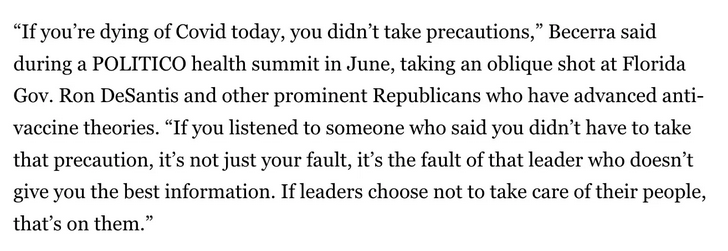
So Politico warns this week that faith in vaccines is falling, and anti-vaxxer narratives are “on the rise.” Sample paragraph, this one describing Health Secretary Xavier Becerra:

The summer of 2023, a claim made in June and credulously repeated in the bottom half of September: If you take Covid vaccines, you can’t get sick, but if you don’t take Covid vaccines, you die. Government leaders who don’t push the 7th and 8th doses of the mRNA injections “choose not to take care of their people”.

[…]

But the narrative rolls on, unperturbed. If you’re dying of Covid, it’s because you hesitated to get your 7,369th dose, anti-vaxxer! Maybe you should have stopped being such a Nazi! In the news media, it’s 2021 forever, and the virtuous science-lovers are rolling up their sleeves to rebuke the science-hating morons, who will not survive the … okay, well, who will not survive the next … okay, well, YOU’LL PROBABLY DIE AT SOME POINT because you didn’t get it. You’re facing a winter of severe illness and death by 2054, at the latest. No amount of evidence will force the storytellers to stop telling this story. It’s the story, so they tell it. The Politico thing ends by quoting Peter Hotez, by the way, as you knew it would.

Similarly, The Atlantic warns now that Donald Trump was a time bomb who kept nearly going off for four years, and only the courage of General Mark Milley kept him under control. Look at the premise at the top of the piece: Disobeying, resisting, and undermining the President of the United States, a military officer protected the Constitution.

How well does the story parse the constitutional issues at stake? This well:

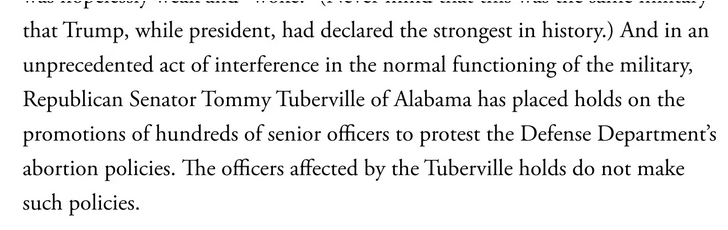
The military decided to have an abortion travel policy, and to fund it. A senator is now interfering in military policy and the unilateral executive appropriations of the Department of Defense, a sign of the ongoing constitutional crisis that began with Trump. Typically, you see, in our constitutional order, the military does whatever it wants, and spends money on its own authority however it feels like spending it, but Tuberville is engaging in the “unprecedented” act of suggesting that Congress should decide how to appropriate federal funds and regulate the armed forces, which means that he hates the Constitution. Article I, Section 8 would like a word, in this obviously extremist description of the authority of Congress:

    To raise and support Armies, but no Appropriation of Money to that Use shall be for a longer Term than two Years;

    To provide and maintain a Navy;

    To make Rules for the Government and Regulation of the land and naval Forces;

And so on. Why is Tommy Tuberville being such a Nazi?

QotD: Progressive hollow men

Filed under: Media, Politics, Quotations, USA — Tags: , , , — Nicholas @ 01:00

Ever feel like you’re living in a bad movie? I’ve recently found there’s a worse sensation: Feeling like you’re living in a good movie. There’s a scene in Apocalypse Now where Marlon Brando’s Col. Kurtz recites the opening stanzas of T.S. Eliot’s “The Hollow Men:”

    Shape without form, shade without colour,
    Paralysed force, gesture without motion;

The poem was written in 1925, but that’s why Eliot was a great artist — he anticipated the soyboi, the soulless urban bugman, by almost 100 years. The Left is nothing but “Hollow Men”-style contrasts. They’re religious fanatics without a religion. They Fucking Love Science™, but think gravity is a social construction. They insist that Blacks are literally being lynched in Current Year America, and yet hardly a day goes by without news that yet another professional race hustler is really White. Their political campaigns, it goes without saying, are Cults of Personality without the personality. Above all, they are moralizers without morality – the things they scold us about are so self-contradictory, or so absurd on their face, that one is forced to conclude that this by design.

Severian, “The Hollow Men”, Rotten Chestnuts, 2020-12-19.

September 21, 2023

Iranian Railways, Red Cross Care Packages, and Tail Gunners – WW2 – OOTF 31

Filed under: Britain, Germany, History, Japan, Military, Railways, Russia, USA, WW2 — Tags: , , , , — Nicholas @ 04:00

World War Two
Published 20 Sept 2023

How did the Allies build and manage an enormous railway supplying the Soviet Union through Iran? How did the Red Cross deliver aid parcels through enemy territory to Allied POWs? And, how effective were the rear gunners in ground attack aircraft like the Stuka and Sturmovik? Find out in this episode of Out of the Foxholes.
(more…)

September 20, 2023

QotD: The structure of an American university

Filed under: Bureaucracy, Education, Quotations, USA — Tags: , , — Nicholas @ 01:00

We need to start by outlining the structure of the university and all of its employees. Universities are very big. Even many small liberal arts colleges will have several hundred (if not many hundreds) of employees and large state universities have thousands; UNC-Chapel Hill has 19,743 undergraduates and 12,961 total staff members, for instance. I should note that while there are many small liberal arts colleges (SLACs) in the USA, the enormous size of large, public R1s1 means that collectively they make up more than half of the US university system by both faculty and students, so this is a case in which the big schools have become typical because they are so big to swamp everything else. That said, smaller institutions matter and what I am going to say here should apply broadly; I will note where conditions differ for different kinds of institutions.

So let’s start dividing all of those employees down so we know what we’re dealing with. We can start by splitting the university into faculty and staff (with student-workers as a third group we’ll not discuss this week); faculty teach and do research whereas staff are all of the supporting administrators and workers that make the university function. We’re not going to talk much about staff, but briefly we can divide them quickly into four big groups: leadership (chancellors, deans, and assistant deans of various kinds; of old these used to be professors pulled into leadership temporarily but these days these are professional managers),2 department staff (who work within academic departments handling the scheduling, paperwork and other essential support services), university staff (who staff the university-wide bureaucracies like the registrar or bursar) and finally what I’ll call – somewhat imprecisely – facilities staff (a wide category covering all of the folks who do a lot of the physical work that keeps a university running; repair, grounds-keeping, janitorial tasks, running dining areas, etc. etc.). All of these people are important, but this week’s post isn’t about them; I break them up here so that when I do mention them, you understand who I mean.

Faculty are divided as well into two large groups: tenure track and non-tenure track. Tenure-track jobs are what most people are familiar with, at least in a vague way. The tenure track was supposed to be (and pre-aughts, was) the “standard” career path for an academic at a university. That’s the system everyone knows, if they know a system. But another system was made.3 And that brings us to non-tenure track positions, both permanent and temporary, full-time and (fake) part-time (which are often actually full time), which will consume most of this post. We’re going to break these up primarily between full-time non-tenured or teaching track positions and notionally “part time” or adjunct appointments, but there are a few other types thrown in there. Crucially, this other system makes up the majority of university teachers, around 67% and rising.

Bret Devereaux, “Collections: Academic Ranks Explained Or What On Earth Is an Adjunct?”, A Collection of Unmitigated Pedantry, 2023-04-28.


    1. R1 is a term from the Carnegie Classification of Institutions of Higher Education, which classifies colleges and universities by the degrees they grant and how research oriented they are. An “R1” classification indicates the highest level of research focus; nearly all of the large flagship state schools are R1 institutions.

    2. Whose stewardship of their universities is somehow almost uniformly worse than what was accomplished by amateur professors who’d rather not have been asked.

    3. Please read with the voice of Cate Blanchett intoning, “but another ring was made”.

September 19, 2023

QotD: Logical consistency isn’t their jam

Filed under: Government, Liberty, Politics, Quotations, USA, Weapons — Tags: , , , , — Nicholas @ 01:00

The same people who last week were screeching about the government having concentration camps now want me to give my AR15s to that same government.

The same people who last month were hyperventilating about the government slaughtering black people now expect me to surrender my guns to that same government.

The same people who last year were setting stuff on fire and yipping about the government rounding up the gays and Muslims for liquidation now think it’s a good idea for me to just hand over my rifles to that same government.

You chuckleheads need to make up your damned minds.

Lawdog, “You know what I find …”, The Lawdog Files, 2019-08-07.

September 18, 2023

It turns out that buying up the rights to old rock songs wasn’t a good investment after all

Filed under: Business, Media, USA — Tags: , , , , , , — Nicholas @ 03:00

Ted Gioia enjoys a little bit of schadenfreude here because he was highly skeptical of the investments in the first place, although the geriatric rockers who “sold out” seem to have generally made out like bandits this time around:

Back in 2021, investors spent more than $5 billion buying the rights to old songs. Never before in history had musicians over the age of 75 received such big paydays.

I watched in amazement as artists who would never sell out actually sold out. And they made this the sale of a lifetime, like a WalMart in El Paso on Black Friday.

Bob Dylan sold out his entire song catalog ($400 million — ka-ching!). Paul Simon sold out ($250 million). Neil Young sold out ($150 million). Stevie Nicks sold out ($100 million). Dozens of others sold out.

As a result, rock songs have now entered their Madison Avenue stage of life.

Twisted Sister once sang “We’re Not Gonna Take It”. But even they took it — a very large payout, to be specific. A few months ago, the song showed up in a commercial for Discover Card.

Bob Dylan’s song “Shelter from the Storm” got turned into a theme for Airbnb. Neil Young’s “Old Man” was rejuvenated as a marketing jingle for the NFL (touting old man quarterback Tom Brady).

Fans mocked this move. Even Neil Young, now officially a grumpy old man himself, expressed irritation at the move. After all, the head of the Hipgnosis, the leading song investment fund, had promised that the rock star’s “Heart of Gold” would never get turned into “Burger of Gold”.

That hasn’t happened (yet). But where do you draw the line?

I was skeptical of these song buyouts from the start — but not just as a curmudgeonly purist. My view was much simpler. I didn’t think old songs were a good investment. […] But even I didn’t anticipate how badly these deals would turn out.

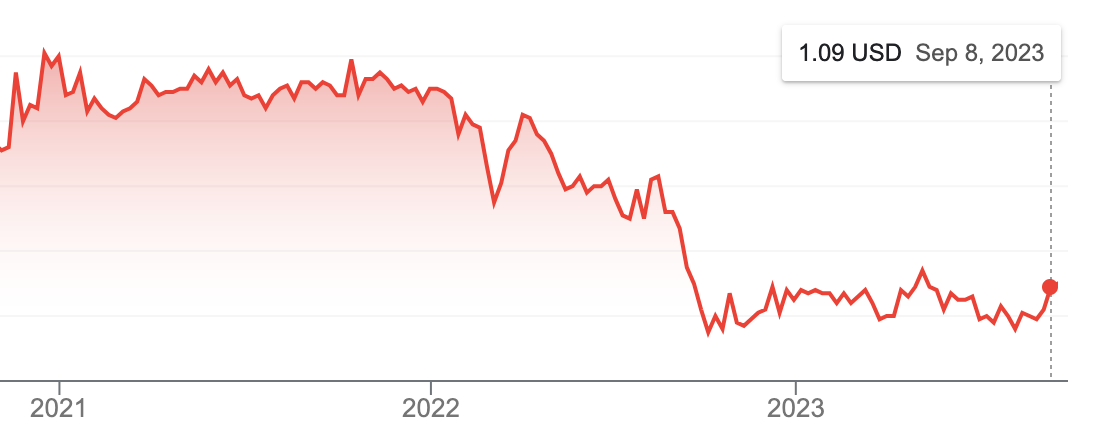
The more songs Hipgnosis bought, the more its share price dropped. The stock is currently down almost 40% from where it was at the start of 2021.

Things have gotten so bad, that the company is now selling songs.

On Thursday, Hipgnosis announced a plan to sell almost a half billion dollars of its song portfolio. They need to do this to pay down debt. That’s an ominous sign, because the songs Hipgnosis bought were supposed to generate lots of cash. Why can’t they handle their debt load with that cash flow?

But there was even worse news. Hipgnosis admitted that they sold these songs at 17.5% below their estimated “fair market value”. This added to the already widespread suspicion that current claims of song value are inflated.

BM59: The Italian M14

Filed under: History, Italy, Military, USA, Weapons — Tags: , , , , , , , — Nicholas @ 02:00

Forgotten Weapons
Published 25 Oct 2017

After World War Two, both the Beretta and Breda companies in Italy began manufacturing M1 Garand rifles. When Italy decided that they wanted a more modern selective-fire, magazine-fed rifle, they chose to adapt the M1 Garand to that end rather than develop a brand new rifle. Two Beretta engineers, Vittorio Valle and Domenico Salza, began work in 1957 on what would become the BM-59. Prototypes were ready in 1959, trials were run in 1960, and by 1962 the new weapon was in Italian military hands.

The BM59 is basically an M1 Garand action and fire control system, but modernized. The caliber was changed to 7.62mm NATO, and the barrel shortened to 19.3 inches. A simple but effective selective fire system was added to the fire control mechanism, and the en bloc clips replaced with a 20-round box magazine (and stripper clip loading guide to match). A folding integral bipod was added to allow the rifle to be used for supporting fire on full auto, and a long muzzle device was added along with a gas cutoff and grenade launching sight to allow the use of NATO standard 22mm rifle grenades.

In this form, the BM59 was a relative quickly developed and quite successful and well-liked rifle. In addition to the Italian military, it was purchased by Argentina, Algeria, Nigeria, and Indonesia. A semiautomatic version was made for the US commercial market and designated the BM62, and a small number of fully automatic BM-59 rifles — like the one in this video — were imported into the US before the 1968 Gun Control Act cut off importation of foreign machine guns.
(more…)

September 17, 2023

How much mis-, mal-, and dis-information do you encounter on an average day on the internet?

Filed under: Media, Politics, Technology, USA — Tags: , , , , , — Nicholas @ 05:00

I don’t know the answer to that question … although I suspect it’s a pretty big proportion of what you’ll see, especially if you stick to legacy media sites who regularly indulge in cover-up, state propaganda, and outright lies while condemning other media as “conspiracy theorists”. Chris Bray, on the other hand, thinks there are hopeful signs that we’ve passed peak disinformation as the pandemic lockdowns get further behind us:

I’ve been trying to come up with a count: If you consume a typical amount of news media and social media product, how many individual pieces of dishonest, misleading, and calculatedly or ignorantly unreal “information” do you take on board over the course of a typical day?

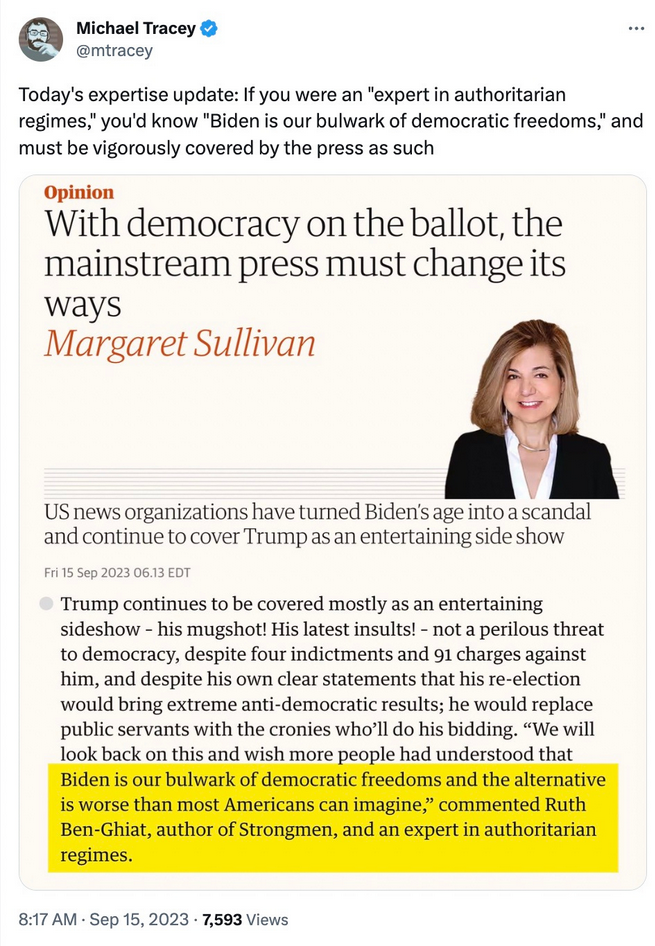
Walter Kirn’s one-sentence summary of contemporary media is stuck in my head: “This is a world-concealing layer of diversionary and illogical and internally inconsistent noise, under which the world exists somewhere.” How much noise do you have to purge to merely get to zero, not at all informed but not not deeply misinformed? And if you encounter the deep thoughts of Ruth Ben-Ghiat, does the deficit merely double, or is it much worse than that?

Democracy means you must not question or oppose the head of state

I’ve been reading on The Site Formerly Known as Twitter this week that Elon Musk’s refusal to activate the privately owned Starlink network over Crimea is a violation of the Geneva Conventions, which now apparently apply to corporate product, and also high treason, for which Elon Musk should be executed. At the risk of mixing metaphors, it’s like the Internet allows strangers to use your brain as a toilet. Although, as the Twitter randos always end up explaining, I just feel this way because I’M PUTIN’S NAZI BUTTBOY.

All day, every day, 24/7/365 — well, maybe with some breaks for sleep, but only if you stop looking at your phone at night — you take on garbage. Your brain is loaded with information barriers, dressed up as information. You read and hear sentences that are designed to prevent understanding.

The Ballad of Chiang and Vinegar Joe – WW2 – Week 264 – September 16, 1944

World War Two
Published 16 Sep 2023

The Japanese attacks in Guangxi worry Joe Stilwell enough that he gets FDR to issue an ultimatum to Chiang Kai-Shek, in France the Allied invasion forces that hit the north and south coasts finally link up, the Warsaw Uprising continues, and the US Marines land on Peleliu and Angaur.
(more…)

« Newer PostsOlder Posts »

Powered by WordPress