
… note that this is also a bit of a rebuke to the dominant strain of prepper fantasies, such as those I began this review with. Prepper fantasies are most fundamentally fantasies of agency, dreams that in the right crisis the actions you take could actually matter, and that in the wake of that crisis you could return to a Rousseauian condition of autonomous activity freed from the internal conflicts engendered by societal oppression (whether that oppression takes the form of stifling social convention or HRified bureaucratic fiat). It’s obvious how the prepper fantasies relate to the great survival stories like Robinson Crusoe, or to the pioneer dramas of the American Westward expansion. It’s a little less obvious, but just as deeply true, that they’re connected to stories of rogues, rascals, and reavers like those by Robert E. Howard or Bronze Age Pervert. All of these stories, fundamentally, are about how a man freed from external restraint and internal conflict can apply himself to better his condition.
The thing is these stories are totally ahistorical — the best that solitary survivors have ever managed was to survive, none of them have rebuilt civilization. As Jane notes in her review of BAP, the sandal-clad barbarians have generally been subjected to a “tyranny of the cousins” even more intrusive and meticulous than the gynocratic safetyism that Bronze Age Lifestyle offers an imaginative escape from. And as for the pioneers, Tanner Greer notes that:
Many imagine the great American man of the past as a prototypical rugged individual, neither tamed nor tameable, bestriding the wilderness and dealing out justice in lonesome silence. But this is a false myth. It bears little resemblance to the actual behavior of the American pioneer, nor to the kinds of behaviors and norms that an agentic culture would need to cultivate today. Instead, the primary ideal enshrined and ritualized as the mark of manhood was “publick usefuleness”, similar, if not quite identical, to the classical concept of virtus. American civilization was built not by rugged individuals but by rugged communities. Manhood was understood as the leadership of and service to these communities.
It would be too easy to end the review here, with the implication that the prepper identity is a fantasy of radical individualism and like all such fantasies, kinda dumb. But the thing is, the prepper world has by and large absorbed this critique and incorporated it into its theorizing. In contrast to the libertarian fantasies of the 1970s, second-wave prepperism (reformed prepperism?) is constantly talking about community, the importance of having friends you can trust, of cultivating deep social bonds with your neighbors, etc.
What Yu Gun reminds us is that this is still totally ahistorical, but this time in a way that indicts not only the preppers, but also a much broader swathe of our society. A man without a community is unnatural, but so is a community without leadership, hierarchy, and order. The prepper version of community is a vision of freely contracting individuals respecting each others’ autonomy while cooperating because it’s in their best interests. This is also the folk version of community that motivates much of our economic and legal regime. Scratch an American “communitarian”, and underneath it’s just another individualist.
If you hang out on prepper forums, a recurrent mantra is to “practice your preps”, that is to start living on the margin as if the apocalypse had already occurred. The purpose of this is to gain experience in the skills you’ll need after the end, and to work out the kinks in your routine now, while it’s still easy to make adjustments. Originally this meant practicing getting lost in the woods, using and maintaining your weapon of choice, eating some of your food stockpile, or whatever. In second-wave prepperism it means all that, plus a bunch of new stuff like hanging out with your neighbors, attending community barbecues, and whatever else it is that freely contracting individuals like to autonomously do while temporarily occupying the same space.
But for we third-wave preppers, it has to take on a very different meaning. Greer’s essay that I quoted above is mainly about how leadership and service in local-scale organizations served as training for leadership and service in much larger groups aimed at problems with much higher stakes. In other words, they were practicing their preps. One of the great secrets of leadership is that following and leading are actually closely related skills, and that practice at one of them transfers well to the other. This is difficult for we Americans to see, because an aversion to hierarchy is built into our national character, and consequently we operate with impoverished models of what it means to be in a position of authority or of subordination.
Long ago I read an article contrasting Western and Korean massively-multiplayer online role-playing games (MMORPGs). Even if you know nothing about computer games, you probably know that in most of them you are the hero, the chosen one, the child of destiny. Talk about fantasies of agency! MMORPGs thus have a tricky needle to thread — somehow all the thousands and thousands of players need to simultaneously be the chosen one, the child of destiny, etc., etc. And they mostly accomplish this by just rolling with it and asking everybody to suspend disbelief. But this article claimed that Korean MMORPGs are different — when players join these games, they’re randomly assigned a role. A tiny fraction might become kings or generals or children of destiny, with the power to decide the fates of peoples and kingdoms, but most are given a role as ordinary soldiers or porters or blacksmiths, and toil away at their in-game mundane tasks, without much ability to affect anything at all.
We like to imagine that after the bombs fall and the smoke clears we will emerge as the new Yu Gun, apportioning merit and assigning tasks. And perhaps you will indeed be called upon to do that, so you should prepare yourself to step up and do it. That preparation will involve some practice commanding others and some practice obeying others’ commands, because the two are inextricably bound together. But in life as in Korean video games, there’s isn’t very much room at the top. Far more likely, when the stage of history is set, we will be cast in a supporting role, like the Korean gamer assigned to role-play as a peasant or like Yu’s followers standing in orderly ranks. Let us not turn our noses up at this vocation, the poorly-behaved seldom make history.
John Psmith, “REVIEW: Medieval Chinese Warfare, 300-900 by David A. Graff”, Mr. and Mrs. Psmith’s Bookshelf, 2023-06-05.
April 12, 2024
QotD: Prepper fantasy versus prepper reality
April 11, 2024
Disney: go woke, go broke?
spiked
Published Apr 10, 2024
The Walt Disney Company has gone from being an international treasure to an international laughing stock. Its films are flopping at the box office and fans are fuming. All because it has gone ridiculously woke, to an almost comical degree. No Disney film, franchise or TV series is now complete without clunky “progressive” messages about diversity, feminism and gender. The company has even started picking fights with anti-woke politicians. Here, Lauren Smith documents Disney’s Great Awokening – and the fan revolt against it. Watch, share and let us know what you think in the comments.Support spiked:
https://www.spiked-online.com/support/
Sign up to spiked’s newsletters: https://www.spiked-online.com/newslet…
Check out spiked’s shop: https://www.spiked-online.com/shop/
The CIA would “brief the press on matters of national importance … when ‘we, the CIA, wanted to circulate disinformation on a particular issue'”
Jon Miltimore outlines the fascinating revelations from 1983 about how the CIA directly manipulated American journalists to propagandize certain issues in the way the Agency desired:

One of Snepp’s many jobs at the Agency was to brief the press on matters of national importance. Or in Snepp’s words, when “we, the CIA, wanted to circulate disinformation on a particular issue”.
Snepp made this statement in a 1983 interview (see above) that I’d encourage readers to watch. In the video, the former CIA analyst discusses how the CIA manipulates journalists with lies and half-truths in pursuit of its own agendas.
For instance, if we wanted to get across to the American public that the North Vietnamese were building up there force structure in South Vietnam, I would go to a journalist and advise him that in the past 6 month X number of North Vietnamese forces had come down the Ho Chi Minh Trail system through southern Laos. There is no way a journalist can check that information, so either he goes with that information or he doesn’t. Usually the journalist goes with it, because it looks like some kind of exclusive.
What Snepp was describing was one of the most simple tactics the CIA has used for decades to control information. He said the success rate of planting these stories in the media was 70-80 percent.
“The correspondents we targeted were those who had terrific influence, the most respected journalists in Saigon,” Snepp said.
Snepp even offered the names of the journalists he successfully targeted: Bud Merrick of US News and World Report; Robert Chaplin of the New Yorker; Malcom Brown of the New York Times; and others.
Snepp worked his way into these journalists’ trust exactly as one would expect.
“I would be directed to cultivate them, to spend time with them at the Caravel Hotel or the Continental Hotel, to socialize with them, to slowly but surely gain their confidence,” Snepp said.
All of this sounds sleazy, but it gets worse.
QotD: North America will never be a “bicycle” culture
I’m deliberately discounting bicycles as a means of locomotion, you’ll notice, because look: America is a car society. Our cities are designed for cars. Indeed, given the vast distances involved over here, cars are what make our lifestyle possible. Europeans who haven’t been here, or who only visit the big tourist pits like NYC and LA, don’t get this. Even if you’ve seen the maps, it doesn’t really register until you experience it. I’m just guessing here, for purposes of explanation, but it really does seem to be the case that if it were possible to hop in your car and drive two hours due east from downtown Paris, you’d pass through three or four countries. There are lots of American cities where, if it were possible to hop in your car and drive two hours straight from downtown, you’d still be in that same city. The continental US is just mind-bogglingly huge; only Russians and maybe Australians share our mental maps. When you’ve got daily commutes that run an hour, hour and a half on freeways, setting anything up with bicycles in mind is just ludicrous.
Severian, “Cars, Bikes, Motorcycles”, Rotten Chestnuts, 2021-07-25.
April 10, 2024
Saving Our Democracy watch – “[Trump] has to do at least ten years, or everybody will hate the navy”
Chris Bray suggests that reading the full linked document may be hazardous to your mental health, so he’s helpfully highlighted a few of the key points that may have you scratching your head and saying something like “The Fuh? What??”
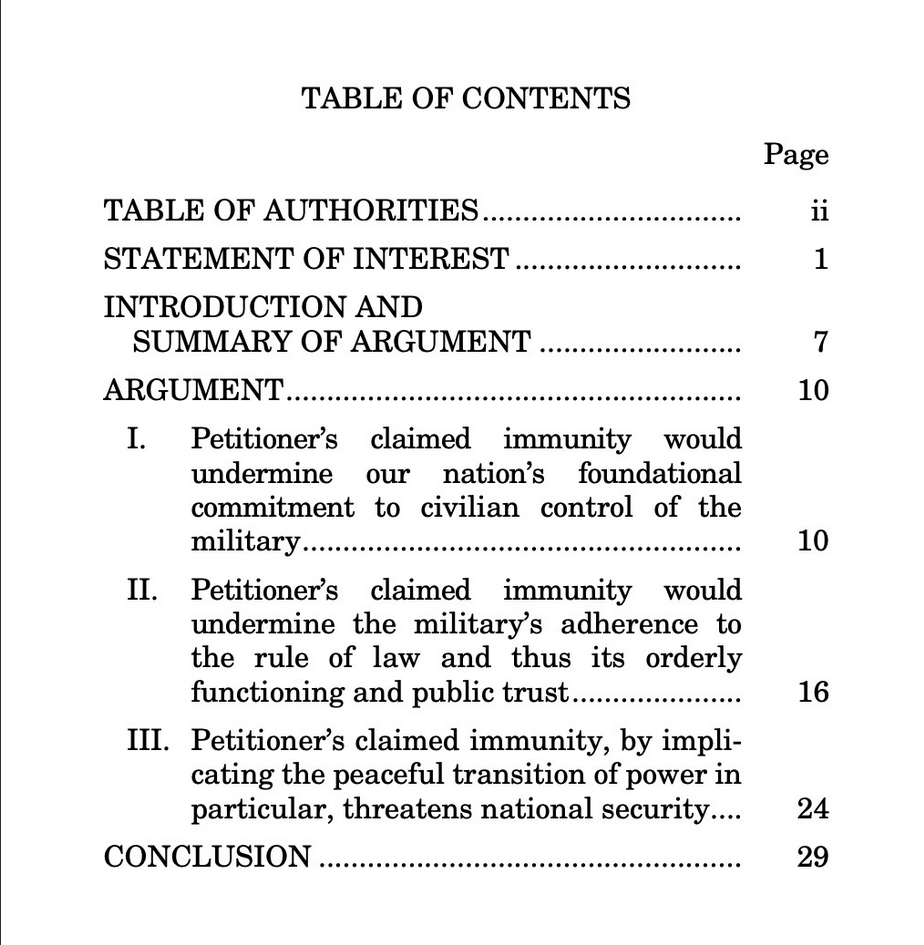
I have a mixed view of Donald Trump’s argument about presidential immunity, which you can read here. But an amicus brief filed with the Supreme Court today by retired flag officers and service secretaries is so bizarre that reading it may permanently alter the structure of my face.
You can read the whole amicus brief here, but treat it like a solar eclipse and don’t stare at it directly. As a first sign of how much good faith the thing contains, one of the amici is Michael Hayden.
The first argument is that Trump has to go to prison or else civilians won’t control the military anymore. You think I’m kidding.
“Amici are deeply interested in this case because presidential immunity from criminal prosecution would threaten the military’s role in American society, our nation’s constitutional order, and our national security.” See the connection? If Donald Trump doesn’t go to prison, “the military’s role in American society” will be damaged. He has to do at least ten years, or everybody will hate the navy.
The prevailing feature of the entire brief is an essence of flattening. Every issue is very simple. There are no competing examples. None of this has ever come up before: The brief deals with questions of presidential immunity around Obama drone-killing a 16 year-old US citizen, or Lincoln unilaterally suspending habeas corpus and using the military to arrest critics of the war, by not mentioning any of it, or any other historical example. Everything is a surface. I’ve graded undergraduate essays, so the tone and depth of the effort feels familiar.
Third argument: Donald Trump has to be prosecuted, because America promotes democracy all over the world, and Trump not being prosecuted is against democracy, so it will be harder for us to promote democracy if we don’t prosecute him. Authoritarian regimes say that American democracy doesn’t work, so: “Presidential immunity from criminal prosecution feeds those false and harmful narratives. Unless Petitioner’s theory is rejected, we risk jeopardizing America’s standing as a guardian of democracy in the world and further feeding the spread of authoritarianism, thereby threatening the national security of the United States and democracies around the world.”
We have to imprison the leader of the political opposition, or people won’t think we’re a democracy, and then there will be more authoritarianism, like when regimes imprison the political opposition.
CDR Salamander says it’s “time to drag LCS out of the gimp box again”
CDR Salamander has never held back on his dislike of the Little Crappy Ship (Littoral Combat Ship) design(s) the US Navy settled on nearly 20 years ago:

As promised yesterday, time to drag LCS out of the gimp box again, because it fits in well with last week’s 3×8 Grid of Shame, flavored in no small part with the Navy’s decision to pull its head inside its shell and cancel its ship briefings.
To solve the many problems we have created for ourselves, we must have a foundational change in our culture. Expecting a different result without changing that, I’m not sure how we get any headway.
From our FITREPs to our shipbuilding plans to the testimony by our leadership to Congress. We spin, mindlessly drone talking points and carefully scripted PAOisms, and from our FITREP to awards system, we willfully share untruths, obscure, hope things just blow up on someone else’s PCS cycle.
[…]
Now, let’s take a look at this second pic. On its face it demonstrates that LCS is a direct byproduct of an institutional habit of not being honest with the American people, their elected representatives, and hell … even ourselves.
Besides both this pic and the first one showing the USN ship being the most out of formation, what catches you eye?
The ship furthest away in formation should look the smallest … but there is nothing “small” about an LCS in the visual spectrum.
In an age where satellites with multi-spectral surveillance capability matched with artificial intelligence, look at that first pic. Is there any way to hide that wake?
Of course not.
Then look at the LCS’s weapons capability compared to the other ships. Is she ready for combat in the littorals against an enemy that will bring modern air, surface, and subsurface threats to her?
Should people only realizing this in the third decade of the 21st Century be taken seriously?
No. I don’t buy any of what they are selling. Either they are lying to my/our face, or they lack the critical thinking skills to see what this kludge was/is/will be.

QotD: Aprons
Sarah Hoyt, “Teaching Offense”, According to Hoyt, 2019-10-25.
April 9, 2024
US PT Boats of WW2 – Guide 369
Drachinifel
Published Jan 6, 2024The PT Boats, fast attack craft of the United States Navy, is today’s subject.
(more…)
QotD: A social conservative criticism of libertarianism
Robert Locke, “Marxism of the Right”, American Conservative, 2005-03-14.
April 8, 2024
The Battle of Okinawa Begins – WW2 – Week 293 – April 6, 1945
World War Two
Published Apr 6, 2024It’s the next step toward invading Japan’s Home Islands — invading Okinawa, and it begins April 1st. Advances are easy by land, but at sea the kamikaze menace is in full swing. In Burma, plans are made to liberate Rangoon; in the west hundreds of thousands of Germans are surrounded in the Ruhr; and in the east, the Soviets begin assaults on Königsberg and Vienna.
(more…)
Beecher’s Bible: A Sharps 1853 from John Brown’s Raid on Harpers Ferry
Forgotten Weapons
Published Jan 8, 2024On October 16, 1859 John Brown and 19 men left the Kennedy farmhouse and made their way a few miles south to the Harpers Ferry Arsenal. They planned to seize the Arsenal and use its arms — along with 200 Sharps 1853 carbines and 1,000 pikes they had previously purchased — to ignite and arm a slave revolt. Brown was a true fanatic for the abolitionist cause, perfectly willing to spill blood for a just cause. His assault on the Arsenal lasted three days, but failed to incite a rebellion. Instead of attracting local slaves to his banner, he attracted local militia and the US Marines. His force was besieged in the arsenal firehouse, and when the Marines broke through the doors they captured five surviving members of the Brown party, including Brown himself. All five were quickly tried and found guilty of murder, treason, and inciting negroes to riot. They were sentenced to death, and hanged on December 2, 1859.
Most of Brown’s 200 Sharps carbines were left in the farmhouse hideout, to be distributed when the insurrection took hold. These were found by local militia, among them the Independent Greys, and some were kept as souvenirs — including this example.
There is an intriguing historical question as to whether Brown’s raid was ultimately good for the country or not. It was extremely divisive at the time, and it can be argued that the raid was a major factor leading to Lincoln’s election and the Civil War. Could slavery have been abolished without the need for a cataclysmic war if John Brown had not fractured the Democratic Party? To what extent is killing for a cause justifiable? Do the ends always justify the means? John Brown had no doubts about his answers to these questions … but maybe he should have.
(more…)
April 7, 2024
Instructions for American Servicemen in Britain (1942)
Henry Getley on the US War Department publication Instructions for American Servicemen in Britain produced for incoming GIs on arrival in Britain from early in 1942:

[W]ith their troops pouring into this country from 1942 onwards to prepare for D-Day, officials at the US War Department did their best to make the culture clash as trouble-free as possible. One of their main efforts was issuing GIs with a seven-page foolscap leaflet called Instructions for American Servicemen in Britain.
It’s available in reprint as a booklet and makes fascinating reading, not least for its straightforward, jargon-free writing style and its overriding message – telling the Yanks to use “plain common horse sense” in their dealings with the British.
In parts, it now seems clumsy and condescending. But its purpose was praiseworthy – to try to get American troops to damp down the impression that they were overpaid, oversexed and over here. Many GIs qualified in all three aspects, of course, but you couldn’t blame the top brass for trying.
The leaflet paints a sympathetic (some would say patronising) picture for the incoming Americans of a Britain – “a small crowded island of forty-five million people” – that had been at war for three years, having initially stood alone against Hitler and braved the Blitz. Hence this “cradle of democracy” was now a “shop-worn and grimy” land of rationing, the blackout, shortages and austerity. But beneath the shabbiness, there was steel.
The British are tough. Don’t be misled by the British tendency to be soft-spoken and polite. If need be, they can be plenty tough. The English language didn’t spread across the oceans and over the mountains and jungles and swamps of the world because these people were panty-waists.
There were helpful hints about cricket, football, darts, pounds, shillings and pence, warm beer and badly-made coffee. And because we are two nations divided by a common language, the Yanks were urged to listen to the BBC.
In England the “upper crust” speak pretty much alike. You will hear the newscaster for the BBC (British Broadcasting Corporation). He is a good example, because he has been trained to talk with the “cultured” accent. He will drop the letter “r” (as people do in some sections of our own country) and will say “hyah” instead of “here”. He will use the broad “a”, pronouncing all the a’s in “banana” like the “a” in father.
However funny you may think this is, you will be able to understand people who talk this way and they will be able to understand you. And you will soon get over thinking it’s funny. You will have more difficulty with some of the local accents. It may comfort you to know that a farmer or villager from Cornwall very often can’t understand a farmer or villager in Yorkshire or Lancashire.
The GIs were warned against bravado and bragging, being told that the British were reserved but not unfriendly. “They will welcome you as friends and allies, but remember that crossing the ocean doesn’t automatically make you a hero. There are housewives in aprons and youngsters in knee pants in Britain who have lived through more high explosives in air raids than many soldiers saw in first-class barrages during the last war.”
April 6, 2024
The Fake (and real) History of Potato Chips
Tasting History with Max Miller
Published Jan 2, 2024The fake and true history of the potato chip and an early 19th century recipe for them. Get the recipe at my new website https://www.tastinghistory.com/ and buy Fake History: 101 Things that Never Happened: https://lnk.to/Xkg1CdFB
(more…)
April 5, 2024
In the still-ongoing “war of the sexes”, when can women just accept they’ve won and cease hostilities?
At the amusingly named Handwaving Freakoutery, you can see a scorecard for the war of the sexes that has been ongoing since I was a child and seems no closer to ending than back in the 1960s:
I say this to make it absolutely clear that unlike a lot of boorishly banal material you might encounter within the wretchedly named “Manosphere”, this is not intended to be a whiny article. I’m not complaining, nor am I calling for societal change or action. I’m simply wondering exactly how dominant female privilege has to get before they declare victory and take their boot off the necks of men. I really don’t know the answer to this question, but we’ll speculate about that below after the wall of graphs. HWFO loves graphs.
Herein we will go point by point through as many measurable societal markers as I can think of, leaving no marker unmarked, and put together a Gender War Scoreboard describing as accurate a snapshot as possible of the current state of the United States. Then we’ll close with some analysis about how badly it would have to get before the women finally just declare victory and move on. This post shall be too big for email.
To assign our score, we will look at sets of data that fall generally into two categories. For victimization ratios and similar, we’ll just look at percentage by gender. For comparing two uncapped sets of data, such as life expectancy, we’ll look at a ratio and make them both add to 100 for an apples-to-apples comparison. Then we’ll add them all up at the end to tally the score.
Salary
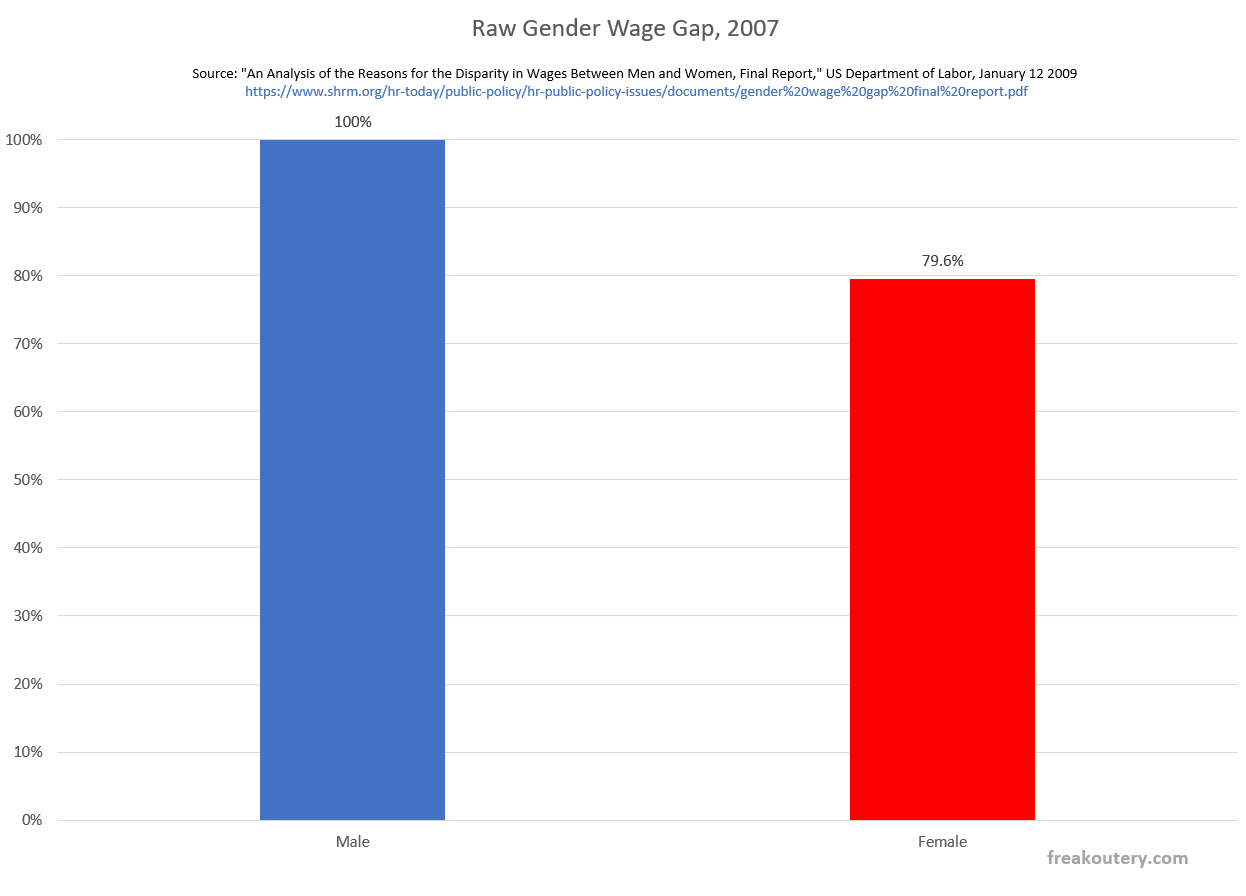
HWFO covered the gender wage gap in 2022, but I’ll summarize it here so you don’t have to read back. According to a 2008 analysis by the Department of Labor, now 16 years old, the raw gender wage gap was 20.4% in 2007:
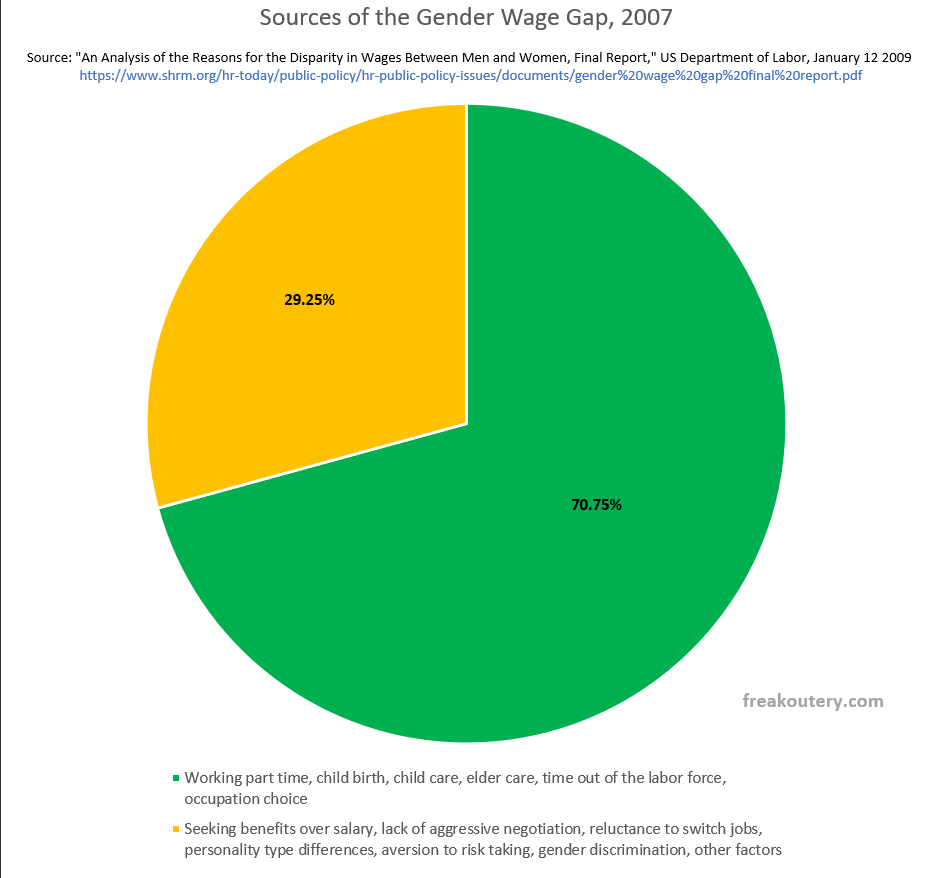
Most of the gap was explainable by career choice and lifestyle choice differences:
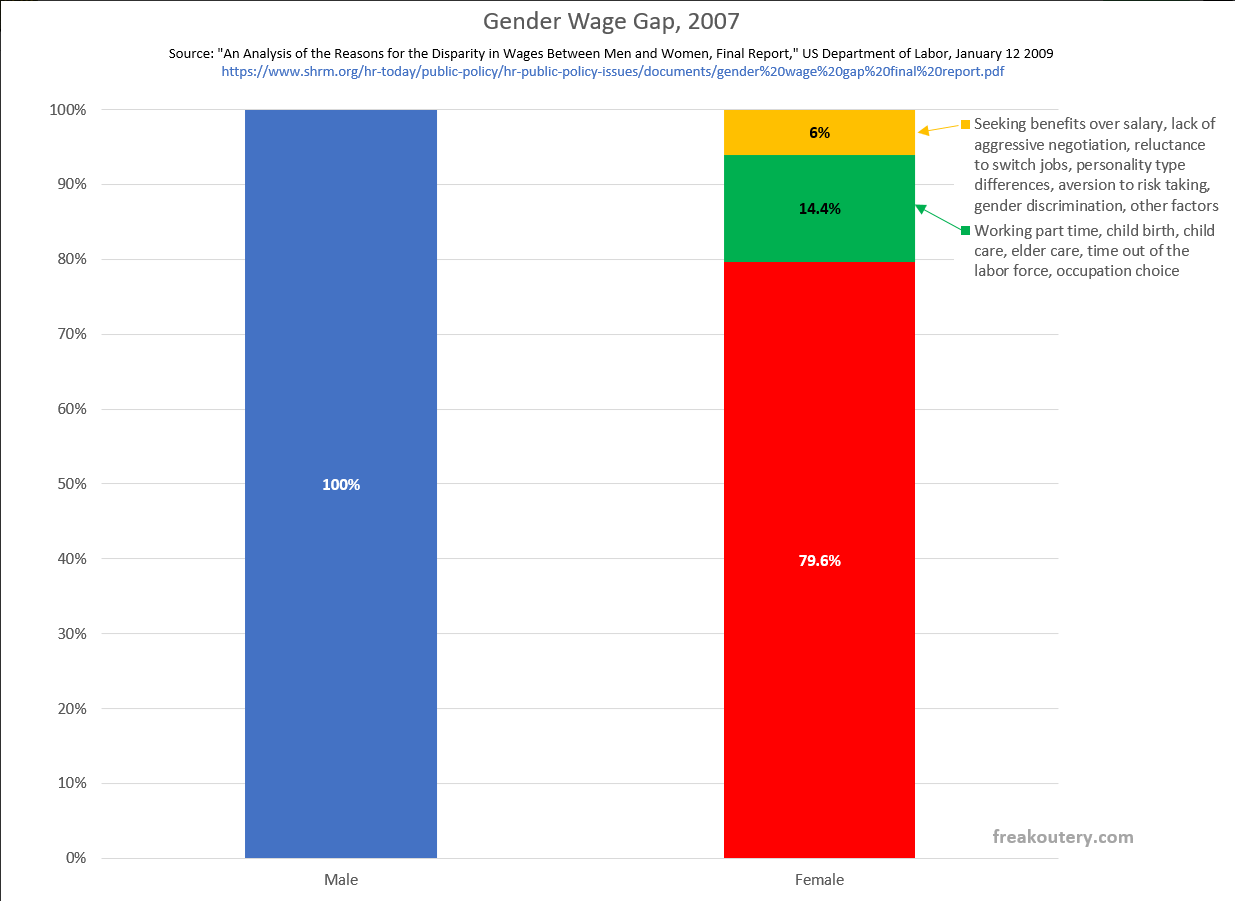
When compared properly that looks like this:
Sixteen years ago, the bits of the gender wage gap that weren’t explained by career and life choice differences only totaled 6%. This fact has been known for a decade and a half and is constantly hidden from view by Pew, the NLWC, and any other major organization that profits from the perception that this gap is large and persistent. It has also assuredly closed to narrower than that 6% in the ensuing decade and a half, but nobody’s replicated the Department of Labor analysis. Look closely at the effects in the green bar identified by the Department of Labor. “Child birth” is how you become a mother. “Child care” is something mothers do. “Working part time” is something mothers do. “Time out of the labor force” is something mothers take. “Occupational choice” is something women change when they become mothers. Here are some graphs from Kleven et al, March 2019:
The solid lines are women. In every studied area, the women make equal or more than the men do up until the birth of their first child, and then they make less. The gender wage gap difference is in the choice to have children. Women choose to make professional concessions to raise a family while the men don’t. Is this fair? Some might say no, but only if they also don’t want to be the primary caregiver for their kids. Some would say yes, for the following two reasons: (1) women choose this, especially in feminist societies, but also (2) men are punished socially for choosing this. If you do not believe me, go make two fake male Tinder profiles with identical cute photos in them, and in the bio of one say “corporate lawyer” and the other say “part time daycare worker” and see which one gets more hits. Then do the same with a female profile. Men are socially punished by women for making the career concession, women are not socially punished by men for making it.
Often when these sorts of “equal pay for equal work” studies are properly controlled for mothering and career choice, they find that men are paid less than women for equal work. Google was pretty famously forced by their neo-progressive staff to do an internal analysis of the subject, and uncomfortably discovered they were overpaying women for being women on an “equal work” basis. The results were twofold. First Google paid all the men a one time bonus, then Google quietly never investigated it again so they could get back to paying women more.

QotD: When the faculty lounge turned nasty over the electric vehicle charging stations
Not because academics are worried about anything so prole as hypocrisy — as we know, cognitive dissonance only affects the Dirt People — but because eggheads operate on a different scale of values. Bentleys etc. are what those people drive … so professors have to kick it bobo style. Thus the faculty lot is filled with Priuses (Prii?), Teslas, and so forth. Back when The Simpsons was funny, it had a throwaway joke about Ed Begley Jr. driving a car so eco-friendly, it was powered entirely by his own sense of self-regard. If they actually marketed those, every professor in America would have one … but since they don’t, the “eco-pimp my ride” competition continues unabated.
Which is hilarious for two reasons. First, there isn’t — there won’t be, there can’t be — sufficient infrastructure to support more than a token few electric vehicles (EVs). Flyover State is nothing if not eco-friendly, though, and so they fell all over themselves giving the faculty charging stations … but see above: All they could manage was one charging station per level, in one parking garage. Which naturally led to much agonizing in the Faculty Senate, not to mention the student newspaper, the town newspaper, and every boutique coffee place and head shop in College Town. How can charging station time be most equitably distributed? Does the Lesbian Negress outweigh (supply your own joke here, please) the White FTM tranny? What about the genderfluid hemophiliac Inuit? Where does the wingless golden-skinned dragonkin rank?
Severian, “Luxury Beliefs”, Rotten Chestnuts, 2021-06-03.


