Quotulatiousness

March 5, 2021

Privateering today?

Filed under: China, History, Law, Military, USA — Tags: , , , — Nicholas @ 05:00

In a recent post at Astral Codex Ten, Scott Alexander posted a link to an article in the US Naval Institute Proceedings putting forward arguments for the United States issuing modern day Letters of Marque. Today he posted a few reactions from his readers to the proposal:

On the article about privateers, local naval expert Bean writes:

    It’s time for the standard disclaimer any time Proceedings comes up: Proceedings is intended as a forum for discussion of matters of interest to naval officers, and it is not peer reviewed. Often very not peer reviewed. Like in this case. Please don’t judge the USNI on the basis of this stuff. They do a lot of good work.

    And yes, it is that stupid. First, privateering is probably illegal today. The US didn’t sign the 1856 Paris declaration outlawing it, but the ban is almost certainly considered customary international law today, and thus binding on the US, too. (International law is very weird.)

    Second, it makes no sense. It was something that people did in an era when the ability of the state to do things was sharply constrained, and it was never all that profitable. These days, the government is a lot more effective, and if it wants to hunt Chinese commerce (never mind the issues about who owns the cargo, which is rather different in the days of worldwide communications and the shipping container) it will make auxiliary commerce raiders of its own. There’s definitely no need to have a DDG sit outside a Brazilian port waiting. Take any reasonable civilian ship (big yacht, fishing boat, tug, whatever) and fit it with a couple of 40mm guns and a boarding party. Have it do the waiting instead.

And our other defense expert, John Schilling, writes:

    Modern naval weapons are too good at sinking ships, whereas privateering requires capturing ships intact to be profitable. For a trivial, and in this context uncontroversial, investment, China can equip their merchant fleet with defensive weapons that will sink any privateer, unless the privateer sinks them first.

    – Privateers, being incapable of surviving a fight with real warships (especially modern ones), need to be able to hide from and if necessary outrun enemy warships. That’s a lot harder to manage in a world of radio, radar, maritime patrol aircraft, and satellites. Harder still if you insist on taking prizes, which will be Lojacked beyond your ability to clear at sea. Even in a hot war with the United State, China will probably be able to spare e.g. an H-6K for a day to sink the privateer that just sank one of China’s freighters, and that’s all it will take.

    – The rest of the world regards privateering as flat-out illegal, so virtually all of the ports of the world will be closed to the privateers *and their prizes*. Operating in the South China Sea directly from Hawaii, without any intermediate bases (what’s left of Guam will have its hands full), is going to be logistically challenging to say the least. And the value of that prize ship you just took is greatly diminished if it can only be used in the US coastal trade, its cargo sold only on the US domestic market never to be reexported.

    This is a stupid idea that keeps coming back every year or two because somebody read too many Napoleonic sea-adventure stories and thinks they’re the only one who read those stories so their clever “obscure” idea is something the rest of us haven’t heard and rejected a dozen times already.

There’s a problem in medicine where people think doctors are trustworthy experts. While this is often true, there are about a million doctors, and some tiny fraction of them are insane. The reasonable doctors mostly keep their mouths shut, but sometimes an insane doctor will endorse some sort of terrible alternative medicine, and then people will get excited: “A doctor endorsed it! It must be real!” The fact is, you can find doctors saying pretty much any bizarre thing — I hear some of them even have Substacks.

My thought when reading that article was “this sounds crazy … but wait! It’s written by a colonel and published by the US Naval Institute! That sounds just wacky enough to make a good link!”

Now I am concerned that colonels work the same way as doctors. I wonder what else is like this.

Colonels absolutely do work the same way as doctors, lawyers, and (especially) journalists — Michael Chrichton christened this the “Gell-Mann Amnesia Effect”.

The topic is as good an excuse as I’m likely to find to post Mark Knopfler’s “Privateering”:

“Privateering”

Yon’s my privateer
See how trim she lies
To every man a lucky hand
And every man a prize
I live to ride the ocean
The mighty world around
To take a little plunder
And to hear the cannon sound
To lay with pretty women
To drink Madeira wine
To hear the rollers thunder
On a shore that isn’t mine

Privateering we will go
Privateering, yo ho ho ho
Privateering we will go
Yo ho ho, yo ho ho

The people on your man o’ war
Are treated worse than scum
I’m no flogging captain
And by God I’ve sailed with some
Come with me to Barbary
We’ll ply there up and down
Not quite exactly
In the service of the Crown
To lay with pretty women
To drink Madeira wine
To hear the rollers thunder
On a shore that isn’t mine

Privateering we will go
Privateering, yo ho ho ho
Privateering we will go
Yo ho ho, yo ho ho
Look’ee there’s my privateer
She’s small but she can sting
Licensed to take prizes
With a letter from the King
I love the streets and taverns
Of a pretty foreign town
Tip my hat to the dark-eyed ladies
As we sally up and down
To lay with pretty women
To drink Madeira wine
To hear the rollers thunder
On a shore that isn’t mine

Privateering we will go
Privateering, yo ho ho ho
Privateering we will go
Yo ho ho, yo ho ho

Britannia needs her privateers
Each time she goes to war
Death to all her enemies
Though prizes matter more
Come with me to Barbary
We’ll ply there up and down
Not quite exactly
In the service of the Crown
To lay with pretty women
To drink Madeira wine
To hear the rollers thunder
On a shore that isn’t mine

Privateering we will go
Privateering, yo ho ho ho
Privateering we will go
Yo ho ho, yo ho ho

March 4, 2021

Fallen Flag — the Seaboard Air Line Railroad

Filed under: History, Railways, USA — Tags: , , , , , — Nicholas @ 03:00

Seaboard Air Line logos used in print advertising, circa 1900 (left) and 1916 (right).
Wikimedia Commons.

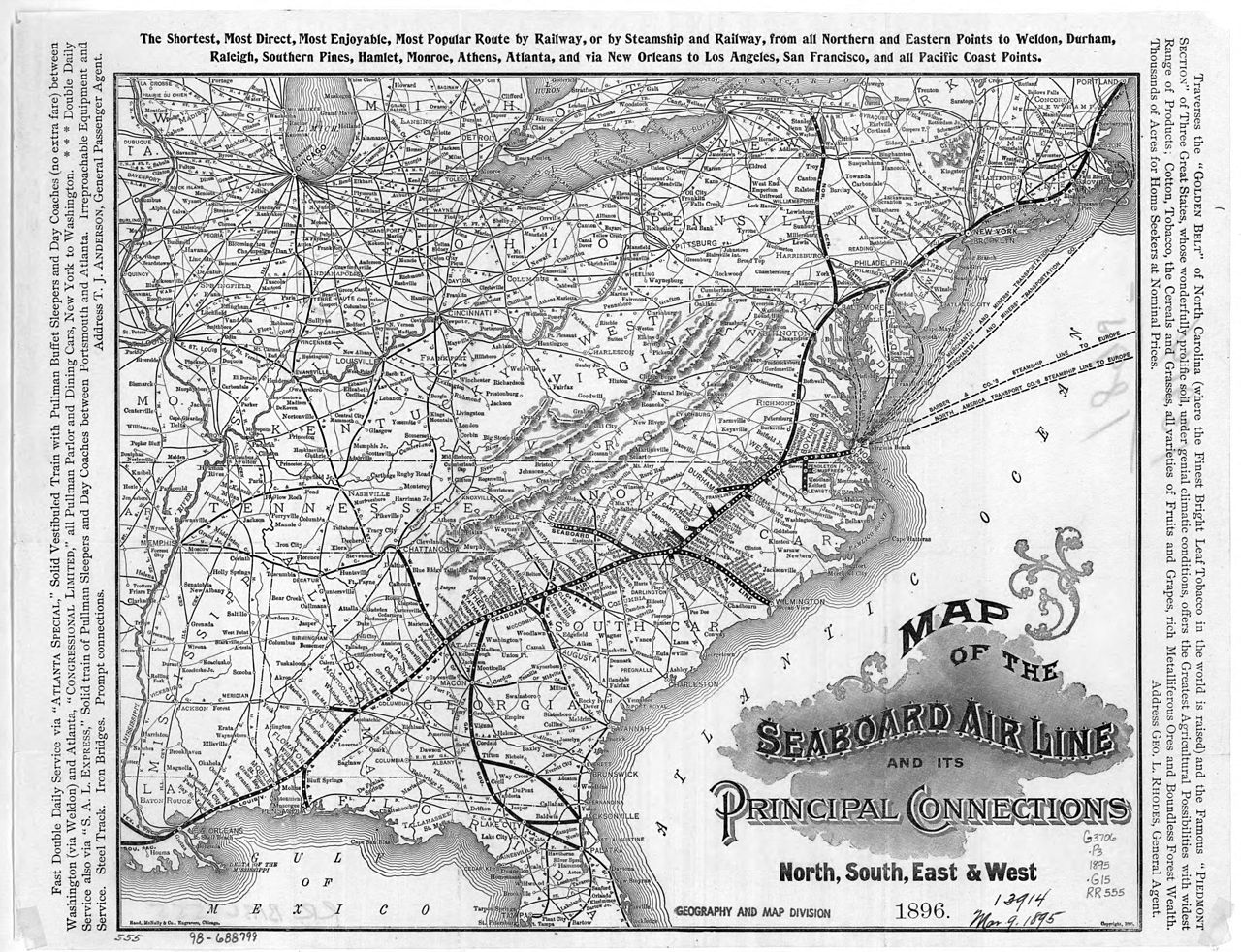
This month’s Classic Trains fallen flag feature is the Seaboard Air Line by Larry Goolsby. The railroad’s earliest antecedent was originally chartered in 1832 to build a rail line from Portsmouth, Virginia to Weldon, North Carolina, a port on the Roanoke River which flows into Albemarle Sound. The Portsmouth & Roanoke began operation in 1834 and changed its name to the Seaboard & Roanoke around 1838 after several financial reorganizations and refinancing efforts. In 1837, the first passenger fatalities in US railroad history occurred in a head-on collision between a eastbound lumber train hit the westbound passenger train from Portsmouth on 11 August. Three young women were killed in the accident, all members of the Ely family.

Along with most other railroads in the Confederate states, Virginian and North Carolinian railroads were seriously damaged physically in the fighting and became political footballs during the Reconstruction Era. In the 1880s, the Seaboard and Roanoke was one of several railroads merged to form the Seaboard Air Line Railway which extended from Virginia to Georgia. The name Seaboard Air Line was in use well before the legal merger as a marketing device to help attract traffic.

The “Air Line” name was often used by railroads of the period to denote a route supposedly “as straight as the crow flies.” It was a reasonably direct run from Portsmouth to Weldon, but the Air Line label would be more than hype when in the 1880s Seaboard acquired a line linking Hamlet and Wilmington, N.C., which included a 79-mile tangent track, longest in the U.S.

As the 19th century closed, the SAL system came under control of a group led by John Skelton Williams, who added a line from Richmond, Va., to Weldon, and acquired the Florida Central & Peninsular, transforming what had been a Portsmouth–Atlanta carrier into a north-south line. In 1900, the various SAL roads were incorporated as Seaboard Air Line Railway with its coastal main line from Richmond going through Raleigh, Columbia, and Savannah to Jacksonville and Tampa.

1896 route map of the Seaboard Air Line.
Wikimedia Commons.

While the World War II years strained SAL’s resources the railroad shouldered the load with new EMD FTs, secondhand steam engines from Western Maryland and Chicago & North Western, and installation of block signals and centralized traffic control over large portions of its main line. Wartime income helped the carrier emerge from receivership in 1946 as Seaboard Air Line Railroad.

High-profile wrecks, several involving passenger trains, spurred quick postwar completion of the signaling and modernization campaign. SAL’s earliest CTC installation had started south from Richmond in 1941. By the early 1950s, signals covered most mainline mileage, keeping the operation competitive with its double-tracked neighbor Atlantic Coast Line.

Seaboard added more streamlined cars from Budd in 1947 and lightweight sleepers from several builders beginning in 1949. The Silver Star name was given to what had been a second section of the Meteor, and the two “Silver Fleet” members held down the first-class New York–Florida trade. The Silver Comet was added to the New York–Birmingham route. Seaboard continued to maintain its premier trains to high standards into the 1960s, proudly calling itself “The Route of Courteous Service.” The Meteor and Star names survive on Amtrak’s New York–Miami route.

As with so many North American railways after World War II, the Seaboard faced stiff competition not only from direct competitors like the Atlantic Coast Line, but also from trucks diverting freight onto the interstate highway system but also from airlines whisking its passengers more rapidly to holiday destinations in Florida. The economic situation was clear in the mid-1950s and Seaboard applied for government approval to merge operations with rival Atlantic Coast in 1958, but did not get through the legal obstacle course until 1967 when the merger was formalized as the new Seaboard Coast Line Railroad.

Teenagers vs the British Empire: Smith Bateman’s Hall Rifle

Filed under: Britain, History, Military, USA, Weapons — Tags: , , , , — Nicholas @ 02:00

Forgotten Weapons
Published 24 Nov 2020

http://www.patreon.com/ForgottenWeapons

https://www.floatplane.com/channel/Fo…

Cool Forgotten Weapons merch! http://shop.bbtv.com/collections/forg…

On May 20, 1826 the United States Congress formally presented Model 1819 Hall rifles with personalized silver plaques to the 20 members of Aikin’s Volunteers, for their “Gallantry at the Siege of Plattsburg”. The Volunteers were a group of 20 boys, aged 14-17, from the Plattsburg Academy who joined up under 21-year-old Martin Aikin to help in the Defense of Platssburg during the British Invasion in 1814. The boys acted as valuable scouts in the days leading up to the battle, and on the main day of fighting they manned positions at a mill on the Saranac River, preventing British troops from crossing under rifle fire. The American General Macomb commended the boys’ contribution to the battle, and promised each a rifle as a token. Of thanks. It would take Congress 14 years to fulfill that promise, but they finally did in 1826, with the only rifles ever presented to civilians by Congress before or since.

Contact:
Forgotten Weapons
6281 N. Oracle #36270
Tucson, AZ 85740

QotD: Accounting for the long-term fall in the crime rate

Filed under: Law, Quotations, USA — Tags: , , , , , — Nicholas @ 01:00

Any criminologist will tell you that criminals as a group are also highly deviant in ways that are not criminal. They have very high rates of accidental injury, alcoholism, nicotine addiction, and involvement in automobile collisions. They have poor impulse control. They have high time preference (that is, they find it difficult to defer gratification or regulate their own behavior in light of distant future consequences). And they’re stupid, well below the whole-population average in IQ or whatever other measure of reasoning capacity you apply. I’m going to revive a term from early criminology and refer to these dysfunctional deviants as “jukes”.

One clue to the long-term fall in crime rates may be that most of the juke traits I’ve just described are heritable. Note that this is not exactly the same thing as genetically transmitted; children may to a significant extent acquire them from their families by imitation and learning.

The long-term fall in crime rates suggest that something may have been disrupting the generational transmission of traits associated with criminal deviance. Are there plausible candidates for that something? Are there selective pressures operating against jukeness that have become more pressing since the 1960s?

I think I can name three: ready availability of intoxicants, contraception, and automobiles.

Once I got this far in my thinking I realized that the authors of Freakonomics got there before me on one of these; they argued for a strong forward influence from availability of abortion to decreased crime rates two decades later. And yes, I know that a couple of conservative economists (Steve Sailer and John Lott) think they’ve found fatal flaws in the Levitt/Dubner argument; I’ve read the debate and I think Levitt/Dubner have done an effective job of defending their insight.

But I’m arguing a more general case that subsumes Levitt/Dubner. That is, that modern life makes juke traits more dangerous to reproductive success than they used to be. Automobiles are a good example. Before they became ubiquitous, most people didn’t own anything that they used every single day and that so often rewarded a moment’s inattention with injury or death.

Ready availability of cheap booze and powerful drugs means people with addictive personalities can kill themselves faster. Easy access to contraception and abortion means impulse fucks are less likely to actually produce offspring. More generally, as people gain more control over their lives and faster ways to screw up, the selective consequences from bad judgment and the selective premium on good judgment both increase.

Eric S. Raymond, “Beyond root causes”, Armed and Dangerous, 2010-01-12.

March 3, 2021

Gen Z is suffering … but not enough?

Filed under: Britain, Health, USA — Tags: , , , , — Nicholas @ 03:00

In Quillette, Freya India considers the plight many of her cohort find themselves in during the ongoing efforts to combat the spread of the Wuhan Coronavirus (aka Covid-19):

“Gen Z” by EpicTop10.com is licensed under CC BY 2.0

My generation is miserable. Gen Z, those of us born after 1997, are the saddest, loneliest, and most mentally fragile age group to date, cursed with rising rates of anxiety, depression, and suicide. How can that be? How can a generation with everything feel so desperately unhappy? By almost every metric, human life is dramatically better today than it ever has been. The number of people living in extreme poverty has fallen from around 90 percent in 1820 to just 10 percent in 2015, while rates of illiteracy, mortality, and battle deaths are also in rapid decline. For the most part, Gen Z are heirs to an immense fortune: a utopian world of instant gratification and technological dynamism. In theory, this should be the age of happiness.

And yet, misery abounds. In the United States, 54 percent of Gen Z report anxiety and nervousness, according to researchers at the American Psychological Association. This is compared with only 40 percent of millennials and a national average of 34 percent. It isn’t just a case of self-report bias either, since the suicide rate for Americans aged between 15 and 24 has risen by over 51 percent in the last decade. For Gen Z women in particular, suicide rates have risen a staggering 87 percent since 2007. In my home country of the UK, one in four girls is clinically depressed by the time they are 14.

There’s no shortage of articles trying to make sense of the mental health epidemic at a time of such global prosperity. Teens and pre-teens today, we’re told, are simply interred beneath the weight of political issues like climate change, immigration, and sexual assault, as well as fatigued by job stress, exam burnout, and the attainment of unrealistic social media standards. The antidote, many suggest, lies in practicing better “self-care,” from daily gratitude journaling to adopting a 38-step skincare routine. And it’s a popular remedy. Since the pandemic began, online searches for “self-care” have risen 250 percent, with schools, universities, and employers turning to compulsory wellness programmes like mindfulness training and meditation sessions to improve mental health.

But, I suspect the problem is more nuanced than this. I don’t doubt that Gen Z is under a lot of strain, but I also think our plight is unique. For the first time in history, much of our misery stems not from too much suffering, but from not suffering enough. Gen Z does face real problems. I have certainly felt beleaguered by the pressures of social media, an oversaturated job market and the impact of coronavirus restrictions on my education. On top of that, there’s the difficulty of simply trying to exist as a fallible human in a political climate which demands infallibility, where nothing feels light-hearted anymore, and everything we say or do in our youth is stained onto the Internet for all time.

So, pressure is no doubt part of it. But previous generations faced egregiously difficult times: world wars, pandemics, economic crises, political rebellions, totalitarian regimes, and conditions of extreme poverty. Not only that, but today there are a wider range of mental health services available than ever before, and Gen Z are more likely than any other generation to seek treatment. So, for our rates of mental illness and suicide to be so high in a time of relative peace, there must exist a more convincing explanation than simply the asperities of life.

What lurks over my generation is not just a sense of misery, but meaninglessness. We exist in a state of lethargy and unfulfillment, tormented not by the tragedy of it all, but the futility. This is a point most articles and public figures today are less willing to discuss. But, to examine this possibility isn’t to say that Gen Z never struggle — but to suggest that at least some of us are caught in a rut of boredom, not burnout.

March 1, 2021

In the 2020 US federal election, “Each side felt that the stakes were existential”

Filed under: Government, Media, Politics, USA — Tags: , , , , , — Nicholas @ 03:00

Michael Anton discusses what he calls the “Continuing Crisis” in the Claremont Review of Books:

“Polling Place Vote Here” by Scott Beale is licensed under CC BY-NC-ND 2.0

A full understanding of what happened that Wednesday would begin with the ruling class’s decades-long betrayal and despoliation of what would eventually come to be called Red or Deplorable or Flyover America. But the more proximate cause was the 2020 election — easily the highest intensity such contest of my lifetime. Each side felt that the stakes were existential. The accuracy of those feelings doesn’t matter; their existence was enough to drive events.

As an incumbent seeking a second term, President Trump — even after the COVID lockdowns had tanked America’s previously supercharged economy — seemed to have a lot of things going for him: near-unanimous support from the base, high primary turnout even though he faced no opposition, a seemingly unified party, approval ratings not far from Barack Obama’s in 2012. According to Gallup, in September 2020 56% of Americans reported doing better than they had four years prior — a level that, in ordinary times, would all but guarantee an incumbent’s re-election.

But these were not ordinary times. It was also easy to see — and many friends and supporters of the president did see, and warned about — shoals ahead. The Democrats used the pandemic as an excuse to accelerate and intensify their decades-long effort to loosen and change American election practices in ways that favor their party. In the spring, they began openly talking about staging a coup: literally using the military to yank Trump from power. It’s one thing to hold a “war game” and plot in secret about a president’s ouster, but why leak the result? Only if you want the public prepared for what otherwise would look like outrageous interference in “our democracy.” Democrats and their media allies also, and for the same reason, assiduously pushed the so-called “Red Mirage” narrative: the story that, while you are likely to see Trump way ahead on election night, he will certainly lose as all the votes are counted. This was less a prediction than preemptive explanation: what you see might look funny, but let us assure you in advance that it’s all on the up-and-up.

In response (or lack thereof) to the other side’s assiduous preparations, the president, his staff, his campaign, and his party committed four serious errors of omission. First, they made hardly any attempt to work with Republican state officials — governors, legislatures, and secretaries of state — to oppose and amend rule changes that would disadvantage them and favor their opponents. As far back as the 2016 election, Trump had complained that Hillary Clinton’s popular vote total had been padded by several million votes by illegal immigrants. Yet he and the GOP did very little to tighten state election procedures. Second, after having failed adequately to oppose those changes, they mounted far too few legal challenges to get them overturned or modified. Third, having declined to challenge the changes, they barely even tried to ramp up their own mail-in voting operation to rival the Democrats’. Fourth, despite numerous loud predictions — both as boasts and warnings — that the election outcome would be unclear and disputed in several states, no team was assembled in advance to investigate and, if necessary, litigate the results. Florida 2000 came as a surprise to candidates Al Gore and George W. Bush. Nonetheless the Bush campaign was able to field almost immediately an army of lawyers, including experts on election law, headed by a former secretary of state, the wily James Baker. The Trump team had at least six months’ warning and, as far as I can see, did nothing to prepare.

H/T to “currencylad” at Catallaxy Files for the link.

February 28, 2021

Japan Destroys Allied Armada in Biggest Naval Battle in Decades – WW2 – 131 – February 27, 1942

World War Two
Published 27 Feb 2021

The Japanese are advancing in the Dutch East Indies and Burma, brushing aside defenders, but their biggest victory this week is at sea, when they not only brush aside the ABDA Fleet, but literally wipe it out of existence. Meanwhile Italian and German submarines are patrolling the Caribbean, sinking any Allied merchant shipping they find. It is yet another week of Axis successes.

Join us on Patreon: https://www.patreon.com/TimeGhostHistory
Or join The TimeGhost Army directly at: https://timeghost.tv

Follow WW2 day by day on Instagram @ww2_day_by_day – https://www.instagram.com/ww2_day_by_day
Between 2 Wars: https://www.youtube.com/playlist?list…
Source list: http://bit.ly/WW2sources

Written and Hosted by: Indy Neidell
Director: Astrid Deinhard
Producers: Astrid Deinhard and Spartacus Olsson
Executive Producers: Astrid Deinhard, Indy Neidell, Spartacus Olsson, Bodo Rittenauer
Creative Producer: Maria Kyhle
Post-Production Director: Wieke Kapteijns
Research by: Indy Neidell
Edited by: Iryna Dulka
Sound design: Marek Kamiński
Map animations: Eastory (https://www.youtube.com/c/eastory​)

Colorizations by:
– Mikołaj Uchman
– Norman Stewart – https://oldtimesincolor.blogspot.com/​

Sources:
– National Portrait Gallery
– IWM: H 17365, A_238, CB(OPS) 5008

Soundtracks from the Epidemic Sound:
– Rannar Sillard – “Easy Target”
– Howard Harper-Barnes- “Underlying Truth”
– Jo Wandrini – “Dragon King”
– Fabien Tell – “Last Point of Safe Return”
– Wendel Scherer – “Out the Window”
– Reynard Seidel – “Rush of Blood”
– Brightarm Orchestra – “On the Edge of Change”
– Craft Case – “Secret Cargo”
– Phoenix Tail – “At the Front”
– Johan Hynynen – “Dark Beginning”
– Wendel Scherer – “Growing Doubt”

Archive by Screenocean/Reuters https://www.screenocean.com​.

A TimeGhost chronological documentary produced by OnLion Entertainment GmbH.

Should the Republicans embrace “class warfare”?

Filed under: Politics, USA — Tags: , , , — Nicholas @ 03:00

Scott Alexander proffers some advice to the US Republican Party in its post-Trump doldrums, even though he admits that “I hate you and you hate me. But maybe I would hate you less if you didn’t suck. Also, the more confused you are, the more you flail around sabotaging everything.”

So here’s my recommendation: use the word “class”. Pivot from mindless populist rage to a thoughtful campaign to fight classism.

Yeah, yeah, “class” sounds Marxist, class warfare and all that, you’re supposed to be against that kind of thing, right? Wrong. Economic class warfare is Marxist, but here in the US class isn’t a purely economic concept. Class is also about culture. You’re already doing class warfare, you’re just doing it blindly and confusedly. Instead, do it openly, while using the words “class” and “classism”.

Trump didn’t win on a platform of capitalism and liberty and whatever. He won on a platform of being anti-establishment. But which establishment? Not rich people. Trump is rich, lots of his Cabinet picks were rich, practically the first thing he did was cut taxes on the rich. Some people thought that contradicted his anti-establishment message, but those people were wrong. Powerful people? Getting warmer, but Mike Pence is a powerful person and Trump wasn’t against Mike Pence. Smart people? Now you’re burning hot.

Trump stood against the upper class. He might define them as: people who live in nice apartments in Manhattan or SF or DC and laugh under their breath if anybody comes from Akron or Tampa. Who eat Thai food and Ethiopian food and anything fusion, think they would gain 200 lbs if they ever stepped in a McDonalds, and won’t even speak the name Chick-Fil-A. Who usually go to Ivy League colleges, though Amherst or Berkeley is acceptable if absolutely necessary. Who conspicuously love Broadway (especially Hamilton), LGBT, education, “expertise”, mass transit, and foreign anything. They conspicuously hate NASCAR, wrestling, football, “fast food”, SUVs, FOX, guns, the South, evangelicals, and reality TV. Who would never get married before age 25 and have cutesy pins about how cats are better than children. Who get jobs in journalism, academia, government, consulting, or anything else with no time-card where you never have to use your hands. Who all have exactly the same political and aesthetic opinions on everything, and think the noblest and most important task imaginable is to gatekeep information in ways that force everyone else to share those opinions too.

(full disclosure: I fit like 2/3 of these descriptors)

Aren’t I just describing well-off people? No. Teachers, social workers, grad students, and starving artists may be poor, but can still be upper-class. Pilots, plumbers, and lumber barons are well-off, but not upper-class. Donald Trump is a billionaire, but still recognizably not upper class. The upper class is a cultural phenomenon.

Aren’t I just describing Democrats? No. The Democrats are a coalition of the upper class, various poor minorities, union labor, and lots of other groups. It’s an easy mistake to make, because you Republicans absolutely loathe the upper class, and whenever you’re talking about Democrats you focus on this group and how much you hate them. But you make the mistake of saying you hate Democrats, and then it looks like boring old partisanship. Or saying you hate the elites, and then it looks like boring old populism. Or saying you hate rootless cosmopolitans, and then it looks like boring old anti-Semitism. Or saying you hate the government, and then it looks like boring old libertarianism.

Instead, just use the words “class” and “classism”. Say “Hey, we Republicans want to be the party of the working class. We are concerned about the rising power of the upper class, and we are dedicated to stamping out classism.”

This is what happens when nobody uses the word “class”!

Cultural appropriation foods around the world

Filed under: Britain, Europe, Food, France, History, India, Italy, Japan, Pacific, USA — Tags: , , , , — Nicholas @ 02:00

J.J. McCullough
Published 14 Dec 2019

Baguettes in Vietnam! Curry in Japan! Tea in India! Let’s look at the practice of eating food from other countries, which is more widespread than you might think, thanks to imperialism and immigration.

FOLLOW ME:

🇨🇦Support me on Patreon! https://www.patreon.com/jjmccullough
🤖Join my Discord! https://discord.gg/3X64ww7
🇺🇸Follow me on Instagram! https://www.instagram.com/jjmccullough/
🇨🇦Read my latest Washington Post columns: https://www.washingtonpost.com/people…
🇨🇦Visit my Canada Website http://thecanadaguide.com

HASHTAGS:
#food #curry #empire

QotD: The essential role of writers like Twain and Mencken

Filed under: Humour, Politics, Quotations, USA — Tags: , , , , , — Nicholas @ 01:00

Mencken lived in horror of the American people, “who put the Hon. Warren Gamaliel Harding beside Friedrich Barbarossa and Charlemagne, and hold the Supreme Court to be directly inspired by the Holy Spirit, and belong ardently to every Rotary Club, Ku Klux Klan, and anti-Saloon League, and choke with emotion when the band plays ‘The Star-Spangled Banner.'” Much of that horror was imaginary, and still is. But we must have horror, especially in politics. How else to justify present and familiar horror except but by reference to a greater horror? In this year’s election, each candidate’s partisans already have been reduced to making the argument that while their own candidate might be awful, the other candidate is literally akin to Adolf Hitler. Yesterday, I heard both from Clinton supporters and Trump supporters that the other one would usher in Third Reich U.S.A. “Don’t tell yourself that it can’t happen here,” one wrote.

A nation needs its Twains and Menckens. (We could have got by without Molly Ivins.) The excrement and sentimentality piles up high and thick in a democratic society, and it’s sometimes easier to burn it away rather than try to shovel it. But they are only counterpoints: They cannot be the leading voice, or the dominant spirit of the age. That is because this is a republic, and in a republic, a politics based on one half of the population hating the other half is a politics that loses even if it wins. The same holds true for one that relies on half of us seeing the other half as useless, wicked, moronic, deluded, or “prehensile morons.” (I know, I know, and you can save your keystrokes: I myself am not running for office.) If you happen to be Mark Twain, that sort of thing is good for a laugh, and maybe for more than a laugh. But it isn’t enough. “We must not be enemies,” President Lincoln declared, and he saw the republic through a good deal worse than weak GDP growth and the sack of a Libyan consulate.

Kevin D. Williamson, “Bitter Laughter: Humor and the politics of hate”, National Review, 2016-08-11.

February 27, 2021

Q&A: Shooting the $ɦ!☦ with InRangeTV

Filed under: Food, History, USA — Tags: , , , , , — Nicholas @ 04:00

Atun-Shei Films
Published 26 Feb 2021

See the rest of our conversation over on Karl’s channel ► https://youtu.be/3sgc0BckrB8​

Atun-Shei and InRange finally got together for a chat! In this video we answer questions from our generous patrons, discussing New Orleans culture, Creole food, the gunfight at the OK Corral, urban life in the ancient world, Confederate monuments, historical justifications for slavery, Louisiana Voodoo, Cajun French, Ron Maxwell movies, and the importance of compassion and empathy.

Support Atun-Shei Films on Patreon ► https://www.patreon.com/atunsheifilms​
Leave a Tip via Paypal ► https://www.paypal.me/atunsheifilms

Buy Merch ► teespring.com/stores/atun-shei-films​

#AtunSheiFilms​ #InRangeTV​ #History​

Original Music by Dillon DeRosa ► http://dillonderosa.com/​
Reddit ► https://www.reddit.com/r/atunsheifilms​
Twitter ► https://twitter.com/atun_shei

February 26, 2021

U.S. Detention, Nazi Deportation, and Death in the East – WAH 029 – February 1942, Pt. 2

Filed under: Germany, History, Italy, Japan, Military, USA, WW2 — Tags: , , , , , , — Nicholas @ 04:00

World War Two
Published 25 Feb 2021

Franklin D. Roosevelt signs an order to intern all Japanese-American citizens on the West Coast of the United States, while the Italians open up new concentration camps to deal with their ethnic enemies in the Balkans. At the same time, a large group of Jews attempts to escape Europe by boat, with disastrous consequences.

Join us on Patreon: https://www.patreon.com/TimeGhostHistory
Or join The TimeGhost Army directly at: https://timeghost.tv

Follow WW2 day by day on Instagram @ww2_day_by_day – https://www.instagram.com/ww2_day_by_day
Between 2 Wars: https://www.youtube.com/playlist?list…
Source list: http://bit.ly/WW2sources

Hosted by: Spartacus Olsson
Written by: Joram Appel and Spartacus Olsson
Director: Astrid Deinhard
Producers: Astrid Deinhard and Spartacus Olsson
Executive Producers: Astrid Deinhard, Indy Neidell, Spartacus Olsson, Bodo Rittenauer
Creative Producer: Maria Kyhle
Post-Production Director: Wieke Kapteijns
Research by: Joram Appel
Edited by: Miki Cackowski
Sound design: Marek Kamiński
Map animations: Eastory (https://www.youtube.com/c/eastory​), Miki Cackowski

Colorizations by:
Norman Stewart – https://oldtimesincolor.blogspot.com/​
Mikołaj Uchman

Sources:
Yad Vashem 143BO2, 5344/2, 6263, 9744/1, 15000/14187511, 15000/14258277, 15000/14088811
Martyr’s path to freedom (Mučeniška pot k svobodi), Ljubljana, 1946
USHMM
View of the Struma in the Istanbul harbor, February 1942, courtesy of USHMM, David Stoliar
From the Noun Project: Ship by kareemovic1000

Soundtracks from the Epidemic Sound:
Cobby Costa – “Flight Path”
Fabien Tell – “Break Free”
Philip Ayers – “It’s Not a Game”
Fabien Tell – “Last Point of Safe Return”
Fabien Tell – “Remembrance”
Rannar Sillard – “Split Decision”
Skrya – “First Responders”

Archive by Screenocean/Reuters https://www.screenocean.com​.

A TimeGhost chronological documentary produced by OnLion Entertainment GmbH.

Waymarkers of the American caste system

Filed under: Books, Education, USA — Tags: , , , , , — Nicholas @ 03:00

Scott Alexander reviews Paul Fussell’s Class: A Guide Through The American Status System, and finds Fussell has helpfully delineated how an outsider can guess someone’s class (or caste, as Fussell would prefer) … at least how that outsider could do so in 1983:

The upper class is old money. The people you think of as rich and famous — tech billionaires, celebrities, whatever — aren’t upper class. However privileged they started off, they still had to put in at least a smidgeon of work to get their money, which disqualifies them. Real uppers inherit. Even famous people who come from old money usually aren’t central examples of upper class; the real upper class has no need to seek fame. They mostly just throw parties — but not interesting parties, because that would imply they have something to prove, which they don’t. They live in mansions — but not awesome mansions they designed themselves with some kind of amazing gaming room or something, because that would imply they have something to prove, which they don’t. They live in meticulously boring mansions and throw meticulously boring parties. They have the best and classiest versions of everything, but it’s a faux pas to compliment any of it, because that would imply that they were the sort of people who might potentially not have had the best and classiest version of that thing. They fill their houses with Picassos and exquisite antique furniture, and none of them ever express the slightest bit of satisfaction or praise about any of it. You have never heard of any of these people, although you might recognize the last name they share with a famous ancestor (Rockefeller, Ford, etc).

The middle classes are salaried professionals, starting with the upper-middle class. Jeff Bezos, for all his billions, is only upper-middle-class at best. So are many of the other people you think of as rich and famous and successful. The upper-middle-class likes New England, Old England, yachts, education, good grammar, yachts, chastity, androgyny, the classics, the humanities, and did I mention yachts?

The middle class is marked by status anxiety. The working class knows where they stand and are content. The upper-middle class has made it; they’re fine. And the upper class doesn’t worry about status because that would imply they have something to prove, which they don’t. But the middle class is terrified. These are the people with corporate jobs who say things like “I’ve got to make a good impression at the meeting Tuesday because my boss’ boss will be there and that might determine whether I get the promotion I’m going for”. The same attitude carries into the rest of their lives; their yards and houses are maintained with a sort of “someone who could change my status might be watching, better make a good impression”. They desperately avoid all potentially controversial opinions — what if the boss disagrees and doesn’t promote them? What if the neighbors disagree and they don’t get invited to parties? They are the most likely to be snobbish and overuse big words, the most obsessed with enforcing norms of virtuous behavior, and the least interested in privacy — asserting any claim to privacy would imply they have something to hide. Their Official Class Emotions are earnestness and optimism; they are the people who patronize musicals like Annie and Man of La Mancha where people sing saccharine songs about hopes and dreams and striving, and the people who buy inspirational posters featuring quotes about perseverance underneath pictures of clouds or something.

Proles do wage labor. High proles are skilled craftspeople like plumbers. Medium and low proles are more typical factory workers. They have a certain kind of freedom, in that they don’t have status anxiety and do what they want. But they’re also kind of sheep. They really like mass culture — the more branded, the better. These are people who drink Coca-Cola (and feel good about themselves for doing so), visit Disneyland (and accept its mystique at face value), and go on Royal Caribbean cruises. When they hear an ad say a product is good, they think of it as a strong point in favor of buying the product. They feel completely comfortable expressing their opinions, but their opinions tend to be things like “Jesus is Lord!”, “USA is number one!”, “McDonalds is so great!”, and “Go $LOCAL_SPORTS_TEAM!”. They are weirdly obsessed with cowboys (Fussell says cowboys represent the idea that poorer people are freer and more authentic than rich office-worker types, plus the West is the prole capital of the USA) and with unicorns (Fussell: “I’ve spent six months trying to find out exactly why, and I’m finally stumped”). When they have unique quirks, they tend to be things like “collecting lots of Disney memorabilia” or “going powerboating slightly more often than the other proles do”. There’s also a sort of desperate prole desire to be noticed and individuated, which takes the form of lots of “Personalized X” or “Y with your name on it”, and also with making a lot of noise (see: powerboating). Fussell describes the most perfectly prole piece of decor as “a blue flameproof hearthrug with your family name in Gothic letters beneath seven spaced gold stars and above a golden eagle in Federal style”.

It’s impossible to tell when Fussell is serious vs. joking. The section on the physiognomy of different classes has to be a joke, right? But then how did he come up with the Virgin vs. Chad meme in 1983? Also, why does my brain keep telling me these are John McCain and Donald Trump?

A friend urges me to think of these not as “rich/successful people” vs. “poor/unsuccessful people”, but as three different ladders on which one can rise or fall. The most successful proles are lumber barons or pro athletes or reality TV stars. These people are much richer and more powerful than, say, a schoolteacher, but they’re still proles, and the schoolteacher is still middle class. Likewise, a very successful middle class person might become a professor or a Senator or Jeff Bezos, but this doesn’t make them even a bit upper class.

(I’m not sure it’s possible to be a more or less successful upper class person; being successful would imply having something to prove, which they don’t).

February 24, 2021

Japan’s Biological Terror! – The Horror of Unit 731 – WW2 Special

Filed under: China, History, Japan, Military, USA, Weapons, WW2 — Tags: , , , , , — Nicholas @ 04:00

World War Two
Published 23 Feb 2021

As one of the few nations during World War Two, Japan made expensive use of biological and chemical weapons, both on and off the battlefield. Unit 731 is their special bio-warfare department, which conducts testing on living human civilians.

Join us on Patreon: https://www.patreon.com/TimeGhostHistory
Or join The TimeGhost Army directly at: https://timeghost.tv

Follow WW2 day by day on Instagram @ww2_day_by_day – https://www.instagram.com/ww2_day_by_day
Between 2 Wars: https://www.youtube.com/playlist?list…
Source list: http://bit.ly/WW2sources

Hosted by: Spartacus Olsson
Written by: Joram Appel
Director: Astrid Deinhard
Producers: Astrid Deinhard and Spartacus Olsson
Executive Producers: Astrid Deinhard, Indy Neidell, Spartacus Olsson, Bodo Rittenauer
Creative Producer: Maria Kyhle
Post-Production Director: Wieke Kapteijns
Research by: Joram Appel
Edited by: Karolina Dołęga
Sound design: Marek Kamiński

Colorizations by:
– Daniel Weiss
– Mikołaj Uchman
– Dememorabilia – https://www.instagram.com/dememorabilia​
– Klimbim
– Norman Stewart – https://oldtimesincolor.blogspot.com/​

Sources:
– National Archive NARA
– Imperial War Museums: D 3162, HU67224, HU 44941, Q 114057
– Bundesarchiv

Soundtracks from Epidemic Sound:
– “For the Many STEMS INSTRUMENTS” – Jon Bjork
– “Weapon of Choice” – Fabien Tell.
– “Moving to Disturbia” – Experia
– “Symphony of the Cold-Blooded” – Christian Andersen
– “It’s Not a Game” – Philip Ayers
– “Please Hear Me Out STEMS INSTRUMENTS” – Philip Ayers
– “London” – Howard Harper-Barnes
– “Break Free” – Fabien Tell
– “Not Safe Yet” – Gunnar Johnsen

Archive by Screenocean/Reuters https://www.screenocean.com​.

A TimeGhost chronological documentary produced by OnLion Entertainment GmbH.

Disney’s Best Propaganda Cartoon

Filed under: Education, Germany, History, Politics, USA, WW2 — Tags: , , — Nicholas @ 02:00

J.J. McCullough
Published 21 Nov 2020

A review of Education for Death, a WW2 propaganda film. This video was sponsored by the Great Courses Plus! Start your free trial today by clicking here: http://ow.ly/az9m30rkCKF

Check out Three Arrows here: https://www.youtube.com/channel/UCCT8…

During the World War II, Disney made a number of cartoons to boost public support for the Allies and denounce Germany. This one, about Little Hans, has always been my favorite.

FOLLOW ME:

🇨🇦Support me on Patreon! https://www.patreon.com/jjmccullough
🤖Join my Discord! https://discord.gg/3X64ww7
🇺🇸Follow me on Instagram! https://www.instagram.com/jjmccullough/
🇨🇦Read my latest Washington Post columns: https://www.washingtonpost.com/people…
🇨🇦Visit my Canada Website http://thecanadaguide.com

HASHTAGS: #propaganda #history #germany

« Newer PostsOlder Posts »

Powered by WordPress