
I’ve been out of academia for a few years, but this bespoke sexuality nonsense was already exploding by the time I got out. I saw two big shifts in the studentry during my academic career. The first was the catastrophic drop in academic readiness, thanks mostly to No Child Left Behind (et al. Lots of trends contributed, especially Participation Trophy culture, but NCLB is a good synecdoche). The second was the end of all-out college kid hedonism.
By the end of my last tour of duty, most college kids were dour puritans. I know, I know, but hear me out. This is the thing people keep forgetting about the Internet: People lie. I know we all know that consciously, but we seem hardwired to believe confessions. In the same way that we might not consciously watch TV — might go some distance out of our way to avoid it — but find ourselves staring mindlessly at the blinking screen when we’re in a bar or a waiting room or something. It seems to be hardwired. So when these folks start writing about all the bizarre sexual shit they’re into, we just … believe them. Sight unseen.
But y’all, in the kingdom of the blind, the one-eyed man is king. I want to state, unequivocally and for the record, that my entire knowledge of undergrads’ sex lives is secondhand. I have zero personal experience in this area. But it’s a close secondhand. For one thing, there’s not much to do in College Town that doesn’t involve undergrads, so I ended up drinking at a lot of the same bars, and in vino veritas. Second, kids these days have no filter. None whatsoever. Finally, social media — my last tour was at a SPLAC, where they strongly encouraged the faculty to be “friends” with the student body on their campus social media apps.
And yeah, they SAY a lot of things … but I highly, highly doubt they actually DO much of anything at all.
For one thing, those “student” bars were lucky I and a few other semi-normal profs were still in our “drink away the pain” phase, because otherwise they would’ve gone out of business. Friday and Saturday nights during football season were still pretty lively, but the rest of the week the “downtown” bars had all the crackling energy of singles’ night down at the mortuary.
Kids just don’t socialize much IRL, and when they do, they don’t hook up. In my not-inconsiderable experience, college drinking these days is like college anything — a grim, pinch-faced, assembly-line business. They intend to get blackout hammered, and they get after it like Heroes of Socialist Labor. Pausing for a quickie in the bathroom would mean skipping a turn in the drinking game — and they all play drinking games; it’s bizarre — so no thanks.
And y’all, those are the outgoing ones. The ones who still have some slight urge to see and be seen out in physical space. The rest of ’em never leave their rooms except at gunpoint, and when you force them to, their eyes never leave their phones.
That’s why I’d bet many crisp stacks of Crispus Attucks that all the “kink” in their social media profiles — even their personal ads — are just for show. They’re not listing all that stuff in order to find someone to have sex with. They’re using it as an excuse not to have sex with anybody, because “having sex with” entails personal interaction and they’re terrified of that. If they ever perfect those VR sex helmets like they had in Demolition Man, watch out, but as of now the whole idea is to seem weird and daring and liberated and kinky, but with no possibility of a follow-up. Oh, you’re into aardvarks and dental tools too? Um … yay? Oh, wait, you dress up as O. a. erikssoni, and I’m only into O. a. leptodon. Sorry!
Severian, “Saturday Miscellania”, Founding Questions, 2022-08-13.
November 29, 2022
November 28, 2022
Near Peer: China (Understanding the Chinese Military)
Army University Press
Published 29 Jul 2022This film examines the Chinese military. Subject matter experts discuss Chinese history, current affairs, and military doctrine. Topics range from Mao, to the PLA, to current advances in military technologies. “Near Peer: China” is the first film in a four-part series exploring America’s global competitors.
(more…)
Mulberry Harbours – Rhinos, Whales, Beetles, Phoenixs and Spuds against the Axis
Drachinifel
Published 13 Jul 2022Today we take a look at the artificial harbours designed, built and then installed on the Normandy beaches in 1944.
Many thanks to @Think Defence for finding and collating so many images and letting me use them! Follow them on Twitter or on their website for more interesting articles!
(more…)
November 27, 2022
The Costliest Day in US Marine History – WW2 – 222 – November 26, 1943
World War Two
Published 26 Nov 2022The Americans attack the Gilbert Islands this week, and though they successfully take Tarawa and Makin Atolls, it is VERY costly in lives, and show that the Japanese are not going to be defeated easily. They also have a naval battle in the Solomons. Fighting continues in the Soviet Union and Italy, and an Allied conference takes place in Cairo, a prelude for a major one in Teheran next week.
(more…)
The Biggest Lie of WWII? The Myth of the Norden Bombsight
Flight Dojo
Published 16 Jun 2022I think most of us, at some point, have had someone say to us “You know, we went to the moon with less computing power than your iPhone” or something to that effect. What you may not know, though, is that less than a century ago, a 2000-piece mechanical computer that lacked a single transistor or chip was the most closely guarded military secret of the Allied war effort. Or, at least, the second most.
Before being overshadowed by the Manhattan Project, the U.S. Navy spent billions helping Carl Norden develop a mechanical computer with one job and one job only: to determine the point at which a level-flying bomber would need to drop its bombs to achieve “pinpoint accuracy” on an intended target.
When it was completed, Mr. Norden famously claimed that the sight was so accurate that it was capable of putting a bomb inside a pickle barrel. And if it could, then war would be revolutionized, or so the powers-at-be thought. The idea was simple: fly your bombers above the enemy’s air defenses, above the reach of their flak batteries, faster than their fighters could fly, and drop your bombs, with pinpoint accuracy, on crucial industrial sites, robbing the enemy of their ability to manufacture the equipment they need to wage a war in the first place.
The only problem was that everything about the Norden Bombsight turned out to be a myth. Not just the obviously mythical bits, like the fact that the crosshairs in the site itself were actually webs from a Black Widow, or that, instead, the reticle was made from the strands of hair of a young Midwestern girl, but everything, the accuracy, the secrecy, and even the fact that it was the only bombsight used in the war.
So how can this be? Until two weeks ago, I believed that the Norden Bombsight was an ingenious piece of equipment that more than any other singular device, changed the tides of WWII in favor of the allies. So why do we still believe in the Norden Bombsight?
Because, as it turns out, myths are useful, not just to the Army Air Corps, the Carl Norden Company, and Hollywood, but to us, the public. As it turns out, they can help us swallow hard truths about the war we’d prefer to avoid.
(more…)
November 26, 2022
Why so Deadly? – Battle of Okinawa 1945
Real Time History
Published 25 Nov 2022The American invasion of Okinawa was the last big island operation on the Pacific Front. It took the US Marines and Army troops several months to defeat the last Japanese resistance on the island in one of the costliest American victories of the 2nd World War — but in the end not even Japanese Kamikaze attacks and using the civilian population could avert the outcome.
(more…)
The Volcanic: Smith & Wesson’s First Pistol
Forgotten Weapons
Published 18 Aug 2017The deep beginnings of the Volcanic go back to Walter Hunt’s Volitional Repeater, which became the Jennings repeating rifle, which then became the Smith-Jennings repeating rifle when Horace Smith was brought in to improve it. Smith was able to make it more commercially viable than the Jennings had been, but he recognized that the system needed significant changes to really become successful. He had met a fellow gun designer who had similar ideas, by the name of Daniel Wesson, and the two would spend a couple years developing and refining the system. In 1854 they thought it was ready for production, and formed the Smith & Wesson Company.
Included in the original company was a man named Courtland Palmer, who owned the patent rights to the Jennings system. Smith & Wesson’s system would probably have been deemed an infringement of Palmer’s patents, and by bringing him into the company they avoided legal trouble. The fact that he was a relatively wealthy financier of the new company certainly didn’t hurt!
The pistol that S&W started producing was a manually repeating one with a tubular magazine under the barrel holding either 6 or 10 rounds. It was available in the .41 caliber Navy model (note: not actually adopted by the Navy) and the .31 caliber pocket version. In this first iteration, both used iron frames, which were all engraved lightly. The prices were pretty steep, and the guns suffered from some reliability problems and a fundamental problem of underpowered ammunition (the .41 caliber had a muzzle velocity of just 260 fps / 79 m/s). However, they did offer a much greater level of rapid repeating firepower than the muzzle loading revolvers of the period, and gained some loyal fans. In total, just 1700 of the guns were produced before the company went bankrupt, about a year after forming.
To recover from that setback, they reformed the company into the new Volcanic Repeating Arms Company, and sold stock in the new company to generate a new supply of capital. This allowed them to get back into production, and the Volcanic company would make another 3000 pistols, all .41 caliber Navy types, before also running out of money 19 months later in 1856.
At this point, Smith and Wesson decide to move in another direction, and one of the main creditors of the Volcanic company was able to acquire all of its assets and put the guns into production a third time. The name of this creditor? None other than Oliver Winchester. Winchester puts a new infusion of his own money into the company under the name New Haven Arms Company. This company produces another 3300 guns, both large and small frame by 1861. The New Haven company comes very near to bankruptcy itself before finally changing the design to create the Henry repeating rifle. The Henry’s rimfire ammunition finally solved the reliability and power problems of the Volcanic, and became the starting point for Winchester to become one of the predominant American arms making companies.
(more…)
November 25, 2022
Our old, comfortable geopolitical certainties are becoming less comfortable and less certain
In The Line, Matt Gurney discusses a few of the things he heard at the recent Halifax International Security Forum:

First, though, I wanted to explore that grim feeling that swept over me as Forum president Peter Van Praagh stepped up to the lectern and opened the formal proceedings with a review of the geopolitical situation, and how we got here.
From his prepared remarks (slightly trimmed):
Last year … we marked the 20th anniversary of 9/11. It was not an auspicious anniversary. Just months earlier, the United States and its allies withdrew their troops from Afghanistan and discarded the hopes and dreams of so many Afghans … [it] was a low point for Afghanistan and indeed, for all of us. … It was the culmination of 20 years of good intentions. And bad results:
The decisions made in the immediate aftermath of 9/11, North Korea going nuclear, Russia’s invasion of Georgia, the Great Recession, Iran, the Arab Spring and the Syrian civil war, the surge of refugees — more than at any time in human history, the successful rise of populist politics, the higher than necessary death toll from coronavirus, Hong Kong losing its freedoms, January 6 and its wake, climate-change disasters, and our withdrawal from Afghanistan …
It was a tragic end to a 20-year tragic era.
That’s a pretty depressing list. Right?
As a student of history, I always strive to avoid too much recency bias. Most of the things you hear described as “unprecedented” aren’t anything remotely close to that. The general public has a memory of a few years — maybe a generation. We definitely do face some novel challenges today, but we are still better off than most generations in human history, and it’s not even close.
Still. Van Praagh offered a bleak if concise catalogue of tragedy and struggle. And there are some notable absences. The Iraq War, for instance, is probably worth noting as a specific event, not just part of the Sept. 11th fallout. Perhaps the Libyan intervention as well. Some of China’s more aggressive actions, especially at home, also come to mind.
But as I mulled over that terse version of early-21st-century history, something else jumped out at me: most of those threats were things that happened far away and to other people.
I mentioned recency bias above, so it’s only fair to note a different bias: “far away” and “other people” depends on the vantage point, doesn’t it? Every event listed above was a direct and local tragedy for the people caught in the middle of it, who don’t have the luxury of viewing these events at a comfortable remove, the way the West generally has.
The pandemic, of course, did not spare the West. Nor did the Great Recession, the toll of a changing climate and the populist upheavals roiling the democracies. Those are local problems for us all.
The military challenges, though, are getting more and more local, aren’t they? North Korea seemed far away once; today it’s using the Pacific Ocean’s vital sealanes for target practice and providing some of the munitions being used against civilians in Europe. Libya, Syria and the other migration crises posed real societal and political challenges for Europe, but nothing like what the continent has been bracing for in the event of either crippling energy shortages or an outright escalation into a military conflict, potentially nuclear conflict, with Russia. China’s growing ambitions and willingness to use force pose direct challenges to the West and its prosperity; American financier Ken Griffin recently made the headlines when he observed that if Chinese military action were to cut off or disrupt American access to Taiwanese semiconductor chips, the immediate impact on the U.S. economy would be between five and 10 per cent of GDP. That would be a Great Depression-sized bodyblow, and it could happen almost instantly and without much warning.
Pondering Van Praagh’s list later on, it occurred to me that the more remote threats to core Western security and economic interests were also more remote in time. The closer Van Praagh’s summation of crises came to the present, the more immediate and near to us they became.
Canada’s all-purpose VTOL transport that could have changed everything; the Canadair CL-84 Dynavert
Polyus Studios
Published 14 Jul 2018The program that developed the CL-84 lasted for almost 20 years and produced one of the most successful VTOL aircraft ever, as far as performance. Canadair produced four Dynavert’s over those 20 years and two of them crashed. In fact one crashed twice. The story of the great CL-84 is one of perseverance and missed potential.
(more…)
QotD: Cults, conspiracy theories, progressives, and “the death wish”
… but alas, he does NOT lose his neuroses, his death wish. That becomes all-consuming.
When the very smart boys in the sociology departments first started studying cults, they assumed — being very smart boys — that cult members would all be dumb, mal-educated yokels. After all, those are the only kind who believe in Magic Sky Fairies, no? But because the urge to suppress or falsify research findings that don’t fit their pre-chosen Narrative hadn’t entirely permeated the academy yet, they actually published their “counterintuitive” findings — the average cult member is smarter, and much better educated, than the hoi polloi.
Which should’ve been obvious by the fact that cults as a general rule don’t bother trying to recruit in slums, or out in the sticks, but DO focus almost their entire recruiting effort near college campuses. They could’ve skipped the fieldwork entirely, and just looked around at the very obvious cult of “Leftism” that they and all their colleagues were already in, but self-awareness has never been a thing on the Left, and that goes triple for the egghead set.
The other thing that becomes immediately obvious in the academic study of cults is that the phrase “suicide cult” is redundant. They’re all suicide cults. Lots of them do us the great favor of admitting it, one way or the other, but THE cult belief is in the imminent immanentizing of the eschaton. The world’s gonna end, and they’re going to be the Big Guy’s right-hand persyns in the new dispensation. The Big Guy could be God, Jesus, the saucer people, Cthulhu, Satan, the Proletariat, whatever — they have a bewildering variety of mythologies, but the underlying belief is exactly the same, every time, and there’s only that ONE belief:
The world is gonna end in their lifetimes, and they themselves are helping to make it happen sooner.
Thus to pscircle back to [the] question: “has there been a historical situation where there is a generalised cult mentality which is attached and detached to a serial cult sequence (coof, ukraine, trump, etc).”
The way I’m interpreting this (please correct me if I’m wrong) is that the Juggalo Cult, unlike all the other known cults throughout history, seems to be able to change its mythology on a dime. We’re all familiar with Festinger, yeah? If not, go read When Prophecy Fails at the nearest opportunity — it’s short, and surprisingly readable for academic sociology. The UFO cult Festinger studied predicted the end of the world. When it didn’t happen, lots of members left the cult … but lots didn’t, and in fact they doubled down — it was only their constant vigilance, they said, that kept the saucer people from destroying the earth as originally planned.
(This is where the phrase “cognitive dissonance” comes from, by the way. Festinger coined it).
Note that the UFO cultists didn’t suddenly flip mythologies as a way to deal with their cogdis — oh, we were wrong, it wasn’t the saucer people, it was the Illuminati. And that seems to apply to any “disconfirmation” of any cult belief. Everything that happens, or doesn’t happen, gets folded in. In the same way, there’s only ever one Devil. See e.g. every conspiracy theory on the Internet, ever. When ___ happens, the guys who think the Freemasons control the world blame the Freemasons, the guys who think it’s the saucer people blame it on the saucer people, etc., same as it ever was.
But if the Freemasons step up and take credit for it, the guys who think it’s the saucer people don’t shrug and say ooops. Rather, they build it in — ok, ok, yeah, technically it was the Freemasons, but we all know who really controls the Freemasons! (It’s the saucer people and the RAND Corporation, in conjunction with the reverse vampires. We’re through the looking glass here, people).
In a sense, of course, the Juggalo Cult does do that — Whitey is always the Devil (do a find-and-replace, swapping in “White supremacy” for “capitalism”, and you could republish the entire Collected Works of V.I. Lenin, verbatim, as your dissertation and no one would be the wiser). But the Juggalos also seem to be unique in that the Apocalypse changes on a dime, too. Festinger’s cult all agreed that the saucer people were still going to destroy the world; they just hadn’t gotten around to it yet, because reasons.
The Juggalo Cult, by contrast, lurches from apocalypse to apocalypse. Global Cooling! Global Warming! Global Climate Change! Reagan! Boooosh! Drumpf! Covid! Ukraine! The Supreme Court! THE CURRENT THING!!!!
This, I think, is the reversion to bicamerality — the “digital clock effect” […] The Juggalo Cultists are still oppressed by their two-millennia-old sense of the passage of linear time — it’s baked into their DNA at this point — but they’ve been acculturated to the Endless Now of social media. There is no past on Twitter, nor any future — there’s just retweets and upvotes and replies, and what’s at the top of the news feed is all that is or could ever be, world without end amen.
They’re trapped in an endless loop — everything they do immanentizes the eschaton, because immanentizing the eschaton is simply a matter of tweeting it. And yet, the eschaton never comes. The tweet is merely replaced by another tweet, which is the only thing in the universe. It’s like what some old “paranormal researchers” said ghosts are — little loops of “film”, endlessly replaying the same thing forever. Time passes — the haunted house is bought and sold, remodeled, added to, stripped to the bricks and rebuilt, bought and sold again — but the ghost is still there, endlessly replaying the same scene, because it’s just static, just energy discharge from some kind of psychic dry-cell battery.
The difference being, of course, that these ghosts can actually pull the nuclear trigger … and they won’t even know they’re doing it, in the same way that the ghosts don’t realize they’re scaring the “occupants” of the “haunted house”, because there ARE no occupants, no house. It’s just the flickering, endlessly repeating NOW.
Severian, “The Ghosts”, Founding Questions, 2022-05-17.
November 24, 2022
A History of Ketchup
Tasting History with Max Miller
Published 12 Jul 2022
(more…)
November 23, 2022
“What we’re witnessing is, in short, the least expensive generational kneecapping of a geopolitical rival in world history”
Stephen Green on the still ongoing Russo-Ukraine war:
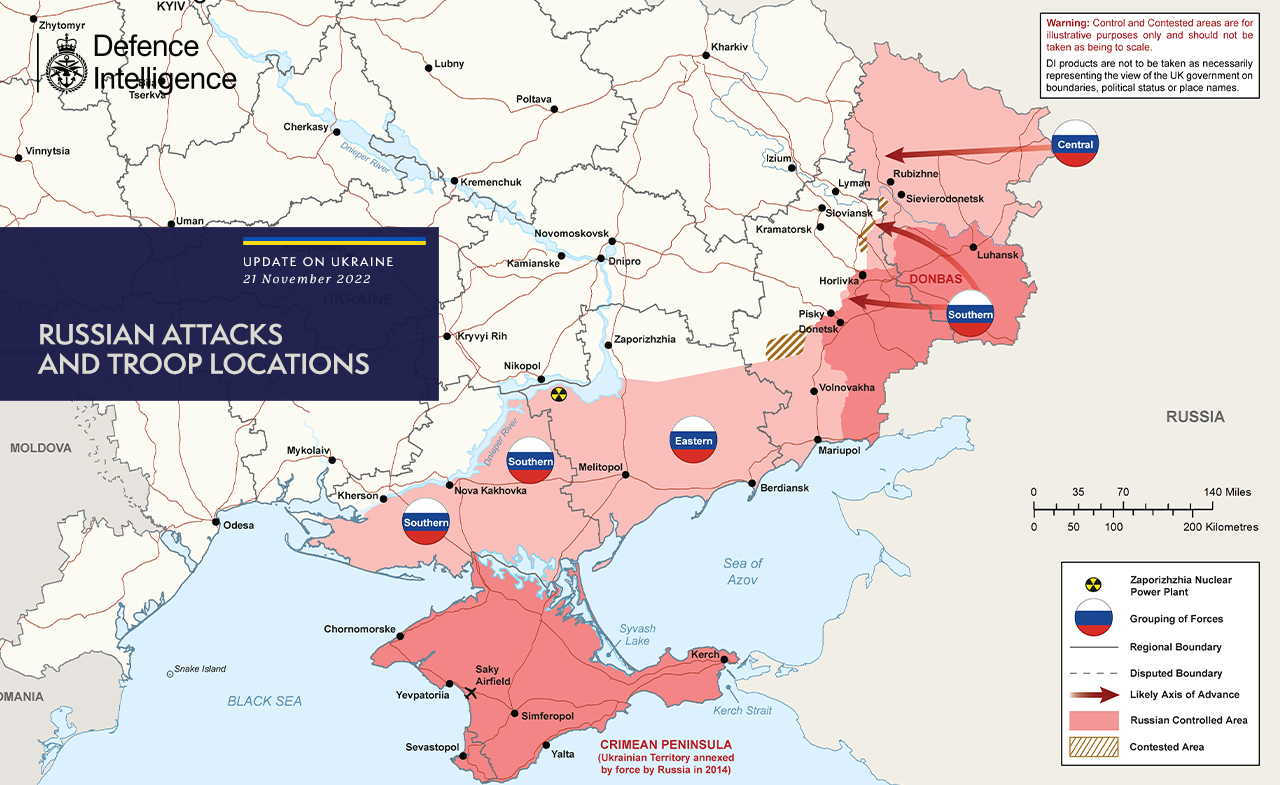
Here’s a hard truth our friends in Kyiv need to remember: Lying isn’t helpful. There are limits to our tolerance.
Here’s another: You’re going to have to make some compromises to end this war because your total victory isn’t in America’s interest here; punishing aggression is. When we decide that Russia has suffered enough, you might find yourselves on your own. Come to the table and negotiate accordingly.
Here is a hard truth for conservative Americans — there are fewer of them than you’d assume from reading Twitter or internet comments sections — opposed to us aiding Ukraine for domestic reasons.
There is no doubt in my mind that much of Ukraine remains what it was: A financial playground for America’s rich elites, and that they have done nothing but increase their ill-gotten gains thanks to our part in keeping Ukraine in the fight. But that’s just one of the many prices we pay for letting our civic structures become so rotten.
The hard truth is, enriching a few corruptocrats is still cheap compared to a continent-wide war in Europe — which is exactly what we risked had we let the Russians march right through.
Here’s a hard truth for my Russian friends and their supporters: The point where Putin & Co. had hoped to aggrandize their country or themselves has long passed. It’s time to ask for a ceasefire and come to the negotiating table.
They know this already, of course, except for the most deluded of true believers. The trick is constructing Sun Tzu’s golden bridge for them to retreat across.
The hard truth I must always keep in mind is that Western leadership, particularly our own, is not up to Sun Tzu’s task.
There is another hard truth that Moscow must come to grips with: Putin threw the dice on an expansionary war but shrank his country’s standing instead.
Russia spent more than a decade modernizing its military. It is becoming increasingly de-modernized with every day of fighting in Ukraine. Destroyed T-80 and T-90 tanks — the most modern in Moscow’s inventory — are being replaced by T-62s that were obsolete 50 years ago. Soldiers in their 20s, casualties of war, are being replaced by ill-trained “mobiks” in their 30s, 40s, and even 50s.
It will take far longer than a decade to replace what Putin has wasted.
The way this war has squandered Russian resources, finances, and demographics has serious geopolitical implications. For a few tens of billions of dollars — admittedly, some of them squandered — our Number Two geopolitical rival has had the heart cut out of its conventional military forces, all without spilling the blood of a single American soldier.
The potential mass-casualty event of Trump being re-instated on Twitter
You can almost hear Tom Knighton‘s eyes rolling here:
I’m not the biggest fan of Donald Trump. Most of his policies — the things he enacted quietly as he went — were pretty decent, including criminal justice reform and reducing federal regulations.
He just couldn’t stop tweeting.
I joked more than once that I wish someone would lock his phone so he couldn’t get on the app. However, I never once thought he should be banned from the platform.
But he was.
Now, he’s back.
Sort of.
His account isn’t banned anymore, though as of this writing, he doesn’t appear to be using it.
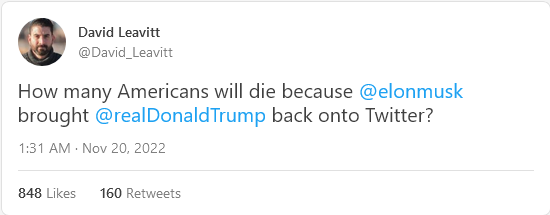
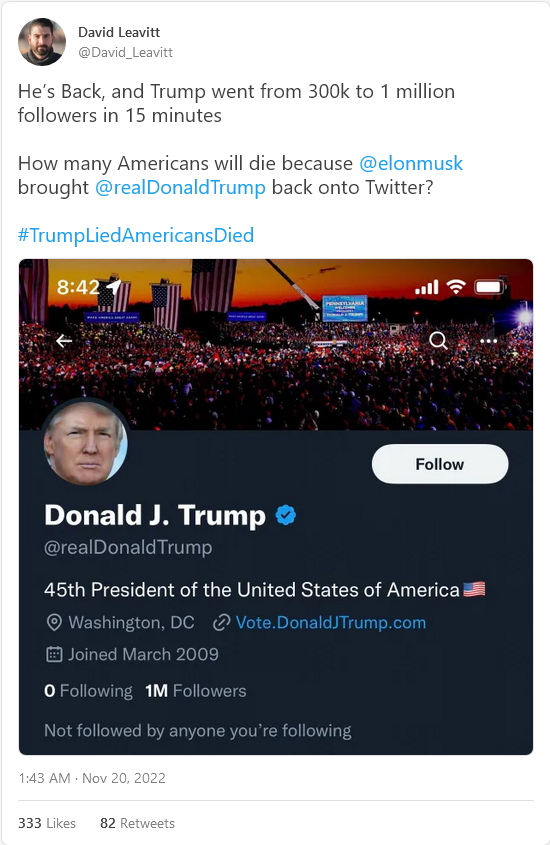
Yet this is, apparently, something just short of genocide if you listen to some journalists.
No, seriously.
I hoped this was a troll, but it’s not.
He apparently actually believes this is a thing, too, because it’s not the only time he claimed Trump being on Twitter will result in people’s deaths.
Again, there’s no word whether Trump will return to use the platform. As of this writing, his last tweet is from January 8th, 2021, so even if Trump’s tweets somehow could result in people’s death, it doesn’t seem like it matters since he’s not back on the platform.
But this unhinged individual has the old-school blue checkmark, the one given because an individual is “notable”.
Yet he also has his cover photo set to a screenshot of him being blocked by Trump. In other words, it looks like the boy is a might obsessed with the Orange One.
And this is the problem.
It’s not about Trump, but the media. This is a guy with mainstream media bylines aplenty. He’s got the old Twitter mark of approval, and he’s literally arguing that a former president having the ability to voice his thoughts on a social media platform will result in people’s deaths.
Does he think Elon Musk has weaponized tweeting and only given the launch codes to Trump?
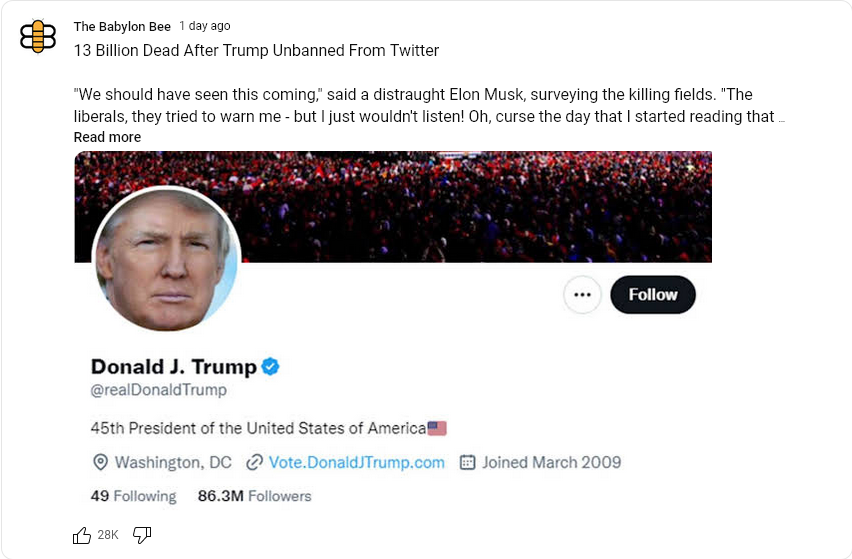
The Babylon Bee (or as Instapundit says, “America’s Newspaper of Record”) is already on this hot new calamity:
November 22, 2022
Our modern abundance of cloth is something to remember at Thanksgiving
Virginia Postrel wrote this originally for USA Today in 2020:
Our closets and drawers bulge with clothing in every imaginable color. Thanks to incremental improvements over the past few decades, our clothes resist stains and wrinkles in ways that would thrill the past’s laundry-weary housewives. T-shirts wick sweat, and raincoats shed water. Sweaters snap back into shape, and pants stretch with our bellies — a handy feature come Thanksgiving dinner.
Today’s textile cornucopia overflows with more than clothes. It includes the damask tablecloth beneath the Thanksgiving feast, the soft microfiber blanket in front of the fire, the potholders pulling dinner from the oven, the dish towels drying the heirloom china. Textiles upholster the dining room chairs and the football fans’ sofa cushions. They bandage the careless carver’s fingers. They furnish burlap wreaths and felt garlands, and, for those who prefer an autumnal escape to nature, backpacks, sleeping bags, and tents.
If, as Arthur C. Clarke famously observed, any sufficiently advanced technology is indistinguishable from magic, the reverse is also true. Any sufficiently familiar technology is indistinguishable from nature. We no more imagine a world without cloth than one without sunlight or rain. Textiles are just there.
Except, until fairly recently, they weren’t.
“Bring good store of clothes, and bedding with you,” an early Plymouth arrival advised a prospective colonist in 1621. Textiles weren’t easily procured in the wilds of Massachusetts. It is only in the past century, and especially in the past generation, that most Americans could forget where cloth comes from. Once so valuable they were stolen from clothes lines and passed down in wills, textile products now occupy only a tiny fraction of household budgets.
Cloth was precious because it took so much effort to make. Throughout history, and around the globe, women spent their days spinning. Yet yarn was always in short supply. In 1656, Massachusetts even passed a law requiring every family with “idle hands” — women and children who weren’t otherwise employed — to spin a minimum amount of yarn, with fines levied on those who didn’t make their quotas.
“The spinners never stand still for want of work; they always have it if they please; but weavers sometimes are idle for want of yarn,” wrote the 18th-century agronomist and travel author Arthur Young, reporting on a tour of northern England. It took about 20 spinners to keep a single weaver supplied with yarn.
A few decades after Young wrote, spinning machines broke the bottleneck and sparked the Industrial Revolution. Abundant yarn improved nearly every aspect of life. From clothing to sails, bed linens to flour sacks, essential items were suddenly much cheaper, more varied, and more easily obtained. It was the beginning of what economic historian Deirdre McCloskey calls “the Great Enrichment,” the economic takeoff that over the next two centuries lifted global living standards by 3000%.

November 21, 2022
City Minutes: Colonial America
Overly Sarcastic Productions
Published 22 Jul 2022Colonial-era North America was a busy place, so let’s take a quick look through some of the major players from the perspective of the lands & cities they inhabited.
SOURCES & Further Reading: Lectures from The Great Courses: “1759 Quebec – Battle For North America” from The Decisive Battles of World History by Gregory Aldrete, “The American Revolution” from Foundations of Western Civilization II by Robert Bucholz, “North American Peoples and Tribes” from Big History of Civilizations by Craig Benjamin, “The Iroquois and Algonquians Before Contact” from Ancient Civilizations of North America by Edwin Barnhart, “Iroquoia and Wendake in the 1600s”, “Indian-European Encounters 1700-1750”, “The Seven Years War in Indian Country” and “The American Revolution Through Native Eyes” from Native Peoples of North America by Daniel M. Cobb, Britannica articles “New York” & “Boston” https://www.britannica.com/place/New-… & https://www.britannica.com/place/Bost…
(more…)


