
World War Two
Published 19 Nov 2022A torpedo attack against the President; a Marine invasion in the central Pacific that turns very bloody in a hurry; German counterattacks in the Soviet Union; a bombing raid in Italy against a secret weapons site — all of that this week.
(more…)
November 20, 2022
A Conspiracy to kill America’s President? – WW2 – 221 – November 19, 1943
Comments Off on A Conspiracy to kill America’s President? – WW2 – 221 – November 19, 1943
November 19, 2022
“But actually, vat ve haf to confront is ze deep, systemic, and structural restructuring of our world”
Because, as Chris Bray points out, there’s no point in restructuring the non-structural structures or something…
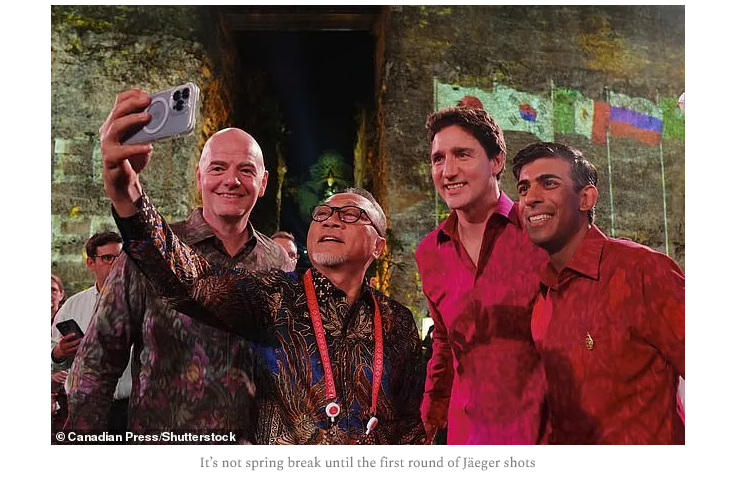
The G20 leaders flew to Bali this week to cosplay social repulsiveness and to hear from Klaus Schwab, who has no government position or formal place in the G20, making the G20 gathering a kind of executive committee meeting for something that rhymes with “Morld Meconomic Morum”.
The terrifyingly vacuous Bond villain said that ve must fundamentally restructure ze vorld, flattering the geniuses like Justin Trudeau and Joe Biden who will now use their personal wisdom and strength to do the restructuring.
(That’s an excerpt — the whole thing is here, if you want to punish your mind.)
There’s so much to love in this babbling, starting with the fact that the wealthiest and most powerful nations in the world can’t manage to deliver decent audio. But listen to what the man says:
1.) Looking out into an audience of the world’s major national leaders, he says that we face a global “multi-crisis”, made up of “economic, political, social, and ecological, and institutional crisis”.
Accepting the premise for the sake of argument, who caused all that crisis? Hello, leaders of the ruined world, I honor your wisdom and clarity, and turn to you to fix your broken countries that you’ve been leading.
2.) “But actually, vat ve haf to confront is ze deep, systemic, and structural restructuring of our world. Und zis vill take some time! Und ze vorld vill look differently, after ve haf gone through zis transition process.”
This is all of Klaus Schwab in three sentences: We must do structural restructuring, see, not non-structural restructuring. And after we have completely, deeply, systematically restructured literally everything in the entire world, the world will look — wait for this, because this is insight from the most renowned of all the experts, a deep mind who you may struggle to follow — different. Yes, changing things a lot makes them not be the same. Und zis is vy Klaus Schwab receives ze big bucks! You and I could not think at this level! Stand at attention!
3.) “Politically, the driving forces for this political transformation, of course, is the transition into a multipolar world, which has a tendency to make our world much more fragmented.”
Political fragmentation, then — the transition into multipolarity — causes fragmentation. The fragmentation into multipolarity makes the world fragmented, thereby, you see, fragmenting it. Careful, Klaus, you’ll accidentally write a whole Thomas Friedman column with your mouth.
The man is like a novelty gift with a pop-up clown inside it: You press the button, and it makes nonsensical streams of word-sounds. Fortunately, however, Klaus was speaking to an audience of Joe Biden, so I’m sure it sounded deep in the room.

Comments Off on “But actually, vat ve haf to confront is ze deep, systemic, and structural restructuring of our world”
American political parties from 1865 down to the Crazy Years we’re living through now
Severian responds to a comment about the Democrats and Republicans and how they have morphed over the years to the point neither party would recognize itself:
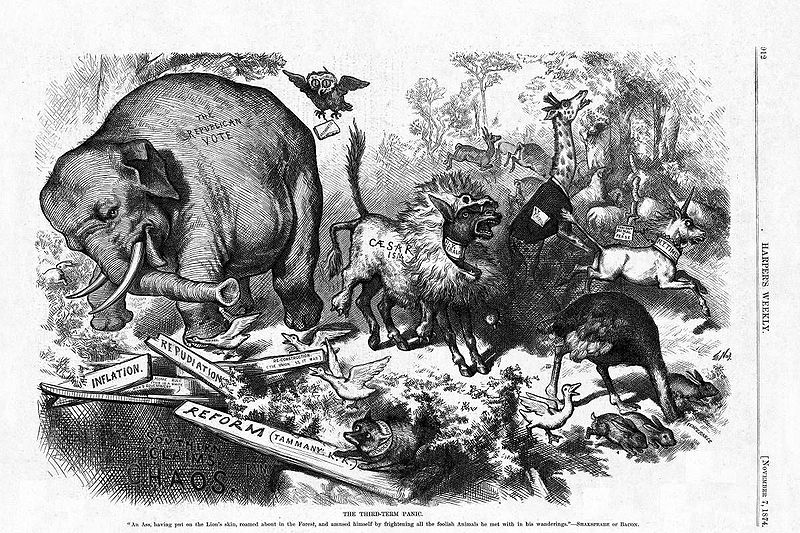
“The Third-Term Panic”, by Thomas Nast, originally published in Harper’s Magazine on 7 November 1874.
A braying ass, in a lion’s coat, and “N.Y. Herald” collar, frightening animals in the forest: a giraffe (“N. Y. Tribune”), a unicorn (“N. Y. Times”), and an owl (“N. Y. World”); an ostrich, its head buried, represents “Temperance”. An elephant, “The Republican Vote”, stands near broken planks (Inflation, Repudiation, Home Rule, and Re-construction). Under the elephant, a pit labeled “Southern Claims. Chaos. Rum.” A fox (“Democratic Party”) has its forepaws on the plank “Reform. (Tammany. K.K.)” The title refers to U.S. Grant’s possible bid for a third presidential term. This possibility was criticized by New York Herald owner and editor James Gordon Bennett, Jr.
Image and caption via Wikimedia Commons.
I find this extremely useful. I’d add that the postbellum parties do shift ideologies fairly regularly, as PR notes, such that even though they’re still called by the same names, they’re nowhere near the same parties, 1865-present.
I’d add some distinguishing tags for ease of reference, like so:DEMOCRATS:
The Redeemers of the “Solid South”, 1865-1882, when their main issue was ending Reconstruction and establishing Jim Crow.
The Grover Cleveland years, 1882-1896: Still primarily an opposition party, their main goal was reining in the ridiculous excesses of the Gilded Age Republicans. As one of about 100 people worldwide who have strong opinions on Grover Cleveland, I should probably recuse myself here, so let me just say this: Union Army veterans were to the Gilded Age GOP what the Ukraine is to the Uniparty now. They simply couldn’t shovel money at them fast enough, and the guys who orchestrate those ridiculous flag-sucking “thank you for your service” celebrations before pro sporting events would tell them to tone it way, way down. Cleveland spent most of his presidency slapping the worst of this down.
[How bad was it? So bad that not only did they pass ridiculous giveaways like the Arrears of Pension Act and the Dependent Pension Act — think “Build Back Brandon” on steroids, times two, plus a bunch of lesser boondoggles — but they got together every Friday night when Congress was in session to pass “private” pension bills. These are exactly what they sound like: Federal pensions to one specific individual, put up by his Congressman. Grover Cleveland used to burn the midnight oil vetoing these ridiculous fucking things, which makes him a true American hero as far as I’m concerned].
The Populist Party years, 1896-1912: They were more or less absorbed by the Populist Party — William Jennings Bryan ran as a “Democrat” in 1896, but he was really a Populist; that election hinged entirely on economic issues. They still had the “Solid South”, but the Democrats of those years were basically Grangers.
The Progressive Years, 1912-1968: They picked up all the disaffected “Bull Moose” Republicans who split the ticket and handed the Presidency to Woodrow Wilson in 1912, becoming the pretty much openly Fascist entity they’d remain until 1968.
The Radical Party, 1968-1992: The fight between the Old and New Left, or Marxism vs. Maoism.
The Boomer Triumphalist Party, 1992-2000. It’s an Alanis-level irony that Bill Clinton was the most “conservative” president in my lifetime, if the metric for “conservatism” is “what self-proclaimed conservatives say they want”. This was our Holiday From History, in which “wonks” reigned supreme, tweaking the commas in the tax code while occasionally making some noises about silly lifestyle shit.
The Batshit Insane Party, 2000-Present. The years of the Great Inversion. Today’s Democrats only know one thing: Whatever is, is wrong.
REPUBLICANS:
The Radical Party, 1864-1876: Determined to impose utopia at bayonet point in the conquered South, they started asking themselves why they couldn’t simply impose utopia at bayonet point everywhere. They never did figure it out, and we owe those awful, awful racists in the Democratic Party our undying thanks for that. This is the closest America ever came to a theocracy until The Current Year. Morphed into
The party of flabbergastingly ludicrous robber baron excess, 1876-1896. In these years, J.P. Morgan personally bailed out the United States Treasury. Think about that. FTX, meet Credit Mobilier. You guys are pikers, and note that was 1872. William McKinley deserves a lot more credit than he gets in pretty much everything, but he might’ve been the most fiscally sane American president. Only Calvin Coolidge is even in the ballpark.
The Progressive Party, 1900-1912. For all the Left loves to call Republicans “fascists”, for a time they were … or close enough, Fascism not being invented quite yet. But the Democrats coopted it under Wilson, leading to
The Party of (Relative) Sanity, 1912-1968. Before Warren G. and Nate Dogg, there were Warren G. Harding and Calvin Coolidge, the only two contestants in the “American politicians with their heads screwed on straight” competition, 20th century division. Alas, superseded by the
Anti-Left Party, 1968-2000. Want to punch a hippie? Vote for Richard Nixon. Or Gerald Ford. Or, yes, the Gipper.
The Invade-the-World, Invite-the-World Branch of the Uniparty, 2000-Present. Wouldn’t it be nice if Bill Clinton could keep it in his pants, and wasn’t a walking toothache like Al Gore? That was the essence of W’s pitch in 2000. Our Holiday From History was supposed to continue, but alas, 9/11. Some very special people at the State Department got their chance to finally settle their centuries-long grudge with the Cossacks, and, well … here we are.
By my count, the longest periods of ideological consistency ran about 50 years … and I’m not sure if that really tells us much, because it makes sense to view 1914-1945, if not 1914-1991, as THE World War, which put some serious constraints on the ideology of both sides.
Trend-wise, what I see is one side going nuts with some huge moral crusade, while the other side frantically tries to slam on the brakes (while getting their beaks good and wet, of course). Antebellum, it was the proslavery side leading the charge, but if they’d been slightly less excitable in the late 1840s, the abolitionist lunatics would’ve done the job for them by the late 1860s. If you know anything about the Gilded Age, you know that they somehow presented the truly ridiculous excesses of the Robber Barons as some kind of moral triumph; this was, after all, Horatio Alger‘s America. Progressivism, of either the Marxist or the John Dewey variety, is just moralizing gussied with The Science™, and so forth.
The big difference between then and now, of course, is that the grand moral crusade of The Current Year is open, shit-flinging nihilism. The “opposition”, such as it is, is also full of shit-flinging nihilists; they just don’t want to go before they’ve squeezed every possible penny out of the Suicide of the West. So … yeah. We’re overdue for a big ideological change. And we shall get it, never fear; we can only hope that we won’t have to see it by the light of radioactive fires.
Comments Off on American political parties from 1865 down to the Crazy Years we’re living through now
Prelude to Victory: Burma, 1942
Army University Press
Published 11 Feb 2022In late 1941 and early 1942 the Imperial Japanese Army swept through the Asia-Pacific region like a wildfire. The Allies appeared powerless to stop them. With the British Army in Asia reeling, and pushed back to the frontier of India, something had to be done to stem the tide. “Prelude to Victory: Burma, 1942” provides context for Field Marshal William J. Slim and the 14th Army’s struggle to retake Burma from the Japanese.
Comments Off on Prelude to Victory: Burma, 1942
QotD: Canada from the American Revolution to the Riel Rebellion
A significant number of Americans who were loyal to Britain and despised the American Revolution moved to Canada during and in the decades after the Revolutionary War. And as the number of English Canadians steadily increased along the Great Lakes and west of the Ottawa River, [Sir Guy] Carleton created what became the province of Ontario, Upper Canada, in 1791. The first lieutenant governor, John Graves Simcoe, devised and implemented an ambitious program of enticing Americans to Canada by effectively giving them rich farmland. The population of English Canada rose swiftly toward parity with the French. In 1792, Simcoe took it upon himself to abolish slavery in Upper Canada, 42 years before this was done in the British Empire, and 71 years before the United States. It was an admirable and pioneering endeavour in the principal area of civil rights controversy in North America in the coming century.
Unfortunately, as the Revolutionary and Napoleonic wars unfolded, the British could not resist the temptation to employ their mastery of the high seas to impose blockades and harass the shipping of neutral powers. The young United States did not have the military force to deter such treatment, and in 1812 those countries went to war. Canada was the blameless focal point of most of the fighting. Canada with the continuing solidarity of the French-Canadians, was able to mount a very solid defense. The many thousands of recently arrived Americans did not support the United States and the generous policy of enticing settlement from the United States was completely vindicated. There were pressures to expel them, monitor them, disqualify them from holding local offices and positions. But it was soon agreed that they could become citizens after eight years of residency. This affected about 40 percent of English-Canadians and this must count as another very successful chapter in Canada’s early record of respect for civil and human rights.
As reasonably successful wars do, considerable national sentiment was created and encouraged by the successful joint struggle to avoid American occupation. Out of these experiences came increased ambitions for democratic self-rule in domestic matters as the British and Americans enjoyed, instead of autocratic rule by British governors. Canada’s position was complicated by the fact that it could not agitate for home rule too energetically or the British would lose patience and sell Canada to the United States for cash or other territory or for a comprehensive alliance. Outright rebellion was not an option for Canada as it had been for the Americans, as the United States would seize Canada if it were not under British protection.
The Canadian solution for agitating but not completely exasperating Great Britain was the Gilbert and Sullivan rebellions of 1837 led by William Lyon Mackenzie in Ontario and Louis-Joseph Papineau in Québec. The Ontario uprising was just a rowdy group of malcontents who became disorderly and were easily chased off, and the French-Canadian group were essentially pamphleteers, though there were some exchanges of fire and small rebel and military units marched to and fro in poor winter weather. A total of about 300 people died, there were 14 executions and 92 people were transported as prisoners to Australia. The rebel leaders fled but were eventually pardoned and returned.
There was enough commotion to get Britain’s attention, but the loyalty of most of the population gratified the British, and they determined to put things right. London sent the well-known reformer Lord Durham to Canada in 1840 to make recommendations. After a year of research by a couple of biased examiners, Durham came to the insane conclusion that the source of Canadian discontent was that the French-Canadians wanted to be relieved of the intolerable burden of being French. Durham proposed uniting Upper and Lower Canada and assumed that the slight resulting English majority would assimilate the French in about 10 years. Of course, this was precisely what the French feared, and the English-Canadians had no desire for it either. But after several years of rearguard action by British governors, the movement for autonomous government succeeded, after the 25-year-old Queen Victoria sent Lord Elgin to Canada as governor to give the Canadians what they wanted. Elgin and Robert Baldwin and Louis-Hippolyte LaFontaine achieved this and secularized a great deal of territory owned by the principal churches so that they could be more easily settled and made the principal universities officially nondenominational. These were again great and non-violent steps in the civil rights of Canadians who now numbered over two million people.
All of North America was now walking on eggshells over the immense problem of American slavery. Slavery was abolished throughout the British Empire in 1834. In practice, there had not ever been more than a couple of hundred slaves in Canada, apart from the natives enslaving each other. Slaves had been imported to the southern states because of their efficiency at harvesting tropical crops such as cotton, so Canada was effectively spared that horrible institution, because of its climate more than its virtue. Canada consistently had a fine record in accepting about 40,000 fugitive slaves that reached the Canadian border in the thirty years before the U.S. Civil War. The leading American anti-slavery advocates Harriet Tubman and John Brown, and Josiah Henson, the model for the chief character in Harriet Beecher Stowe’s novel Uncle Tom’s Cabin, which sold an unheard-of two million copies in the 1850s, all lived in Canada for years. There were at least 11 black Canadian doctors who were fugitive slaves or sons of fugitive slaves who served in the Union Army in the Civil War, and the white Canadian anti-slavery activist, Dr. Alexander Ross, at the request of President Lincoln, assisted in breaking up a Confederate spy ring in Montréal. Escaped slave Joseph Taper, of St. Catharine’s, wrote this letter back to his former and still putative owner in 1839: “I now take this opportunity to inform you that I’m in a land of liberty, in good health … In the Queen’s dominions, man is as God intended he should be; all are born free and equal, not like the southern laws, which put man on a level with brutes. All the coloured population is supplied with schools. My boy Edward, who will be six years next January, is now reading and I intend keeping him at school until he becomes a good scholar. My wife and self are sitting by a good comfortable fire, happy, knowing that there are none to molest us or make us afraid. God save Queen Victoria.”
As many as 40,000 Canadian volunteers served in the Union Army in the Civil War and Canada was thanked on several occasions by President Lincoln for infiltrating Confederate exile organizations. This was an issue in which all Canadians were united and is a legitimate matter of national pride.
The next major civil rights challenge that Canada had to face was that of the Métis — the mixed white and indigenous people on the Great Plains of Canada. The territory of the natives had been steadily reduced by white settlement and the nutritious content of their diet had been reduced by the heavy depletion of the herds of plains Buffalo. There were also many other grievances and undoubtedly a number of violations of the Indian treaties and of the Indian Act and a flamboyant Metis lawyer, Louis Riel, led an uprising on the western plains in 1878. This was eventually suppressed with little violence, as Prime Minister John A. Macdonald dispatched an adequate military force under Field Marshal Garnet Wolseley, Gilbert and Sullivan’s “very model of the modern major general”. Riel fled to the U.S. and the Canadian government made a number of useful concessions to the aggrieved natives. But in 1885, Riel returned and led a rebellion in northwest Saskatchewan. At the same time, the Canadian Pacific Railway ran out of money and was about to flounder into bankruptcy. Macdonald brilliantly sent Canadian forces West on the railway and they surprised and defeated the insurgents and captured Riel. By emphasizing the railway’s role in saving the country (as Riel was making both annexationist and secessionist noises), Macdonald won passage of a bill to finance completion of the railway. Macdonald also gave the natives the right to vote and rewarded his allies among the native leaders. However, he created a lasting grievance by allowing the execution of Riel. Although 15 people died in the uprising, he should have commuted the sentence for insanity — Louis Riel was delusional.
Conrad Black, “Canada’s excellent history of civil and human rights”, New English Review, 2022-08-18.
Comments Off on QotD: Canada from the American Revolution to the Riel Rebellion
November 17, 2022
TikTok (aka “Digital Fentanyl”)
Geoffrey Cain at Common Sense on the malign influence of the massively popular Chinese social media platform on US politics and culture:

The midterm elections of 2022 were many things — a shocker for Republicans, the possible end of Donald Trump, a win for centrist Democrats. Overlooked is the fact that they were also a big turning point for TikTok, the Chinese social-media platform.
TikTok is not only the most trafficked news app for Americans under 30. It was also a major political force this year. Exhibit A: the Senate race in Pennsylvania, in which both Democrat John Fetterman and his Republican rival, Mehmet Oz, deployed TikTok, with Oz railing against the cost of vegetables in one video, and Fetterman slamming Oz for saying “crudité” in a highly effective response. Other candidates who took to TikTok this cycle include Tim Ryan, who ran for Senate in Ohio, and Val Demmings, who ran for Senate in Florida. (Both are Democrats.) The Democratic National Committee, early this year, launched its own TikTok channel.
Now, there are calls to shut it down. Just yesterday, FBI Director Christopher Wray said the bureau has “national-security concerns” about TikTok. Last Friday, the top Republican on the Federal Communications Commission, Brendan Carr, called TikTok “China’s digital fentanyl”. The day before, Senator Marco Rubio and Rep. Mike Gallagher, both Republicans, introduced legislation banning the social-media platform, noting that the data of millions of Americans is “effectively controlled” by the Chinese Communist Party. Earlier in the month, Carr also said the U.S. government should ban TikTok.
It’s about time.
Ever since TikTok began expanding into the United States, more than four years ago, we’ve known that it was a disaster waiting to happen. What’s shocking is that it’s taken this long to get serious political attention.
I know all about this. I used to be an investigative reporter in China. In December 2017, I first heard from friends on social media that a Chinese tech unicorn called ByteDance was planning on entering the American market with a new app. It was called TikTok.
Alongside its sibling app, Douyin, which operates only in China, TikTok was poised to sweep up the Gen Z audience in America, with its preference for video snippets of dancing celebrities, DIY projects, cooking demonstrations, skincare routines and other Gen Z’ers singing and dancing in their parents’ kitchens. As the fastest growing social media app ever, it rankled American competitors Facebook and YouTube, which were banned in China.
By October 2018, ByteDance was the world’s most valuable startup, with a valuation of $75 billion.
Four years later, ByteDance is worth $300 billion. TikTok is expected to reach 1.8 billion users globally by the end of the year. And a quarter of American adults under 30 get their news from the social-media app.
There’s a good reason for this success. TikTok has developed one of the most powerful machine-learning algorithms ever — one that is able to reveal people’s unknown desires to themselves.
Every day, every hour, every waking minute, TikTok is hoovering up seemingly infinite bits of information about its users — their tastes, hobbies, political views, sexual preferences, their facial structure, the sound of their voice. Ostensibly, all this is meant to provide a better product. It should also be noted that this information can be used for spying, influencing millions of users — even waging war. Every time we swipe for the next video, every time we post videos of our own, we are helping the world’s most sophisticated police state learn more about us.
Comments Off on TikTok (aka “Digital Fentanyl”)
The Pornstars of World War Two – Pin-Ups – On the Homefront 017
World War Two
Published 16 Nov 2022How do you motivate men to leave home and go fight in a foreign land? Send them packing with Betty Grable, Rita Hayworth, and Irene Manning, of course! It helps if you include an Esquire magazine and girlie cartoons from the infamous Alberto Vargas.
(more…)
Comments Off on The Pornstars of World War Two – Pin-Ups – On the Homefront 017
November 16, 2022
“Angertainment is unlikely the sole cause of US political polarisation, but it certainly hasn’t helped”
At Quillette, Claire Lehmann rounds up the rising distrust/disgust among the American public in their views of the legacy media:
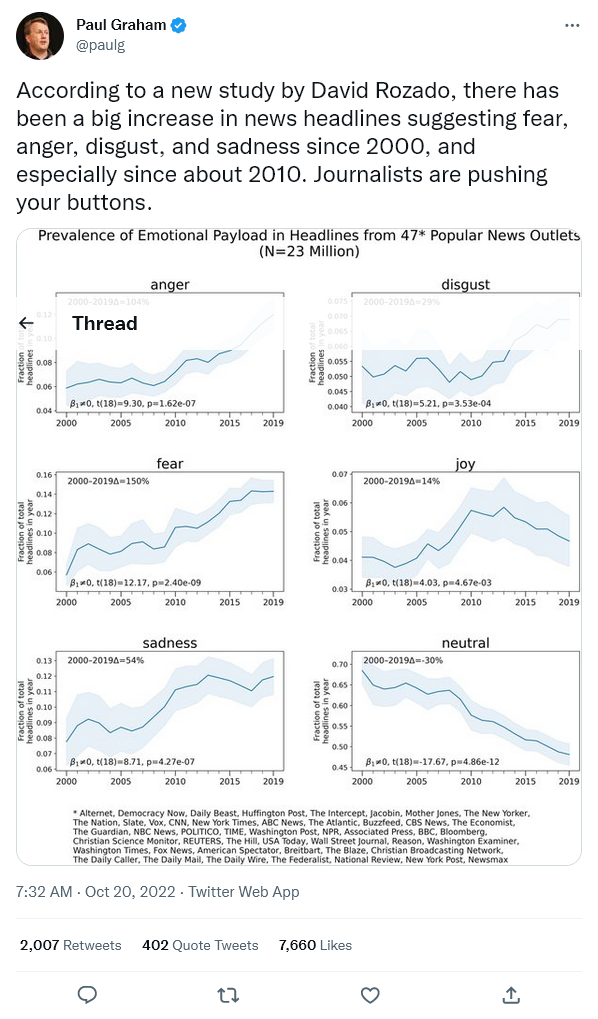
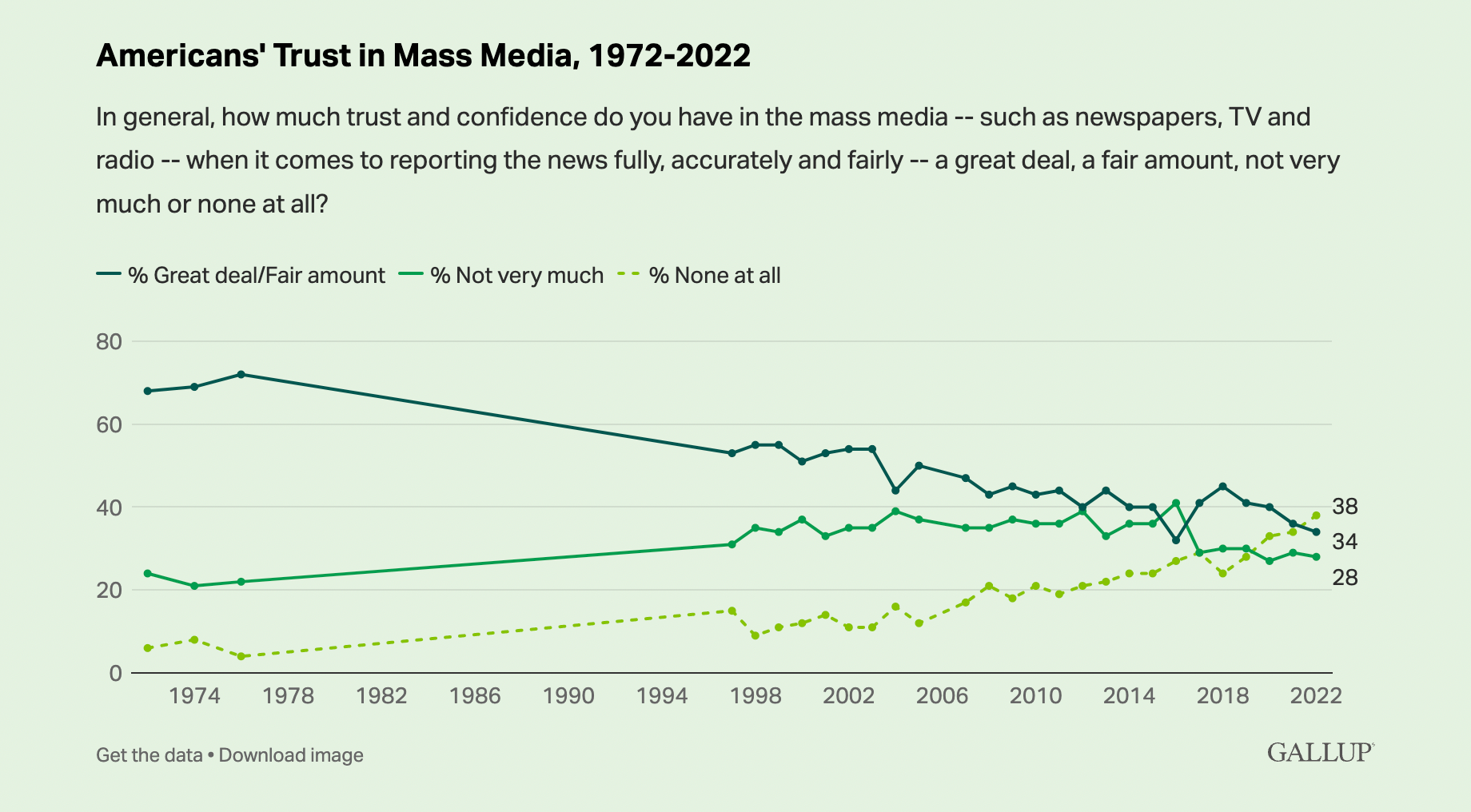
In October, a study published in PLOS One provided some fresh insight into how and why American media has become so dysfunctional. Over the past 20 years, the study reported, headlines that convey anger, fear, sadness, and disgust have been increasing, while headlines conveying neutrality or joy have been in decline. These trends have coincided with a massive drop in trust in news journalism, particularly in the US.
According to Gallop polling, seven percent of Americans say they have “a great deal” of trust in the media, while 38 percent say they have none at all. As angertainment has increased, trust has decreased. As one political tribe provides angertainment for its loyal readers and viewers, the other becomes increasingly alarmed and disgusted. Angertainment may be profitable for journalism in the short-term but over the long-term it trashes the integrity of the profession.
Angertainment is unlikely the sole cause of US political polarisation, but it certainly hasn’t helped. Just as mad cow disease was caused by feeding bovine-meal to cows, angertainment feeds on polarisation which in turn feeds on angertainment. It’s a cannibalistic cycle.
[…]
The incentives for journalism are broken. This is not always the fault of individual journalists, although some strive for truth and accuracy with more sincerity than others. Nor is it solely the fault of media companies, although many of them prioritise profit and engagement over rigour and fairness. It is not even the fault of “Big Tech”, even though social media companies have built the machine on which these broken incentives run.
It’s the fault of all of us. We are the ones who devour angertainment and get high on watching our enemies suffer. We are the ones who want to see various idiots eviscerated and dismembered by the bayonets of Twitter. We are the ones who clamour after content which makes us feel virtuous, complacent, and like we belong. The 20-year incline in headlines denoting fear, anger, disgust, and sadness in American media would not have occurred if audiences had not been rewarding it. In a competitive eco-system, media organisations must adapt to their audiences, feed them what they want, or die. But like the cows feeding on the meat-and-bone meal of other cows, this feedback loop creates the cultural equivalent of a neurodegenerative disease.
I have been just as guilty of this as any other publisher, consumer, or creator of media. But in recent months I’ve largely stepped back from social media, stood outside this machine, and have watched it whir and whizz from the sidelines. It is possible to disengage and reconsider the machine from a safe distance, starving it of fuel. And every day at Quillette I am reminded by my writers and readers and subscribers that it is possible to publish and create journalism that is appreciated for its analytical and aesthetic value, rather than for the artillery it provides in a never-ending culture war. It’s a war in which facts and reputations exist merely as cannon fodder, and where truth is less important than tribe. The media’s incentives may be broken, but we as individuals do not have to be.
Comments Off on “Angertainment is unlikely the sole cause of US political polarisation, but it certainly hasn’t helped”
November 15, 2022
QotD: Second-wave feminism
Camille Paglia, “Prominent Democratic Feminist Camille Paglia Says Hillary Clinton ‘Exploits Feminism’”, Washington Free Beacon, 2017-05-15.
Comments Off on QotD: Second-wave feminism
November 13, 2022
Kiev Liberated! Celebrations in Moscow! – WW2 – 220 – November 12, 1943
World War Two
Published 12 Nov 2022The Red Army has driven the Axis forces out of Kiev, the third largest city in the USSR. The Allies are also advancing, albeit slowly and at great cost, in Italy, but in the South Pacific, they launch a massive air strike against Rabaul … and what is the result?
(more…)
Comments Off on Kiev Liberated! Celebrations in Moscow! – WW2 – 220 – November 12, 1943
Corruption in US politics? Where’s the fainting couch?
Elizabeth Nickson looks at several recent books covering political corruption in US politics:
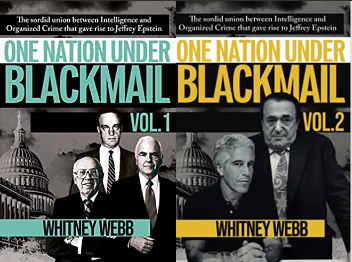
Whitney Webb’s One Nation under Blackmail published late last month, explains in exhaustive detail how the American government was taken over by well-dressed thieves. Webb writes from the left, but she is dispassionate. In 1,000 pages, she explains the history of the turning of democracy, starting post WW2 with the heinous Dulles brothers, moving through Reagan with country club thugs calling themselves The Enterprise, to Jeffrey Epstein’s seduction of Bill and Hillary Clinton. Promising riches beyond their imaginings, the seduction led the couple, by increments, to sell out the country to China and Wall Street.
Webb explains how Epstein set up the Clinton and Gates Foundations promising a new iteration in “charity”, one that made profits, and pushed forward the founders as Saviours. Clinton in her years as Sec State, flew around the world eating brownies and demanding tithes for herself, in return for every beneficence she gave courtesy of the American taxpayer. The ’08 crisis was brought to us by the same crooks, and the same methods, chipping away at regulation. The head Fannie and Freddie Mae bureaucrat, James A Johnson walked away with $100 million leaving the world in crisis. Tens of millions lost everything.
Add this to [Profiles in Corruption] Peter Schweizer’s extraordinary detailing of how Pelosi etc. made their hundreds of millions using taxpayer money, pinpointed deregulation and insider trading.
Schweizer describes how the mega-criminal dealing of the Bidens with China and the Ukraine has walked us into a potential nuclear conflict with both Russia and China. The Lords of Easy Money shows how Wall Street and all the pension funds, all the index funds, have been rolling over corporate debt and taking profits, then borrowing more, selling, borrowing more, selling, and repeat. Which means that every American enterprise that is traded and somehow functional, is laden with corporate debt it cannot possibly pay the interest on, as interest rates rise. Jay Powell made his $50 million that way.
Webb shows how Epstein coached Gates through invading and then purchasing public health both at home and through the UN. Add in the Covid mess, and another bunch of corporate and government thieves walked away with $3 Trillion, in the US alone.
Do you really think they’d allow the endless prosecutions they deserve? Do you really think they want to give back the money they stole?
Comments Off on Corruption in US politics? Where’s the fainting couch?
November 12, 2022
The Final Bloody Chapter of Operation Reinhard – War Against Humanity 085
World War Two
Published 9 Nov 2022The genocide of the Jews of Eastern Europe concludes with Operation Harvest Festival — Aktion Erntefest when 42,000 are murdered in the Lublin district.
(more…)
Comments Off on The Final Bloody Chapter of Operation Reinhard – War Against Humanity 085
SUPERCUT – Every Window Cameo in Batman (1966-1968)
Tommy Westphall’s Snowglobe
Published 14 Jan 2020The dynamic duo’s show of the 60s was fond of celebrity cameos. Here is a Supercut of every single one of them.
In order of appearance:
1. Jerry Lewis
2. George Cisar (from the 1966 film)
3. Dick Clark
4. Van Williams and Bruce Lee as The Green Hornet and Kato from The Green Hornet
5. Sammy Davis Jr.
6. Bill Dana as José Jiménez
7. Howard Duff as of Sam Stone from Felony Squad
8. Werner Klemperer as Colonel Klink from Hogan’s Heroes
9. Ted Cassidy as Lurch from The Addams Family
10. Don Ho
11. Santa Claus
12. Art Linkletter
13. Edward G. Robinson
14. Suzy Knickerbocker
15. The Carpet King
(more…)
Comments Off on SUPERCUT – Every Window Cameo in Batman (1966-1968)
November 10, 2022
The headscratcher that was the American midterms outcome
As the voters went to the polls on Tuesday, it was easy to find doom-and-gloom-mongering among Democratic stalwarts and most of the mainstream media (BIRM), and chest-thumping triumphalism on the right. Both sides seemed to agree that the outcome was going to be somewhere between a red landslide and a red wipeout. So … how do we square the expectations of both sides with what actually happened? Chris Bray makes an attempt:
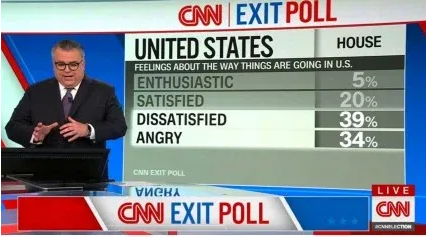
Eight percent uptake of the much-touted bivalent booster, 75% wrong track sentiment, pretty good night for the party in power. Multiple signs of a total loss of trust and respect for the existing order equals a decision to more or less stay the course.
Tribalism is the first explanation, sure. If you shat on a sidewalk and ran it for office with a D behind its name, Democrats would vote for it; if you shat on a sidewalk and ran it for office with an R behind its name, Republicans would vote for it. John Fetterman is headed for the United States Senate. Go ‘way, I’m ‘batin’.
And I agree with the argument that Republicans didn’t offer much of a plan or a vision, a premise you can check by reading Kevin McCarthy’s Commitment to America. More mush from the wimp.
But the other thing, and you can argue with me about this, is that the society of the spectacle madness of messaging without regard to reality actually achieves its purpose, no matter how absurd it is. We have to add $3 trillion in extra debt-funded spending to the economy to reduce inflation! If you vote Republican, they’ll kill our children!
Amazingly, this turns out to work pretty well. The available evidence suggests that we have a sizable population that cannot assess fact claims. I propose that we test this with sample messages to voters: If you vote for bubblegum trees, the sky bees will give you a diamond-crusted ribeye! (Ohh, I have to vote for bubblegum trees!) If you’re out in public, look to your left; then look to your right. At least one of those people thinks Karine Jean-Pierre makes some pretty good points.

Sarah Hoyt strongly believes that the busy midnight vote-finders of 2020 were just as busy on Tuesday night:
As I write this late on the 8th, the tsunami is resolving itself into a wavelet.
Or rather, the tsunami has been overfrauded into a wavelet. And it might be frauded away to a Dem win before I wake tomorrow.
This shouldn’t be a surprise to any of us who were awake and remember this:
And we know damn well it was a Trump landslide before that.
So for the Republicans to have picked up any seat, this was the tsunami to end all tsunamis.
I know the usual idiots are out there, already saying “It was abortion: the Womyns came out in force to vote dem.”
Are there women who are single ticket abortion voters. Sure. Most are older than I and are determined to make sure their actions and choices are validated a posteriori. They’re an ever dwindling minority. Married women vote more and more for the right every time. Single women? Who knows? But I suspect there’s been a shift in that too after the last too years. And most of them don’t see that career path ahead they once did.
Then there’s the other bs which is of course “The people don’t want to be free.” That’s bs. The people, every time they can express their displeasure do so. But having the vote taken away from them via fraud means THEY each individual thinks he or she is alone.
Things like “Let’s go Brandon” sweep the nation, but there’s no major legal or financial movement to protest the fraud, because each person thinks “I guess all these idiots are so beaten down they like beaten down, and I’m the only one who is angry.”
Meanwhile the perpetrators know what the people think, and erect barricades in DC to protect themselves from the anger they sense but can’t seem to bring out into the open.
Yes, we’re getting the house, and probably not the senate. Which means a good five/six seats fraud. I’m in a group right now with people crunching numbers, and the fraud is evident. The races the democrats cared out got flipped by turning just those votes for the dems. That’s the flexibility of Dominion at work, and the way they can turn a vote into the other.

At Founding Questions, Severian is appropriately sanguine about the notion of “adjusted” or “fortified” ballot counts in disputed races:
So the “elections” were fun, eh? By far the best “news” from the Dissident perspective is that they did, in fact, pull out all the stops for S-s-s-Strokey. As I think it was Based 5.0 who quipped below, it looks like dual-passport-holding Muslim carny barkers aren’t going to be making America great again. Here’s hoping they’re stupid enough to fall for the “Dr. Jill” trap twice — now they’re stuck with Strokey the way they’re stuck with Tapioca Joe, because Giselle is Dr. Jill on steroids (perhaps literally). Eh, Dr. Jill had 40 years in [Washington, DC] to get a taste of the finer things; Giselle’s price is probably far lower. But until Strokey resigns for health reasons and is replaced […] the image of a tatted-out, brain-damaged hobo in a hoodie shuffling around the Senate floor is so on the nose, no novelist would dare use it.
[…]
I bet if we look back on it, we’ll see the state (lowercase s) Media freaking out first, dragging the Official State (capital S) Media with them. It makes sense, given the perverse incentive structure of the Media. Stick with me here:
Joe Schmoe (D) is running for Congress in Flyover State. Obviously The Media wants him to win, because (D). And they’re sure he’s going to, because his opponent is some “ultra-MAGA” yahoo. But Reality is what it is, and suddenly the yahoo is getting closer and closer …
At that point, The Media’s perverted incentive structure kicks in. The “reporters” at the biggest local rag in Flyover State, the Toad Suck Times-Picayune, only care about one thing: Getting the fuck out of Toad Suck, trading the Times-Picayune for a slot somewhere higher up the chain. Now, there are only two ways to do that: Be a hard-hitting, straight-shooting newshoun …
HAHAHAHAHAHAHAHAHAHAHAHA!! Oh Jesus, I’m sorry, I thought I could type that with a straight face, but I can’t. Give me a minute …
… ok, there’s only one way to move up in The Media, and that’s by proving yourself a more zealous cultist than the next guy. So our Heroic Journalist starts doing what he thinks the Inner Party wants, which is of course “propping up Joe Schmoe for all he’s worth”. But here’s the rub: He’s not privy to what the Inner Party actually wants. Of course he’s not; after all, he’s riding a desk at the Toad Suck Times-Picayune. And of course everybody in a similar position, nationwide, is doing the same thing …
… but they’re all at least kinda sorta privy to the real polls that come down from the big organizations (recall that there are maybe three companies that control all the newspapers in the US), and so he knows things are looking grim for Joe Schmoe. More importantly, he sees that Tapioca Joe himself is out stumping for Democrats, and not in battleground states — they’re putting Brandon out there in supposedly safe Democratic districts.
So our man at the Toad Suck Times-Picayune consults his own personal political tea leaves, and he concludes: We’re gonna lose. The “red wave” is real. So again, he starts doing what he thinks his masters want, the thing he thinks will get him noticed at the higher levels: He admits the truth, or as much as he personally can stomach, and starts laying in the groundwork for #TheResistance, same as in 2020. Oh, Kari Lake is ahead 8% over Abortion Mouse there in AZ (give Ace of Normies this, he coins a good nickname), well obviously that’s because of bigotry MAGA yadda yadda and don’t forget the Russian hacking!
But here’s the problem with that: It does get him noticed by the Big League club, but in the exact opposite way. So long as everyone stays on point, you can brazen it out through the inevitable “fortification”. Had everyone stayed on point, a “worryingly tight race” — they’ll admit that much, for verisimilitude — can easily be turned into one of those 3am miracles the Dems are famous for. Hey, whaddaya know, all the mail in ballots were for Joe Schmoe. What a surprise.
But now that the Toad Suck Times-Picayune is running stories about the challenger being ahead, the Big League clubs have to at least acknowledge it, the school of fish effect takes over, and pretty soon you’ve got the entire Media in panic mode. Which has the further effect of making the freelance riggers even crazier, so that the regularly scheduled 3am ballot drop is being disrupted by mysterious “hiccups” at key locations — you know, “cyberattacks” and whatnot (why the fuck is a voting machine connected to the internet in the first place?), and so on, plus all the mailmen and so forth dumping a whole bunch of ballots from red districts into the nearest streams, culverts, and landfills. Jimmy Hoffa is probably up to his eye sockets in Republican ballots out there in the foundations of Giants’ Stadium…
And so the weird shit we see above, and the odd “had a Narrative all ready” vs. “are clearly scrambling” coverage of different contests.
I can’t think of a better way to really shore up the idea that ALL elections are rigged than that. Wait a minute, the “red wave” was on last week. You guys admitted it. Early Tuesday afternoon, every talking head on tv looked like he was weaving a noose under the “news” desk; you’d expect “journalists” hanging from the rafters by 7pm.
But … ooops! Short of actually being caught on camera throwing Republican ballots in a bonfire, or openly xeroxing Democrat ones — and it’s only mid-morning of the day after, give it time — I can’t think of a clearer way of announcing that it’s ALL rigged than that.
Comments Off on The headscratcher that was the American midterms outcome
USMC Winchester 70 Sniper – Vietnam Era
Forgotten Weapons
Published 24 Sep 2016This Winchester M70 was a rifle owned by the captain of the Camp Pendleton rifle team, and as such it is an excellent authentic example of the US sniper rifle of the early Vietnam era. It is chambered for the .30-06 cartridge, with a Winchester heavy target barrel and shorter stock. The scope is a 14x Unertl — quite high magnification, considering that the most recent official issue sniper rifle at the time was the M1D with a 2.2x scope. These rifles were used in a quasi-official capacity in Vietnam, and would ultimately evolving into the official M40 and M40A1 sniper rifles.
(more…)
Comments Off on USMC Winchester 70 Sniper – Vietnam Era


