
… the botanic gardens were holding a sculpture exhibit, called “human nature” with statues from various times and places.
And why was this a bad idea, Sarah?
Mostly because I’m married to a mathematician. There is a certain … ah … compulsiveness that comes with it. If there’s something that’s numbered and has a route, we OF COURSE have to follow the route and see every single statue, even if that’s not what we set out to do.
This made things very interesting, since the wedding parties were blocking some of the statues, and others we could see from a distance were the sort of modern art that your kids could do with a backyard forge, meaning the actual level of artistry was about the level of a kindergartner, only they used metal instead of playdough.
This leads us to Sarah’s first rule of art: if people viewing it have trouble telling it from accidental formations, it’s probably not art.
The second corollary of this is: if you need an elaborate card pointing out to you that it’s art, it’s probably not art.
The third would be that if you need a placard explaining to you how daring and courageous this art is, and how it defied some tyrannical regime at great peril to the artist’s life, it’s not only not art, you’re in the presence of a self-aggrandizing conman.
Sarah Hoyt, “Art and Revolution”, According to Hoyt, 2019-05-31.
November 10, 2022
QotD: Sarah’s rules of art
November 9, 2022
The Big Mac’s “peacekeeping magic” is gone
In The Critic, Christopher McCallion illustrates the irrational optimism that countries having McDonald’s restaurants wouldn’t go to war with one another:
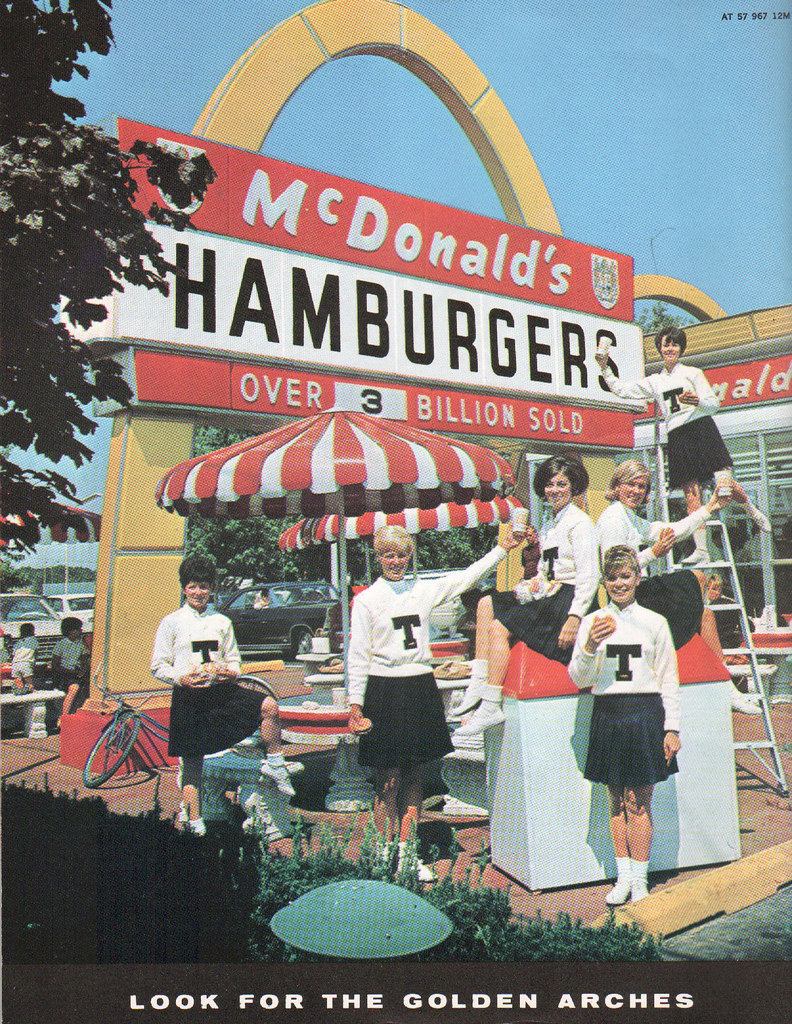
“Toledo, McDonald’s, 1967” by DBduo Photography is licensed under CC BY-SA 2.0 

 .
.
In 1910, Norman Angell wrote his famous book The Great Illusion, which argued that it would be irrational for the European great powers to go to war with one another when their prosperity was so interconnected by mutual trade and investment. The subsequent outbreak of WWI confirmed for many observers that competition for relative power and security trumped the pacific pursuit of reciprocal gains in wealth.
Following the Cold War, however, the sheer scope and intensity of globalization convinced many that a new era of capitalist peace had arrived. Thomas Friedman famously proposed a “Golden Arches Theory of Conflict Prevention”, which claimed that no two countries with a McDonalds had ever gone to war. There were many propitious augurs for a new era of peace: the lines stretched for blocks when McDonalds first opened in Moscow, and even still-nominally Communist China proclaimed, “to get rich is glorious.”
Simply put, the “capitalist peace theory” says that mutual gains from trade reduce incentives for conflict between economically engaged states, making the prosperity of each dependent on the other and producing high opportunity costs for war.
Realists have long countered this theory by claiming that states prioritize relative gains over absolute gains. State X and State Y may both be made wealthier in absolute terms by trading with one another, but if Y’s wealth grows at a faster pace than X, X may fear that Y’s rapidly growing wealth could be translated into a surplus of military power putting X’s security at risk. Realists contend that states will ultimately prioritize security over all other goals for the simple reason that without security, no other goals can be assured, including the pursuit of prosperity. Realists tend to reverse the logic of interdependence, claiming that low barriers to the cross-border flow of goods and capital are effects, rather than causes, of peace.
It appears that the realists are being proven right. On the eve of the unveiling of the Nordstream-2 pipeline between Russia and Europe, Moscow decided to invade Ukraine, which (literally) blew up the multi-billion-dollar project and all its future returns. Even McDonald’s, the golden harbinger of perpetual peace, shuttered its operations in Russia.
An even more important example is provided in East Asia. The US and China, the two largest economies in the world, are engaged in a rapidly escalating economic, technological, and military rivalry. Not only did the US initiate a trade war against China, it has also launched an increasingly severe series of export restrictions on advanced technology to China, clearly designed to halt China’s economic growth and limit its growing military power. America’s attempts to cut China off at the knees are reminiscent of the measures taken early in the Cold War to contain the Soviet Union and isolate it from the other industrial centers of the world.
Macaroni & Cheese from 1845
Tasting History with Max Miller
Published 8 Nov 2022
(more…)
How-to Eat Like a Marine in the Field
Munchies
Published 11 Jul 2018Lieutenant Glenn-Roundtree shows us how to make his ideal MRE (Meal, Ready-to-Eat), which includes a beef ravioli taco and cherry blueberry cobbler.
(more…)
November 8, 2022
Freeland to NATO? Almost certainly not
CDR Salamander explains why, despite her having good qualities that match some of what the job requires, we shouldn’t be betting any money on Deputy PM Chrystia Freeland taking over the role of Secretary General of NATO:
Screencap from a CPAC video of Chrystia Freeland’s speech at the Brookings Institution in October, 2022.
So, via NYT, as a war wages in Eastern Europe and NATO is looking for a new Secretary General, what is the focus?
The behind-the-scenes jockeying for who should succeed Jens Stoltenberg has begun in earnest, with a focus on women.
Here’s the CV:
While the officials cautioned that these are early days, and very often the names that surface first do not survive the bargaining among NATO’s 30 members, they said one prime candidate has surfaced in Washington: Chrystia Freeland, 54, the Canadian-Ukrainian deputy prime minister and finance minister of Canada.
Ms. Freeland, 54, a former journalist (who is married to a reporter for The New York Times), has also been Canada’s foreign minister. Her advantages are considerable: she speaks English, French, Italian, Ukrainian and Russian; she has run complicated ministries; she is good at news conferences and other public appearances; and she would be the first woman and first Canadian ever to run NATO.
The fact that word is on the street that the primary filter here is if someone is XX vs XY would be laughable if not so destructive. There is absolutely nothing wrong with a woman being Secretary General, but that should have nothing to do with the decision. The fact is leading with that as the first criteria, any woman selected as Secretary General this round, would — rightly — always have a shadow over them for this simple fact that they did not get the position on merit — but simply an attempt to signal virtue to … well … fellow members of the woke left in the West, I guess. NATO’s potential enemies will only be encouraged by such an act.
This does nothing for NATO or women — and it degrades both by the process.
That being said, as her name is being floated, let’s look at Freeland. Many US citizens may recognize her from her very undiplomatic interactions with the Trump Administration. It wasn’t just Trump, but something worse that seeps out. Even during the Biden Administration, her not-so-subtle sniffs of standard issue leftist Canadian anti-Americanism crops up on a regular basis. It only gets worse when she deals with Americans to the right of Bernie Sanders.
In NATO, you need someone who is a subtle politician — again with experience working in a vigorous multi-party coalition with highly different views, priorities, and goals. That is why Europeans make such good Secretary Generals. While Canada also has a parliamentary system, it and its parties are VERY different than the European model. Freeland only gets partial credit here.
There is also the issue of temperament. Read the links above. Freeland likes to pick fights, often in public. Worse, she seems to enjoy — again as most standard-issue Canadian leftists do — in making snide comments about the government and people of the alliance’s largest monetary and troop contributing nation — the United States of America.
The Secretary General of NATO has to be someone by temperament and habit seen as a non-partisan person toward the USA so that they can work with American administrations from all political parties. Freeland has significant issues with the American Republican Party in general and American conservatives in particular. That alone should be enough for serious alliance nations from Poland to Great Britain to be against her as a possible candidate. In summary; Freeland does not possess the skills or temperament for the position.
Now is not the time for such frivolity.
The last reason — and the most important reason for me — that Freeland should not be the Secretary General will be recognizable to regular readers here. It has nothing to do with her as a person, but her nation, Canada.
I love Canada and Canadians — but this is not personal, this is business. Serious alliance business. Simply by the numbers, Canada has not earned the position.
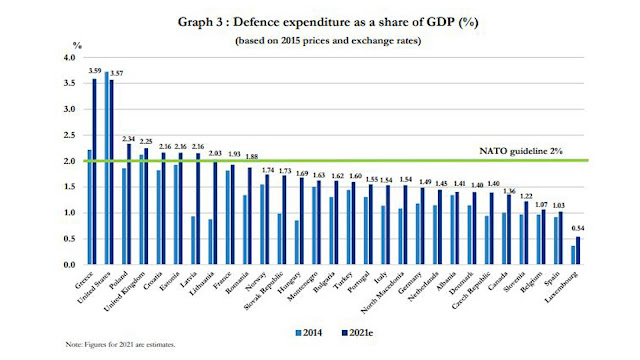
Review my post from September if needed, but Canada spends ~1.3% of her GDP on defense. This is WELL below NATO’s 2% minimum. Only Slovenia, Belgium, Spain and Luxembourg spend less.
We are well past being polite to alliance members who refuse to pull their fair share of the burden. Canada simply has not put herself in the position to reward any of her political elite with the position of Secretary General, man or woman.
November 6, 2022
How bad do the midterm elections look for the Democrats? Even Andrew Sullivan is voting Republican this time
From the free-to-cheapskates excerpt of Andrew Sullivan’s Weekly Dish:
“Polling Place Vote Here” by Scott Beale is licensed under CC BY-NC-ND 2.0 
 .
.
The day I received my absentee ballot from the DC government, there was a story in the Washington Post about the DC Council’s imminent vote:
The bill would eliminate most mandatory minimum sentences, allow for jury trials in almost all misdemeanor cases and reduce the maximum penalties for offenses such as burglaries, carjackings and robberies.
Over the past few years, violent crime in DC has been rising fast. Last year the murder rate was the highest since 2003, and this year the death toll is slightly higher so far. Carjackings are up 36 percent and robberies are up 57 percent. Almost all this hideous violence is inflicted on African-Americans, including many children. It permeates outward, creating a deeper public sense of insecurity and out-of-control crime. Tent cities are now all over the city. People suffering from mental illness patrol the streets. You feel the decline in law and order, the slow fraying of the city, every day.
And yet the Council has decided that now is the time to make it harder to prosecute and easier to defend violent criminals, partly in the name of “equity”. Yes, it’s part of a longstanding “modernization” of the criminal code, but they had to include these provisions and now? And this isn’t new. Just before the crime explosion took off, the DC mayor had “Black Lives Matter” painted on the street in letters so large you could read them from a plane, and allowed “Defund the Police” to remain next to it. That summer, woke mobs were allowed to harass anyone in their vicinity, yelling slogans that vilified all police — and the MSM took the side of the bullies. After the summer of 2020, the DC police force dropped to its lowest level in two decades.
So guess what? I’m going to vote for the Republican and the most conservative Independent I can find next Tuesday. And I can’t be the only Biden and Clinton and Obama voter who’s feeling something like this, after the past two years.
There was no choice in 2020, given Trump. I understand that. If he runs again, we’ll have no choice one more time. And, more than most, I am aware of the profound threat to democratic legitimacy that the election-denying GOP core now represents. But that’s precisely why we need to send the Dems a message this week, before it really is too late.
By “we”, I mean anyone not committed to the hard-left agenda Biden has relentlessly pursued since taking office. In my view, he and his media mouthpieces have tragically enabled the far right over the past two years far more than they’ve hurt them. I hoped in 2020 that after a clear but modest win, with simultaneous gains for the GOP in the House and a fluke tie in the Senate, Biden would grasp a chance to capture the sane middle, isolating the far right. After the horror of January 6, the opportunity beckoned ever more directly.
And yet Biden instantly threw it away. In return for centrists’ and moderates’ support, Biden effectively told us to get lost. He championed the entire far-left agenda: the biggest expansion in government since LBJ; a massive stimulus that, in a period of supply constraints, fueled durable inflation; a second welfare stimulus was also planned — which would have made inflation even worse; record rates of mass migration, and no end in sight; a policy of almost no legal restrictions on abortion (with public funding as well!); the replacement of biological sex with postmodern “genders”; the imposition of critical race theory in high schools and critical queer theory in kindergarten; an attack on welfare reform; “equity” hiring across the federal government; plans to regulate media “disinformation”; fast-track sex-changes for minors; next-to-no due process in college sex-harassment proceedings; and on and on it went. Even the policy most popular with the center — the infrastructure bill — was instantly conditioned on an attempt to massively expand the welfare state. What on earth in this agenda was there for anyone in the center?
Allies Launch New Phase in Pacific War – WW2 – 219 – November 5, 1943
World War Two
Published 5 Nov 2022The Allies hit the beaches of Bougainville, largest and last of the Solomon Islands. They create and expand a beachhead there and also win battles there at sea and in the skies. In the USSSR, the Soviets are closing in on Kiev and in the south have isolated the Crimea, but in spite of that, Adolf Hitler issues a new directive that Germany’s focus for the future should be in the west and the threat of an Allied invasion there.
(more…)
November 5, 2022
Psyops in theory and practice
Theophilus Chilton on the development of psyops and some examples of their use in US civilian contexts in recent years:
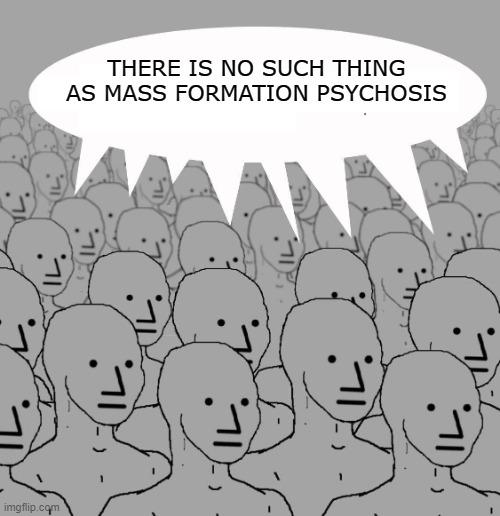
I trust that most readers are familiar with the concept of a “psyop”, a psychological operation designed to sway its targets in certain desired directions. Many of the mechanics of psyops were pioneered by the CIA and other intelligence agencies during the Cold War but have now been turned against civilian populations in the USA and elsewhere in an effort by the Regime to maintain control and minimise opposition to its various agendas. However, I’d like to make the point that psyops qualitatively differ from standard, run-of-the-mill propaganda such as governments have used for millennia.
The difference is primarily that of the time preferences involved. Whether it’s designed to whip up a population against an enemy or to try to obfuscate the truth about some particular event that has occurred, propaganda tends to operate on a shorter timescale and with more limited and simple policy goals in mind. It’s not surprising that modern propaganda techniques share a lot in common with commercial advertising designed to induce an “impulse buy” response in potential customers. Propaganda generally operates the same way — create a monodirectional response to a particular stimulus.
Psyops, on the other hand, are quite a bit more complex and generally involve the building of a narrative memeplex over the course of months, years, or even decades. Psyops are, of course, also fake but theirs is a fakeness that builds upon constant, repetitious narrative-building that lays out a foundational lens through which any individual incident or act can be systematically interpreted, adding them to the overall saga being told.
With conventional propaganda, the aim is to communicate Regime diktat to the average citizen. However, it does not necessarily expect the recipients to believe the propaganda, but merely comply with the goals. The Powers That Be in such cases don’t care why Havel’s greengrocer puts the sign up in his window, but merely that he does so. The primary purpose of psyops, on the other hand, is to ensure compliance by convincing the target to self-comply, rather than it having to be done by outside force or persuasion. It’s always touch and go when you’re making someone outwardly comply but inwardly they’re dissident. When the mark can be convinced to willingly self-police, this makes the government’s job easier since they don’t have to worry about this closet dissidence. The true believer is the best believer.
In essence, propaganda aims for immediate reactive persuasion while psyops seek long-term groundlaying that gives more all-inclusive means of maintaining overarching narrative control.
Now, a lot of people out there like to think they’re immune to psyops because “hurr durr I don’t beleeb da media!!” But they’re not. Indeed, a lot of these boomercon types are just as susceptible to psyops as anyone else when the right buttons are pushed. This is because they’ve been primed for it by the systematic, society-wide preparation of the psychological battle space without their ever realising it. In many cases, the foundations for a psyop are so culturally systematic that people don’t even realise what is happening.
For example, there are a ton of people out there who would pride themselves on being independent thinkers who nevertheless believed everything that was peddled during the covid and vaccine psyops. The reason for this is because they want to think of themselves as smart, knowledgeable about science, etc. Smart People believe the Right Things, after all. That, in turn, is the result of decades of psyops that have ensconced “science” as the arbiter of morality and truth in post-Christian America. So even when the science is fake or wrong, it is still accorded a moral authority that it does not deserve.
A working flight simulator, no computers necessary
Tom Scott
Published 4 Jul 2022There are only a few working Link Trainers left in the world: but before microprocessors, before display screnes, half a million pilots learned the basics of instrument flying inside one. More: https://www.most.org/explore/link-fli…
(more…)
QotD: The use of chemical weapons after WW2
Both Cold War superpowers stockpiled chemical weapons, but seem to have retained considerable ambivalence about their use. In the United States, chemical weapons seem to have been primarily viewed not as part of tactical doctrine, but as a smaller step on a nuclear deterrence ladder (the idea being that the ability to retaliate in smaller but still dramatic steps to deter more dramatic escalations; the idea of an “escalation ladder” belongs to Herman Kahn); chemical weapons weren’t a tactical option but baby-steps on the road to tactical and then strategic nuclear devices (as an aside, I find the idea that “tactical” WMDs – nuclear or chemical – could somehow be used without triggering escalation to strategic use deeply misguided). At the same time, there was quite a bit of active research for a weapon-system that had an uncertain place in the doctrine – an effort to find a use for a weapon-system the United States already had, which never quite seems to have succeeded. The ambivalence seems to have been resolved decisively in 1969 when Nixon simply took chemical weapons off of the table with an open “no first use” policy.
Looking at Soviet doctrine is harder (both because I don’t read Russian and also, quite frankly because the current epidemic makes it hard for me to get German and English language resources on the topic) The USSR was more strongly interested in chemical weapons throughout the Cold War than the United States (note that while the linked article presents US intelligence on Soviet doctrine as uncomplicated, the actual intelligence was ambivalent – with the CIA and Army intelligence generally downgrading expectations of chemical use by the USSR, especially by the 1980s). The USSR does seem to have doctrine imagine their use at the tactical and operational level (specifically as stop-gap measures for when tactical nuclear weapons weren’t available – you’d use chemical weapons on targets when you ran out of tactical nuclear weapons), but then, that had been true in WWII but when push came to shove, the chemical munitions weren’t used. The Soviets appear to have used chemical weapons as a terror weapon in Afghanistan, but that was hardly a use against a peer modern system force. But it seems that, as the Cold War wound down, planners in the USSR came around to the same basic idea as American thinkers, with the role of chemical weapons – even as more and more effective chemicals were developed – being progressively downgraded before the program was abandoned altogether.
This certainly wasn’t because the USSR of the 1980s thought that a confrontation with NATO was less likely – the Able Archer exercise in 1983 could be argued to represent the absolute peak of Cold War tensions, rivaled only by the Cuban Missile Crisis. So this steady move away from chemical warfare wasn’t out of pacifism or utopianism; it stands to reason that it was instead motivated by a calculation as to the (limited) effectiveness of such weapons.
And I think it is worth noting that this sort of cycle – an effort to find a use for an existing weapon – is fairly common in modern military development. You can see similar efforts in the development of tactical nuclear weapons: developmental dead-ends like Davy Crockett or nuclear artillery. But the conclusion that was reached was not “chemical weapons are morally terrible” but rather “chemical weapons offer no real advantage”. In essence, the two big powers of the Cold War (and, as a side note, also the lesser components of the Warsaw Pact and NATO) spent the whole Cold War looking for an effective way to use chemical weapons against each other, and seem to have – by the end – concluded on the balance that there wasn’t one. Either conventional weapons get the job done, or you escalate to nuclear systems.
(Israel, as an aside, seems to have gone through this process in microcosm. Threatened by neighbors with active chemical weapons programs, the Israelis seem to have developed their own, but have never found a battlefield use for them, despite having been in no less than three conventional, existential wars (meaning the very existence of the state was threatened – the sort of war where moral qualms mean relatively little) since 1948.)
And I want to stress this point: it isn’t that chemical munitions do nothing, but rather they are less effective than an equivalent amount of conventional, high explosive munitions (or, at levels of extreme escalation, tactical and strategic nuclear weapons). This isn’t a value question, but a value-against-replacement question – why maintain, issue, store, and shoot expensive chemical munitions if cheap, easier to store, easier to manufacture high explosive munitions are both more obtainable and also better? When you add the geopolitical and morale impact on top of that – you sacrifice diplomatic capital using such weapons and potentially demoralize your own soldiers, who don’t want to see themselves as delivering inhumane weapons – it’s pretty clear why they wouldn’t bother. Nevertheless, the moral calculus isn’t the dominant factor: battlefield efficacy – or the relative lack thereof – is.
Bret Devereaux, “Collections: Why Don’t We Use Chemical Weapons Anymore?”, A Collection of Unmitigated Pedantry, 2020-03-20.
November 4, 2022
Amnesty “literally means a pardon, i.e. the absence of punishment … for a crime committed in the past“
Sarah Reynolds considers the implications of what Emily Oster wrote in her Atlantic article suggesting a Covid-19 amnesty:
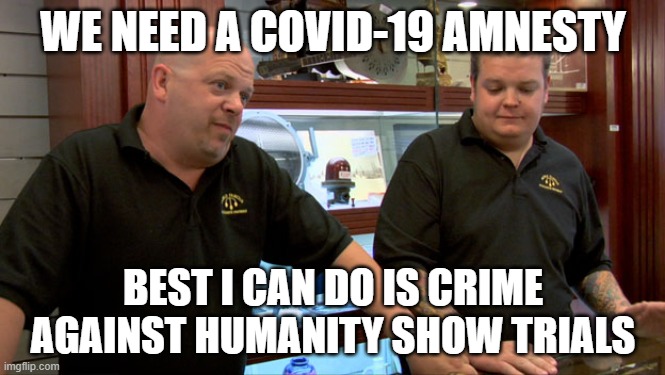
Now “amnesty” is a very specific word. It doesn’t mean forgiveness, it literally means a pardon, i.e. the absence of punishment … for a crime committed in the past.
It is a stark and loaded word indeed when used to refer to anything Covid-related because it establishes two parties: victims and perpetrators. Group 1: Those who committed crimes and could be in the legal sense pardoned of the criminal behavior they engaged in; and Group 2: those who will consequently not get justice.
The implication of such a dichotomy (if one were to appear) is horrifying.
The author alludes to the appeal and inevitability of forgiveness; I posit in contrast that forgiveness is a spiritual concept, one that may be inextricably linked to a religious belief for some, so she’s jumping the gun here because Forgiveness would be the stage after Justice, and only for those whose religion, faith, or spiritual practice also inspires or compels it.
Use of the word amnesty is terribly concerning to me because it insinuates that grave injustice has been committed. And if some horrible truth is coming out soon, her piece in the Atlantic serves as a way to beta test our/society’s future reaction to it — acting as the proverbial canary in the coal mine.
In other words, if we’re this outraged now knowing only what we know so far, how outraged will we be then, after this (speculated by me) coming newsflash triggers national indignation from coast to coast?
The most revealing part of the Professor’s piece in the Atlantic is this statement:
The standard saying is that those who forget history are doomed to repeat it. But dwelling on the mistakes of history can lead to a repetitive doom loop as well. Let’s acknowledge that we made complicated choices in the face of deep uncertainty, and then try to work together to build back and move forward.
No, vacuums are complicated. All those attachments.
Tyranny is quite straight-forward, in contrast.
Years ago, I read a book that taught the reader that people are often confessing and how to detect it. If you look at and listen to their word choices, you can sometimes find what it is they did in the past, what they fear will happen in the future, and clues about whether or not they are capable of remorse. Many of you who have watched my youtube or read my blog before I got on substack know how I like to do a communication analysis, and delineate a) what’s literally being said, b) what the person really meant, and c) the third and most important/revealing part, what’s being left unsaid. And I rarely hear people say, “it’s complicated”, unless they are feeling profound regret, fear of the consequences of those “complicated choices”, and plenty of denial of the emotional origin of that particular word choice. They don’t even know why they were compelled unconsciously to use that word … but we do. The stark truth would likely be anything but complicated and possibly horrifying. (For example, what if Oster got on twitter tomorrow and tweeted out, “I don’t think I feel regret or remorse like other people. Intellectually, I get it: the Pandemic response caused human beings unbearable pain and society irrevocable damage but it doesn’t really bother me per se and sometimes I even feel gratified by it, especially when I witness overt force (mandates) replace emotional manipulation (shame).” Now I’m sure Oster is a wonderful person with a fully intact moral compass who’s 100% able to empathetically relate to others!! But … IF … on the off chance it were a true statement so she did declare it on twitter, it might seem complicated to her, but to us it would be the simplest most logical explanation for her actions. We’d go, oh! She’s a sociopath! Oh my God, now it all makes perfect sense! Hahahahaha I get it now hahahahaha because we live in hell!!)
H/T to Chris Bray for the link.
QotD: History while it’s happening
Well, future historian, since I know how much that sucks, I’ll spare you. If you’re plowing through my papers (you’re welcome for all the Slave Leia pictures, by the way) and you get to the “Impeachment of Donald Trump” section, you’ll have something. Maybe nothing interesting, or particularly coherent, but at least it’s something. Professional courtesy.
If nothing else, this impeachment fiasco confirms that we’re ruled by fools. No earth-shattering insight, that, I realize, but there it is. Really it’s just math — since most people in all times and places have been fools, it stands to reason that nearly every human who has ever lived has had a large part of his fate decided by an idiot. This is true even of those blessed to have seen good leadership in action, as even the best men are fools about lots of things. Up to and including the things that make their reputations. George Washington, for instance, was indisputably a great leader, but a terrible general — with Cornwallis trapped on the Yorktown peninsula in Virginia, he had to be talked out of moving the Continental Army north, to reconquer New York. He was one of history’s great captains, but I bet I could take him in a game of Risk.
Severian, “Impeachment Thoughts”, Rotten Chestnuts, 2019-12-19.
November 3, 2022
Amnesty? How about “no”.
Tom Knighton on the recent trial balloons being sent up by certain media folks to test the willingness of us proles to “forgive and forget” their authoritarian cheerleading over the last two+ years:
Recently, a story over at The Atlantic proposed an amnesty over what happened during the COVID-19 pandemic. The idea was that we just let bygones be bygones and no one holds anyone else accountable for what happened.
Lives were ruined, people died alone and miserable — and in some cases, because they were alone and miserable — but we’re supposed to ignore all of that.
At Spiked, Lauren Smith says that the nasty authoritarian tendencies of those in power during the pandemic should absolutely not be forgotten:
As the Covid-19 pandemic fades from view, some may be tempted to forget those miserable two years of lockdowns, social distancing and other restrictions on our liberties. This is certainly the view of a widely shared article in the Atlantic, which calls for a “pandemic amnesty”. American economist Emily Oster asks us to “forgive one another for what we did and said when we were in the dark about Covid”. It quickly becomes clear why Oster would prefer us to move on.
During 2020 and 2021, Oster was very much on the side of lockdown. And she supported vaccine mandates in universities and for workers. In fairness to Oster, she did not support every Covid measure. She did, for instance, criticise how long it took for schools to re-open in the US back in the summer of 2020. Yet ultimately, she belonged to the side that was happy to criminalise meeting a friend for coffee or to separate people from their dying loved ones.
Now, with hindsight, Oster regrets some of her positions. The crux of her argument is that the people baying for more lockdowns, harsher restrictions and vaccine mandates couldn’t possibly have known any different at the time. She says that they couldn’t have known that outdoor transmission of Covid was rare, that schoolchildren were always a low-risk group and that cloth masks were virtually useless in preventing viral spread.
Many, however, did know these facts, including back in the spring of 2020. But those who said them out loud were quickly turned into pariahs.
Although Oster admits that those on the anti-lockdown side got many things right, she says this was merely a question of “luck”. But it should not have taken any great foresight to see the danger of lockdowns. They were responsible for the most significant loss of liberty in the history of the democratic world. Their impact on economic output was as profound as that of any war. Not since the days before universal education had so many kids been shut out of school. Worse still, those who did warn of these inevitable and dangerous consequences were met with derision and censorship.
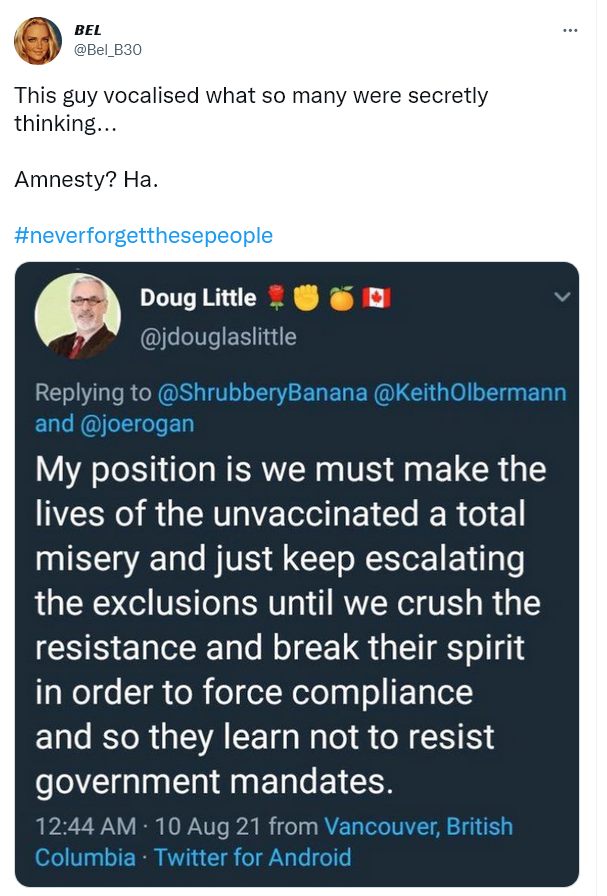
This is a pretty representative viewpoint of the lockdown mindset:
Twitter’s evolution from protecting celebrities to shaping “the narrative”
At Common Sense, Walter Kirn recounts his own recognition of how Twitter has changed since he first opened an account in 2009 (incidentally, the same year I did … but unlike Walter, I still have about the same number of followers there as I did in my first year):
The platform belonged to celebrities back then, who hawked their movies, albums, and TV shows in words that were their own, supposedly, fostering in fans a dubious intimacy with figures they knew only from interviews. One of these stars, an investor in the platform, was Ashton Kutcher, the prankish, grinning actor who became omnipresent for a spell and then, stupendously enriched, largely vanished from public consciousness. It seemed that Twitter had sped-up fame such that it bloomed and died in record time.
The power of the new platform struck me first in 2012. Two incidents. The first one, a small one, occurred in Indianapolis, where I’d gone to watch the Super Bowl. I attended a party the night before the game at which many Hollywood folk were present, including an actor on a cable TV show who played a roguish businessman. The actor was extremely drunk, lurching about and hitting on young women, and it happened that my wife, back home, whom I’d texted about the scene, was able to read real-time tweets about his antics from other partygoers. A few hours afterward she noticed that these tweets had disappeared. Instant reality-editing. Impressive.
I concluded that Twitter was in the business not only of promoting reputations, but of protecting them. It offered special deals for special people. Until then, I’d thought of it as a neutral broker.
[…]
My own habits on Twitter changed around that time. Observational humor had been my mainstay mode, but I realized that Twitter had become an engine of serious opinions on current affairs. On election night in 2016, while working at another journal, Harper’s, I was given control of the magazine’s Twitter feed and asked to think out loud about events while following them on cable news. I saw early that Trump was on his way to victory — or at least he was doing much better than predicted — and I offered a series of tart remarks about the crestfallen manners of various pundits who couldn’t hide their mounting disappointment.
The official election results were still unknown — Clinton retained a chance to win, in theory — but before the tale was told, my editors yanked my credentials for the account and gave them to someone else. The new person swerved from the storyline I’d set (which reflected reality) and adopted a mocking tone about Trump’s chances, even posting a picture of a campaign hat sitting glumly on a folding chair at his headquarters in New York City.
It struck me at first as pure denial. Later I decided that it was far more intentional — that my left-leaning magazine wished to preserve the illusion for its readers that the election’s outcome was unforeseeable, possibly to maintain suspense or so it could later act startled and disturbed in concert with its TV peers. Its Twitter feed, as a record of its reactions, had to align with this narrative.
I grew convinced that night that Twitter meant trouble for me. It had become an opinion-sculpting instrument, an oracle of the establishment, and I knew I would end up out of step with it, if only because I’m of a temperament which habitually goes against the flow to challenge and test the flow, to keep it honest. Mass agreement, in my experience, both as a person and a journalist, is typically achieved at a cost to reality and truth.
Is the AutoMag Curse Over? The New Auto Mag 180-D
Forgotten Weapons
Published 1 Jul 2022Historically speaking, the AutoMag 180 pistol has been a reaper of investors. Between 1971 and 1982, no fewer than six different companies went bankrupt trying to make a profit building Auto Mags. However, we may have finally reached the end of that streak …
In 2015, all the existing tools, parts, and IP related to the Auto Mag was sold to a new company (Auto Mag Ltd). Similar to the previous companies lured in by the glamour of this massive handgun, these new owners saw the list of existing parts (including several hundred frames) and figured they could assemble and sell a few hundred guns and make a nice return. Also similar to previous companies, they completed the deal and then discovered that those existing parts had major problems. Fundamentally, the Model 180 was simply not a mature design.
Where the new company has taken a new path is that they have spent the past 7 years reengineering the whole gun to fix its shortcomings. They have made a couple dozen design changes, although without changing anything fundamental in the appearance or operating principles of the gun. They have done things like lighten the firing pin, strengthen the locking lugs, tweak the magazine geometry, and so on — the changes that should have been make back in 1971 before the first example was ever shipped.
I came into this review with pretty low expectations — so many people have tried and failed to make a proper Automag that I really didn’t think Auto Mag Ltd would be able to pull it off. And yet to my happy surprise, it seems that they actually have. The gun ran flawlessly for me and was actually a lot of fun to shoot.
(more…)


