
Forgotten Weapons
Published 1 Jul 2022Historically speaking, the AutoMag 180 pistol has been a reaper of investors. Between 1971 and 1982, no fewer than six different companies went bankrupt trying to make a profit building Auto Mags. However, we may have finally reached the end of that streak …
In 2015, all the existing tools, parts, and IP related to the Auto Mag was sold to a new company (Auto Mag Ltd). Similar to the previous companies lured in by the glamour of this massive handgun, these new owners saw the list of existing parts (including several hundred frames) and figured they could assemble and sell a few hundred guns and make a nice return. Also similar to previous companies, they completed the deal and then discovered that those existing parts had major problems. Fundamentally, the Model 180 was simply not a mature design.
Where the new company has taken a new path is that they have spent the past 7 years reengineering the whole gun to fix its shortcomings. They have made a couple dozen design changes, although without changing anything fundamental in the appearance or operating principles of the gun. They have done things like lighten the firing pin, strengthen the locking lugs, tweak the magazine geometry, and so on — the changes that should have been make back in 1971 before the first example was ever shipped.
I came into this review with pretty low expectations — so many people have tried and failed to make a proper Automag that I really didn’t think Auto Mag Ltd would be able to pull it off. And yet to my happy surprise, it seems that they actually have. The gun ran flawlessly for me and was actually a lot of fun to shoot.
(more…)
November 3, 2022
Is the AutoMag Curse Over? The New Auto Mag 180-D
QotD: Why reading the news became less informative and more didactic
One of the small, pervasive changes that makes news stories seem both patronizing and politicized is the increasingly common practice of inserting judgmental adjectives into otherwise descriptive sentences. Telling readers that a statement is “false” while repeating it may be justified, if intrusive, but in other cases it’s an unnecessary tic.
Gone is the assumption that readers are intelligent people who can draw their own conclusions from a compelling presentation of the facts. Journalists now seem to live in fear that their readers won’t think correctly. Take this sentence from an interesting article on the evolution of American Sign Language: “For a portion of the 20th century, many schools for the deaf were more inclined to try to teach their students spoken English, rather than ASL, based on harmful beliefs that signing was inferior to spoken language.” (Emphasis added.)
If you read the article, you are highly unlikely to come to the conclusion that signing is anything less than a full-blown language, not inferior to spoken English. But the article never gives evidence that this incorrect 20th-century belief was harmful. It doesn’t discuss the pluses and minuses of signing, or why one belief was succeeded by another. That’s a different story. In the context of this story, the adjective is unnecessary, distracting, and insulting to the reader’s intelligence.
Virginia Postrel, “Shrinkflation, Disqualiflation, and Depression and more”, Virginia’s Newsletter, 2022-07-28.
November 2, 2022
QotD: Being “the world’s policeman”
The United States took on the mantle of world’s policeman in the post-Second World War world. They have spent much of the last 60 years trying to keep the peace, and, interestingly, to maintain the balance of power. (Do not be fooled by the concept of the overwhelming superpower. Britain was a lot closer to being able to take on the rest of the world in the 19th century, when it really could defeat every other navy in the world combined; than the US is now, where it could perhaps face Iran, Russia and India simultaneously, as long as the European Union is friendly. Whoops, forgot China, the Balkans, Palestine, Syria, North Korea, Iraq, Afghanistan, Somalia and other little blips on the US horizon. Well let’s be honest, no one has ever been able to take on more than a few of the other powers simultaneously. NO one.)
For their troubles, they are usually pilloried by those all about them, particularly by up and coming powers who want their “place in the sun” – the Soviet Union and China being the stand-out examples. (Though there is a lot of whinging from old allies like France). For the last forty years (since Vietnam, and certainly since Gulf War One), there have been signs that the US voter is having serious second thoughts about the whole concept.
Britain was quite reluctant to take over later imperial dependencies, particularly leftover states of defeated Empires like Turkey, such as Iraq and Palestine: but also parts of Africa and Asia “of interest to no bugger”. They were never part of the British ideal of commercial empire, and were almost impossible to govern. They were abandoned as soon as possible.
The United States is currently experiencing the joys of taking over, or being responsible for unwanted bits of empire. Strangely the names Iraq and Palestine are occurring on that list, as well as Afghanistan and possibly other commitments to come. (The US has interfered in these areas far longer than Britain had before she was stuck with them). They cannot be considered part of a logical geopolitical empire (not even for oil conspiracy nuts), and will be abandoned as soon as possible.
The British voter responded to the world wars by wanting out of empire. Now. Some of the states thus “released” were well-developed societies with decent infrastructure and good literacy and rule of law concepts. India, Malta, Ceylon, Bermuda and Singapore spring to mind. Others were abandoned prematurely: without literacy, rule of law, good infrastructure, a developed civil service, practice of voting, or any of the other minor necessities for establishing a democratic state. See any list of African dictatorships.
The US voter is responding to current events by wanting out of the Middle East ASAP. They are intent on abandoning states to “democracy”, regardless of a lack of literacy, rule of law, good infrastructure, a developed civil service, practice of voting, or any of the other minor necessities for establishing a democratic state. Whoops.
Britain suffered from an immense artificial economic high after the Napoleonic war. This left the British economy extremely artificially inflated for eighty years, and still well above its realistic weight in the world for another fifty (and only really brought back to the field by the immense economic losses of two world wars). In the last twenty years Britain has held a more realistic place in the world economy for its population and industrial level (though still relatively inflated by an immense backlog of prestige and sometimes reluctant respect.).
The US suffered from an immense artificial economic high after WWII. This left the US economy artificially inflated for the rest of the century, and still well above its realistic weight in the world to the present. … Sometime in the next few decades, the US will probably return to a more realistic place in the world economy for its population and industrial level. (Minor variables like World War III may make this projection uncertain as to actual timing, but it will happen: simply because the US will not be able to largely sit out most of the next world wars and profiteer from everyone else’s ruin the way she could in the last two).
Nigel Davies, “The Empires of Britain and the United States – Toying with Historical Analogy”, rethinking history, 2009-01-10.
November 1, 2022
If it wasn’t for double standards, the legacy media wouldn’t have any standards at all
At Spiked, Brendan O’Neill calls out the US mainstream media for their blatant double standards on political violence after the as-yet still mystery-shrouded attack on the husband of the Speaker of the House of Representatives over the weekend:

Paul and Nancy Pelosi, 16 February, 2022.
Detail of a photo by Amos Ben Gershom via Wikimedia Commons.
It was the mention of zip ties that got me thinking. Apparently the man who allegedly broke into the San Francisco home of Nancy and Paul Pelosi on Friday was carrying zip ties. A possibly crazed individual approaching the home of a powerful politician with plastic fasteners that can be used to bind a person’s hands – it was both a nightmarish prospect and a familiar one, too. Wasn’t another public figure in the US recently targeted by someone who had zip ties? And a gun, a knife, pepper spray and a crowbar? Yes. It was Brett Kavanaugh. But many don’t remember that. Because thanks to the media, certain acts of political hate get less traction than others.
People are rightly horrified by what happened to Paul Pelosi on Friday. David DePape allegedly broke into the Pelosi home and yelled “Where is Nancy?”. She wasn’t there. DePape then allegedly attacked Mr Pelosi, who is 82, with a hammer. Pelosi suffered a skull fracture and is still in hospital, though he is expected to make a full recovery. This was a horrific assault on an elderly person, as well as seeming to have been motivated by a deep political animus. Sadly, it was not a one-off. There was a creepily similar incident at the home of Supreme Court justice Brett Kavanaugh in Maryland in June.
A 26-year-old man from California travelled to Maryland allegedly with the intention of murdering Kavanaugh. That’s what he is charged with – attempted murder. He was armed with a tactical knife, a Glock 17 pistol, zip ties and other murderous paraphernalia. The difference between Kavanaugh’s alleged tormentor and the man who allegedly broke into the Pelosi home is that the former failed to gain entry. He spied two US marshals close to Kavanaugh’s home and called off his deadly mission. Kavanaugh was luckier than Paul Pelosi.
It is unquestionable that the assault on the Pelosi home has caused more waves and fury among the media elites than the mercifully thwarted attempted assassination of Kavanaugh did. The Kavanaugh incident swiftly faded from public consciousness. One observer wrote of the media’s “eerie silence” on Kavanaugh. It was pointed out that the “attempted assassination of Brett Kavanaugh” was being downplayed by the New York Times the very day after it happened. On the NYT‘s homepage, the Kavanaugh story was 16th in order of importance, behind stories about the new Jurassic Park movie and Kelly Clarkson’s singing skills. In that day’s paper, it was on page 20. Nate Silver said it was “crazy” that the targeting of Kavanaugh was not “treated as a bigger story”. “There’s often more bias in which stories are deemed to be salient than how they’re written about it”, he said.
That is well said. Media bias is apparent not only in the information and takes that the media publish but also in what the media decree to be important in the first place. And it would appear that the targeting of a right-wing, pro-life justice is less important – a lot less important – than the targeting of the home of a Democratic, pro-choice politician. Politics is clearly at play here. Kavanaugh’s moral outlook runs counter to that of the liberal media and coastal elites, and thus he makes for an unsympathetic character. Nancy Pelosi, on the other hand – she’s the crusading Democrat the chattering classes love. An assault on her home moves the liberal elites profoundly.
On the rapidly changing reported details of the attack on Paul Pelosi, Jim Treacher has some salient questions:
First things first: Paul Pelosi is currently in the hospital recovering from his attack, and here’s wishing him a speedy recovery. It sounds horrible and I wouldn’t wish it on anybody. Crime in America is spiraling out of control.
Now …
The Pelosis are worth somewhere north of $100 million. Nancy Pelosi is the speaker of the United States House of Representatives, and second in the line of presidential succession. You’re telling me her husband Paul was alone in a house with no security or surveillance cameras? This lunatic David DePape just walked right up to the house and broke in?
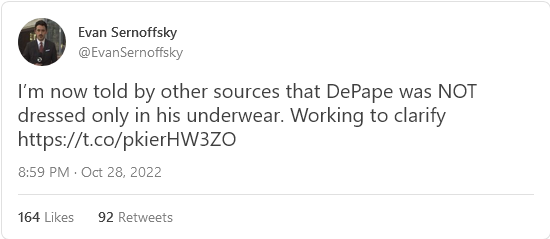
I’ve got other questions. The initial report was that DePape was in his underwear when the police caught him beating Pelosi with a hammer. Now we’re told that’s not true.
Wait, what? How do you get that detail wrong? Did it come from the police? I can understand misremembering the color of his pants. But the cops couldn’t tell whether he was wearing any?
And then there’s this:
Okay, I’m just trying to picture the scene that the two responding officers saw: They entered the Pelosi home, found DePape attacking Pelosi, and stopped him.
How did they get into the house? Did they break down the door? Was it unlocked, or already open? Did DePape or Pelosi open it?
The story is that the police encountered DePape in the middle of beating Pelosi. So if DePape opened the door for them … why? Or if Pelosi opened the door for them … how?
I see a lot of people speculating that this was some sort of lovers’ quarrel, or a Grindr date gone wrong, or something along those lines. Doesn’t seem likely to me, but is it really outside the realm of possibility? Are you a homophobe? I thought we were supposed to accept all genders and preferences and whatnot. It’s 2022.

October 31, 2022
“If The Regime doesn’t have their canned narrative ready to go, it’s real news”
At Founding Questions, Severian offers some preliminary thoughts on the new field of “Brandonology”, specifically how to determine whether what’s in the legacy media is news or propaganda:
I’m throwing this out there now, because it’s shaping up to be a long-term project and I think we can all contribute to it as needed. But as Brandonology / FNGology is such a new discipline, it’ll help to lay in the foundations.
The first step in analyzing the “news” is determining whether or not it is, in fact, news. “News” here being defined as “an unplanned event — or catastrophic fuckup of a planned event — to which The Regime is forced to react in more or less real time”. Lot of that going around recently, such that we’re spoiled for choice. Pick pretty much any of the shenanigans in Ukraine: The botched assassination of Alexander Dugin; the Nordstream sabotage; the Ukrainian dirty bomb false flag. Those clearly fall into the “catastrophic fuckup of a planned event” category …
… or do they? Because as Z Man pointed out in great detail on his last podcast, all of that stuff seemed to catch The Regime flatfooted. Yeah, somebody planned those things, but that somebody wasn’t Brandon, or anyone close to Brandon, or anyone in position to prop up Brandon. Which is the surest tell for actual news (as defined above) right there: If The Regime doesn’t have their canned narrative ready to go, it’s real news.
The necessity of the canned narrative also allows the keen Brandonologist to anticipate the “news”. For instance, it has obviously started to dawn on The Regime that they’re going to get walloped in the midterms, so they’re trying out narratives as we speak. Z Man identified one I hadn’t seen, something about Brandon “inadvertently” saying something about the debt ceiling that’s supposed to give the Republicans all kinds of ammunition against him. I’m not so sure. I’ll have to look into it, but the fact that it squarely blames Brandon — who The Regime still insists is the very picture of mental acuity and vigor — pings my radar a bit. I think the stuff Her Nibs is rolling out is much likelier the Narrative being developed — she’s outright stating that “the Republicans” are going to engage in massive voter fraud.
Which to normal people is chutzpah beyond belief, but that’s how The Regime rolls. The 2016 election was, of course, full of Russian Hacking™. The 2020 election, by contrast, was the cleanest canvass in human history, and you’re an insurrectionist, a domestic extremist, and of course a racist if you dare to suggest the mere possibility of an American election being tampered with. But wouldn’t you know it, those dastardly Russians are going to rally here in 2022, because you can’t keep a Russian Hacker™ down. They might even hire a few prostitutes to pee on a bed for good measure; that’s how evil they are.
Further complicating the task, though, is that “botched op” thing. We’ve got Brandon et al. on record threatening Nordstream, so you know that was an American caper gone bad … but gone real, real bad, because if The Regime had been fully in the know, there’d have been a whole bunch of Tier Four Stoyak about lousy maintenance on the pipelines for months in advance.
Why aren’t you as angry and afraid as the media wants you to be?
Chris Bray on the unrelenting din of fear porn you get if you pay any attention to the legacy media:
It’s like a magic act where the door to the secret compartment moves slowly and has a spotlight pointed at it, and the audience sees the illusion every time, because it’s literally not an illusion, being right out there in the open, but the magician still pretends that everyone watching is shocked and baffled by the trick.
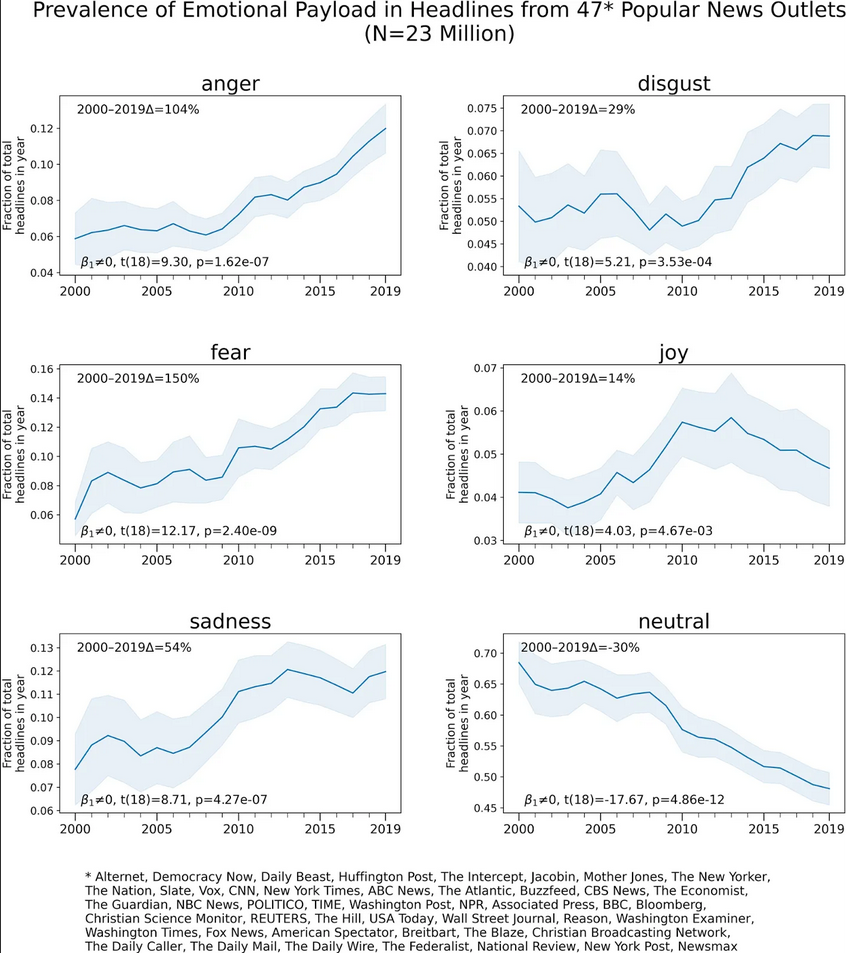
So. Via Nellie Bowles, writing at Common Sense, this summary of findings from a recent study of the American news media:
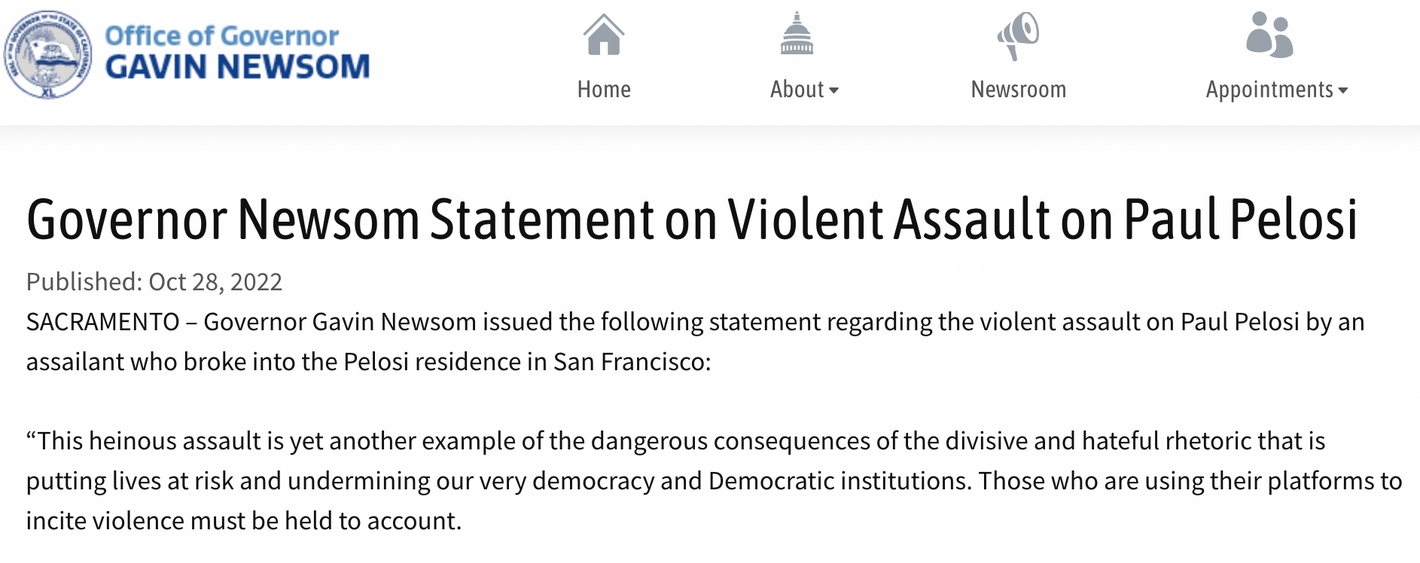
Today’s Standard-Issue Explanatory Line™ on Paul Pelosi being attacked in his home is that TRUMP TRUMP TRUMP, toxic far-right rhetoric!!!!! Ten minutes after the shabby break-in at the Katie Hobbs for Governor office was omfg literally Watergate before it evaporated into nothing much, a uniquely strange Berkeley nudist is a far-right puppet with an opening at the bottom for Donald Trump’s hand, steered by hateful rhetoric that incites violence:
[…]
Wouldn’t it be refreshing if the news media focused on a clear description of what happened before they got to the blame and politicization?
There are a dozen obvious things to say about all of this, even if you aren’t Steve Scalise — the double standard, the depiction of ordinary political criticism as “demonization”, the discarding of contradictory evidence to make round pegs fit square holes — and I’m mostly not going to bother saying them in any detail.
But the thing that has to be said is that the people who increasingly hold the attention of their audiences with hyperemotional clickbait, with the obvious manipulation of negative emotions, are warning us about the dangerous effects of hyperemotional rhetorical manipulation in the public sphere.
Ohhhhh, we’re about to LOSE OUR VERY DEMOCRACY! We tremble on the edge of a FASCIST TAKEOVER! And also, toxic rhetoric is bad.
QotD: The True Believer
Why? From the Wiki summary, believers will persist in the face of overwhelming disconfirmation if:
- A belief must be held with deep conviction and it must have some relevance to action, that is, to what the believer does or how he or she behaves.
- The person holding the belief must have committed himself to it; that is, for the sake of his belief, he must have taken some important action that is difficult to undo. In general, the more important such actions are, and the more difficult they are to undo, the greater is the individual’s commitment to the belief.
- The belief must be sufficiently specific and sufficiently concerned with the real world so that events may unequivocally refute the belief.
- Such undeniable disconfirmatory evidence must occur and must be recognized by the individual holding the belief.
- The individual believer must have social support. It is unlikely that one isolated believer could withstand the kind of disconfirming evidence that has been specified. If, however, the believer is a member of a group of convinced persons who can support one another, the belief may be maintained and the believers may attempt to proselytize or persuade nonmembers that the belief is correct.
This is Leftism in a nutshell, and it explains why SJWs are impervious to factual, rational argument. Boiled down as far as it will go: Group identity is so important to the Leftist that, faced with the choice between continued group membership and the evidence of xzhyr own lying eyes, xzhey will pick group membership, every time. This sets up its own feedback mechanism, such that disconfirmations of their dogmas actually increase their commitment — only the truest, holiest believers would keep believing in the face of the facts.
Severian, “What Happens if the UFO Actually Comes?”, Rotten Chestnuts, 2019-09-25.
October 30, 2022
Andrew Sullivan on the rise of Rishi Sunak (or was it “Rashid Sanook”?)
In the free-to-cheapskates excerpt from his Weekly Dish newsletter, Andrew Sullivan contemplates the differences between how Barack Obama was seen as a historical figure to the US media and yet that same media can’t manage to see how Prime Minister Sunak is “the British Obama”:
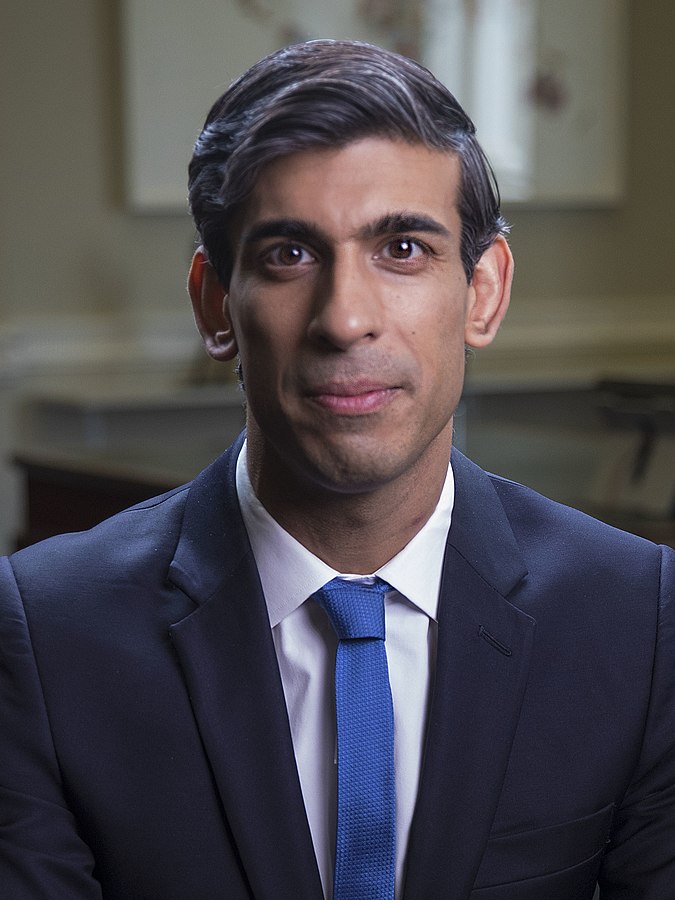
Rishi Sunak shortly after becoming Chancellor of the Exchequer in 2020.
In his inimitable way, Joe Biden this week celebrated the rather remarkable fact the the new Conservative prime minister in Britain is the grandson of Indian immigrants:
As recently as today, we’ve gotten news that Rashid Sanook is now the prime minister. As my brother would say, “Go figure.” And the Conservative party! … Pretty astounding. A groundbreaking milestone. And it matters! It matters!
He got the name wrong, but he’s Joe Biden. He gets names wrong. But unlike many on the left, especially the woke left, and perhaps because he is old enough to remember the after-effects of colonialism, Biden could bring himself to see what a staggering moment it is. It really is. It has gotten a bit obscured in the incredible mess of recent Tory politics. But staring us in the face is a historic shift.
It’s an Obama moment, after a fashion.
[…]
No, Sunak didn’t run an inspirational campaign like Obama. He’s not an orator even close in skill, he hasn’t won an election in his own right, and he didn’t come out of the blue. But he’s even younger than Obama when he took office — just 42, five years younger than Obama when he became president, and, unlike Obama, a slip of a thing and only 5’7″. And, for understandable reasons, Sunak seems much less worried about the cultural and political aspects of breaking the race barrier than Obama was.
Sunak is, for example, an openly practicing and proud Hindu. He lit Diwali lights around 11 Downing Street and took his oath on the Bhagavad Gita. That’s not someone running from his heritage. And he is also a Brexiteer from conviction, and, unlike Truss, a fiscal conservative who’s a realist about what can and can’t be done in a period of extraordinary economic stress for Brits and massive post-Covid debt.
All of this suggests something too many liberals have forgotten. These countries of alleged “white supremacy” have less racism than almost anywhere else in the world. It is hard to imagine a non-white president of France or Germany or Italy — let alone China or Russia or anywhere in Central Europe. It is hard to think of another empire that was deliberately unwound by its architects, and who then, within two generations, installed the grandson of former colonial subjects to its most powerful office. And Obama, of course, was twice elected with more heartland white support than Hillary Clinton.
Sunak has, moreover, been selected by the Tory party — that bastion of alleged bigotry that has already had three female prime ministers in its history, and now also a non-white man, James Cleverly, as foreign secretary, and a woman of Indian ancestry, Suella Braverman, as home secretary. Three of the top four ministers of state in Sunak’s cabinet are non-white. The new chairman of the Conservative party is Nadhim Zahawi. I’m telling you this because the US MSM — who are usually obsessed with racial representation in every single mundane situation — suddenly aren’t that interested, when some of their woke priors are rattled.
This is true of the broader American left. A faction obsessed with racial “equity” cannot take a moment to observe a historical moment of extraordinary proportions. Some, like Trevor Noah, have even completely invented a racist “backlash” against Sunak that simply hasn’t happened, apart from one call on one radio call-in show. (I was on BBC Radio this morning talking to an interviewer who was simply baffled by the projection.)
Noah has the excuse of being a comedian. But the New York Times‘ coverage has been almost as ludicrously slanted as its usual coverage of post-Brexit Britain, and it quickly ran two op-eds by British leftists trashing Sunak. Every story that refers to his ethnicity always slams his class “privilege” — i.e. that his parents were middle-class children of immigrants. This morning, the paper ran another hit-piece on Sunak’s wealth. The only benefit of his Indian ancestry appears to be that he will help the Indian diaspora in Britain itself. The incredible arc of imperial history finally coming full circle? Barely a mention.
Fresh German Armor in the USSR! – WW2 – 218 – October 29, 1943
World War Two
Published 29 Oct 2022Erich von Manstein finally gets the reserve armor he’s been begging Hitler for, so he can carry out his counteroffensive in Ukraine. The Soviets are still on the move themselves though. In Italy, though, the Allies are moving at a crawl since the Germans have mined and booby trapped everything. There’s also new action in the Solomons and a celebration in Japan.
(more…)
October 29, 2022
Your Thoughts on Our D-Day Coverage So Far – WW2 – Reading Comments
Updated with re-uploaded video, 3 Nov 2022. The original video was taken down within a few hours. This is the same video less one short rant that Indy reconsidered and has chosen to omit.
World War Two
Published 28 Oct 2022Indy and Sparty pick out some of the best, most interesting, and even controversial comments by you under our videos. Stay for the PJs.
(more…)
October 28, 2022
The real tech startup lifecycle
Dave Burge (aka @Iowahawk on the Twits) beautifully encapsulates the lifecycle of most successful tech startups:

I like the thing where people assume everybody working at Twitter is a computer science PhD slinging 5000 lines of code daily with stacks of job offers for Silicon Valley headhunters, and not a small army of 27-year old cat lady hall monitors
Successful social media companies begin in a shed with 12 coders, and end up in a sumptuous glass tower with 1200 HR staffers, 2000 product managers, 5000 salespeople, 20 gourmet chefs, and 12 coders
True story, I was in SV a few weeks ago and visited a startup that’s gone from $4MM to $100+MM rev in 2 years. HQ currently cramped office with 30-40 coders in a strip mall, but moving to office tower soon. I’m like, man, you’ll eventually be missing this.
Why do successful tech companies have so many seemingly useless employees? For the same reason recording stars have entourages
Here’s the sociology: 5 coders form startup. Least embarrassing one becomes CEO. The other ones, CFO, COO, CMO, and best coder becomes CTO.
Company gets big; CFO, COO CMO hold a dick measuring contest to hire the biggest dept.
CTO still wants to be the only coder.
I suspect it really does takes 1000 or more developers to keep Twitter running; backend, DB, security, adtech/martech etc. But I’d guess a significant # of Twitter devs are basically translating what triggers the cat ladies into AI algorithms.
October 27, 2022
Tamara Keel reviews the new FN High Power pistol
These days, thanks to both financial and legal limitations, there’s no chance I’ll ever own either an original Browning Hi Power or the new FN High Power, but I can still dream about ’em:

Browning High Power 9mm, the standard side-arm of the Canadian army from WW2 until its replacements start to arrive some time in 2023.
Let me state this up front: I’m a proud American. I love baseball and apple pie. If you cut me, I bleed red, white and blue. Whichever Detroit automaker you think is best, I think they are, too. And, therefore, I am a loyal fan of John Moses Browning’s M1911.
But, with that out of the way, it pains me to admit that the 1911 wasn’t Browning’s most important or influential pistol design. The 1911 is largely an American obsession, and when the rest of the world thinks about JMB’s martial handguns, the one that springs to mind is the Fabrique Nationale GP35, better known as the FN Hi Power.
Actually the result of a collaboration between Browning and his successor at FN, the great Dieudonné Saive, the Hi Power is one of the most prolific service pistols ever created, being used by the militaries of half a hundred countries.
Though it had some features that made it cheaper and easier to produce than the M1911, such as the fixed, under-barrel cam that replaced the swinging link on the older design, the Hi Power was still expensive to produce compared to newer designs. Even the change to a simpler external extractor in the 1960s wasn’t enough to keep it competitive, cost-wise, for budget-conscious militaries, and its double-stack, 13-round mag — a revelation in the 1930s — was by now commonplace.
Browning (an FN subsidiary) finally ended production a few years ago, but it turned out that demand for the Hi Power still existed.
EAA began selling a Turkish-made clone recently, and Springfield Armory upped the ante with the SA-35, which offered some minor tweaks to the original design.
Early this year, though, FN America went nuclear on the Hi Power market by offering the all-new, American-made High Power.
Note the spelling change, because this isn’t your granddad’s Hi Power.

“Controls are ambidextrous. A thumb-safety lever and a slide-stop lever can be found on either side of the new High Power, and the magazine release is reversible • While not interchangeable with the older unit on the left, the new magazines are more capacious • The mag well is expectedly wide and promotes fast reloads • The topstrap is smooth, but the semi-matte PVD finish prevents glare • The trigger is a great improvement over the original, thanks in part to the absence of a magazine-disconnect safety • Removing the slide is simple, but you have to control it against the tension of the recoil spring.”
Photos from Shooting Illustrated, most likely by Tamara Keel.
500 Years of Correcting “Historical” Halloween Costumes
Bernadette Banner
Published 26 Oct 2019Ft. my attempts to re-draw them But Better.
[The auction is now concluded.]FOOTNOTES
1. “A literal armful of skirt”: Portrait of Giovanni(?) Arnolfini and his Wife by Jan van Eyck, 1434 http://bit.ly/33ZToHd
2. 16th century split front skirts and square neckline, for comparison: “Portrait of Katherine Parr”, c. 1545 http://bit.ly/2BSUCs5
3. Examples of gowns cut in long panels: from Le Livre des faiz monseigneur saint Loys, composé à la requête du cardinal de Bourbon et de la duchesse de Bourbonnois (p. 195), 1401 – 1500 http://bit.ly/2WcpWLu
4. Exceedingly Extra sleeves: “Saint George Slaying the Dragon” by Jost Haller, c. 1450. Unterlinden Museum. Digital image from Wikimedia Commons. http://bit.ly/2JksLFe
5. Hoods: Le Livre des faiz monseigneur saint Loys, composé à la requête du cardinal de Bourbon et de la duchesse de Bourbonnois (p. 205), 1401 – 1500 http://bit.ly/33Ya7e6
6. Cap? Fillet? from Le Livre des faiz monseigneur saint Loys, composé à la requête du cardinal de Bourbon et de la duchesse de Bourbonnois (p. 211), 1401 – 1500 http://bit.ly/33ZI0Lx
7. French farthingale: “Ballet des fées des forêts de Saint-Germain – Entrée des Esperculates” Daneil Rabel, 1626 http://bit.ly/31M3dal
8. Queen Elizabeth I effigy bodies: “Corset from Elizabeth I’s wax effigy 1603” http://bit.ly/369ezJ5
9. “The Merchant Taylors”, 1749. The British Museum http://bit.ly/2JiYR42
(more…)
October 26, 2022
You apparently only need to worry about inflation if you’re one of the “little people”
Tom Knighton was angered by a recent comment from a well-to-do type who is frustrated at all the “needless” worry about inflation when there are “bigger concerns” in play:
I really don’t like talking about my personal life too much, but I kind of feel like I have to. It started a couple of days when Never Trumper Tom Nichols tweeted this:
Frankly, I’m still pissed about it three days later.
You see, it must be nice for Nichols to view this as a problem of perspective, that people just aren’t seeing the forest for the trees because gas is a tad high.
I can’t be one of those people.
For the record, I think of myself as a working-class writer. I don’t make those six-figure salaries and socialize with the elite at cocktail parties. I make enough to support my family of four in what many could generously term a modest lifestyle.
And I’m OK with that. While I want more, I love the fact that my work life is what it is and I have tons more freedom to do what I want throughout the day.
These days, though, things are different.
You see, while Nichols pretends it’s just people a little grumpy about gas prices, I see the harsh reality that people like him never will.
I’m the guy looking at the time before the next paycheck and realizing that we might not have food in the house for a day or two. I’m the one trying to decide how to stretch the last $40 in our bank account to cover those couple of days and praying it will. I’m also the one who knows that two years ago, this wasn’t a problem.
Hell, a year ago, it wasn’t an issue.
And I don’t make awful money, all things considered. I can only imagine what it’s like for those whose families don’t bring in what I normally make.
For Nichols to get worked up because people don’t see any existential crisis but do see the harsh reality slapping them in the face day in, day out sounds an awful lot like “Let them eat cake” to me.
Unfortunately, that’s what folks like Nichols think.
Nichols, who seems to believe in expertise based on his previous work, is talking about stuff he knows nothing about, things he lacks the expertise to comprehend.
The current inflation isn’t just some mild inconvenience. It’s not one of those things where we all can just shrug and push through until better times. It’s real and it’s here and it’s hurting people like me.
That gives me a certain amount of expertise because this is my life and my livelihood. This is how my family suffers.
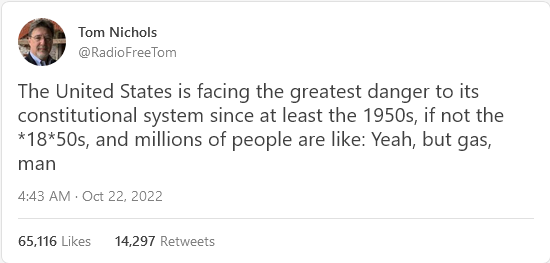
I’m very much with him on this, as rising inflation is already a pretty big concern for us and it doesn’t look like it’ll get better any time soon.
October 25, 2022
A Multi-Trillion Dollar Pipe Dream
PragerU
Published 16 Jun 2022Are we heading toward an all-renewable energy future, spearheaded by wind and solar? Or are those energy sources wholly inadequate for the task? Mark Mills, Senior Fellow at the Manhattan Institute and author of The Cloud Revolution, compares the energy dream to the energy reality.
(more…)


