
PragerU
Published 16 Jun 2022Are we heading toward an all-renewable energy future, spearheaded by wind and solar? Or are those energy sources wholly inadequate for the task? Mark Mills, Senior Fellow at the Manhattan Institute and author of The Cloud Revolution, compares the energy dream to the energy reality.
(more…)
October 25, 2022
A Multi-Trillion Dollar Pipe Dream
Comments Off on A Multi-Trillion Dollar Pipe Dream
October 24, 2022
The rise of “Queer Theory”
In City Journal, Christopher F. Rufo provides the background that has lead to the widespread phenomenon of “Drag Queen Story Hour”:

Start with queer theory, the academic discipline born in 1984 with the publication of Gayle S. Rubin’s essay “Thinking Sex: Notes for a Radical Theory of the Politics of Sexuality”. Beginning in the late 1970s, Rubin, a lesbian writer and activist, had immersed herself in the subcultures of leather, bondage, orgies, fisting, and sado-masochism in San Francisco, migrating through an ephemeral network of BDSM (bondage, domination, sadomasochism) clubs, literary societies, and New Age spiritualist gatherings. In “Thinking Sex”, Rubin sought to reconcile her experiences in the sexual underworld with the broader forces of American society. Following the work of the French theorist Michel Foucault, Rubin sought to expose the power dynamics that shaped and repressed human sexual experience.
“Modern Western societies appraise sex acts according to a hierarchical system of sexual value,” Rubin wrote. “Marital, reproductive heterosexuals are alone at the top erotic pyramid. Clamouring below are unmarried monogamous heterosexuals in couples, followed by most other heterosexuals. … Stable, long-term lesbian and gay male couples are verging on respectability, but bar dykes and promiscuous gay men are hovering just above the groups at the very bottom of the pyramid. The most despised sexual castes currently include transsexuals, transvestites, fetishists, sadomasochists, sex workers such as prostitutes and porn models, and the lowliest of all, those whose eroticism transgresses generational boundaries.”
Rubin’s project — and, by extension, that of queer theory — was to interrogate, deconstruct, and subvert this sexual hierarchy and usher in a world beyond limits, much like the one she had experienced in San Francisco. The key mechanism for achieving this turn was the thesis of social construction. “The new scholarship on sexual behaviour has given sex a history and created a constructivist alternative to” the view that sex is a natural and pre-political phenomenon, Rubin wrote. “Underlying this body of work is an assumption that sexuality is constituted in society and history, not biologically ordained. This does not mean the biological capacities are not prerequisites for human sexuality. It does mean that human sexuality is not comprehensible in purely biological terms.” In other words, traditional conceptions of sex, regarding it as a natural behavior that reflects an unchanging order, are pure mythology, designed to rationalize and justify systems of oppression. For Rubin and later queer theorists, sex and gender were infinitely malleable. There was nothing permanent about human sexuality, which was, after all, “political”. Through a revolution of values, they believed, the sexual hierarchy could be torn down and rebuilt in their image.
There was some reason to believe that Rubin might be right. The sexual revolution had been conquering territory for two decades: the birth-control pill, the liberalization of laws surrounding marriage and abortion, the intellectual movements of feminism and sex liberation, the culture that had emerged around Playboy magazine. By 1984, as Rubin acknowledged, stable homosexual couples had achieved a certain amount of respectability in society. But Rubin, the queer theorists, and the fetishists of the BDSM subculture wanted more. They believed that they were on the cusp of fundamentally transforming sexual norms. “There [are] historical periods in which sexuality is more sharply contested and more overtly politicized,” Rubin wrote. “In such periods, the domain of erotic life is, in effect, renegotiated.” And, following the practice of any good negotiator, they laid out their theory of the case and their maximum demands. As Rubin explained: “A radical theory of sex must identify, describe, explain, and denounce erotic injustice and sexual oppression. Such a theory needs refined conceptual tools which can grasp the subject and hold it in view. It must build rich descriptions of sexuality as it exists in society and history. It requires a convincing critical language that can convey the barbarity of sexual persecution.” Once the ground is softened and the conventions are demystified, the sexual revolutionaries could do the work of rehabilitating the figures at the bottom of the hierarchy — “transsexuals, transvestites, fetishists, sadomasochists, sex workers”.
Where does this process end? At its logical conclusion: the abolition of restrictions on the behavior at the bottom end of the moral spectrum — pedophilia. Though she uses euphemisms such as “boylovers” and “men who love underaged youth”, Rubin makes her case clearly and emphatically. In long passages throughout “Thinking Sex”, Rubin denounces fears of child sex abuse as “erotic hysteria”, rails against anti–child pornography laws, and argues for legalizing and normalizing the behavior of “those whose eroticism transgresses generational boundaries”. These men are not deviants, but victims, in Rubin’s telling. “Like communists and homosexuals in the 1950s, boylovers are so stigmatized that it is difficult to find defenders for their civil liberties, let alone for their erotic orientation,” she explains. “Consequently, the police have feasted on them. Local police, the FBI, and watchdog postal inspectors have joined to build a huge apparatus whose sole aim is to wipe out the community of men who love underaged youth. In twenty years or so, when some of the smoke has cleared, it will be much easier to show that these men have been the victims of a savage and undeserved witch hunt.” Rubin wrote fondly of those primitive hunter-gatherer tribes in New Guinea in which “boy-love” was practiced freely.
Such positions are hardly idiosyncratic within the discipline of queer theory. The father figure of the ideology, Foucault, whom Rubin relies upon for her philosophical grounding, was a notorious sadomasochist who once joined scores of other prominent intellectuals to sign a petition to legalize adult–child sexual relationships in France. Like Rubin, Foucault haunted the underground sex scene in the Western capitals and reveled in transgressive sexuality. “It could be that the child, with his own sexuality, may have desired that adult, he may even have consented, he may even have made the first moves,” Foucault once told an interviewer on the question of sex between adults and minors. “And to assume that a child is incapable of explaining what happened and was incapable of giving his consent are two abuses that are intolerable, quite unacceptable.”
Rubin’s American compatriots made the same argument even more explicitly. Longtime Rubin collaborator Pat Califia, who would later become a transgender man, claimed that American society had turned pedophiles into “the new communists, the new niggers, the new witches”. For Califia, age-of-consent laws, religious sexual mores, and families who police the sexuality of their children represented a thousand-pound bulwark against sexual freedom. “You can’t liberate children and adolescents without disrupting the entire hierarchy of adult power and coercion and challenging the hegemony of antisex fundamentalist religious values,” she lamented. All of it — the family, the law, the religion, the culture — was a vector of oppression, and all of it had to go.
Comments Off on The rise of “Queer Theory”
October 23, 2022
Stalin Agrees to the United Nations – WW2 – 217 – October 22, 1943
World War Two
Published 22 Oct 2022A conference in Moscow lays out some postwar plans of the Allies, but the war has to be won first. The Allies fight their way across both the Dnieper and Volturno Rivers, but the going looks like it’s going to be tougher after the crossings. Meanwhile, in the South Seas the Japanese change plans in the face of Allied advances over there.
(more…)
Comments Off on Stalin Agrees to the United Nations – WW2 – 217 – October 22, 1943
October 22, 2022
Battle of the Bulge 1944: Could the German Plan Work?
Real Time History
Published 21 Oct 2022Sign up for Nebula and watch Rhineland 45: https://nebula.tv/realtimehistory
The Battle of the Bulge was one of the last German offensives during the Second World War. It caught the US Army off guard in the Ardennes sector but ultimately the Allies prevailed. But did Unternehmen Wacht am Rhein (“Operation Watch on the Rhine”) ever have a chance to succeed and reach Antwerp?
(more…)
Comments Off on Battle of the Bulge 1944: Could the German Plan Work?
Taking Out the Trash: What We Get Wrong About Recycling
Kite & Key Media
Published 24 May 2022Recycling is essential to protecting the environment, right? Well … it’s complicated. Many of our recycling practices are largely ineffective. And many of the materials it would be most beneficial to reuse barely get recycled at all.
In the 1980s, the recycling movement really took off thanks to the viral story about a trash barge called the Mobro.
In 1987, the Mobro floundered at sea for six months trying to find a port that would accept its load of garbage. The Mobro was rejected by port after port because of unsubstantiated rumors that it was carrying hazardous medical waste.
The Mobro‘s journey put the issue of waste management in the forefront of Americans’ minds. We were told recycling would solve our waste management woes — reducing trash in landfills and facilitating the reuse of plastics. Turns out, recycling isn’t the panacea we imagined it would be.
For starters, we’re not running out of landfill space. If you took just the land in the country that’s available for grazing — and then used just one-tenth of one percent of it — it could hold all the waste Americans will produce over the next 1,000 years.
As for recycling … well, it’s complicated. Take plastic, for instance. Making new plastic is actually cheaper than recycling old plastic. And the newest, high-tech methods of recycling plastic generate carbon emissions 55 times higher than just putting it in a landfill.
Many localities that used to profit from their recycling programs are losing money. Prince George’s County, Maryland, made $750,000 on its recyclables in 2017. A year later, they lost $2.7 million. Recycling has become so expensive that hundreds of local governments have stopped doing it.
Fortunately, there is one area of recycling that has potential: electronic waste. In recent years, only about 30% of e-waste — the remains of discarded computers, cell phones, TVs, etc. — has been recycled, which doesn’t make much sense. It’s packed with valuable metals and rare earths that we rely on for everything from consumer electronics to military technology.
Adding e-waste to the mix could save recycling as we know it. It could make the practice profitable again. And it could be better for the environment.
(more…)
Comments Off on Taking Out the Trash: What We Get Wrong About Recycling
QotD: OCS in the era of the snowflake
Recruiting posters used to pitch “join the army; earn money for college”. I haven’t seen nearly as much of that lately, with one huge exception: Officers. Since you have to have a college degree to be an officer, they make that a huge part of their pitch. I’m pretty sure they’re offering to wipe some big amount of student loan debt if you sign up for OCS, and if they haven’t, I’d bet long money it’s coming soon enough. They already do it for medics — I know a couple guys who paid off their med school loans that way. You get some kind of abbreviated Basic, then an even more abbreviated OCS — learning where to stick the insignia, basically — and you’re out as a captain (I think) in the medical service.
But — and this is the point — college these days is the END of what you might call the “special snowflake” pipeline.
They can put medicos through that “just learn where to stick the insignia” course because medicos aren’t line officers, are never expected to be line officers, and will probably never come within 500 miles of the sound of gunfire. Kids recruited out of college, on the other hand, are going into line units. What kind of Special Snowflake is going to put up with even a tiny fraction of the chickenshit even the loosest army in the world is going to put them through?
And it doesn’t help sticking them with the service troops, because in any army I’ve ever heard of, the chickenshit is actually much worse in the rear with the gear. All of which is the deepest possible affront to a Snowflake’s amour propre, which is why xzhey will never sign up …
… or, worse, consider the kind of Snowflake that would sign up. I think “a Dunning-Krugerrand who is also a diagnosable sadist” would probably cover it.
Think of what that must do to morale … and from that, to effectiveness in general.
Severian, “Alt Thread: Officer Psychology”, Founding Questions, 2022-07-12.
October 21, 2022
“The function of elected officials in California is the performance of symbols, the narcissistic status dance”
Chris Bray on the essentially performative nature of law-making in California:
That mayor is gone, now, but her rotating crop of replacements aren’t noticeably more committed to the quotidian reality of the city, 3.4 square miles of crumbling streets. They’re busy with the climate action plan, and with their very very serious regional outreach to achieve social justice and climate justice and, you know, something something justice something. They are performing their symbols.
So start with this premise: The function of elected officials in California is the performance of symbols, the narcissistic status dance.
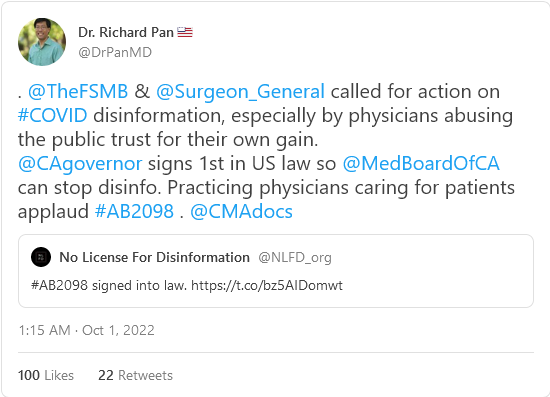
Doing just that, the bumbling halfwit Richard Pan, a pediatrician turned Big Pharma water-carrier, has succeeded in the passage of his “disinformation” bill, AB 2098. Here’s how the legislative counsel explains the bill:
Existing law requires the applicable board to take action against any licensed physician and surgeon who is charged with unprofessional conduct, as provided.
This bill would designate the dissemination of misinformation or disinformation related to the SARS-CoV-2 coronavirus, or “COVID-19,” as unprofessional conduct.
But, as Igor Chudov notes, the bill — now the law — defines away its purpose, declaring that misinformation is “false information that is contradicted by contemporary scientific consensus contrary to the standard of care”. (And disinformation, the law says, is merely misinformation spread with “malicious intent”, disagreeing with the consensus plus being mean and bad.)
Being a longtime admirer of Richard Pan’s unique mind, I adore the definition of falsehood as something contrary to the consensus. It’s true, you moron, ’cause lots of people believe it! (The earth is at the center, and the sun revolves around it! Go to your room!) But back to Chudov’s good catch: The law evaporates if you can show that the consensus isn’t, and European public health regulators, among others, are doing that work. So if a doctor violates the consensus by telling a patient that the mRNA injections don’t prevent infection or transmission … okay, hold on a second.
So Senator Pan wishes to burn the witch, but he defines “witch” in such pudding-soft language that he gives the witch-burners nowhere to stand without sinking and vanishing. His declared purpose evaporates in the sloppiness of his mind. But he gets the symbol, declaring that he has declared that the witch should be burned. He gets his tweet.
Comments Off on “The function of elected officials in California is the performance of symbols, the narcissistic status dance”
QotD: The real reason for Upton Sinclair writing The Jungle
As a result, the Federal Meat Inspection Act passed Congress, and consumers were saved from ghastly diseases. The lesson is that government is essential to stop enterprise from poisoning us with its food.
To some extent, this mythology accounts for the wide support for government’s involvement in stopping disease spread today, including Covid and the catastrophic response.
Not only that, but the story is also the basis for the US Department of Agriculture’s food inspection efforts, the Food and Drug Administration’s regulation of medical drugs, the central plan that governs food production, the Centers for Disease Control and Prevention, and the legions of bureaucrats who inspect and badger us every step of the way. It is the founding template for why government is involved in our food and health at all.
It’s all premised on the implausible idea that people who make and sell us food have no concern as to whether it makes us sick. It only takes a quick second, though, to realize that this idea just isn’t true. So long as there is a functioning, consumer-driven marketplace, customer focus, which presumably includes not killing you, is the best regulator. Producer reputation has been a huge feature of profitability, too. And hygiene was a huge feature of reputation — long before Yelp.
Sinclair’s book was not intended as a factual account. It was a fantasy rendered as an ideological screed. It did drum up support for regulation, but the real reason for the act’s passage was that the large Chicago meat packers realized that regulation would hurt their smaller competitors more than themselves. Meat inspections imposed costs that cartelized the industry.
That’s why the largest players were the law’s biggest promoters. Such laws almost have more to do with benefiting elites than protecting the public. It was not really about safety, the best scholarship shows, but exclusionary regulation to raise competitors’ costs of doing business.
Jeffrey A. Tucker, “Poke and Sniff: A Lesson from 1906”, Brownstone Institute, 2022-06-29.
Comments Off on QotD: The real reason for Upton Sinclair writing The Jungle
October 20, 2022
QotD: “Medical gaslighting”
Of course, sometimes doctors will be wrong, because in my experience most of them are not great diagnosticians. And it will usually involve women because women visit doctors with complaints much more often than men. But “medical gaslighting” imports a notion of bad faith instead of error. It’s the medical version of “believe all women”, and you know how well that turned out …
Glenn Reynolds, Instapundit, 2022-07-17.
Comments Off on QotD: “Medical gaslighting”
October 19, 2022
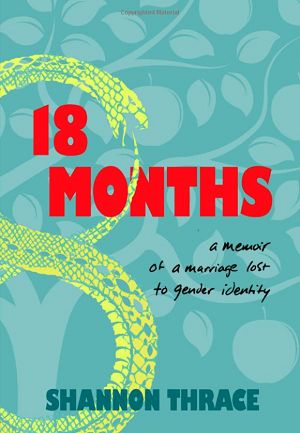
Jonathan Kay reviews 18 Months by Shannon Thrace
At Quillette, a review of a new book on the breakdown of a once-happy marriage when one partner decides that mere transvestism isn’t enough any more and becomes transgendered:
The trans community is diverse, especially when it comes to attitudes toward sex. As writer Angus Fox noted in a seven-part Quillette series, When Sons Become Daughters, some biologically male trans-identified teenagers live a sexless existence; and are drawn to puberty blockers and androgynous aesthetics precisely because they seem to offer safe harbour from male sexual development. In the case of middle-aged men who abruptly adopt a trans identity later in life, on the other hand, it can be the opposite: the presentation is often hyper-sexualized.
(more…)
Comments Off on Jonathan Kay reviews 18 Months by Shannon Thrace
October 18, 2022
CENSORED: The Great Escape from Death Camp Sobibor – October 16, 1943 – WAH 082
World War Two
Published 16 Oct 2022The German Nazis and their helpers are facing increasing resistance, this week in Rome from the Vatican, and at the Sobibor extermination camp from their victims.
(more…)
Comments Off on CENSORED: The Great Escape from Death Camp Sobibor – October 16, 1943 – WAH 082
QotD: The US media and the Democratic Party since 1968
That suited the Democrats’ short-term interests just fine. Then as now, the Democrats were a bunch of fellow-traveling wannabe-totalitarians. The difference, though, is that in 1968 grownups were still in charge of the party. Being intimately familiar with the concept of “useful idiots”, the grownup Dems were happy to encourage the journo-kids’ delusions of grandeur. The kids might not have been able to stir up enough shit to get Hubert Humphrey elected — that would’ve been a tough sell for Josef Goebbels — but they could make life hot for Richard Nixon. In other words, the Democrats thought they held the whip.
1972 should’ve been a wakeup call, but to be fair, all the campaign wonks were still reeling from The Great Magic Party Switch of 1964. Both halves of the failed Democratic ticket from 1968 ran in the 1972 primaries, and so did George Wallace (who actually won more primaries than either Humphrey or Muskie — 6 to 5 and 4, respectively). Which left George McGovern, a goofy hippie from a nothing state who was so bad at politics that he got outflanked as a peacenik by Richard Nixon, the man who was right at that moment actually running the goddamn war. […]
[McGovern’s platform was], in short, “amnesty, abortion, and acid,” a Donald Trump-level linguistic killshot if ever there was one.
The point isn’t that McGovern was a goofy hippie. The point is that McGovern was The Media’s fair-haired boy. Hubert Humphrey was no one’s idea of a steely-eyed realist, but he was a grown-up. When he attacked McGovern as too radical during their primary debates, he was expressing America’s frustration with bratty, coddled, know-nothing college kids and their bong-addled, patchouli-soaked nonsense. But since it was the aforesaid spoiled, stoned college kids who wrote the election coverage …
Viewed from this perspective, Democratic Party politics up to now can be seen as the increasingly desperate attempts of the few remaining grownups to fend off The Media’s increasingly frantic grabs for the whip. Take a gander at these goofballs from 1976. Remember the “Scoop Jackson Democrats” all the National Review types kept gushing about when they needed some Democratic cover for W’s imperial misadventures? “Scoop” Jackson was a real guy, and probably the only adult in the room in 1976. Jimmy Carter, the eventual nominee, could at least fake being a serious, mature human being when he wasn’t being chased by enraged, swimming bunnies. The Jerry Brown of 1976 is the very same Jerry Brown who is putting the finishing touches on the shitholization of California here in 2019, and guess who The Media just loooooooved back in the ’76 primaries?
See also: Every other election through 2016. Sometimes The Media and the Party moved in tandem — e.g. Bill Clinton — but more often it played out like 1988, when the Party had to drag a bland nonentity (Mike Dukakis) over the finish line in the face of a Media darling (Jesse Jackson). This dynamic also explains the weird “enthusiasm gap” of Democratic voters starting in 2000 — nobody actually liked Al Gore or John Kerry, but since W. made The Media lose their tiny little minds, they went all-in on painting those two human toothaches as The Saviors of Mankind.
Severian, “Which Hand Holds the Whip?”, Rotten Chestnuts, 2019-07-17.
Comments Off on QotD: The US media and the Democratic Party since 1968
October 16, 2022
“Musk’s plebeian sense of humor is probably a big part of why the establishment can’t stand him”
Patrick Carroll speculates on why Elon Musk is so disliked by the other rich and powerful folks in his 0.01% demographic:
This isn’t the first time Musk has brought his playful, irreverent, meme-culture spirit to the market. A few years ago he launched his car into space because he thought it would be amusing, and some of his companies now accept Dogecoin as payment.
Musk in general seems rather fun, relatable, and laid back. He doesn’t take himself too seriously, and that’s probably a big part of why people like him.
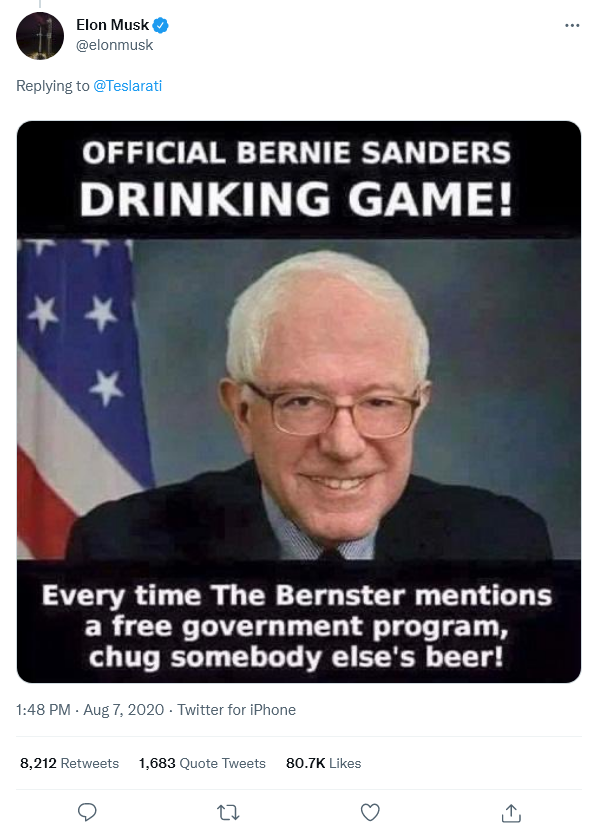
Another reason he’s so likable is that he doesn’t mind poking fun at politicians, executives, and other “blue-check” elites. To the contrary, he seems to enjoy it.
Examples of Musk mocking the elites abound.
[…]
The question then becomes, how do we combat the insistence on political correctness? How do we push back when moral busybodies insert themselves in matters that are none of their business?
At first, it’s tempting to meet them on their own terms, to politely and logically state our case and request that they leave us alone. And sometimes that can be the right move. But often, a much more effective approach is to do what Elon Musk is doing: become the fool.
Rather than taking the elites seriously, the fool uses wit, humor, and satire to highlight how ridiculous the elites have become. He employs clever mockery and a tactful mischievousness to call the authority of the elites into question. When done well, this approach can be brilliantly effective. There’s a reason joking about politicians was banned in the Soviet Union.
The story of the Weasley twins and Professor Umbridge in Harry Potter and the Order of the Phoenix is one of my favorite examples of how mischievousness and mockery can be used to expose and embarrass those who take things too seriously. As you probably know, Umbridge was committed to formality and order, and she imposed stringent limits on fun and games. Now, the Weasley twins — the jesters of Hogwarts, as it were — could have responded with vitriol. They could have written angry letters, signed a petition, and gone through all the proper channels to get her removed. But instead, they threw a party in the middle of exams, making a complete mockery of her seriousness. They gave her the one thing she couldn’t stand: fun. And wasn’t that way more powerful?
If I had to guess, Musk’s plebeian sense of humor is probably a big part of why the establishment can’t stand him. They don’t mind someone who challenges them through the proper channels and in a respectful manner — that’s actually playing into their hand, because it concedes they are deserving of respect in the first place. What they can’t stand is being taken lightly, being teased and ridiculed and ultimately ignored.
Why can’t they stand that? Because our reverence for the elites is actually the source of their power. They win as long as we take them seriously. They lose the moment we don’t.
Comments Off on “Musk’s plebeian sense of humor is probably a big part of why the establishment can’t stand him”
Zaporizhzhia! – WW2 – 216 – October 15, 1943
World War Two
Published 15 Oct 2022The Allies begin an aerial bombing campaign against the Japanese base at Rabaul. It has big success, though Allied bombing in Europe this week achieves big failure. The Allied advance in Italy is slowing down to a crawl, but in the USSR the advance across the Dnieper continues, specifically at the Zaporozhe bridgehead.
(more…)
Comments Off on Zaporizhzhia! – WW2 – 216 – October 15, 1943
The concept of “childhood” changes over time
Chris Bray on the steady changes in how adult societies have viewed their children from the “better whipped than damned” views of the Puritans to the “childhood is sexy” views of today’s avante-garde opinion pushers:
Childhood is mercury.
Puritans thought that children were born in a state of profound corruption, marked by Original Sin. Infants cry and toddlers mope and disobey because they’re fallen, and haven’t had the time and the training to grow into any higher character. The devil is in them, literally. And so the first task of the Puritan parent was “will-breaking”, the act of crushing the natural depravity of the selfish and amoral infant. A child was “better whipped than damned”, in need of the firm and steady repression of his natural depravity. Proper parenting was cold and distant; parents were to instruct.
By the back half of the 19th century, children were sweet creatures, born in a state of natural innocence, until the depravity of society destroyed their gentle character. (“Man is born free, and everywhere he is in chains.”) Meanwhile, the decline of family-centered industry changed the household. The historical father, present all day on the family farm and guiding his children with patriarchal modeling and moral instruction, left for work at the factory or the office, and mom occupied “the women’s sphere“, the nurturing home.
Depraved infants, stern and firm parents; innocent children, nurturing mothers. Those two conceptions of childhood and the family can be found less than a hundred years apart at their edges. There are some other pieces to layer into that story, and see also the last thing I wrote here about the history of childhood. But the briefest version of an explanation is that the changing idea of what it meant to be a child was a reflection of growing affluence and security: Calvinist religious dissenters living hard and unstable lives viewed childhood darkly, while the apotheosis of Romantic childhood appeared in the homes of the emerging Victorian management class.
So childhood is mercury: It moves and morphs with societal changes, becoming a different thing in different cultures and economies. It tells you what the temperature is.
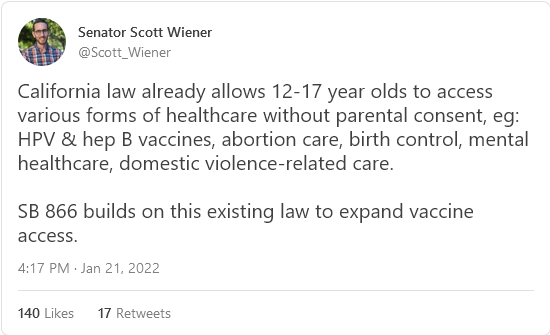
In the febrile cultural implosion of 2022, childhood is sexy, and legislators work hard to make sure 12 year-olds can manage their STDs without the interference of their stupid clingy parents.
Or click on this link to see a fun story about a teacher in Alabama who has a sideline as a drag queen, reading a story to young children about a dog who digs up a bone and then cleverly telling the children, “Everybody loves a big bone.” Wink wink! I mean, really, what could be sexier or more fun than talking to very young children about thick adult erections, amirite?
Update: Corrected link.
Comments Off on The concept of “childhood” changes over time


