
Forgotten Weapons
Published 6 Jun 2022
(more…)
October 15, 2022
An Israeli LMG, Part I: The .303 Dror
Comments Off on An Israeli LMG, Part I: The .303 Dror
October 14, 2022
The commercial failure of Bros
With the movie failing to find much of an audience, the director and lead actor blame homophobia, because that’s far easier than accepting that rom-com movies are quaint, out-of-date, and stale in the modern hookup culture:
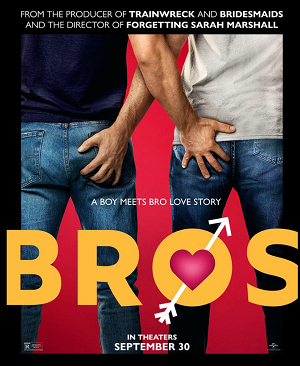
In the case of movies, one might respond to Stoller and Eichner by saying that entertainers are supposed to provide products that the viewing public wishes to see. It might surprise the team behind the didactic Bros that many of us watch movies to be entertained, not to be preached at, seeing them as brief, trivial moments of escape from the drudge of daily life, not an opportunity to (as the Victorians would have said) “improve” ourselves. But even though it has proved an abject commercial failure, the movie is nonetheless instructive in how our culture is changing. And both its production values and its failure are likely signs not of the LGBTQ movement’s influence stalling, but of its remarkable success.
[…]
Romance depends upon sex being costly. It was the difficulty of obtaining sex, the need for that delicate, complicated, and unpredictable interpersonal dance between two people, that was the very essence of what it was to be romantic. In a world where sex is not simply casual but remarkably cheap, the notion of romance is dead. Romance requires a particular kind of culture in order to make sense. A world of hookups, one-night stands, and all-pervasive pornography is not one that gives people the cultural grammar and syntax to understand it. That the movie apparently contains scenes of sex and nudity is hardly exceptional today. But that’s the point: A world where sex and nudity are displayed on the screen is not a world where romance has any place. Just as explicit rap lyrics reflect a world antithetical to that in which Frank Sinatra sang “Fly me to the moon”, so the endless tedium of explicit sex on celluloid is not that of Audrey Hepburn and Fred Astaire in Funny Face. Romance depends upon social codes of restraint and modesty, and upon the idea that sex is not something casual but something special, even sacred.
The same point can be made with reference to what we might call romantic tragedy. Take Tolstoy’s Anna Karenina. The story simply could not be set in modern America because Anna, married to the tedious Karenin but falling in love with the dashing Vronsky, would simply file for divorce and move out of Karenin’s house and into that of her lover. The tragic romance is rooted in the impossibility of Anna’s situation, given the way sex is seen through the powerful moral lens of nineteenth-century Russian society. The genre of romantic tragedy depends upon a specific moral framework. So does the genre of romantic comedy. But the sexual revolution has obliterated that moral framework.
To return to Bros, it is frankly as ridiculous to make a rom-com in the twenty-first century as it is to hire a cast and crew on the basis of modern categories of identity rather than professional competence. And, while the Bros team might regard its box office failure as discouraging, it might just as easily be evidence of the triumph of the LGBTQ movement in wider society as it is of a residual resistance to the same. Please don’t blame homophobia for your commercial failure. Romance is dead. And you helped to kill it.
Comments Off on The commercial failure of Bros
QotD: High school
Those of us on the back nine of our lives remember high school as a process of differential diagnosis. You try on a certain set of social roles to see which, if any, fit. You don’t go out for the baseball team because it’s the first step to making the Majors. Really, you might not even like playing baseball all that much. You go out for the baseball team because you want to be a Jock. If you make the team, you’re a Jock for a while, leading the Jock life and learning its lessons. If you don’t make the team, you go find something else — the Debate Club, heavy metal music, whatever — and learn the lessons those lifestyles teach.
You didn’t understand this back then, of course, but your parents did, and — crucially — your teachers did. If you wanted to be a Metalhead this semester, they’d treat you like a Metalhead, complete with the “Why are you wasting your potential (and ruining your ears) with that godawful noise?” They’d make a show of having a Very Serious Conversation with you about the dangers of drugs and satanism … knowing full well that you weren’t on drugs, weren’t sacrificing virgins to Moloch (if for no other reason than you didn’t actually know any girls), and would, in fact, come back as a clean-scrubbed Preppie after summer break your junior year.
The key word in “adolescent rebellion”, after all, is adolescent. All of that stuff was just practice. If it proceeded in the normal way, what going through all the permutations of high school identity taught you was:
- you’re a fairly normal person; and
- that’s ok.
In other words, you are not a collection of externals — clothes, music, hairstyles. You’re you. The externals can change, fairly radically — remember that one summer you broke your nose trying to be a skater? — but there’s a core in there that’s you. Which is great, because it means that you are just a person who takes customer service calls in a cubicle farm to pay the bills; they’re not going to put “Here lies Bill, a Customer Service Representative” on your tombstone.
Severian, “The Basic College Girl”, Rotten Chestnuts, 2019-07-24.
Comments Off on QotD: High school
October 12, 2022
The two traditions of the American political left
Chris Bray responds to a post by Leighton Woodhouse that declares that “left libertarianism” has won the battle for the soul of the American left:

I see two traditions on the American political left.
One is a tradition skeptical of authority, or aggressively hostile to it: Striking miners battling Coal and Iron Police, or Pinkertons, or Colorado sheriffs, or the National Guard; Wobblies fighting cops in the street; Great War-era socialists attacking the military draft, and going to prison for it; the Weatherman planting bombs in police and military offices. This tradition on the left views government as authority, a repressive servant of the status quo — “the executive committee of the bourgeoisie”. Leftists in this tradition say that of course government serves capitalism and corporate power, and of course the government isn’t on our side. Go back to the Coal and Iron Police to see how radical labor activists saw them: state-sanctioned police, with badges, on the private payroll of the industrialists. The young radical George Orwell, writing about his time fighting in Spain: “When I see an actual flesh-and-blood worker in conflict with his natural enemy, the policeman, I do not have to ask myself which side I am on.”
The other is a tradition centered on the supposedly inherent decency, wisdom, and fairness of government, a tradition that runs through the capital-p Progressive Era and Woodrow Wilson, to the New Deal, and onward into the Great Society. In this tradition, state power is benevolence itself, and points its kindness downward. Government interposes itself between the downtrodden worker and the power of the wealthy, ensuring the dignity of the poor. Tax the rich! In this tradition, government represents our best selves, our highest yearning for a better world. Why, just look at how much more equitable the progressive income tax made our social order, back when marginal tax rates were so much more fair at the top. Government serves, protects, nurtures: It’s the tool of the ordinary man, offering the noble guarantees of Social Security and Medicaid. Of course government is on our side, fellow downtrodden, and we need more of it.
Those two traditions don’t fit together, though the obvious way to square the circle is to say that a Bill Ayers opposes the power of the state when it opposes him, and embraces it if he thinks his side has come to control it. This would mean that there aren’t two ideological traditions — just two different instrumental postures. But no one who survived the Ludlow Massacre thought the government was a benevolent servant of the working man.
As Leighton Woodhouse notes, we have a good deal of what looks like anti-authority leftism in our cities, in the form of movements that call for the end of mass incarceration, the defunding of the police, and the transition to a social services model in response to homelessness and drug addiction. In this view, rising crime and growing homelessness are signs of urban leftists rejecting authority as a tool. Homelessness is not a crime, you fascists!
But I’ve written before about the incredible strangeness of progressive political columnists denouncing Donald Trump’s vicious authoritarianism, and then proudly pivoting to an expression of their approval of the warm and caring Justin Trudeau — who cracked down on incipient Trumpism in his country by boldly freezing the bank accounts of dangerous participants in the evil right-wing truck convoy. When government freezes the bank accounts of protesters, government is fighting against authoritarianism, obviously. More government power means less authoritarianism!
Comments Off on The two traditions of the American political left
QotD: Luxury beliefs
An easy way to show that you’re not a member of the riff-raff, the masses, is to hold the opposite opinion, or a strange opinion that maybe doesn’t make sense, because it shows you’re not one of them. It’s not just the opinion itself, but the way that you express it. If you express it using vocabulary that no-one has ever heard of, for example … You often are not paying the price for your luxury beliefs, but even if you do, it’s still not nearly the same as the cost inflicted on the lower classes if they were to adopt those luxury beliefs too. […]
I talked to a friend of mine who was telling me, “When I set my Tinder radius to one mile, just around the university, and I see the bios of the women, a lot of their profiles say things like ‘poly’ or ‘keeping it casual’ – basically, they’re not interested in anything too serious.” He says something like half of them have something like that in their bio. And then he said, “But when I expand the radius on my Tinder to five miles, to include the rest of the city and the more run-down areas beyond the university bubble, half the women are single moms.” And basically, the luxury beliefs of the former group, the educated group, trickled down and ended up having this outsize effect on the people who are less fortunate, who don’t have the [social and] economic capital of the people who can afford that belief.
David Thompson, quoting from the transcript of a TRIGGERnometry interview with Rob Henderson, David Thompson, 2022-07-11.
Comments Off on QotD: Luxury beliefs
October 11, 2022
Growing grapes for wine
A guest post at Founding Questions from Allen discusses his many years of growing grapes:

“Pelee Island winery” by John Kannenberg is licensed under CC BY-NC-ND 2.0


I grew grapes for wine, the noble Vitis Vinifera, for close to 30 years. My heart went out of it when I saw the advent of celebrity wine producers. I could stomach the idea of box wine for women with their cats, after all what else did they have, but the very idea that celebrity itself might indicate discernment or ability was a bridge too far for me.
A good wine can enhance a meal. In fact given any other choice I will choose water with lemon if a decent wine is not available. The acid in the wine, or from the lemon, keeps the palate clear and lets you get more flavor out of a well done meal. Then there is the allure, “why yes I grow my own grapes and make my own wine my dear, care for a glass?” If there is a better way to get a lady to throw her panties at a farmer I don’t know what it is. Oh, and that is FNG, that country song, “She Thinks My Tractor’s Sexy”. No she doesn’t, you damn dope.
I know it sounds trite but good wine starts in the dirt and everything in the dirt ends up in the wine. I had sandy, rocky soil with minimal amounts of organic material. Vines need to struggle to make good wine grapes. I did fertilize but with composted organic material and a mixture of manures. If your manure still contain some amount of ammonia in it the wine will have an interesting bouquet so patience grasshopper, give it 2-3 years to compost well. Watering, I always drip irrigated but sparingly. If you’ve got city water its treatment chemicals will end up in the wine so avoid it as much as possible. I had my own deep water wells so I didn’t have that worry. It’s the same with pest treatments. I planted a certain type of tree near the vineyard that Ladybugs were partial to. Ladybugs do a number on most common insect pests.
So you’ve got your dirt now what? Dig son dig. My preferred vine and row spacing was 8 feet by 8 feet, 8 feet between vines with rows 8 feet apart. I dug a trench approximately 3 feet wide by 3 feet deep for each row of vines. Before you ask, yes I did it by hand. Machinery can actually make things worse as it can compact the soil to rock hard consistency where it isn’t digging. The idea here is to get the vines’ roots to run deep and spread. If your soil is especially compacted a power auger is useful to break up the soil.
Next up you need a trellis because grapes require a lot of support. I used a four wire trellis with two arms to spread the canopy out. The more leaf area you have the more photosynthesis and consequently higher growth you will have. It also will drive the acid sugar balance in the grapes. You’ll have to experiment with it to find out what works best for your location and microclimate. Fortunately you have that 4 to 5 years before you get a good crop.
Comments Off on Growing grapes for wine
Looking for a full definition of “Two-Spirit” is a fruitless task
In Quillette, Jonathan Kay tries to find a satisfactory definition of the term “Two-Spirit” but despite his best efforts comes up empty:
On August 28th, Justin Trudeau’s government announced “Canada’s first federal 2SLGBTQI+ action plan: Building Our Future With Pride“, which was described as “a whole-of-government approach to achieve a future where everyone in Canada is truly free to be who they are and love who they love”. One aim of the $100-million plan, the government explained, is to convince Canadians to adopt the term “2SLGBTQI+” in place of “LGBT” — on the basis that 2SLGBTQI+ “is more inclusive and places the experiences of Indigenous 2SLGBTQI+ communities at the foreground as the first 2SLGBTQI+ peoples in North America”.
The two characters given pride of place, “2S”, signify “Two-Spirit”, a term that’s been a form of self-identification among Indigenous North Americans since the 1990s. But the descriptor doesn’t appear to be in wide everyday use outside Canada. And so non-Canadian readers will sometimes ask me to explain its meaning — at which point, I have to admit that I can’t. And I’m hardly alone: While most Canadians know that the “Two-Spirit” category is connected to Indigenous identity in some way, there’s an unspoken rule against requesting more specific information.
Last week, the Elementary Teachers’ Federation of Ontario (ETFO), the province’s elementary-school teachers union, published what the authors present as a primer on Two-Spirit identity, a document written in close consultation with 2S-identified Indigenous people. Since the report’s target audience consists of workaday teachers who educate young students, I imagined that Niizh Manidoowag: Two-Spirit might finally provide me with a straightforward explanation of what the 2S identifier actually means.
Unfortunately, it doesn’t. In fact, one of the main themes of the 32-page document is that the task of defining the Two-Spirit concept is (quite literally) beyond the powers of Western language and epistemology. And in any case, the category is almost completely open-ended: The act of proclaiming oneself Two-Spirited could be a statement about one’s gender, or sexual orientation, or both, or neither. Or 2S can be a statement about one’s politics, spirituality, or simply one’s desire to present as “anti-colonial”.
According to the ETFO report, there are only two non-negotiable elements of a Two-Spirited individual—both of which are spelled out multiple times in the document, and in bold letters. Neither rule is concerned with sex or gender, but rather with race and political orientation: To be Two-Spirited requires (1) that you are Indigenous; and (2) that you are engaged in a “decolonizing act of resistance”:
There is no one way to prescribe usage of the term [Two-Spirit] … There is no one way to define the term Two-Spirit. Two-Spirit people and their roles predate colonial impositions, expectations, and assumptions of sex, gender, and sexual orientation. Where colonial worldviews often frame concepts as linear, compartmentalized, categorical, and hierarchical, Indigenous worldviews tend to be understood as non-linear, reciprocal, (w)holistic, relational, and independent of Eurocentric perspectives and framings. As such, identifying as two-spirit is a decolonizing act of resistance in and of itself.
The term Two-Spirit was first popularized in 1990, at an inter-tribal Native American/First Nations gay and lesbian summit in Winnipeg, and is derived from the Ojibwa words Niizh Manidoowag. By one account, delegates were looking for a term that would “distance Native/First Nations people from non-Natives, as well as from the words ‘berdache‘ [a European term suggesting deviancy] and ‘gay'”. But lore has it that the true originator is a Fisher River First Nation woman named Myra Laramee, who experienced a vision of the world as seen “through the lens of having both feminine and masculine spirit”.
On the surface, that sounds like what today might be called “non-binary”. But that analogy fails on a fundamental level. The idea of gender identity relates to the (perceived) nature of oneself. Two-Spirit people, on the other hand, are described in the ETFO report as possessing a savant-like power (or “lens”) that channels truths about the nature of the external world.
The Two Spirit concept is also entirely distinct from run-of-the-mill gender dysphoria. In everyday progressive gender parlance, it is typically insisted that trans women are just like other women. Two-Spirited people, by contrast, are presented as an entirely unique specimen whose arrival within traditional Indigenous societies was “celebrated” — “highly valued” “gifts” who “possess the best of both gendered identities”.

Comments Off on Looking for a full definition of “Two-Spirit” is a fruitless task
A tribute to the F-101 ‘Voodoo’ Fighter
Matsimus
Published 4 Jun 2022The McDonnell F-101 Voodoo is a supersonic jet fighter which served the United States Air Force (USAF) and the Royal Canadian Air Force (RCAF).
Initially designed by McDonnell Aircraft Corporation as a long-range bomber escort (known as a penetration fighter) for the USAF’s Strategic Air Command (SAC), the Voodoo was instead developed as a nuclear-armed fighter-bomber for the USAF’s Tactical Air Command (TAC), and as a photo reconnaissance aircraft based on the same airframe. An F-101A set a number of world speed records for jet-powered aircraft, including fastest airspeed, attaining 1,207.6 miles (1,943.4 km) per hour on 12 December 1957.[1] They operated in the reconnaissance role until 1979.
Delays in the 1954 interceptor project led to demands for an interim interceptor aircraft design, a role that was eventually won by the B model of the Voodoo. This required extensive modifications to add a large radar to the nose of the aircraft, a second crew member to operate it, and a new weapons bay using a rotating door that kept its four AIM-4 Falcon missiles or two AIR-2 Genie rockets hidden within the airframe until it was time to be fired. The F-101B entered service with USAF Air Defense Command in 1959 and the Royal Canadian Air Force in 1961. US examples were handed off to the USAF Air National Guard where they served until 1982. Canadian examples remained in service until 1984.
(more…)
Comments Off on A tribute to the F-101 ‘Voodoo’ Fighter
October 10, 2022
How tall?
“An Englishman in New York” contemplates the ideal heights of city buildings:
I have often wondered what the maximum number of storeys for a good street is. No doubt an individual building can be indefinitely high, in the right setting. But this surely cannot be true of streets: a street with a thousand storeys would either be terrifyingly dark and claustrophobic, if the street were of normal width, or vast and bleak, if its width were scaled up to correspond with its height. So there must be some maximum beyond which pleasing street-based urbanism becomes impossible.
Some people think that the maximum is two or three. These people often believe that one is moving into inhumane scales when one goes above this point. Growing up in London, I knew the maximum must be at least four or five, since that is the norm for the Georgian terraces. I have a distinct memory of visiting Paris and realising it could not be less than eight, since that is the norm for the Belle Epoque.
Visiting Manhattan for the first time, I find it must be more still. The streets of Midtown Manhattan, each 60 feet wide, are often built up to ten or twelve storeys, with four or six more slightly set back above. The avenues, 100 feet wide, are often built up to fifteen or twenty storeys, with another five or ten set back. And to be clear: I refer to the height at which they are continuously built up, excluding the towers that rise above. The avenues of New York are perhaps not paradigmatic great streets, notably because they are almost invariably packed with four lanes of traffic. But their underlying form is good, as is borne out in the handful of cases in which they have been partly pedestrianised.
These streets evolved under New York’s famous 1916 building regulations. Before 1916, New York landowners could essentially build as high as they liked, and this did indeed generate streets that were sometimes rather menacing (pictured below left). The 1916 system was designed to allow as much height as possible while preserving the amenity of the street, indexing the height of the buildings to the width of the street and setting back the upper storeys in the time-honoured European fashion (pictured below right). This system lasted until 1961, when it was replaced with modernist regulations designed to generate slab blocks standing on open plazas; the results of this were so obviously inferior that the older system has been partly reinstated.
A pre-1916 street; a post-1916 avenue
My sense is that Manhattan’s tallest 1916-61 streets could not take many more storeys without losing amenity: the regulators basically succeeded in allowing as much height as possible without compromising the public spaces. In a city at a more southerly latitude, where the light is more intense, perhaps a few could be added; and perhaps the avenues could be widened further, with a corresponding growth in the buildings. It is hard to judge imaginary streets. But at any rate, New York shows we can go a lot higher than I had once supposed: there can be great streets with twenty storeys, five or ten more under a light plane, and more again in isolated towers.

And on grid-pattern streets:
Gridiron street plans have been used for planned cities in many times and places — in Harappa, in Dynastic China, in European Antiquity, even in the Middle Ages — so I assume there must be something very good about them. But I have never quite worked out what it is. One annoying thing about gridiron plans is the great frequency of road crossings. Walking the 3.2 miles from the Empire State Building to 1 Wall Street, one must wait, by my count, at 62 traffic lights. Walking the 3.3 miles from the Tower of London to Buckingham Palace, one encounters only 12, along with 8 crossings without lights that probably do not require waiting.
That is a slightly extreme example, but I think frequency of crossings is a general truth about gridirons. A gridiron distributes crossing points evenly and regularly, such that there is no way to reduce the number that one passes. If one wants to go three blocks east and twelve blocks south in Manhattan, there is no way one can avoid traversing fifteen roads. In an organic street plan with an equal overall density of roads, the crossings will be grouped in irregular ways. If one walked randomly, one would average the same number of crossings. But of course people do not walk randomly: one chooses one’s route, with a view in part to reducing the number of roads one has to cross. And so, rather picturesquely, the street plans long called “irrational” are in this respect preferable precisely because they are used by rational creatures.
Comments Off on How tall?
October 9, 2022
What do you call it when a military-funded organization intervenes in US domestic politics? It’s “anti-fascism“, obviously
Chris Bray continues digging into the activities of a Department of Defence-funded operation at the University of Maryland:
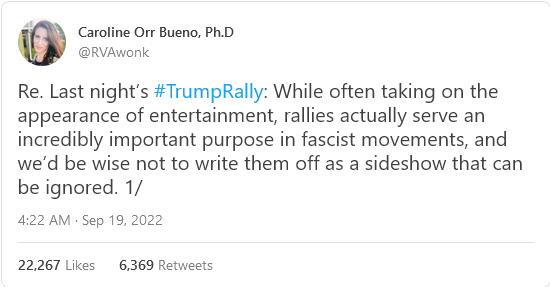
I wrote this morning about the disinformation expert Caroline Orr Bueno, a postdoctoral fellow at ARLIS — the Applied Research Laboratory for Intelligence and Security at the University of Maryland (who is identified as Caroline Orr on her ARLIS profile, so that’s the name I’ve used for her). Orr aggressively and repeatedly argues against the American political right, framing conservative politics as fascist and describing Donald Trump as an authoritarian figure. She makes a political argument, and she does it often.
This is true not only of her social media posts, but also of her published work. She’s a pro-Antifa political partisan (more about this in a moment), specifically arguing against the right and against Donald Trump rather than only studying disinformation across the political spectrum.
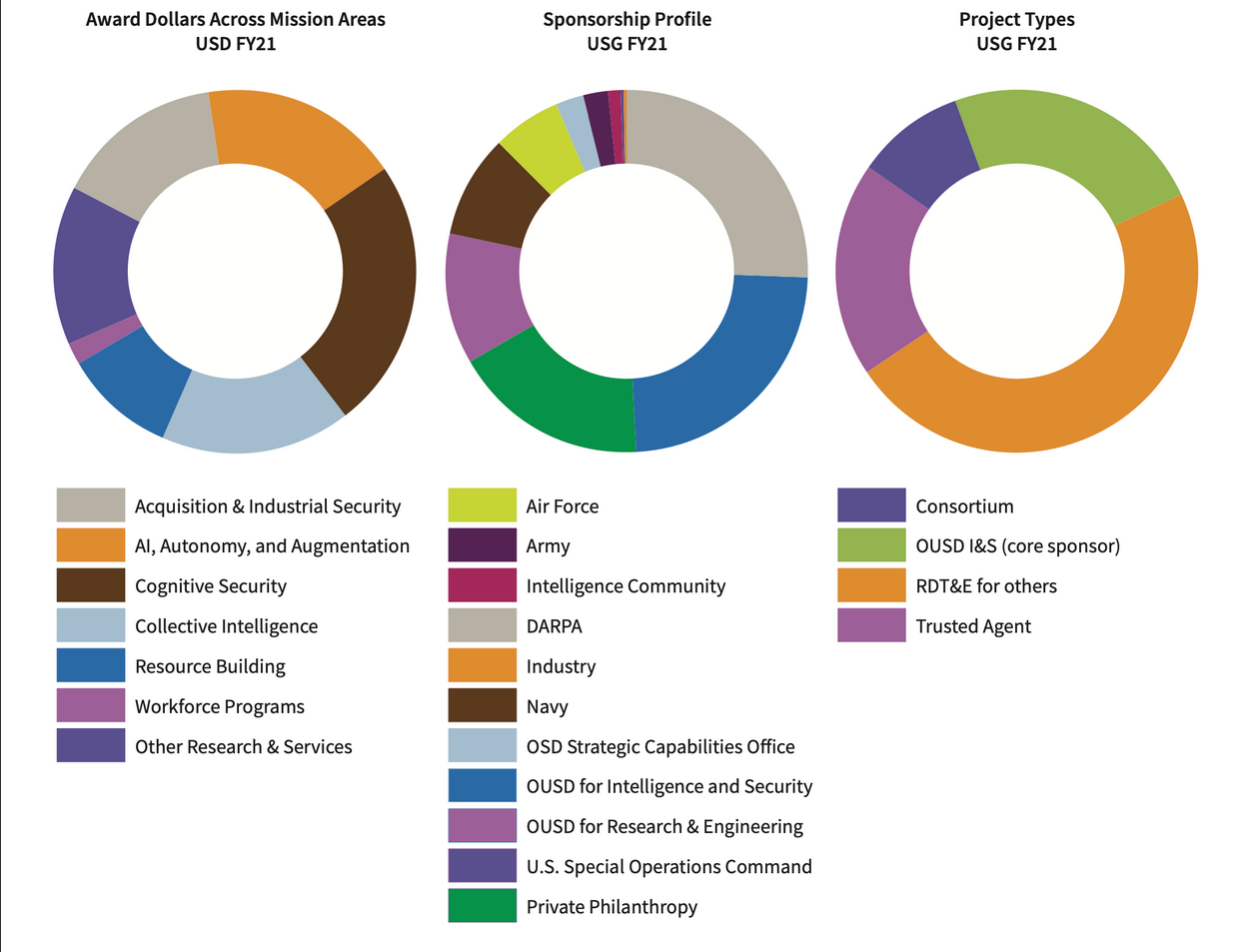
Now: ARLIS, where Orr works, is primarily funded by the Department of Defense, and its “core sponsor” is the Undersecretary of Defense for Intelligence and Security. You can download the 2021 annual report from ARLIS here […] You can find a description of the laboratory’s $46 million in funding on page 26 of that report:
So a research center largely funded by the military, and specifically sponsored by and aligned with the Undersecretary of Defense for Intelligence and Security, is arguing against a likely candidate for President of the United States and his supporters, participating in the work of shaping a political narrative while drawing DOD funds. Orr’s national security work as a military intelligence-funded researcher is to make sure people know that Donald Trump is bad.
This scholar has military funding:
Military intelligence is paying for politics. Military-funded academic researchers have the same academic freedom every other academic researcher has, and Orr has a right to express political opinions. But she’s doing government-funded research into the academic topic of Trump is bad so don’t support him, and that’s a misuse of federal funding and military authority. I assign the failure to the institution, not to the person. (The irony of military-funded academic leftist politics is not hard to spot, but that sort of thing doesn’t seem to matter anymore.)

Comments Off on What do you call it when a military-funded organization intervenes in US domestic politics? It’s “anti-fascism“, obviously
Could the Soviets Cut Off Crimea? – WW2 – 215 – October 8, 1943
World War Two
Published 8 Oct 2022The Germans booby-trapped Naples when they evacuated last week and local civilians now pay the price. In the Mediterranean, Kos falls to the Germans while Corsica is liberated by the French. There is action all along the Dnieper in the USSR, and the Australians advance in New Guinea, and the Japanese evacuate Vella Lavella in the Solomons.
(more…)
Comments Off on Could the Soviets Cut Off Crimea? – WW2 – 215 – October 8, 1943
SIG M5 Spear Deep Dive: Is This a Good US Army Rifle?
Forgotten Weapons
Published 3 Jun 2022The NGSW (Next Generation Squad Weapon) program began in 2017 to find a replacement for the M4, M249, and the 5.56mm cartridge. It came to a conclusion in April 2022 with the formula acceptance of the SIG M5 rifle, M250 machine gun, Vortex M157 optic, and the 6.8x51mm cartridge. SIG released a handful of civilian semiauto M5 / Spear rifles and thanks to Illumin Arms I have one to examine.
The rifle (Spear is its commercial designation; M5 is the military one) is an evolution of the SIG MCX, which is in turn an evolution of the AR-15 and AR-18 systems. The MCX moved the recoil spring assembly into the top of the upper receiver, allowing the use of a folding stock. It also had very easily swapped barrels and a suite of fully ambidextrous controls. Scaled up to AR-10 size and chambered for 6.8x51mm, the MCX became the Spear.
That new cartridge (commercial designated .277 SIG Fury) is designed to produce high muzzle velocities out of a short barrel (the M5 has a 13 inch barrel). It does this by boosting the operating pressure up to an eye-watering 80,000psi, which required the development of hybrid case using a stainless steel case head. This allows the case to handle those pressures safely. The currently available commercial ammunition is loaded to lower pressure, however. Much of the military and civilian use of this rifle will be done with downloaded training ammunition, which uses a conventional all-brass case.
Both the M5 and M250 were ordered by the Army with suppressors on every weapon, a significant advancement in Army policy. The can is another SIG development, entirely made using additive manufacturing and designed specifically to prevent gas blowback into shooters’ faces (which is succeeds at wonderfully).
Overall, I believe the M5 / Spear is an excellent rifle — soft shooting, reliable, and very accurate. However, that does not mean it is the right rifle for the Army. Will its ability to defeat modern body armor prove worth the tradeoff in extra soldier combat load weight and reduced ammunition capacity? Only time will tell…
(more…)
Comments Off on SIG M5 Spear Deep Dive: Is This a Good US Army Rifle?
October 8, 2022
QotD: Does homework, well, work? ¯\_(ツ)_/¯
Unfortunately, all the research on this (showcased in eg Cooper 2006) is terrible.
Most studies cited by both sides use “time spent doing homework” as the independent variable, then correlate it with test scores or grades. If students who do more time on homework get better test scores, they conclude homework works; otherwise, that it doesn’t.
One minor complaint about this methodology is that we don’t really know if anyone is reporting time spent on homework accurately. Cooper cites some studies showing that student-reported time-spent-on-homework correlates with test scores at a respectable r = 0.25. But in the same sample, parent-reported time-spent-on-homework correlates at close to zero. Cooper speculates that the students’ estimates are better than the parents’, and I think this makes sense — it’s easier to reduce a correlation by adding noise than to increase it — but in the end we don’t know. According to a Washington Post article, students in two very similar datasets reported very different amounts of time spent on homework — maybe because of the way they asked the question? I don’t know, self-report from schoolchildren seems fraught.
But this is the least of our problems. This methodology assumes that time spent on homework is a safe proxy for amount of homework. It isn’t. Students may spend less time on homework because they’re smart, find it easy, and can finish it very quickly. Or they might spend more time on homework because they love learning and care about the subject matter a lot. Or they might spend more time because they’re second-generation Asian immigrants with taskmaster parents who insist on it being perfect. Or they might spend less time because they’re in some kind of horrible living environment not conducive to sitting at a desk quietly. All of these make “time spent doing homework” a poor proxy for “amount of homework that teacher assigned” in a way that directly confounds a homework-test scores correlation. Most studies don’t bother to adjust for these factors. The ones that do choose a few of them haphazardly, make wild guesses about what model to use, and then come up with basically random results.
Both homework proponents (Harris Cooper) and opponents (Alfie Kohn) briefly nod to this problem, then take these studies seriously anyway. If you do that, you find that probably homework isn’t helpful in elementary school, but might be helpful during high school (though some people disagree with either half of that statement). But why would you take these seriously?
Scott Alexander, “Nobody Knows How Well Homework Works”, Astral Codex Ten, 2022-07-07.
Comments Off on QotD: Does homework, well, work? ¯\_(ツ)_/¯
October 7, 2022
The Combat Dogs of World War Two – WW2 Special
World War Two
Published 6 Oct 2022Where man goes, so does man’s best friend. Across the globe, tens of thousands of dogs are called up. They play their part in tales of heroism and joy. But without any agency over their own lives, they also experience fear, death, and cruelty.
Comments Off on The Combat Dogs of World War Two – WW2 Special
October 6, 2022
The pendulum swings back toward institutionalization
During the 1950s and 60s, many mental institutions were shut down due to concerns about the way the patients in those institutions were being treated. Those suffering from mental health issues were, to a large degree, just discharged into the larger community with few supports to help them re-integrate. Today, the concerns about severely mentally ill peoples’ actions may be pushing the system back toward some form of formal re-institutionalization, as Michael Shellenberger reports for Common Sense:
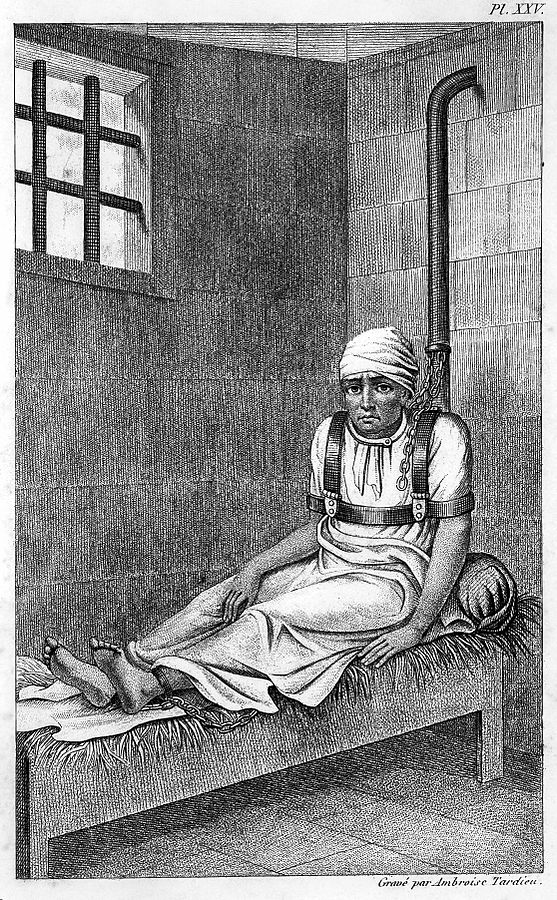
William Norris, shackled sitting upright on his bed at Bedlam, 1838.
Engraving by Ambroise Tardieu, Des maladies mentales Esquirol via Wikimedia Commons.
Though it is difficult to get an exact estimate, a large body of research makes clear that people like Zisopoulos, Mesa, and Simon are just three among hundreds of cases of people in New York alone — to say nothing of cities like Los Angeles, Seattle, San Francisco and others — in which mentally ill people off their medication have assaulted or killed people. And if you think the problem is getting worse, you are right.
In 2021, felony assaults in New York’s subway were almost 25 percent higher compared to 2019, despite a lower ridership because of the pandemic. The number of people pushed onto tracks rose from 9 in 2017 to 20 in 2019 to 30 in 2021. Psychiatrists and emergency department workers in San Francisco and Los Angeles tell me that they have seen a significant increase in homeless patients in psychotic states over the last few years.
How have we arrived at the point where we leave people with psychosis to their demons, and leave the public to take their chances? How have we allowed so many of our cities to have no decent plans or places for the burgeoning number of the violent mentally ill on the streets?
There are two major forces at work. The first is that the U.S. never created a functioning mental health care system. The second is that powerful groups have effectively prevented dangerously mentally ill people from getting treatment.
Starting in the late 19th century, the U.S. created large psychiatric hospitals, often in the countryside, known as asylums, for the mentally ill. Asylums were a major progressive achievement because they delivered, for many decades, significantly more humane, evidence-based care to people who, until then, had often been neglected, abused, or even killed.
But by the middle of the 20th century, the reputation of psychiatric hospitals was in tatters — and deservedly so. Conditions in many of them were appalling, even barbaric. People who were not severely mentally ill were sometimes subjected to years of involuntary hospitalization.
Many reformers just wanted better funding and oversight, but other reformers were more radical, and proposed shutting the hospitals down entirely and replacing them with community-based clinics. Some reformers claimed that serious mental illnesses were the result of poverty and inequality, not biology, and argued that they could be cured through radical social change.
The reformers largely won. State hospitals were shut down in droves before sufficient community centers could be built to treat the suffering. Over the next two decades, as state mental hospitals emptied out, many released patients ended up on the street, or incarcerated. Those community clinics that did start operating tended to treat “the worried well” — those suffering from comparatively low-level anxiety and depression, rather than psychosis.
Decades later, governments were still cutting funding for the treatment of the mentally ill. New York State in 2010 reduced Medicaid reimbursement for inpatient stays of the mentally ill in hospitals beyond 12 days. As a result, New York hospitals released the mentally ill earlier than they should have. From 2012 to 2019, the number of mentally ill adults in inpatient psychiatric care in hospitals and mental institutions in New York City declined from 4,100 to just 3,000. Meanwhile, the number of seriously mentally ill homeless people rose from 11,500 to 13,200.
The story is similar in California. Between 2012 and 2019, more than one-third of the group homes in San Francisco that served mentally ill and disabled people under the age of sixty closed their doors. Why? The measly Medi-Cal and Medicare reimbursement of $1,058 per person per month, and rising estate prices, made it more valuable for the private owners of group homes to sell than to keep operating them.
At the national level, the same dynamic was in play. The U.S. as a whole lost 15,000 board and care beds for the mentally ill and disabled between 2010 and 2016. Today, approximately 121,000 mentally ill people are conservatively estimated to be living on America’s streets.
Comments Off on The pendulum swings back toward institutionalization


