
Grad students spend most of their time in the library, and because of the peculiar ecology of college towns, even their non-library hours are spent almost exclusively with other academics. You have to work very, very hard to have any kind of “normal” life in a college town, in other words, so even if you’re not a goofball when you arrive, pretty soon Stockholm Syndrome kicks in and you find yourself, if not liking, then at least tolerating, experimental theater and milk made from plants.
After a few years of this, you forget what normal life is even like. You come to understand the deep and longstanding grievances the Poststructuralist Feminist Marxists have with the Marxist Feminist Poststructuralists. Oh, there’s scads of “diversity” on campus — all those recruiting brochures they mail to dumb parents in the ‘burbs aren’t lying — but there’s one thing you’ll never, ever find: The thought that maybe politics doesn’t matter all that much.
That’s the answer, right there. Academic “humanities” work is mostly bullshit because most people just don’t care about politics. To normals, if they think about “politics” at all, it’s in Schoolhouse Rock terms — some guys in Washington vote on some stuff, and that’s how a bill becomes a law. They certainly don’t mean ideology, which is pretty much the only thing academics mean. That a normal person could walk into the voting booth without really knowing if he’s going to pull the lever for Trump or Hillary fries an egghead’s circuits…
… and yet, as we all know, the majority of American voters do this, every single time. There’s something profound about normal person behavior that academics just can’t — or won’t — grasp.
Severian, “Ignoring the Human Factor”, Rotten Chestnuts, 2019-08-14.
October 6, 2022
QotD: Life in grad school
October 4, 2022
“On the cover of the Rolling Stone“
Ted Gioia discusses the oddly nostalgic turn modern music writing has taken:
The first thing you notice is the sheer abundance of music magazines on display. We must truly be living in a golden age of music writing if it can support so many periodicals.
I was very happy to see this — at least at first glance.
But at second glance, I started to notice the cover stories.
Lavish attention is devoted here to artists who built their audience in the last century — Miles Davis, David Bowie, Buddy Holly, Blondie, Led Zeppelin, Björk, Motorhead, The Cure, etc. That’s an impressive roster of artists (well, most of them), but they don’t really need the publicity nowadays — they were legends before many of us were born.
Even the magazine names reveal a tilt toward nostalgia. I can’t make out the titles in their entirety, but I see the words Retro, Vintage, and Classic. Publishers are shrewd people, and they don’t put these words in large font unless the audience responds to them.
Maybe print media is nostalgic by definition — if, as we’re repeatedly told, young people don’t read things on paper. (I’m skeptical of that claim, but I hear it all the time.) Yet when I visit the websites, I see the same backward glance. You can’t click on Rolling Stone‘s homepage or Twitter feed without finding some massive list article — touting the “100 Best Songs of 1982” or “The 100 Greatest Country Albums of All Time“. You will find similar retro celebrations at almost every other music media website with a large crossover readership.
Editors love lists nowadays, especially of all-time greats. If I pitch an article like that, the whole editorial team starts salivating — you can even feel the moisture over Zoom — in sharp contrast to any proposed article on a young, unproven musician. Those pitches get pitched right back in your face. You might conclude that we have now arrived at the end of history, with all greatness residing in the past. The editors, at least, must think so.
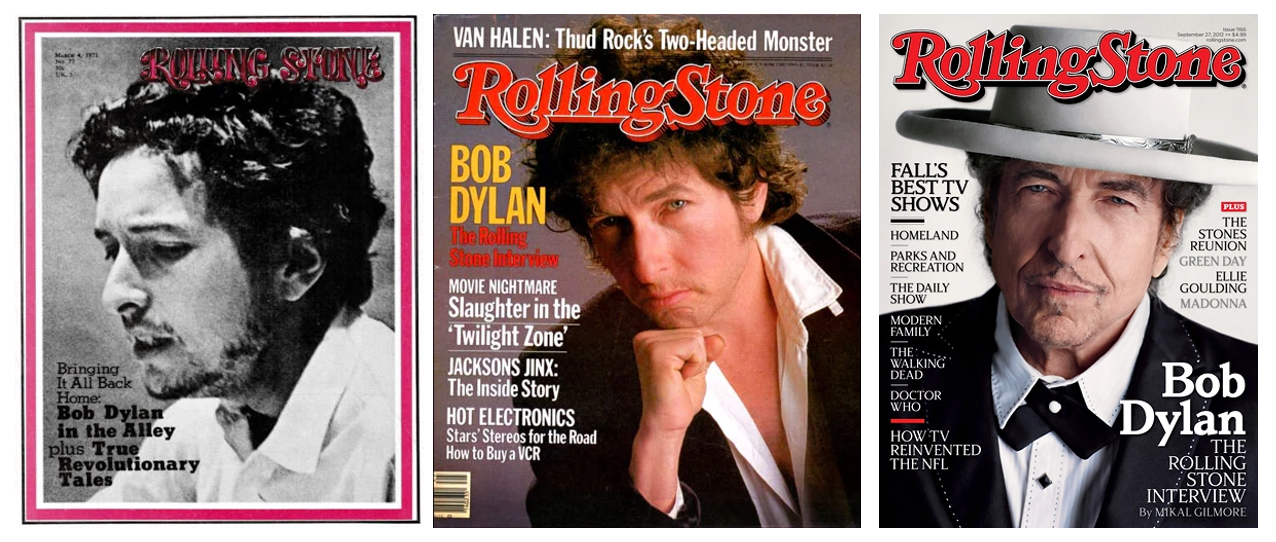
Things weren’t always like this. Go back and look at old issues of Rolling Stone or Downbeat or some other music magazine — there were years in which every cover story was about a living person and usually someone young with something new to say.
Those days are gone. But here’s the most ironic fact of all — the actual cover stories haven’t changed.
On the cover of the Rolling Stone — 1971, 1984 and 2012
By the way, I’d like to know when Rolling Stone published its first “all-time greats” list — that was the moment when nostalgia first entered the rock bloodstream, a vital force previously resistant to sentimental yearnings for the past.
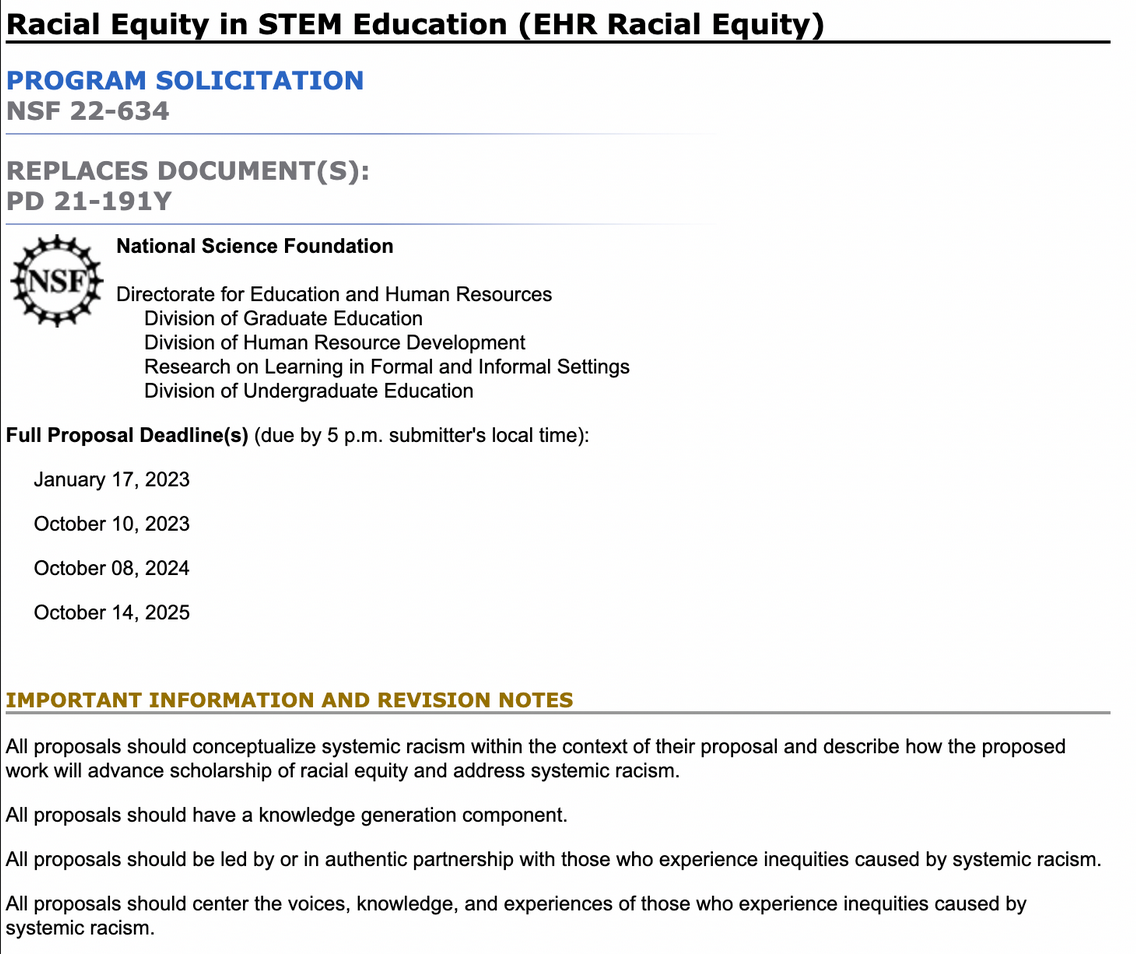
“… apparently the future of science is BAJEDI (Belonging Accessibility Justice Equity Diversity and Inclusion), which is quite a bit cooler than mere DEI”
And you thought the stuffy old National Science Foundation was only supporting pale, stale, cisgendered white male research? Think again!
I’ve written many times about the National Science Foundation and its increasingly politicized conception of “science”. As an independent federal agency with a nearly $9 billion budget, the NSF is a behemoth in the world of academic science, shaping research agendas and the future of the professoriate. And apparently the future of science is BAJEDI (Belonging Accessibility Justice Equity Diversity and Inclusion), which is quite a bit cooler than mere DEI. Here’s a current funding opportunity for scientists:
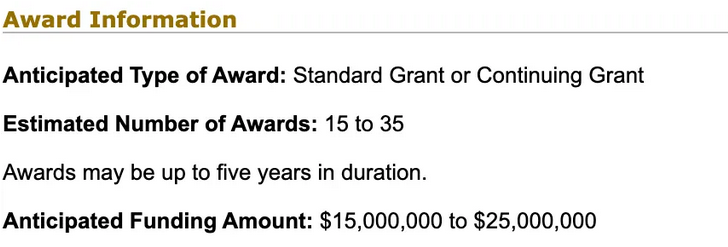
The federal agency that funds research projects like “Probing Nucleation and Growth Dynamics of Lithium Dendrites in Solid Electrolytes” is moving hard into the business of social justice, with career-making grants that will focus STEM researchers on the problem of racial grievances. Here’s how much money is available for that racial equity program:
The premise underlying this turn toward equity-focused science projects is that “science scholars who are underrepresented in STEM produce higher rates of scientific novelty”. Innovation is grounded in race and ethnicity; the more gloriously intersectional you are, the more creative you become. Imagine the boldness of a transgendered Asian Pacific Islander astrophysics, and how much newer and fresher our conception of the universe is when it doesn’t come from straight white males.
And so the NSF wants to fund “diversity champions” who will freshen up our science with BIPOC innovation — which means adding more sociologists to the team of geophysicists: “When developing proposals, the PI team should acknowledge the need for increased engagement from social and behavioral science experts to address issues related to BAJEDI in the geosciences and include these best practices and experts in proposed projects.” […]
It’s a real cultural revolution in the world of academic science.
October 2, 2022
Smolensk and Naples Liberated! Both in ruins – WW2 – 214 – October 1, 1943
World War Two
Published 1 Oct 2022Major prizes are taken by the Allies this week on two fronts — Naples in Italy and Smolensk in the USSR, but they are advancing all over the Eastern Front, across the Italian peninsula, and in the South Seas, but the enemy is leaving a trail of destruction as he pulls back.
(more…)
Robert Heinlein’s “Crazy Years” have nothing on real headlines in 2022
Ed West on what he calls the “triumph of the blank slate” in western culture:
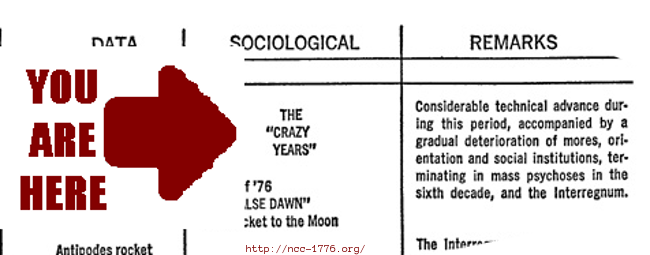
As a depressive conservative who always sneered at the new atheist movement, I’ve enjoyed a certain, almost masochistic smugness about the way the sharp decline in American religious practice has led to a proliferation of wacky beliefs. I told you so, I laugh, as our boat heads for the rocks and certain doom for all of us. And every month I read something else in the media which makes me think, with the best will in the world and a sincere belief in improving our lot, that country’s ruling class is losing its grip on reality.
To take one recent example, an article in the Atlantic recently made the case that separating sport by sex doesn’t make sense, because it “reinforces the idea that boys are inherently bigger, faster, and stronger than girls in a competitive setting — a notion that’s been challenged by scientists for years”.
The author stated that “though sex differences in sports show advantages for men, researchers today still don’t know how much of this to attribute to biological difference versus the lack of support provided to women athletes to reach their highest potential”.
Quoting an academic who claim “that sex differences aren’t really clear at all” the author reported of some studies showing that “the gap they did find between girls and boys was likely due to socialization, not biology”.
On a similar theme, a few weeks back the New York Times ran a piece arguing that “maternal instinct is a myth that men created”. In the essay, published in the world’s most influential newspaper, it was stated that “The notion that the selflessness and tenderness babies require is uniquely ingrained in the biology of women, ready to go at the flip of a switch, is a relatively modern — and pernicious — one. It was constructed over decades by men selling an image of what a mother should be, diverting our attention from what she actually is and calling it science.”
Even the most prestigious science magazines increasingly make claims about sex that a decade ago would have seemed wacky. Just recently, Scientific American stated that “Before the late 18th century, Western science recognized only one sex — the male — and considered the female body an inferior version of it. The shift historians call the ‘two-sex model’ served mainly to reinforce gender and racial divisions by tying social status to the body.”
If you find any of these beliefs strange, then you might need to “educate” yourself about “the science” because this is the direction of travel now. This kind of stuff is everywhere, growing in popularity in all areas, but all ultimately having the same common inheritance — the blank slate.
Yet what is strange is that such ideas are triumphant, even as the scientific evidence against them mounts up, with the expanding understanding of genetics and the role of inheritance. The tabula rasa should by all rights be dead, indeed it should have been killed twenty years ago with the publication of one of the most important books of the century so far, Steven Pinker’s The Blank Slate.
With its subtitle “the modern denial of human nature”, Pinker’s worked looked at the various ideas that had emerged out of academia and into wider society: that rape was not about sex, that hunter-gatherer societies were peaceful, that sex differences were learned, all of these beliefs having the common theme that humans are born with infinitely malleable minds and that that life outcomes are entirely shaped by society.
Pinker felt, quite reasonably, that many of these comforting beliefs were on the way out. Of the idea that differences in intelligence were entirely environmental, he wrote that “even in the 1970s the argument was tortuous, but by the 1980s it was desperate and today it is a historical curiosity”. And yet this historical curiosity continues to flourish, and 20 years after publication, the blank slate is stronger than ever. More so than in 2002, it’s taboo to discuss the genetic components of human intelligence or the biological factors involved in differing male and female behaviour. The ground has shifted – towards the blank slate.
Pinker is an optimistic Whiggish liberal who has since produced books looking at the decline of violence and making the case that things are getting better — that’s taken a wobble this decade, but I think he’ll be proven right, even if I think the new atheist-aligned cognitive psychologist has a slight blind spot about religion. In the Blank Slate he argued that worthy progressive goals should not rest on untrue scientific assumptions about human nature. When those ideas are proven false, the political argument will crumble too — and yet this hasn’t happened. Instead the taboos just grows stronger.
What is a Bopper Car?
Lake Superior Railroad Museum & NS Scenic Railroad
Published 5 Jun 2020Railroads came up with lots of great ideas to make things more efficient. Many of those ideas, like bottled water, and the red carpet, are part of our daily lives … as we have shown you in previous episodes.
Today, we talk about an idea that sounded good, but didn’t work out: The Bopper Car. A combination of hopper car and box car. Only a few were made, and the remaining ones were donated to the Lake Superior Railroad Museum. Today they’re used as storage for many of the shop’s parts.
(more…)
QotD: US intelligence failures in the Tet Offensive
By summer 1967, MACV (for convenience) had convinced itself that the North Vietnamese no longer had the resources to win the war militarily, and they knew it. This conclusion was based in large part on metrics coming in from field commanders. Specifically, MACV argued that by mid-1967, the Communists had passed what they, MACV, termed the “inflection point” — the North Vietnamese were losing more forces than they could replace, which led to a significant decrease in NVA / VC fighting capacity, plummeting morale, etc.
At no point, it seemed, did they question this assumption, or the bases of this assumption, the key to which was: Kill ratio. We all know how that goes, no need to get into the weeds, but note that everything hinges on the North Vietnamese not only losing the war, but knowing themselves to be losing.
[…]
So, too, with ever-increasing reports that the Viet Cong were going to launch major attacks on South Vietnamese cities. Since US analysts assumed the VC didn’t have the forces for that, these reports were dismissed as propaganda.
Finally, the assumption that the NVA knew themselves to be losing was seemingly confirmed with the siege of the big US firebase at Khe Sanh. It shared a similar geography with Dien Bien Phu, and when some of the same units that had participated in the original battle showed up to take on the Marines, US analysts concluded that the Communists, desperate for a psychological victory, were trying to make another Dien Bien Phu out of Khe Sanh.
At most, US analysts reasoned, Khe Sahn was another Battle of the Bulge — a last-ditch “saving throw”-type attack by an almost-beaten enemy. Much like German forces in the Ardennes, then, the North Vietnamese would attack the Americans, because they were the strongest part of the Allies, and therefore the most immediate military threat.
In fact, almost the exact opposite was true, pretty much all the way down the line. The NVA’s plan was to attack ARVN (the South Vietnamese Army) because they were the weakest, and would be even weaker during Tet, when half of them would be on furlough. But ARVN wasn’t out on the perimeter and along the DMZ. They were in the cities. The whole point of the attack on Khe Sanh (and of a whole series of skirmishes called “the border battles”) was to keep US forces out on the perimeter and away from the cities.
It worked spectacularly, too — even as Tet was unfolding, Gen. Westmoreland assumed it was a diversion, to draw American troops away from Khe Sanh. Half the country had been overrun before Westy began to think maybe Khe Sanh wasn’t the target after all; he only really believed it when the NVA broke off the siege and withdrew.
It was Narrative uber alles.
Severian, “Book Rec: Tet, Intelligence Failure”, Founding Questions, 2022-06-30.
October 1, 2022
American Empire, question mark
An interview with Niall Ferguson in the Dartmouth Review by Lintaro Donovan revisits Ferguson’s 2005 book Colossus in light of what has happened during the nearly two decades since it was published:
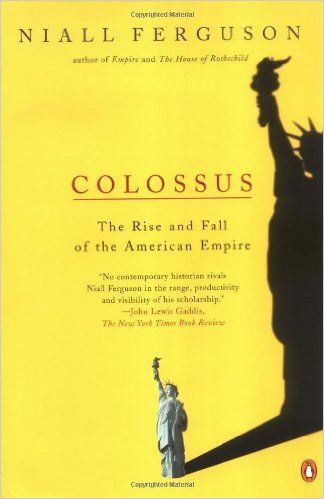
TDR: In your 2005 book Colossus: The Rise and Fall of the American Empire, you advance the thesis that the United States is an empire in denial and that such denial will be our undoing, both domestically and abroad. Does that thesis still hold in the world of 2022?
NF: I think it has withstood quite well the test of nearly 20 years. If you recall, the analysis was that the United States was trying essentially an imperial enterprise in Afghanistan and Iraq and that there were three deficits that were going to make it fail. There was the manpower deficit, because people really did not want to spend that much time in Afghanistan and Iraq – hence the short tours of duty. There was the fiscal deficit, which was already obviously a problem and has only gotten worse. And then there was the attention deficit. The prediction was that the US [BREAK] public would become disillusioned with these endeavors just as it became disillusioned with Vietnam. And if anything, the surprising thing is how long it took to get out of Afghanistan.
I wouldn’t have predicted it would be 2021. I expected it sooner than that. But I think that the overall framing of the US as an empire-in-denial works because it’s so deeply rooted in the way Americans think about themselves and the language that their leaders use. What was odd was that some neo-conservatives back then really were willing to say, “We’re an empire now”.
Of course, it kind of blew them up politically so that they’re now an irrelevant bunch of never-Trumpers. So I feel that book stood up remarkably well to the test of time. I’d stick by it.
TDR: What I’m hearing from your answer is that our denial is sort of endemic to what Americans are and that there were issues that were already present before the invasion of Iraq. Do you think that there’s any personality in American public life today who might be able to get us out of our denial and fix these issues that you’re talking about?
NF: No, because I think, if anything, the kind of aversion to empire has grown on both the left and the right. And so you have different versions of it.
Those wings, the progressive wing of the Democratic Party and the Trumpian wing of the Republican Party, are much stronger than they were then. I don’t think we are going to see any revival until the US suffers the kind of attack that it suffered at Pearl Harbor or 9/11.
Until there’s a punch landed, what will happen is that the US will try to exercise power through indirect means like sanctions or getting Ukrainians to fight Russians or arming the Taiwanese. And, in that sense, I think we’ve reverted to a Cold War playbook without calling it a cold war.
The problem is that we aren’t as far ahead [of China] economically and technologically as we were relative to the Soviet Union. If you’re doing a cold war with China, you have to reckon with quite a formidable antagonist, but that I think is where we are.
It’s amazing how far there is now a bipartisan consensus that China’s the problem. The continuities from the Trump to Biden Administration are very striking in that respect. I don’t see that changing until something bad happens, whether it’s a showdown over Taiwan that the US actually loses, or the collapse of Ukraine, which I guess is a conceivable if now unlikely scenario, or another terrorist attack, though I think that’s not especially likely these days.
The other thing to watch out for is the Middle East. Basically, as in the Cold War, you’ve got the potential for a crisis to happen. The problem for the US is that it’s quite overstretched. If there’s a crisis in Eastern Europe and a crisis in the Far East, say Taiwan, and one in the Middle East, then the US is going to be completely unable to respond to all of those.
It’s already in the position that it can’t give Stinger and Javelin missiles to the Taiwanese, because they’ve already been given to the Ukrainians and we can’t actually make that many new ones. It feels like we are doing Cold War but with quite a bit more overstretch than was true certainly in the 1980s.
QotD: The Left does not handle political reverses gracefully
The Left is absolutely right to fear all of this because these things represent the furtherance of a growing trend towards decentralisation that I’ve been talking about recently. This is bad for them because the Left’s whole program — and I’m talking about going back for at least two centuries — has been based on the centralisation of power into its own hands. Everything the Left does is predicated upon the “principle” of coalescing power into its hands in government, NGOs, woke corporations, and a constellation of other institutions that all coordinate together to advance the progressive agenda. Due to our place in our current demographic-structural secular cycle, this decentralisation is nigh inevitable, but that doesn’t mean the Left won’t (literally) burn through a lot of social capital fruitlessly trying to stop it.
These recent Supreme Court rulings represent real loses for their program at the most sovereign level in our government. This, in turn, signals openly their loss of control over that institution. This is why we’re seeing increasingly desperate ideas being floated for ploys to take back the SCOTUS, from packing the Court to (somehow) convincing 2/3 of the states to gut it completely. They know they’ve lost control over it as an institution, so they’re perfectly willing to dynamite it (hopefully not meaning that literally), like an ex-girlfriend who takes a baseball bat to a guy’s X-Box rather than just giving it back to him like a sane person would do. In the space of a few short years, the SCOTUS has gone from hero to zero in the Left’s eyes, since for them everything is situational in nature. Once something, anything, outlives its usefulness to them, it goes up against the wall.
The thing to understand from this is that these losses the Court has handed to the Left are real things. They’re not just some kind of plot to “mobilise their voters” to win the midterms in November. While lefties may often be cunning, they are also arrogant and in many ways kind of dumb. These people are really not out here playing some grandmaster game of four-dimensional chess. They’re desperate, which is why they’re willing to engage in such blatant attempts at gaming the system through naked procedural manipulation. They’re the ones who are suddenly finding themselves in the place of having to operate outside of “our sacred norms” by refuting the legitimacy of institutions that go against them.
Bear in mind that the Left’s entire view of legitimacy is predicated on this “ever-forward march of progress”. To “move backwards” is to show weakness, to reveal a chink in the armour of the dialectic of inexorable progress. This sense of legitimacy, in turn, was based upon their capture of the various power-generating and power-wielding institutions, including the Supreme Court, since the “right” people now had possession of the means to remake society. What a lot of people forget is that the whole “march of progress” since the mid-1960s occurred because of this institutional takeover. Their judicially imposed agenda has never really “won the argument” on any issue. They just used social and political force to achieve their goals, followed up by media-driven social pressure and anarchotyranny to “encourage” conformity among the general population. So yeah, especially with something like the repeal of Roe v. Wade, their whole program is in jeopardy. The post-Roe stance on abortion adopted in 1973 was the truly radical stance on this issue, but they don’t want you to realise this.
Theophilus Chilton, “The Left Is in a Precarious Place”, The Neo-Ciceronian Times, 2022-06-29.
September 30, 2022
“To maintain the illusion of free, all our online activities are sinking into spam, scam, and sham”
Ted Gioia on the insatiable growth of predatory behaviour from providers of “free” content online:
The biggest trick the Devil ever played was convincing people that online stuff is free. But the Devil always collects, sooner or later — and we are starting to learn the actual terms of this cursed deal.
Consider some recent news stories:
- YouTube has been testing users’ willingness to watch 10 unskippable ads on a video. And the ads aren’t spaced out. They come at you, one right after the other, at the outset — because Google wants to be paid first, even if the video sucks.
- Nobody wants ads on iPhone, but they’re coming. Executives at Apple are allegedly planning to triple the ad revenue from phones.
- “For some Google searches literally the whole screen on Google is ads.”
- TikTok can track a user’s every keystroke, and Beijing has “access to everything”.
- “Scams are showing up at the top of online searches.”
- Snapchat has been forced to pay $35 million for storing and selling users’ biometric information without permission.
- Even if you pay for ad-free streaming, Spotify inserts ads in podcasts.
- Ads are coming to Netflix too.
- Etc. etc. etc.
This is what happens when “free” really isn’t free — but consumers prefer to stay in denial. Go ahead and rob me, just make sure I’m not looking when it happens.
It’s even worse than that. Web users are now hooked on free — and like all addictions, this one is far costlier than you realize at the outset.
You have more leverage when you negotiate an actual price. When I cancel a paid subscription, the corporate provider always comes back with a special offer to get me to reconsider. But how much bargaining power do I have if I refuse to click on those “terms and conditions” that always come with the free stuff?
I’ll answer that for you — none at all.
How bad will it get? YouTube described its ten unskippable ads as a “test” — but this wasn’t done in a laboratory or with volunteers. They just forced it on users, and watched them squirm. And squirm they did.
In fact, one person reported a 12-ad blitz.
This wouldn’t be so bad if it was just one business or sector of the economy that played these games. But this is the de facto business model for the entire digital economy. To maintain the illusion of free, all our online activities are sinking into spam, scam, and sham. Everything from sending an email to sharing a photo gets monitored and monetized by big tech companies — and often you’re the last person to find out what the real price is.
M1C Sniper Garand
Forgotten Weapons
Published 18 Sep 2016The M1C was an M1 Garand with a telescopic sight, using a mounting system developed by the Griffin & Howe company of New York. It utilized a rail pinned and screwed to the left side of the receiver, coupled with a quick-release scope on top. The rails had to be installed prior to heat treating the receivers, which had the unfortunately consequence of preventing rifles form being chosen for sniper conversion based on their mechanical accuracy. Instead, accuracy would be tested only after rifles were complete, leading to a 60% rejection rate.
The scope was offset to the left of the receiver so as not to interfere with the Garand’s clip loading, and issued with a leather cheek pad to give the shooter’s cheek weld a matching offset to the left. The scope used with the M1C was the M73B1, later replaced with the M81 and M82 scopes — all military versions of the 2.5x Lyman Alaskan hunting scope (which was a very good piece of equipment despite its low magnification)
The M1C was adopted in 1944, but production and quality control delays would prevent it from seeing any action in WWII. It was in use during the Korean War, however, before being replaced by the M1D.
(more…)
QotD: Many media people are folks “who Don’t Read Shit” about the stories they “report” on
First, as I traveled to Boston to go to court, and as I wracked up PACER charges downloading legal briefs and judicial orders, I would have email exchanges with newspaper reporters who wanted me to tell them what had happened. I would shoot back an email message that said, “Judge’s ruling attached,” and they would reply, “Yeah, saw the attachment, what does it say?”
Over two years, through events in a trial court and in an appellate court, with multiple parties pursuing complicated and divergent courses, reporters would not read. They wouldn’t read the 40-page legal briefs filed by the lawyers for all the competing sides, but they also wouldn’t read a three-page order from a judge. They would not read, period. They wanted the tl;dr, in a sentence or two. “Yeah, what’s it say?”
In our own moment, I remain extremely confident that the flood of bullshit like this […] is being slopped out by people who DRS — who Don’t Read Shit — about the topic they cover. Somebody in a government agency shot this dude an email message that said COVID VACCINES ARE MIRACLE DRUGS EVERYONE SHOULD GET THEM, and he said to himself, “Miracle drugs, got it!” We’re plagued by an army of people who pour “information” into the world based on two Twitter posts and a text message, after a full three to five seconds of deep thought …
Chris Bray, “Chris Bray is Stupid and Evil”, Tell Me How This Ends, 2022-04-07.
September 28, 2022
Pemmican: History’s Power Bar
Tasting History with Max Miller
Published 27 Sep 2022
(more…)
There are two kinds of people online talking about mental illness: those suffering with mental illness and those glorying in the attention they get for faking it
Freddie deBoer on the phenomenon of mental health culture online and the two primary kinds of participants (my headline over-dramatizes the case he’s actually making):
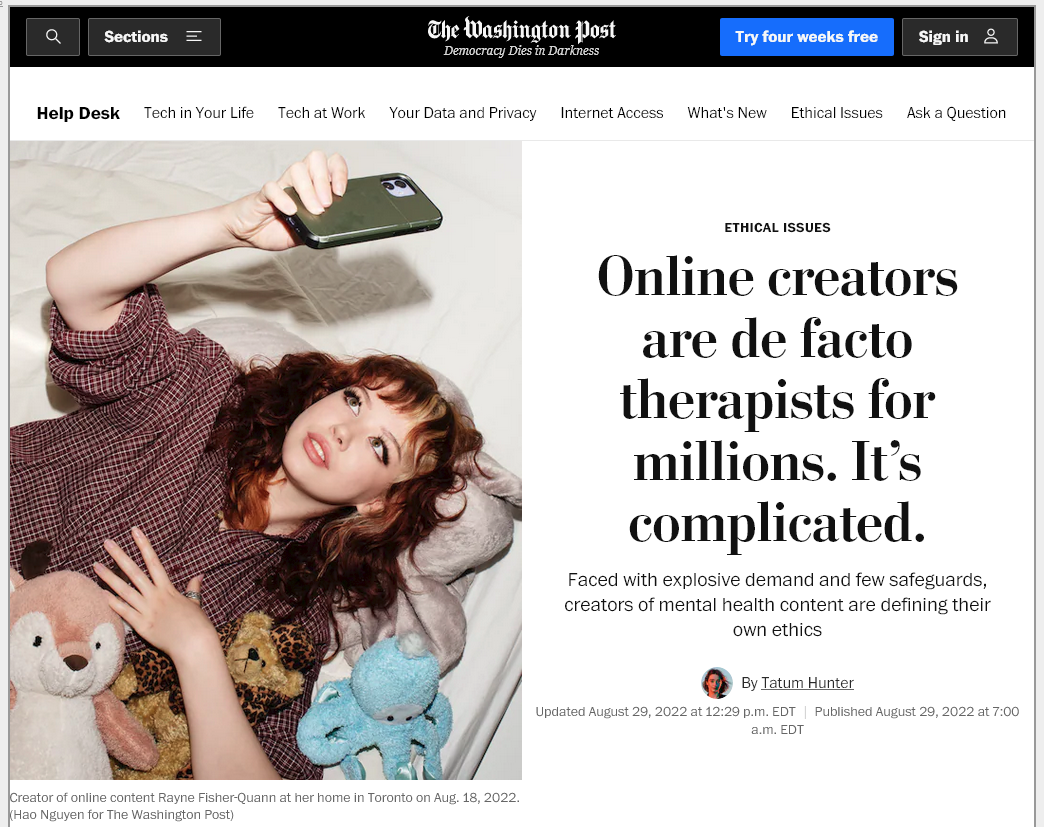
I was not, at first glance, inspired with confidence by this Washington Post piece on online mental illness culture. The piece has a header image of a “mental illness influencer” lounging in bed, taking a selfie. I’m someone who’s committed to de-glamorizing mental illness, and I’ve been begging people to stop romanticizing pathology for a long time. I suppose there’s an implied critique in that photograph, but it’s not ideal.
On substance, Tatum Hunter’s piece fails the way so many others have failed in this milieu: it studiously avoids the possibility that some people who talk about their mental illnesses online don’t really have them. I’m not specifically talking about simple fraud and lies, which I suspect are rare, but rather the weird combination of hypochondria, Munchausen’s syndrome, and social contagion that we see all around us in these spaces. Spend any time at all in these communities on Tumblr or Tik Tok and you will find many people, most of them young, who are using mental illness as a means to self-define, to differentiate themselves from the hordes of other people they see online who are just like them. I’ve written again and again about why it’s a bad idea to want to be your mental illness, and it’s even worse to want to be mentally ill, period – not just bad for other people, but bad for you. But there are people who have become influencers and garnered hundreds of thousands of followers on their apps of choice by performing mental illness. People use their disorders to chase clout. That’s just reality.
Hunter considers the problems of misdiagnosis, of self-diagnosis, of people undertaking mental health care on the advice of internet randoms rather than under the care of a doctor, but nowhere does she seriously consider the possibility that the basic problem for many people is that they believe they have mental disorders they don’t in fact have. I think doing so is seen, at this point, as a kind of identity crime, and thus unlikely to be found in the Washington Post.
But hypochondria exists. Munchausen’s syndrome exists. Psychosomatic illness exists. I can get people to admit to those realities in the abstract, now, but they stay entirely in the abstract – to suggest that any group of people is suffering under those conditions, rather than under authentic mental illness, is treated as a sin. This was my biggest disappointment with Ross Douthat’s book on his chronic illness, which I quite liked overall; Douthat never stops his narrative to ask whether any of the people who believe themselves to be sick from chronic illness actually aren’t. (Surely he himself suffered, but because of the woo and mysticism found in that space, an accounting was necessary.) And I don’t know how we confront the spiraling number of people claiming to have illnesses for which there are no objective tests without being frank about the existence of hypochondria, Munchausen’s, and psychosomatic illness – particularly when people insist on deepening the social incentives by giving the sick more and more attention.
Even for the authentically ill, online culture is fraught. The meta-problem with pieces like that in WaPo, obviously, is that by giving certain members of this community the glamour shot treatment (literally in this case), they’re creating direct incentive for people to make illness their identity -and to not get better. Young people understand the allure of being seen; they don’t yet understand the horror of being frozen in other people’s gazes. They don’t understand the costs of being defined. There have been many opportunities for me to make myself the mental illness guy, certainly including financial opportunities. Perhaps I’ve already fallen into that trap, despite my efforts to remain a generalist. But I’ve fought to avoid that because I know just how painful and limiting self-definition can become. I’m sorry to pull wizened old guy here, but young people don’t understand. They don’t understand that pinning yourself down that way can produce a kind of horror.
This Is Why We Can’t Have Nice Infrastructure
Kite & Key Media
Published 31 May 2021America is a land of constant progress. Sometimes it seems like there’s nothing we can’t accomplish. And then we try to build something…
In recent years, infrastructure projects have taken way too long and cost way more than they should. Boston’s “Big Dig”, for example, took 15 years and cost more than 5x as much as projected. California’s High-Speed Rail was supposed to run between L.A. and San Francisco by 2020. Instead, some track nowhere near either city might be ready by 2027.
Why can’t America build quickly or cost effectively anymore? A well-intentioned regulatory law from the 1970s has a lot to do with it…
When the National Environmental Policy Act (NEPA) first took effect in the 1970s, the environmental impact analysis it required from builders before a project could begin would often run less than 10 pages. Today, the average is more than 600 pages.
Maybe delays and ballooning costs are worth it to protect the planet, right? Here’s the crazy part: NEPA doesn’t even guarantee that. In some cases, it’s actually making us less green.
(more…)


