
My guess — and I am NOT an art historian, I can’t stress that enough — is that this reflects the increasing emphasis on the individual [in the late 15th century]. Which, again, is tied to the acceptance of linear time — the desire to be commemorated as an individual, unique person, not as a type. The more people who could afford portraits, the more people wanted them, and the more the individual commemoration mattered. High-medieval “portraits” are extremely accurate as funeral sculptures, but illustrations in manuscripts are often little better than stick figures.
By the (I think) 16th, and certainly by the 17th, centuries, you’ve got portraits of people as Classical throwbacks — contemporary figures tricked out in Roman togas and whatnot. This is the full acceptance of linear time — you can move a distinct individual both forward and back along not just the course of his life, but the course of linear history.
Contrast this to the Juggalos, whose first impulse in any situation is to take a selfie … but who never, ever look at those selfies. Basic College Girl “culture” is often described as narcissistic — lord knows I’ve done it enough myself — but the funny thing is, for as self-involved as they are, they have almost no pictures of themselves hanging around. They don’t decorate their office cubicles with pictures of their families. Nothing could be easier than “flipping” through a digital photo “book”, but they never do. They go to extraordinary lengths to arrange the perfect selfie … but then they could instantly delete it, for all the impact it has.
I think this is because they actively shun the idea of linear time. When I was a young man, every girl had a photo album in her dorm room, and part of the “getting to know you” process was flipping through it with her. Half the fun was seeing the brutal fashions of yesteryear; you both had a good laugh over it.
I think that would be actively painful for Juggalos, and not just because they can’t stand to have others see them as less than 100% perfect at all times. Rather, I think the problem is the fundamental one — they don’t want to be reminded that time passes.
They want the endless now. They want to be ghosts.
Severian, “The Ghosts (II)”, Founding Questions, 2022-05-18.
September 28, 2022
QotD: Yearning for the “endless now”
September 27, 2022
Sarah Hoyt on how Americans are mis-understanding the TV show Bridgerton
I don’t watch TV, so I haven’t seen the show myself, but apparently a lot of Blacks in the US are taking away the multi-racial casting of a parallel-universe TV show set in the Regency period as being a true representation of British history:

Anyway, all this came to a head with my watching the Bridgerton series. As other people know, it bothers the living daylights out of me to cast well-known historical figures as another race. Not because there can’t be decent actors of another race, but because I know there is a percentage of the population who takes fictional movies and shows as revealing “the truth”.
My mom, who is better educated (alas) than most American high school graduates is one of those. She will adapt her vision of the past according to some crazy movie she just watched. (The number of arguments I’ve had.)
For those who haven’t watched Bridgerton (bog standard regency romances, with gorgeous, if not period-accurate clothing) they cast a certain number of noblemen as black or indian or other “races” and the English Queen in Bridgerton is black.
The buried history in the mini-series (suggested and Heinleined in) is that black and white people coexisted in England side by side, until the king married a black Queen, and then suddenly mixed marriages were allowed.
This is obviously a fantastic parallel world history. Yes, there were black people in England in the regency. I’m sorry to tell you there were very few and 99% of them were slaves or servants brought by people who had lived in Africa.
There was no “black nobility” and no system of apartheid.
HOWEVER as we found out, American people absolutely believe this nonsense. They believe Queen Charlotte (mostly German, honestly) was “black” based on a very bad portrait and rumors of a Moorish ancestress. (Note this rumor was almost certainly political slander. Also that Moor at that time in the peninsula depending on whether in the South or the North might mean slim, small and tan, but did not mean AFRICAN.) Weirdly the best debunking I found was from Quora.
HOWEVER I also found endless pages of well-educated black-Americans celebrating Queen Charlotte for “Black history month”.
Let me also point out that both the Queen and her husband (Yes, mad King George) were ardent abolitionists and that did she have any legitimate hint of African blood ALL the opposition would have fixated on this, and the caricatures would have been next level. However this never happened. Queen Charlotte was and looked German, even if a portrait can imply “stereotypical” African features … As long as you remember that those features exist in a lot of other races, and that a lot of them are also Neanderthal.
Sure, if you go with the one drop theory, Queen Charlotte was black. So is everyone else. EVERYONE else, even those whose 23andme swears they’re pure Scandinavian. Because sometime in the last two thousand years all of us got an African ancestor, somewhere, on one of the many, many lines that fed into our family. (Note genealogy is also a lie to some extent, since it’s impossible to follow every single female (if you’re tracking the male. Vice versa otherwise) line that dropped into your family, and everyone who fed into every other of those lines.)
The problem is that it was the rats in the head of the American black producers of the series that led them to create this entire parallel universe which they THINK IS TRUE on the basis of “well the queen was black”. WITHOUT LOOKING.
And now those rats are reproducing everywhere, but most notably in black American heads, who now believe that “Well, the king married a black queen, so it must be true that the Americans rebelled to keep enslaving the black people”.
This is all not just arrant nonsense, but poisonous bullshit, and has no contact whatsoever with reality.
What can we do about it?
Correct it, ruthlessly, whenever we come across it. And keep pointing out that a queen who was blond and blue eyed was not in fact “black” unless everyone is. And that reading racial tea leaves is a pseudo-science, like phrenology.
I would very much appreciate if we could put this behind us so may family doesn’t keep getting asked “what is your racial background” by complete strangers. (And not just census takers, whom I like to answer with “human”.)
Look, in the end, the darkest African and the lightest Scandinavian have more in common with each other than not. To pretend otherwise is arrant nonsense.
Yes, our far-distant ancestors developed racism as a necessary survival tool (along with the uncanny valley discomfort) because you could fall into the hands of another hominin band and become “food”. (The chimps are less discriminating and will also eat babies of their own band.)
We are now past that, and I would like it not to return. Yes, there are physical characteristics that go with certain character traits, but it’s harder to track than you think, and they’re often things that have nothing to do with race, let alone racial stereotypes.
We all have one drop of slaves and enslaved, or saints, sinners, murderers, murder victims, kings and peasants, ascetics and whores. And we all have all the inclinations of all of mankind in varying degrees.
It’s what you make of it and with it that determines whether you can wear “human” as a crown, or in fact get cast out of the human race for shoving in line.It’s time to stop with the nonsense.
September 26, 2022
Did D-Day win WW2? – a WW2 expert discussion
World War Two
Published 25 Sep 2022WW2 historians Indy Neidell, Spartacus Olsson, and Paul Woodadge moderated by Ryan Socash discuss the meaning and significance of D-Day from historical, current, and future perspectives. Recorded on the road while shooting in Normandy for TimeGhost’s 24-hour documentary on the events of June 6, 1944.
(more…)
“We’ve credentialed people for membership in a series of high-cultural-status groups on the basis of their ability to chant slogans and perform rituals; they are coreless”
Chris Bray on Vivek Ramaswamy’s book Woke, Inc.:
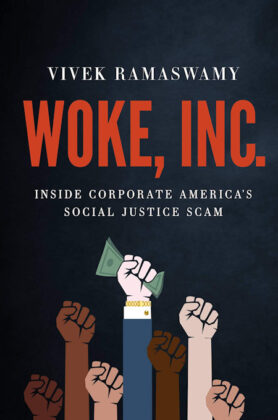
Vivek Ramaswamy was trying to close a deal, so he went to do some relationship building over dinner at an investor’s house. As dinner ended, the investor’s son came downstairs to greet the visitors, and he turned out to be a high school senior who was applying to Harvard. By the most remarkable coincidence, Vivek Ramaswamy is a Harvard grad, so the kid asked for some advice on getting in. Stand out, the Harvard grad told the Harvard applicant. Have something that makes you different than all the other applicants. Oh, the kid said, yeah — I got that. It turns out the seventeen year-old son of a venture capitalist had started a non-profit to fight against global sex slavery, which did indeed impress the admissions office and did indeed get him into Harvard. When Ramaswamy ran into the kid again, a few years later, he was shopping for Wall Street internships — and had moved on from the whole sex slavery thing, which had by then served its purpose.
Ramaswamy’s book Woke, Inc., a title published last year that seems to be gaining new momentum now as its author takes on corporate ESG posturing, accurately promises to take readers “inside corporate America’s social justice scam”, though I don’t love everything he offers as a solution. He clearly is reporting from inside: He’s a Harvard grad, a Yale Law grad, a former hedge fund employee, and a former pharmaceutical CEO. (Those credentials make you trust his argument, right?)
The thing the kid did, dummying up a quick thing to fight global sex slavery to get it into his admissions package, is a version of a maneuver that Ramaswamy finds all over the woke corporate world. The highly woke consumer products company Unilever is passionate about taking deep notice of intersectionality and serving women of color, and it partners with UN Women, “a nonprofit branch of the UN dedicated to advancing gender equality and empowering women”. Also, dozens of women who work on a Unilever tea plantation in Kenya were gang-raped in front of their families, an event that was coupled with a dozen or so murders, and Unilever declined to provide them with substantial support or assistance: “Unilever said the attacks on its plantation were unexpected and therefore that it should not be held liable”.
Unilever provides money to UN Women, Ramaswamy concludes, and UN Women provides Unilever with “moral cover for the Kenyan massacre”. Woke Unilever is a façade for, you know, Unilever. It’s a strategy, one example of many, and Ramaswamy argues that the “arranged marriage” between wokeness and corporate capitalism was born out of Occupy Wall Street: Here’s a check, now let’s stop talking about TARP and start talking about white privilege.
You should read Woke, Inc., so I won’t go on summarizing. But without going deeper into Ramaswamy’s argument, which reflects a series of increasingly familiar observations about social class and the function of wokeness, the point is the inauthenticity and shallowness of corporate social justice posturing, all of which is meant to protect the core of the project — to provide cover for business practices that might otherwise be criticized. It’s a show, a performative and manipulative posture. You could easily make comparable arguments about wokeness and power in academia, media, or government.
Now, to take all of this and pivot to an argument that will satisfy absolutely no one, if the social justice façade is a façade — shallow, performative, calculatedly purpose-serving — then there’s a good chance the branch managers of the globalist project will drop it when it slides out of fashion. The kid who, wanting a career on Wall Street, did the sex slavery nonprofit thing just long enough to get into Harvard: That kid is a middle manager now, and he’ll recite slogans about white privilege or not, as Current Thing demands, as long as the checks still cash. We’ve credentialed people for membership in a series of high-cultural-status groups on the basis of their ability to chant slogans and perform rituals; they are coreless.
September 25, 2022
Red Army Reaches the Dnieper – WW2 – 213 – September 24, 1943
World War Two
Published 24 Sep 2022Benito Mussolini proclaims a new fascist republic in Italy, but this time it is a full puppet state to Germany. There is scattered fighting around Italy and the Dodecanese — including a massacre of Italian POWs, but the big Allied advances this week are the Australians in New Guinea and the Soviets retaking their own territory. They take ground, in fact, from near Smolensk all the way south to the Sea of Azov.
(more…)
September 24, 2022
The end of crisis culture – “[Y]ou can’t go on having a culture of crisis if people stop showing up for it”
Chris Bray on the inevitable endgame of “all crisis, all the time” culture:
The journalist John Tierney has described the Crisis Crisis, “the incessant state of alarm fomented by journalists and politicians”. What we’re experiencing now is the Crisis Crisis crisis, the emerging crisis caused by the Crisis Crisis. Over and over again, interventions in some invented or overhyped form of the crisis, undertaken in the hysterical spirit of the Crisis Crisis, cause a form of the Crisis Crisis crisis, which eventually results in a course correction that may or may not be fully apparent for a while. Skip right over the next paragraph if you don’t need to see examples again.
The Sri Lankan government intervenes in climate change by instantly ending the use of commercial fertilizers in agriculture, which causes a dangerous decline in the production of food. The German government intervenes in climate change by declaring a commitment to 100% clean energy, which causes dangerous instability in the availability of actual energy (“committing national suicide“), with some help from the Nord Stream shut-off valve, which nobody ever could have seen coming. The Dutch government intervenes in climate change by declaring an intention to limit agricultural production, which doesn’t cause anything yet, because Dutch farmers won’t stand for it, but final outcome TBD.
All over the world, things that work stop working because of excessive and unwarranted interventions led by people who cry crisis and throw sand in functioning gears. Dutch agriculture was just fine; then the government decided to help end the crisis. The interventions — the interveners, the people who get in the way — are harming us, when their harm could be prevented by literal nothing, by the simple choice to not perform the interventions. What we need is for the interveners to go play Risk in their basement or something, and forget their important duty to help.
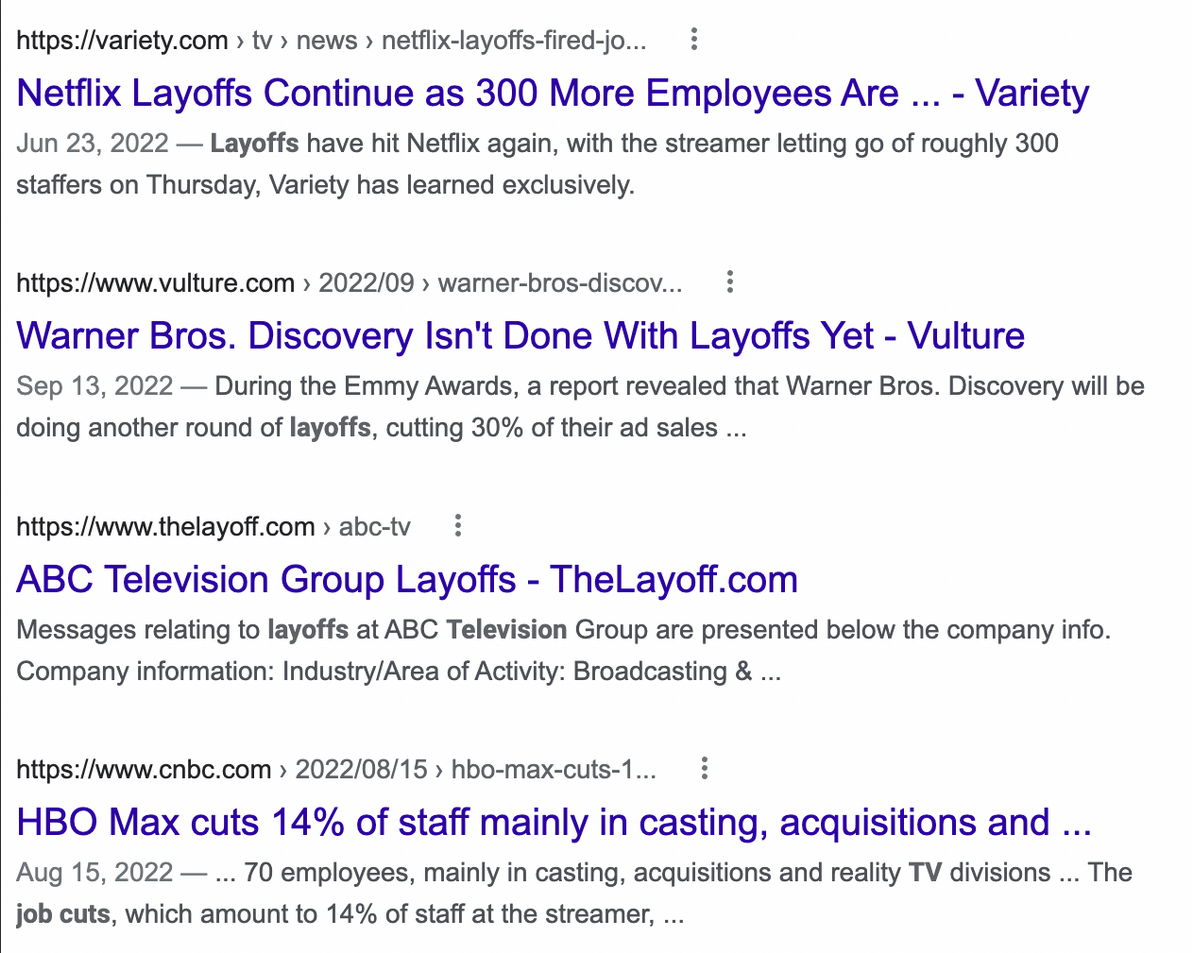
The entertainment industry has had its own intervention, famously described on Substack, in woke-facing talent purges and narrative shifts and insulting “It’s Ghostbusters … but with WOMEN!” reboots. And now some hint about the endgame of the one big cycle of fraud comes from woke Hollywood — which has pounded audiences with The Message for years, resulting in a catastrophic loss of audience. The result is starting to look like this:
The social justice intervention in Hollywood storytelling is harming Hollywood; the intervention in that industry is causing the decline of the industry. At some point, people stop eating shit.
Business Intrigue Gone Wrong: High Powers for Oman
Forgotten Weapons
Published 16 May 2022The story of the Browning High Power pistols with Omani national crests is an interesting one. It begins with a man named Paul Van Hee brokering a contract for Cadillac-Gage “Commando” armored cars for the Omani government in the late 1960s. These were to be equipped with FN MAG machine guns, and it came to Van Hee’s attention that Oman might also be interested in High Power pistols. He wasn’t an FN agent, but figured he could make that deal happen (and presumably make a nice profit on it).
Van Hee imported 36 new High Powers into the US, and then had them engraved with Omani crests (although the first 9 were accidentally engraved backwards). Around the time he was showing the guns to the Omani delegation, though, the deal fell apart. FN got wind of it and arranged the sale themselves, eventually shipping 5,000 pistols to Oman (without any special markings).
The demonstration guns remained in the US, and were sold off onto the collector market having never actually seen Oman. Interestingly, they are exempted from the NFA when fitted with original Belgian shoulder stocks, like this one is.
(more…)
September 23, 2022
Is This Atlanta Streetcar “The Worst Transit Project of All Time”?
ReasonTV
Published 22 Sep 2022Transit ridership, especially rail, has collapsed post-pandemic, but the Atlanta BeltLine Coalition says now is the time to take federal dollars and build a $2.5 billion streetcar.
Full text and links: https://reason.com/video/2022/09/22/i…
—
Twenty-three years ago, Atlanta-native and architecture and urban planning student Ryan Gravel had an experience that opened his mind to what urban living could be.“My senior year I spent abroad in Paris and lived without a car for a year and traveled by train everywhere,” says Gravel. “And within a month of arriving, I had lost 15 pounds. I was in the best shape of my life because I was walking everywhere, and the role of the physical city was made clear to me in a way it really had never been before.”
For his Georgia Tech master’s thesis, Gravel sketched out a plan to make Atlanta more like Paris. He proposed redeveloping the land along the city’s historic rail lines to create a 22-mile loop called the Atlanta BeltLine. He proposed turning the city’s abandoned industrial areas and single-family home neighborhoods into business districts and walking trails. And he proposed connecting downtown to the rest of the city all with a new train running along the entire Atlanta BeltLine.
“I never imagined we would actually do it,” says Gravel.
But they did — for the most part. Cathy Woolard, who was president of the Atlanta City Council, read Gravel’s thesis and decided to use it as a blueprint to remake much of the city. Today, the Atlanta BeltLine is a walking and biking trail, parts of which are bordered by retail and condos.
But one piece of Gravel’s grand vision didn’t get built: The train.
Today, Gravel runs a co-working and event space along the BeltLine, which also serves as a gathering place for urbanists interested in making Atlanta less dependent on cars. He says that the train line is essential for improving city life.
“In those early days, when we built the movement behind the [BeltLine] project, it was around transit,” says Gravel.
The three COVID relief bills set aside $69 billion in federal funding for local transit agencies to operate and add to their transportation systems, meaning that Atlanta might finally get its train—with many American taxpayers who will never step foot on it picking up much of the tab.
Many American cities have used federal money in the past to build rail transit lines that suffer from dismal ridership, that are expensive to maintain, and that are a major drain on their budgets.
(more…)
Sarah Hoyt on the Overton Window
At According to Hoyt, Sarah considers the Overton Window:
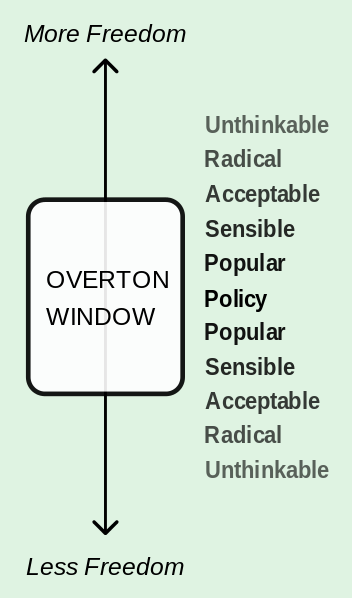
Diagram of the “Overton Window”, based on a concept promoted by Joseph P. Overton (1960–2003), former director of the Mackinac Center for Public Policy. The term “Overton Window” was coined by colleagues of Joe Overton after his death. In the political theory of the Overton Window, new ideas fall into a range of acceptability to the public, at the edges of which an elected official risks being voted out of office.
Illustration by Hydrargyrum via Wikimedia Commons
The Overton window is not natural to human society. It is the product of the mass-information-media-entertainment era.
No?
Sure, in some villages, or some other places, there are things you can’t see/say. That is usually because someone in that society, be it a village or a nation, is going to get under your nose for saying it. (At one point, you could get arrested in Portugal for shouting “Portugal is a sh*tty country!”)
Having “Unsayable” and “Unthinkable” and “if you say that in public you’ll be shunned” is always a sign of an oppressive society, whether the punishments are physical or mental, beatings or mere shunning.
Having beliefs that are beyond the pale — in fact, the existence of the pale — are a sign of an unhealthy society, one in which a truth is being enforced that is different from reality.
No? Fight me.
Look, yeah, sure, there are things people in all eras didn’t discuss in certain company due to manners or delicacy. One didn’t discuss sexual acts in front of children, not equipped to understand them, in most of the west since the onset of Christianity. One didn’t say certain things in front of elders either. “Gentlemen don’t discuss politics or coitus”. But that was a matter of — in a small gathering, or a confined society — keeping the social gears lubricated, and keeping disagreements at bay. What “couldn’t be said” varied.
However, the Overton window is something else. It is “you can’t report certain things, even if they are true, at the risk of becoming a social pariah”.
It avoids discussions of really important things, like how our kids are being sodomized by public education. Or how welfare really doesn’t contribute to the welfare of anyone. Or how Child Protective Systems is a money-laundering scam, in which kids die. Or how our government-funded science has become all government and almost no science. Etc.
It encourages rape rings like Rotherham, and has most of the black population of the US believe they are more at risk of police shootings than whites, which is plainly not true, but can’t be said, because the media has deemed saying so is “racist” (Somehow.) So people live in fear, rather than knowing they’re not at higher risk than anyone else.
And while speaking of risk, the media, and its control of information and encouragement of shunning dissenters, has led to fear of a “slightly more dangerous” flu, and led to elderly people living their last years in isolation and terror, and also led to our kids being isolated into loss of social function.
Furthermore, the only way to keep the Overton window over a whole country is to enforce strict control over the media, and even social media, and to ruthlessly crush down dissenters, so that everyone appears to agree, leading to shock-rejection of those who manage to break through the wall of government-encouraged-enforced lying.
A wall that they try to keep even when the lies are patently absurd and harmful. (Like the idea anyone who dislikes the Biden reign of terror is a terrorist or insurgent, or for that matter racist.)
The Overton window can suck what I don’t have.
QotD: Ron DeSantis for Caesar?
Ron DeSantis, for example, has gotten a lot of Grillers’ panties moist, and while that’s one of the strongest possible arguments for the proposition that he’s just another Swamp Thing — Ace of Normies might not remember how hard he used to squeeeee for fucking Paul Ryan, but I do — it’s nonetheless true that Ron DeSantis has acted at least kinda sorta like … what’s the word?
Ah yes: An adult.
Ron DeSantis’s response to Covid was pretty much exactly what even the most flaming moonbat liberal governor would’ve done as late as 1990, because there were still some grownups in politics back then. Now that the entire Swamp is filled with autistic Mean Girls with PMS, the State can’t carry out even its most basic functions. Governors still have real power […], and there are a few of them that aren’t totally retarded, and so I’d imagine we’ll see a period of retail-level Caesarism — the lights are on three days a week in Nebraska; quick, everybody load up the Conestoga wagon and head for Omaha!
Severian, “Friday Mailbag”, Founding Questions, 2022-06-17.
September 22, 2022
Waking – or shaking – NATO’s freeloaders (like Canada)
CDR Salamander has a proposal to encourage cheapskate freeloaders like Justin Trudeau’s Canada (although it didn’t start with him … Canada has been freeloading militarily since the early 1970s) to take on more like a fair share of NATO’s needs:

President Vladimir Putin on Wednesday ordered Russia’s first mobilisation since World War Two and backed a plan to annex swathes of Ukraine, warning the West he was not bluffing when he said he’d be ready to use nuclear weapons to defend Russia.
In the biggest escalation of the Ukraine war since Moscow’s Feb. 24 invasion, Putin explicitly raised the spectre of a nuclear conflict, approved a plan to annex a chunk of Ukraine the size of Hungary, and called up 300,000 reservists.
This should not be a shock to anyone. If it is, perhaps you should consider investing your time in cat-blogging.
It should bring to the front that NATO can no longer allow unserious nations to play like they are anything but security free-riders. They need to contribute their fair share or pay some consequence. Alliances have benefits and responsibilities. You should not have one without the other.
While percentage of GDP is an imperfect measure of contribution, it is better than all the other ones. It is as simple benchmark of national effort.
As these are the best numbers we have, let’s look at 2021 and then forward.
It is amazing that after all Russia has shown Western Europe — both of its nature and the nature of modern warfare — that so many of our NATO allies continue to slow walk defense spending, doing the very minimum to be a full and fair partner in the alliance.
Russian victory — however they define it — or Russian defeat — however Ukraine defines it — will not change the geography or nature of Russia. She is not going anywhere.
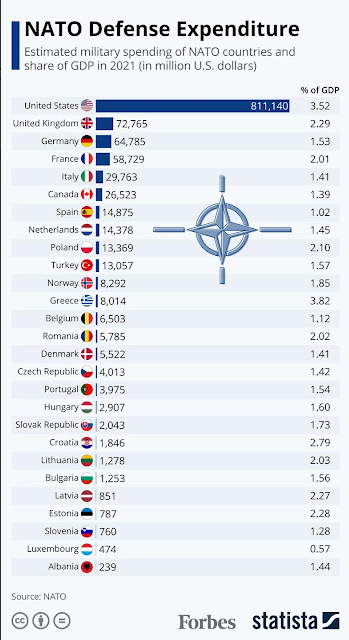
So, what’s to be done to encourage nations like Canada to put up or shut up? This might help:
“Out years” are where dragons live, so anyone not on guide-slope to 2%+ by the end of 2023 – when one way or another the Russo-Ukrainian War should be over – will find someway to not get there in a wave of excuses and bluffing.
We should call their bluff.
As such, and this is generous, we need to finally pursue PLAN SALAMANDER for NATO “Flags-to-Post” that I first proposed almost six years ago.
In NATO, General and Flag Officer billets are distributed amongst nations in a rather complicated way, but this formula is controlled by NATO – and as such – can be changed.
Entering argument: take the present formula for “fair distribution” and multiply by .75 any nation that spends 1.5% to 1.99% GDP on defense. Multiply by .5 any nation that spends between 1.25% to 1.499%. Multiply by .25 1.0% to 1.240%. If you fall below 1%, you get nothing and your OF5 (Col./Capt) billets are halved.
1.25x for 2.01%-2.25%. 1.5X for 2.26%-2.75%; 1.75x for 2.76% -3.0%. 2x for +3.01%.
The math gets funky when a lot of people get over 2%, but we can refine it later. Doesn’t cost a penny and will unquestionably get the attention of those nations. Trust me on this. By January 1st, 2024 no more excuses. A small and symbolic punishment, but a good start that may be all that is needed. This is not the second half of the 20th Century any more.
California’s Central Valley of despair
At Astral Codex Ten, Scott Alexander wonders why California’s Central Valley is in such terrible shape — far worse than you’d expect even if the rest of California is looking a bit curdled:

Here’s a topographic map of California (source):
You might notice it has a big valley in the center. This is called “The Central Valley”. Sometimes it also gets called the San Joaquin Valley in the south, or the the Sacramento Valley in the north.
The Central Valley is mostly farms — a little piece of the Midwest in the middle of California. If the Midwest is flyover country, the Central Valley is drive-through country, with most Californians experiencing it only on their way between LA and SF.
Most, myself included, drive through as fast as possible. With a few provisional exceptions — Sacramento, Davis, some areas further north — the Central Valley is terrible. It’s not just the temperatures, which can reach 110°F (43°C) in the summer. Or the air pollution, which by all accounts is at crisis level. Or the smell, which I assume is fertilizer or cattle-related. It’s the cities and people and the whole situation. A short drive through is enough to notice poverty, decay, and homeless camps worse even than the rest of California.
But I didn’t realize how bad it was until reading this piece on the San Joaquin River. It claims that if the Central Valley were its own state, it would be the poorest in America, even worse than Mississippi.
This was kind of shocking. I always think of Mississippi as bad because of a history of racial violence, racial segregation, and getting burned down during the Civil War. But the Central Valley has none of those things, plus it has extremely fertile farmland, plus it’s in one of the richest states of the country and should at least get good subsidies and infrastructure. How did it get so bad?
First of all, is this claim true?
I can’t find official per capita income statistics for the Central Valley, separate from the rest of California, but you can find all the individual counties here. When you look at the ones in the Central Valley, you get a median per capita income of $21,729 (this is binned by counties, which might confuse things, but by good luck there are as many people in counties above the median-income county as below it, so probably not by very much). This is indeed lower than Mississippi’s per capita income of $25,444, although if you look by household or family income, the Central Valley does better again.
Of large Central Valley cities, Sacramento has a median income of $33,565 (but it’s the state capital, which inflates it with politicians and lobbyists), Fresno of $25,738, and Bakersfield of $30,144. Compare to Mississippi, where the state capital of Jackson has $23,714, and numbers 2 and 3 cities Gulfport and Southhaven have $25,074 and $34,237. Overall Missisippi comes out worse here, and none of these seem horrible compared to eg Phoenix with $31,821. Given these numbers (from Google), urban salaries in the Central Valley don’t seem so bad. But when instead I look directly at this list of 280 US metropolitan areas by per capita income, numbers are much lower. Bakersfield at $15,760 is 260th/280, Fresno is 267th, and only Sacramento does okay at 22nd. Mississippi cities come in at 146, 202, and 251. Maybe the difference is because Google’s data is city proper and the list is metro area?
Still, it seems fair to say that the Central Valley is at least somewhat in the same league as Mississippi, even though exactly who outscores whom is inconsistent.
September 21, 2022
QotD: Why postwar western economic and humanitarian “interventions” almost always failed
Prior to the Cold War, America’s interference in other countries’ internal affairs was practically nonexistent outside of the Caribbean where America’s preoccupation was with the stability in the region. What went on in Egypt, Thailand, Argentina, or Greece was none of our business, nor did we frankly care. However, having just survived the cataclysm of WWII, and the realization that Communism was a danger bent on world domination, and that each country that became Communist made that possibility much more likely changed that laissez faire attitude 180 degrees. Whereas NATO was formed for the purpose of deterring a military attack on Western Europe by the Soviet Union (the generals mentally fighting the last war as is always the case, not realizing that the war now was ideological and propagandistic rather than military), diplomats began to question how to best combat Communist insurgencies in the Third World. The arrived (wrong) conclusion was that the reason a country became Communist was because the dirt-poor people were so desperate that they became Marxists in order to improve their lives, so if the West helped poor countries economically Communists could not gain a foothold. As such, they ignored the fact that most Communist movements are organized and headed not by poor people, but by a cadre of power-hungry middle-class intellectuals.
As has been mentioned, the first approach was with foreign aid. The second was with military intervention, in Korea, Vietnam, Santo Domingo, Grenada, and Lebanon. Although such interventions were mostly successful, they carried a heavy price as American blood was spilled in foreign countries. America’s supposed allies hardly helped at all, including the citizens of the countries (Korea and Vietnam) that themselves were in danger of being conquered by Communist forces.
Armando Simón, “Schlimmbesserung“, New English Review, 2022-06-16.
September 19, 2022
There’s a difference between “caring what kids think” and “pandering for kids’ attention and affection”
Rob Henderson wonders why so many adults these days are clearly desperate for the approval of young people:

During my recent re-watch of the entirety of Mad Men, which takes place in the 1960s, a recurring thought entered my mind: This was the last generation where young adults behaved like they were older than their real age. Don Draper is around thirty-five at the start of the series, and carries himself in a more adult manner than many 45 year olds today.
Recently, Abigail Shrier quoted a physician and psychologist who stated that “Fifty years ago, boys wanted to be men. But today, many American men want to be boys”.
Until the early 1960s, young people acted older than their actual age. Now, older adults pretend to be younger than their actual age.
Which is perhaps one reason why boomers are so easy to mock. They don’t act their age.
[…]
About two years later, I was at a breakfast gathering with some other students on campus. Our guest was a former governor and presidential candidate. He was gracious, and spent most of the time answering questions from students.
And in his answers, he continually returned to variations of the same response: “We screwed up, and it’s up to you guys to fix it. I’m so happy to see how bright you all are and how sharp your questions have been, because you will fix the mistakes my generation made.”
This mystified me. This guy was well into his sixties, with a lifetime of unique experiences in leadership roles, was telling a bunch of 20-year-olds (though I was a little older) that older adults are relying on them.
In the military, we thought of those senior to us as the leaders. It was okay to give feedback, of course. Commanding officers would regularly consult lower ranking and enlisted members to see what was working and what could be improved. But that happens only after getting through the filter of the initial training endeavors.
I remember in the first week of basic training, our instructor declared, “I don’t want any of you [expletive] thinking you are doing anyone a favor being here. I could get rid of all of you clowns and have your replacements here within the hour.” (This was 2007, well before the recruitment crisis).
My 17-year-old brain heard that thought, yeah, he’s probably right. I thought of the bus loads of other ungainly young guys I saw stepping off and being confronted with “Pick ’em up, and put ’em down” and other mind games from the instructors while waiting in the endless in-processing lines.
So then I got to college and learned that even though any seat, at least at selective schools, can be filled immediately with a bright applicant (top colleges reject thousands of them each year), students are never ejected for disrespecting professors or anyone else. In the military the first message was, you are a peon and less than nothing and we can easily have you replaced (this changes as you advance in rank, of course — at least to some degree). In college, the first message was, you are amazing and privileged and a future leader (and marginalized and erased) and you will never lose your position here among the future ruling class. That feeling of whiplash will forever linger in my mind.
[…]
Older adults crave validation from the youth, which is one reason they are mocked. Young people sense their desire to be seen as cool and deprive them of this by taunting them.
This desire for esteem may be why older adults won’t exert any authority in response to energetic young conflict entrepreneurs who yell at them or threaten them.
Older adults want to be on the side of youth. So desperate to pencil themselves out of the “old” category. Every parent wants to be the “cool parent”, every professor wants to be the “cool” professor. You can be cool and still be an authority figure. Maybe decades of imbibing the worst of U.S. pop culture made everyone forget this.
Albania – Hitler’s Latest Ally? – WAH 078 – September 18, 1943
World War Two
Published 18 Sep 2022The German Nazi Genocide of the Jews surpasses four million deaths, while the Soviet Union and US step up oppression against some their own citizens.
(more…)


