
If it’s to work at all, representative government has to be representative. That is, it must be consented to by the governed. But not only did we not consent to be ruled this way, we couldn’t. Just to take the most obvious problem: We have no idea who our rulers actually are.
Hawaiian judges are our kakistocracy‘s public face, but all the decisions that matter are made long before the hacks in black get involved. As we know, we Americans commit, on average, three felonies a day. If, when, and how these come to the State’s attention are almost completely random. This is true for any law, actually, and because it is, it’s not really an exaggeration to say that your livelihood, and often your actual freedom, depends on what side of the bed the cop got up on this morning.
If The Authorities notice you when they’re in a good mood, you skate. If The Authorities are in a bad mood, though — tired, hung over, had a fight with the spouse, whatever — you’re screwed. What actually happens to you depends on the lawyers, a.k.a the most incestuous little fraternity on the planet. Whether they choose to prosecute or not, and for what, and what deals they make over a drink or seven determine what happens to you once you get in front of hizzoner … who, of course, is also butt-buddies with all the lawyers who appear in his chambers, since he was one of them not too long ago and they remain his entire social circle.
Who in his right mind could possibly agree to this? No, forget “right mind” — it’s simply not possible for anyone, not even someone as far out on reality’s fringes as the SJWs, to consent to this. Those “people” (in the strict biological sense) think houseplants have human rights, but not even they would agree to have their life’s course determined by two dimbulbs with great hair and ugly neckties cutting deals with each other in a dive bar.
But so long as we fetishize the form of “representative government,” it can’t be otherwise. As folks in Our Thing never tire of pointing out, had The People ever been consulted about our preferences, at any time after 1963, we’d still be living in a White Christian nation with a solid manufacturing base and a minuscule military footprint. If it were possible to throw the bums out, we would’ve thrown out every bum on every ballot since at least Calvin Coolidge. But we can’t throw the bums out, because the process is rigged.
Severian, “Form > Process > Outcome”, Rotten Chestnuts, 2019-09-06.
September 19, 2022
QotD: Representative government
September 18, 2022
Jailbreak! Mussolini on the Loose Again! – WW2 – 212 – September 17, 1943
World War Two
Published 17 Sep 2022
(more…)
QotD: Late night TV’s negative impact on US national culture (aka “Clown nose on, clown nose off”)
Shows like Saturday Night Live, the Daily Show, late night television …
They take the news, spin it through a comedy filter, and present it to the masses. This presents an easily digestible, and thus easily believable, simplified and polarized view of events, that their viewers are then encouraged to apply to the news that is coming from real news sources. Anyone who objects to this is “overreacting, or doesn’t have a sense of humor” and thus is dismissed as irrelevant.
And thus the culture of lies continues, and gets ramped up as it spreads.
It’s sickening.
James Resoldier, posting to MeWe‘s “Hoyt’s Huns” group, 2022-06-16. (private group, so no public URL available)
September 16, 2022
The rise of the “golden penis”
Look folks, there are some headlines that just write themselves, but it’s not my coining — here’s Janice Fiamengo to explain where that … memorable term … came from:

We’ve been told for years that the future is female, that everyone benefits from female leadership and everything improves when women take charge.
Any man on a college campus who has ever objected to the plethora of special university programs and women-only scholarships and pro-woman propaganda was told he had a problem with gender equality.
But now it turns out that some women themselves are not entirely happy with the deal feminists engineered for them, which sees them outnumbering men at close to 3-2 at most English-speaking universities, and thousands of words have already been devoted to the idea that college women deserve a more satisfactory dating experience.
According to Monica Greep in an article from last fall for the Daily Mail, “How Golden Penis Syndrome is ruining dating for university women”, the “deficit of male students” at college “means men develop inflated egos and become Casanovas who cheat — despite a lack of social and sexual skills”.
The formulation reminds me of an old Woody Allen joke from his movie Annie Hall. In my updated version, two women are discussing college dating: “The guys are awful, egotistical schmucks who think they’re really great,” says one. “I know,” says the other, “And there are so few of them!”
If these men are so lacking in “social and sexual skills”, as the article tut tuts, then why are the women upset that there are not more of them? If the women don’t want guys who are Casanovas, they don’t have to date them. But admitting that women have any role in creating the hookup culture being decried is impossible for most commentators today; the fault must always be found in the men. There is even a “relationship therapist” quoted in the article who tells us that Golden Penis Syndrome “speaks of the delusional belief that you are unusually and uniquely gifted as a man”.
Really? Did any of these analysts interview any young men who actually said that about themselves, or is this a case of women projecting onto men their own self-delusions, angry because the men have failed to respond to them as they, the women, would prefer?
As has become typical of pronouncements about men and women, the article blames men for being in the minority at college: at some institutions, they make up only 25% of the student body (see Mark Perry’s charts, for example here, showing the decades-long gender asymmetries; and see his proof that women outnumber men in STEM fields too). The shortage apparently causes men “to see themselves as a prize to be won by female suitors”.
What articles such as this one won’t admit is that these guys are “prizes to be won”, and increasingly so in light of the reported imbalance.
It is well known that college-educated men who marry are, on average, likely to work the longest hours, seek promotion most aggressively, and become high earners focused on supporting their wives and families (even post-divorce, as too often happens). A woman who is fortunate enough to marry a man like this stands to secure a materially better life, often at her husband’s expense of health and leisure, than she would have had if she had depended solely on her own earning power and work ethic (women are famously more interested in “work-life balance” than men are). Now with these men in the minority, women are having to compete for the men’s attention, and we’re supposed to feel sorry for them.
Of course the alleged problem has an obvious solution: the women could date and marry non-university-educated men. Why won’t they? The article mentions this somewhat embarrassing reality in gender-neutral terms by noting that “At the same time [that] university sex ratios have been skewing female, there’s been a simultaneous increase in what academics call ‘assortative mating’.” The article explains, “That’s a fancy way of saying that college grads only want to date and marry other grads.”
Wrong.
It’s not male college grads who won’t marry anyone other than a female college grad. As a 2019 study confirmed, it is almost exclusively women who insist on the need for their mates to earn more. In a sane age genuinely committed to “gender equality”, we might criticize women for their stereotypical behavior, for perceiving men as “success objects”. But we never criticize women for acting out of self-interest.
Only men are criticized for that, as well as for uncouth dating behaviors that everyone knows women also engage in when circumstances favor them: playing the field, cheating, “ghosting”, and so on. Being picky, demanding, and often downright rude are all recognized as a woman’s prerogative because women ARE seen as inherently valuable.
September 15, 2022
The promise of grand “green” plans versus the reality when the plans are implemented
Elizabeth Nickson on the contrast between how things like the “Green New Deal” are represented by their proponents and the media and what their actual real-world outcomes are like:

“Forest fire” by Ervins Strauhmanis is licensed under CC BY 2.0 
 .
.
Ever wonder what happens to a region once it is “preserved”? Right now, all through the US and Canada, governments are taking giant bites of land, and locking them down under the guidance of the UN’s Agenda 2030, which means a full 30% of the land and waters will be “saved”. If anyone notices, the local media preens and praises itself. Aren’t we all so wonderful and enlightened and caring, the PR says, and the newspapers copy it line-for-line.
No, it’s terrible. It is possibly the very worst thing ever. Set-aside land degrades. There aren’t enough bureaucrats in the world to take care of it. Besides out in the forest or up on the ranges is decidedly not where a civil servant wants to be. As a result none of them know what they have done. It’s a loop, politicians, stupid women and beta males, civil servants engaged in a masturbatory celebration of their goodness and triumph over commerce. From hipster neighborhoods all over North America a song of self-praise rises like smoke into the air.
Except now, right now, I sit in a smoke haze courtesy of the set aside forests in Washington State which are burning. Look, this is simple to think through. In the early 90’s Clinton ratified the spotted owl preservation plan and hundreds of millions of acres of forest were left to themselves, no cutting, no grazing, no firewood collection, no thinning, no fire breaks, no removal of dead trees, especially not beetle-killed trees. In fact, no touch.
What happens when a formerly industrial forest is left to itself? A thousand tiny trees start to grow right up against each other. They grow like carrots that haven’t been thinned. They grow so thick they can’t get light. They draw all the water from the ground, they end up like tinder. Around them brush grows — it too cannot get light or much water so it too is desiccated. It grows up the trees, trying to get at the water in the trees, and acts as a fire ladder
Boom.
Massive canopy fires, which, since they decommissioned the roads into the forest, are very very difficult to either brake or put out.
On every single environmental metric, in every single system, these people destroy the land. What they do is exactly the opposite of what they claim. They take massive amounts of tax money to “save” land and then they destroy the resource. And the towns in the resource area. And the families, and the tax base.
I could go through every environmental goal, and tear it apart. None of them use science that is provable. It can’t be duplicated, its assumptions are wrong, its statistics fiddled. Tens of thousands of papers are used to create these policies, written by the environment movement through its NGOs, funded by rich morons from old families, most of whose ancestors created environmental devastation themselves. I can refute the math and assumptions of EVERY SINGLE ONE OF THEM given a maximum of four hours and one phone call. No one challenges these studies, and these abominations then become law. Law that destroys the water and land.
“Presentism is … a disease, a contagion here in America as infectious as the Wuhan flu”
Jeff Minick on the mental attitude that animates so many progressives:
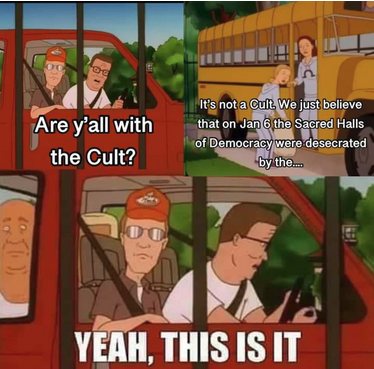
My online dictionary defines presentism as “uncritical adherence to present-day attitudes, especially the tendency to interpret past events in terms of modern values and concepts”. To my surprise, the 40-year-old dictionary on my shelf also contains this eyesore of a word and definition.
To be present, of course, is a generally considered a virtue. It can mean everything from giving ourselves to the job at hand — no one wants a surgeon dreaming of his upcoming vacation to St. Croix while he’s cracking open your chest — to consoling a grieving friend.
But presentism is altogether different. It’s a disease, a contagion here in America as infectious as the Wuhan flu. The latter spreads by way of a virus, the former through ignorance and puffed-up pride.
Presentism is what inspires the afflicted to tear down the statues of such Americans as Washington, Jefferson, and Robert E. Lee for owning slaves without ever once asking why this was so or seeking to discover what these men thought of slavery. Presentism is why the “Little House Books” and some of the early stories by Dr. Seuss are attacked or banned entirely.
Presentism is the reason so many young people can name the Kardashians but can’t tell you the importance of Abraham Lincoln or why we fought in World War II.
Presentism accounts in large measure for our Mount Everest of debt and inflation. Those overseeing our nation’s finances have refused to listen to warnings from the past, even the recent past, about the clear dangers of a government creating trillions of dollars out of the air.
Presentism has led America into overseas adventures that have invariably come to a bad end. Afghanistan, for example, has long been known as the graveyard of empires, a cemetery which includes the tombstones of British and Russian ambitions. By our refusal to heed the lessons of that history and our botched withdrawal from Kabul, we dug our own grave alongside them.
H/T to Kim du Toit for the link.
September 14, 2022
“Americans, particularly the kind of Very Serious people who make up our intelligentsia, are desperate for a good war”
Freddie deBoer thinks he’s sussed out the reason so many Americans are so very, very pro-Ukraine in the ongoing fighting between the Russian invaders and the Ukrainian defenders (beyond the normal desire to “root for the underdog”):

Approximate front-line positions just before the Ukrainian counter-attack east of Kharkiv in early September 2022.
It was not until I was an adult that I realized that the absurd fervor for Desert Storm was in fact about Vietnam. Fifteen years earlier, American helicopters had fled in humiliation from Saigon, and nothing had happened to take the sour taste out of the mouth of Americans since. There was plenty of power projection in that decade and a half, but no great good wars for the United States to win in grand and glorious fashion, unless you worked really hard to talk yourself into Grenada. America had been badly stung by losing a war to a vastly poorer and less technologically-advanced force. Americans had been nursing their wounds all those years. So when Saddam Hussein invaded Kuwait, and the “international community” rose to expel him, the country was ready. We were ready for another righteous combat of the Goodies vs. the Baddies. We were ready for the good guys to be the winners again.
This dynamic, I’m certain, is the source of American bloodlust over Ukraine.
We have now spent twenty years without good, noble wars against the Baddies ourselves. Afghanistan was a war effort undertaken in rage and terror, and was accordingly never intelligently conceptualized at the most basic level. The war aim of finding and capturing bin Laden and destroying Al Qaeda gave way to a war on the Taliban that ensured an endless occupation. The Potemkin government we installed was never popular with the people of the country, entailed comical levels of corruption, and showed no ability to train a loyal and effective Afghan army. After 20 years our country tired of spending hundreds of billions on that failure, we left, the government collapsed almost without resistance, and the Taliban are in power again. In Iraq, the basic arguments for the war (WMDs and a Hussein-al Qaeda connection) were swiftly revealed to be bullshit. Saddam’s army fell quickly and he was dispatched after a show trial, but a persistent insurgency inflicted thousands of American casualties. The chaos enabled the rise of ISIS and its various horrors. The new Iraqi government we’ve installed is impossibly corrupt and scores a 31/100 on Freedom House’s ratings of a country’s dedication to political rights and civil liberties. That’s what the United States has gotten for $8 trillion spent on warmaking since 9/11.
America loves a winner, and will not tolerate a loser. So I once heard. Americans, particularly the kind of Very Serious people who make up our intelligentsia, are desperate for a good war. A just war. A war where we win. They’re sick of wars that feel morally complicated, sick of wars that they have to feel queasy about, sick of wars that aren’t just Goodies and Baddies. They are very, very hungry for good war. I think Ukraine is the Desert Storm a lot of people have been waiting for: a war with (they insist) perfectly simplistic moral stakes, an impossibly noble (they assume) set of Goodies, a marauding and senseless (they demand) set of Baddies. All they’re waiting on is victory. And it’s for this reason, this view of war as one big cope, that the pro-Ukraine position is the single most rigidly enforced consensus in our country since 9/11. There is no other issue on which the majority has more vociferously demanded total consensus or more viciously attacked any who dissent or even ask questions. Because America needs a win. People need to believe in a Goodies and Baddies world again.
There are, of course, all manner of hard questions that we could ask, even if we were supportive of Ukraine in this war. That this is a conflict that has constantly inspired left-leaning people to literally say “well, yes, there’s Nazis, but …” might be seen as a matter of some concern. Perhaps, we might just say, isn’t that a little disturbing? But not in this discursive environment. Or we might consider that a total loss for Russia could be one of the most dangerous outcomes for the world even if you support Ukraine. What do you think happens, with a wounded and isolated Russia? Let’s say people get what they want and Putin is deposed. What do you think happens next? We finally get that shining city on a hill in Moscow that we were promised with the collapse of the Soviet Union? That we’ll get the world leader we expected Bagdhad to be in 2003, that a foreign country with foreign people and foreign concerns will suddenly become a docile member of the liberal-capitalist order? Maybe the best post-Putin outcome would be for a similar corrupt autocrat to take his place; at least then there might be stability. A far more likely and more frightening outcome is that leadership is splintered, you have in effect a set of rival warlords squabbling over the spoils, and the world’s largest nuclear arsenal is exposed in a terrifying way. Seems like something to worry about.
But, no. To a degree that genuinely shocks me, hard questions have been forbidden. Complications have been denied. Comparisons to previous conflicts have been forsaken. And this from Democrat and Republican, liberal and leftist, neocon and Never Trumper. It’s constant, everpresent, and relentless, the denial of any complication in the case of Ukraine and Russia. The glee and the gloating and the urge to ridicule anyone who takes even a single step outside of the consensus is remarkable, unlike anything I’ve ever really encountered before. And I find that I can’t even get people to have a conversation about that, a meta-conversation about why the debate on Ukraine is not a debate, about why there are many people who will consider any political position except one that troubles the moral question of Russia’s invasion, about why so many people who learned to speak with care and equivocation during Iraq now insist that there is no complication at hand with this issue at all. I can’t even get a conversation about the conversation going. People get too mad.
September 13, 2022
Society would be happier if we all paid even less attention to “the tossers of Tinsel Town”
Ian O’Doherty on the malign influence pretty people who mouth other people’s words for the cameras still exude in our popular culture:
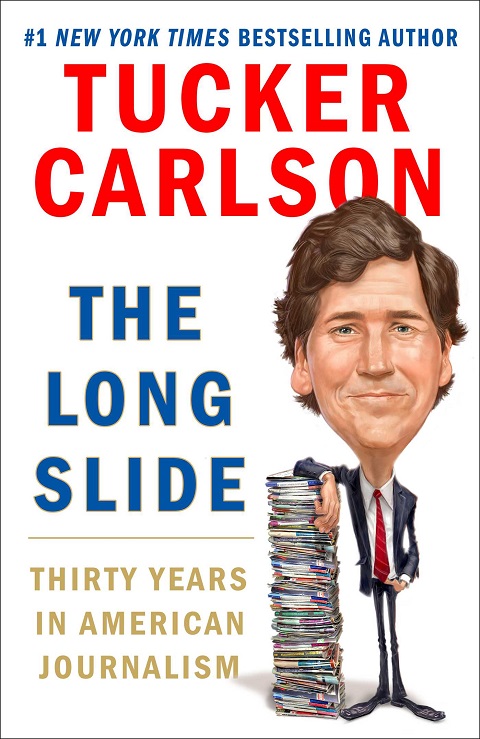
Tucker Carlson … the man from Jennifer Lawrence’s nightmares, apparently.
They never learn, do they? If the tumultuous events we have all watched with growing horror over the past few years taught us one thing, it is this – people don’t care what the pampered starlets of Hollywood have to say about politics. If we did, then Hillary Clinton would be comfortably enjoying her second term as the pantsuit POTUS, Jeremy Corbyn would be prime minister of the UK and we would all be driving electric cars.
But regular people are smarter than actors, which seems to drive the luvvies wild with fury. Rather than accepting that maybe, just maybe, there is another side to the argument, the tossers of Tinsel Town insist that anyone who doesn’t fully embrace the so-called progressive agenda is simply a monster.
We saw this recently when Jennifer Lawrence, who used to be quite refreshingly down to Earth, proudly admitted that she had to “work so hard … to forgive my dad and my family” for voting Republican. She also, quite wonderfully, spoke about having “recurring nightmares” about Fox News anchor Tucker Carlson.
In the course of her interview for the cover issue of Vogue magazine – that renowned bastion of proletarian agitation – the Hunger Games actress claimed that she was born a Kentucky Republican, was raised as a Kentucky Republican and had considered herself to be a Kentucky Republican, until she watched an episode of 30 Rock. And then her worldview completely changed.
Now most of us would agree that 30 Rock was a brilliant sitcom. After all, it was so ingenious in its construction that it even managed to make Alec Baldwin look likeable. But would anyone think that Liz Lemon’s line, “I’m not a crazy liberal – I just think people should drive hybrid cars”, would be enough to utterly transform someone’s political beliefs?
Apparently, this is what changed everything for Lawrence. She even seemed proud of the fact that a throwaway line in a sitcom triggered some sort of Damascene conversion to what is now so tediously known as “the right side of history”.
Predictably, following the Vogue interview, Lawrence was hailed as a modern-day Joan of Arc – for refusing to be “passive about politics”. But there is no real bravery involved in simply having the courage of other people’s convictions – she knows which way the political wind is blowing and is bending to it. That’s not all that brave, is it?
The Boise Pride Festival’s “Drag Kids on Stage”
I’m not sure I could accurately place Boise on a map, but the city’s relative obscurity doesn’t mean it can’t have a really progressive LGBT scene, including a special “Drag Kids” event planned for their Pride Festival:
Remember that California has just passed a new law, SB 1100, to protect local legislative bodies against “bullying” from people who do hateful things like disagreeing with them, and that the recent failure of another (spectacularly offensive) bill in the state legislature was the product of “harassment”, by which the author of the bill meant that the peasantry forcefully and persistently criticized it. And you should definitely read this two–part essay from Bat Cattitude on the technocratic presumption that disagreement with technocrats can only be dangerous extremism.
With that background in mind, consider a modest victory in the most dismal battlefield of the culture war, and then watch the response to it.
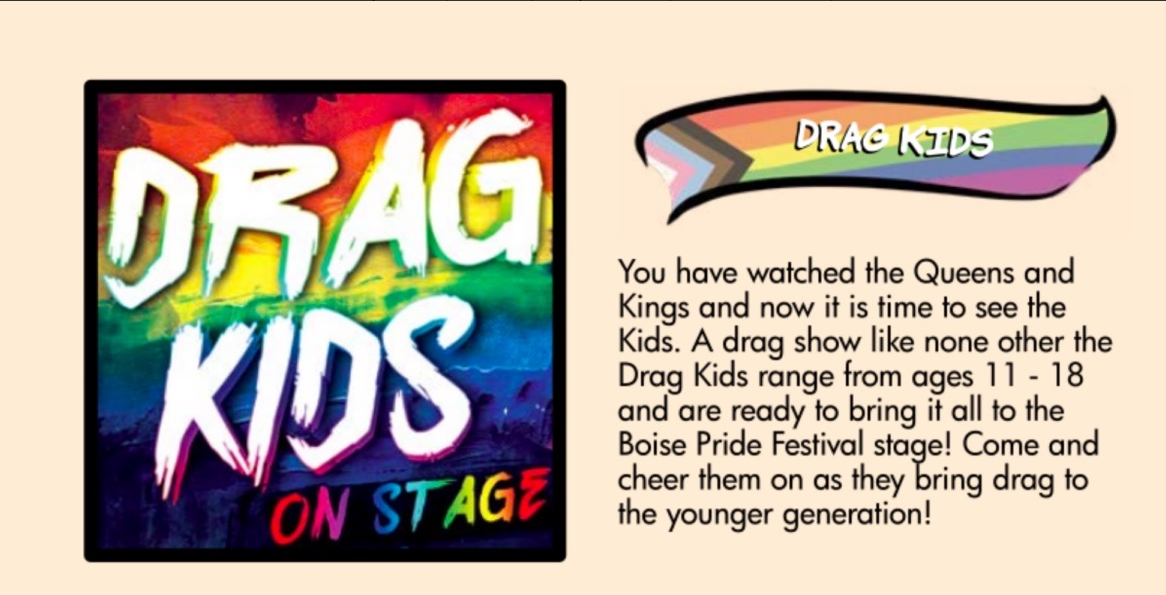
This one happens in Boise, a purple town in a red state. This year’s Boise Pride Festival was all set to feature an event called Drag Kids:
“Now it is time to see the kids”, sexy eleven year-olds shaking that dirty little moneymaker on the stage. So hot. So empowering!
[…]
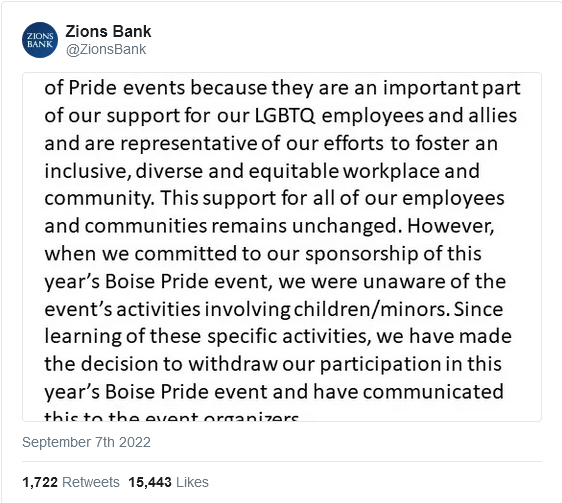
Now, the Big Pivot: Boise Pride pays its bills by soliciting the support of corporate sponsors, so a bunch of corporations suddenly found themselves sponsoring the sexuality-incorporating performances of some hot little eleven year-olds. They quickly began to jump clear of the thing:
Because bigotry still prevails in Amerikkka, see, corporations aren’t brave enough to stand up and support the sexy eleven year-olds in their extremely hot sexiness. Atavists! Prudes!
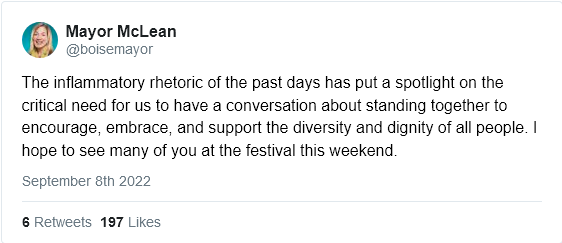
Now, here come the politicians. The mayor of Boise, Lauren McLean, is Very Disappointed In You All™:
Slogan slogan slogan, slogan slogan, slogan slogan slogan. A spotlight on the critical need for a conversation about standing together!
If you challenged Mayor NPC to publicly identify specific pieces of inflammatory rhetoric that were important and central to the controversy, she couldn’t; she just knows that the “inflammatory rhetoric” box has to be checked, because Mean Republicans objected to something involving an LGBT event, specifics not important. Nor could she explain how sexy children represent the dignity of all people, or respond coherently to a discussion about sexual commodification and the erasure of childhood. She has a list of slogans. She deploys them.
September 11, 2022
“Learning is something we humans do, while schooling is something done to us”
Kerry McDonald refutes the “learning loss” narrative we’ve been inundated with:

“Abandoned Schoolhouse and Wheat Field 3443 B” by jim.choate59 is licensed under CC BY-NC-ND 2.0


There are mounting concerns over profound learning loss due to prolonged school closures and remote learning. New data released last week by the US Department of Education reveal that fourth-grade reading and math scores dropped sharply over the past two years.
Fingers are waving regarding who is to blame, but the alleged “learning loss” now being exposed is more reflective of the nature of forced schooling rather than how children actually learn.
The current hullabaloo over pandemic learning loss mirrors the well-worn narrative regarding “summer slide”, in which children allegedly lose knowledge over summer vacation. In 2017, I wrote an article for Boston NPR stating that there’s no such thing as the summer slide.
Students may memorize and regurgitate information for a test or a teacher, but if it has no meaning for them, they quickly forget it. Come high school graduation, most of us forget most of what we supposedly learned in school.
In his New York Times opinion article this week, economist Bryan Caplan makes a related point: “I figure that most of the learning students lost in Zoom school is learning they would have lost by early adulthood even if schools had remained open. My claim is not that in the long run remote learning is almost as good as in-person learning. My claim is that in the long run in-person learning is almost as bad as remote learning.”
Learning and schooling are completely different. Learning is something we humans do, while schooling is something done to us. We need more learning and less schooling.
Yet, the solutions being proposed to deal with the identified learning loss over the past two years promise the opposite. Billions of dollars in federal COVID relief funds are being funneled into more schooling and school-like activities, including intensive tutoring, extended-day learning programs, longer school years, and more summer school. These efforts could raise test scores, as has been seen in Texas where students receive 30 hours of tutoring in each subject area in which they have failed a test, but do they really reflect true learning?
As we know from research on unschoolers and others who learn in self-directed education settings, non-coercive, interest-driven learning tends to be deep and authentic. When learning is individually-initiated and unforced, it is not a chore. It is absorbed and retained with enthusiasm because it is tied to personal passions and goals.
The Allies’ Latest Victory – WW2 – 211 – September 10, 1943
World War Two
Published 10 Sep 2022Dwight Eisenhower publicly announces the secret armistice signed last week, and Italy is now officially out of the war. The Italian fleet sails for Malta and Allied captivity. The Allies have landed in force in Southern Italy and they do face some heavy opposition from German forces — who have no intention of giving up Italy. In the USSR, though, the Soviets continue liberating territory all over Ukraine as they force the Germans back to the Dnieper River.
(more…)
Are we looking at a modern equivalent to the Bronze Age Collapse?
If you’re feeling happy and optimistic, Theophilus Chilton has a bucket of cold water to douse you with:

Migrations, invasions and destructions during the end of the Bronze Age (c. 1200 BC), based on public domain information from DEMIS Mapserver.
Map by Alexikoua via Wikimedia Commons.
Regular readers know that I’ve talked about collapse (as well as the implied regeneration that follows it) on here a lot. In nearly all cases, though, I’ve discussed it within a specifically American context – the collapse of the present American system and the potential for one or more post-American successor states arising in place of the present globohomo order. However, we should recognise that collapse is a general phenomenon that affects any and all large nations eventually. Just as America is not a special snowflake who is exempt from the laws of demographic-structural theory, so also is she not the only one subject to them.
Further in this vein, we should recognise that no major nation is isolated from its neighbours. No matter how self-sufficient, sooner or later everybody gets hooked up into trade networks. As trade networks expand, you develop world systems that display increased international interconnectedness and interdependency. From a demographic-structural perspective, the interconnectedness of these global systems acts to “synch up” the secular cycles of the nations involved as “information flows” increase. The upside to this is that when one part of the system prospers, everyone does. The downside, of course, is that when one part collapses, everyone does as well.
There are several historical examples of this kind of interconnected system synching up and then collapsing. Probably one of the most well-known examples would be the Bronze Age collapse which occurred in the Mediterranean world system roughly between 1225-1150 BC. Likely due to several shocks to the system working in tandem (drought, volcanic eruptions, migrations into the Balkans from the north, etc.), a series of invasions of the Sea Peoples spread out across the entire eastern end of the Mediterranean, toppling Mycenaean Greece and the Hittite Empire, and nearly did the same to Egypt. From there, the shocks moved outward throughout the rest of Anatolia and Syro-Palestine and eastward into Mesopotamia, disrupting the entire interconnected trade network. The system was apparently already primed to be toppled by these jolts, however, due to the top-heavy political structures (elite overproduction) and overspecialisation in these empires that contributed to their fragility in the face of system shocks. When the first one fell, the effects spread out like dominoes falling in a row.
There is evidence that this collapse extended beyond the Mediterranean basin and disrupted the civilisation existing in the Nordic Bronze Age around the Baltic Sea. Right around the same time that Bronze Age Mediterranean society was collapsing, serious changes to society in the Baltic basin were also taking place, primarily due to the disruption of trade routes that connected the two regions, with amber flowing south and metals and prestige goods returning north. During this period, the population in the area transitioned from a society organised primarily around scattered villages and farms into one that became more heavily militarised and centred around fortified towns, indicating that there was a change in the region’s elite organisation, or at least a strong modification of it (remember that collapse phases are characterised by struggles between competing elite groups). A large battle that dates to this era has been archaeologically uncovered in the Tollense Valley of northeastern Germany which is thought to have involved over 5000 combatants — a huge number for this area at this time, indicating more centralised state-like organisational capacities than were previously thought to have existed in the region. All in all, the evidence seems to suggest that this culture underwent some type of collapse phase at this time, likely in tandem with that occurring further south.
Other times and places have also seen such world system collapses take place. for instance, when the western Roman Empire was falling in the 3rd-5th centuries AD, the entire Mediterranean basis (again) underwent a systemwide socioeconomic collapse and decentralisation. More recently, the entire Eurasian trade system, from England to China, underwent a synchronised collapse phase in the early 17th century AD that saw revolutions, elite conflict, decentralisation, and social simplification take place across the length of the continent.
The great irony of interconnectedness is that too much of it actually works to reduce resilience within a system. Because an intensively globalised world system entails a lot of specialisation as different parts begin to focus on the production of different commodities needed within the network, this makes each part of the system more dependent upon the others. This works to reduce the resiliency of each of these individual parts, and the greater interconnectedness allows failure in one part to be communicated more widely and rapidly to other parts than might otherwise be the case in less interconnected systems.
QotD: De-institutionalization
Deinstitutionalization began slowly at first, in the 1950s, but the pace accelerated around 1970, despite signs that all was not going according to plan. On the ground, psychiatrists noticed earlier than anyone else that the most obvious question — where are these people going to go when they leave the mental institutions? — had no clear answers. Whatever misgivings psychiatrists voiced over the system’s abandonment of the mentally ill to streets, slums, and jails was too little and too late.
That modern psychiatry is mostly practiced outside of mental institutions is not its only difference from premodern psychiatry. Scull devotes extensive coverage to two equally decisive developments: the rise and fall of Freudianism, and psychopharmacology.
The Freudians normalized therapy in America and provided crucial intellectual support for the idea that mental health care is for everyone, not just the deranged. Around the same time as deinstitutionalization, Freud’s reputation, especially in elite circles, was on a level with Newton and Copernicus. Since then, Freudianism has mostly gone the way of phlogiston and leeches. That happened not just because people decided the psychoanalysts’ approach to therapy didn’t work but also because insurance wouldn’t pay for it. Insurance would, however, pay for modes of therapy that were less open-ended than the “reconstruction of personality that psychoanalysis proclaimed as its mission”, more targeted to a specific psychological symptom, and, most crucially of all, performed by non-M.D.s. Therapy was on the rise, but psychiatrists found themselves doing less and less of it.
As psychiatry cast aside Freudian concepts such as the “refrigerator mother”, which rooted mental illness in psychodynamic tensions, it increasingly trained its focus on biology. Drugs contributed to, and gained a boost from, this reorientation. Scull loathes the drug industry and only grudgingly allows that it has made improvements in the lives of mentally ill Americans. He divides up the vast American drug-taking public into three groups: those for whom they work, those for whom they don’t work, and those for whom they may work, but not enough to counter the unpleasant side effects. He argues that the last two groups are insupportably large.
Stephen Eide, “Soul Doctors”, City Journal, 2022-05-18.
September 10, 2022
In a stormy and uncertain world, at least the New York Times remains consistent
Ed West on hearing the news that the Queen had died:
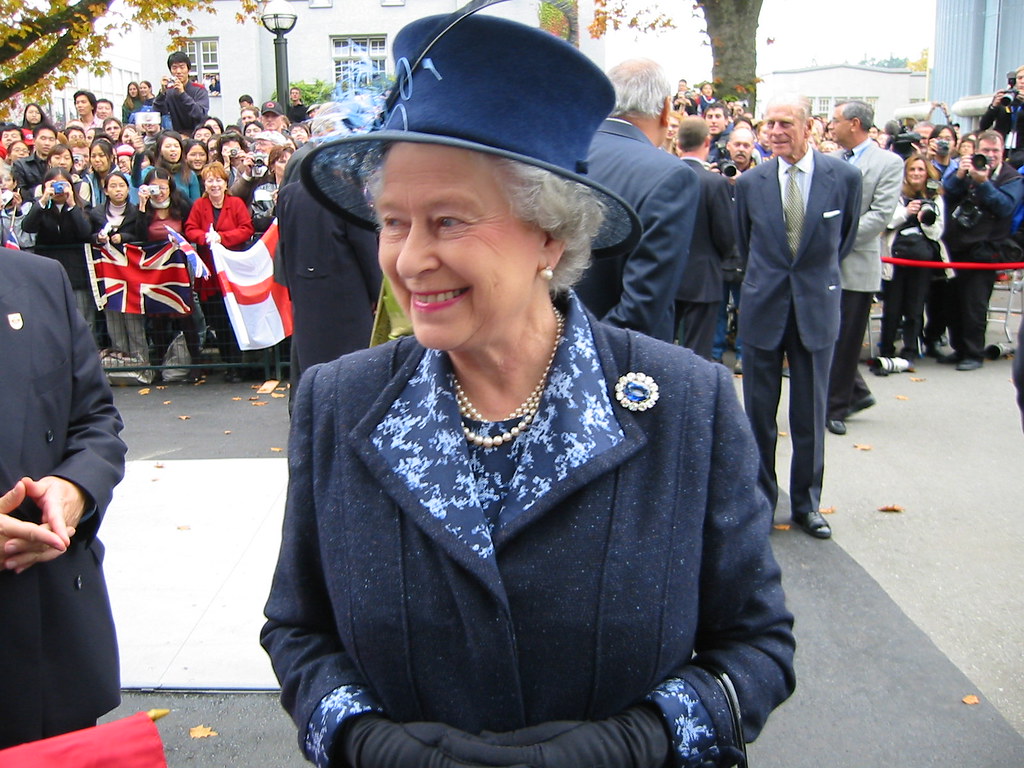
“Her Majesty Queen Elizabeth II” by Tinker Sailor Soldier Spy is licensed under CC BY-NC-ND 2.0 
 .
.
Unusually for me, being a cold-blooded Englishman whose emotional range is somewhere between Peter Cushing in Star Wars and Tywin Lannister, I found myself crying over the news yesterday evening. I cry more as I get older – presumably it’s all the testosterone draining away – and I shed tears for the Queen.
Her Majesty’s death was announced around 6.30 GMT. Soon after 9pm the New York Times pops up on Twitter, in its usual sanctimonious, scolding told, telling us that “We should not romanticize her era”, because, according to a Harvard professor “The queen helped obscure a bloody history of decolonization whose proportions and legacies have yet to be adequately acknowledged.”
Our Queen has died, a deeply-loved, politically-neutral figure who many saw as being like another grandmother. She was someone we all knew throughout our lives, who felt like a protective figure, associated with the political stability that our island has enjoyed for so long.
Yet for some inexplicable reason, the voice of America’s progressive establishment thought it appropriate to immediately publish this article, with the headline “Mourn the Queen, Not Her Empire”, something literally no one even considered or thought about. The British Empire may be long dead but it lives on, timeless and immortal, in the minds of New York Times editors.
Much has been written about the changing social mores of the Queen’s reign, but I think it’s still generally accepted that you wait until a person is buried before launching criticisms of their legacy; at the very least a couple of days. Yet while even the Kremlin managed to send some kind words on Queen Elizabeth’s passing, the New York Times went straight in with the yes-she-will-be-mourned-but.
As head of the Commonwealth, the Queen “put a stolid traditionalist front over decades of violent upheaval. As such, the queen helped obscure a bloody history of decolonization whose proportions and legacies have yet to be adequately acknowledged.”
“We may never learn what the queen did or didn’t know about the crimes committed in her name,” the historian concludes, but “xenophobia and racism have been rising, fueled by the toxic politics of Brexit. Picking up on a longstanding investment in the Commonwealth among Euroskeptics (both left and right) as a British-led alternative to European integration, Mr. Johnson’s government (with the now-Prime Minister Liz Truss as its foreign secretary) leaned into a vision of ‘Global Britain’ steeped in half-truths and imperial nostalgia.”
Andrew Sullivan found himself similarly moved at the news (after a bit of mandatory Trump-bashing to start the column):
[In the 2016 TV show The Crown] I found myself watching the life of an entirely different head of state: a young, somewhat shy woman suddenly elevated to immense responsibilities and duties in her twenties, hemmed in by protocol, rigidified by discipline. The new president could barely get through the day without some provocation, insult, threat or lie. Elizabeth Windsor was tasked as a twenty-something with a job that required her to say or do nothing that could be misconstrued, controversial, or even interestingly human — for the rest of her life.
The immense difficulty of this is proven by the failure of almost every other member of her family — including her husband — to pull it off. We know her son King Charles III’s views on a host of different subjects, many admirable, some cringe-inducing. We know so much of the psychological struggles of Diana; the reactionary outbursts of Philip; the trauma of Harry; the depravity of Andrew; the agonies of Margaret. We still know nothing like that about the Queen. Because whatever else her life was about, it was not about her.
Part of the hard-to-explain grief I feel today is related to how staggeringly rare that level of self-restraint is today. Narcissism is everywhere. Every feeling we have is bound to be expressed. Self-revelation, transparency, authenticity — these are our values. The idea that we are firstly humans with duties to others that will require and demand the suppression of our own needs and feelings seems archaic. Elizabeth kept it alive simply by example.
With her death, it’s hard not to fear that so much she exemplified — restraint, duty, grace, reticence, persistence — are disappearing from the world. As long as she was there, they were at the center of an idea of Britishness that helped define the culture at its best. Perhaps the most famous woman in the world, she remained a sphinx, hard to decipher, impossible to label. She was not particularly beautiful or dashing or inspiring. She said nothing surprising. She was simply the Queen. She showed up. She got on with it. She was there. She was always there.
Whatever else happened to the other royals, she stayed the same. And whatever else happened in Britain — from the end of Empire to Brexit — she stayed the same. This is an achievement of nearly inhuman proportions, requiring discipline beyond most mortals. Think of a year, 1992, in which one son, Andrew, divorced, a daughter-in-law, Sarah Ferguson was seen cavorting nude in the tabloids, a daughter, Anne, separated, another son’s famously failed marriage, Charles’, dominated the headlines, and your house burns down. Here is how Her Majesty “vented”:
1992 is not a year on which I shall look back with undiluted pleasure. In the words of one of my more sympathetic correspondents, it has turned out to be an “Annus Horribilis“.
Dry, understated, with the only vivid phrase ascribed to a correspondent. Flawless.
She was an icon, but not an idol. An idol requires the vivid expression of virtues, personality, style. Diana was an idol — fusing a compelling and vulnerable temperament with Hollywood glamor. And Diana, of course, was in her time loved far more intensely than her mother-in-law; connected emotionally with ordinary people like a rockstar; only eventually to face the longterm consequences of that exposure and crumble under the murderous spotlight of it all.
Elizabeth never rode those tides of acclaim or celebrity. She never pressed the easy buttons of conventional popularity. She didn’t even become known for her caustic wit like the Queen Mother, or her compulsively social sorties like Margaret. The gays of Britain could turn both of these queens into camp divas. But not her. In private as in public, she had the kind of integrity no one can mock successfully.
Magical Monetary Theory (MMT) – You’re soaking in it
At the Foundation for Economic Education, Kellen McGovern Jones outlines the rapid rise of MMT as “the answer to everyone’s problems” in the last few years and all the predictable problems it has sown in its wake:

“Inflation & Gold” by Paolo Camera is licensed under CC BY 2.0 .
Modern Monetary Theory (MMT) was the “Mumble Rap” of politics and economics in the late 2010s. The theory was incoherent, unsubstantial, and — before the pandemic, you could not avoid it if you wanted to.
People across the country celebrated MMT. Alexandria Ocasio-Cortez, the Democrat Congresswoman from New York heralded MMT by proclaiming it “absolutely [must be] … a larger part of our conversation [on government spending].” The New York Times and other old-guard news sources authored countless articles raising the profile of MMT, while universities scrambled to hold guest lectures with prominent MMT economists like Dr. L. Randall Wray. Senator Bernie Sanders went as far as to hire MMT economists to his economic advisory team.
The most fundamental principle of MMT is that our government does not have to watch its wallet like everyday Joes. MMT contends that the government can spend as much as it wants on various projects because it can always print more money to pay for its agenda.
Soon after MMT became fashionable in the media, the once dissident economic theory leapt from being the obscure fascination of tweedy professors smoking pipes in universities to the seemingly deliberate policy of the United States government. When the Pandemic Hit, many argued that MMT was the solution to the pandemics problems. Books like The Deficit Myth by Dr. Stephanie Kelton became New York Times bestsellers, and the United States embarked on a massive spending spree without raising taxes or interest rates.
Attempting to stop the spread of Covid, state and federal governments coordinated to shut down nearly every business in the United States. Then, following the model of MMT, the federal government decided to spend, and spend, and spend, to combat the shutdown it had just imposed. Both Republican and Democrat-controlled administrations and congresses enacted trillions of dollars in Covid spending.
It is not hard to see that this spray and pray mentality of shooting bundles of cash into the economy and hoping it does not have any negative consequences was ripe for massive inflation from the beginning. Despite what MMT proponents may want you to believe, there is no way to abolish the laws of supply and demand. When there is a lot of something, it is less valuable. Massively increasing the supply of money in the economy will decrease the value of said money.
MMT economists seemed woefully unaware of this reality prior to the pandemic. Lecturing at Stoney Brook University, Kelton attempted to soothe worries about inflation by explaining that (in the modern economy) the government simply instructs banks to increase the number of dollars in someone’s bank account rather than physically printing the US Dollar and putting it into circulation. Somehow — through means that were never entirely clear — this fact was supposed to make people feel better.
In reality, there is no difference between changing the number in someone’s bank account or printing money. In both cases, the result is the same, the supply of money has increased. Evidence of MMTs inflationary effects are now everywhere.


