
I’m in the process of editing a document for a technical project that is intended to be an introduction for newbies to certain fairly complex issues. While requesting feedback on the project mailing list, I realized that I had accidentally revealed a major secret of really top-grade writing, exactly the sort of thing that put The Cathedral and the Bazaar on the New York Times best-seller list.
I see no reason not to share it with my readers. So here is the relevant part of my request for feedback:
Please fix typos and outright grammatical errors. If you think you have spotted a higher-level usage problem or awkwardness, check with me before changing it. What you think is technically erroneous may be expressive voice.
Explanation: Style is the contrast between expectation and surprise. Poets writing metric poetry learn to introduce small breaks in scansion in order to induce tension-and-release cycles at a higher level that will hold the reader’s interest. The corresponding prose trick is to bend usage rules or change the register of the writing slightly away from what the reader unconsciously expects. If you try to “fix” these you will probably be stepping on an intended effect. So check first.
(I will also observe that unless you are already an unusually skilled writer, you should not try to replicate this technique; the risk of sounding affected or just teeth-jarringly bad is high. As Penn & Teller puts it, “These stunts are being performed by trained, professional idiots.”)
Eric S. Raymond, “A major secret of effective writing”, Armed and Dangerous, 2011-02-05.
December 9, 2023
QotD: A secret of effective writing
December 8, 2023
QotD: Prices as information
Let’s all take another huge toke and return to our Libertarian paradise, where all conceivable information is both completely accurate and totally free to circulate. And since we’re now all so very, very mellow, let’s give Karl Marx due credit. One of his main gripes with “capitalism” is that it “commodifies” everything. Everything has its price under “capitalism”, Marx said, even stuff that shouldn’t – human life, human dignity. Since this is a college classroom and I’m the prof, I can assign some homework. Go google up “kid killed over sneakers”. You can always find stories like that. Put your natural, in-many-ways-admirable young person’s urge to rationalize aside, and simply consider the information. What were those Air Jordans really worth, based on the stuff we’ve learned today?
See what I mean? Marx had a point. What are those sneakers worth, considered from the standpoint of “demand”? Obviously more than whatever a human life is worth, considered from the same standpoint. Hence Marxism’s enduring appeal to young people whose hearts are in the right place. “Commodificiation”, or “reification” as he sometimes called it, is very real, and very nasty …
Severian, “Velocity of Information (I)”, Founding Questions, 2020-12-26.
December 7, 2023
QotD: Displacing the “little platoons”
Janice Rogers Brown, “A Whiter Shade of Pale”, a speech to the Federalist Society, 2000-04-11.
December 6, 2023
QotD: What Charles VIII brought back from his Naples vacation
There was still a long “shaking out” period for the new technology: figuring out how to get enough saltpeter for gunpowder (now that’s a story we’ll come back to some day), how to build a large enough and strong enough metal barrel, and how to actually use the weapons (in sieges? against infantry? big guns? little guns?) and so on. By 1453, the Ottomans have a capable siege-train of gunpowder artillery. Mehmed II (r. 1444-1481) pummeled the walls of Constantinople with some 5,000 shots using some 55,000 pounds of gunpowder; at last Theodosius’ engineers had met their match.
And then, in 1494, Charles VIII invaded Italy – in a dispute over the throne of Naples – with the first proper mobile siege train in Christendom (not in Europe, mind you, because Mehmed had beat our boy Chuck here by a solid four decades). A lot of changes had been happening to make these guns more effective: longer barrels allowed for more power and accuracy, wheeled carriages made them more mobile, trunnions made elevation control easier and some limited degree of caliber standardization reduced windage and simplified supply (though standardization at this point remains quite limited).
The various Italian states, exactly none of whom were excited to see Charles attempting to claim the Kingdom of Naples, could have figured that the many castles and fortified cities of northern Italy were likely to slow Charles down, giving them plenty of time to finish up their own holidays before this obnoxious French tourist showed up. On the 19th of October, 1494, Charles showed up to besiege the fortress at Mordano – a fortress which might well have been expected to hold him up for weeks or even months; on October 20th, 1494, Charles sacked Mordano and massacred the inhabitants, after having blasted a breach with his guns. Florence promptly surrendered and Charles marched to Naples, taking it in 1495 (it surrendered too). Francesco Guicciardini phrased it thusly (trans. via Lee, Waging War, 228),
They [Charles’ artillery] were planted against the Walls of a Town with such speed, the Space between the Shots was so little, and the Balls flew so quick, and were impelled with such Force, that as much Execution was done in a few Hours, as formerly, in Italy, in the like Number of Days.
The impacts of the sudden apparent obsolescence of European castles were considerable. The period from 1450 to 1550 sees a remarkable degree of state-consolidation in Europe (broadly construed) castles, and the power they gave the local nobility to resist the crown, had been one of the drivers of European fragmentation, though we should be careful not to overstate the gunpowder impact here: there are other reasons for a burst of state consolidation at this juncture. Of course that creates a run-away effect of its own, as states that consolidate have the resources to employ larger and more effective siege trains.
Now this strong reaction doesn’t happen everywhere or really anywhere outside of Europe. Part of that has to do with the way that castles were built. Because castles were designed to resist escalade, the walls needed to be built as high as possible, since that was the best way to resist attacks by ladders or towers. But of course, given a fixed amount of building resources, building high also means building thin (and European masonry techniques enabled tall-and-thin construction with walls essentially being constructed with a thick layer of fill material sandwiched between courses of stone). But “tall and thin”, while good against ladders, was a huge liability against cannon.
By contrast, city walls in China were often constructed using a rammed earth core. In essence, earth was piled up in courses and packed very tightly, and then sheathed in stone. This was a labor-intensive building style (but large cities and lots of state capacity meant that labor was available), and it meant the walls had to be made thick in order to be made tall since even rammed earth can only be piled up at an angle substantially less than vertical. But against cannon, the result was walls which were already massively thick, impossible to topple over and the earth-fill, unlike European stone-fill, could absorb some of the energy of the impact without cracking or shattering. Even if the stone shell was broken, the earth wouldn’t tumble out (because it was rammed), but would instead self-seal small gaps. And no attacker could hope that a few lucky hits to the base of a wall built like this would cause it to topple over, given how wide it is at the base. Consequently, European castle walls were vulnerable to cannon in a way that contemporary walls in many other places, such as China, were not. Again, path dependence in fortification matters, because of that antagonistic co-evolution.
In the event, in Italy, Charles’ Italian Vacation started to go badly almost immediately after Naples was taken. A united front against him, the League of Venice, formed in 1495 and fought Charles to a bloody draw at Fornovo in July, 1495. In the long-term, French involvement would draw in the Habsburgs, whose involvement would prevent the French from making permanent gains in a series of wars in Italy lasting well into the 1550s.
But more relevant for our topic was the tremendous shock of that first campaign and the sudden failure of defenses which had long been considered strong. The reader can, I’d argue, detect the continued light tremors of that shock as late as Machiavelli’s The Prince (1532, but perhaps written in some form by 1513). Meanwhile, Italian fortress designers were already at work retrofitting old castles and fortifications (and building new ones) to more effectively resist artillery. Their secret weapon? Geometry.
Bret Devereaux, “Collections: Fortification, Part IV: French Guns and Italian Lines”, A Collection of Unmitigated Pedantry, 2021-12-17.
December 5, 2023
QotD: British meals – the midday meal
The richer classes have their midday meal at one-thirty in the afternoon and call it “luncheon”. At about half-past four in the afternoon they have a cup of tea and perhaps a piece of bread-and-butter or a slice of cake, which they call “afternoon tea” and they have their evening meal at half-past seven or eight, and call it “dinner”. The others, perhaps ninety percent of the population, have their midday meal somewhat earlier – usually about half-past twelve – and call it “dinner”. They have their main evening meal at about half-past six and call it “tea” and before going to bed they have a light snack – for instance cocoa and bread-and-jam – which they call “supper”. The distinction is regional as well as social. In the North of England, Scotland and Ireland many well-to-do people prefer to follow the working-class time scheme, partly because it fits in better with the working day, and partly, perhaps, from motives of conservation: for our ancestors of a century ago also had their meals at approximately these hours.
But though the name and the hour may differ, every British person’s idea of midday meal is approximately the same. We are not here concerned with the quasi-French meals that are served in hotels, but solely with British cookery, and therefore we can leave both soups and hors d’oeuvres out of account. Most British people are inclined to despise both, and do not care for them in the middle of the day. British soups are seldom good, and there is hardly a single one that is peculiar to the British Isles, while even the word “hors d’oeuvre” has no equivalent in the British language. The British midday meal consists essentially of meat, preferably roast meat, a heavy pudding, and cheese. And here one comes upon the central institution of British life, the “joint”: that is, a large piece of meat – round of beef or leg of pork or mutton – roasted whole with its potatoes round it, and preserving a flavour and a juiciness which meat cooked in smaller quantities never seems to attain.
Most characteristic of all is roast beef, and of all the cuts of beef, the sirloin is the best. It is always roasted lightly enough to be red in the middle: pork and mutton are roasted more thoroughly. Beef is carved in wafer-thin slices, mutton in thick slices. With beef there nearly always goes Yorkshire pudding, which is a sort of crisp pancake made of milk, flour and eggs and which is delicious when sodden with gravy. In some parts of the country suet pudding is eaten with roast beef instead of Yorkshire pudding. Sometimes instead of roasted fresh beef there is boiled salt beef, which is always eaten with suet dumplings and carrots or turnips.
[…]
In the second half of the midday meal we come upon one of the greatest glories of British cookery – its puddings. The number of these is so enormous that it would be impossible to give an exhaustive list, but, putting aside stewed fruits, British puddings can be classified under three main heads: suet puddings, pies and tarts, and milk puddings.
[…]
If the midday meal ends with cheese, that cheese will probably be foreign. Some of the cheeses native to Britain are very good, but they are not produced in large quantities and are mostly consumed locally. The best of them is Stilton, a cheese rather the same kind as Roquefort or Gorgonzola, but stronger-tasting and closer in the grain. Wensleydale, a similar but milder cheese, is also very good.
George Orwell, “British Cookery”, 1946. (Originally commissioned by the British Council, but refused by them and later published in abbreviated form.)
December 4, 2023
QotD: The “ivory gulag”
So, too, with their mentalities. I spent many years toiling in the groves of academe, so obviously my social life (such as it was) contained a lot of post-menopausal lesbians. No creature is more solipsistic than this. Whatever maternal instincts she once might’ve had, have curdled into general naggy truculence, and since they have all the money and free time in the world in which to indulge their narcissism, if they can’t find any actual wrongthink around they’ll simply invent some. Before the Deplorables were driven to organize themselves for gaudy, suicidal, IRA-style violence, post-Oranzhevvy Trashcanistan felt, I imagine, a lot like a college campus …
… which the few people with normal serum hormone levels who were stuck there often called “the ivory gulag”. Make of that what you will.
Severian, “Hormones, or Lack Thereof”, Founding Questions, 2021-01-20.
December 3, 2023
QotD: Intersectionality and the “American experiment”
Today’s identity politics has another interesting feature: it teaches students to think in a way antithetical to what a liberal arts education should do. When I was at Yale in the 1980s, I was given so many tools for understanding the world. By the time I graduated, I could think about things as a Utilitarian or a Kantian, as a Freudian or a behaviorist, as a computer scientist or a humanist. I was given many lenses to apply to any one situation. But nowadays, students who major in departments that prioritize social justice over the disinterested pursuit of truth are given just one lens — power — and told to apply it to all situations. Everything is about power. Every situation is to be analyzed in terms of the bad people acting to preserve their power and privilege over the good people. This is not an education. This is induction into a cult, a fundamentalist religion, a paranoid worldview that separates people from each other and sends them down the road to alienation, anxiety, and intellectual impotence.
Jonathan Haidt, “The Age of Outrage: What the current political climate is doing to our country and our universities”, City Journal, 2017-12-17.
December 2, 2023
QotD: Western media and Putin’s war
Regarding [Vladimir Putin’s] Magical Mystery War, I’m going with the stoyak that the casualty counts peddled by the [western media] is part of a very very old playbook which various Western observers have peddled since 1905-that of Russian stupidity and indifference to casualties. Russia loses a war? They’re stupid gopniks who flung their soldiers into meat grinders until they rebelled (1905 or 1917). Russia wins a war? They’re stupid gopniks who flung their soldiers into meat grinders until they won (1945, 2023). Note that you can effortlessly pivot your propaganda when it becomes obvious in hindsight the outcome of the war. This becomes very important when [Putin] negotiates his 18th century kabiniettskreig ending to the war, since nobody in the West, especially AINO, understands how a cabinet war is fought, much less ends. They will claim that they foiled Putin’s plan for conquering all Ukraine (which he never has wanted) by killing hundreds of thousands of poor, oppressed, stupid, vodka-fueled gopniks used as cannon fodder who simply overwhelmed the valiant forces of good by sheer numbers. Not by superior strategy or tactics, or weapons, but the good ol’ Russian sledgehammer. Just like Hitler’s excuse in 1945, when Ivan was knock knock knockin’ on his bunker door. His generals who survived carried that piece of gospel West when the US Army started studying how to fight the Reds and asked the Germans how they did it. Their answer was happily embraced by the next generation of Very Clever Boys in the 1960s and carried forward to today’s Fistagon — Wunderwaffen.
Pickle Rick, commenting on “Friday Mailbag”, Founding Questions, 2023-12-01.
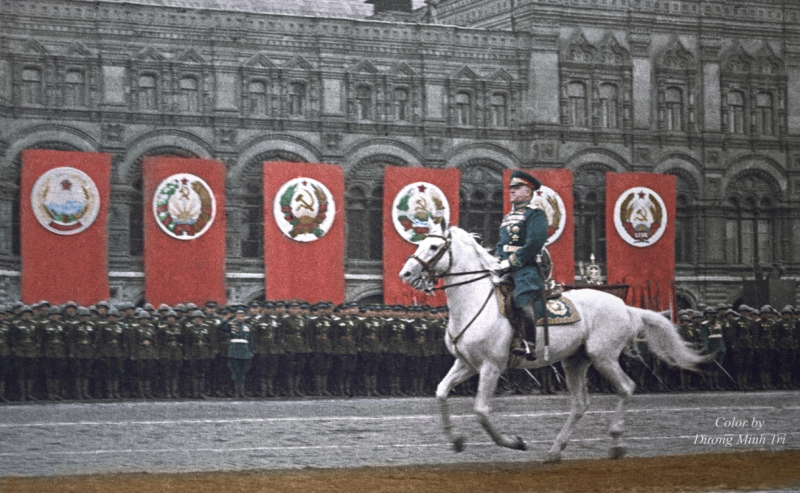
Rick agreed to me posting this quote as long as I included this colourized photo of Marshal of the Soviet Union Georgy Zhukov (“because it’s gangsta as FUCK”)
December 1, 2023
QotD: The OODA loop
OODA theory is worth reading about in more depth for anyone interested in … well, any kind of competitive dynamics, actually – military, commercial, individual, anything. The Wikipedia article is a good start. Stripped to its essentials, the theory is that competing entities have to go through repeated iterations of observing conditions, relating observation to a generative theory, deciding what option to pursue, and acting. Victory tends to go to the competitor who can run this cycle the fastest.
OODA theory was originally generalized from the observation that in fighter design, maneuverability (especially a shorter turning radius) beats straight-line speed. When you get inside your opponent’s OODA loop, either physically or conceptually, you can attack him from unexpected angles. You can be where he isn’t. You have the initiative; he is reduced to reacting, often with too little and too late.
Eric S. Raymond, “The Smartphone Wars: Tightening the OODA Loop”, Armed and Dangerous, 2011-02-18.
November 30, 2023
QotD: “Information velocity” in the English Civil War
Some of the battles of the Wars of the Roses were bigger than some of the Civil War’s battles – an estimated 50,000 men fought at Towton, in 1461 – but the Civil War was inconceivably harder and nastier than the Wars of the Roses, because the Civil War was an ideological war. The Wars of the Roses could’ve ended, at least theoretically, at any time – get the king and five dukes in a room, hammer out a compromise, and simply order everyone in each lord’s affinity to lay down his weapons. The Civil War could only end when everyone, in every army, was persuaded to lay down his arms.
Thus the winners had to negotiate with the people, directly. The Putney Debates didn’t involve everyone in the realm, but they were representative, truly representative, of everyone who mattered. Though no one explicitly made an appeal to competence alone, it was – and is, and must be – fundamental to representative government. Guys like Gerrard Winstanley had some interesting ideas, but they were fundamentally impractical, and Winstanley was not popularly viewed as a competent leader. Oliver Cromwell, on the other hand, was competence personified – the Protectorate became Cromwell’s military dictatorship largely because the People, as literally represented by the New Model Army, wanted it so … and, thanks to much faster information velocity, could make their wishes known.
Severian, “Inertia and Incompetence”, Founding Questions, 2020-12-25.
November 29, 2023
QotD: The children of the revolution
As soon as you saw people as things to be measured, they didn’t measure up. What would run through the streets soon enough wouldn’t be a revolution or a riot. It’d be people who were frightened and panicking. It was what happened when the machinery of city life faltered, the wheels stopped turning, and all the little rules broke down. And when that happened, humans were worse than sheep. Sheep just ran; they didn’t try to bite the sheep next to them.
Terry Pratchett, Night Watch, 2002.
November 28, 2023
QotD: The tactical problem of attacking WW1 trenches
[…]
So, the first problem: artillery. Neither side starts the war in trenches. Rather the war starts with large armies, consisting mostly of infantry with rifles, backed up by smaller amounts of cavalry for scouting duties (who typically fight dismounted because this is 1914, not 1814) and substantial amounts of artillery, mostly smaller caliber direct-fire1 guns, maneuvering in the open, trying to do fancy things like flanking and enveloping attacks to win by movement rather than by brute attrition (though it is worth noting that this war of maneuver is also the period of the highest casualties on a per-day basis). The tremendous lethality of those weapons – both rifles that are accurate for hundreds of yards, machine guns that can deny entire areas of the battlefield to infantry and the artillery, which is utterly murderous against any infantry it can see and by far the most lethal part of the equation – all of that demands trenches. Trenches shield the infantry from all of that firepower. So you end up with parallel trenches, typically a few hundred yards apart as the armies settle in to defenses and maneuver breaks down (because the armies are large enough to occupy the entire front from the Alps to the Sea).
The new problem this creates, from the perspective of the defender, is how to defend these trenches. If enemies actually get close to them, they are very vulnerable because the soldier at the top of the trench has a huge advantage against enemies in the trench: he can fire down more easily, can throw grenades down very easily and also has an enormous mechanical advantage if the fight comes to bayonets and trench-knives, which it might. If you end up fighting at the lip of your trench against massed enemy infantry, you have almost certainly already lost. The defensive solution here, of course, are those machine guns which can deploy enough fire to prohibit enemies moving over no man’s land: put a bunch of those in strong-points in your trench line and you can prevent enemy infantry from reaching you.
Now the attacker has the problem: how to prevent the machine guns from making approach impossible. The popular conception here is that WWI generals didn’t “figure out” machine guns for a long time; that’s not quite true. By the end of 1914, most everyone seems to have recognized that attacking into machine guns without some way of shutting them down was futile. But generals who had done their studies already had the ready solution: the way to beat infantry defenses was with artillery and had been for centuries. Light, smaller, direct-fire guns wouldn’t work2 but heavy, indirect-fire howitzers could! Now landing a shell directly in a trench was hard and trenches were already being zig-zagged to prevent shell fragments flying down the whole line anyway, so actually annihilating the defenses wasn’t quite in the cards (though heavy shells designed to penetrate the ground with large high-explosive payloads could heave a hundred meters of trench along with all of their inhabitants up into the air at a stretch with predictably fatal results). But anyone fool enough to be standing out during a barrage would be killed, so your artillery could force enemy gunners to hide in deep dugouts designed to resist artillery. Machine gunners hiding in deep dugouts can’t fire their machine guns at your approaching infantry.
And now we have the “race to the parapet”. The attacker opens with a barrage, which has two purposes: silence enemy artillery (which could utterly ruin the attack if it isn’t knocked out) and second to disable the machine guns: knock out some directly, force the crews of the rest to flee underground. But attacking infantry can’t occupy a position its own artillery is shelling, so there is some gap between when the shells stop and when the attack arrives. In that gap, the defender is going to rush to set up their machine guns while the attacker rushes to get to the lip of the trench:first one to get into position is going to inflict a terrible slaughter on the other.
Now the defender begins to look for ways to slant the race to his advantage. One option is better dugouts and indeed there is fairly rapid development in sophistication here, with artillery-resistant shelters dug many meters underground, often reinforced with lots of concrete. Artillery which could have torn apart the long-prepared expensive fortresses of a few decades earlier struggle to actually kill all of the infantry in such positions (though they can bury them alive and men hiding in a dugout are, of course, not at the parapet ready to fire). The other option was to slow the enemy advance and here came barbed wire. One misconception to clear up here: the barbed wire here is not like you would see on a fence (like an animal pen, or as an anti-climb device at the top of a chain link fence), it is not a single wire or a set of parallel wires. Rather it is set out in giant coils, like massive hay-bales of barbed wire, or else strung in large numbers of interwoven strands held up with wooden or metal posts. And there isn’t merely one line of it, but multiple lines deep. If the attacker goes in with no preparation, the result will be sadly predictable even without machine guns: troops will get stuck at the wire (or worse yet, on the wire) and then get shot to pieces. But even if troops have wire-cutters, cutting the wire and clearing passages through it will still slow them down … and this is a race.
Bret Devereaux, “Collections: No Man’s Land, Part I: The Trench Stalemate”, A Collection of Unmitigated Pedantry, 2021-09-17.
1. Direct fire here means the guns fire on a low trajectory; you are more or less pointing them where you want the shell to go and shooting straight at it, as you might with a traditional firearm.
2. The problem with direct-fire artillery here is that you cannot effectively hide it in a trench (because it’s direct fire) and you can’t keep it well concealed, so in the event of an attack, the enemy is likely to begin by using their artillery to disable your artillery. The limitations of direct-fire guns hit the French particularly hard once the trench stalemate set in, because it reduced the usefulness of their very effective 75mm field gun (the famed “French 75” after which the modern cocktail is named [Forgotten Weapons did a video covering both]). That didn’t make direct-fire guns useless, but it put a lot more importance on much heavier indirect-fire artillery.
November 27, 2023
QotD: The PUA (Pick-up Artist)
One one hand, I recognize techniques like kino escalation. Oh, do I ever! Adroit use of that one has gotten me into the sack more times than I can count. On the other hand, I’m basically incapable of what PUAs call the neg; I can’t insult a woman even by implication unless I think she’s done something to specifically deserve it, and the thought of flinging negs to score sex disgusts me in a very fundamental way.
On the gripping hand … I recognize a harsh truthfulness in a lot of what the PUAs are saying. Crudely put, the “game” advice for most men (the population PUAs call AFCs or “Average Frustrated Chumps”) reduces to behaving like an asshole so women will mistake you for an alpha. I really am an alpha, so I don’t have to asshole-fake it — but it is nevertheless quite clear to me that the PUAs are on to something. This is frequently a successful strategy; I’ve been outcompeted by it myself on several humiliating occasions. Furthermore, the PUAs are probably correct in asserting that for many AFCs it is the best strategy available, and never mind that the thought of running it myself turns my stomach.
In the PUA’s disturbingly persuasive analysis, I’ve had the luxury of not treating women like shit only because I have often had USPs for the brighter-than-average women I was interested in, notably in the combination of alpha-male qualities with high intelligence and expressive skills. Without those USPs, argues the PUA, my choices would have reduced to “frustrated loser” or “sexually successful douchebag” — and, looking at my own experience and that of my less successful peers, I find myself unable to refute this.
That is kind of horrifying if you think about it. Possession of USPs is rare by definition, and if you have one you’re more than averagely likely to be an alpha anyway. The PUA is telling us that human beings are designed in such a way that the most reliable way for the large majority of beta males to get sex is to behave like narcissistic, dominating, emotionally-unavailable jerks. This would be appalling enough as pure theory, but the PUA makes it worse by applying it to actually have lots of sex. “Success” one blog unsparingly observes “is defined by penis in vagina”. Never take your eye off that ball, says the PUA. Much as one might like to dismiss this as crass reductionism, evolutionary theory makes any countercase rather difficult to argue.
How did our poor species get into this hole? The PUA community gravitates to evolutionary-psychology explanations for human behavior as much as I do, it’s one of the interesting things about reading their stuff. It’s remarkable how often they manage to apply facts about human reproductive biology in a tactical way. The use they make of evo-bio concepts like hypergamy, peacocking, and sexy-son theory is, I find, sound and justified. The kind of pitiless clinical eye they turn on human mating interactions could scarcely be bettered by most scientists.
But the PUAs don’t, at least so far as I’ve yet seen, have a generative explanation for why women friend-zone nice guys and fuck bad boys. They accept this as the foundation of game without asking what circumstances in the environment of evolutionary adaptedness stuck women with apparently counterproductive wiring.
I’ve thought about this, and the only plausible explanation I can come up with is that in the EEA, when early humans lived in small hunting bands, the behaviors modern assholes now use to fake alpha must have been reliable indicators of superior status. Perhaps they were much more risky to fake in a small society where beta males were almost constantly under they eye of senior alphas with hard fists.
Meanwhile, back in modernity, we’re stuck with the consequences – men who have been trained to be imitation-alpha jerks and abusers by women who are sexually fickle, manipulative and cruel towards beta males. It’s not a pretty picture, not if you’re looking in from halfway outside it like me and certainly not if you’re stuck in the middle of it as an invisible AFC or a woman wondering why she’s surrounded by douchebags.
Eric S. Raymond, “A natural contemplates game”, Armed and Dangerous, 2011-03-03.
November 26, 2023
QotD: From Industrial Revolution labour surplus to modern era academic surplus
The great thing about industrial work, though, is that you don’t have to be particularly bright to do it. There’s always going to be a fraction of the population that fails the IQ test, no matter how low you set the bar, but in the early Industrial Revolution that bar was pretty low indeed. So much so, in fact, that pretty soon places like America were experiencing drastic labor shortages, and there’s your history of 19th century immigration. The problem, though, isn’t the low IQ guys. It’s the high-IQ guys whose high IQs don’t line up with remunerative skills.
My academic colleagues were a great example, which is why they were all Marxists. I make fun of their stupidity all the time, but the truth is, they’re most of them bright enough, IQ-wise. Not geniuses by any means, but let’s say 120 IQ on average. Alas, as we all know, 120-with-verbal-dexterity is a very different thing from 120-and-good-with-a-slide-rule. Academics are the former, and any society that wants to remain stable HAS to find something for those people to do. Trust me on this: You do not want to be the obviously smartest guy in the room when everyone else in the room is, say, a plumber. This is no knock on plumbers, who by and large are cool guys, but it IS a knock on the high-IQ guy’s ego. Yeah, maybe I can write you a mean sonnet, or a nifty essay on the problems of labor over-supply in 16th century England, but those guys build stuff. And they get paid.
Those guys — the non-STEM smart guys — used to go into academia, and that used to be enough. Alas, soon enough we had an oversupply of them, too, which is why academia soon became the academic-industrial complex. 90% of what goes on at a modern university is just make-work. It’s either bullshit nobody needs, like “education” majors, or it’s basically just degrees in “activism”. It’s like Say’s Law for retards — supply creates its own demand, in this case subsidized by a trillion-dollar student loan industry. Better, much better, that it should all be plowed under, and the fields salted.
Any society digging itself out of the rubble of the future should always remember: No overproduction of elites!
Severian, “The Academic-Industrial Complex”, Rotten Chestnuts, 2021-05-30.
November 25, 2023
QotD: Political language mirrors the ritualized nature of political life
In a crisis, they recite. We’ve all watched them do this. “This is not who we are.” “Let me be clear: Hate has no home here.” You know what they’re going to say before they say it, and you know the tone before you hear it. The current mayor of Los Angeles is very fond of “our message has been very clear” and “we’re going to link arms and stand together”, so you’re not surprised to hear her respond to a question with something like, “Well, Maria, thank you for that great question. Our message has been very clear: We’re going to link arms and stand together.” Listening to elected officials speak is qualitatively different than listening to people speak. They perform the ritual behaviours of their status group.
[…]
They become debilitated by a lifetime of ritual language. If a staffer hasn’t told them to look somber and say “I’m sorry for your loss”, they don’t know how. It isn’t a line they’ve been equipped with for the event. Hey man your kids burned to death I almost lost my Corvette once, man. All kiddin’ aside, man!
[…]
They aren’t people anymore. They can’t talk like people. They don’t have normal human affect. What’s particularly interesting is that this learned inability to read human cues is recent and narrow. Bill Clinton, as much a politician as anyone who has ever lived, had a well-known ability to see people and signal his empathy, or at least to do a brilliant job of faking it. Similarly, Donald Trump is obviously very very fond of Donald Trump, who is amazing, trust me, everybody says so, but he has a normal human ability to spontaneously bullshit with the normals. Elite disconnection isn’t inevitable.
The broken personal thing behind all the broken institutional things is a loss of basic human connection and behavior. It’s a learned disconnection, and they can’t hide it.
Chris Bray, “The Mask Becomes Your Face”, Tell Me How This Ends, 2023-08-22.


