
… before we dive into how Roman citizenship worked, we need to have a baseline for how citizenship worked in most ancient polities so we can get a sense of the way Roman citizenship is typical and the ways that it is different. In the broader ancient Mediterranean world, citizenship was generally a feature of self-governing urban polities (“city-states”). Though I am going to use Athens as my “type model” here, citizenship was not exclusively Greek; Italic communities; Carthage seems to have had a very similar system. That said, our detailed knowledge of the laws of many of the smaller Greek poleis is very limited; we only know that the Athenian system was regarded more-or-less as “typical” (as opposed to Sparta, consistently regarded as unusual or strange, though even more closed to new entrants than Athens).
Citizenship status was clearly extremely important to the ancients whose communities had it. Greek and Roman writers, for instance, do not generally write that “Athens” or “Carthage” do something (go to war, make peace, etc), but rather that “the Athenians” or “the Carthaginians” do so – the body of citizens acts, not the state. Only citizens (or more correctly, adult citizen-males) were permitted to engage in direct political activity – voting, speaking in the assembly, or holding office – in a Greek polis; at Athens, for a non-citizen to do any of these things (or to pretend to be a citizen) carried the death penalty. This status was a jealously guarded one. It had other legal privileges; as early as Draco’s homicide law (laid down in 622/1) it is clear that there were legal advantages to Athenian citizenship. After Solon (Archon in 594), Athenian citizens became legally immune to being reduced to slavery; non-citizen foreigners who fell into debt were apparently not so protected (for more on this, see S. Lape, Race and Citizen Identity in the Classical Athenian Democracy (2010), 9ff). Citizenship, for those who had it, was likely the most important communal identity they had – certainly more so than linguistic or ethnic connections (an Athenian was an Athenian first, a Greek a distant second).
So then who got to be a citizen? At Athens, the rules changed a little over time. Solon’s reforms may mark the point at which citizenship became the controlling identity (Lape, op. cit. makes this argument). While Solon himself briefly opened up Athenian citizenship to migrants with useful skills, that door was soon slammed shut (Plut. Sol. 24.2); citizenship was largely limited to children with both a citizen father and a citizen mother (this seems to have been more flexible early on but was codified into law in 451/0 by Pericles). Bastards (the Greek term is nothoi) were barred from the citizenship at least from the reforms of Cleisthenes in 509/8. This exclusivity was not unique to Athens; recall that Spartiate status worked the same way (albeit covering an even smaller class of people). Likewise, our Latin sources on Carthage – no Carthaginian account of their government (or indeed any Carthaginian literature) survives – suggest that only Carthaginians whose descent could be traced to the founding settlers had full legal rights. Under the reforms of Cleisthenes (509/8), each Athenian, upon coming of age, had their claim to citizenship assessed by the members of their respective deme (a legally defined neighborhood) to determine if they were of Athenian citizen stock on both sides.
It is worth discussing the implication of those rules. The rules of Athenian citizenship imagine the citizen body as a collection of families, recreating itself, generation to generation, with perhaps occasional expulsions, but with minimal new entrants. Citizens only married other citizens because that was the only condition under which they could have valid citizen children. Such a policy creates a legally defined ethnic group that is – again, legally – incapable of incorporating or mixing with other groups. In this sense, Athenian citizenship, like most ancient citizenship, was radically exclusionary. Thousands of people lived permanently in Athens – resident foreigners called metics – with no hope of ever gaining Athenian citizenship, because there were no formal channels to ever do so.
(As an aside, it was possible for the Athenian citizenry to admit new members, but only by an act of the Ekklesia, the Athenian assembly. For a modern sense of what that means, imagine if it was only possible to become an American citizen by an act of Congress (good luck with the 60 votes to break a filibuster!) that names you, specifically as a new citizen. We don’t know exactly how many citizens were so admitted into the Athenian citizen body, but it was clearly very low – probably only a few hundred through the entire fourth century, for instance. In practice, this was a system where there were no formal mechanisms for naturalizing new citizens at all, that only occasionally made very specific exceptions for individuals or communities.)
In short, while there were occasional exceptions where the doorway to citizenship in a community might open briefly, in practice the citizen body in a Greek polis was a closed group of families which replaced themselves through the generations but did not admit new arrivals and instead prided themselves on the exclusive value of the status they held. The fact that the citizen body of these poleis couldn’t expand to admit new members or incorporate new communities but had become calcified and frozen would eventually doom the Greeks to lose their independence, since polities of such small size could not compete in the world of great kingdoms and empires that emerged with Philip II and Alexander.
Bret Devereaux, “Collections: The Queen’s Latin or Who Were the Romans, Part II: Citizens and Allies”, A Collection of Unmitigated Pedantry, 2021-06-25.
November 24, 2023
QotD: “Citizenship” in the ancient and classical world
November 23, 2023
QotD: The Austrian and Chicago schools of economics
War propelled the “Austrian” thinkers westward, and the fall of the Berlin wall propelled the “Chicago” school east. The terms no longer have geographical significance.
What all classical liberals have in common is the passionate vindication and defence of human freedom. That is what makes them, unlike progressives, readable in subsequent generations. Their subject matter cannot become dated. The “Austrians” are also necessary to understand modern history, positively as well as negatively, in the evolution of, for instance, the Christian Democratic movement that conceived a peaceful post-war Europe, in defiance of secularizing bureaucratic trends and mass-man “ideals”. Alas, this was overall defeated by the Eurocratic trend-setters, determined to build a magnificent autocratic monument to themselves.
I have the most enchanting memory of opening the box that contained an American reprint of Human Action (big thick book), which I had ordered at the age of fifteen. I no longer own a copy, but gather it still stands as a monument to the resistance — a study of “praxeology”, or purposeful human choices, stretching so wide that even religion and morality could be touched. (Conventional economics has no time for either.) A half-century later, I can even remember the construction of an earnest reading list, that was soon abandoned when I went on the road.
One may see the great division in Western thought and politics, which the Austrian-school Friedrich Hayek traced back to Bacon and Descartes, and can be traced farther to the Nominalists of the later Middle Ages. Humans live in freedom and make choices, to be restrained only by the plainest moral codes. Or, by the alternative thesis, we are components of a machine, which the man with Power can monkey with, by implanting stimuli here and there.
We are creatures of God, or — we are replaceable parts in a bureaucracy.
David Warren, “Austrian schoolboy”, Essays in Idleness, 2019-09-17.
November 22, 2023
QotD: American universities, “sportsball”, and wealthy alumni
NOT, I hasten to add, because the Prez and the Trustees (hereafter: The Administration) were some kind of normal folks. Oh God no — quite the opposite, in fact. No open conservative has been hired to any position in academia for the past thirty, forty years; to make it into the ranks of The Administration, you have to be #woker than #woke. Rather, it was because The Administration were among the few mortals privy to the college’s balance sheet. Seriously, those things are more closely guarded than our nuclear launch codes … but The Administration sees them, and draws the only possible conclusion: Without sportsball, the whole university system is toast.
But alas for the bottom line, Intersectionality is a jealous god, and xzhey will have none before xzhem. The Administration knows — they must know, they can’t not know — that all the stuff that makes big league college football go comes from “boosters”, i.e. rich idiots with way more money than sense, and their corporations. But since The Administration is full of even dumber Marxists than the faculty — yeah yeah, I know, I didn’t think it was possible either — they’ve apparently decided to assume, in true Leftist style, that since the money has always just kinda, you know, been there, it will continue to, you know, somehow, someway, continue to be there.
I mean, what are those rich oilmen from Texas gonna do, not watch football?
Severian, “Ludicrous Speed Update: The NCAA”, Rotten Chestnuts, 2021-04-14.
November 21, 2023
QotD: Collabortage
Collabortage always looks accidental, like a result of exhaustion or management failure. Contributing factors tend to include: poor communication between project teams on opposite sides of an intercorporate barrier, never-resolved conflicts between partners about project objectives, understaffing by both partners because each expects the other to do the heavy lifting, and (very often) loss of internal resource-contention battles to efforts fully owned by one player.
Occasionally the suspicion develops that collabortage was deliberate, the underhanded tactic of one partner (usually the larger one) intended to derail a partner whose innovations might otherwise have disrupted a business plan.
Eric S. Raymond, “Collabortage”, Armed and Dangerous, 2011-02-16.
November 20, 2023
QotD: Flax and linen in the ancient and medieval world
Flax is a productive little plant that produces two main products: flax seeds, which are used to produce linseed oil, and the bast of the flax plant which is used to make linen. The latter is our focus here so I am not going to go into linseed oil’s uses, but it should be noted that there is an alternative product. That said, my impression is that flax grown for its seeds is generally grown differently (spaced out, rather than packed together) and generally different varieties are used. That said, flax cultivated for one purpose might produce some of the other product (Pliny notes this, NH 19.16-17)
Flax was a cultivated plant (which is to say, it was farmed); fortunately we have discussed quite a bit about farming in general already and so we can really focus in on the peculiarities of the flax plant itself; if you are interested in the activities and social status of farmers, well, we have a post for that. Flax farming by and large seems to have involved mostly the same sorts of farmers as cereal farming; I get no sense in the Greco-Roman agronomists, for instance, that this was done by different folks. Flax farming changed relatively little prior to mechanization; my impression reading on it is that flax was farmed and gathered much the same in 1900 BC as it was in 1900 AD. In terms of soil, flax requires quite a lot of moisture and so grows best in either deep loam or (more commonly used in the ancient world, it seems) alluvial soils; in both cases, it should be loose, unconsolidated “sandy” (that is, small particle-sized) soil. Alluvium is loose, often sandy soil that is the product of erosion (that is to say, it is soil composed of the bits that have been eroded off of larger rocks by the action of water); the most common place to see lots of alluvial soil are in the flood-plains of rivers where it is deposited as the river floods forming what is called an alluvial plain.
Thus Pliny (NH 19.7ff) when listing the best flax-growing regions names places like Tarragona, Spain (with the seasonally flooding Francoli river) or the Po River Basin in Italy (with its large alluvial plain) and of course Egypt (with the regular flooding of the Nile). Pliny notes that linen from Sætabis in Spain was the best in Europe, followed by linens produced in the Po River Valley, though it seems clear that the rider here “made in Europe” in his text is meant to exclude Egypt, which would have otherwise dominated the list – Pliny openly admits that Egyptian flax, while making the least durable kind of linen (see below on harvesting times) was the most valuable (though he also treats Egyptian cotton which, by his time, was being cultivated in limited amounts in the Nile delta, as a form of flax, which obviously it isn’t). Flax is fairly resistant to short bursts of mild freezing temperatures, but prolonged freezes will kill the plants; it seems little accident that most flax production seems to have happened in fairly warm or at least temperate climes.
Flax is (as Pliny notes) a very fast growing plant – indeed, the fastest growing crop he knew of. Modern flax grown for fibers is generally ready for harvesting in roughly 100 days and this accords broadly with what the ancient agronomists suggest; Pliny says that flax is sown in spring and harvested in summer, while the other agronomists, likely reflecting practice further south suggest sowing in late fall and early winter and likewise harvesting relatively quickly. Flax that is going to be harvested for fibers tended to be planted in dense bunches or rows (Columella notes this method but does not endorse it, De Rust. 2.10.17). The reason for this is that when placed close together, the plants compete for sunlight by growing taller and thinner and with fewer flowers, which maximizes the amount of stalk per plant. By contrast, flax planted for linseed oil is more spaced out to maximize the number of flowers (and thus the amount of seed) per plant.
Once the flax was considered ready for harvest, it was pulled up out of the ground (including the root system) in bunches in handfuls rather than as individual plants […] and then hung to dry. Both Pliny and Columella (De Rust. 2.10.17) note that this pulling method tended to tear up the soil and regarded this as very damaging; they are on to something, since none of the flax plant is left to be plowed under, flax cultivation does seem to be fairly tough on the soil (for this reason Columella advises only growing flax in regions with ideal soil for it and where it brings a good profit). The exact time of harvest varies based on the use intended for the flax fibers; harvesting the flax later results in stronger, but rougher, fibers. Late-pulled flax is called “yellow” flax (for the same reason that blond hair is called “flaxen” – it’s yellow!) and was used for more work-a-day fabrics and ropes.
Bret Devereaux, “Collections: Clothing, How Did They Make It? Part I: High Fiber”, A Collection of Unmitigated Pedantry, 2021-03-05.
November 19, 2023
QotD: Defining “social justice”
As you say, “social justice” entails treating people not as individuals but as mascots and categories. And judging a person and their actions based on which Designated Victim Group they supposedly belong to and then assigning various exemptions and indulgences depending on that notional group identity and whatever presumptuous baggage can be attached to it, with varying degrees of perversity. And conversely, assigning imaginary sins and “privilege” to someone else based on whatever Designated Oppressor Group they can be said to belong to, however fatuously, and regardless of the particulars of the actual person.
Which is to say, “social justice” is largely about judging people tribally, cartoonishly, and by different and contradictory standards, based on some supposed group identity, which apparently — and conveniently — overrides all else. It’s glib, question-begging and instantly pernicious. Morality for the mediocre. As you say, viewed rationally, it’s something close to the opposite of justice. And yet, among our self-imagined betters, it’s the latest must-have.
In much the same way, “equity” — another word favoured by both educators and campus activists — is defined, if at all, only in the woolliest and most evasive of terms. And which, when used by those same educators and activists, seems to mean something like “equality of outcome regardless of inputs.” Inputs including diligence and punctuality. And that isn’t fair either.
David Thompson, commenting on “Everything It Touches”, davidthompson, 2019-04-22.
November 18, 2023
QotD: Teaching Marx’s Labour Theory of Value in university
The Labor Theory of Value makes intuitive sense, especially to college kids, who consider themselves both idealists and socially sophisticated. So, I’d tell them, we all agree: Nike’s sneakers cost $2 to make, but sell for $200; therefore, the other $198 must be capitalist exploitation, right? In a socially-just world, sneakers would never cost more than $2, since that’s the amount of “socially useful” labor that went into making them.
To really get them thinking, at that point I’d offer to trade them my shoes, which were of course the butt-ugliest things I could find, bought special at the local Salvation Army just for that purpose. “These cost $2,” I’d tell them. “They’re my social justice shoes. Who’s willing to trade? Oh, nobody? Why ever not?” Or I’d come to class in a plain Wal-Mart t-shirt, on which I’d written “I Heart [This University]” in Magic Marker. Same deal, I’d tell them. “The stuff you guys are wearing sends the same message, but I’ve been in the bookstore, I know for a fact that the hoodie you’re wearing [pointing to the most dolled-up Basic Becky I could find] costs $75. My shirt only cost $2. We’re both telling the world that we love [this university], but yours cost a whole lot more. You, Becky, are taking like $73 out of the mouths of poor people by wearing that … right?”
Repeat as often as needed, until they get the idea that “price” isn’t the same thing as “cost”. This isn’t physics class, I’d tell them, where we can assume away important real-world stuff like friction. Out here in the real world, we have to take stuff like “overhead” and “taxes” into account, such that even if those ugly sneakers or that crappy college-logo t-shirt only “cost” $2 at the point of manufacture, getting them onto the shelves at the the store here in College Town adds a whole bunch more. And then there’s demand, which we’ve already covered. I offered to trade y’all my shoes. Hell, I offered to give away my homemade t-shirt, and nobody took me up on it. You might change your tune if you were naked – and here we will note that this was the kind of situation Karl Marx was putatively addressing – but if you have any choice at all you’ll stick with what you have, because nobody in his right mind wants to wander around campus in a homemade t-shirt …
In short, I’d tell them, price is information. Done right – in an absolutely free market, the capital-L Libertarian paradise, which is of course as bong-addled a fantasy as Marx’s – price is perfect information. Nike’s sneakers don’t sell for $200 because that’s what it cost to make them. The $200 is the aggregate of all those costs we talked about before – cost of materials, labor, transportation, taxes, and, as we’ve seen by the fact that y’all still won’t trade me shoes, the most important piece of information, demand.
Severian, “Velocity of Information (I)”, Founding Questions, 2020-12-26.
November 17, 2023
QotD: The essential meaninglessness of “happiness” surveys
The good economist understands that ever-greater prosperity does not bring ever-greater felt happiness. But the good economist also understands that people are indeed better off, in a real sense, the higher is their material standard of living. Greater material prosperity brings opportunities to experience new wants, wants that people less prosperous never experience. Inability to satisfy all of these new wants makes many people feel “unhappy”. But were these same people less materially prosperous, they would be at least equally “unhappy” for want of ability to satisfy needs that their current higher level of material prosperity enables them to satisfy.
Another piece of reality revealed by Rogge’s point is that worries about technology or trade destroying opportunities to work are misguided. As long as human beings have unmet desires and unfilled wants, human beings will have opportunities to work.
Don Boudreaux, “Quotation of the Day…”, Café Hayek, 2019-08-02.
November 16, 2023
QotD: Infantry soldiers in the age of pike and shot
Such soldiers were, in their ideal, to quickly but mechanically reload their weapons, respond to orders and shift formation more or less oblivious to the battle around them. Indeed, uniforms for these soldiers came to favor high, starched collars precisely to limit their field of vision. This is not the man who, in Tyrtaeus’ words (elsewhere in his corpus), “bites on his lip and stands against the foe” but rather a human who, in the perfect form, was so mechanical in motions and habits that their courage or lack thereof, their awareness of the battlefield or lack thereof, didn’t matter at all. But at least, the [Classical] Greek might think, at least such men still ought not quail under fire but instead stood tall in the face of it.
After all, as late as the Second World War, it was thought that good British officers ought not duck or take cover under fire, in order to demonstrate and model good coolness under fire for their soldiers. The impression I get from talking to recent combat veterans (admittedly, American ones rather than British, since I live in the United States) is that an officer who behaved in that same way on today’s battlefield would be thought reckless (or stupid), not brave. Instead, the modern image of courage under fire is the soldier moving fast, staying low, moving to and through cover whenever possible – recklessness is discouraged precisely because it might put a comrade in danger.
Instead, the courage that is valued in many of today’s armies is the courage to stay calm and make cool, rational decisions. It is, to borrow the first line in Rudyard Kipling’s “If-“, “If you can keep your head when all about you/Are losing theirs and blaming it on you.” Which is not at all what was expected of the 17th century infantryman, whose officers trusted him to make nearly no decisions at all! But, as we’ve discussed, the modern system of combat demands that lots of decisions be devolved down further and further in the command hierarchy, with senior officers giving subordinates (often down to NCOs) the freedom to alter plans on the fly at the local level so long as they are following the general mission instructions (a system often referred to by its German term, auftragstaktik).
Bret Devereaux, “Collections: The Universal Warrior, Part IIa: The Many Faces of Battle”, A Collection of Unmitigated Pedantry, 2021-02-05.
November 15, 2023
QotD: Enid Blyton not considered worthy of a commemorative coin
Enid Blyton was born in 1897. Pretty much everyone of that generation — and of every one preceding it — would qualify as a “racist, sexist, homophobe” by the standards of the modern left.
As for “not very well-regarded”, well she has sold over 600 million books — which probably counts for something, no?
We do not know the identities of this Royal Mint “advisory committee” but we know exactly what type of person they are. They are the same type of people who make up the committee of the Advertising Standards Authority (ASA) which has decided to make adverts that promote “gender stereotypes” effectively illegal in the UK.
[…]
There is no shortage of similar examples of the “political correctness gone mad” which has hijacked British culture. But the people enforcing it are a tiny minority of committed Social Justice Warriors — most of them educated in some worthless degree subject like gender studies, often “working” either in the human resources department or one with “diversity”, “equality”, or “sustainability” in their title — entirely at odds with the way most of the country still thinks.
Like the Soviet Politburo or China’s Central Committee, they are the very few who exert extraordinary — indeed, terrifying — power over the many.
True to Marxist Antonio Gramsci’s call for a “long march through the institutions”, these people have gained key positions of power the length and breadth of British culture.
James Delingpole, “From ‘Sexist’ Advert Bans to ‘Racist’ Enid Blyton, the Left Has Ruined Britain”, Breitbart, 2018-08-27.
November 14, 2023
QotD: Don’t bother trying to reason someone out of a position they never reasoned themselves into
We’re dealing with emotion, kameraden. Think of your last big fight with your girlfriend, and let me know how well your unassailable facts, your airtight logic, worked out for you.
That’s the reason the old Right (back when that term meant something) lost every fight with the Left. Even when they saw it, they didn’t really grasp it. For instance, there’s a reason I’ve never read a single other word by Henry Hazlitt, though he was a big league public intellectual in his day — he saw, but he didn’t know:
The whole gospel of Karl Marx can be summed up in a single sentence: Hate the man who is better off than you are. Never under any circumstances admit that his success may be due to his own efforts, to the productive contribution he has made to the whole community. Always attribute his success to the exploitation, the cheating, the more or less open robbery of others. Never under any circumstances admit that your own failure may be owing to your own weakness, or that the failure of anyone else may be due to his own defects – his laziness, incompetence, improvidence, or stupidity.
That’s the best definition of “Leftism” ever penned. It describes Social Justice Warriors perfectly, though it was written in 1946. And still Hazlitt, like all his brethren on the Right, still kept trying to reason Leftists out of their Leftism.
Severian, “Crossing the Bar”, Rotten Chestnuts, 2021-04-06.
November 13, 2023
QotD: The “queering-the-museum” movement
That at least is the objective. But the actual result is an exercise in narcissism. It turns the past into little more than a mirror reflecting the identitarian obsessions of the present back at us. It tells us less than nothing.
And no wonder. Understanding the past through a “queer” prism is profoundly ahistorical. In the 1500s, “queer” didn’t mean what it does today. It meant “strange, peculiar, odd or eccentric“, and had nothing to do with sexual or gender identity at all. Queer only started to be used as a term for gay men at the turn of the 20th century. And “queer studies” was not named as such until the mid-1990s. Viewing the Mary Rose collection through a “queer” lens is to obscure its historical specificity.
It’s not just the Mary Rose Museum that has succumbed to the cult of queer theory, either. Even more bizarrely, the British Library claimed during Pride month this year that the animal world can be viewed through a queer lens. And so Britain’s national centre of knowledge and learning staged events “celebrat[ing] nature in all its queerness”. In particular, it focussed on animals whose sexual behaviour breaks free from standard “gender roles”, from bisexual penguins and lesbian albatrosses to gender-bending fish. “[Researchers’] discoveries”, stated a press release, “show that animal sexuality is far more diverse than we once thought and has been limited by narrow human stereotypes of heterosexuality, monogamy and gender roles”.
This is obviously absurd. Animals do not experience or possess a sense of identity, sexuality or gender. For a fish to “bend” gender it would need to understand what gender is and how to subvert it – quite an achievement for a creature with a five-second memory recall.
Applying “queer” models to the animal world in this way does a disservice not just to our knowledge of animals, but also to our understanding of humans. Non-human animals aim to remain alive and comfortable and propagate their species. Human sex and sexual identity goes far beyond mere survival and comfort. While there may be many interesting reasons why two female penguins pair off, we can be certain that a sense of lesbian self-identity is not one of them.
As the cases of the Mary Rose Museum and the British Library show, queer methodology does not help us to understand history or nature. This is hardly a surprise. Applying a queer lens to species or epochs where it has no place simply exposes the banality of queer theory. It sees nothing but its own reflection. This narcissistic endeavour is now posing a threat to knowledge itself.
Ann Furedi, “The narcissism of queer theory”, Spiked, 2023-08-12.
November 12, 2023
QotD: Archaeological evidence on the foundation of Rome
Rome itself, a cluster of hills situated at an important ford over the Tiber (and thus a natural trade and migration route running north-south along Italy’s Western side), was already inhabited by the close of the Neolithic with small settlement clusters on several of its hills. As you might well imagine, excavating pre-historic Rome is difficult, due to the centuries of development piled on top of it and the fact that in many cases pre-historic evidence must exist directly below subsequent ruins which are now cultural heritage sites. Nevertheless, archaeology sheds quite a lot of light. That archaeological evidence allows us to reject the sort of “empty fields” city foundation that Livy implies. Rather than being “founded”, the city of Rome as we know it formed out of the political merger of these communities (the technical term is synoecism from Greek συνοικισμóς, literally “[putting] the houses together”). There is, importantly, no clear evidence of any archaeological discontinuity between the old settlements on the hills and the newly forming city; these seem to have been the same people. The Palatine hill, which is “chosen” by Romulus in the legend and would be the site of the houses of Rome’s most important and affluent citizens during the historical period, seems to have been the most prominent of these settlements even at this early stage.
A key event in this merging comes in the mid-600s, when these hill-communities begin draining the small valley that lay between the Capitoline and Palatine hills; this valley would naturally have been marshy and quite useless but once drained, it formed a vital meeting place at the center of these hill communities – what would become the Forum Romanum. That public works project – credited by the Romans to the semi-legendary king Tarquinius Priscus (Plin. Natural History 36.104ff) – is remarkably telling, both because it signals that there was enough of a political authority in Rome to marshal the resources to see it done (suggesting somewhat more centralized government, perhaps early kings) and because the new forum formed the meeting place and political center for these communities, quite literally binding them together into a single polity. It is at this point that we can really begin speaking of Rome and Romans with confidence.
What does our archaeology tell us about this early community at this point and for the next several centuries?
The clearest element of this early polity is the Latin influence. Linguistically, Rome was of Latium, spoke (and wrote their earliest inscriptions) in Latin and it falls quite easily to reason that the majority of the people in these early hilltop communities around the Tiber ford were culturally and linguistically Latins. But there are also strong signs of Etruscan and Greek influence in the temples. For instance, in the Forum Boarium (between the Tiber and the Palatine), we see evidence for a cult location dating to the seventh century, with a temple constructed there in the early sixth century (and reconstructed again towards the end of that century); votive offerings recovered from the site include Attic ware pottery and a votive ivory figurine of a lion bearing an inscription in Etruscan.
Archaeological evidence for the Sabines is less evident. Distinctive Sabine material culture hasn’t been recovered from Rome as of yet. There are some clear examples of linguistic influence from Sabine to Latin, although the Romans often misidentify them; the name of the Quirinal hill, for instance (thought by the Romans to be where the Sabines settled after joining the city) doesn’t seem to be Sabine in origin. That said, religious institutions associated with the hill in the historical period (particularly the priests known as the Salii Collini) may have some Sabine connections. More notably, a number of key Roman families (gentes in Latin; we might translate this word as “clans”) claimed Sabine descent. Of particular note, several of these are Patrician gentes, meaning that they traced their lineage to families prominent under the kings or very early in the Republic. Among these were the Claudii (a key family in Roman politics from the founding of the Republic to the early Empire; Liv. 2.16), the Tarpeii (recorded as holding a number of consulships in the fifth century), and the Valerii (prominent from the early days of the Republic and well into the empire; Dionysius 2.46.3). There seems little reason to doubt the ethnic origins of these families.
So on the one hand we cannot say with certainty that there were Sabines in Rome in the eighth century as Livy would have it (though nothing rules it out), but there very clearly were by the foundation of the Republic in 509. The Sabine communities outside of Rome (because it is clear they didn’t all move into Rome) were absorbed in 290 and granted citizenship sine suffrago (citizenship without the vote) almost immediately; voting rights came fairly quickly thereafter in 268 BC (Vel. Pat. 1.14.6-7). The speed with which these Sabine communities outside of Rome were admitted to full citizenship speaks, I suspect, to the degree to which the Sabines were already by that point seen as a kindred people (despite the fact that they spoke a language quite different from Latin; Sabine Osco-Umbrian was its own language, albeit in the same language family).
The only group we can say quite clearly that there is no evidence for in early Rome from Livy’s fusion society are the Trojans; there is no trace of Anatolian influence this early (and we might expect the sudden intrusion of meaningful amounts of Anatolian material culture to be really obvious). Which is to say that Aeneas is made up; no great surprise there.
But Livy’s conception of an early Roman community – perhaps at the end of the sixth century rather than in the middle of the eighth – that was already a conglomeration of peoples with different linguistic, ethnic and religious backgrounds is largely confirmed by the evidence. Moreover, layered on top of this are influences that speak to this early Rome’s connectedness to the broader Mediterranean milieu – I’ve mentioned already the presence of Greek cultural products both in Rome and in the area surrounding it. Greek and eastern artistic motifs (the latter likely brought by Phoenician traders) appear with the “Orientalizing” style in the material culture of the area as early as 730 B.C. – no great surprise there either as the Greeks had begun planting colonies in Italy and Sicily by that point and Phoenician traders are clearly active in the region as well. Evidently Carthaginian cultural contacts also existed at an early point; the Romans made a treaty with Carthage in the very first year of the Republic, which almost certainly seems like it must have replaced some older understanding between the Roman king and Carthage (Polybius 3.22.1). Given the trade contacts, it seems likely that there would have been Phoenician merchants in permanent residence in Rome; evidence for such permanently resident Greeks is even stronger.
In short, our evidence suggests that were one to walk the forum of Rome at the dawn of the Republic – the beginning of what we might properly call the historical period for Rome – you might well hear not only Latin, but also Sabine Umbrian, Etruscan and Greek and even Phoenician spoken (to be clear, those are three completely different language families; Umbrian, Latin and Greek are Indo-European languages, Phoenician was a Semitic language and Etruscan is a non-Indo-European language which may be a language isolate – perhaps the modern equivalent might be a street in which English, French, Italian, Chinese and Arabic are all spoken). The objects on sale in the markets might be similarly diverse.
I keep coming back to the languages, by the by, because I want to stress that these really were different people. There is a tendency – we will come back to it next time – for a lot of modern folks to assume that, “Oh well, these are all Italians, right?” But the idea of “Italians” as such didn’t exist yet (and Italy even today isn’t quite so homogeneous as many people outside of it often assume!). And we know that the different languages were mirrored by different religious and cultural practices (although material culture – the “stuff” of daily life, was often shared through trade contacts). Languages thus make a fairly clear and easy marker for a whole range of cultural differences, though – and we will come back to this as well – it is important to remember that people’s identities are often complex; identity is generally a layered, “yes, but also …” affair. I have only glanced over this, but we also see traces of Latin, Etruscan, Greek and Umbrian religious practice in early Roman sanctuaries and our later literary sources; Phoenician influence has also been posited – we know at least that there was a temple to Uni/Astarte in Pyrgi within 30 miles of Rome so Phoenician religious influence could never have been that far away.
We thus have to conclude that Livy is correct on at least one thing: Rome seems to have been a multi-ethnic, diverse place from the beginning with a range of languages, religious practices. Rome was a frontier town at the beginning and it had the wide mix of peoples that one would expect of such a frontier town. It sat at the juncture of Etruria (inhabited by Etruscans) to the north, of Latium (inhabited by Latins) to the South, and of the Apennine mountains (inhabited by Umbrians like the Sabines). At the same time, Rome’s position on the Tiber ford made it the logical place for land-based trade (especially from Greek settlements in Campania, like Cumae, Capua and Neapolis – that is, Naples) to cross the Tiber moving either north or south. Finally, the Tiber River is navigable up to the ford (and the Romans were conscious of the value of this, e.g. Liv 5.54), so Rome was also a natural destination point for seafaring Greek and Phoenician traders looking for a destination to sell their wares. Rome was, in short, far from a homogeneous culture; it was a place where many different peoples meet, even in its very earliest days. Indeed, as we will see, that fact is probably part of what positioned Rome to become the leading city of Italy.
(For those looking to track down some of these archaeological references or get a sense of the source material, though it is now a touch dated, The Cambridge Ancient History, Vol 7.2: The Rise of Rome to 220 B.C., edited by F.W. Walbank, A.E. Astin, M.W. Frederiksen, and R.M. Ogilvie (1990) offers a fairly good overview, particularly the early chapters by Ogilvie, Torelli and Momigliano. For something more suited to regular folks, when I teach this I use M.T. Boatwright, D.J. Gargola, N. Lenski and R.J.A. Talbert, The Romans: From Village To Empire (2012) and it has a decent textbook summary, p. 22-42, covering early Rome with particularly good reference to the archaeology)
Bret Devereaux, “Collections: The Queen’s Latin or Who Were the Romans? Part I: Beginnings and Legends”, A Collection of Unmitigated Pedantry, 2021-06-11.
November 11, 2023
QotD: Diary entry, 11 November, 1979
I hope you’ll forgive my self-insert here, but watching the video on the Mississauga train derailment prompted me to dig up a bit of personal history related to this thankfully non-tragic event in Canadian history. This is what I wrote about the events of that week not at the time (I was far too busy living it to record anything) but a couple of months after the fact. Samuel Pepys I wasn’t. I note in passing that my memories today don’t exactly match what I wrote in early 1980, which does bring home to me the fallibility of “eyewitness” reports after the fact.
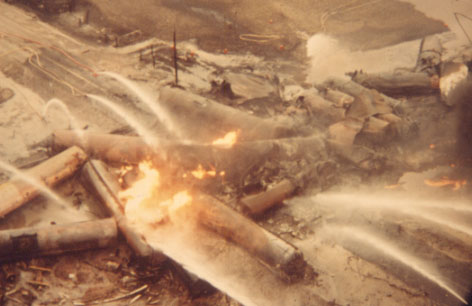
On the night of November 10, 1979, a 106-car Canadian Pacific freight train derailed at Mavis Road, north of Dundas Street. As a result of the subsequent explosion, when one of the tank cars carrying propane exploded, and because other tank cars were carrying chlorine, the decision was made to evacuate nearby residents in one of the largest peace time evacuations in history. This photo shows flames from the wreckage, with hoses pouring water on it.
Photo from the Mississauga Library System website, Identifier M466. Full gallery here.
In November of ’79, on the 11th actually, a chemical train derailed just northwest of [our apartment near Dundas and Hurontario Streets]. It spilled 16 tank cars full of propane and one full of chlorine all over the Mavis Road crossing.
I was driving back to Hamilton on Saturday night to drop off [my girlfriend]. Rockney was inexplicably along with us that night. Around midnight, I noticed the road all around us light up as though dawn had come early. Also noticed a pronounced mushroom-type cloud and lots of incident light at its base. Right there, my mind kicked into Hyperdrive and I analyzed the data, assumed the worst, and nearly swung off the highway to protect us behind an embankment. [The others] saw that it wasn’t an H- or A-type of explosion, and so we didn’t worry too much. Flames [on the eastern horizon] were easily visible from Hamilton.
I went back [to Mississauga], dropped Rockney off [and] noticed a police car blocking the intersection of Dundas and Hurontario with its lights going. Talked to Mum, who was still up, and went to bed at 3:00am.
We were woken up at 10:00am by police evacuating the building. I called Rockney and we all trooped over to his place. I stayed for 1/2 an hour, and decided to go back to the house, change into [my army reserve] uniform, and go up to Brampton for our Remembrance Day parade. On the way, I was stopped by the police and directed to go to Square One, where an evacuation centre had been set up. As I arrived there, the last bus-load of evacuees left headed for Streetsville Secondary School. I arrived there in time [to be given responsibility for security] with 15 assorted army and navy cadets [who were in uniform for their respective Remembrance Day services] who had no officer handy. We cleared the halls [at the direction of police and school authorities] and tried to maintain calm among the evacuated throng.
By 8 that evening, my force had shrunk to seven cadets led by Petty Officer Linda P. An officer cadet of the Air Reserve and five air cadets with him refused to assist me or the police. [I was angry at the time, but he was probably worried about the legal side of providing “aid to the civil power” while in uniform without permission from his chain of command. I was a junior NCO, so that thought never crossed my mind until much later.]
By this time, I had attached Chris P. [a friend of Rockney’s who was evacuated to Streetsville] and several other husky teenagers to my “security force” and we were able to keep things fairly quiet.
As people [started to realize] that they would be there all night, most of them settled down very nicely. [My team of cadets] issued blankets we’d received on a truck from CFB Downsview and shared out the available gym mats [as makeshift mattresses].
A local McDonalds sent in a “breakfast” of cold Big Macs [I’m sure they were hot going out the door, but they took a long time to get to us] — [the non-cadet members of] my security force got more than their fair share, but that was expected. Most of the media had disappeared by this time so we soon got involved in minor disputes with some irate citizens.
Sometime during Monday afternoon a Master Corporal from CFB Downsview called me to arrange a coffee run down to the [emergency crews working to contain] the fire. Nothing came of it in the end [I have no idea why they thought I’d be a useful participant, as I had no transportation other than my own car … maybe I was the only member of the military in the immediate vicinity].
Tried calling Rockney’s place [to see how my family were doing] but got no answer, same at Bill & Clive’s apartment [several miles further east of Rockney’s]. No idea where my parents have gone. [After being evacuated a second time, they’d ended up at the International Centre with the family cat and stayed there until later in the week, as I found out later. My sister hadn’t been at home so she was evacuated elsewhere with her boyfriend’s family. I have no idea where she spent the week.]
Monday night wasn’t too bad, except for [media reports] that there were 3 escaped cons in the area so i couldn’t send girls out alone on security sweeps [outside the school building]. Me, Chris P., Jordan L., and John D. were the only [ones available to do exterior security] now, getting VERY tired. Got an hour’s sleep.
On Tuesday a bunch of students from Humber College showed up. They were all taking the Law Enforcement course and wanted to help me with security. [The] only problem was that the course was 9/10ths female [so] I couldn’t use them [for exterior patrols, which is where we needed help the most].
Also showing up [later on Tuesday] was a local CB radio group who tried to take over from me and my team. It took two hours [of argument] before they gave up and went off to try to take over some other evacuation centre. [Around this time,] vandalism started on the back side of the school and in the portable classrooms. No one was caught at it, unfortunately. [I didn’t note it here, but I strongly suspected that one or more of my volunteers had done some of the damage out of boredom, but I had no proof.]
The biggest problem, however, was racial. A large group of black teenagers had taken over one of the Home Economics classrooms and had 2 competing ghetto blasters to make mucho noise. 2 fights had to be broken up in there and we had to call the police in to cope with the second fight.
[Tuesday] night was uneventful for a change. Wednesday wasn’t, as rumours of being able to go home kept hitting the people in the evacuation centre and nearly overwhelming the security teams at the doors. One asshole, a guy about 20-25 years old, kept buttonholing me and other members of my team and demanding shampoo, of all things. Eventually, someone got him some and he “went to the showers”. [In hindsight, he probably had just come down from whatever drugs he’d been on for the previous few days.]
On Wednesday night, the evacuation centre in Streetsville was shut down and everyone was moved to other facilities on Mississauga Transit buses. Most were taken to the Royal York Hotel in downtown Toronto, but my remaining team members were sent to a Holiday Inn in Scarborough. [I was in rough shape by then and someone got me to hospital to get checked out. I was there for about 10 hours before they discharged me with advice to “get plenty of rest”.]
Thursday we spent in the hotel, charging everything to CP Rail. They must have hit the roof when the bill arrived — especially the bar bill! We threw an “exhaustion party” in our room on Thursday night and on Friday we were finally allowed to go home (most of us, anyway).
When I went back to school the following week, I was given the third degree by the vice principal because the Red Cross didn’t have me listed as an evacuee. I had to get the hospital records to show that I had actually taken part before I was allowed back into class. [A similar thing happened the next unit parade night, as I’d been on TV several times in my uniform during the event and my commanding officer was quite upset about it, thinking I’d been pretending to act in some sort of official capacity, which I hadn’t been.]
November 10, 2023
QotD: Economic distortions of slavery in the Antebellum South
At the end of the day, economies grow and become wealthier as labor and capital are employed more productively. Slavery does exactly the opposite.
Slaves are far less productive than free laborers. They have no incentive to do any more work than the absolute minimum to avoid punishment, and have zero incentive (and a number of disincentives) to use their brain to perform tasks more intelligently. So every slave is a potentially productive worker converted into an unproductive one. Thus, every dollar of capital invested in a slave was a dollar invested in reducing worker productivity.
As a bit of background, the US in the early 19th century had a resource profile opposite from the old country. In Europe, labor was over-abundant and land and resources like timber were scarce. In the US, land and resources were plentiful but labor was scarce. For landowners, it was really hard to get farm labor because everyone who came over here would quickly quit their job and headed out to the edge of settlement and grabbed some land to cultivate for themselves.
In this environment the market was sending pretty clear pricing signals — that it was simply not a good use of scarce labor resources to grow low margin crops on huge plantations requiring scores or hundreds of laborers. Slave-owners circumvented this pricing signal by finding workers they could force to work for free. Force was used to apply high-value labor to lower-value tasks. This does not create prosperity, it destroys it.
As a result, whereas $1000 invested in the North likely improved worker productivity, $1000 invested in the South destroyed it. The North poured capital into future prosperity. The South poured it into supporting a dead-end feudal plantation economy. As a result the south was impoverished for a century, really until northern companies began investing in the South after WWII. If slavery really made for so much of an abundance of opportunities, then why did very few immigrants in the 19th century go to the South? They went to the industrial northeast or (as did my grandparents) to the midwest. The US in the 19th century was prosperous despite slavery in the south, not because of it.
Warren Meyer, “Slavery Made the US Less Prosperous, Not More So”, Coyote Blog, 2019-07-12.


