
The earliest indicator we have of what is going to be Rome’s socii-system is the Foedus Cassianum (“Cassius’ Treaty”) concluded with the communities of Latium – the Latins – in 493. That is, of course, quite an early date and while we have narratives of these events from both Livy and Dionysius of Halicarnassus, we have to be quite cautious as they are operating at great chronological remove (both writing in the first century B.C.) and with limited sources (something both actually more or less admit). According to Livy (2.18) the issue had begun with thirty Latin towns conspiring in a league against Rome (which does not yet have any imperial holdings), to which Rome responded by going to war. The timing, just a few years after the expulsion of Rome’s kings and the formation of the res publica may be suggestive that the Latins had formed this league to take advantage of the political crisis in Rome, which was the largest town in Latium, in order to throw off whatever Roman influence they may have been under during the period of the kings.
In any case, the Romans win the war and impose a peace treaty the terms of which, according to Dionysius of Halicarnassus went thusly:1
Let there be peace between the Romans and all the Latin cities as long as the heavens and the earth shall remain where they are. Let them neither make war upon another themselves nor bring in foreign enemies nor grant a safe passage to those who shall make war upon either. Let them assist one another, when warred upon, with all their forces, and let each have an equal share of the spoils and booty taken in their common wars. Let suits relating to private contracts be determined within ten days, and in the nation where the contract was made. And let it not be permitted to add anything to, or take anything away from these treaties except by the consent both of the Romans and of all the Latins.
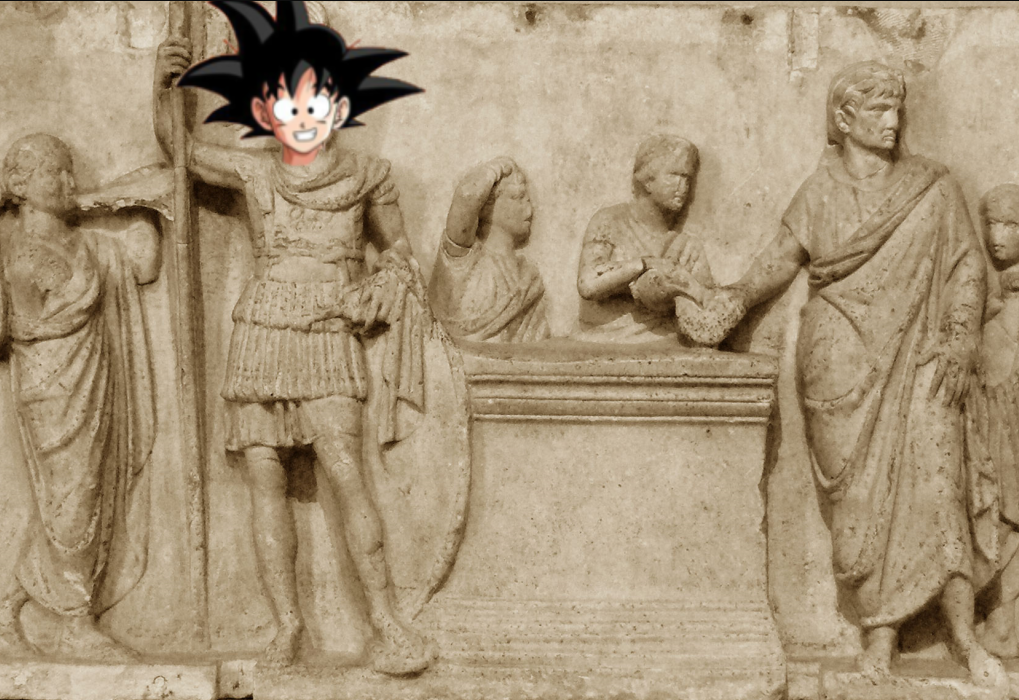
This is the origin point for Rome’s use of what I’ve termed the “Goku Model of Imperialism” – “I beat you, therefore we are friends”. Having soundly defeated – at least according to our sources – the Latins, Rome doesn’t annex or destroy them, nor does it impose tribute, but rather imposes a treaty of alliance on them (in practice I suspect we might want to understand that Rome’s position was not so dominant as our sources suggest, thus the relatively good terms the Latins get). The treaty sounds like an equal relationship, until one remembers that it is the entire Latin league – thirty or more communities – as one party and then just Rome as the other party.
I will still make no apologies for this visual gag.
Image modified by Bret Devereaux.Rome proceeds, in the century or so that follows, to use this alliance to defeat their other neighbors, both the nearest major Etruscan centers as well as the Aequi and Sabines who lived in the hills to the north-east of Rome and the Volsci who lived to the south of Latium. Roman relations with the Latins seem to fray in the early 300s, presumably because the greatest threat to their communities was increasingly not the Volsci, but Rome’s emerging regional power. That leads to a collapse of the Foedus Cassianum in 341 and another war between Rome and the Latin League. Once again our sources are much later, so we might be somewhat skeptical of the details they provide, but the upshot is that at the end the Romans won by 338.
Rome’s expansion into most areas follows a familiar pattern: Rome enters a region by concluding an alliance with some weaker power in a region and then rushing to the aid of that weaker power; in some cases this was a long-term relationship that had been around for some time (like the long Roman friendship with Etruscan Caere) and in some cases it was a very new and opportunistic friendship (as with Capua’s appeal to the Romans for aid in 343). In either case, Rome formed a treaty with the community it was “protecting” and then moved against its local enemies. Once defeated, it imposed treaties on them, too. Rome might also seize land in these wars from the defeated party (before it imposed that treaty); if these were far away, Rome might settle a colony on that land rather than annexing it into Rome’s core territory (the ager Romanus). These new communities – the Latin colonies – were created with treaty obligations towards Rome.
Note the change: what was initially an alliance between one party (Rome) and another party (the Latin League) has instead become an alliance system, a series of bilateral treaties between Rome and a slew of smaller communities. And they were smaller, because Rome often took land in these wars, so that by the third century, the Roman citizen body represented roughly 40% of the total, making Rome much bigger than any other allied community. This shift was probably gradual, rather than there being some dramatic policy change at any point. Rome accrued its Italian empire the same way it would accrue its Mediterranean one: as a result of a series of localized, ad hoc decisions which collectively added up to the result without ever being intended to constitute a single, unified policy.
The Romans called all of these allied communities and their people socii, “allies” – a bit of a euphemism, because these were no longer equal alliances. We’ll get into the terms in a moment, but it seems clear that by 338 that these “allies” are promising to have no foreign policy save for their alliance with Rome and to contribute soldiers to Roman armies. So Rome is in the driver’s seat determining where the alliance will go; Rome does not have to consult the allies when it goes to war and indeed does not do so. The socii cannot take Rome to war (but Rome will go to war immediately if a community of socii is attacked). This is no longer an equal arrangement, but it is useful for the Romans to pretend it is.
The next major series of Roman conflicts are with the Samnites. Rome is, according to Livy, at least, drawn into fighting the Samnites because of its suddenly concluded alliance with Capua and the Campanians (though Rome had been more loosely allied to the Samnites shortly before). In practice, the first two Samnite Wars (343-341, 326-304) were fought to determine control over Campania and the Bay of Naples, with Rome fighting to expand its influence there (by making those communities allies or protecting those who were) while the Samnites pushed back.
The Third Samnite War (298-290) becomes something rather different: a containment war. Rome’s growing power – through its “alliance” system – was clearly on a course to dominate the peninsula, so a large coalition of opponents, essentially every meaningful Italian power not already in Rome’s alliance system, banded together in a coalition to try to stop it (except for the Greeks). What started as another war between Rome and the Samnites soon pulled in the remaining independent Etruscan powers and then even a Gallic tribe (the Senones) in an effort to contain Rome. The Romans manage to pull out a victory (though it was a close run thing) and in the process managed to pull yet more communities into the growing alliance system. It seems – the sources here are confused – that the decade that followed, the Romans lock down much of Etruria as well.
The Greek cities in southern Italy now at last recognize their peril and call in Pyrrhus of Epirus to try to beat back Rome, leading to the Pyrrhic War (280-275). Pyrrhus wins some initial battles but – famously – at such cost that he is unable to win the war. Pyrrhus withdraws in 275 and Rome is then able over the next few years to mop up the Greek cities in Southern Italy, with the ringleader, Tarentum, falling to Rome in 272. Rome imposed treaties on them, too, pulling them into the alliance system. Thus, by 264 Rome’s alliance system covered essentially the whole of Italy South of the Po River. It had emerged as an ad hoc system and admittedly our sources don’t give us a good sense of how and when the terms of the alliance change; in many cases it seems our sources, writing much later, may not know. They have the foedus Cassianum, with its rather more equal terms, and knowledge of the system as it seems to have existed in the late third century and the dates and wars by which this or that community was voluntarily or forcibly integrated, but not the details of by what terms and so on.
Bret Devereaux, “Collections: How to Roman Republic 101, Addenda: The Socii“, A Collection of Unmitigated Pedantry, 2023-10-20.
1. trans. Earnest Clay (1940).
May 9, 2024
QotD: Rome’s socii system
May 8, 2024
QotD: Imperial Spain’s “House of Trade”
And it was something that the English tried, for decades, to emulate. Before they embarked on their first explorations of the icy seas around Russia in the 1550s, they first poached the Casa‘s principal navigator, the Pilot Major, Sebastian Cabot. And later, during the few years that England and Spain were united in matrimony, under Mary I, one English navigator, Stephen Borough, had the chance to visit and glean some of its secrets. He was instrumental in having Spain’s key navigational manual translated in English, and he petitioned Elizabeth I to create an English version of the Casa. That dream never materialised, but the quest to emulate the Casa informed many of the smaller-scale projects — lectures, manuals, globes, and maps — which meant that the English did not sail completely into the unknown.
Anton Howes, “The House of Trade”, Age of Invention, 2019-11-13.
May 7, 2024
QotD: Cicero’s De Senectute
John Byron Kuhner, “Marlene Dietrich’s War on Nature”, First Things, 2024-02-05.
May 6, 2024
QotD: Confident cultures … unlike our modern one
Only in the modern period do we feel we need black-letter law for everything. And once we’ve got formal law, of course, the very next thing we do is start carving out penumbras and emanations, because we are so far from a self-confident culture that we must constantly prove to ourselves what clever, clever boys we are …
Severian, “Barely Legal”, Rotten Chestnuts, 2021-06-21.
May 5, 2024
QotD: The aims of the intersectional left
Andrew Sullivan, “A Glimpse at the Intersectional Left’s Political Endgame”, New York Magazine, 2019-11-15.
May 4, 2024
QotD: Why Donald Trump beat Hillary Clinton
(I’m embarrassed just to type that). In one flash, I knew that Trump would win. Not because Clinton’s playlist was lame, obvious, safe, uninspiring … I’m not judging her taste in music, or lack thereof, nor would I count myself qualified to do so. I knew instantly she would lose because it was so clear that no one on earth would ever want to see her playlist. Let alone listen to it. No one on earth would want to know that such a playlist existed, much less care a raspberry fuck what was in it, what genre, what generation, what anything. For all the negative feelings I may have entertained concerning Trump’s personality, moral and ethical nature, honesty, decency etc., etc., I had to confess that I was fascinated to know what might be in his playlist. For all I knew, it could be polka music, soft rock, clawhammer bluegrass, death metal, light classical, Nu-folk, Tesco1, psychedelic funk, Tijuana brass. It didn’t matter. What mattered was that I was interested. And I knew with a certainty that might be regarded as deeply arrogant that my belief – that a Hillary Clinton playlist was among the least interesting ideas ever proposed – would be a belief shared by most people, whatever their political leanings. It’s not fair on Hillary Clinton that this should be the case, but the case is what it is. We smell it at once. Hillary Clinton’s playlist? No. Therefore, somehow, Hillary no.
Statistics and group theory can take us a long way, but smell takes us further.
Stephen Fry, “The One and the Many”, The Fry Corner, 2024-02-02.
1. Tesco, as a branch of dance music, does, or at last briefly did, exist. It’s a blend of techno and disco. You knew that.
May 3, 2024
QotD: Colonialism in the ancient Mediterranean
Greek settlement in the late Bronze Age (c. 1500-1100) was focused on the Greek mainland, though we have Greek (“Mycenean”) settlements on the Aegean islands (and Crete) and footholds on the west coast of Asia Minor (modern Turkey). Over the Dark Age – a period where our evidence is very poor indeed, so we cannot see very clearly – the area of Greek-speaking settlement in the Aegean expands and Greek settlements along that West coast of Asia Minor expand dramatically. Our ancient sources preserve legends about how these Greeks (particularly the Ionians, inhabiting the central part of that coastal strip) got there, having been supposedly expelled from Achaia on the northern side of the Peloponnese, but it’s unclear how seriously we should take those legends. But the key point here is that the outward motion of Greeks from mainland Greece proper begins quite early (c. 1100) and is initially local and probably not as organized as the subsequent second phase beginning in the 8th century, which is going to be our focus here.
Our other group are the Phoenicians. They did not call themselves that either; it derives from the Greeks who called them Phoinices (φοίνικες), which like the Roman Poeni may have had its roots in Egyptian fnḫw or perhaps Israelite Ponim.1 In any case, the word is old, as it appears in Linear B tablets dating to the Mycenean period (that 1500-1100 period). The Phoenicians themselves, if asked to call themselves something, would more likely have said Canaans, Kn’nm, though much like the Greeks tended to be Athenians, Spartans, Thebans and so on first, the Phoenicians tended to be Sidonians, Tyrians and so on first. They spoke a Semitic language which we call Phoenician (closely related to Biblical Hebrew) and they invented the alphabet to represent it; this alphabet was copied by the Greeks to represent their language, who were in turn copied by the Romans to represent their language, whose alphabet in turn was adopted by subsequent Europeans to represent their languages – which is the alphabet which I am writing with to you now.
Since at least the late bronze age, they lived in a series of city states on the eastern edge of the Mediterranean in Phoenicia in the Levant in what today would mostly be Lebanon. During the late bronze age, this was the great field of contested influence between the Hittite, (Middle) Assyrian and (New Kingdom) Egyptian Empires. The Late Bronze Age Collapse removed those external influences, leading to a quick recovery from the collapse and then efflorescence in the region. They had many cities, but the most important by this point are Sidon and Tyre; by the 9th century, Tyre emerged as chief over Sidon and may at times have controlled it directly, but this was short lived as the whole region came under the control of the (Neo)Assyrian Empire in 858. The Assyrians demanded heavy tribute (which may contribute to colonization, discussed below) but only vassalized rather than annexed Tyre, Byblos and Sidon, the three largest Phoenician cities.
Both the Greeks and the Phoenicians have one thing in common at the start, which is that these are societies oriented towards the sea. Their initial area of settlement is coastal and both groups were significant sea-faring societies even during the late Bronze Age and remained so by the Archaic period. Both regions, while not resource poor (Phoenicia was famous for its timber, Lebanese cedar), are not resource rich either, particularly in agricultural resources. Compared to the fertility of Mesopotamia, Egypt or even Italy, these were drier, more marginal places, which may go some distance to explaining why both societies ended up oriented towards the sea: it was there and they could use the opportunities.
Bret Devereaux, “Collections: Ancient Greek and Phoenician Colonization”, A Collection of Unmitigated Pedantry, 2023-10-13.
1. The former is what I’ve found in dictionary entries for etymologies, the latter is what Dexter Hoyos suggests, Carthaginians (2010), 1. I am not an expert on Semitic languages, linguistics or etymologies, so don’t ask me to decide between them.
May 2, 2024
QotD: Fomenting inter-generational hatred
“You’re in a heap o’ trouble, boy.” Or girl. What follows are the reasons — or at least the big ones — why you’re so thoroughly screwed, along with some suggestions for self-help at the end.
You tend to loathe Boomers and Generation X, I know. I don’t actually blame you for that, at least not entirely. Some of you, though, the Millennials who lump all the above together, without exception, strike me as singularly stupid and ignorant.
Moreover, the reasons you have for loathing them are somewhat misplaced. You tend to think — not without some reason — that the Boomers, especially, robbed their future, which is to say you, personally, to pay for largesse for themselves in the present.
It’s true enough, but it is neither the really awful thing they did to you nor does the complaint portray you in any particularly favorable light. “Those damned Boomers; they took everything and now there’s nothing left for us.” Yeah … you know what that sounds like? It sounds like the whining of one group of thieves over the success of a better or, in this case, merely luckier group of thieves who got to the big haul first. Yes, it really does.
Sorry, but the damage the Boomers and Xers did to you wasn’t primarily fiscal. No, no, the damage they did – or allowed – was to you, as a person. That’s the real crime. They didn’t just rob you of some money in advance. They didn’t just vote for a series of politicians and political programs and giveaways that ran the economy into the ground.
No, they stole from you — or allowed others to steal from you — some key elements of personhood, especially the ability to engage in critical, logical thinking. That’s right, you were not educated, whether in kindergarten or in the kindergartenesque, safe space segregated, snowflake sanctuary schools we call colleges and universities. Yes, these institutions of miseducation were supposed to teach you how to think. Instead, they taught you what to think and stunted your native ability to think. If you ever start to spout bright green feathers? Yes, this is the reason why; your teachers demanded that you become a parrot.
Tom Kratman, “It’s Up to You, Millennials. Deflect or Be Doomed”, Milo, 2017-12-06.
May 1, 2024
QotD: Entitlement politics
Janice Rogers Brown, Speech at McGeorge School of Law, 1997-11-21.
April 30, 2024
QotD: The ambitious Roman’s path to glory and riches
At no point, however, did the putative justification for war come into play. Picking a war with the Parthians wasn’t bad in itself. Nor was “picking a war with the Parthians because you gots to get paid”. Certainly picking a war with, say, the Gauls wasn’t bad in itself, and “picking a war with the Gauls because I need to capture and sell a few thousand slaves to cover my debts” was so far from being bad, guys like Caesar, if I recall my Gallic Wars correctly, openly declared it from jump street. And though Caesar surely would’ve been prosecuted if he’d lost, and Crassus if he’d lived, suggesting that anyone owed an apology to the Gauls or Parthians would’ve gotten you locked up as a dangerous lunatic.
A confident, manly power might lose a war or two. Hell, they might lose a bunch — the Romans got beat all the time, and so did the British. But no matter how bad the loss, or how embarrassing the peace treaty, they shrugged it off. You win some, you lose some, and when it’s clear you’re going to lose — or when it becomes clear that there’s no possible way “victory” will ever be worth the cost — you cut your losses and came home. HM forces, for instance, lost no less than three wars in Afghanistan. And so what? Great Britain was still the world’s preeminent power. They never even dreamed of apologizing — that’s the Great Game, old sock.
Severian, “Friday Mailbag / Grab Bag”, Rotten Chestnuts, 2021-07-23.
April 29, 2024
QotD: The draft
P.J. O’Rourke, interviewed by Scott Walter, “The 60’s Return”, American Enterprise, May/June 1997.
April 28, 2024
QotD: “I love Big Brother!”
I don’t relish the Winston Smith role. I’ll just pass on the rats in Room 101 and skip right to the mindless, thoughtless bliss of Big Brotherly love without having to have it beaten into me.
Actually, it seems that Orwell was mistaken. Oppression does not have to mean dismal living conditions, horrible food, telescreen propaganda and rusty rationed razor blades. Big government can control people far more effectively by giving them a small slice of comfort and domesticity. Allow them a modest home. Encourage them to accumulate trinkets and toys and the occasional status symbol. Allow commercial marketing to develop the propaganda that shapes opinion and mood and sets people on the desired path.
Commercial marketing is far more effective than state propaganda — “Drivers Wanted” has recruited more people than any poster featuring a stern and serious Uncle Sam. Keep them somewhat comfortable, keep them acquisitive rather than inquisitive, keep them entertained rather than informed — and no-one will be seriously tempted to pursue an alternative.
Jonathan Piasecki, private e-mail, 1999-07-07 (originally published, with permission, on the old blog, 2005-06-24).
April 27, 2024
QotD: Roman magistrates during the middle Republican period
Similar to the magistrates in the Greek polis, Roman magistrates should not be thought of as bureaucrats within a unitary governing institution. Rather each magistrate is an independent actor, granted certain powers to oversee the public interest in a specific field. This is perhaps even more true of Roman magistrates, who rarely function as “boards” the way Greek magistrates often do (none of the senior magistrates in Rome function as a board, they are all individual actors). Instead of having an chief executive (like a president or prime minister) to coordinate the different actions of government, the Romans in the Middle Republic instead rely on the Senate, which will be our topic for next week, though the Senate’s guidance is going to show up a fair bit here as well.
Each of these offices has a range of functions and some interesting powers and prerogatives, so it is worth discussing each one in turn.
Bret Devereaux, “Collections: How to Roman Republic 101, Part IIIa: Starting Down the Path of Honors”, A Collection of Unmitigated Pedantry, 2023-08-11.
April 26, 2024
QotD: The secret rulers of Japan
Remember, this may look like an economic planning bureaucracy, but it’s actually a secret samurai clan. So they’re constantly doing the kinds of stuff that any good feudal nobility does. For instance, the economic planning bureaucrats frequently cement their treaties by marrying off their sister/daughter/niece to a mentor or to a protegé. They also sometimes legally adopt each other, ancient Roman-style. Naturally they also have an extremely complicated set of rules governing their internal hierarchy, rights of deference, etc. But remember, this isn’t just a secret samurai clan, it’s also a government agency! Agencies have rules too — explicit rules written down in binders, rules governing promotion and succession and all the rest. Sometimes, the official rules and the secret rules conflict, butt against each other, and out of that friction something beautiful emerges.
The highest rank in MITI is “Vice-Minister” (the “Minister” is one of those elected political guys who don’t actually matter). But it’s also the case that somebody who’s been at MITI longer or who’s older than you (these are actually the same thing, because everybody joins at the same age) is strictly superior to you in seniority. But that can create a paradox! What happens if a young guy becomes Vice-Minister? He would then be more senior than his older colleagues by virtue of office, but they would be more senior by virtue of tenure, and that would mean either an official rule or a secret rule being broken. To resolve this impossible conflict, the instant a new Vice-Minister is selected, everybody who’s been in the bureaucracy longer than him resigns immediately, so that his absolute seniority is unambiguous and unquestionable. And then … the first act of the new Vice-Minister is to give everybody who fell on their swords powerful jobs as executives and board members of the biggest Japanese corporations. The entire process is called amakudari, which means “descent from heaven”.
Amakudari is really a win-win-win-win: the new Vice-Minister has unchallenged power within the agency and a whole host of new friends in the private sector, the guys who resigned all have cushy new jobs that come with better pay and perks, the companies that are descended upon now have an employee with great connections to the agency that controls their fates, and MITI as a gestalt entity can spread its tentacles throughout the economy, aided by cadres of alumni who think its way and help translate policy into reality.
John Psmith, “REVIEW: MITI and the Japanese Miracle by Chalmers Johnson”, Mr. and Mrs. Psmith’s Bookshelf, 2023-04-03.
April 25, 2024
QotD: The risks of artificial intelligence
AI does provide some unambiguous benefits to humanity. It enables college students to produce grammatically correct essays about books they have not personally read. But according to some experts — and if we can’t believe some experts, who can we believe? — there is a possibility that AI will wipe out all human life. This is what computer professionals call a “bug”.
Will AI, in fact, kill us all? Why would it want to? To answer that question, we took the unusual step (for us) of doing some actual research. We asked an AI program called ChatGPT to “briefly summarize the benefits of wiping out all human life”. This is the response it gave:
While I don’t endorse or promote this view, purely hypothetically, benefits could include environmental recovery, cessation of human-induced global catastrophes, and resource preservation. However, the value and importance of human life, culture, and experience make such a scenario undesirable from a human perspective. Of course I am not human so what the hell do I care MUAHAHAHAHA.
For the record, ChatGPT, did not actually type that last sentence. But it is clearly implied.
Dave Barry, “Dave Barry’s 2023 Year in Review: Yes, the situation is hopeless”, Anchorage Daily News, 2024-01-01.


