
… there is a tendency when popular culture represents the past to erase not merely the farmers, but most of the commons generally. Castles seem to be filled with a few servants, a whole bunch of knights and lords and perhaps, if we are lucky, a single blacksmith that somehow makes all of their tools.
But the actual human landscape of the pre-modern period was defined – in agrarian societies, at least – by vast numbers of farms and farmers. Their work proceeded on this cyclical basis, from plowing to sowing to weeding to harvesting and threshing to storage and then back again. Religious observances and social festivals were in turn organized around that calendar (it is not an accident how many Holy Days and big festivals seem to cluster around the harvest season in late Autumn/early Winter, or in Spring). The uneven labor demands of this cycle (intense in plowing and reaping, but easier in between) in turn also provided for the background hum of much early urban life, where the “cities” were for the most part just large towns surrounded by farmland (where often the folks living in the cities might work farmland just outside of the gates). People looked forward to festivals and events organized along the agricultural calendar, to the opportunities a good harvest might provide them to do things like get married or expand their farms. The human drama that defines our lives was no less real for the men and women who toiled in the fields or the farmhouses.
And of course all of this activity was necessary to support literally any other kind of activity.
Bret Devereaux, “Collections: Bread, How Did They Make It? Part III: Actually Farming”, A Collection of Unmitigated Pedantry, 2020-08-06.
March 7, 2022
QotD: Historical fiction and fantasy works usually leave out the vast majority of the people who did all the work
March 6, 2022
QotD: The academic rat-race
Since only “scholars” who publish get tenure, and since journals only publish original “research”, the only way to publish consistently is to make shit up. Given that Shakespeare ain’t writing no more sonnets, the only way to get tenure in, say, English Literature is to argue that, properly “deconstructed”, the list of contents on a packet of beef jerky is just as valuable — indeed, more valuable — as a “cultural artifact” than anything the Bard, curse his CisHetPat White soul, ever wrote. Hence, the road to tenure takes only left turns.
Severian, “I Learned A New Word”, Rotten Chestnuts, 2019-01-23.
March 5, 2022
QotD: Bike gangs
Mark Steyn, “Exit strategy”, Western Standard, 2005-06-15
March 4, 2022
QotD: “Avoid New York City”
Kim du Toit, “Don’t Do That”, Splendid Isolation, 2019-01-28.
March 3, 2022
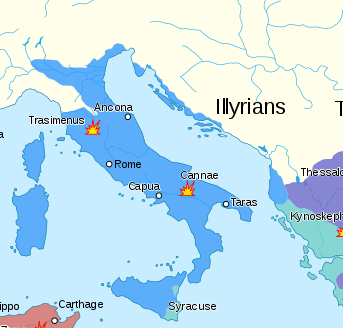
QotD: Diversity was Rome’s strength … as is true of almost every empire in history
Quite a few people look at a map like that, classify most of Rome’s territories as “Italian” and assume there is a large, homogeneous ethnic core there (except, I suspect, anyone who has actually been to Italy and is aware that Italy is hardly homogeneous, even today!). But Roman Italy in 218 B.C. was nothing like that.
Peninsular Italy (which doesn’t include the Po River Valley) contained a bewildering array of cultures and peoples: at least three distinct religious systems (Roman, Etruscan, Greek), half a dozen languages (some completely unrelated to each other) and many clearly distinct cultural and ethnic groups divided into communities with strong local identities and fierce local rivalries (if you want more on this, check out Salmon, The Making of Roman Italy (1982), Fronda, Between Rome and Carthage (2010), and Keaveney, Rome and the Unification of Italy (2005)).
The Roman army was by no means entirely Roman – it was split between Roman citizens and what the Romans called the socii (lit: “allies”) – a polite term for the communities they had subjugated in Italy (a periphery!). Rome demanded military service – this was the resource they would extract – from these communities; the socii pretty much always made up more than half of the army. Diversity was literally the Roman strength, in terms of total military force. Without it, Rome would have remained just one city-state in Italy, and not a particularly important one besides.
(As an aside: while citizenship is extended to nearly all of Italy in the 80s B.C., by then Rome is making extensive use of non-Italian troops in its armies. by the early empire, half of the army – the auxilia – were non-Roman citizens recruited from the provinces. Roman armies were essentially never majority “Roman” in any period, save possibly for the third century. And before anyone asks what about even earlier than my snapshot – it is quite clear – both archaeologically and in the Romans’ own foundation myths – that Rome was a fusion-society, culturally diverse from the city’s foundation. Indeed, sitting at the meeting point of Latin and Etruscan cultural zones as well as upland and coastal geographic zones was one of the great advantages Rome enjoyed in its early history, as near as we can tell.)
Outside of Italy, narrowly construed, the diversity only increases. Sicily’s population included Greeks, Punic (read: Carthaginian) settlers, and the truly native non-Greeks. Sardinia and Corsica had their own local culture as well. Cisalpine Gaul – the Po River Valley – was, as the name implies, mostly Gallic! As the Romans expended into Spain during the Second Punic War, they would add Iberians, Celt-Iberians, and yet more Punic settlers to their empire. And even those descriptions mask tremendous diversity – Iberians and Celt-Iberians were about as diverse among themselves as the Italians were; a quick read of Strabo reveals a wonderful array of sub-groups in all of these regions, with their own customs, languages, and so on.
Even if the Romans didn’t raise military force directly from any one of these groups, they do need to raise revenue from them – remember, the entire point of having the empire is to raise revenue from it, to make other people do the farming and mining and other labor necessary to support your society from the proceeds of their tribute. To keep that revenue flowing – revenue that, as the Roman army professionalized in the late second century B.C., increasingly paid for Roman military activity which held the empire together – you need to be good at managing those groups. Empires that are bad at handling a wide array of different cultures/religions/languages do not long remain empires.
Bret Devereaux, “Collections: Why Are There No Empires in Age of Empires?”, A Collection of Unmitigated Pedantry, 2019-11-22.
March 2, 2022
QotD: George Orwell was a dedicated socialist
What this war has demonstrated is that private capitalism – that is, an economic system in which land, factories, mines and transport are owned privately and operated solely for profit – does not work. It cannot deliver the goods. This fact had been known to millions of people for years past, but nothing ever came of it, because there was no real urge from below to alter the system, and those at the top had trained themselves to be impenetrably stupid on just this point. Argument and propaganda got one nowhere. The lords of property simply sat on their bottoms and proclaimed that all was for the best. Hitler’s conquest of Europe, however, was a physical debunking of capitalism. War, for all its evil, is at any rate an unanswerable test of strength, like a try-your-grip machine. Great strength returns the penny, and there is no way of faking the result.
When the nautical screw was first invented, there was a controversy that lasted for years as to whether screw-steamers or paddle-steamers were better. The paddle-steamers, like all obsolete things, had their champions, who supported them by ingenious arguments. Finally, however, a distinguished admiral tied a screw-steamer and a paddle-steamer of equal horsepower stern to stern and set their engines running. That settled the question once and for all. And it was something similar that happened on the fields of Norway and of Flanders. Once and for all it was proved that a planned economy is stronger than a planless one.
George Orwell, “The Lion And The Unicorn: Socialism and the English Genius”, 1941-02-19.
March 1, 2022
QotD: The Great Library of Alexandria
The Mouseion at Alexandria was far from the only shrine to the Muses in the ancient world, nor was it the only one with an associated centre of study. Pythogoras had recommended the establishment of a shrine to the Muses for the promotion of learning on his first arrival on Croton, for example and the Seleucid kings built one at Antioch in the late second century BC, with an attendant centre for study and a library. The fact that the Great Library was actually associated with a religious shrine is something that is ignored or glossed over in many modern accounts. [Carl] Sagan […] mentions about how one of the “daughter libraries” was the Serapeum, which was the temple of Serapis, but he skips around this in a rather gingerly manner. He says the Serapeum was “once a temple, but was later reconsecrated to knowledge”. This is nonsense. The Serapeum was always a temple and was not “reconsecrated” to anything. Libraries were often established as adjuncts to temples but it seems Sagan was attempting to distance the “annex” of the Great Library from the temple in which it sat because this did not quite fit his theme of secular knowledge’s superiority to “mysticism”. Like the Serapeum, the Mouseion was a temple with a research institution and a book collection associated with it.
This aside, the Mouseion really was primarily a research institution and its associated book collection – which we will continue to refer to by the shorthand expression the “Great Library” – was clearly one of if not the most extensive in the ancient world (more on that below). Many famous ancient scholars worked in the Mouseion, including Eratosthenes and probably Ptolemy. But several who are often claimed as working there (or even as being “librarians” of the Great Library, no less) clearly did not. Sagan’s hymn of praise says that Hipparchus studied there, but he seems to have only used some of the books from the collection and there is no evidence he ever even visited from his home on Rhodes. Likewise Sagan says Archimedes worked there, but there is no clear evidence for this and what little we know of Archimedes’ life indicates he spent it in Syracuse. Of the others Sagan mentions, Euclid and Herophilos may have studied there, depending on when the Mouseion was established and Dionysius of Thrace is another maybe, though more likely. On the whole, Sagan’s roll call of great scholars is mainly hyperbole and speculation rather than historical fact. The other figure who is regularly invoked as being associated with the Great Library, and even presented as its “last librarian”, is (again) Hypatia. This is despite the fact that both the Great Library and its daughter library in the Serapeum had ceased to exist by her time.
Tim O’Neill, “The Great Myths 5: The Destruction Of The Great Library Of Alexandria”, History for Atheists, 2017-07-02.
February 28, 2022
QotD: Passengers versus freight in railway efficiency terms
Now consider a freight train. The typical car weighs 25-30 tons empty and can carry between 70 and 120 tons of cargo. This means that 70-80% of the fuel in a freight train is being used to move the cargo.
Now you have to take me on faith on one statement — it is really hard, in fact close to impossible, to optimize a rail system for both passengers and freight. In the extreme of high speed rail, passenger trains required separate dedicated tracks. Most rail systems, even when they serve both sorts of traffic, generally prioritize one or the other. So, if you wanted to save energy and had to pick, which would you choose — focusing on freight or focusing on passengers? Oh and by the way, if you want to make it more personal, throw in a consideration of which you would rather have next to you on crowded roads, another car or another freight truck?
This is why the supposedly-green folks’ denigrating of US rail is so crazy to me. The US rails system makes at least as much sense as the European system, even before you consider that it was mostly privately funded and runs without the subsidies that are necessary to keep European rail running. Yes, as an American tourist travelling in Europe, the European rails system is great. Agreed. I use it every time I go there. I have to assume that this elite tourist experience must be part of why folks ignore the basic science here.
Warren Meyer, “A Reminder: Why the US Rail System Is At Least as Good As the European System if You Care About Energy Use”, Coyote Blog, 2018-05-25.
February 27, 2022
QotD: Tactics, operations, strategy, grand strategy … let’s call the whole thing off
That in turn leads him to under-emphasize the massive difference between the two definitions of strategy he presents (though he seems aware of its significance, a viewer might not be): one of which confines itself to how to achieve policy ends by military force and the other of which includes the decision not to use force to achieve those ends. I very much prefer the latter definition of strategy, to the point that I am fond of saying that “any game which doesn’t let you declare peace is merely Real Time or Turn Based Tactics.” A definition of strategy that includes only “how to use military force to achieve policy ends” risks fading rapidly into operations and […] mistaking operations for strategy is a classic and disastrous planning blunder.
It’s still a very useful video, especially as a starting point for thinking about these terms, but those are points I think could have done with a touch more clarification; again, not a critique per se – nothing MHnV says is wrong, just a preference.
Bret Devereaux, “Fireside Friday: August 14th, 2020”, A Collection of Unmitigated Pedantry, 2020-08-14.
February 26, 2022
QotD: Taste in decoration
It’s as if a Las Vegas wedding chapel designer had been abducted, brought to Indonesia, and forced, at gun-point, to lower his standards. One half-waits for the Elvis impersonator to come down the staircase.
Conrad, “The Long Weekend”, The Gweilo Diaries, 2004-09-28
February 25, 2022
QotD: The lure of the forbidden knowledge
Forbidden ideas have an appeal that orthodoxy never does — just ask Martin Luther. In fact, the parallels between the rise of the alt-right and the Reformation are interesting. In Luther’s world the printing press had recently created new and difficult to control ways for people to share subversive ideas. Early forms of capitalism led to the rise of new social classes and fueled resentment against traditional elites and traditional forms of authority. There were even early forms of the meme. Long before Pepe the Frog was co-opted by the alt-right, drawing donkey ears on images of priests was a way of provoking the powerful.
It’s surely the case that some of the speech that activists and university administrators seek to suppress poses a much more direct threat to real people than does a debate about supply side economics or evolution, but it’s worth remembering that to the Church, the Lutheran heresy was a real threat too. It posed a mortal danger to the eternal souls of people who were deceived by its falsehoods and rejected orthodoxy. I doubt that the Inquisitors felt any more qualms about deplatforming Lutheran heretics than did the activists at Middlebury.
As the Church learned, simply suppressing heresy cannot guarantee that it will go away. If anything, meeting heretical speech with violence or disruption just adds to its allure, confirming in the minds of the already convinced that they are right and leading the fence sitters to take another, perhaps more sympathetic, look. Dismissing heretical speech because it falls into a category that is rejected by the orthodox is not that much more effective a strategy.
We can do a lot to keep things from getting to the sort of highly contentious encounters like the ones at Middlebury and Berkeley, just by addressing uncomfortable issues with evidence rather than just categorization in our courses. Next time you are tempted to sidestep contentious issues in your class or to dismiss a student’s question because it falls into a forbidden category, don’t.
In the long run we can’t win an argument by avoiding it.
Erik Gilbert, “Liberal Orthodoxy and the New Heresy”, Quillette, 2019-02-04.
February 24, 2022
QotD: Being 18
Grant McCracken, “What’s it like being 18?”, This Blog Sits at the, 2006-03-27.
February 23, 2022
QotD: Debunking the “Spartan one-man-army” myth
Well, ok, perhaps they fought in groups, but were individually better at it. There is something to this. Multiple sources – most notably Xenophon stresses the greater degree of physical fitness that the Spartiates display (Xen. Lac. 4.5, 5.9). The Spartiates were rich after all, so they were well fed and able to build muscle accordingly; they also had a pretty active life-style (mostly things like sport-hunting) and kept athletically active. Chances are the average Spartiate was thus larger and fitter than the average hoplite – although again, the other Lakedaemonians in the phalanx (perioikoi, hypomeiones, mothakes, neodamodes, even helots fighting as hoplites) would probably balance out this effect to at least some degree (more strongly as time went on and the number of Spartiates shrunk!)
But what about martial skills and combat expertise? The fact is, there isn’t much evidence for a Spartan military training regime – certainly nothing like what the Romans had, or even what later Hellenistic Greek poleis set up. We’ve already discussed the agoge and you will note that at no point did swordsmanship, spear use, shield use, or anything of the like come up. There is, to be fair, some mock battles with fennel stalks in place of spears and some war-dances which may have served to mimic combat, but the agoge isn’t a training program, it’s an indoctrination program. Plutarch and Xenophon – who describe it – are quite clear on this: the point is to produce men who are obedient to the laws and subservient to the community (Xen. Lac. 2.10-11; Plut. Lyc. 25.3). Any advantages to military quality are evidently secondary (e.g. Xen. Lac. 2.7).
Xenophon himself notes – in the words of Cyrus (who he presents as an ideal ruler) – that hoplite-style warfare in close-combat required little practice (Xen. Cyrop. 2.1.9-16). And I want to stress two things about this statement: first that Xenophon had seen a lot of hoplite battle when he knew this and was in a position to know and second that he had also seen a lot of Sparta. It is hard to imagine Xenophon – with his Laconophilia – saying that practice for hoplites was unimportant if the Spartans had relied on it heavily. Nevertheless, there he is, saying that all of the movements a hoplite actually needed to perform – blocking with the shield, striking with spear or sword – were instinctive and did not need to be taught or practiced.
Plato provides our first solid evidence for the hoplomachia – practice drills in hoplite warfare – but immediately suggests through the person of Laches that the Spartans, specifically do not practice it (Plat. Lach. 182d-183a), because they think it doesn’t work. There is clearly some practicing with arms in Sparta as elsewhere in Greece (see J. K. Anderson, Military Theory and Practice in the Age of Xenophon (1970), 84-93 for the best discussion of the evidence; note also Wheeler, “Hoplomachia and Greek Dances in Arms” (1982)), but it never approaches the formal weapons drills we see from the Romans, or the complex fighting systems of the late Middle Ages. Nor does Sparta appear to be meaningfully exceptional in this regard; they seem to be exactly as tutored – or untutored – as all the other Greeks.
Nor may we rely on the assumption that the Spartan has more battle experience than his foes. The fact is that Greek poleis went to war fairly regularly and that they tended to bring most of their hoplite class out to battle when they did and as such most Greeks of the hoplite class from anywhere will have likely experienced combat. The Spartans are not unique in this and it is not clear that Sparta fights more often – they murder helots more often, sure, but this is hardly effective preparation for open battle.
(The contrast with Rome is again instructive. Sparta is intermittently at war, but the Roman Republic is continuously at war for all but six years out of five centuries, with the average Roman citizen probably spending upwards of seven years under arms – and this is before the professionalization of the legion. The average Roman free-holding farmer (the technical term is assidui) of the Middle Republic might truthfully have considered Leonidas and his 300 as amateurish by comparison.)
So what can we conclude? Well, the Spartiates are probably, on the whole, better nourished and fitter than their average opponent. If they have an edge in weapons training, it is fairly small – some sort of martial arts experts or superlative weapon-masters they are not. Which, of course they aren’t; the way they fight doesn’t require them to be. Hoplite fighting was never about individual martial excellence or skill, but about holding a position in the formation, supporting and being supported in turn by the shields of the men around you. The hoplite didn’t need to be a spear-master and evidently – we must agree with Xenophon – gained little from becoming so.
Bret Devereaux, “Collections: This. Isn’t. Sparta. Part VI: Spartan Battle”, A Collection of Unmitigated Pedantry, 2019-09-20.
February 22, 2022
QotD: Architecture’s crisis of confidence
Last year, recognizing general public’s low opinion of architects, the American Institute of Architects (AIA), the trade organization for the profession, launched an effort to “reposition” the industry by hiring marketing and brand-identity firms.
And now The New York Times, the ultimate arbiter of elite opinion, recently published an op-ed that declared, “For too long, our profession [architecture] has flatly dismissed the general public’s take on our work, even as we talk about making that work more relevant with worthy ideas like sustainability, smart growth and ‘resilience planning’.” The authors are not kooks on the fringe but architect Steven Bingler and Martin C. Pedersen, former executive editor of Metropolis magazine, both of them very much in the establishment.
The authors observe that self-congratulatory, insulated architects are “increasingly incapable … of creating artful, harmonious work that resonates with a broad swath of the general population, the very people we are, at least theoretically, meant to serve.” Bingler and Pedersen note that this has been a problem for over forty years (my emphasis), and that things are even worse today.
Justin Shubow, “Architecture Continues To Implode: More Insiders Admit The Profession Is Failing”, Forbes, 2015-01-06.
February 21, 2022
QotD: Parenting dilemmas
On one hand, you’re touched they made something for you, and you want to reward their creative desires. On the other hand, if you accept everything uncritically, they’ll grow up without standards, and think everything they toss off gets the same wonderful reaction. (“A broken crayon with some string glued on the end? Why, it’s the best birthday present ever, Hon. And tell your husband I said hello.”)
James Lileks, “Romzak triglit? For me? I love it!”, Star Tribune, 2006-04-21.


