
[Prime minister Stephen] Harper’s genius, as a power-seeking politician, is the opposite of Obama’s (the once popular USA president). He carries the “Conservative” label, of a party slightly to the right of the others in our Parliament. Therefore he has most of the liberal media machinery against him. Obama, as perhaps we all know, has enjoyed until recently a compliant and fawning media, that do not criticize their darling, nor hesitate to suppress news that would be unfavourable to him. Obama’s tactic has been to draw attention constantly to himself. He has something to say on every subject, empty of content, but dramatically insistent in its repetition of the first person singular. By contrast, Harper goes out of his way to distract attention from himself, and when he can’t, to avoid vehemence of any kind, or anything resembling drama.
This is not to say he isn’t ruthless, as a political operator, and backroom settler of scores. Anyone associated with Christian causes, such as the defence of human life, will know how he rules his pro-life backbenchers. His intention is to keep the party “on message,” with a message that will not excite media attention, so he can get on with normal administration. His strength is his reputation for management: he has not, like Obama, made a hash of everything he has touched. The Canadian budget is actually in surplus, and while our cumulative debt is substantial, and we face the same unfunded welfare liabilities to an aging population, we have not the bottomless debt and fiscal chaos into which Obama and other irresponsible politicians have delivered the United States. (Notwithstanding, when they crash, it will be right on top of us.)
But of course, this is a “democracy,” and the great majority of our population, as those in all other countries, are almost entirely ignorant of public affairs. Like children, they get bored with good government, but unlike children they have, collectively, the power to do something about it.
David Warren, “Ottawa in the news”, Essays in Idleness, 2014-10-23.
October 17, 2015
October 14, 2015
Canadian defence … a still-relevant view from ten years ago
Instapundit linked to a ten-year-old post at Albion’s Seedlings, and I noticed that the next post there is still pretty much dead-on in describing why Canada’s military is in the state we still see today. Spoiler: the post is titled “Was Canada Ever Serious? Militia and Military Since Confederation“:
Initial chapters [of Canadian Brass: The Making of a Professional Army 1860-1939 by Stephen Harris, 1988] consolidate the early periods of Canadian military history as the British military staff digested the new geopolitical realities demonstrated during the American Civil War. Canada was to be spun loose politically in 1867 but its foreign policy and defense were to remain a very strange hybrid well into the 20th century. The WW1 period in Canadian Brass is divided into pre-war, a Sam Hughes [Militia Minister] WW1 period, and a post-Hughes WW1 period. An interbellum period gets thorough coverage and then WW2 is broken out into separate Military Planning, and Training & Education chapters.
The rather shocking message of this book is that the Canadian military has been the constant butt of political interference during the last 150 years except for two brief periods: WW2 proper, and 1951-1964. During virtually all other periods of Canadian history, the permanent (professional) military forces have been starved of funds, denigrated in public by all and sundry, and then ignored completely during mobilization for wartime. The only time in Canadian history that professional pre-mobilization plans were actually used was WW2. In all other eras, professional plans were ignored and politicians turned to various militia cronies to assemble, train, lead, and transport Canadian troops.
[…]
The author suggests, therefore, that lack of professionalism in the organization of the military led to unnecessary political crises (specifically the split between Quebec and English-speaking Canada), and, in the case of the First World War, the needless slaughter of the initial Canadian divisions (because they were led by totally unqualified militia officers with political connections). The WW1 crisis created by Minister of Militia Sam Hughes was the result of a totally mythical and exaggerated memory of militia superiority in the War of 1812 and the Fenian raids of 1866, and careful news management out of the Boer War. Militia were held to be a superior in all ways to a professional force, moral and martial. Government money for militias (urban and especially rural) was a traditional source of political patronage in Canada, frustrating British military advisers and Governor-Generals for literally generations (and ruining many Brit careers in the process). Such patronage methodically starved the professional units in a nascent professional Canadian Army of training, equipment, facilities, pensions, wages and prestige. The result was a professional army that wasn’t and an oblivious overconfident citizen-soldier militia that was destined for a horrific introduction to modern war.
The casualty situation got so bad by the late fall of 1916 that Hughes was dismissed, and a new generation of Canadian officers (all political appointees but survivors of the savage Darwinian selection at the front) began to lead, and promote their junior officers out of the ranks. The impact on morale and military success from early 1917 to the end of the First World War were dramatic. Canadian reputations for combat effectiveness essentially came out of this period.
[…]
It’s clear, in retrospect, that Canadian politicians and the Canadian public have had a long-standing expectation that the British (and then the US) were going to bail them out in any serious military situation. As a result, the professional Canadian military was seen as simply another source of political largesse for the party in power. It never had to be effective, and post-1964, it actually was designed not to be used at all … unification of the three services (Army, Navy, Air Force), and endless UN peace-keeping missions were an effective way to strip combat effectiveness and combat equipment out of the Canadian military. Harris provides all the necessary context and information for that conclusion but is politic enough to avoid much further commentary.
He does writes an interesting epilogue that delicately skirts around those post-1939 issues … and avoids touching the “third rail” of military bilingualism introduced in the 60s, which further degraded esprit de corps and combat effectiveness. After all, Mr. Harris was essentially writing about his own Cold War employer at the time of publication (1988), and probably wanted to keep his job. Nonetheless, it’s pretty clear that the Liberal dismantlement of the conventional Canadian military (after tactical nukes appeared in Europe in the 60s) was yet another iteration of the political manipulation of the permanent military and a return of the good old days of “jobs for the boys.” The sorry state of today’s Canadian military (a small but excellent antiterrorist force [JTF2] to protect the elite in Ottawa, and a sprinkle of blue helmet cannon fodder without adequate air transport) is therefore very much part of a proud Canadian political tradition stretching back 135 years. It’s not a mistake. It’s on purpose.
Ten years on, we don’t do the UN peacekeeping stuff to any great extent, but even with a “pro-military” government in power for most of that time, the Canadian Armed Forces are still starved for resources and up-to-date equipment (and procurement is still seen as a way to spread government money around to “deserving” regions rather than a way of getting the best tools for the money). Thanks to our unique strategic situation, Canada can still be a military free-loader — and glories in it.
October 13, 2015
Gary Johnson might end up being the “non-weird candidate for whom America has been waiting”
The US Libertarian Party’s nomination race won’t make much of a splash in the media (for the usual reasons all minor parties encounter), but if Gary Johnson wins the nomination again he might be the most normal candidate in 2016:
Gary Johnson, not yet an official 2016 Libertarian Party candidate for president, spoke to the two-day LibertyFest 2015 at the Warsaw hall in the Williamsburg neighborhood of New York City this weekend. He defended freedom in all its forms, from the unregulated entrepreneurship of Uber and Lyft to marijuana, reduced taxes, and reduced warfare.
Yet even I — an anarcho-capitalist, as you may recall — am beginning to wonder if it’s necessary to emphasize philosophy for Johnson to shine in the strange setting of the 2016 race. I mean, if the Republicans end up offering someone as odd as Trump or Carson, and the Democrats offer a criminal such as Clinton or a socialist such as Sanders … couldn’t Johnson plausibly just run as the non-weird candidate for whom America has been waiting?
And believe me, I know how strange it sounds to be talking about the Libertarian as the normal one for a change. (Jimmy McMillan, the “Rent Is Too Damn High” guy, spoke on the same stage a couple hours before Johnson, and it’s not clear McMillan is even a full-fledged libertarian — maybe more of a Georgist? Or just an interesting, earnest character?)
Let us assume for the sake of argument that Johnson beats other would-be Libertarian Party nominees including Austin Petersen, who gave an energetic LibertyFest speech about mobilizing libertarian activists as if for war and hopes he’ll one day get the chance to institute a flat tax. Much as Libertarians usually worry about having a candidate who lacks the guts to push their philosophy in a full-throated way (witness their occasional wariness about Rand Paul), might this be a good year in which to skip ideology and use mere sanity as a wedge issue?
QotD: Reactionary views on marriage
I have heard some reactionaries say that although there are not intellectual differences between men and women, there are emotional differences, and that women are (either for biological or cultural reasons) more “submissive” to men’s “dominant” – and a quick search of the BDSM community seems to both to validate the general rule and to showcase some very striking exceptions.
But my money would be on a simpler hypothesis. Every marriage involves conflict. The traditional concept of gender contains two roles that are divided in a time-tested way to minimize conflict as much as possible. In a perfect-spherical-cow sense, either the husband or the wife could step into either role, and it would still work just as well. But since men have been socialized for one role since childhood, and women socialized for the other role, it seems that in most cases the easiest solution is to stick them in the one they’ve been trained for.
We could also go with a third hypothesis: that women aren’t actually bizarre aliens from the planet Zygra’ax with completely inexplicable preferences. I mean, suppose you had the following two options:
1. A job working from home, where you are your own boss. The job description is “spending as much or as little time as you want with your own children and helping them grow and adjust to the adult world.” (but Sister Y also has a post on the childless alternative to this)
2. A job in the office, where you do have a boss, and she wants you to get her the Atkins report “by yesterday” or she is going to throw your sorry ass out on the street where it belongs, and there better not be any complaints about it this time.
Assume both jobs would give you exactly the same amount of social status and respect.
Now assume that suddenly a bunch of people come along saying that actually, only losers pick Job 1 and surely you’re not a loser, are you? And you have to watch all your former Job 1 buddies go out and take Job 2 and be praised for this and your husband asks why you aren’t going into Job 2 and contributing something to the family finances for once, and eventually you just give in and go to Job 2, but also you’ve got to do large portions of Job 1, and also the extra income mysteriously fails to give your family any more money and in fact you are worse off financially than before.
Is it so hard to imagine that a lot of women would be less happy under this new scenario?
Now of course (most) feminists very reasonably say that it’s Totally Okay If You Want To Stay Home And We’re Not Trying To Force Anyone. But let’s use the feminists’ own criteria on that one. Suppose Disney put out a series of movies in which they had lots of great female role models who only worked in the home and were subservient to their husbands all the time, and lauded them as real women who were courageous and awesome and sexy and not just poor oppressed stick-in-the-muds, and then at the end they flashed a brief message “But Of Course Working Outside The Home Is Totally Okay Also”. Do you think feminists would respond “Yeah, we have no problem with this, after all they did flash that message at the end”?
Scott Alexander, “Reactionary Philosophy In An Enormous, Planet-Sized Nutshell”, Slate Star Codex, 2013-03-03.
October 12, 2015
QotD: The inevitable result of the “Arab Spring”
When journalists were going nuts a few years ago about the wonders of the wave of ‘revolutions’ that they decided to refer to as an ‘Arab Spring’, I was reminded how few modern academics, let alone journalists, have any understanding of history. None of the political analysts or professional pundits seemed to have much more of a clue about how things would INEVITABLY turn out, than babes in a wood.
Which is ridiculous, because you would imagine that anyone with a pretense of being worth consulting might have at least a clue that there might be historical parallels worth considering. Frankly it is terrifying that our modern ‘chattering classes’ honestly seem to imagine that they are above being able to learn anything from history.
1848 of course saw a wave of ‘revolutions’ all across Europe, which many people at the time hailed as the inevitable downfall of the ancient regimes, and the prelude of the rise of true modern democracy. How sweet.
In fact, of course, the revolutions led to a re-imposition of the ancient regimes, or much worse dictatorships: often with harder edges to prevent such things happening again. In fact it can be credibly argued that the results of this wave of revolutions was to slow down the democratization of Europe by at least 50 years.
I suspect the same thing will result from the Arab Spring.
Nigel Davies, “The ‘Arab Spring’, 1848, and the 30 Years War/s…”, rethinking history, 2015-09-19.
October 9, 2015
October 6, 2015
Jay Currie trolls the readers at Dr. Dawg’s blog
Jay Currie has a bit of fun at the expense of poor folks suffering from sudden-onset Harper Derangement Syndrome:
Oh Dear the “yokels” and the “unwashed”, being thoroughly unenlightened, are failing in their duty to follow the lead of their betters and have noticed that there may be a few issues with mass Muslim immigration. Disgusting.
Worse, that spiv Harper doesn’t even have the grace and breeding to use dogwhistles in herding his flock. The dreadful man is throwing raw meat to the rubes and, to no one’s great surprise those Ill-educated reactionaries and rednecks are eating it up. There is, I fear, a very real danger that the 80% of bigoted Canadians (90% in the idiot reaches of Quebec) will take this opportunity to try to undo forty years of enlightened immigration and refugee policy by voting for those revolting CPC candidates.
The Wal-Mart classes are restless.Time to clutch the pink pearls and person the checkpoints surrounding the nicer, leafier, bastions of tolerance in Canada’s more sophisticated urban centers. Lock down the common rooms and charcuterie bars, disguise your Prius and avoid being seen with your Said (or books of any sort really): the proles are on the move.
[…]
The beast Harper looked vulnerable at the beginning of this campaign. After all, no one we knew would think of voting for the thug. But Harper has a low, animal, cunning. He is unafraid of the great white blob. He has been seen at hockey rinks at 6 in the morning and obviously buys his suits in some dreadful mall. His wife has stayed at home with the children. He is, obviously, one of them. He does not need to dogwhistle – the blob knows its own.
So, beware. The unwashed, the yokels, the bigots and the rubes have been summoned. All we can hope for is that, once they have vented their fury on niqab wearers they will resume their slumber. The alternative is simply too awful to contemplate.
October 4, 2015
The federal NDP and the triumph of the “Tommunist Manifesto”
In the Regina Leader-Post, Christine Whitaker talks about “life without fossil fuels” and what it might mean for Western Canada:
Author Naomi Klein and her supporters, promoting their Leap Manifesto (otherwise known as the “Tommunist Manifesto”), proudly assert that they now have 10,000 signatures to this document, most of which are “celebrities” and left-wing politicians, including, of course, David Suzuki.
This document starts from the premise that Canada is facing the deepest crisis in recent memory. The basic concept is that we must put an end to the use of fossil fuels; that we could live in a country powered only by renewable energy; that we could get 100 per cent of our electricity from renewable resources within the next two decades.
I wonder if these people realize that, to achieve this goal, there would need to be hundreds of thousands of wind turbines across the land. There would not be a single acre of rural Canada free of those monstrosities. Someone would also need to invent commercial airliners powered by clean energy, and there would no longer be any trucks to deliver food to the city stores. The whole manifesto is ridiculous.
So this is my counter-manifesto. It is equally silly, but I make no apologies. This is how Klein and company want our children and grandchildren to live.
Article 1: All persons who sign the Leap Manifesto, including Suzuki, should be immediately placed on an international no-fly list. They must never again be allowed to travel on planes powered by fossil fuels.
Article 2: All signatories will immediately have all their gasoline-powered vehicles confiscated.
Article 3: All public utilities (power, natural gas, water, telephone lines) will be disconnected from their homes.
As they say, read the whole thing.
Let us now discuss “the Conservative advantage among bigoted, ornery, vote-crazy oldies”
Believe it or not, the end of the seemingly eternal federal election is finally in sight. We’re getting to the wind-up stage of the campaign and we can now expect certain evergreen political topics to be discussed as we wearily struggle down to the wire. Colby Cosh covers one of the biggest “issues” of every federal election:
The parties are running low on ammunition in the election that never ends, and I can sense, like a tracker laying an ear to the ground, the approach of conversations about demographics and the getting-out of the vote. With this campaign sub-season — suitably located in the autumn — will come talk of “gray power”; dread of the Conservative advantage among bigoted, ornery, vote-crazy oldies; and, above all, the suffocating hatred of the young toward the liver-spotted hands that grip our levers of power and ward off change.
I rarely speak of Baby Boomers without a generous helping of contemptuous spittle. But the great equalizers, pain and death and dementia and distraction, are now starting to take them. The people I call Turnout Nerds obsess over youth voting: it seems unnatural to them, even revolting, that fewer than half of people under 35 bother to struggle to the polls, choosing to deny us their breezy new ideas and their orientation toward the future. (Not that I can see much actual evidence of either quality.)
They do not talk much about what happens to voter turnout once Canadians have passed their peak propensity to vote, which arrives, according to the official estimates for the 2011 election, at the age of 67. The graph, it turns out, looks like a skewed triangle. Voters in the age cohorts from 20-25 had less than 40 per cent turnout in 2011. There is a slow linear climb from there; turnout passes 50 per cent in the mid-30s, 60 per cent in the mid-40s, 70 per cent on the cusp of age 60. It rises to above 75 per cent at about the traditional retirement age.
But the dropoff in turnout from there is steeper than the rise — and how else could it be, given arthritis and lumbago and the other cruel facts of late life? And by age 67, according to an insurance man’s icy “life tables,” more than one per cent of the population is dying every year. If you adjust for mortality, and imagine a hypothetical pool of Canadian voters starting out at age 18, the estimated age at which the highest number of the original group will be voting isn’t 67; it’s more like a flat peak between the ages of 59 and 64. After that, coronaries start taking away more voters than enthusiasm is adding.
October 1, 2015
US tax cut proposals fail the laugh test
At Ace of Spades H.Q., Ace responds to a recent Kevin Williamson post:
It is standard conservative theory that tax cuts and spending cuts go hand in hand. But after decades of ever-rising spending, coupled with occasional tax cuts, I’m not so certain of that any longer.
I believe it was after Reagan that Republican theorists began justifying his model of tax-cuts-now-spending-cuts-later as the “starve the beast” theory of limiting government — if we cut taxes, therefore cutting government’s resources, we should, logically, force the government to adapt itself to living with fewer taxpayer dollars. Ergo, spending should be forced down by the practicalities of the situation — either you start cutting spending, or else you start running up dangerous, Greece-level of debts.
The problem is that this country has always elected the “or else” part of this syllogism: We are racking up dangerous, Greece-levels of debts, and we’re barely even talking about that any longer.
The problem has grown so immense that we’ve decided to declare it officially a Non-Problem. (It will decide to re-assert itself as a Really Big Problem in a short period of time.)
So I no longer believe in the “starve the beast” theory, because the “starve the beast” theory relies upon Americans understanding the mid-to-longer term trajectory of their spending choices, which they plainly do not.
Since Americans are not capable of understanding the mid-to-longer term trajectory of their spending choices, it seems to me the only way to impose budget discipline and spending rollback is to offer Americans an immediate, as opposed to future, confrontation with reality: that is, if Americans wish to have so much government, they should be forced to pay for the level of government they are choosing, and not defer that payment (as they apparently will choose, every single time) into the future, to be imposed upon their children.
But, instead, they must be forced to reckon with the level of government they are choosing now by paying the full freight and cost of that government now.
That is to say: I believe that rolling back spending is only possible when Americans are made to feel the costs of the government they’re choosing, and that will only happen when they’re forced to actually pay for it.
The biggest hurdle, after the economic illiteracy of the voting public, is the starkly clear self-interest of the politicians: they can get re-elected only if they pander sufficiently to the voters. The voters, who do not understand how the government works (and refuse to believe it when you tell them) … want ever-more of it to benefit them as soon as possible. Telling the voters that you’ll not only not give them more but that you’ll be giving them significantly less is a great way to lose your next election (assuming you don’t get thrown out of office before that even comes up).
September 30, 2015
Let’s all just leave the Governor General out of everyone’s election scenario-making exercises
Colby Cosh on the sudden interest among the chattering classes about the role of the Governor General during election campaigns:
What’s with malcontent nitwit constitutional experts popping up in the newspaper to warn of “political instability” because we’re having a three-sided election? You know, this isn’t really that hard. The United Kingdom, a nuclear-armed power across the Atlantic that may be vaguely familiar, had an election in 2010 that failed to produce a majority. Its 650-seat House of Commons ended up with 306 Conservatives, 258 Labour MPs, 62 Liberal Democrats and a ragbag of deputies from nationalist and leftist parties.
[…]
If there is no majority party, that will involve tough decisions, most likely falling upon whomever finds himself in third place. But it should not end up with the governor general making some kind of awkward choice in a vacuum. The party leaders should feel enormous pressure to arrive at a decision between them, as if there were a taboo protecting the governor general’s door. The Privy Council Office is probably already creating that pressure. A governor general should never be presented with anything but a fait accompli. He plays the role of the Queen locally, and should be thought of like the Queen, as being above political decision-making.
The proper thing for constitutional pundits to be doing right now is to strengthen that taboo. Musings about imaginary scenarios in which the viceroy might have to involve himself in the selection of a government are fun — exactly the kind of thing I myself enjoy. But if you are cooking up such an op-ed, or giving quotes of that nature to a journalist, you are signing a license for party leaders to prolong the negotiation period that might follow our election, and encouraging them to make illicit use of sly appeals to the public about what the governor general ought to be doing.
In a minority situation, the temptation will be there: some leader will want to suggest that an arrangement for government that leaves him out has been arrived at unfairly. Or a third-place finisher who should be deciding the identity of a prime minister other than himself, and who has the real power to decide, might lose his nerve and start thinking he can evade the choice.
September 29, 2015
Universities, alcohol, women, and consent
At Simple Justice, Scott Greenfield includes a poster from Southeast Missouri State University that nicely summarizes both the institutional infantilization of university students and the current double standard on booze and consent rules:
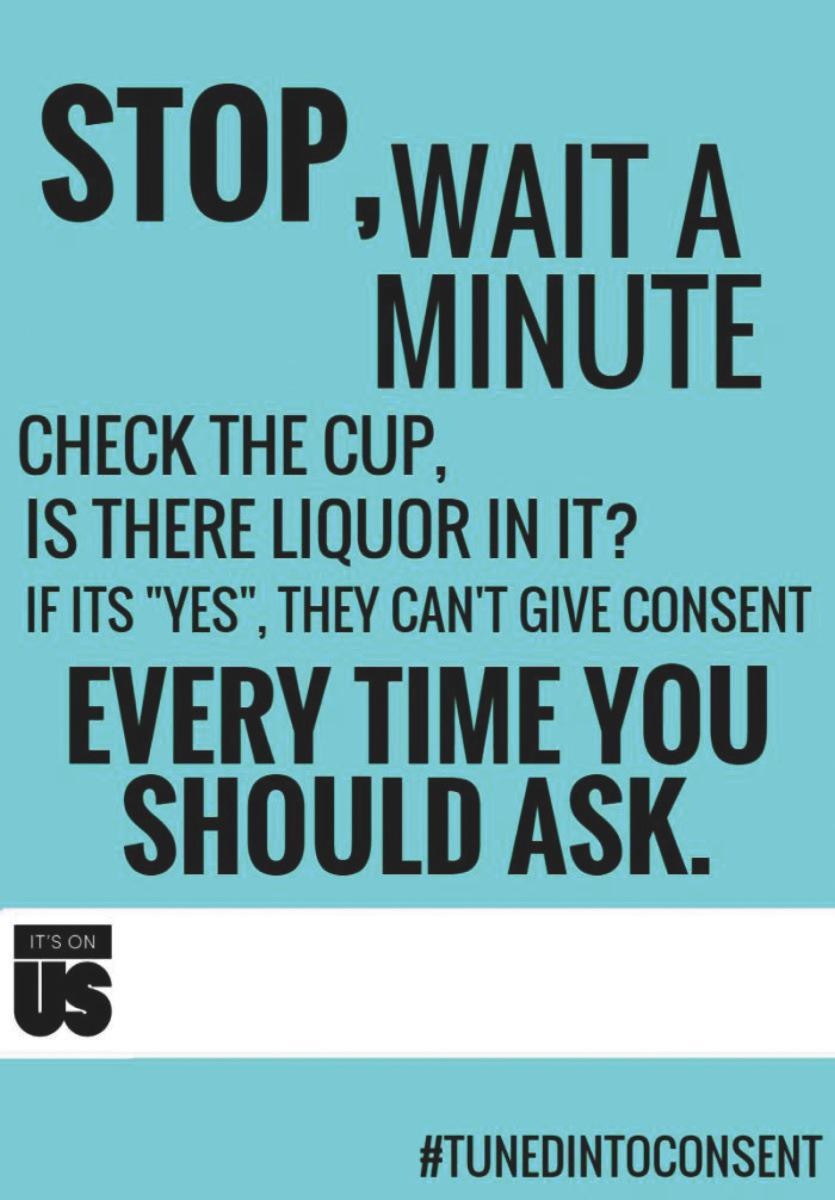
There is universal agreement that any female (though not male) who has passed out is incapable of giving consent to sex. But as the spectrum of reaction to alcohol or drugs comes closer to the sober end, it becomes increasingly problematic. The word used to describe a woman who cannot consent is “incapacitation.”
What is incapacitation? That’s impossible to say. It usually described by either specific instances of conduct (“if she’s puking her guts out, that means she’s incapacitated”), which offers no guidance when she’s not puking her guts out, or when she’s done puking her guts out, or before she’s puking her guts out.
The underlying rationale is that a woman who is so drunk that she cannot formulate knowing, intentional and voluntary consent, cannot consent to sex. This is a dubious standard, as the incapacity to consent doesn’t mean she would not consent, but that she cannot consent.
To put this in context, consider a person who fully consents, enthusiastically desires to engage in conduct, but wasn’t specifically asked beforehand. This person can truthfully assert that it was non-consensual under the Affirmative Consent standard, because she never overtly expressed consent.* The objective standard is not met, although the subjective standard is fully met.
The problem is reminiscent of drunk driving, which was determined by the objective inability to perform the tasks necessary to safely drive a car before the law turned to Blood Alcohol Content as a proxy, an inadequate measure but a convenient one for law enforcement to prove. Sexual incapacitation suffers from a lack of definition and no objective basis.
What is clear about incapacitation is that it’s not when there is “liquor in the cup,” or when “she has touched alcohol,” any more than it would be a crime for her to thereafter get behind the wheel of a car. Yet, the notion that any alcohol (or drugs, which don’t seem to find their way onto posters or flyers as much) per se vitiates consent is spreading and being used as the hard and fast line.
Bad preschool is worse than no preschool
Megan McArdle on the popular notion that preschool programs are a panacea for all that ails the public school system:
Universal preschool has become the ginseng of American politics, a sort of broad-spectrum nostrum that will cure almost anything that ails you. Inequality, male-female pay gaps, crime, poverty — just apply some early childhood programs, and watch those maladies fade. Expect to hear this a lot from Hillary Clinton in the coming presidential race.
And what kind of a crotchety, sour, greedy old columnist could be opposed to such a wonderful idea? I’m so glad you asked.
In truth, I am not opposed to early childhood education programs. I am opposed to blind boosterism of such programs, the kind that confidently predicts marvelous results from thin empirical evidence, and briskly proceeds to demand huge sums be spent accordingly. There are three big problems with this:
1. The empirical evidence is shakier than many boosters suggest. The possible benefits of these programs can be divided into two baskets: cognitive benefits (improvement in academic skills and performance), and non-cognitive benefits (improvement in such things as social skills, hyperactivity, gratification delay, and so forth). The evidence of cognitive benefits is underwhelming; they appear, and then tend to fade out as the children leave the program and proceed through our nation’s school systems.
A lot of hope has therefore been poured into non-cognitive benefits. Some early programs seem to show long-term improvements in things like graduation rates, employment and criminal activity. However, many of these programs were very small, which raises the possibility that we’re dealing with small samples plus publication bias, rather than something that actually works. In general, in social science, you tend to see that the larger the sample and the better designed the study, the less remarkable the effects. And this is definitely what you see with early childhood programs. Perry, Abecedarian, the Chicago Child-Parent Center: these are inspiring projects. They’re not nearly large enough to base a national program on.
[…]
And indeed, that’s what a new study out of Quebec seems to suggest. In the 1990s, the province instituted an inexpensive universal child-care program. The program doesn’t seem to have produced much in the way of cognitive benefits, and its non-cognitive benefits were actually negative — that is, kids exposed to the program (those who lived in Quebec) were more likely to have various problems than control groups in other provinces.
Now, this is, as I always caution, Just One Study. It’s a pretty convincing study, of a pretty large group. But it’s still a single study, which means that we should not rush to say that universal child care is a bad idea, or even that cheap, badly designed universal child care is a bad idea.
What we should rush to say, however, is that the background assumption about such programs — that at worst they’re a waste of money for zero results — cannot be safely held. We have to assume some possibility that our early childhood program will actually be worse for the kids than the status quo is.
September 28, 2015
Meaningless polls with weeks yet to run in the election campaign
Jay Currie advises casual poll watchers to pretty much ignore the polls at the moment. Yes, those same polls the TV talking heads and the deep-thinkers at the major newspapers spend so much time “analyzing”: they are probably the least useful form of information in a Westminster-style election campaign like ours. A poll of a thousand “representative” Canadians doesn’t tell you anything about how the voters in any given riding are likely to vote, and that’s where the election is decided. I’ve been joking with my family that, based on the appearance of signs in our Whitby riding, the likely winner on October 19th will be the window cleaning firm “Men in Kilts”.
Here’s why Jay recommends just ignoring the “horse race” media coverage:
Canadian mainstream media knows only one way to cover an election: it is always a horse race with polls coming out weekly or even daily in which one party or another edges ahead or falls behind by less than the margin of error.
Polls are funny things: they give a particular picture of the race at a particular time without providing much by the way of explanation. And, in Canada, the most reported “national” polls measure a race which does not exist. We don’t vote nationally or even province by province: we vote riding by riding.
The bright boys in the Conservative and NDP war rooms know this and, apparently, someone has been kind enough to explain the rudiments to the geniuses surrounding Trudeau. The fact is that the election turns on, at most, 100 ridings scattered across Canada. Amusingly, these are not the same ridings for each party.
With less than a month to go to election day, but with a month of campaigning and polling behind them, each of the parties will be able to focus its efforts on a) marginal seats where that party’s sitting candidate may lose, b) competitive ridings where that party’s candidate might win a riding previously held by another party.
Talk of the Blue Wave or Orange Crush is like the English pre-WWI talking about rolling the Huns up by Christmas: now we are in trench warfare. And now, small differences are all that matter. Exciting as it may be for the Greens to run 5% nationally, they are running more or less even in Victoria which would up their seat count to 2 and knock an NDP held seat off Mulcair’s search for a plurality of House of Commons seats. And there are ridings like this across Canada.
At the same time, the trench war is influenced by the perception of who is actually winning the overall election. Political scientists talk about bandwagon effects. Here Harper has the huge advantage of incumbency. For every Harper Derangement Syndrome voter out there, there are at least one or two voters who, while they don’t love Harper, prefer the devil they know.
Canadian election analysis used to be pretty easy:
- How many seats are there in Quebec? Give 75% or more to the Liberals.
- How many seats are there in Alberta? Give 90% to the Progressive Conservatives.
- How many urban blue collar seats are there? Give 50% or more to the NDP.
- How many remaining seats are there in Ontario? Split the urban seats 65% Liberal and 30% NDP and the suburban and rural seats 55% PC and 35% Liberal.
- Finally, count out the few dozen remaining seats and guess which way they’ll go (and history matters … a seat that’s been in NDP hands since the CCF years will probably stay there, while a seat that flips regularly every election will probably flip again).
I’m joking, but not by a lot. However, that was then and this is a very different now. All those “rules” have been thrown out the window in the last decade and each party probably has a colour-coded map of the country which shows where it makes any political sense to expend time and resources to retain a friendly seat or steal an opposing seat. (Spoiler: those maps are nowhere near as accurate as the various parties are hoping.)
You (as a federal party official) don’t want to obviously give up on any seat, but you also don’t want to have all your heavy-hitters showing up for events in a riding you don’t have any realistic chance to win: not only is it a waste of time and resources, it can make you look desperate and that’s a very bad way to appear during an election campaign.
I’m not making any predictions about how the election will turn out … I don’t even know who I’ll be voting for on the day, but the folks in the expensive outfits on TV don’t know either. With the national polling being so close and no definite signs of a bandwagon forming, it could go almost any direction. Last time around we had the Crooks, the Fascists, the Commies, and the Traitors. This time the parties are not quite as mired in scandal, so we’ve got the Nice Hair Guy, the Bad Hair Guy, the Beardy Guy, and everyone else (let’s not pretend that the Greens or the Bloc are going to form a government this time around). You drop your ballot and you take your chances. See you on the other side.


