
One of the constant nightmares of traveling with politicians is the need to keep them in sight at all times. Every presidential campaign has its own fearful litany of horror stories about reporters – and, occasionally, even a key staff member – who thought they had plenty of time to “run across the street for a quick beer” instead of hanging around in the rear of some grim auditorium half-listening to the drone of a long-familiar speech, only to come back in 20 minutes to find the auditorium empty and no sign of the press bus, the candidate or anybody who can tell him where they went. These stories are invariably set in places like Butte, Buffalo or Icepick, Minnesota, on a night in the middle of March. The temperature is always below zero, there is usually a raging blizzard to keep cabs off the street, and just as the victim remembers that he has left his wallet in his overcoat on the press bus, his stomach erupts with a sudden attack of ptomaine poisoning. And then, while crawling around on his knees in some ice-covered alley and racked with fits of projectile vomiting, he is grabbed by vicious cops and whipped on the shins with a night stick, then locked in the drunk tank of the local jail and buggered all night by winos.
These stories abound, and there is just enough truth in them to make most campaign journalists so fearful of a sudden change in the schedule that they will not even go looking for a bathroom until the pain becomes unendurable and at least three reliable people have promised to fetch them back to the fold at the first sign of any movement that could signal an early departure. The closest I ever came to getting left behind was during the California primary in 1972, when I emerged from a bathroom in the Salinas railroad depot and realized that the caboose car of McGovern’s “victory train” was about 100 yards further down the tracks than it had been only three minutes earlier. George was still standing outside on the platform, waving to the crowd, but the train was moving – and as I started my sprint through the crowd, running over women, children, cripples and anything else that couldn’t get out of my way, I thought I saw a big grin on McGovern’s face as the train began picking up speed….… I am still amazed that I caught up with the goddamn thing without blowing every valve in my heart, or even missing the iron ladder when I made my last-second leap and being swept under the train and chopped in half by the wheels.
Ever since then I have not been inclined to take many risks while traveling in strange territory with politicians. Even the very few who might feel a bit guilty about leaving me behind would have to do it anyway, because they are all enslaved by their schedules, and when it comes to a choice between getting to the airport on time or waiting for a journalist who has wandered off to seek booze, they will shrug and race off to the airport.
Hunter S. Thompson, “Fear and Loathing on the Campaign Trail ’76: Third-rate romance, low-rent rendezvous — hanging with Ted Kennedy, Jimmy Carter, and a bottle of Wild Turkey”, Rolling Stone, 1976-06-03.
June 1, 2018
QotD: Travelling with a political campaign
May 31, 2018
Megan McArdle’s tweetstorm explaining the Reagan coalition to under-35s
I’d embed all of these, except it would take a week for the page to render, so here’s the start of the thread, and the rest will just be copy-pasta’d text:
This week's column is on the series finale of The Americans, and what the series finale of Soviet Communism did to American politics, particularly on the right.
— Megan McArdle (@asymmetricinfo) May 30, 2018
Fear not, my little chickadees, there will be no spoilers. Except that, as Woddy Allen once remarked of “War and Peace”, “It involves Russia.”
Oh, heck, obviously this tweetstorm is going to be typo-tastic. I think we’re just gonna have to roll with it, folks.
Actually, most of this Tweetstorm is going to be about one small point that I raised in the column, but didn’t have space to explore.
Which is the extent to which those on the left who are under 45, and particularly those who are under 35, fundamentally misunderstand the Reagan coalition, because they don’t remember communism.
There’s a phenomenon in cognitive science called “hindsight bias”. People wildly overestimate their ability to predict events when they know what the outcome was.
Indeed, if you ask them to predict an event, then tell them the outcome, and then ask them what they predicted, some of them will misremember having correctly predicted the outcome.
They will also think they could have predicted an outcome that was designed to be random. Don’t think that you are not one of these people. All of us are, at least to some extent, plagued by hindsight bias. It takes conscious effort to overcome, and you never will, fully.
So once you know that Soviet Communism was doomed to the ash heap of history, because it is an infinitely inferior way of satisfying your society’s basic material needs, you become nearly incapable of imagining what it was like to live in the shadow of the Berlin Wall.
Unless you actually did.
Nonetheless, let me try to explain what it was like to our younger viewers. When I grew up, the Soviet Bloc was just one massive red blob on the map. One that the Soviets had repeatedly demonstrated an interest in expanding.
Whatever you think of American foreign policy post-1945, Soviet foreign policy was like that too, except with nastier. Our client regimes were terrible. Their client regimes were terrible. But we didn’t shoot people to keep them from leaving, or run a totalitarian police state.
It obviously, in hindsight, was not plausible to think that they were going to take over the whole world. They didn’t have the resources. But alas, we did not get the benefit of hindsight when it was happening. Almost until the Wall came down, people were predicting convergence.
There was a large, expansionist power. They were basically singlehandedly keeping Cuba afloat, subsidizing actual, honest-to-God communist groups that wanted to bring the rugged splendors of life without consumer goods to America, and oh, had a history of invading their neighbors
And then there were the nukes. So true, funny story–they were phasing out nuclear drills when I was in grammar school, because someone in the NYC Department of Ed had realized there’s not much point in drilling to become radioactive vapor. Pretty much just happens naturally.
But I had an older teacher who insisted on telling us to get under our desks if the Bomb hit. Also, inexplicably, to tuck our pants into our socks to protect us from fallout.
“I’m afraid your daughter is dead, Mrs. McArdle. But just look at those pristine ankles!”
Were Red Dawn and Top Gun over the top and a little silly? Yes. But folks in the 1980s (at least those of the appropriate age for viewing such things) didn’t watch them *ironically*. They believed the Soviets wanted to bury us. Because they had said stuff like “We will bury you”
We grew up actually afraid that the Soviet Union was going to turn our country into a sheet of radioactive glass. In hindsight, seems obviously overblown, but again: *we didn’t have hindsight*.
Also, even in the 1980s, there was a delusional portion of the left that actually thought life was better for ordinary people in the Soviet Union. That portion had, thankfully, gotten smaller after Hungary. But there was a larger portion that thought maybe it wasn’t really worse.
To be clear, I’m not talking about “Democrats”. I’m talking about hard leftists who I grew up with on the Upper West Side. They existed, and were kind of noisy.
And then there was a larger still part of the left that wasn’t Marxist, but thought that the things they were concerned about, like gender inequality and racism, didn’t exist under communism, or were better.
(NARRATOR: they existed. They weren’t better)
They thought these things because it’s hard to get good information about a police state. People saw America’s oppressions being reported on the front pages of American newspapers, and concluded that they must be worse than places we had no information on.
The existence of various sorts of at least vaguely communist-sympathetic folks inside the country, and an eerie background expectation that at any moment, a large, Imperialist communist power outside our borders might vaporize you, made this a very, very politically salient issue
If you are trying to interpret the Reagan Right without understanding the large emotional impact that this had on voters, you are getting it badly wrong.
As an aside, as I also mentioned in this column, this is *ALSO* true of people who aren’t old enough to remember urban crime in the 1980s.
I was mugged for the first time at the age of 8. In the girl’s bathroom of my grammar school. Which was supposedly the safest on the UWS.
A kid in my high school class was hospitalized after a gang of boys his own age beat and mugged him. At 10 in the morning. Off of Park Avenue.
It’s easy to have a complex, nuanced, high-level response to crime when you’re reading about crime statistics. When you are actually personally, viscerally afraid of being hurt or killed every time you walk out of your front door, your reaction tends not to be so measured.
Was there a racialized aspect to politicians talking about crime? Absolutely. That was not, however, the only thing driving it. When politicians ranted about crime, what they were often really actually talking about was … crime. Which was genuinely scary for everyone.
Which is why, as the excellent “Locking Up Our Own” documents, so many “tough on crime” laws that did huge and disproportionate damage to young black men were originated or supported by the black community. They were most at risk from law enforcement, but also from crime.
We can argue over how important “the Southern Strategy” was to the GOP’s rise. But you can’t argue that race was the whole story. Or even the overwhelming majority of the story. There was a lot going on.
But some of those problems faded, largely of their own accord. And the generation that doesn’t remember them first-hand tends to discount those problems that faded, leaving only the problem which is still with us, to which they overattribute Reagan’s success.
The left frequently suggests that conservatives are insufficiently imaginative when discussing the problems of the poor, leaving out huge areas of complexity and nuance. They’re right. I see young lefties making the same error about the problems of their parents & grandparents.
It’s one part hindsight bias (“*I’d* have known this wasn’t that big a threat”) and one part the simple difficulty of imagining how something feels if you haven’t lived it.
May 30, 2018
Eurocrats send Italy back to the polls, to get it right this time
What were the Italians thinking? Didn’t they realize that the election of Euroskeptics would just result in the powers-that-be sending them back to vote (and possibly to vote again) until they get the right answer? Brendan O’Neill calls it a putsch:
There has been a putsch in Italy. A bloodless putsch, with no guns or jackboots, but a putsch nonetheless. The president’s vetoing of the finance minister put forward by the populist parties that won a huge number of votes in the General Election in March represents a grave assault on the democratic will. It is a technocratic coup, an EU-influenced, big-business-pleasing attempt to isolate and weaken the popular anti-Brussels sentiment that has swept Italy. Indeed, it has brought about the collapse of the talks to form a new populist government and made it necessary to hold fresh elections. Let’s be honest about what has happened here: March’s democratic election has essentially been voided by technocrats who care more about Euro financiers than they do about the ordinary people of Italy.
Italy has been plunged into political crisis by establishment figures who are repulsed by the Euroscepticism spreading through the nation. In the election in March, the mainstream parties – the Democratic Party and Forza Italia – were decimated by voters. They suffered an historic blow at the ballot box, the Democratic Party getting 18.7 per cent of the vote, and Forza Italia an even sadder 14 per cent. Meanwhile, populist parties, in particular the Five Star Movement (M5S) and the League (formerly the Northern League), soared to the forefront of political life. M5S won 32.7 per cent of the vote, and the League won 17.4 per cent – a huge rise on the four per cent it got in the election in 2013.
[…]
The usurping of the popular will is best summed up in who has been promoted by Mattarella to replace Conte as the interim prime minister: Carlo Cottarelli, a former senior official in the International Monetary Fund who is referred to as ‘Mr Scissors’ for his insistence on cuts to public spending. So even though millions of Italians voted for populist parties that said they would reverse spending cuts and challenge Eurozone stability rules, now they find themselves ruled, for the time being, by a technocrat who takes an entirely different view. They have ended up with the opposite to what they voted for. This is the putsch; this is the technocratic coup; this is the thwarting of the democratic outlook by an establishment that thinks it knows better than ordinary people how their lives should be run.
This is how life in the Eurozone, and in the EU more broadly, works now. The people and the parties they vote for are written off by the expert class and technocrats and the forces of big business as irrational or prejudiced or dangerous, and the popular will is overriden in the name of maintaining the status quo. We saw this in the EU fury that greeted the French, Dutch and Irish revolts against the EU Constitution a decade ago; in the enforcement of spending cuts in Greece and Ireland that the people in those countries did not want; and we see it in the ongoing efforts by Brussels and its useful idiots in Britain to weaken or even kill off our mass vote for Brexit. Remainers, behold the truth of the institution you are fighting to defend: not the happy-clappy union of European peoples of your deluded dreams, but rather a vast oligarchical machine that laughs in the face of national sovereignty, views the democratic will as a pesky fly to be swatted away, and looks upon ordinary people as too pig-ignorant to make big political decisions. We need more rebellions against this elitist Euro-hatred for the views of ordinary people, and an all-out defence of the hard-won European principle of democracy.
May 27, 2018
Woke-ism, the new religion of progressives
John McWhorter notes the strong parallels between Christianity and woke-ness:
Over the past several years, for instance, whites across the country have been taught that it isn’t enough to understand that racism exists. Rather, the good white person views themselves as the bearer of an unearned “privilege” because of their color. Not long ago, I attended an event where a black man spoke of him and his black colleagues dressing in suits at work even on Casual Fridays, out of a sense that whites would look down on black men dressed down. The mostly white audience laughed and applauded warmly—at a story accusing people precisely like them of being racists.
This brand of self-flagellation has become the new form of enlightenment on race issues. It qualifies as a kind of worship; the parallels with Christianity are almost uncannily rich. White privilege is the secular white person’s Original Sin, present at birth and ultimately ineradicable. One does one’s penance by endlessly attesting to this privilege in hope of some kind of forgiveness. After the black man I mentioned above spoke, the next speaker was a middle-aged white man who spoke of having a coach come to his office each week to talk to him about his white privilege. The audience, of course, applauded warmly at this man’s description of having what an anthropologist observer would recognize not as a “coach” but as a pastor.
I have seen whites owning up to their white privilege using the hand-in-the-air-palm-out gesture typically associated with testifying in church. After the event I have been describing, all concerned deemed it “wonderful” even though nothing new had been learned. The purpose of the event was to remind the parishioners of the prevalence of the racist sin and its reflection in themselves, and to offer a kind of forgiveness, this latter being essentially the function of the black people on the panel and in the audience. Amen.
[…]
The self-affirming part is the rub. This new cult of atonement is less about black people than white people. Fifty years ago, a white person learning about the race problem came away asking “How can I help?” Today the same person too often comes away asking, “How can I show that I’m a moral person?” That isn’t what the Civil Rights revolution was about; it is the product of decades of mission creep aided by the emergence of social media.
What gets lost is that all of this awareness was supposed to be about helping black people, especially poor ones. We are too often distracted from this by a race awareness that has come to be largely about white people seeking grace. For example, one reads often of studies showing that black boys are punished and suspended in school more often than other kids. But then one reads equally often that poverty makes boys, in particular, more likely to be aggressive and have a harder time concentrating. We are taught to assume that the punishments and suspensions are due to racism, and to somehow ignore the data showing that the conditions too many black boys grow up in unfortunately makes them indeed more likely to act up in school. Might the poverty be the key problem to address? But, try this purely logical reasoning in polite company only at the risk of being treated as a moral reprobate. Our conversation is to be solely about racism, not solutions — other than looking to a vaguely defined future time when racism somehow disappears, America having “come to terms” with it: i.e. Judgment Day. As to what exactly this coming to terms would consist of, I suppose only our Pastor of White Privilege knows.
May 24, 2018
QotD: Hunter S. Thompson on the importance of breakfast
It is not going to be easy for those poor bastards out in San Francisco who have been waiting all day in a condition of extreme fear and anxiety for my long and finely reasoned analysis of “The Meaning of Jimmy Carter” to come roaring out of my faithful mojo wire and across 2,000 miles of telephone line to understand why I am sitting here in a Texas motel full of hookers and writing at length on The Meaning of Breakfast……. But like almost everything else worth understanding, the explanation for this is deceptively quick and basic.
After more than ten years of trying to deal with politics and politicians in a professional manner, I have finally come to the harsh understanding that there is no way at all – not even for a doctor of chemotherapy with total access to the whole spectrum of legal and illegal drugs, the physical constitution of a mule shark and a brain as rare and sharp and original as the Sloat diamond – to function as a political journalist without abandoning the whole concept of a decent breakfast. I have worked like 12 bastards for more than a decade to be able to have it both ways, but the conflict is too basic and too deeply rooted in the nature of both politics and breakfast to ever be reconciled. It is one of those very few Great Forks in The Road of Life that cannot be avoided: like a Jesuit priest who is also a practicing nudist with a $200-a-day smack habit wanting to be the first Naked Pope (or Pope Naked the First, if we want to use the language of the church)….… Or a vegetarian pacifist with a .44 magnum fetish who wants to run for president without giving up his membership in the National Rifle Association or his New York City pistol permit that allows him to wear twin six-guns on Meet the Press, Face the Nation and all of his press conferences.
There are some combinations that nobody can handle: shooting bats on the wing with a double-barreled .410 and a head full of jimson weed is one of them, and another is the idea that it is possible for a freelance writer with at least four close friends named Jones to cover a hopelessly scrambled presidential campaign better than any six-man team of career political journalists on the New York Times or the Washington Post and still eat a three-hour breakfast in the sun every morning.
Hunter S. Thompson, “Fear and Loathing on the Campaign Trail ’76: Third-rate romance, low-rent rendezvous — hanging with Ted Kennedy, Jimmy Carter, and a bottle of Wild Turkey”, Rolling Stone, 1976-06-03.
May 23, 2018
“Red Ken” leaves the Labour Party
The former Lord Mayor of London resigned from the British Labour Party earlier this week:
Ken Livingstone resigned from the Labour Party yesterday. Allegations of anti-Semitism, following his comments about Hitler supporting Zionism, had, he said, become a distraction. Indeed, his ongoing membership of the party had become a particular problem for Labour leader Jeremy Corbyn, his friend and ally, whose leadership has been dogged by the suggestion that he is soft on left anti-Semitism. Nevertheless, Livingstone’s resignation is a cruel end to a career that saw him twice govern London as mayor, earn a reputation for radicalism, and play a decisive part in the development of the policy of ‘equal opportunities’ at work.
He was elected to represent Norwood on the Greater London Council (GLC) in 1973. He became head of the GLC in 1981, until it was abolished by the Conservative government in 1986. In 2000, when the Labour government created the Greater London Authority, and a new elected mayoral position, Livingstone was blocked by the party hierarchy from standing. Instead he ran as an independent and won. Later he was re-elected as a Labour candidate and held the position until he was defeated by Boris Johnson in 2008.
In the 1980s, Livingstone was one of the left-wingers who took control of London boroughs after Labour lost control of central government. Seeing that the old alliance of trade unions and Labour was no longer successful in rallying voters, Livingstone set about mobilising other constituencies. As had been trialled in Lambeth council by Ted Knight and Herman Ouseley, Livingstone set up a race-relations unit at the GLC, with a special remit to address discrimination in the recruitment of its workforce.
With similar policies extended to women’s employment, and later to the employment of lesbian and gay employees and those with disabilities, the GLC policy formed the archetype for the equal-opportunities policies that are today ubiquitous.
[…]
Livingstone has certainly given his opponents a lot of ammunition. He defends a view of Zionism as a collaboration with Nazism that loses sight of the difference between the two. He could claim that it is not his historical thesis, but one supported by such writers as Lenni Brenner. Still, more than a few people have noticed that Livingstone seems a bit stuck on this claim, in a way that suggests he might relish provoking Jewish activists and journalists.
Nevertheless, there is a lot of bitter resentment held by more moderate Labour supporters about the way that the left of the party has berated them over questions of racial justice over the years. And so the issue of anti-Semitism has become a means for some of them to get some payback by denouncing Livingstone’s supposed anti-Semitism.
Many of those denouncing Livingstone today are seeking to paint him – and, by connection, Corbyn’s team – as hopelessly anti-Semitic. In doing so they appear indifferent to the debt they owe to Livingstone for the development of equal-opportunities policies, whose very logic they are using to denounce an enemy for his improper expressions.
QotD: The threaten, bribe, bamboozle hypothesis
Ruling elites have three basic ways to keep the subject population under their thumb: threaten, bribe, and bamboozle. Everything they do is a variant of one of these basic actions. So, if the lush, misleading overgrowth were cut away, all government activities could be undertaken by only three departments: the Department of Cops and Soldiers; the Department of Santa Claus; and the Department of Delusion. However, if such a drastic, visible simplification were undertaken, the efficacy of the bamboozlement would be greatly diminished. It would be a public disservice to load more truth on the public than it can stand.
Much of what the government does ostensibly to carry out some valuable purpose (e.g., assisting the deserving poor, the sick, the struggling millionaire farmers, the domestic sellers facing allegedly unfair import competition, the sober college students, the elderly, people suffering ethnic or racial discrimination; protecting the nation against menacing foreigners and aliens from outer space; containing disastrous global warming; promoting a cleaner, healthier environment; undertaking or subsidizing scientific and technological research) amounts to specific forms of bribery, to buying people’s loyalties by giving them a portion of the loot the government acquires by means of its threats of enforcement and its bamboozlement in regard to the subjects’ “civic duty” to cough up taxes as the government stipulates. The state’s organizational complexity and its associated pragmatic and ideological veils prevent the general public from seeing what is really going on and then, perhaps, opposing it or becoming more recalcitrant in complying with government edicts and demands for tribute, thereby throwing sand in the state’s machinery of oppression and plunder.
As an exercise, you might test the TBB (threaten, bribe, bamboozle) hypothesis. See if you can find any significant government activity that does not fit under one or more of these three rubrics.
Robert Higgs, “The Three Basic Means by Which Ruling Elites Maintain Their Control”, The Beacon, 2016-09-07.
May 21, 2018
The five tribes of the Scottish Nationalist Party
Stephen Daisley explains the five main groupings within the overall SNP and why they aren’t getting along:

Fractiousness is nothing new in Scottish Nationalism. For most of its history, the only thing SNP members could agree on was the merit of a good rammy. Gradualists declared sovereignty would come in increments; while fundamentalists insisted independence yesterday would still be independence too late. Conference was an annual pitched battle where each faction schemed, cajoled and manoeuvred against the other. The gradualists came to dominate the leadership and party machine, but the fundies consoled themselves that the members were really with them.
After 11 years in government, a lost independence referendum and an explosion in membership, the battle lines in Scottish nationalism have been redrawn into five main camps. These are the Deciders, the New Establishment, the Separatist Spoilers, the Social Media Chauvinists and the Reluctant Reformers.
At the top sit the Deciders – First Minister Nicola Sturgeon, husband Peter Murrell and select advisers. This is the most exclusive club and it runs the party (and the country) almost singlehandedly. Consultation outwith the clique is rare and once a course of action has been decided, the chances of an outsider successfully challenging it are next to none. The Deciders decide; everyone else exists to nod along and applaud as instructed.
The New Establishment is the nomenklatura of SNP Scotland; dutiful courtiers, stenographers and political enforcers for the Nationalist elite. Among them are financially canny third sector executives, on-message opinion formers and the professional class who were conscientious Labour until the polls told their conscience to back the other horse.
The New Establishment rates itself highly and bristles when shown insufficient deference – a daily hazard when the rest of the movement sees them as useful idiots.
One such impatient class is the Separatist Spoilers. Many have arrived at the doors of the SNP megachurch after September 2014, emptying their pockets into the collection box and singing the hymns one syllable behind everyone else.
Others will be regular attendees and even elders, who are heartened by the new congregants and their fervour, even if they are a little brash, a bit Central Belt, a touch too socially and culturally Labour.
What unites the Separatist Spoilers is unwavering devotion to the catechism of independence. Separation is their chiefest joy. Nothing – no biased BBC reporting, no Unionist-infiltrated GERS office, no ‘facts’ from the London-based IFS – will dissuade them from the path of righteousness.
They are spoilers insofar as the ruination of Scotland’s schools, hospitals, and economy are deemed a price worth paying for her freedom.
Beyond these lie the Social Media Chauvinists, who combine belligerent nationalism with online invective and intimidation. The category is not limited to obscure keyboard warriors; it includes elected Nationalists for whom abusing the enemy – they do not see mere opponents – is intrinsic to their politics.
Social Media Chauvinists whip up cybernat pile-ons, keep the worst of the grassroots ginned up and target journalists and critics sceptical of the regime. They have constructed their own reality from an echo chamber of antagonistic bloggers and unhinged conspiracy theorists. Their indoor voice is a howl and paranoia their idea of equanimity; they are often to be found in a tizz over British-branded foodstuffs and unpatriotic weather maps.
[…]
Most pitiful of all are the Reluctant Reformers. They are no less committed to independence but accept the constraints of economics and public opinion. They are willing to make a go of devolution but alarmed by how quickly colleagues tire of discussing the attainment gap and NHS performance. Opponents are to be engaged with and compromise found in the common interest. Reluctant Reformers are in tune with SNP voters but treacherously off-key to the rest of the movement.
Separatist Spoilers hate the New Establishment; Reluctant Reformers hate the Social Media Chauvinists; everybody hates the Deciders.
H/T to Colby Cosh for the link.
May 20, 2018
QotD: Robert Conquest’s Laws of Politics
1. Everyone is conservative about what he knows best.
2. Any organization not explicitly right-wing sooner or later becomes left-wing.
3. The simplest way to explain the behavior of any bureaucratic organization is to assume that it is controlled by a cabal of its enemies.
May 19, 2018
QotD: Operation “keeping up appearances”
It’s hard to blame the Army, and even if it wasn’t not all of even most of the blame can be laid at the Army’s doorstep.
Government, both Conservative and Liberal kept repeating Pierre Trudeau’s lie that “we’re here and we’re doing our full, fair and agreed upon share.” Kudos to Prime Minister Mulroney who, when faced with irrefutable and embarrassingly public evidence that we simply could not deploy and sustain two small brigades in war, cancelled the North Norway brigade commitment and pulled the Germany-based brigade back to Canada.
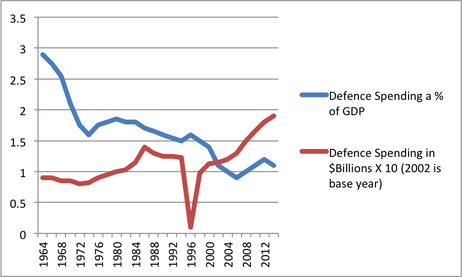
This graph, which is only rough, being drawn from three different sources and “rounded” for ease of plotting, shows, essentially, what happened between 1964 (Prime Minister Pearson) and 2014 Prime Minister Harper). As you can see defence spending as a percentage of Gross Domestic Product ~ a fair measure of our national, political commitment to our defence of Canada and of our allies and neighbours, has declined steadily even though, generally, with one “blip” in the Chrétien era, when he was trying to wrestle with the deficit, the actual dollars spent on defence have grown in number. What it really shows is that our GDP grew a lot in the past 50 years ~ it’s now almost $2.5 Trillion (that’s $2,500,000,000,000.00) ~ but our political willingness (or appreciation of the necessity) to spend 2% of GDP, as we did in about 1970s and as we have, sort of, agreed (in NATO) do aspire to do again, has not kept pace with our increasing prosperity. In fact, while the dollars spend on defence have doubled, in 50 years, the % of GDP spent of defence has fallen to ⅓ of its 1964 level. But ministers’ desires to “talk good fight” remain at historically high levels and even as resources shrink admirals and generals are told to “keep up appearances”. That, keeping up appearances, was what the admirals and generals wanted to do … no one really wanted to go into various international military fora and say “as our resources decline we’re going to have to do less,” instead they went out and said “we’re learning new ways to do more with less,” which is, of course, utter nonsense. Meanwhile more and more quite senior officers came back from tours of duty in the USA and brought with them some very American ideas about organization and management. Now American organizational models might work very well for armies with 1,000,000+ soldiers, or even for those with 495,000, like South Korea’s perhaps, even for those with 100,000+ like the French army, but they are not always or even often suitable for an army with 20,000± regulars and 25,000± reservists. The new organizations might make us look bigger, on paper, but they hide the fact the army has been hollowed out since 1970.
The Army of 1964, the one that consumed its fair share of the 3% of GDP that Canada spent on defence had four brigades, the largest had about 6,500 soldiers in it, the smaller ones had about 5,000 each. That was more men and women in combat units than we have in the entire, top heavy, Canadian Army today in total. But we still have three of the four brigades, we have nine instead of 13 battalions of infantry and three instead of four regiments of artillery … but how? Simple: it’s the Potemkin village, again, battalions that should have 950 soldiers have 500 … if their lucky. In fact there are no combat ready infantry battalions. Any battalion being readied for operations must be reinforced from other infantry battalions … we have nine battalion commanders and nine regimental sergeants major and so on but we only have enough soldiers in rifle platoons to staff five battalions … maybe only four if the battalions are properly equipped with mortars and heavy assault weapons. Why? Because no one, not ministers, not senior civil servants and not the generals want to “cut his coat according to his cloth.”
Ted Campbell, “A Canadian Potemkin Village”, Ted Campbell’s Point of View, 2016-09-15.
May 18, 2018
Deploy scare quotes as required when considering the “cultural” “impact” of the suburbs
Rick McGinnis has a thoughtful piece on the creation and evolution of the modern western suburb, in the context of the ongoing Ontario election:
Maybe it’s some remnant of our tribal past, but it’s hard for us to leave behind some impulse to fear and vilify whoever lives one village over, beyond the river or in the next valley. We might think we’re sophisticated, cosmopolitan people, but this nascent tribalism is never far from the surface, and I saw it re-emerge with a roar during recent municipal elections here in Toronto.
Back when the late Rob Ford won his surprise mayoral victory in 2010 – certainly a surprise for his opponents, who couldn’t imagine how decisively he’d win – the electoral post-mortems painted his triumph as the revenge of the suburbs that once comprised a group of independent townships over the downtown, Toronto’s older urban core.
It was a battle between the suburbs and the city, won this time by the suburbs, who rallied behind various standards – summed up in the media as a love of cars, ethnic and cultural homogeneity and lower property taxes. As with any history written by the losers – the media, for the most part, who identified as urbanite, not suburbanite – it relied on conveniently ignoring facts that didn’t fit, and the deployment of sweeping generalizations, many of them out of date – if they were ever true at all – by decades.
[…]
Up here in Ontario, the imminent provincial election means that the suburbs versus city scenario will be revived, to either apportion blame should Progressive Conservative leader Doug Ford become premier, or get unpacked if he loses and the boogeyman of a monolithic voting bloc needs to be triumphantly debunked.
There remains the small matter that Ford Nation events – held inevitably in the suburbs since the heyday of Doug’s brother Rob – are visibly far more diverse than, say, the average Liberal fundraiser, and Ford opponents have been chewing on that tough gristle for nearly a decade.
Obviously, the suburbs can’t be both a politically, economically and culturally monolithic place, and a diverse, complex collection of communities mysteriously moved to unite during election cycles to oppose the prerogatives of certain political parties and the urbanites who love them. There’s a very complex story about the suburbs dying to be told, but we’re still invested in stereotypes that are decades out-of-date for the purposes of situational political utility. It’s an object lesson that politics, more than anything else, is the enemy of truth.
Diversity has joined “marriage,” “rights,” “privilege” and “family” on that list of words that we’ve come to use without sharing a common meaning, especially when we talk about places like the suburbs, what have come to mean something very different in our imaginations than they exist in reality. For the people living there – whose lived experience has nothing to do with convenient fictions – the suburbs are really just a place where a mortgage might be affordable, where you can have a front and a back yard, and where you don’t share walls with your neighbours.
QotD: The purpose of propaganda
No one understood better than Stalin that the true object of propaganda is neither to convince nor even to persuade, but to produce a uniform pattern of public utterance in which the first trace of unorthodox thought immediately reveals itself as a jarring dissonance.
Leonard Schapiro, The Communist Party of the Soviet Union, 1960.
May 17, 2018
May 15, 2018
QotD: The making of Gandhi
As it happens, the government of India openly admits to having provided one-third of the financing of Gandhi out of state funds, straight out of the national treasury — and after close study of the finished product I would not be a bit surprised to hear that it was 100 percent. If Pandit Nehru is portrayed flatteringly in the film, one must remember that Nehru himself took part in the initial story conferences (he originally wanted Gandhi to be played by Alec Guinness) and that his daughter Indira Gandhi is, after all, Prime Minister of India (though no relation to Mohandas Gandhi). The screenplay was checked and rechecked by Indian officials at every stage, often by the Prime Minister herself, with close consultations on plot and even casting. If the movie contains a particularly poisonous portrait of Mohammed Ali Jinnah, the founder of Pakistan, the Indian reply, I suppose, would be that if the Pakistanis want an attractive portrayal of Jinnah let them pay for their own movie. A friend of mine, highly sophisticated in political matters but innocent about film-making, declared that Gandhi should be preceded by the legend: The following film is a paid political advertisement by the government of India.
Gandhi, then, is a large, pious, historical morality tale centered on a saintly, sanitized Mahatma Gandhi cleansed of anything too embarrassingly Hindu (the word “caste” is not mentioned from one end of the film to the other) and, indeed, of most of the rest of Gandhi’s life, much of which would drastically diminish his saintliness in Western eyes. There is little to indicate that the India of today has followed Gandhi’s precepts in almost nothing. There is little, in fact, to indicate that India is even India. The spectator realizes the scene is the Indian subcontinent because there are thousands of extras dressed in dhotis and saris. The characters go about talking in these quaint Peter Sellers accents. We have occasional shots of India’s holy poverty, holy hovels, some landscapes, many of them photographed quite beautifully, for those who like travelogues. We have a character called Lord Mountbatten (India’s last Viceroy); a composite American journalist (assembled from Vincent Sheehan, William L. Shirer, Louis Fischer, and straight fiction); a character called simply “Viceroy” (presumably another composite); an assemblage of Gandhi’s Indian followers under the name of one of them (Patel); and of course Nehru.
I sorely missed the fabulous Annie Besant, that English clergyman’s wife, turned atheist, turned Theo-sophist, turned Indian nationalist, who actually became president of the Indian National Congress and had a terrific falling out with Gandhi, becoming his fierce opponent. And if the producers felt they had to work in a cameo role for an American star to add to the film’s appeal in the United States, it is positively embarrassing that they should have brought in the photographer Margaret Bourke-White, a person of no importance whatever in Gandhi’s life and a role Candice Bergen plays with a repellant unctuousness. If the film-makers had been interested in drama and not hagiography, it is hard to see how they could have resisted the awesome confrontation between Gandhi and, yes, Margaret Sanger. For the two did meet. Now there was a meeting of East and West, and may the better person win! (She did. Margaret Sanger argued her views on birth control with such vigor that Gandhi had a nervous breakdown.)
I cannot honestly say I had any reasonable expectation that the film would show scenes of Gandhi’s pretty teenage girl followers fighting “hysterically” (the word was used) for the honor of sleeping naked with the Mahatma and cuddling the nude septuagenarian in their arms. (Gandhi was “testing” his vow of chastity in order to gain moral strength for his mighty struggle with Jinnah.) When told there was a man named Freud who said that, despite his declared intention, Gandhi might actually be enjoying the caresses of the naked girls, Gandhi continued, unperturbed. Nor, frankly, did I expect to see Gandhi giving daily enemas to all the young girls in his ashrams (his daily greeting was, “Have you had a good bowel movement this morning, sisters?”), nor see the girls giving him his daily enema. Although Gandhi seems to have written less about home rule for India than he did about enemas, and excrement, and latrine cleaning (“The bathroom is a temple. It should be so clean and inviting that anyone would enjoy eating there”), I confess such scenes might pose problems for a Western director.
Richard Grenier, “The Gandhi Nobody Knows”, Commentary, 1983-03-01.
May 11, 2018
Imagine Ontario’s election
Andrew Coyne on the fantasy campaign that is just kicking off in Ontario:
The first NDP ad of the 2018 Ontario election campaign invites viewers to “imagine a place” where hydro is cheap, drugs are free, and dental care is on the house — all at no cost to anyone except the “very rich” who will be “asked” to “pay a little more,” which I gather is NDPese for “taxed within an inch of their lives.”
That word — “imagine” — might be the theme of the coming election. The three major parties appear to be living in a world of the imagination, with platforms full of imaginary promises paid for with imaginary dollars. The province is sinking ever deeper in debt, notwithstanding the Liberal government’s desperate efforts to conceal it, its debt-to-GDP ratio headed for 45 per cent even after a decade or more of uninterrupted economic growth. A recession of any length or severity would blow that number skyward.
Beyond that the picture only grows darker, with the first of the baby boomers just into their 70s and the costs of health care projected to rise, relentlessly, as they grow into their dotage. And yet all three parties are merrily racking up new spending promises — daycare, pharmacare, dentacare, the works — with money they wouldn’t have even if the official budget numbers were genuine, and not, as the province’s auditor general has lately warned, a swindle and a fraud (I paraphrase). It’s an election in la-la land.
Oddly, this does not seem to be the conventional view. The advance word on the election, rather, is that Ontario is facing a choice of unprecedented starkness, a polarizing election with no one seeming to occupy the middle ground.
“It’s hard to remember a provincial campaign that’s featured two leaders so diametrically opposed to each other,” broadcaster Steve Paikin wrote recently, of the Liberals’ Kathleen Wynne and the Conservatives’ Doug Ford. “The political centre,” agrees the Globe and Mail’s Marcus Gee, “has vanished like a puddle in the sun.”
It’s true that the Liberals and the NDP are in something of a bidding war for the left-of-centre vote. If the March budget signalled a retreat from the Liberals’ not-overly-stringent devotion to fiscal restraint, the NDP platform goes further in every direction: about $4 billion a year further, in fact.


