
The last person to trust with power is someone who is dying to have it. The best person to wield power is someone who is reluctant to do so, but who will do it for a while as a civic duty. That is why term limits should make it impossible to have a whole career in politics.
Thomas Sowell, “A Few Assorted Thoughts About Sex, Lies And Human Race”, Sun Sentinel, 1998-11-28.
June 16, 2018
QotD: Term limits
Comments Off on QotD: Term limits
June 14, 2018
The economic idiocy of Canada’s supply management system
Andrew Coyne, who finally seems to have weaned himself off the PR voting jag, explains the Canadian government’s idiotic yet deeply entrenched supply management bureaucracy:
How did supply management, of all things, come to be at the centre of everything?
The policy, under which farmers in a number of sectors — milk, cheese, eggs, poultry — are organized into government-approved price-fixing rings, enforced by a complex system of quotas and protected by prohibitive tariffs on imports of the same goods, has been in place since the early 1970s. It affects fewer than 15,000 farmers nationwide, who between them account for less than one per cent of Canada’s GDP.
Yet it has somehow become the central issue not only of our domestic politics, but of international trade talks. It was the pretext for Donald Trump’s decision to impose tariffs on imports of aluminum and steel, and is his most-cited grievance with Canadian trade policy. As such, it has become the rallying cry of preening political patriots, each of the parties seeking to outdo the others in defence of a policy whose avowed purpose, let us remember, is to make basic food items more expensive for Canadians.
It has also become a source of deep division within the Conservative Party. It was already, of course, thanks to last year’s leadership race, in which Maxime Bernier made its elimination the central plank in his campaign, as Andrew Scheer made its retention the key to his. Indeed, Scheer’s narrow victory was directly attributable to the votes of thousands of Quebec dairy farmers, who took out party memberships for the sole purpose of ensuring Bernier’s defeat. It is even possible the Scheer campaign encouraged them in this endeavour.
[…]
There is no serious case for supply management — a policy that is is as unjust, inasmuch as it imposes the heaviest burden on the poorest families, as it is inefficient; that locks out new farmers and deters existing farmers from seeking new markets; and that makes us look utter hypocrites in free-trade talks, not only with the U.S., but the rest of the world — and no serious person whose livelihood does not depend upon it would make it.
And yet every member of every party is obliged to swear a public oath of undying fealty to it. That all do, but for one, is a sign of the institutional rot in our politics. For they do so not in spite of its awfulness but because of it — because the willingness to say two plus two equals five has become the ultimate test of loyalty.
On other issues, that might be because of genuine agreement. But a willingness to sign onto a truly hideous policy like supply management — that’s certain proof an MP is a “team player.”
Comments Off on The economic idiocy of Canada’s supply management system
QotD: The gender-neutral child
The media is full of excited stories heralding the revolution in children’s play. This recent headline in Time is typical: “The Next Generation of Kids Will Play With Gender Neutral Toys.” But children are not gender-neutral, and they famously resist efforts to make them so. If 40 percent of millennials think otherwise, that’s probably because they haven’t had kids yet.
Parents and teachers should certainly expose their kids to a wide range of toys and play, and teach them to accept kids who enjoy gender non-conforming toys. When toy companies rigidly classify certain toys as girl-only or boy-only, that may create a stigma against those who cross the line. Overt signage is superfluous anyway. So let’s hope other retailers follow Target’s example.
But the crusade promoted by the White House is not about tolerance for non-conformers. Its goal is to re-socialize the majority of gender-typical children toward gender neutrality. Jarret is right that it won’t be easy. With few exceptions, children are powerfully drawn to sex-stereotyped play.
Parents who read too much Judith Butler in college and view gender as fluid and malleable may be startled by the counterevidence their three-year-olds provide. The usually eloquent Julia Turner, editor of Slate, became tongue-tied a few weeks ago when she tried to explain a mysterious development at home: Her little twin sons were obsessed with wheeled objects — particularly cement mixers. Parenthood, she confessed, had “complicated” her worldview. Turner kept affirming her loyalty to the gender-is-a-social-construct school. But then, referring to her sons’ insistent boyishness, she uttered four heretical words: “There’s a there there…”
Indeed there is. And it takes a liberal arts degree not to see it. A 2012 cross-cultural study on sex differences confirmed what most of us see: despite some exceptions, females tend to be more sensitive, esthetic, sentimental, intuitive, and tender-minded, while males tend to be more utilitarian, objective, unsentimental, and tough-minded.
The female penchant for nurturing play and the male propensity for rough-and-tumble hold cross-culturally and even cross-species. Among our close relatives such as rhesus and vervet monkeys, researchers have found that females play with dolls far more than do their brothers, who prefer balls and toy cars. It seems unlikely the monkeys are acting out a culturally manufactured gender binary. Something else is going on. Most scientists attribute typical male/female differences to some yet-to-be understood combination of biology and culture.
Christina Hoff Sommers, “Those Who Push For Toy Neutrality Don’t Get Little Girls At All”, The Federalist, 2016-09-11.
Comments Off on QotD: The gender-neutral child
June 13, 2018
Imagine … a tariff-free world
Danny Chabino on what he calls “Trump’s G7 Surprise”:
In what I consider a brilliant move on the part of Trump and his team, instead of initially discussing what tariffs he would increase if x,y and z didn’t happen or if whichever nation wouldn’t reduce tariffs on whatever industry, he simply raised the simple question of why don’t we just not have tariffs at all? It’s brilliant in the sense that it not only shut down all the anticipated arguments, but also placed the world’s leaders in a position of having to awkwardly defend the very idea of tariffs (and subsidies), and they knew they couldn’t really do that. It highlighted the true intentions of the world’s leaders as representatives of the authoritarian nature of almost every existing government in the world today.
Now, please don’t misunderstand this article as me beaming with a Trump glow. In fact, Trump knew full well no one would take him up on such an offer. I do believe if they had he would have followed through, but his next moves will be ones that I believe are the wrong ones. He will seek to raise tariffs, which has always done more harm to the nation raising the tariffs than it has done good that nation. Trump will do just as he has threatened and hurt his own country;’s economy with new tariffs.
What I do enjoy, though, is that all of the world’s major leaders had to essentially admit that they don’t want their people and their economies to be better off. At least not on their own. They want their people and economies to be dependent upon their leadership and their governments. While everyone at the summit knew that the greatest of outcomes would be for all the world’s most powerful nations to exercise free trade, and that this would benefit the entire world in great proportions, that really wasn’t their aim. Their aim was to gain greater power. What an incredible admission!
When given a golden opportunity to end tariffs and increase freedom and prosperity for most citizens of the world, the world’s leaders instead chose to cling hard to their own designs. The world’s leaders know full well that tariffs hurt their own citizens, but they don’t care. Tariffs have never served the function of creating market efficiency, and they have never helped protect a nation’s economy. Instead, they have always been a means for governments to exercise control over huge parts of their own economies, and where there is control, there is power. Politicians and world leaders seek power. It’s like their drug of choice, and they can never get enough of it.
Comments Off on Imagine … a tariff-free world
QotD: Utopia
Utopia is not under the slightest obligation to produce results: its sole function is to allow its devotees to condemn what exists in the name of what does not.
Jean-François Revel, Last Exit to Utopia, 2009.
Comments Off on QotD: Utopia
June 11, 2018
L. Neil Smith on the Koch brothers and the libertarian movement
In the latest issue of the Libertarian Enterprise, L. Neil Smith discusses his experiences working with the Koch brothers:
It says here that David Koch is retiring. In case you don’t know, he is the younger of two oil billionaire brothers associated with the libertarian movement who bankrolled the Cato Institute, and whom “progressives” love to hate, automatically blaming them for what little they don’t blame Donald Trump for.
Genuine libertarians and conservatives don’t like them much, either, for a variety of reasons. My own first is that I served on the 1977 Libertarian Party National Platform Committee with Charlie, David’s older brother and found him to be a timid, unimaginative soul, more concerned with credibility and respectability than with truth or principle. At the time, the think-tank he and his brother created was attempting to turn the LP into a wholly-owned subsidiary (David ran in 1980 for Vice President with Ed Clark), and I didn’t like that, either.
The Koch brothers are also open-borderists, siding with establishment Republicans like that smirk-weasel Paul Ryan who want an imported servant-class they can abuse. I’ve changed my mind on that issue for good and sufficient reasons, and they ought to be good and sufficient for the Koch Brothers, too, if they were really libertarians. American culture is unique and wonderful; I do not want to see it changed or destroyed as the cultures of Sweden and England are being, by uncontrolled mass immigration. Letting a lot of Third Worlders into the United States of America is like letting a lot of Californians into Colorado. Pretty soon it’ll be just like the mess they made and left behind.
We have a saying here: “Don’t Californicate Colorado”.
David is retiring, it says here, due to an extremely long bout with prostate cancer. It does not say what his prognosis is. My own father, whom I miss every day, fought prostate cancer for six ghastly years and died. I’m sorry David has it now; I would not wish that fate on anybody.
But the reason I’m writing this is to speak the truth, to a great big pile of money, if not to power. The Kochs don’t have power because they don’t have a clue how to spend money politically, and, among other counter-productive follies, they threw their dough away with all four hands, supporting a think-tank incapable of reaching the people by the millions the way Donald Trump has. I have never known anyone who read a paper produced by the Cato Institute or listened to a lecture given by one of their wonks — except other wonks.
June 10, 2018
Why the Canadian media (and the Laurentian Elite) misjudge Trump
Ted Campbell provides a thumbnail sketch of Donald Trump and suggests why the Canadian establishment finds him so hard to understand (and to work with):
In the view of Professors Bradbury and Leuprecht Canada and all of the US’ competitors are falling into Trump’s trap and the WTO ~ and global fair trade ~ will be the chief victim because, from President Trump’s perspective it is better that we all sink into poverty as long as the US remains top dog.
OK, what do we actually know about Donald Trump? What drives his policy choices?
I’m going to engage in a bit of ‘pop psychology’ and very personal speculation to try to clarify my own thoughts about President Trump as he prepares to meet, in just a few hours, with the G7 in Canada.
Is he stupid? No, not really … perhaps not “well read” as, say, most presidents from George Washington and Thomas Jefferson through to George H.W. Bush and Barack Obama were, but he’s not a stupid man. Is he intellectually lazy? I believe so … I think that explains why he is reported to dislike sitting through briefings and so on; he seems to want to follow his own instincts and cut through all the details, especially those which might not support his instinctive preferred course of action.
Is he a racist? The available evidence says “No,” he’s not. Is he Islamophobic? Not likely, I think. Is he a white supremacist? Not that, either, in my view, but it may be closer to his ‘basic instincts.’ He is, I suspect, something a kin to the Nativists who sprung up in mid 19th century America. He is, I believe, suspicious of everyone who is not a born and bred American. It not a racist or religious thing, it is simple nationalism of a rather narrow and nasty sort.
I think he is also, or wishes to be, an isolationist; I suspect he actively detests the World Trade Organization, the United Nations, the World Court, the International Monetary Fund, the Organization of American States, NATO and, possibly, even bilateral even NORAD because he sees each as an attempt by foreigners to entangle America and tie its hands. He is said to be less opposed to bilateral deals in which the US is, inevitably, the major partner but dislikes multi-lateral deals wherein American can be outnumbered and outvoted by others. he seems not to care who the “others” are … foreigners are foreigners, none are friends.
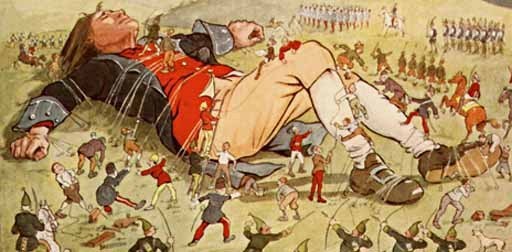
He is, as I have said before, an instinctive man; he makes up his mind quickly ~ although he may change it, by a full 180°, in hours or days ~ based on the evidence he wants to hear and believe, and I suspect that his instinctive reaction to the world is the America is like a modern day, national Gulliver, marooned in a hostile, greedy world and tied down by agreements and treaties and institutions created by little people …
… and then forced to abide by the little peoples’ rules.
[…]
His view of “winning,” it seems to me, owes more to Conan the Barbarian than to Adam Smith or Andrew Carnegie. Thus, I think Time has it about right … he wants to be an absolute monarch.
In fact, I think he shares Prime Minister Justin Trudeau’s “admiration” for China’s “basic dictatorship, which “allows them to turn their economy around on a dime.” Since I don’t think he, Trump, or Trudeau for that matter, knows much about economics I can only conclude that he admires Xi Jinping’s ability to exercise dictatorial power and throw his perceived enemies in jail on a whim.
That, I suspect, is President Trump’s “basic instinct:” he wants to be the absolute monarch of whatever enterprise with which he happens to be involved ~ property development, repeated bankruptcy proceedings, reality TV shows and now the US presidency. I’m guessing that we might have Donald Trump in the White House until 2020 … his view of America in the world, as Gulliver, is shared by many millions of his fellow citizens and the US Democrats seem, at best, incoherent in policy terms.
Comments Off on Why the Canadian media (and the Laurentian Elite) misjudge Trump
June 9, 2018
The (formerly) friendly Bobby – “The police have been alienating their erstwhile natural friends for some time”
Patrick West on the long decline in public trust for British police:
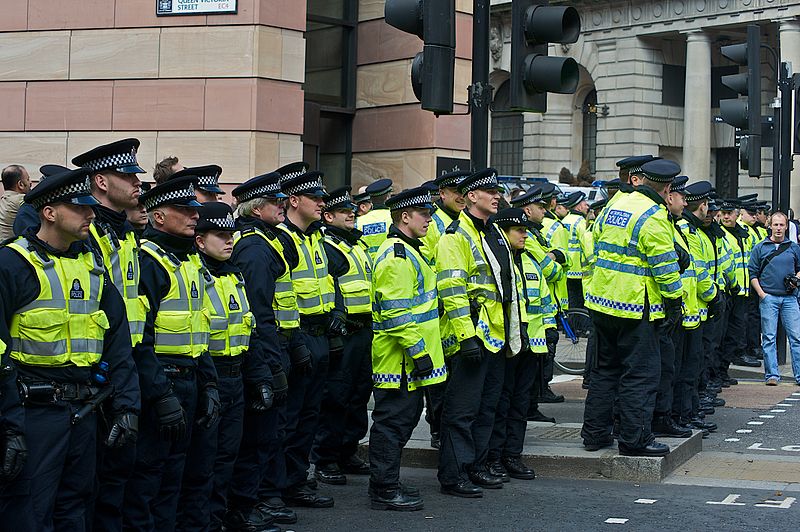
Metropolitan Police at G20 protests in London, 2009-04-01
Photo via Wikimedia Commons
In Britain, there have traditionally been two sections of society who dislike the police. One type are radicals – or pseudo-radicals, as epitomised by the capitalist-run store Lush and Rik from The Young Ones – who object to the forces of law’n’order on anarcho-libertarian grounds. The police for them are ‘pigs’. The other type are the working class, or sections of it, who object to the police on account of them poking their nose into private matters that don’t concern them. The police for them have historically been ‘the filth’.
Yet the police are now widely disliked beyond those two demographics. These days, even conservatives and the respectable middle class don’t like the rozzers. A story beyond the hoo-ha over Lush and its anti-police ads might help to explain why.
This year there has been a litany of reports about rape cases collapsing owing to police failing to investigate evidence that would have exonerated the defendants. And this week it was revealed that 47 rape and sexual-assault cases in England and Wales were halted between January and mid-February because evidence was withheld from defence lawyers.
This is not entirely the police’s fault. They have been under political pressure from lobby groups obsessed with attaining rape conviction quotas – as if justice was about achieving statistical targets, rather than punishing guilty individuals and letting innocent individuals go free. As the Daily Telegraph, a newspaper that should be a natural friend of the police, put it: ‘It is hard not to conclude that under pressure to increase conviction rates, the police and prosecutors simply withheld evidence that would help the defence, in order to make a successful prosecution more likely.’
The police have been alienating their erstwhile natural friends for some time. This first became evident at the end of the last century, with the jailing of the Norfolk farmer Tony Martin for shooting dead a burglar who had broken into his home. The consequent outrage in the conservative press stemmed from a belief that the police were now more concerned with the human rights of criminals than with crimes against private property, in this case.
Comments Off on The (formerly) friendly Bobby – “The police have been alienating their erstwhile natural friends for some time”
Various comments on the Ontario election
Once the voting was underway, I briefly checked my Facebook feed and, as expected, saw a lot of declared support for the NDP (even among those who normally lean Liberal), a few of the more outspoken Conservatives fighting their corner, but others I think of as Conservative-leaning were generally being very quiet. I didn’t bother with my Twitter feed, as relatively few of the people I follow are from Ontario, and the same for my Gab feed (Twitter biases as far left as Gab tends to the far right).
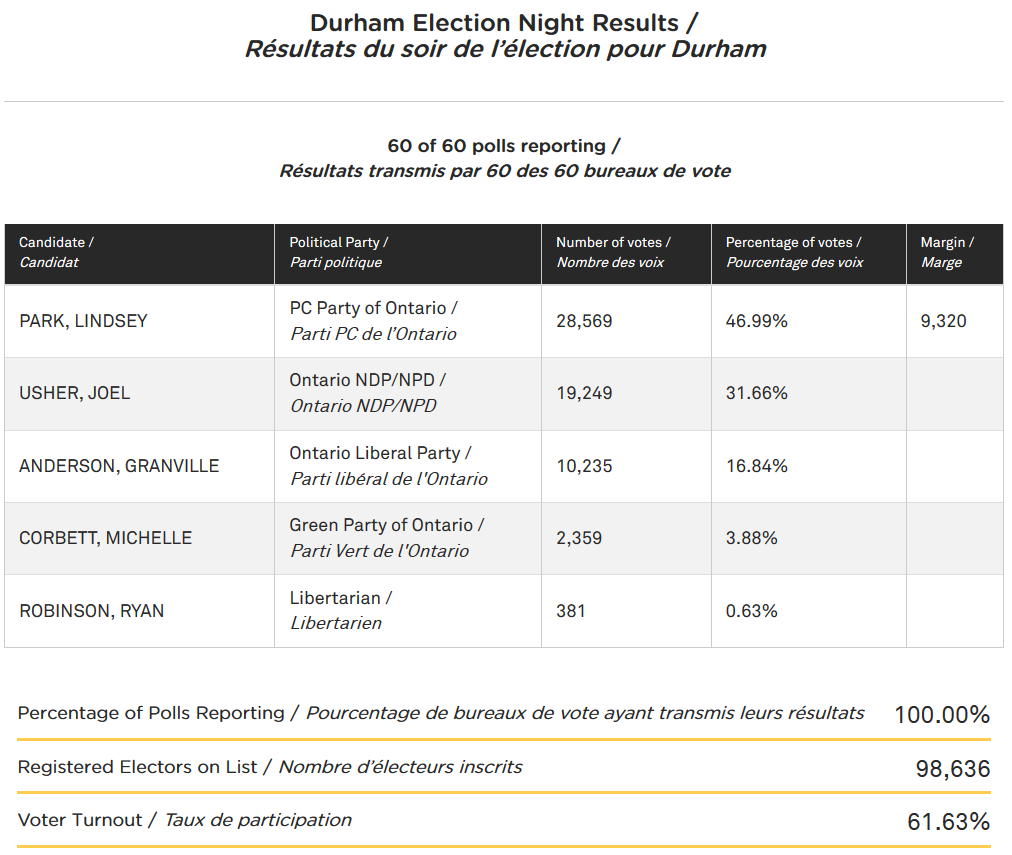
When I went in to vote (I had a Libertarian candidate in my riding), I asked the poll clerk if there had been any ballot refusals and she said “there’d been a few”. The preliminary results shown on the Elections Ontario site for my riding:
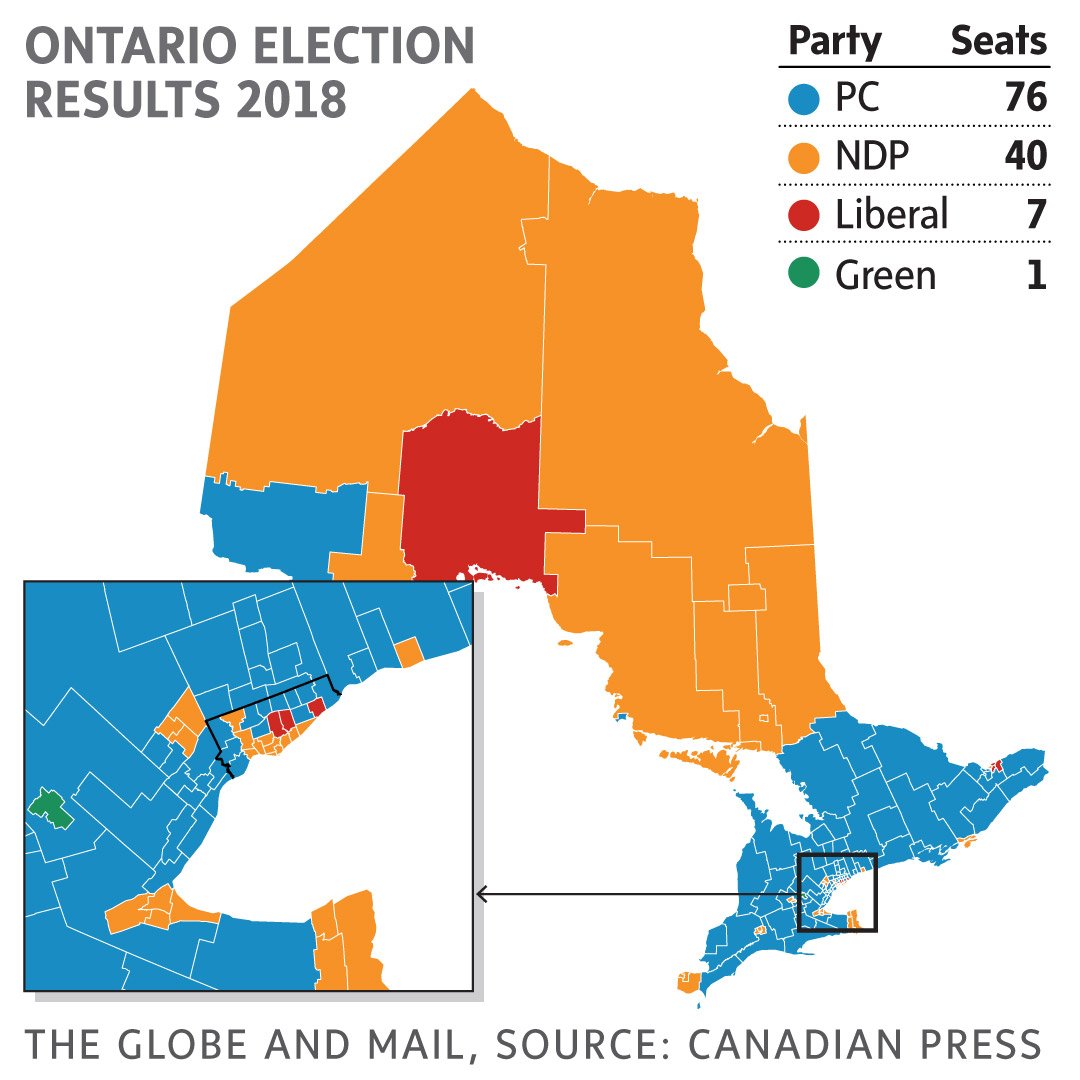
The Globe and Mail sent a tweet showing the overall shape of the PC victory:
David Warren commented on the election results:
My Chief Texas Correspondent leaps naturally upon the result of yesterday’s Ontario provincial election, in which our governing Liberals were annihilated. He sees this as a conventional “shift to the Right,” in Merican party terms, and celebrates it as such.
To which I reply: that the moronic city voters went not Right but over to the NDPee, which promised more spending than even the Liberals could imagine, and various grand new welfare schemes. (They are a zoological garden of various activist nutjobs.) Our outgoing premier’s personal charmlessness factored into the result. The winning Doug Ford is a total clown, and the media will have him for breakfast and snacks, yet for one brief glorious moment the Leftoids are in disarray. Ford is no Trump, though he might be able to match your esteemed President in straightforward vulgarity. He cannot have the fondest clew what he will do with the mess he has inherited, now that he is in power. He will have to betray that half of his constituency to which he promised the opposite of what he pledged to the other half, with unstudied vagueness. His caucus will be crawling with Suburban Saracens and other multicultural eccentrics — not the old solid Tory phalanx of white, Presbo-Methodist, rural hicks. Alas, though the ride may be wild, it won’t be fun to watch.
At BlogTO, Lauren O’Neil gathers a lot of Toronto-centric Twitter comments (not surprisingly, most are not complementary toward the Premier-elect (who, I’m informed we should more accurately be calling the Premier-designate instead)).
Kathy Shaidle posted on Facebook:
Am I relieved? You bet. But: Remember how close the polls were. The NDP got a lot of votes, and while our system means that the PCs won, the “popular” vote still shows how many leftoids there are in the province. And who else noticed that Doug’s “enthusiastic” official opening lines — “What a response. This is incredible.” — was scripted, and delivered with the stilted conviction of an Ed Wood stock player? On that note, I’ve seen less wooden Chippendale highboys…
Comments Off on Various comments on the Ontario election
June 8, 2018
The British political scene has all the horrific fascination of a slow-motion car crash
Colby Cosh says that anyone who claims to be shocked and appalled at the Ontario political mess need only glance across the pond to put things into proper perspective:
The one thing everyone seems to agree upon about Ontario’s provincial election is that it has been all kind of horrid, strange and exhausting; if there is another thing they agree upon, it is that Ontario politics will probably continue to be horrid, strange and exhausting for a while even when it’s over. I have one word for these people: Brexit. Try following U.K. politics for a while in the era of British secession from the European Union. You will scurry, shrieking, back to Queen’s Park soon enough.
The Brexit drama is a mesmerizing blend of jargon and impotence, frustration and confusion; it is a vivisection of democracy from which Britain cannot avert its gaze. In Ontario you still have distinguishable political parties: in Britain now, familiar entities have been altogether dissolved into underlying tendencies, shades and conspiracies. So-and-so is a “soft Brexiter.” How soft? Oh, not as soft as Mr. Whatnot, but distinctly softer than Miss How-Do-You-Do. Mysterious verbal puzzles — do you favour the “single market” or the “internal market”? — become theatres of struggle.
A bonus of Brexit-watching for us is that, over the past six months or so, you have often been able to get the brief neurochemical pop that Canadians all receive when Canada is mentioned abroad. The Canada-EU free-trade deal CETA, which you may remember being signed in October 2016 after some obscure trouble with Walloons, has turned out to be an important anchoring concept in the Brexit debate. CETA is the European Union’s most liberal and comprehensive trade deal with an offshore non-member — and that is just what Britain voted to become.
Advocates of a “hard” Brexit, with no judicial, bureaucratic or fiscal ties to the continent, began pointing to CETA as a readymade model for Britain-EU relations almost before the ink was dry. Problem: CETA broadly allows free movement of goods between Canada and Europe, but services are not included. Britain doesn’t make much physical stuff anymore, and it quit digging coal; it depends especially heavily on providing financial services to the world.
Comments Off on The British political scene has all the horrific fascination of a slow-motion car crash
June 7, 2018
Faith Moore explains how to avoid sexually objectifying women
It’s apparently very simple and straightforward, once you double-check the feminist cheat sheet:
Apparently feminism has become so confusing that even feminists don’t know what’s feminist anymore. But Everyday feminists apparently do — and they’ve provided us with a handy cheat sheet so we don’t accidentally objectify someone who was trying to be empowered, or empower someone who was trying to be objectified.
The way to tell the difference, according to Everyday Feminism, is to figure out who has the power. “If the person being ‘looked at,’ or sexualized, has the power in the situation, then they are sexually empowered.” Here’s an example: “if someone puts on ‘sexy’ clothing and goes out in public or takes a selfie and shares it, they have the power because they chose themselves to put on those clothes.”
Oh, okay, I get it. So, if a woman chooses to put on “sexy” clothes and go out in public then all the catcalls and inappropriate comments and unwanted marriage proposals are empowering because she chose to put on those clothes. Oh, and also if she takes a “sexy” selfie and posts it on Instagram, all the comments about how she’s a “slut” and a “whore” and should “put her clothes on” are also empowering because she chose to share that photo. (I’m learning so much!)
But wait! Apparently beauty standards “compel” some people to wear sexy clothing “because they believe that they won’t be beautiful” otherwise. And there are even some people who feel they must not wear sexy clothing “because they are shamed if they do.”
So even if you think you put on those clothes of your own free will, it’s possible that society was actually hiding in your closet handing you things to put on (which is creepy) and that’s why you dressed all sexy (or not sexy). Which means that even though you thought you were empowered, it turns out you’re actually being objectified. And if you choose not to dress in the way you wanted to dress because society tells you that society was telling you it was wrong, then you’re empowered because you’re doing what someone else told you not to do about what someone else told you to do. (This makes total sense. I’m such a good feminist!)
But what about people who don’t dress “sexy”? Don’t worry, they can be objectified too. “Even a person who is ‘modestly’ dressed can objectified if the ‘looking’ person makes a non-sexual situation sexual without the ‘looked at’ person’s consent.” Oh good, for a minute there I thought “modestly dressed” people were being excluded from objectification and was worried because I know exclusion is wrong and we shouldn’t do it. Phew! Glad that even people who don’t want to be objectified still can be.
Comments Off on Faith Moore explains how to avoid sexually objectifying women
June 6, 2018
June 5, 2018
Down with the experts!
In Quillette, Alex Smith explores the limits of expertise and why so many people today would eagerly agree with the sentiments in my headline:
“People are sick of experts.” These infamous and much-derided words uttered by UK Conservative parliamentarian Michael Gove express a sentiment with which we are now probably all familiar. It has come to represent a sign of the times — either an indictment or a celebration (depending on one’s political point of view) of our current age.
Certainly, the disdain for expertise and its promised consequences have been highly alarming for many people. They are woven through various controversial and destabilising phenomena from Trump, to Brexit, to fake news, to the generally ‘anti-elitist’ tone that characterises populist politics and much contemporary discourse. And this attitude stands in stark contrast to the unspoken but assumed Obama-era doctrine of “let the experts figure it out”; an idea that had a palpable End of History feeling about it, and that makes this abrupt reversion to ignorance all the more startling.
The majority of educated people are fairly unequivocal in their belief that this rebound is a bad thing, and as such many influential voices — Quillette‘s included — have been doing their best to restore the value of expertise to our society. The nobility of this ambition is quite obvious. Why on earth would we not want to take decisions informed by the most qualified opinions? However, it is within this obviousness that the danger lies.
I want to propose that high expertise, whilst generally beneficial, also has the capacity in certain circumstances to be pathological as well — and that if we don’t recognise this and correct for it, then we will continue down our current path of drowning its benefits with its problems. In short, if you want to profit from expertise, you must tame it first.
[…]
However, it is worth drawing a distinction between these two types of expertise — the kind people question, and the kind people don’t. In short, people value expertise in closed systems, but are distrustful of expertise in open systems. A typical example of a closed system would be a car engine or a knee joint. These are semi-complex systems with ‘walls’ — that is to say, they are self-contained and are relatively incubated from the chaos of the outside world. As such, human beings are generally capable of wrapping their heads around the possible variables within them, and can therefore control them to a largely predictable degree. Engineers, surgeons, pilots, all these kinds of ‘trusted’ experts operate in closed systems.
Open systems, on the other hand, are those that are ‘exposed to the elements,’ so to speak. They have no walls and are therefore essentially chaotic, with far more variables than any person could ever hope to grasp. The economy is an open system. So is climate. So are politics. No matter how much you know about these things, there is not only always more to know, but there is also an utterly unpredictable slide towards chaos as these things interact.
The erosion of trust in expertise has arisen exclusively from experts in open systems mistakenly believing that they know enough to either predict those systems or — worse — control them. This is an almost perfect definition of hubris, an idea as old as consciousness itself. Man cannot control nature, and open systems are by definition natural systems. No master of open systems has ever succeeded — they have only failed less catastrophically than their counterparts.
Comments Off on Down with the experts!
June 4, 2018
The economic damage of tariffs
Tim Worstall fisks a recent Pat Buchanan brain fart article on the glories of erecting tariff walls against foreign trade:
Pat Buchanan has been going on for decades about how wondrous tariffs are and if only they were brought back then things would be just peachy. Sadly, this all seems to be based on his not understanding trade, tariffs, nor apparently even history. That’s not a good set of recommendations for a policy about trade and tariffs, one that has been tried many a time in history.
Now, it is entirely true that if we returned to a more Hamiltonian policy era then we’d all be richer. But that wouldn’t be because we had tariffs which paid for government rather than an income or corporate tax. It’s because government would be confiscating a very much smaller portion of what we all produce to pay for itself. If the Feds took 3% of everything we do instead of the current 18% or so then sure, we’d all be richer. But that’s true however that tax is raised.
[…]
His argument is that, protected from foreign competition, American business was able to develop and grow into being world beaters. No, I don’t think this is true – I insist that behind tariff barriers companies stagnate. Indeed it’s standard economics that the medium to long term effects of trade are that the competition from foreigners is what makes the domestic companies stronger and more productive. But put that argument to one side. Assume that Buchanan is correct.
For his conclusion to be correct then it must have been true that the total costs of trade were rising in that time period. Total costs being tariffs plus transport. Only if the total costs were rising was protection rising. The tariffs are only part of the story. And as it happens total protection was falling over this time period. The falls in the costs of transport – for the US externally primarily the steam ship – were greater than the rises in the tariffs. Thus the US was becoming more open to trade at this time when industry was booming and growing to world class levels.
That’s not an argument in favour of trade protection now, is it?
The U.S. relied on tariffs to convert from an agricultural economy in 1800 to the mightiest manufacturing power on earth by 1900.
Well, it’s also true that what the US was inside those tariff barriers was the largest free trade area in the world. I’m the guy insisting that free trade makes places grow, Pat the opposite. And the place with more free trade among more people than anywhere else grows fastest? That’s a point in my favour, no, not Pat’s? Remember, the US Constitution expressly forbids the individual states from having tariffs between them…..that regulation is left to the Feds who have never imposed them.
How have EU nations run up endless trade surpluses with America? By imposing a value-added tax, or VAT, on imports from the U.S., while rebating the VAT on exports to the USA. Works just like a tariff.
No, a VAT does not work like a tariff. In no manner at all does it do so in fact. As every economist keeps trying to point out. Within the EU all goods and services, no matter where they’re made, pay the exact same rate of VAT. Well, OK, ladies unmentionables pay a lower rate than motor cars, that’s true, but all unmentionables pay the same rate, all cars. There is no difference made between domestic and foreign production. It’s entirely unlike a tariff therefore, the crucial component of which is that distinction made between home and foreign production.
Stuff made in the EU and sold in the US pays no VAT. Stuff made in the US and sold in the US pays no VAT. Again, we’ve no distinction by source or origin, this is entirely and completely unlike a tariff.
Comments Off on The economic damage of tariffs
QotD: Pushing the Confederacy down the memory hole
Lately, I have been mightily irritated by the politically-correct campaign to permanently banish the old Confederate flag, and all music associated with the Southern cause, or any symbol that it once existed, before it was comprehensively defeated a century-and-a-half ago. Memorials of Robert E. Lee are being treated as memorials of Adolf Q. Hitler.
It strikes me that even under the old lamentable cotton-plantation slave system of the South, people mixed and got to smell one another — rich and poor, black and white, genteel and grotesque. That, the most forgotten slogan of the Dixie Land was her war cry: “Down with the Eagle, and up with the Cross!” That, it is the Cross of Saint Andrew astride the old Confederate flag that is most galling to the hyper-secular, liberal mind. That, the greatest triumph of the Union propaganda was to tar all those flag-bearers in the way our contemporary media demean all dissenters from the current party line as “racists,” “sexists,” “phobes,” and nothing more. That, the principal crime of the South was to stand by the wording of the U.S. Constitution, and from the beginning, to get in the way of a grand national scheme for social engineering, which triumphed with Lincoln (though hardly a liberal by the standards of today). That, in the Southern view, the eagle swooped down on them, with claws.
Something similar is now happening in the division of “Red States” and “Blue”: in an America from which the Christian conception of the “common man” is being systematically expunged. All who resist the categories to which they have been assigned are instinctively rebelling; “victim” and “oppressor” alike. This is what “common men” will do, when tarred and pressed, often without fully understanding why they rebel. They remember, however obliquely, whose sons and daughters they are. That, no matter how low in social station, they are Christ’s, and not the segregated chattels of some malicious and incompetent — and intentionally divisive — Washington Nanny.
The recovery of USA, and more largely, the recovery of Christendom, turns on the recovery of this conception of the “common man” — as Man, not as member of a client group. This has nought to do with “equality,” for it is none of a government’s business to help one group get even with another. Rather it is to serve man as man. This is a matter that goes deeper even than slavery, as Saint Paul explained. It is an unarguable, even mystical point. Where that conception survives, of the common in man, Christendom persists, and can potentially flourish.
David Warren, “The common man”, Essays in Idleness, 2016-08-29.


