
This demands a continuous alteration of the past, made possible by the system of thought which really embraces all the rest, and which is known in Newspeak as DOUBLETHINK.
The alteration of the past is necessary for two reasons, one of which is subsidiary and, so to speak, precautionary. The subsidiary reason is that the Party member, like the proletarian, tolerates present-day conditions partly because he has no standards of comparison … This day-to-day falsification of the past, carried out by the Ministry of Truth, is as necessary to the stability of the regime as the work of repression and espionage carried out by the Ministry of Love.
The mutability of the past is the central tenet of Ingsoc. Past events, it is argued, have no objective existence, but survive only in written records and in human memories. The past is whatever the records and the memories agree upon. And since the Party is in full control of all records and in equally full control of the minds of its members, it follows that the past is whatever the Party chooses to make it. It also follows that though the past is alterable, it never has been altered in any specific instance. For when it has been recreated in whatever shape is needed at the moment, then this new version IS the past, and no different past can ever have existed … It is also necessary to REMEMBER that events happened in the desired manner. And if it is necessary to rearrange one’s memories or to tamper with written records, then it is necessary to FORGET that one has done so. The trick of doing this can be learned like any other mental technique. It is learned by the majority of Party members, and certainly by all who are intelligent as well as orthodox. In Oldspeak it is called, quite frankly, “reality control”. In Newspeak it is called DOUBLETHINK.
George Orwell, Nineteen Eighty-Four, 1949.
May 4, 2021
QotD: DOUBLETHINK
May 1, 2021
The more we ask governments to do, the less well they do … everything
Matt Gurney’s latest Code 47 post reflects on the good and bad of Canadian governance right now (and yes, I agree with his basic take that despite buffoonery and incompetence at all levels of government, Canadians still generally have it good):

Parliament Hill in Ottawa.
Photo by S Nameirakpam via Wikimedia Commons.
In some ways, absolutely. Canada’s relative awesomeness is not an accident. We rest on the accomplishments of prior generations and some of what we do today contributes directly to the common prosperity. A ton of stuff happens behind the scenes, every day, that contribute enormously to our way of life — really, make it possible. But in other ways, the pandemic has revealed just how incompetent and inept our governments have become meeting new challenges. It’s like every last bit of bandwidth our governments have is used up just keeping the status quo running along, and if we ask it to do anything new, it’s like hitting a computer with one process too many for its CPU. It just locks up.
Real-life example: I was watching today as the Ontario and federal governments continued bickering about the proper border controls we should have during what will probably be the last phase of this crisis. And what struck me was the sheer insanity of not having settled this a long time ago. I’m not even saying what I think the answer should have been. There’s a lot of genuinely competing interests there. I have my opinion, you can have yours. But can we at least agree that what to do about the goddamn borders ought not to still be under active decision 14 frickin’ months after this all began?

The federal government, in particular, seems to have fallen into a trap of its own making in that it corporately seems to believe that saying they’ll do something is exactly the same as actually doing something. Often enough, I’m pleased and relieved to find that Trudeau Jr.’s latest brain fart never got further than the press release and obligatory photo op, but it has become a constant in federal affairs. Optics matter far more than achievements, as long as the tame Canadian media play along — and they always played along with their boyfriend PM even before he bought them off with real money — nothing really changes. And everyone seems generally okay with this … except that real problems are not being addressed (ask any First Nations representative about how well the feds are helping with long-standing, known issues, for instance).
Certain provinces have done better than others. It’s tempting to point at them and go, ah ha, there’s what we should have done. And I think this is in large part fair and true. But it’s hard to make direct comparisons. Nova Scotia is not Ontario, and what worked in Nova Scotia wouldn’t necessarily have worked here. Believe me, if I could have swapped in their leaders for ours, I would have. It would have been an upgrade for sure. But the right solution, and personalities, for one crisis, in one time and place, aren’t necessarily the right solution for even that same crisis, at the same time, in a different place. I suspect we’ll spend a long time arguing about this once it’s all over, but I think that’s more or less where I’ve landed. Most of us would have been better off trying to be more like the Atlantic, but that doesn’t mean it would have recreated Atlantic-like successes everywhere.
But all that being said, there have been enormous basic failures, both in leadership and execution. You’ve all heard the joke about how someone new to government is shocked and dispirited to finally seize the levers of power, only to discover they’re not connected to anything. You can push and pull the levers all day long. But they don’t do anything. In Canada, both federally and in some of the provinces, we’ve been shockingly slow, again and again, to pull those levers. And sometimes, even after they’re pulled, nothing happens.
I don’t know if I have this thought through yet in a meaningful, useful way. This is a big, big idea that I’m starting at from different angles, trying to even conceive of its dimensions and scope. But if there is one problem we have — we have more, but if there is a meta-problem — I think it is that Canadian governments have lost the ability to execute new policy agendas. What we already have will generally work, more or less. But new things, or updates to old things? We routinely accept that failure is an option, or that even our successes will be late and overbudget — beyond acceptable real-world margins. (Life is always more complicated than theory.) There are things in my life that I just take for granted will work. If I get into my car and it doesn’t start, that surprises me, even though I am intellectually aware that that’s a possibility every time I try. But too often, with government, there is an entirely justified skepticism that it’ll succeed at all, let alone as intended, and yet, we shrug, because, hey. It’s Canada. Things are still good. How upset can I get about another program failure when I can just go fire up the barbecue and watch some hockey or something.
Governments are generally not very good at solving problems, especially novel problems that don’t already have a template to follow for success in similar circumstances. Set up a bureaucracy, establish processes and procedures, and set it in motion and it’ll carry on until the final Trump, but don’t ask it to cope with a crisis or even just an unexpected event or six. That’s not what they’re good at and they generally lack the organizational flexibility to adapt on the fly. Or at all.
QotD: “WOLF! Film at 11”
Natalie Solent, “Why do Americans think the media might be hiding things from them? Let’s try asking Tony Bobulinski on Twitter”, Samizdata, 2021-01-13.
April 25, 2021
They don’t call it “neo-Marxism”, but that’s what Critical Race Theory really is
In City Journal, Christopher Rufo explains why Critical Race Theory is a natural child of orthodox Marxist thought:
Critical race theory is an academic discipline, formulated in the 1990s and built on the intellectual framework of identity-based Marxism. Relegated for many years to universities and obscure academic journals, it has increasingly become the default ideology in our public institutions over the past decade. It has been injected into government agencies, public school systems, teacher training programs, and corporate human-resources departments, in the form of diversity-training programs, human-resources modules, public-policy frameworks, and school curricula.
Its supporters deploy a series of euphemisms to describe critical race theory, including “equity,” “social justice,” “diversity and inclusion,” and “culturally responsive teaching.” Critical race theorists, masters of language construction, realize that “neo-Marxism” would be a hard sell. Equity, on the other hand, sounds non-threatening and is easily confused with the American principle of equality. But the distinction is vast and important. Indeed, critical race theorists explicitly reject equality — the principle proclaimed in the Declaration of Independence, defended in the Civil War, and codified into law with the Fourteenth and Fifteenth Amendments, the Civil Rights Act of 1964, and the Voting Rights Act of 1965. To them, equality represents “mere nondiscrimination” and provides “camouflage” for white supremacy, patriarchy, and oppression.
In contrast to equality, equity as defined and promoted by critical race theorists is little more than reformulated Marxism. In the name of equity, UCLA law professor and critical race theorist Cheryl Harris has proposed suspending private property rights, seizing land and wealth, and redistributing them along racial lines. Critical race guru Ibram X. Kendi, who directs the Center for Antiracist Research at Boston University, has proposed the creation of a federal Department of Antiracism. This department would be independent of (i.e., unaccountable to) the elected branches of government, and would have the power to nullify, veto, or abolish any law at any level of government and curtail the speech of political leaders and others deemed insufficiently “antiracist.”
One practical result of the creation of such a department would be the overthrow of capitalism, since, according to Kendi, “In order to truly be antiracist, you also have to truly be anti-capitalist.” In other words, identity is the means; Marxism is the end.
An equity-based form of government would mean the end not only of private property but also of individual rights, equality under the law, federalism, and freedom of speech. These would be replaced by race-based redistribution of wealth, group-based rights, active discrimination, and omnipotent bureaucratic authority. Historically, the accusation of “anti-Americanism” has been overused. But in this case, it’s not a matter of interpretation: critical race theory prescribes a revolutionary program that would overturn the principles of the Declaration and destroy the remaining structure of the Constitution.
The causes and effects of “ostrich parasitic syndrome”
Barbara Kay on Canadian academic Gad Saad, who sometimes lets his “inner honey badger” get out on social media:

Gad Saad 2010 JMSB Faculty Portrait
Saad, 57, is a professor of marketing at the John Molson School of Business at Montreal’s Concordia University. His domain is evolutionary psychology as applied to business — a niche field, to be sure. He’s written such papers as “Gender differences in information search strategies for a Christmas gift,” and “Menstrual cycle effects on prosocial orientation, gift giving and charitable giving,” which provide valuable information to guide marketing strategies.
You’d be hard pressed to find any academic in Canada who’s more deeply steeped in knowledge about the ineluctable differences between the sexes. (Speaking of “the sexes,” business schools may be the last places left in academia to use those words to designate men and women and acknowledge their differences. Perhaps because their students want to succeed in the real world.)
[…]
Since then, Saad has understood the absolute necessity for critical thinking and freedom of speech. In the present, unhealthy climate, feelings rule, while critical thinking’s value declines daily. Just as our immune systems are designed to cope with novel intruders or atrophy, if we live in an intellectual bubble — as university students do now, rarely confronting opposing views — our cognitive immune systems atrophy, Saad says.
The consequence is what Saad calls “ostrich parasitic syndrome” (OPS). This disorder, in his words, “causes a person to deny realities that are otherwise as clear as the existence of gravity.” Science, reason, infinite data, common sense — all are rejected.
Cognitively disarmed, OPS sufferers accept alternate realities: climate change is “related to terrorism” (Bill Nye, the “science guy”); it is “gross and racist” to suggest Islam is connected to Islamism (Ben Affleck); the Israeli military “dehumanizes” Palestinian women by choosing not to rape them (not a typo: this was the thrust of an award-winning thesis by a radically leftist Israeli sociologist); men can literally be women (nearly everyone says this now, for fear of being labelled transphobic).
It used to be that you could “stand off on the sidelines” when you called out postmodern BS. No longer. There’s no middle ground anymore. You call out the BS or you keep schtum. If you choose the former, as Saad’s writing and actions demonstrate, you need to cultivate your own inner honey badger. Nothing else works.
QotD: “The Great Satan”
Bob Tarantino, “LIB Review: It’s the Crude, Dude”, Let It Bleed, 2005-03-05.
April 24, 2021
[“white” evil is] “not only objectivity, individualism, and writing, but linear thinking, quantitative reasoning, the Protestant work ethic, planning for the future, and being on time”
The latest post by John McWhorter at It Bears Mentioning discusses the “white” behaviours and thought patterns that many activists believe are as harmful to American blacks as outright white supremacism:
John McWhorter’s Twitter thumbnail image
The organization 1776Unites, founded by my mentor and model Bob Woodson, has tweeted out a video where various black people decry a now fashionable idea that “whiteness” includes being smart. As in, precise, objective, fond of the written word, oriented towards dispassion, on time.
Those things are all manifestations of intelligence, vigilance, discipline. But according to our Elect folk, we black people are best off channeling our Crazy Badass Mothafucka. Because that’s more “authentic.” And, I get the feeling, fun to watch.
Because so many think that the battle that I and others are waging against Critical Race Theory’s transmogrification into education for children is an obsession with something that isn’t a real problem, I want to explore a bit. Someone I deeply respect not long ago surmised to me that the idea that black kids should be exempt from real standards is something being promulgated via mere paper “handouts,” and that the real problem is censorship from the right. I just don’t think so.
First, watch this, the 1776Unites video. Just a few minutes.
And now, as to what we are referring to, it starts actually before last summer. I knew something was really wrong when in 2019 at a conference in New York City for the city’s principals and superintendents, participants were presented with an idea that to teach with sensitivity to race issues meant keeping certain issues in mind.
These included ways of looking at things that are “white” rather than correct: namely, objectivity, individualism, and valuing the written word. Schools Chancellor Richard Carranza was fine with this, happily telling the media that it’s white people’s job to do the “work” of identifying the racist assumptions in how they go about their business.
So: to stand outside of matters and analyze them with one’s own private mind, and perhaps couch one’s conclusions with the considered artifice of writing rather than the spontaneity of speaking, is inauthentic for black and Latino people. It is racist to impose such things on black and Latino (and Native American?) kids. Or at best, brown kids should be taught this uptight “white” business only as a gloomy alternative to the realness of just hanging out sharing passing personal impressions via chatting.
[…]
This view of precision and detachment as white is a view about, more economically, reason. The idea is that to master close reasoning is suspect. It is exactly the roots of the “Math is Racist” notion, and if you want a whiff of how religiously people can glom on to such ideas, take a look at my Twitter feed in the week after I posted about that here.
Yet, seeing this educational philosophy laid out in the sunlight, The Elect cannot dismiss it as fringe “kookiness” — unless they want to insult the curators of a national museum devoted to celebrating the very black people The Elect live to liberate. At the African-American History Museum in Washington, D.C., for a hot minute or two in 2020 you could see a variation on the Jones-Okun business, an expanded presentation of what we must reject as “white” evil. An educational poster was displayed that slammed not only objectivity, individualism, and writing, but linear thinking, quantitative reasoning, the Protestant work ethic, planning for the future, and being on time.
QotD: Marxism and the teenage mind
That’s why the worst thing a teenager can think of is “unfair.” It’s wrong because it feels wrong, and anything that’s wrong must be somebody’s fault — again, how could it be otherwise? Parents can’t afford to let their kids learn big lessons the hard way. Literally can’t afford it, in that teenagers can’t see why, for example, you can’t take that turn at 85 mph on an icy road. You can explain it to them until you’re blue in the face, but as anyone who has spent any time around teenagers knows, there’s a large subset of them that will simply refuse to get it. Alas, those tend to be the brighter ones, and so a large part of the subtle art of teenager management is setting up smaller, less catastrophic situations for them to fuck up, such that they hopefully learn by analogy. Which is still, of course, the grownups’ fault …
A big part of growing up, then, is: realizing that not everything is someone’s fault. Every effect has a cause, that’s a simple truth of logic, but not every event has a cause. The real world, grownups know, is what Buddha said it is, a nexus of causes and conditions. Even the simplest event has innumerable proximate causes, necessary-but-not-sufficient conditions, and so on. If you want to argue, in terms of pure logic, that every event is an intersection of a long series of causal chains that are all, in theory, perfectly discoverable, go nuts, but for all practical purposes, shit just happens. Accepting that is one of the foundation stones of adulthood.
From that perspective, one’s youthful Marxism seems silly, and nothing seems sillier than Marx’s endless ranting against the perfidy of “the capitalists.” Just as your parents aren’t really the capricious tyrants you thought they were when they wouldn’t let you use the car on Friday night, so even the biggest of businessmen are just people. Marx paints them as cartoonishly evil, but though a guy like Andrew Carnegie was a real bastard in his youth, no doubt about that, he too grew up, becoming a staunch philanthropist and anti-imperialist. So, too, with the labor theory of value, which is the closest thing to the quintessence of the teenage mind ever put to paper — those Air Jordans are “overpriced,” no one denies that, but it’s simply not true that selling $5 shoes for $200 is “exploitation.” There’s this thing called “demand,” and … well, you get it.
Severian, “Marx Was Right After All (on ongoing series”, Rotten Chestnuts, 2021-01-12.
April 23, 2021
QotD: Why the British despise the middle class
The aristocracy have always looked down upon the middle class. That gross and inelegant disdain for trade for example. The insistence that actually doing something for a living – even professionally – just isn’t as good as doing nothing off a rent roll.
From the other end we’ve that very bolshie – in the colloquial sense – insistence that the middle class are just parasites upon the toil of the workers. This being what also informs – misinforms – that idea that we’d be better off if we had much more manufacturing. Men in flat caps doing something physical etc.
That is, much of the society dislikes the very existence of the middle class. Actually, more than dislikes, from above they’re – we’re – despised and from below hated to the point that we bourgeoisie should be eliminated as a class.
The surprise that fewer claim to be of that section of the hierarchy than are is thus, well, it’s a surprise, right?
Tim Worstall, “Sociologist Can’t Do Sociology”, Continental Telegraph, 2021-01-19.
April 16, 2021
The continued evolution of the Marxist class struggle – “Goodbye the working class, hello to the wokeing class”
Arthur Chrenkoff provides some background on the evolution of Marxist thought as they abandon efforts to rouse the working classes of the west against their capitalist oppressors and switch to attempting to rouse the “wokeing class” against their deplorable racist, homophobic, transphobic, sexist white male cisgendered oppressors:
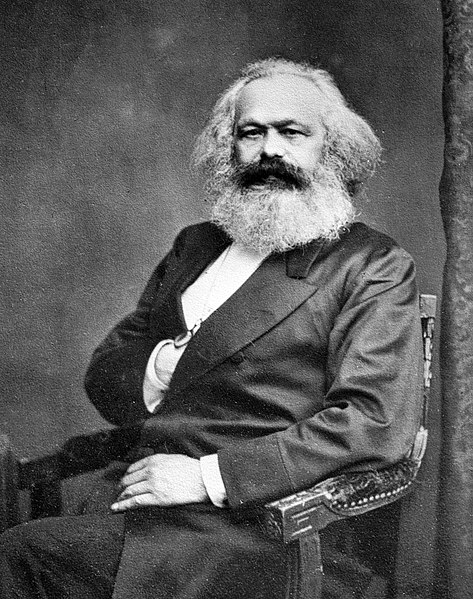
In developing his philosophy, Karl Marx posited human history as a struggle of two sections of society: the minority who hold the all power and the powerless majority. In Marx’s time, the minority was termed the capitalist class, the bourgeoisie, or simply The Capital, those controlling (owning and benefitting from) the means of production, while the majority was called the working class, or the proletariat, the masses who sell their labour, and whose collective toil makes the capitalists rich. The essential dynamic of a society is one of power: who has it and who doesn’t, and how it’s exercised (or as Lenin said, “who whom?”). It’s a zero sum equation: all or nothing, the one or the other, the powerful and the powerless, the oppressors and the oppressed. There is a moral dimension to this dichotomy: the former, by virtue of their position, are the villains, the latter the virtuous. It’s also absolutist: the individual doesn’t matter and individuality is an irrelevant illusion; you are the class to which you belong.
One of the most important aspects of this group dynamic is that the dominant class uses its position and power to shape the society in accordance with its needs. Thus, all the institutions, laws, traditions and phenomena reflect the interests of the ruling class; they are designed to benefit them and only them and keep their power entrenched. And what benefits one class invariably harms the other: the masses. You can thus say that in a capitalist society everything’s classist.
The twentieth century dashed the hopes of Marx’s disciples that the proletariat would revolt against and overthrow their capitalist oppressors. The working class was bought off with better working conditions and rising incomes: a house, a car, and a football game. While elsewhere communism triumphed through coups and foreign invasions, in the Western world genuine revolutions did not happen; capitalism is still around. While the working class might have disappointed and let down Marxists, the basic Marxist thinking has not changed: the society is divided into two mutually hostile groups, the oppressors and the oppressed. Now we just need to find the different oppressed and we’ll have another crack at destroying capitalism and creating our socialist utopia. Out with the purely economic divisions, in with racial, gender and sexual ones. Goodbye the working class, hello to the wokeing class.
Fast forward to 2021, and the neo-Marxist struggle continues to gather wind in its sail. On the one side the power-holders: white, male, straight; on the other the powerless: women, people of colour, other sexualities. The actors might have been changed but the essential drama remains the same: the struggle of the virtuous but powerless oppressed majority against their dastardly rulers and the system created for their benefit and everyone else’s disadvantage. Just as in the past every aspect of society was biased against and harmful to the proletariat, so now it is against the proletariat 2.0: everything’s racist – and sexist, and homophobic and transphobic. This is also why the activists describe racism as “systemic”; not because there are still Jim Crow laws in existence, and legal segregation and discrimination, but because the system created by the “white” society by its very nature must be oppressive and hostile to anyone non-white. Piecemeal fixing problems and gradual reforms are useless; the only solution is a radical societal transformation that elevates the oppressed and casts down the oppressors.
April 14, 2021
Schrödinger’s photo ID requirements
Mark Steyn notes the odd inconsistency of US authorities insisting on or ignoring the need for photo ID for different demographics. So much for equal treatment in the United States.

“TSA Checkpoint” by phidauex is licensed under CC BY-NC-SA 2.0


Whenever you fly anywhere in America, you require picture ID — so that, when you get to the head of the great endless security line, the TSA agent can get out his jeweler’s loupe and examine how the ink lies on the paper. And, when he’s finished doing that, he can fish out his UV light to study the watermark on your ID.
Which is all bollocks even by the standards of American security-state bureaucracy. Why bother going to all the tedious trouble of fake ID when real ID is so easy to acquire? On September 11th 2001, four of the terrorists boarded the flight with genuine, valid picture ID issued by the state of Virginia and obtained through the illegal-immigrant day-workers’ network run out of the parking lot of the 7-Eleven in Falls Church.
If that didn’t get Americans mad about the cosseting of the undocumented, I doubt they’ll care a fig about this latest privilege. But I thought it worth mentioning anyway: While you’re stuck with the Loupe & Light guy poring over your ID, the federal government announced last week that migrants crossing the southern border will be permitted to fly within the United States without any valid ID. You’re on orange alert now and forever, they’re in the express check-in.
This is where selective enforcement of the laws always leads — to a broader contempt for all law, and an end to equality before the law. In 2021 no developed nation needs mass unskilled immigration. Some have it for historical reasons — a hangover of empire, as in Britain and France; some have it for sentimentalist pseudo-humanitarian reasons, as in Sweden and Norway. But neither of these rationales account for what the laughably misnamed Department of Homeland Security is doing at America’s southern border.
QotD: Emmanuel Goldstein, the Enemy of the People
Goldstein was delivering his usual venomous attack upon the doctrines of the Party — an attack so exaggerated and perverse that a child should have been able to see through it, and yet just plausible enough to fill one with an alarmed feeling that other people, less level-headed than oneself, might be taken in by it …
The sight or even the thought of Goldstein produced fear and anger automatically … But what was strange was that although Goldstein was hated and despised by everybody, although every day and a thousand times a day, on platforms, on the telescreen, in newspapers, in books, his theories were refuted, smashed, ridiculed, held up to the general gaze for the pitiful rubbish that they were — in spite of all this, his influence never seemed to grow less. Always there were fresh dupes waiting to be seduced by him. A day never passed when spies and saboteurs acting under his directions were not unmasked by the Thought Police.
George Orwell, Nineteen Eighty-Four, 1949.
April 11, 2021
QotD: Canada’s “Natural Governing Party”
Checks and balances? Canada? Third parties can’t even participate fully in electoral campaigns here. Checks and balances are very few in this centralized, caucus whipped, PMO-run federal government. Let us pass on quickly lest the good doctor/statesman becomes completely embarrassed by his own rhetoric.
John the Mad, “Lloyd’s Unworthy Letter”, John the Mad, 2005-03-05.
April 8, 2021
Andrew Doyle defends freedom of speech in his new book
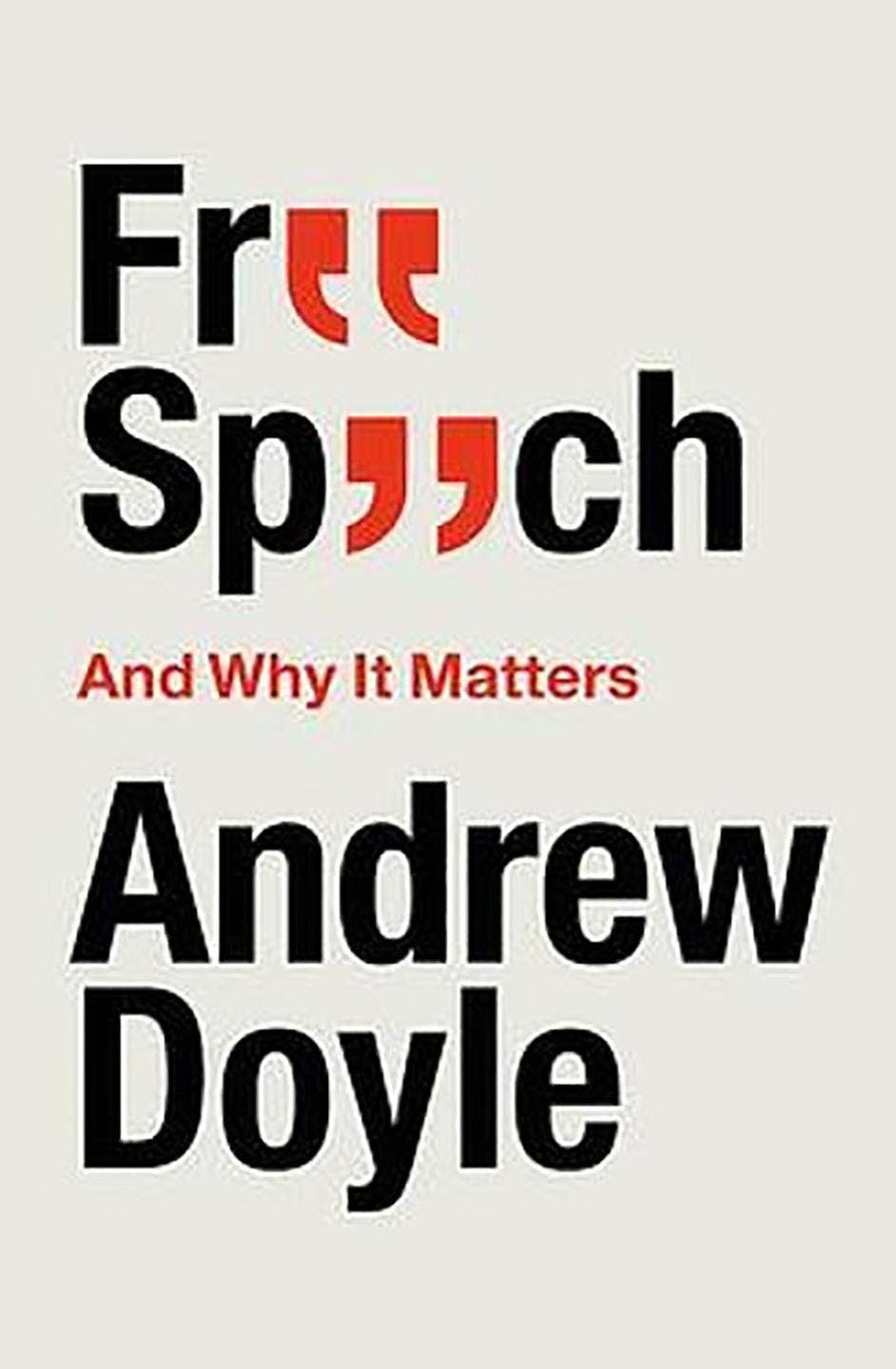
In The Critic, Simon Evans reviews Free Speech And Why It Matters by Andrew Doyle (who is perhaps best known on this side of the pond for his ultrawoke Twitter persona “Titania McGrath”):
When I am weaker than you, I ask you for Freedom, because that is according to your principles; when I am Stronger than you, I take away your freedom because that is according to my principles.
Frank Herbert, Children of DuneIt is most peculiar. If the counter-culture had a dominant theme, it was the right to criticise the establishment and to question orthodoxy of all kinds. Back in the Sixties, it was central to its mission to Expand your Consciousness, man. And it worked. Walls came tumbling down. Yet now, everywhere you look, it seems the elements of society — students, academics, comedians — that one would most naturally associate with that freedom of expression, are introducing caveats and qualifiers to that principle faster than you can cry “Stop Little Pol-Pot, Stop!” They are turning, before our very eyes, into actual scolds.
It must be supposed that what was once the siege army, camped outside the moat like Occupy Wall Street, has captured the castle, for they are demanding that the walls be re-erected. That “hate” speech be distinguished from free speech and dealt with accordingly. That freedom of speech need not mean freedom from consequences. And a general suspicion is at large, among the young, that free speech is some sort of artefact of complacent boomer self-indulgence, like Steely Dan and second homes. No longer counter-culture, but decidedly counter-revolutionary.
I’m a comedian, and these have been strange times for our trade. Brexit saw comedians side with the mirthless neo-liberal consensus, against the humorous, sceptical grumble of the common rabble. The same thing happened in America, with bar-room stand-ups horrified by the vulgarity of Trump. And now the latest revision sees many of my fellow jesters and fools unsure whether people can really be trusted with free speech.One might have thought this issue had been settled long ago, in this country, and in liberty’s favour. But no, it seems we need to sharpen our tools once again, and Andrew Doyle’s new book is an excellent place to start.
Making the case for the defence, Doyle’s book is terse, restrained and as carefully argued as a QC’s summing-up in a top-drawer courtroom drama. Whether his command of the material comes from his doctorate in Renaissance literature or his experience of defending the comedy character Titania McGrath from infuriated wokerati, who knows? It is a beautifully balanced and comprehensive overview that will of course be read by no one who needs to hear it.
It is admirably historically literate. Doyle takes a quote from Milton’s Areopagitica as his epigram, with the old poet, declaiming over the din of the Civil War, as defiant as Satan himself, “Give me liberty to know, to utter, and to argue freely according to conscience, above all liberties.”
This sets the tone for the whole book, but Doyle also presents arguments intended to appeal to those who insist that we live in a society. With the compromises that entails. This was most famously recognised by notorious cis-hetero white man and free speech absolutist John Stuart Mill, who was surveying the world from the heights of Victorian Exceptionalism when he published the still unsurpassed On Liberty.

April 7, 2021
QotD: The G-[pick-a-number] meetings
The first three were essential to plan for victory and peace, though many of their key provisions, especially for the liberation of Eastern Europe, were ignored by Stalin. The first Nixon-Brezhnev meeting was substantive and a couple of the later Reagan-Gorbachev meetings were very productive. These were intense business meetings between people who really were at the summit of world power and influence. The only matter agreed to in meetings between Soviet and American leaders between 1945 and 1972 was in the “kitchen debate” between then vice-president Nixon and Khrushchev in Moscow in 1959, when (forgive my coarseness in the interests of historical accuracy), Khrushchev accused Nixon of uttering “Horse shit, no, it is cow shit, and nothing is fouler than that” to which Nixon replied, “You don’t recognize the truth, and incidentally, pig shit is fouler than cow shit.” Khrushchev conceded the second point.
Conrad Black, “Take heed Canada: the U.S. would win a true trade war”, Conrad Black, 2018-06-16.


