Quotulatiousness

October 7, 2020

Canada’s new documentary monoculture – many now “skew the truth by reinforcing the viewpoint du jour

Filed under: Bureaucracy, Cancon, Media, Politics — Tags: , , , — Nicholas @ 03:00

In The Line, Christina Clark explains why she’s no longer in the business of making documentaries in Canada:

Many of the stories now told through documentary skew the truth by reinforcing the viewpoint du jour. Interviews and scenes that break with the chosen narrative, that offer something other than a black-and-white approach to society and the complexities of humanity, happen off camera or end up on the editing room floor. This is all in an effort to promote diverse voices and the political opinions that allegedly support them. But when we lay claim to a singular viewpoint or dismiss a perspective because the creator’s or the subject’s skin tone or gender does not fit the narrative of inclusion, we are actually removing diversity from the storytelling equation. And what we’re left with are one-sided storylines that reinforce an echo chamber of virtue signalling.

I can no longer deny the dysfunctional approach to telling half-truths and undermining alternate viewpoints in my industry in the name of securing public funding for programming that fails to resonate with the public that is paying for it. Over the last year, I’ve been turning down contracts and finding an exit strategy. I’m pre-emptively cancelling myself.

Documentary was once considered Canada’s national art form. Part of our country’s success with the medium can be attributed to the creation of our National Film Board (NFB), established to “make and distribute films designed to help Canadians in all parts of Canada to understand the ways of living and the problems of Canadians in other parts.” The NFB was founded to provide public funding to storytellers to show us who we are, as a country, as citizens.

To secure public funding for a documentary film or program in Canada, producers typically need to have a broadcaster already signed on to the project. Then, they can apply to funds like the Canada Media Fund, Telefilm or Rogers. Without a broadcaster licence, you cannot apply for public funding. The criteria for licencing a film or television series has narrowed in recent years — not unlike the audiences these programs are targeting.

Take, for example, the Creative Relief Fund that the CBC put together during the early months of COVID to award $2 million in development and production funding for new projects, ranging from fiction and non-fiction television to documentary shorts to plays and podcasts. This was an enticing invitation for creators in lockdown. During this time, friends and colleagues of mine in the industry were messaging each other back and forth, offering feedback on each other’s ideas, as we were all intending to apply. These are some questions we all wondered aloud, in the safety of our private chats: “Do you think this story is diverse enough?” “This story might be too white …” “I don’t think the language is woke enough, do you think they’ll see the bigger story here?” That’s because many broadcasters have “Inclusion and Diversity Plans” that you have to fill out for your project, that track the racial and gender makeup of your crew and your interviewees. While it is not explicitly mandatory to accommodate broadcasters’ criteria for diversity, a lot of filmmakers already know before they even pitch an idea that their chances of getting greenlit are greater if they do.

October 6, 2020

Has Boris had his fifteen minutes yet?

Filed under: Britain, Government, Politics — Tags: , , , , — Nicholas @ 05:00

James Delingpole is very much of the opinion that Boris Johnson’s time is almost up and is starting to consider who would replace him as British PM:

Prime Minister Boris Johnson at his first Cabinet meeting in Downing Street, 25 July 2019.
Official photograph via Wikimedia Commons.

It’s no longer a question of “if” but when the ailing, flailing UK Prime Minister crashes and burns. The only remaining questions now are “How much more damage is the buffoon going to inflict before he retires, gracefully or otherwise?” and “Who is going to pick up the pieces when he is gone?”

With the second question, my money is on Chancellor Rishi Sunak. Sure he’s a young-ish (40), fairly untested, partly unknown quantity and, perhaps worse, he’s a graduate of Goldman Sachs. On the other hand, with no General Election likely till 2024, it’s a simple fact that whoever replaces Johnson as prime minister will almost certainly be a member of his current cabinet. Sunak scores highly because he’s arguably the senior minister least tainted by Johnson’s spectacular mishandling of Chinese coronavirus.

Unlike Johnson, his preening Health Secretary Matt Hancock, and Chancellor of the Duchy of Lancaster Michael Gove, Sunak is not one of the so-called “Doves” advocating for ever more stringent measures — lockdowns, masks, curfews, quarantines, a mooted cancellation of Christmas.

Rather, he is the leader of the Hawk faction arguing that it is long since time to prioritise the economy.

Dominic Cummings advising Boris Johnson, probably

True, opinion polls currently favour the Doves — aka the Bedwetters. The British public has so far proved remarkably amenable to having its freedoms snatched away in order to keep it “safe” from coronavirus. Polls continue to suggest that the vast majority of British people want more authoritarian measures, not fewer, in order to deal with the crisis. And Dominic Cummings — the sinister, opinion-poll-driven schemer who, as Johnson’s chief advisor has been controlling the Prime Minister much in the manner of Wormtongue controlling King Théoden in Lord of the Rings — has been more than happy to oblige.

But it would be a massive error to assume that this state of affairs will last.

October 5, 2020

Letters to a Young Contrarian was fundamentally a twentieth-century work by a man who thought of himself as a sixties radical”

Filed under: Books, History, Liberty, Politics, USA — Tags: , , — Nicholas @ 03:00

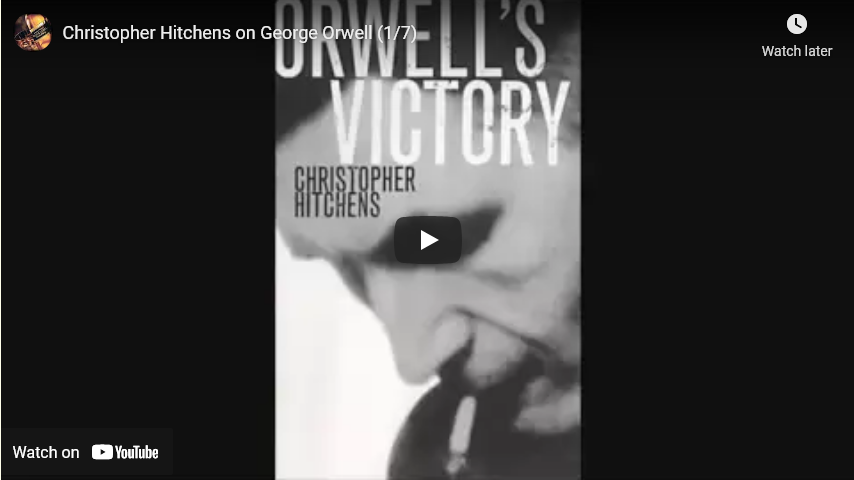
In The Critic, Roland Elliott Brown considers the work of Christopher Hitchens, and particularly his Letters to a Young Contrarian from 2001:

The book is now nearly twenty years old. Hitchens wrote it in late 2000 and early 2001 for Perseus Books’ Rilke-inspired “Art of Mentoring” series, and it was published a month or so after 9/11. In view of this timeline, it occupies an eerily-placid DMZ between the “acceptable” 1990s Hitchens, whose only big sin against the political left had been to hound the centrist Bill Clinton, and the ostensibly-more isolated one post-2001, who took heart at the prospect of America using its military might against jihadis and Baathists. The book was largely a post-mortem on the intellectual battles of the twentieth century, and a lesson in writerly integrity. Today, it reads as a riposte to the new “populism” and the “awokening”.

Since Hitchens’s death from oesophageal cancer in 2011, his presence has been missed on major subjects. In a counterfactual world, it seems likely that Syria, ISIS, and the Iran nuclear negotiations (all entangled) would have occupied him in the first half of the 2010s, and that the potential unravelling of the American republic would have worried him in the second. Part of what his admirers miss, too […] is his performative flair. Though new media weren’t his passion, he owes much of his legacy to his YouTube archive, wherein his long-form lectures, debates, and C-span interviews seem, in hindsight, to have provided a model for the popularity of long-form podcasts.

The Letters can be read as a guide to giving an authentic performance as a political actor. Hitchens begins by selling an imagined student his lifestyle; in one good month, he writes (with some perhaps-inauthentic modesty), he has given evidence against Mother Teresa at the Vatican, taken pride in his arguments over Bosnia as Slobodan Milosevic went to the Hague, and had the thrill of being sued by Henry Kissinger. What the world needs now, the book implies, is for the young to find their appetite for the takedown. (One wonders to what extent his search for successors may have emerged from early intimations of mortality: in one C-span interview about the book, he also urged the youth not to take up smoking.)

[…]

But to reiterate, Letters to a Young Contrarian was fundamentally a twentieth-century work by a man who thought of himself as a sixties radical. Other sixties people like Noam Chomsky and Gore Vidal, with whom Hitchens would later fall out over the War on Terror, figure here in heroic roles. Radicals, he argues in the third chapter, are needed to force major issues. Would slavery have ended in America, he asks, if not for the fanaticism of John Brown? Many of his mentors — Peter Sedgwick, E.P. Thompson — were sometime British communists (and long-time socialists) who had ditched the Party after the Soviet invasion of Hungary (what a pity, then, that he never got to debate “the left” with Jordan Peterson).

Of course, Hitchens was not the only sixties radical to court influence in the 2000s, nor was he the most influential. Much of the radicalism he valued now comes to us — via less subtle mentors — in parody form: as sixties-worship gone sour, as a morbid focus on immutable characteristics, as a desire to short-circuit debate, as the unclean spirit that possesses young journalists to misrepresent their subjects so that they can gloat about the takedown. East of the old Iron Curtain, Alexander Lukashenko borrows a page from the dissidents of ’89 by carrying on “as if” there had been no pandemic, “as if” he had won a presidential election, and “as if” NATO was getting ready to invade Belarus. In such times, it seems worth living “as if” the cigarette-smoking ghost still had an eye on the scene.

QotD: Language changes to accord with critical studies theory

A Canadian Broadcasting [Corporation] program also debuted a new term this past week: “non-straight cisgender people.” This is the newly approved newspeak for gay people, parsed through the language of critical queer studies. The proponents of this new language seem eager to retire familiar terms like “gay men” or “lesbians” — perhaps because they suggest that the homosexual experience is rooted in basic human nature and can exist outside the parameters of structural oppression. So they find ways to define us in terms of queer theory, insisting there are only oppressed LGBTQ+ people. That’s also why, for example, so many on the left insist that gay white men had very little to do with Stonewall, which was led, we’re told, by trans women of color, subsequently betrayed by white men, who stole the movement from them. That this is untrue is irrelevant. It’s a narrative which serves to dismantle structures of oppression. And that’s all that matters.

Leading progressive maternity and doula organizations now deploy and encourage a whole array of “gender-neutral language” with respect to sex, birth, labor, and parenting. And so we now have the terms “chest-feeding,” “persons who menstruate,” “persons who produce sperm,” and “birthing person” for breastfeeding, women, men, and mothers, respectively. And instead of a butthole, we have a “back-hole”; instead of a vagina, we have a “front hole.” “Ovaries” and “uterus” are now rendered as “internal organs,” which may strike you as somewhat vague. These may sound completely absurd now, but given the choke hold critical gender theory has on almost all elite organizations, you can be sure you’ll hear them soon enough. They’ll likely be mandatory if you want to prove you’re not a transphobe. It was an objection to one of these terms — “people who menstruate” — that got J.K. Rowling tarred again as a bigot.

Those of us who oppose this abuse of the English language, who try to abide by Orwell’s dictum to use the simplest, clearest Anglo-Saxon words to describe reality, are now instantly suspect. Given the fear of losing your job for resisting this madness, most people will submit to this linguistic distortion. As you can see everywhere, the stigma of being called a bigot sweeps away all objects before it. But the further this goes — and there is no limiting principle in critical theory at all — the less able we are to describe reality. Which is, of course, the point. Narratives, only narratives, exist. And power, only power, matters.

Andrew Sullivan, “China Is a Genocidal Menace”, New York, 2020-07-03.

October 3, 2020

“The Tory party, desirous of a fat majority, will sell the country out over Europe”

Filed under: Britain, Europe, Politics — Tags: , , , , — Nicholas @ 03:00

In The Critic, Gawain Towler sees a major opportunity for Nigel Farage and the Brexit Party:

The simple fact is that this Government had the opportunity to do something about our negotiations with the EU in the months after the election. They had a whopping great majority and the goodwill of the nation. Boris had used his ebullience to present the country with a vision that with one bound we would be free, the deal was oven-ready, he was going to get Brexit done. Yes, he had inherited the Withdrawal Agreement, a deeply duff deal, from his predecessor. His resignation as Foreign Secretary over it gave us the confidence that he recognised it as such. And yet on the 25 January, a mere month after his triumphant election victory, he signed that same duff deal and condemned the country to this slow lingering betrayal. It was not necessary to do so, he could have pointed to the election, the vote, and with the support of the country gone to Brussels and made it clear he would not sign. This he signally failed to do.

So here we are again, with the EU making threatening noises, taking legal action with leaks coming out of Berlin and London suggesting that the UK is prepared to make more concessions. A No 10 spokesman confirmed that “The PM will be speaking to President von der Leyen tomorrow afternoon to take stock of negotiations and discuss next steps.”

According to Bruno Waterfield of The Times, “This is seen broadly as a good sign – if, as expected, the British prime minister is ready to signal a bit more give on fish, state aid and subsidy control”.

Note the “more give” – there has already been a lot of giving.

The thing is that Boris is beset with problems, with the Remain lobby, both on his own green benchers and elsewhere; yet again digging up dire predictions of economic meltdown, the CBI taking the lead. The ERG group of Tory sceptics have been oddly quiet, focusing more on Covid-19 than on the clear danger of a failed Brexit. There is no pressure on one side, and a great tidal wave of it pushing him to make a deal at any cost.

Then there is the electoral arithmetic. This shouldn’t matter so far out from an election, but the rumours of Boris’s political demise and the currents swirling around the Chancellor make Labour’s slight lead in the polls a matter of concern. Labour is beginning to solidify after years of infighting, but it is not cutting into Tory support.

That is where Nigel Farage and the Brexit Party come in.

October 1, 2020

Supreme Court Shenanigans!

Filed under: Government, Law, Politics, USA — Tags: , , , — Nicholas @ 06:00

CGP Grey
Published 30 Sep 2020

September 30, 2020

“The culture war is the ‘New Normal'”

Filed under: Books, Britain, Media, Politics, USA — Tags: , , , , — Nicholas @ 05:00

Andrew Doyle discusses the debate over the culture war in Spiked:

The phrase that probably best characterises the events of 2020 is the “New Normal”. Although it’s typically used to describe our changed circumstances under lockdown, it could just as easily be applied to the way in which we have all grown accustomed to the worst excesses of the social-justice revolution.

News stories that only five years ago would have been dismissed as asinine aberrations now recur with a quotidian certainty. Recent notable examples include: Princeton University confessing to “systemic racism”, leading to an investigation by the Department of Education on the grounds that racism is a violation of civil-rights law; the Royal Academy of Dramatic Arts making a similar admission, thereby emboldening some of its students to produce a 100-page document full of demands so entitled that it would make Veruca Salt blush; and an academic and novelist stating that debate is “an imperialist capitalist white supremacist cis-heteropatriarchal technique that transforms a potential exchange of knowledge into a tool of exclusion and oppression”. Yes, the culture war is the “New Normal”.

Yet with all the evidence before our eyes, certain commentators persist with their view that the culture war is a right-wing myth advanced by those who are resistant to change. “There’s no actual ‘culture war’, is there?”, writes LBC’s James O’Brien: “It’s just a new way of describing disagreements between people who hate racism and discrimination and people who love it.” Then there is the Guardian‘s Owen Jones, who maintains that “a lot of what’s called ‘the culture war’ is just younger people trying to assert their different social and moral values over older generations who run most of the media”. Nesrine Malik has argued that the culture war has been manufactured by the right, although it will not have escaped most people’s attention that the majority of salvos come from the left side of the battlefield.

It’s this kind of gaslighting – to borrow the language of social-justice activists – that we have already seen from writers who insist that “cancel culture” doesn’t exist, in spite of abundant and incontrovertible evidence that it does.

This is because, as Helen Pluckrose and James Lindsay have so clearly outlined in their seminal book Cynical Theories, the ideology of social justice has its origins in postmodernism, a school of thought which favours “lived experience” and multiple “ways of knowing” over objective truth. It doesn’t matter, for instance, that JK Rowling has never said or written anything transphobic — her new novel must be denounced for advancing an anti-trans agenda, even though it contains no actual references to trans people. These activists have apparently taken their cues from Humpty Dumpty in Lewis Carroll’s Through the Looking Glass (1871). “When I use a word”, he says to Alice, “it means just what I choose it to mean – neither more nor less”.

America First – Patriots or Nazis? – WW2 Special

Filed under: History, Media, Politics, USA — Tags: , , , , — Nicholas @ 04:00

World War Two
Published 29 Sep 2020

In 1941, the question of whether America should join the European War still isn’t settled. Different groups whip up opposition to it, and those such as the America First Committee seem suspiciously sympathetic to Hitler’s message and cause.

Join us on Patreon: https://www.patreon.com/TimeGhostHistory
Or join The TimeGhost Army directly at: https://timeghost.tv

Follow WW2 day by day on Instagram @ww2_day_by_day – https://www.instagram.com/ww2_day_by_day
Between 2 Wars: https://www.youtube.com/playlist?list…
Source list: http://bit.ly/WW2sources

Hosted by: Indy Neidell
Written by: Francis van Berkel and Indy Neidell
Director: Astrid Deinhard
Producers: Astrid Deinhard and Spartacus Olsson
Executive Producers: Astrid Deinhard, Indy Neidell, Spartacus Olsson, Bodo Rittenauer
Creative Producer: Joram Appel
Post-Production Director: Wieke Kapteijns
Research by: James Newman
Edited by: Miki Cackowski
Sound design: Marek Kamiński
Map animations: Eastory (https://www.youtube.com/c/eastory)

Colorizations by:
Daniel Weiss
Norman Stewart – https://oldtimesincolor.blogspot.com/

Sources:
from the Noun Project: people by ProSymbols

Soundtracks from the Epidemic Sound:
Reynard Seidel – “Deflection”
Johannes Bornlof – “The Inspector 4”
Philip Ayers – “Trapped in a Maze”
Johannes Bornlof – “Deviation In Time”
Phoenix Tail – “At the Front”

Archive by Screenocean/Reuters https://www.screenocean.com.

A TimeGhost chronological documentary produced by OnLion Entertainment GmbH.

QotD: Victimhood culture

Filed under: Books, Politics, Quotations — Tags: , , , , , — Nicholas @ 01:00

In their newly released book, The Rise of Victimhood Culture: Microaggressions, Safe Spaces, and the New Culture Wars, the moral sociologists Bradley Campbell and Jason Manning describe the three main moral cultures that exist today, which they give the shorthand labels of dignity, honor, and victimhood. A dignity culture, which has been the dominant moral culture of Western middle classes for some time, has a set of moral values that promotes the idea of moral equality and was crystallized in Martin Luther King Jr.’s vision that people ought to be judged according to the content of their character, not the color of their skin.

Victimhood culture departs from dignity culture in several important ways. Moral worth is in large part defined by the color of one’s skin, or at least one’s membership in a fixed identity group: i.e., women, people of color, LGBTIQ, Muslims, or indigenous peoples. Such groups are sacred, and a lack of deference to them is seen as a sign of deviance. The reverse is true for those who belong to groups that are considered historical oppressors: whites, males, straight people, Zionists. Anyone belonging to an “oppressor” group is stained by their privilege, or “whiteness,” and is cast onto the moral scrapheap.

Claire Lehmann, “The Evils of Cultural Appropriation”, Tablet, 2018-06-11.

September 29, 2020

The Lamprey Party of America

Filed under: History, Politics, USA — Tags: , , , , , — Nicholas @ 05:00

In the latest Libertarian Enterprise, L. Neil Smith suggests that we need a modern Thomas Nast to add to the political menagerie of elephants and donkeys:

“The Third-Term Panic”, by Thomas Nast, originally published in Harper’s Magazine on 7 November 1874.

A braying ass, in a lion’s coat, and “N.Y. Herald” collar, frightening animals in the forest: a giraffe (“N. Y. Tribune”), a unicorn (“N. Y. Times”), and an owl (“N. Y. World”); an ostrich, its head buried, represents “Temperance”. An elephant, “The Republican Vote”, stands near broken planks (Inflation, Repudiation, Home Rule, and Re-construction). Under the elephant, a pit labeled “Southern Claims. Chaos. Rum.” A fox (“Democratic Party”) has its forepaws on the plank “Reform. (Tammany. K.K.)” The title refers to U.S. Grant’s possible bid for a third presidential term. This possibility was criticized by New York Herald owner and editor James Gordon Bennett, Jr.
Image and caption via Wikimedia Commons.

The 19th century political caricaturist and editorial cartoonist Thomas Nast (1840-1902) is famous for identifying Republicans as elephants and Democrats as donkeys. He also created the Tammany tiger, and Santa Claus as we know him today.

Mr. Nast was a handsome and clever fellow, a Bavarian immigrant, to whom we all owe a great deal, but I have long thought that more animals need to be added to America’s political menagerie, none of them as wholesome and savory as elephants and donkeys. Lampreys are eel-like fish, sort of vertebrate leeches or underwater vampires, that attach themselves to larger fish with their circular, tooth-lined mouths, hitching a free ride, punching a hole through the legitimate fish’s flesh, and feeding on its blood. They look and feel (I am informed) slimy and disgusting. The freedom movement needs a cartoonist (I can think of one or two) capable of rendering a cartoon lamprey in all of its horrifying malevolence.

What party would be represented by a lamprey? Well, it has gone by several names, and it’s filled with familiar and despicable figures. Alaska Senator Lisa Murkowski, described as “to the left of all Republicans, except Susan Collins, and … Democrat Senator Joe Manchin” is a lamprey, riding along on the Republican party, parasitically sucking its lifeblood, never contributing anything to advance its progress. She voted with Obama a stunning 72.3% of the time. I could say Murkowski is a “never-Trumper”, but she was a lamprey long before the Donald ever came along. My wife Cathy, first made aware of Murkowski’s malevolent role in American politics, exclaimed, “Alaskans! What the hell is wrong with you?”

Another well-known lamprey is Willard “Mitt” Romney, who viciously opposes all of Trump’s undertakings, foreign and domestic, and whose father George was a leader of the cabal in 1964 who betrayed fellow-Republican Presidential candidate Barry Goldwater and helped Democrats and the media stab him in the back, electing that murderous gangster Lyndon Baines Johnson. George Romney would have called Barry a “deplorable” if the term had been current back then, for the same reasons the political elites despise President Trump today. They believe only they are fit to determine how to live your life. The delusion seems to be hereditary.

QotD: Robin DiAngelo’s theory of “White Fragility”

Filed under: Books, Media, Politics, Quotations, USA — Tags: , , , , — Nicholas @ 01:00

Throughout White Fragility DiAngelo tries to convince readers of two things. First, DiAngelo argues that white people are inescapably racist, writing, “All white people are invested in and collude with racism,” and that “The white collective fundamentally hates blackness for what it reminds us of: that we are capable and guilty of perpetrating immeasurable harm and that our gains come through the subjugation of others.”

Second, DiAngelo argues that any white person who does not admit to their own racism is blinded by their “white fragility.” In DiAngelo’s words, because white people are, “Socialized into a deeply internalized sense of superiority that we either are unaware of or can never admit to ourselves, we become highly fragile in conversations about race.” This fragility purportedly explains why, “people who identify as white are so difficult in conversations regarding race.”

It’s not difficult to see why the theory of white fragility might catch on. Race is a sensitive subject that many people of all races are uncomfortable discussing. Furthermore, white people publicly accused of racism risk social ostracization and professional ruin. The idea that some white people may be defensive when accused of racism is not surprising. But though some white people may exhibit a degree of what DiAngelo calls fragility, her grandiose theory as applied to all or even most white people has two fatal flaws.

First, DiAngelo’s theory of white fragility is unfalsifiable. It is impossible for someone to prove that they are not fragile, just as it is impossible for someone to prove they are not possessed by a demon. One could play mad libs with racial groups and nouns — “Asian Insecurity,” “Black Hostility,” etc. — and there would be no way for members of those groups to prove they are not insecure or hostile.

More insidiously, DiAngelo frames her theory of white fragility such that any conceivable reaction a white person has when discussing race is purportedly evidence of fragility, and any denial of her theory is interpreted as proof of its validity. For example, DiAngelo writes that,

    The mere suggestion that being white has meaning often triggers a range of defensive responses. These include emotions such as anger, fear, guilt, and behaviors such as argumentation, silence, and withdrawal from the stress-inducing situation. These responses work to reinstate white equilibrium as they repel the challenge, return our racial comfort, and maintain our dominance within the racial hierarchy. I conceptualize this process as white fragility. Though white fragility is triggered by discomfort and anxiety, it is born of superiority and entitlement.

In other words, if DiAngelo accuses you of racism or fragility and you disagree with her in any way — through argument, silence, or withdrawal — your reaction is considered proof of your fragility. DiAngelo leaves white readers with only two options. Either acknowledge your fragility, which proves DiAngelo’s theory, or deny your fragility, which according to DiAngelo, also proves her theory. This is a logical fallacy known as a Kafkatrap. If our legal system worked this way, no person accused of a crime would ever be acquitted because their denial would prove their guilt.

David Edward Burke, “The Intellectual Fraud of Robin DiAngelo’s White Fragility“, The Logical Liberal, 2020-06-13.

September 28, 2020

The Elgin Marbles as oversized bargaining chips

Filed under: Britain, Europe, Greece, History, Politics, USA — Tags: , , , , — Nicholas @ 05:00

Michael Curtis on the renewed demands that the British government return the Elgin Marbles to Athens:

Some of the sculptures in the Elgin Marbles collection on display in the Duveen Gallery of the British Museum.
Photo by Paul Hudson via Wikimedia Commons.

The internecine wars in Washington, D.C., continue over government funding, a coronavirus relief bill, government shutdown, but on September 9, 2020 one form of political truce between Republicans and Democrats on foreign affairs was announced. Eighteen members of the U.S. Congress, bilateral members of the Congressional Caucus on Hellenic issues, including the chairs of the House Oversight and Rules committees, and Foreign Affairs subcommittee on issues relating to Europe, had written a letter to British Prime Minister Boris Johnson.

It informed him, in case he didn’t know, that the Elgin marbles, EM, had been the source of controversy among allies for many decades. The letter urged the British government, already saddled by labyrinth Brexit discussions, to negotiate with the Greek government in earnest over the return of the Elgin marbles to Greece by 2021, the 200th anniversary of the modern Greek nation. The eighteen Congress people joined other Americans intruding in British affairs. On September 16, 2020 both Joe Biden and Nancy Pelosi said there can be no US-UK trade deal if Brexit negotiations undermined the 1998 Good Friday peace agreement. However, the letter of the Congress group has raised the problem of the restitution of cultural objects taken from their country of origin.

Prime Minister Johnson does not need reminding that it was Thomas Bruce, Earl Elgin, British Ambassador to the Ottoman Empire, which included Greece, who took the marbles from the Parthenon in Athens, 1801-1805. The Parthenon, the central building of the Acropolis of Athens. was built around 488 B.C. to honor a goddess called Athena, and was at different times a Christian church and a mosque. The pillars and sculptures of the Parthenon were made of marble.

Elgin, with a passion for classical antiquities, made the case that the art works in the temples of Greece, then under Ottoman control would be destroyed because of Turkish indifference. Some had been destroyed in 1687 when the Venetians attacked Athens. The Sublime Porte granted Elgin’s request to take away pieces of stone with old inscriptions or figures. Perhaps this was gratitude for British action in blocking the advance of Napoleon in Egypt. Elgin took pediment sculptur friezes, metopes, and fragmented pieces from the walls of the Parthenon, and brought them to Britain. In 1816 he sold the sculptures to the British government which then sent them to the British Museum where they have remained.

Though the letter by the 18 members of Congress might be considered impertinent, it contained no threat of any kind but attempted to spark action on a disputed issue which has emotional appeal and symbolic importance, the presence of the Elgin marbles in the British Museum. In recent years the issue has been raised by officials of the European Union as well as by celebrated private citizens such as the actor George Clooney and his wife, and co-stars Bill Murray and Matt Damon, who while working on the 2014 film The Monuments Men, about art stolen by the Nazis, thought return of the Elgin marbles to Greece was the “right thing” to do.

It’s been a while since these stickers occupied pride of place on every Prius bumper, hasn’t it?

Filed under: China, History, Politics, USA — Tags: , , — Nicholas @ 03:00

Arthur Chrenkoff wonders “Whatever happened to ‘Free Tibet’?”

With its heyday probably twenty years ago, it used to be a major cause celebre for artists and activists, with bumper stickers adorning countless cars, including – proverbially – the early Priuses. It was mostly a thing of the left (certainly in Australia it was largely associated with the Greens) and the hippies and New Agers enchanted by the wit and wisdom of the Dalai Lama, spruiking his version of Buddhism from exile. This probably scared many people off, which is a pity because the question of Tibetan independence shouldn’t be judged on the merits of its incense burning Western supporters.

So what happened? Tibet is certainly still not free – if anything the things have gotten worse on the rooftop of the world – but the campaign has largely dropped out of the public consciousness. I don’t quite know the answer myself. Maybe some political causes, like fashion trends, have limited life spans. Maybe the left has learned to stop worrying and live with China as one of the few viable alternatives to the “Western neoliberal world order”. Maybe China has become too rich and powerful to hope that candle-lit vigils for Lhasa will do any good.

So what’s been happening in Tibet lately, just out of interest?

QotD: The proper role of men, according to the SCUM Manifesto

Filed under: Books, Media, Politics, Quotations — Tags: , , , — Nicholas @ 01:00

Prior to the institution of automation, to the replacement of males by machines, the male should be of use to the female, wait on her, cater to her slightest whim, obey her every command, be totally subservient to her, exist in perfect obedience to her will, as opposed to the completely warped, degenerate situation we have now of men, not only existing at all, cluttering up the world with their ignominious presence, but being pandered to and groveled before by the mass of females, millions of women piously worshiping the Golden Calf, the dog leading the master on a leash, when in fact the male, short of being a drag queen, is least miserable when his dogginess is recognized — no unrealistic emotional demands are made of him and the completely together female is calling the shots. Rational men want to be squashed, stepped on, crushed and crunched, treated as the curs, the filth that they are, have their repulsiveness confirmed.

Valerie Solanas, SCUM Manifesto, 1967.

September 27, 2020

Homelessness in Los Angeles

In Quillette, Amy Alkon talks about the homeless crisis in LA, particularly her own immediate experience with a couple who “camped out” in front of her house.

Throughout [Los Angeles Mayor Eric] Garcetti’s seven years as Mayor, Los Angeles has witnessed a shocking explosion of homelessness. When he took office in 2013, the city had about 23,000 residents classified as homeless, two thirds of whom were unsheltered, living on the streets. By mid-2019, the figure was about 36,000, and three-quarters of them were living on the streets. Currently, there are 41,000 homeless. Garcetti’s pet plan to alleviate the homelessness crisis was the construction of permanent supportive housing. In 2016, compassionate voters approved $1.2 billion in new spending to fund these units. Three years later, only 72 apartments had been built, at a cost of about $690,000 apiece. Meanwhile, an El Salvador-based company has come up with nifty $4,000 3D-printed houses that look like great places to live and can be put up in a single day.

There’s also been a failure to admit that housing alone isn’t the solution. As urban-policy researcher Christopher Rufo explains, only about 20 percent of the homeless population are people down on their luck, who just need housing and a few supportive services to get back on their feet. Approximately 75 percent of the unsheltered homeless have substance-abuse disorders and 78 percent have mental-health disorders. Many have both.

As a bleeding-heart libertarian, I feel personally compelled to try to help people who are struggling. I do this by volunteering as a mediator, doing free dispute resolution to provide “access to justice” to people who can’t afford court. And since about 2009, I personally have given support to one of those easily helpable 20 percent Rufo refers to, getting him paying work and a bank account, and storing his stuff in my garage. He is a good man and a hard worker — sober for many years — who simply seems to have issues in the “front-office” organizational parts of his brain that help most of us get our act together to, say, pay bills on time. He just needs somebody to back him up on the bureaucratic aspects of life. I’m happy to say he now has a roof over his head. He lives in a motel across the country, and all I still do for him is provide him with a permanent address. I receive his Veterans Administration and Social Security mail at my house, which I mail to him with smiley faces and hearts on the envelopes, colored in with pink and orange highlighter.

This success story would not be possible for most homeless people, the nearly 80 percent who are addicted and/or mentally ill. As Rufo writes:

    Progressives have rallied around the slogan “Housing First,” but haven’t confronted the deeper question: And then what? It’s important to understand that, even on Skid Row, approximately 70 percent of the poor, addicted, disabled, and mentally ill residents are already housed in the neighborhood’s dense network of permanent supportive-housing units, nonprofit developments, emergency shelters, Section 8 apartments, and single room-occupancy hotels.

    When I toured the area with Richard Copley, a former homeless addict who now works security at the Midnight Mission, he explained that when he was in the depths of his methamphetamine addiction, he had a hotel room but chose to spend the night in his tent on the streets to be “closer to the action.” Copley now lives … at the Ward Hotel — which he calls the “mental ward” — where he says there are frequent fights and drugs are available at all hours of the day. The truth is that homelessness is not primarily a housing problem but a human one. Mayors, developers, and service providers want to cut ribbons in front of new residential towers, but the real challenge is not just to build new apartment units but to rebuild the human beings who live inside them.

The situation is especially tragic for those who are so mentally ill that they cannot take care of themselves, and are often a danger to both themselves and others. And I sometimes wonder which movie star or other famous person needs to be stabbed or bludgeoned before politicians take meaningful action.

It’s fashionable in progressive circles to demonize law enforcement, but Rufo explains that in 2006, then-L.A. police chief Bill Bratton implemented a “Broken Windows” policing initiative on Skid Row. It led to a 42 percent reduction in felonies, a 50 percent reduction in deaths by overdose, and a 75 percent reduction in homicides. The overall homeless population was reduced from 1,876 people to 700 — a huge success. Activists filed lawsuits and ran publicity campaigns, slowly killing Bratton’s program, on the grounds that it “criminalizes homelessness.” As a libertarian, I’m opposed to drug laws and forced behavior — but only to a point. It is not compassion to leave people to be victimized by criminals simply because they are unhoused, nor is leaving mentally and physically disabled people strewn across the streets amidst piles of garbage a form of freedom.

Mayor Garcetti, in lieu of admitting the real challenges — the first step to taking meaningful action to alleviate the homelessness crisis — has simply ignored the human results of his failed policy. As a result, whole sections of the city, including formerly livable streets in my beloved Venice, have been turned into Skid Row by the Sea.

« Newer PostsOlder Posts »

Powered by WordPress