Quotulatiousness

February 1, 2021

In the wake of l’affaire GameStop, frantic regulators call for more power to intervene in the market

“Regulatory capture” is the term for situations where the regulators and the regulated begin to get too close and the regulated industries or organizations begin to indirectly control the actions of the regulator for their own benefit. A topical example would be the sudden, agonized cries of politicians and market regulators for new powers to clamp down on disruptive players like the Redditors or other small investors who triggered the rise in GameStop share prices causing potentially ruinous financial losses for regulated hedge funds.

“GameStop” by JeepersMedia is licensed under CC BY 2.0

Although the story has garnered the attention of regulators and even the White House, the wrong takeaway is to suggest options for retail investors should be restricted more than they already are. Yet this is precisely what William Gavin, Secretary of the Commonwealth of Massachusetts, has called for. Gavin argued that there should be a 30-day trading suspension on GameStop to protect “small and unsophisticated investors.”

Gavin’s suggestion would have serious extended consequences. First, consider the knowledge problem that is involved in constructing such a restrictive regulation. When exactly would a rally become unacceptable? Despite years of decline, Kodak experienced a rally after its announcement that it would move into pharmaceuticals. Would this be permissible? If so, one could simply point to GameStop’s decision to appoint three new directors in an effort to turn the company around. If this is not enough, regulators must clearly state what identified the investments as unacceptable.

It is unclear if there is a perfect benchmark to distinguish rallies. But without such a measure, the suspension proposal would put every rally at risk of wrongful closure — potentially halting the growth of companies and industries, alike. Worse yet, the fear of missing out on a rising stock may push some investors to rush in with less information than they would otherwise acquire. Even if it is in a traditional rally, an uninformed decision could cause more harm than good.

Yet suppose the knowledge problem is solved and there is a perfect measure in place. Should other protections be put in place? One could make the case for a law against allowing “unsophisticated” gamblers from going to Las Vegas and losing money. And although this may seem like a leap, Gavin himself told Reuters, “This isn’t investing, this is gambling,” when he spoke of the GameStop rally.

The rally has attracted the world’s attention, but it does not require it. Rallies are a normal part of financial market activity. The only difference here is that it was Main Street that pulled one over on Wall Street.

QotD: “Useless things … do not further The Revolution”

Filed under: Politics, Quotations — Tags: , , , — Nicholas @ 01:00

“Fat acceptance,” slutwalks, and all the rest of it follow naturally from Bolshie beliefs. If you accept — as a good little Dialectical Materialist must — that there’s nothing to human happiness but bread, shoes, and shit, ugliness — physical, moral, mental — becomes a good in itself. How could it be otherwise? Only truly useless things can be beautiful, and useless things, by definition, do not further The Revolution.

Too bad for the Bolshies that it’s in our nature to confuse the messenger with the message. I like to think of myself as an open-minded, tolerant man who takes things as they come, but holy jeeebus, I don’t care what Emma Goldman’s deal is — if she’s for it, I’m against it. I need bleach for my eyes.

We need to use that. It’s no coincidence that Ashley Judd and now Taylor Swift are spouting off about Progtard politics — they used to be cute; now they’re not. See what Social Justice does to you, ladies?

Severian, “The Face You Deserve”, Rotten Chestnuts, 2018-10-11.

January 30, 2021

QotD: Positional goods and social signalling

PC-brigadiers behave exactly like owners of a positional good who panic because wider availability of that good threatens their social status. The PC brigade has been highly successful in creating new social taboos, but their success is their very problem. Moral superiority is a prime example of a positional good, because we cannot all be morally superior to each other. Once you have successfully exorcised a word or an opinion, how do you differentiate yourself from others now? You need new things to be outraged about, new ways of asserting your imagined moral superiority.

You can do that by insisting that the no real progress has been made, that your issue is as real as ever, and just manifests itself in more subtle ways. Many people may imitate your rhetoric, but they do not really mean it, they are faking it, they are poseurs … You can also hugely inflate the definition of an existing offense … Or you can move on to discover new things to label “offensive”, new victim groups, new patterns of dominance and oppression.

If I am right, then Political Correctness is really just a special form of conspicuous consumption, leading to a zero-sum status race. The fact that PC fans are still constantly outraged, despite the fact that PC has never been so pervasive, would then just be a special form of the Easterlin Paradox.

Kristian Niemietz, “The economics of political correctness”, Institute of Economic Affairs, 2014-04-30.

January 29, 2021

Costs of keeping Biden’s promise to forgive student debt

Filed under: Economics, Education, Government, Politics, USA — Tags: , , — Nicholas @ 03:00

Antony Davies and James R. Harrigan consider the frequently issued campaign promise by Joe Biden and what it will cost to implement:

Given the results of the recent election, it should come as no surprise that we’re poised for the next big expansion: student debt forgiveness, a promise Joe Biden made frequently as he campaigned for the presidency. Like the big ideas that came before it, this idea will cost us more than we can afford from day one, and far more than its proponents will admit. Biden’s plan as currently envisioned would cost over $300 billion. But that’s just this year. The plan will set in motion unintended consequences that will doubtlessly persist for generations.

First, next year’s crop of new students will — understandably — demand that their loans be forgiven too. And so will those of the year after that, and so on. This program will quickly become a sort of college UBI, where the government just hands out $10,000 to every college student. Some argue that if this results in a better educated populace, then it’s worth the cost. But it won’t result in a better educated populace; it will result in a whole bunch of students majoring in things the market doesn’t value, and another batch simply taking a four-year vacation on the taxpayer’s dime. Heretofore, graduates knew they needed marketable skills in order to repay their college loans. But when student loans are forgiven as a matter of course, graduates bear no cost for wasting our collective resources by studying things the market doesn’t value, or by not studying at all.

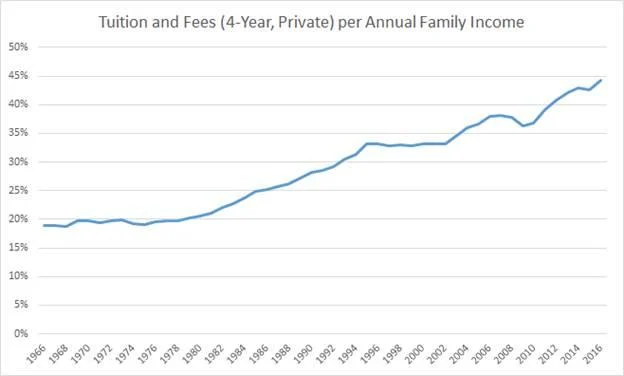
Data sources: Federal Reserve Bank of St. Louis, National Center for Education Statistics.

Second, colleges and universities will respond to this new reality by raising tuition commensurately. Tuition and fees were a pretty constant 18 to 19 percent of family income from the 1960s until 1978. In 1965, the federal government started guaranteeing student loans. In 1973, Congress established Sallie Mae and charged it with providing subsidized students loans. And by 1978, tuition and fees had started a steady march to 45 percent of family income today. When the government makes it less painful for students to borrow, whether by guaranteeing, subsidizing, or forgiving loans, it takes away some of the pain of student borrowing, which makes it easier for colleges and universities to raise tuition.

Third, expect many taxpayers to cry foul. Homeowners will quite sensibly wonder why the government is not forgiving their mortgages. After all, student loans add up to about $1.4 trillion, while American mortgages total more than $16 trillion. If relieving students from the burden of their debts is a good idea, it should be an even better idea to relieve homeowners of theirs.

What about students who worked multiple jobs or attended less prestigious schools so they could avoid going into debt? Why aren’t they being rewarded? What about students who diligently paid off their debt and are now debt free? Will they receive nothing? What about, fantastically, people in the trades? Is it reasonable to charge people — via the higher taxes loan forgiveness will bring — who did not go to college to subsidize those who do? Regardless of the answers to these questions, implementing this plan will be fraught with difficulty.

QotD: Banishing racism

Filed under: Liberty, Politics, Quotations, USA — Tags: , , , — Nicholas @ 01:00

The simple, powerful truth that banishes racist prejudice is this: the individual is not the mass. Statistical distributions do not predict the traits of individuals. It’s OK to acknowledge that (for example) Ashkenazic Jews average significantly brighter than gentile whites, because the difference in the means of those bell curves tells us nothing about where any single Jew or gentile falls on them.

We can – we must, in fact – learn to judge individuals as individuals, not as members of racial or other ascriptive groups. This has always been the right thing to do; as knowledge about genetic group differences becomes more detailed and widespread, we will need to learn how to focus rigorously on individuals with the same discipline (and the same justified fear of failure) that we now apply to averting our eyes from genetic group differences.

Part of the reason this evolution won’t be easy is that so much of our politics has been distorted by racial grievance-mongering. It’s not only the obvious bad guys like neo-Nazis, Black separatists like Louis Farrakhan, and Bharatiya Janata who are invested in racialist categorization as a lever to power. The political Left has fallen into a lazy habit of screaming “racist!” at anyone who disagrees with them, won’t readily relinquish that rhetorical club, and have a lot invested in the present system of taboo, resentment, “disparate impact” legislation, and racial identity politics; expect them, too, to be part of the problem rather than part of the solution.

Still, the right strategy is clear. Actual knowledge makes both prejudice and repression unsustainable. “Know thyself!” said the oracle, and behavioral genetics will allow – actually, force us – to know ourselves in ways we never have before. That way lies the pain of revelation, but also the path of redemption.

Eric S. Raymond, “A Specter is Haunting Genetics”, Armed and Dangerous, 2010-06-19.

January 25, 2021

QotD: Indira Gandhi’s exploitation of the goddess Kali

Filed under: History, India, Media, Politics, Quotations, Religion — Tags: , , — Nicholas @ 01:00

In colonial India, Kali’s notoriety boomed. For in her both coloniser and colonised found a figurehead. Corrupted by the British, Kali was spun as a sexually depraved, blood-swigging black sorceress. As William Ward phrased it in his encyclopaedia, “She exhibits altogether the appearance of a drunken frantic fury … on whose altar victims annually bleed”. Such descriptions, deemed by Indians to be reductively fixated on her destructive powers to the omission of her maternal reserve, activated a movement for her reclamation and turned her into an icon in the struggle for Indian independence in the late-nineteenth century. Put on calendars, cigarette packets, matchboxes, and subject of hugely popular prints, Kali was embraced as a vision of freedom. The reverence for her was inseparable from politics. And it took just two decades after India gained its freedom for a politician to exploit it.

Indira Gandhi — the daughter of one of the freedom movement’s protagonists Pandit Nehru and India’s first and only female prime minister — chose consciously to co-opt this divinity in service of burnishing her own self-image. Indeed, during her first spell in office, from 1966-1977, Indira’s image was as prolific as the colourful printed pictures of the tantric goddess splashed across India’s towns and bazaars. Her appearance was, understandably, more benign. But in India’s jostling visual marketplace her image — big smile and bobbed black hair shot with a streak of white framed by a demure uttariya (veil) — was as inescapable as any deity’s.

Indira played the demagogue superbly. But just as her popularity among Indians soared, and her political confidence grew, those around her began equating her strong, intolerant, and cold politics with female divinities and their overwhelming powers. According to a hugely contentious apocryphal story, Indira’s young rival Atal Bihari Vajpayee, who would go on to succeed her as prime minister, was so overcome by devotion at the sight of her gallantry during India’s war with Pakistan in 1971 that he called her Ma Durga — Kali’s mother.

Cleo Roberts, “Indira Gandhi: a gift from the gods?”, The Critic, 2020-10-15.

January 24, 2021

The dangers of depending on “experts”

Filed under: Media, Politics — Tags: , , , , , — Nicholas @ 03:00

David Warren considers the vastly expanded role of “experts” in our public discourse:

Having no degree in either field, I try not to write what will be contradicted by an expert. On the other hand, “expert” has become a murky concept. Once we had to distinguish only between demonstrated credible experts, and villains. Common sense could usually tell them apart. But with the growth of our “sophistication,” the category of villainy has been much expanded. We have a category of institutionally credentialled experts who aren’t exactly liars, but more like what Harry G. Frankfurt defined as “bullshitters.” They struggle to remain plausible, but are using their expertise to advance interested views. And, having such motives — in opposition to the plain pursuit of truth — they seek publicity, and angle to obtain it.

As Dr Frankfurt hinted, in his short philosophical treatise on this topic (On Bullshit, 2005), these can be, and usually are, more trouble than old-fashioned liars. For a real liar knows he is lying, and can be caught out. By comparison, the modern media expert avoids what is strictly checkable, not only to protect himself, but from indifference for truth. He is, according to me, the intellectual descendant of the mediæval Nominalists, adumbrating words, not realities. While less intelligent than his predecessors, he carries on the tradition of saying that something is true because he says so.

“Consensus science” is of this nature. In it, truth can be negotiated, or imposed. While the weather next Saturday will be known to the living, a prediction for much later in the century has no meaning. From the number of variables in play, I can tell you with certainty, that woke “climatologists” are talking bosh; and every signature on their consensus I may add to my list of persons to ignore. This is elementary stuff: and I do try to stick to what is elementary, and foreseeable.

The success rate, for elaborate predictions, remains, at this point in our history, zero-point-zero. But it is becoming so also for the present, and past. The Batflu, here, is current primary example. Owing to obvious manipulation, we cannot know much about its effects. In rough terms, we can know that they are exaggerated, because almost every expert has a vested interest in getting the numbers up, and those who disagree will be punished. The same is true for all the popular remedies, including such nonsense as mangle-wearing, and obsessive social distancing. No legitimate research lies behind either, so we must assume the purposes for various lockdown orders are not actually the Batflu.

QotD: The “returned ballot”

Filed under: Cancon, Politics, Quotations — Tags: , — Nicholas @ 01:00

In Canada we used to have — still have, according to a friend who should know — the excellent institution of the “returned ballot.” It is my usual way of voting. I can write with some confidence that it has never won.

Here’s what you do. You go into the polling station, show your ID (in Canada voters must identify themselves). The officer crosses you off the voting list, and gives you a ballot. Then you say, “I wish to return this ballot.” He says, “Thank you, sir,” and takes out his returned ballot book. (It need be nothing special: a school exercise book will do.) He copies your name into that, along with your address. (It is the only way to get your preference recorded.) You thank him, then wander off through the boobs who came to vote for somebody.

One has oneself, in effect, just voted for “none of the above.” This is the theory.

In practice the officer, who may or may not speak English or French, but probably needed the money, looks puzzled and a little frightened. He has no idea what you are talking about. You dig in, to provide a patient lesson in elementary civics. He won’t have a book, but you have brought along a cahier with “Returned Ballots” written on the cover in large capitals with a felt pen, and some heraldry doodled above it. To be helpful, you have already written your name and address on the first line. He consults all the other polling staff then says, “Thank you, sir.”

When, later, you check the results, you will not find a single returned ballot mentioned. Perhaps you were counted among the spoilt ones.

Now if you had been counted, and had persuaded a plurality of your fellow citizens to do likewise in, say, the riding of Parkdale (about one-in-four would triumph in most Canadian ridings; one-in-six if the turnout were low enough), the election is annulled. A by-election must then be called, in which none of the previous candidates may stand.

David Warren, “Let’s be practical”, Essays in Idleness, 2018-09-15.

January 22, 2021

Hypocrisy is bad (for mere humans) but ostentatious hypocrisy is reserved for the powerful

Filed under: Government, Media, Politics — Tags: , , , — Nicholas @ 03:00

David Warren notes the two very different kinds of hypocrisy on display during these fallen days:

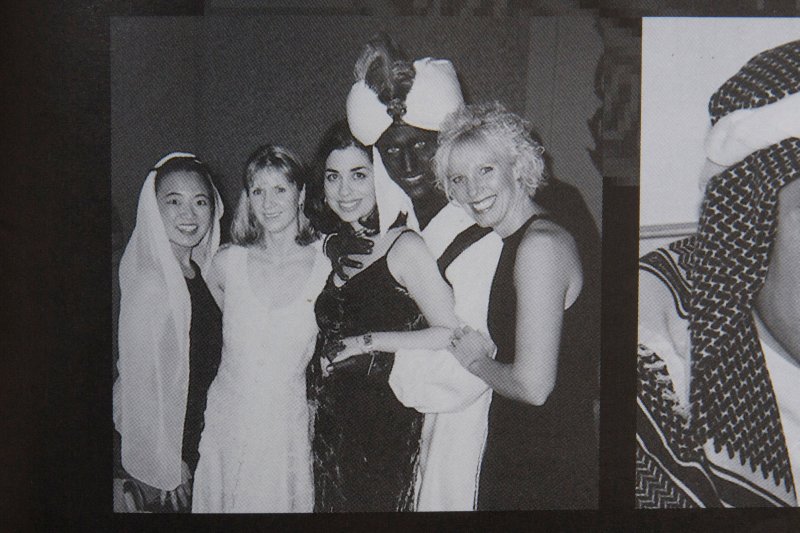
Justin Trudeau with dark makeup on his face, neck and hands at a 2001 “Arabian Nights”-themed party at the West Point Grey Academy, the private school where he taught.
Photo from the West Point Grey Academy yearbook, via Time

Hypocrisy is often dismissed as a humdrum moral vice; rather as pæderasty, or buggery, or commissioning abortions: things considered very grave in the past, but now quite acceptable among progressive persons. One feels almost cruel, or envious, to criticize the adept hypocrite. How dare we try to withdraw the air in which he lives and breathes? “Zero tolerance” is directed at more serious vices, such as having wrong opinions, or voting Republican.

As Paul Valéry said, “Power without abuse loses its charm,” and when, for instance, a governor who proclaims crippling Batflu restrictions is seen ignoring them, he is outraged. His critics are his opponents, he reasons; they really ought to be investigated first!

A milder, general criticism is sometimes made, about the lifestyles of the rich and famous. How is it that prominent environmentalists burn so much jet fuel in their travels from one conference to another, at the world’s most lavish resorts? Shouldn’t they go about in sackcloth and ashes, as they tell us to do?

This is to misunderstand their hypocrisy. We assume they are motivated by greed, and the love of pleasure, the way we would be. But why must it be piled on so thick? Many a jetsetter hardly uses the jacuzzis. He takes a quick shower, because he has another aeroplane to catch.

Yes, most people are attracted to the sumptuous, but in a fine and private way. They rarely encourage the paparazzi, or wish to be watched over their fences and walls. They hire security, to scare trespassers away. Servants, up to a point, must be endured, but in the past they could be ignored, the way we ignore appliances. I may not have a toaster, but I do have a stove, and could swear that it is staring at me. But it was manufactured in the 1960s, so I needn’t fear it has an Internet connexion. And besides, if it did, it wouldn’t be reporting to the tabloids, but to technical staff. We try to ignore them, at least so long as we can pretend they are equivalent to our maids and butlers.

January 21, 2021

QotD: The Laurentian Elite and the “new Canada” of the 1960s

The Patriot Game captures a unique characteristic, and problem, with Canadian conservatism. Lots of Canadian conservatives really don’t like Canada all that much. Brimelow is right to suggest that the contemporary Canadian identity is very much a creation of the Liberals and the New Class, and this isn’t one that conservatives feel all that comfortable with. What this has done is create a powerful anti-Canadian impulse in portions of the conservative movement.

Because the Liberals were so successful in creating this new identity, conservatives, especially Western conservatives (understandably) felt alienated in this new Canada. Brimelow gave some intellectual heft and crafted a coherent theory around why conservatives felt this way.

The broader narrative Brimelow, and others, put forward is that Canada’s British heritage was central to our identity and sense of who we are, but that this identity was destroyed by the Liberals who then built a new one in their own image. In the 1960s, Canadian Liberalism became self-consciously post-British, and the 1960s really do represent an approximate decade in which the “old Canada” died and a “new Canada” was born. The 1960s weren’t just a time of social change, they marked the end of the British Empire, the start of the Quiet Revolution, and of course most symbolically saw the replacement of the Red Ensign with the Maple Leaf flag. The battles between Diefenbaker and Pearson (and Pierre Trudeau) work as a stand in for the divide between old British Canada and new Liberal Canada.

Ben Woodfinden, “True North Patriotism and a Distinctly Canadian Conservatism”, The Dominion, 2020-10-20.

January 20, 2021

“Canada Post … is not to act as the censor of mail or to determine the extent of freedom of expression in Canada”

Filed under: Cancon, Law, Liberty, Politics — Tags: , , , — Nicholas @ 05:00

Colby Cosh on a recent incident in Regina where a Canada Post employee took it upon himself to act as a local censor for people on his delivery route:

Today’s idiot of the day is not, perhaps surprisingly, the Regina postman who got suspended for refusing to deliver the Epoch Times, the oddball anti-communist newspaper that’s affiliated with China’s persecuted Falun Gong religious movement. Don’t get us wrong: Ramiro Sepulveda is clearly a bit of a nitwit. He seems to believe that a newspaper founded by commie-hating Chinese-Americans is designed to provoke hatred toward “Asian communities in North America.”

Sepulveda didn’t want to deliver free copies of the Times to non-soliciting customers because it “spits lies.” Perhaps regrettably, the strong reaction by Canada Post means that our junk mail, quite a lot of which consists of boastful missives from politicians, is not destined to be fact-checked and aggressively suppressed by the corporation’s rank and file.

Sepulveda was properly punished for not doing his job. And Canada Post used the opportunity to promote its content-neutrality as an agent of the state, although it did not quite dare to use the phrase “statutory monopoly.” In a statement to the broadcasters who reported on Sepulveda’s off-piste personal fact-checking, the agency said: “Canada Post is obligated to deliver any mail that is properly prepared and paid for, unless it is considered non-mailable matter. The courts have told Canada Post that its role is not to act as the censor of mail or to determine the extent of freedom of expression in Canada.”

They might have added that access to the mail has been denied to individuals for spreading hatred only a handful of times in the history of the country; this, too, is as it ought to be, and it is certainly not postal employees who ought to be improvising such bans. Ideally, all postmen would be doing their best not to create the suspicion that they are eyeballing what is sent to our homes with the intention of ringing up a reporter and causing a fuss. Say what you like about these poor toilers: most of them never give us any reason to doubt their discretion.

Larry Correia (mostly) leaves Facebook

Filed under: Books, Media, Politics — Tags: , , , — Nicholas @ 03:00

SF author Larry Correia has spent a lot of time in “Facebook jail” for posting things that the admins considered unacceptable under their constantly changing guidelines, so he’s finally bidding adieu to the platform:

I’m paring down my FB presence. For the last week I’ve only been on for a brief time each day. I’ll be taking that down even further. I’ll be posting links when I blog for the people who stick around. There’s a few groups I use here that I can’t get the equivalent resource anywhere else yet (but I’m currently banned from posting in all groups anyway). And that’s about it.

Basically, I’m done being a content creator for these censorious pieces of shit. Guys like me write stuff which gets shared hundreds of times and gets thousands of people commenting/participating. FB uses that free content to keep people corralled here so they can mine your data.

And then when us content creators get uppity, they fuck us over with impunity while their ideological allies get a pass. But then we come crawling back again and again, like abused trailer park wives, because we don’t want to abandon the kids (as in the communities we spent the last ten years building before the relationship turned abusive).

I’ve stuck around because I didn’t want to hurt my business/sales. This is still the best place to reach the most people the fastest. We made it that way. All us content creators foolishly moved over here back when Facebook promised to be one thing. Now that they’ve pulled a bait and switch, the content creators feel trapped.

In good conscience, this can’t continue. I’m done helping these parasites. Facebook is trash. We all know it. We’ve all seen it. We’re just here because of inertia.

Over the last decade, working with some stupendous moderators and great fans, we built a gigantic, thriving, fun, fan page here on Facebook. It’s one of the bigger author fan pages on the internet where the author can still actually talk to his fans. Being able to interact there was great. But Facebook took that from me on a whim. They banned me from my own group because of what I MIGHT say.

However we prepared a fallback. There’s another Monster Hunter Nation fan page over on MeWe. I’ll be posting there instead from here on. If the fans want to keep posting here, great, but I won’t be. I can’t even post this to my own FB fan page, which illustrates just how screwed up this situation is.

We’ll see how long that lasts, until Big Tech finds some way to squish every place they can’t control.

My primary place will still be my blog, monsterhunternation dot com. There is an email newsletter there you can sign up for which is only book related stuff, no politics. I’m on MeWe under my same name. I was on Parler as @monsterhunter45, though I never really used it, and I have no idea if that place is going to survive. I’ll be looking into other alternatives as well.

January 16, 2021

QotD: Make companies product-focused again

Filed under: Business, Politics, Quotations — Tags: , , — Nicholas @ 01:00

When I go to a coffee shop or a bank, I am not interesting in their views about politics or social issues, indeed, I actively do not want to know. I just want a fucking coffee or to arrange something financial (hopefully not confusing the two). If they want to tell me about how yummy their products are because their beans are lovingly rubbed with civet poo, or how well they are looking after their depositors’ money, that is fine.

But pretty much anything else … please just STFU unless it is directly related to the business. I get that certain “life style” brands might want their logo in a Formula One car or on Eddie Izzard’s frock. But I am not interested in how inclusive the local bookstore is, nor do I want to hear that an auto-parts shop is proud of the blasted NHS.

I do not even want any companies declaiming how much they support causes I like, let alone ones that I either oppose or which just make me roll my eyes at the sheer presumption of their marketing department. For me, this is negative marketing. I already avoid certain shops and restaurants that prominently display their “social awareness” to me: they are actually doing the opposite, emphasising that I am not their target market. So I take them at their word and if I can easily get what they sell elsewhere from someone who doesn’t, that is what I always do.

Make companies product-focused again.

Perry de Havilland, “Make companies product-focused again”, Samizdata, 2020-09-30.

January 13, 2021

Driving people offline will break essential political feedback loops

Filed under: Liberty, Media, Politics, USA — Tags: , , — Nicholas @ 03:00

Larry Correia on the ongoing purge of Trump supporters from many social media networks:

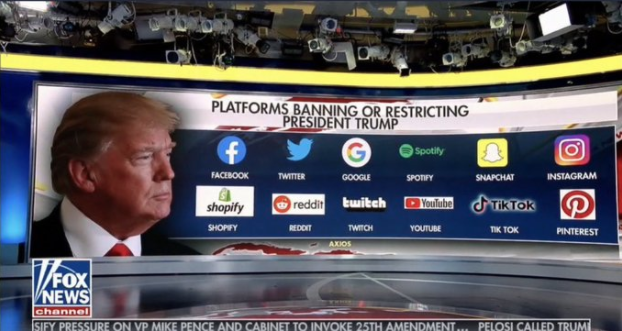
Screencap of a Fox News report on the social media networks that have deplatformed President Donald Trump, January 2021.

For all of history when people have a problem they have been able to talk about it and hash it out. Solutions to complex problems don’t spring fully formed into existence the instant you note the problem. You get ideas from others. Their perspectives help you better articulate the issue and recognize consequences you didn’t expect.

Lawyers know law, engineers know engineering, artists know art, so on. So when there is a big problem that spreads across multiple fields, of course you need to talk it over with people who know those areas, because they know things you don’t. Being smart in one area doesn’t automatically make you an expert in others. We all need help. Big problems require discussion and brainstorming. Even if it isn’t effective, it’s still useful for the clever people who can make solutions to be able to listen to what the regular populace thinks and feels so that they can get the scope and understand how the problem hurts the public.

In the old days these conversations happened at churches, taverns, colleges, that kind of thing. All the famous places where big solutions to big problems were hashed out have a historical marker on them today. For us, those things are now illegal or stifled and we get the internet.

So of course the people who don’t see the problems as problems — or sometimes they are the problem — are trying to stop the rest of us from discussing the problems or they are trying to control where and how the conversations happen. Since they benefit from the problem, they will squash or sabotage people talking about solutions. It is in their best interests to do so, and when you give a bully a stick, they will beat you with it.

The topic of the current problem isn’t the important thing. This is our public square now whether we like it or not. We have foolishly abdicated the public square and now we are paying the price. Of course they can’t just let people they don’t like converse. That’s dangerous to their positions.

So when information they don’t like appears, they hide it. If they can’t hide it, they “fact check” it, and often that’s just a headline screaming false followed by an article full of straw grasping excuses they know most people won’t read. The goal is to shut you up or discredit you.

In the old days, at your pub or church, your drinking buddies or co-religionists probably shared your concerns and faced the same problems. So at least you were working toward a common goal. But now, big tech doesn’t want that. They don’t like groups or forums that don’t share their orthodoxy. They want/need to keep you here, and they need strangers to constantly kick in the doors and blunder in to tell you that you are stupid or crazy, that way we waste time arguing with them. It used to be a village had one idiot. When we talk now we get to deal with a thousand villages worth of idiot.

January 12, 2021

“Big Tech” flexes the muscles and squeezes down the Overton Window online

In the FEE Daily newsletter, Brad Polumbo outlines the collusive mass deplatforming of President Trump and many of his high profile supporters:

Screencap of a Fox News report on the social media networks that have deplatformed President Donald Trump, January 2021.

Amid the fallout from the January 6 attack on the US Capitol, President Trump has been banned from just about every social media platform.

This crackdown is, frankly, unprecedented.

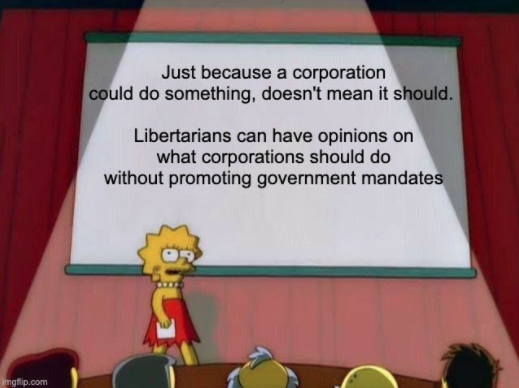
To be sure, social media and tech companies are private companies, and are not bound by the First Amendment. They have no legal obligation to host President Trump’s speech.

But there’s a question beyond can here that ranges into the should.

And I, for one, find it extremely disturbing that the elected President of the United States — who just weeks ago received roughly 75 million votes — is deemed beyond the pale of acceptable speech by Silicon Valley overlords who are overwhelmingly left-wing. Especially so given that these same platforms still allow the literal Chinese Communist Party to post pro-genocide propaganda and allow the members of the Iranian regime to openly foment violence.

The least consumers can demand is some consistency. Personally, I would find it much more reasonable for companies like Twitter to remove individual posts, including by President Trump, that violate rules — like fomenting violence — than to erase prominent political figures from the digital conversation entirely.

We should all want to see a free and open discourse online promoted by the companies we patronize. At the same time, none of this is cause for government control of the internet or meddling with the Section 230 liability shield.

If conservatives don’t like how Twitter CEO Jack Dorsey regulates content, they’d hate how Kamala Harris would do it.

« Newer PostsOlder Posts »

Powered by WordPress