ReasonTV
Published 23 Jun 2022Because of the social media circus surrounding the Johnny Depp/Amber Heard defamation trial, it was easy to overlook one of the principal — yet least likely — actors in the courtroom drama: the American Civil Liberties Union (ACLU), which ghostwrote and placed the 2018 Washington Post op-ed by Heard about surviving domestic abuse that was the basis of the trial.
——————-
It’s only the latest example of how the group has in recent years strayed from its original mission of defending speech, no matter how vile. Awash with money after former President Donald Trump was elected, the ACLU transformed into an organization that championed progressive causes, undermining the principled neutrality that helped make it a powerful advocate for the rights of clients ranging from Nazis to socialists.
It questioned the due process rights of college students accused of sexual assault and harassment under Title IX rules. It ran partisan ads against Supreme Court nominee Brett Kavanaugh and for Georgia gubernatorial candidate Stacey Abrams, a move that current Executive Director Anthony Romero told The New York Times was a mistake. The ACLU also called for the federal government to forgive $50,000 per borrower in student loans.
As the ACLU recedes from its mission, enter another free speech organization, the Foundation for Individual Rights in Education, or FIRE. Founded in 1999 to combat speech codes on college campuses, FIRE is expanding to go well beyond the university and changing its name to the Foundation for Individual Rights and Expression. The group has raised $29 million toward a three-year “litigation, opinion research and public education campaign aimed at boosting and solidifying support for free-speech values.”
“I think there have been better moments for freedom of speech when it comes to the culture,” says FIRE’s president, Greg Lukianoff. “When it comes to the law, the law is about as good as it’s ever been. But when it comes to the culture, our argument is that it’s gotten a lot worse and that we don’t have to accept it.”
Lukianoff tells Reason that FIRE’s new initiatives have been in the works for years, but gained urgency during the COVID lockdowns. “Pretty much from day one, people have been asking us to take our advocacy off campus to an extent nationally,” he says. “But 2020 was such a scarily bad year for freedom of speech on campus and off, we decided to accelerate that process.” Despite 80 percent of campuses being closed and doing instruction remotely, Lukianoff says that FIRE received 50 percent more requests for help from college students and faculty. He also points to The New York Times‘ editorial page editor, James Bennet, getting squeezed out after running an article by Sen. Tom Cotton (R–Ark.) and high-profile journalists such as Bari Weiss, Andrew Sullivan, and Matt Yglesias “stepping away from [their publications], saying that the environment was too intolerant.”
FIRE is also expanding its efforts beyond legal advocacy and into promoting what Lukianoff calls “the culture of free speech.” As Politico reports, it will spend $10 million “in planned national cable and billboard advertising featuring activists on both ends of the political spectrum extolling the virtues of free speech.”
He says that people in their 40s and 50s grew up in a country where the culture of free speech was embedded in colloquial sayings and common attitudes. “Things like everyone’s entitled to their opinion, which is something you heard all the time when we were kids. It’s a free country, to each their own, statements of deep pluralism, like the idea that [you should] walk a mile in a man’s shoes,” he explains. “All of these things are great principles for taking advantage of pluralism, but they’ve largely sort of fallen out of usage due to a growing skepticism about freedom of speech, particularly on campus, that’s been about 40 years in the making.”
Lukianoff has nothing negative to say about the ACLU (in fact, he used to work there) and stresses that FIRE has worked with the organization since “day one” and continues to do so. But unlike the ACLU, FIRE isn’t at risk of turning into a progressive advocacy organization, partly because its staff is truly bipartisan.
That pluralistic pride extends to the groups funding FIRE, too. Lukianoff thinks that despite the rise of cancel culture, most Americans still understand the value of free speech, but they need to be encouraged to stand up for it. FIRE’s polling, he says, reveals that “it’s really a pretty small minority, particularly pronounced on Twitter, that is anti-free-speech philosophically and thinks that people should shut up and conform.”
For that reason, he’s upbeat that FIRE will succeed in helping to restore belief in the value and function of free speech.
Interview by Nick Gillespie. Edited by Regan Taylor.
June 24, 2022
The Guardians of Free Speech
What happens when the proles stop listening to elite Chicken Littles?
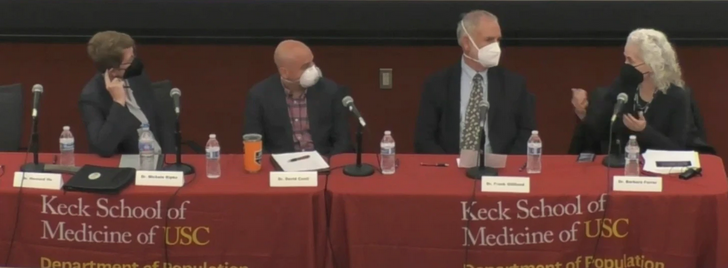
Chris Bray suggests that we should call it “class formation psychosis” instead of “mass”, because it’s the kakistocrats who are doing everything they can to induce “the masses” to feel the fear and obey:
… here’s a picture of a recent panel discussion among public health experts in Los Angeles County, which I wrote about here:
So the normals are just living their lives, and appearing to enjoy it, while the status-projecting elite are engaged in an effort to signal fear and control.
I encourage you to read [Mattias Desmet’s new book] The Psychology of Totalitarianism, especially as an account from an early adopter of the view that our pandemic hysteria has been irrational. But I’m surprised to find myself not buying the argument. Desmet gets the dynamic, but misses the subject: He sees what’s happening, but not who’s doing it. The book is about “the masses”, as in this passage from Chapter 6:
We have to add one more important characteristic to the problematic psychological properties of mass formation: radical intolerance of other opinions and a strong tendency toward authoritarianism. To the masses, dissident voices appear 1) antisocial and devoid of solidarity, because they refuse to participate in the solidarity that the mass formation creates; 2) completely unfounded, as critical arguments are not assigned any cognitive or emotional weight within the narrow circle of attention of the masses; 3) extremely aversive because they threaten to break the intoxication, and in this way confront the masses again with the negative situation that preceded the mass formation (lack of social bond and meaning, indefinable fear and unease); 4) extremely frustrating because they threaten to remove the venting of latent aggression.
This radical intolerance ensures that the masses are convinced of their superior ethical and moral intentions and of the reprehensibility of everything and everyone who resists them: Whoever does not participate is a traitor of the collective.
As someone who spent every moment of the pandemic traveling all over the place, family camping our way through a dozen states and visiting national parks and other tourist-centered destinations, I’ve never met the masses who were consumed with this fearful aggression. In South Dakota in the summer of 2020, I was sitting next to my tent in a state park when some dads on another campsite saw my license plate, then marched over and said that holy shit, man, did you really drive all the way here from California? I hadn’t seen a mask in days, and no one maintained six feet of social distance. As I experienced all over the state, we shook hands and talked. A few days before, at a state park in eastern Wyoming, the couple in the neighboring campsite walked over and offered us dinner, then got trashed on Bud Light — which I didn’t know was possible, on the grounds of “making love in a canoe” — while they hung out by our campfire.
But where we found intolerance and enforced fearfulness was in space controlled by government, as when we got in line outside the Jenny Lake store and quickly drew the attention of the, I am not making this up, line monitor. Masks! Masks! Masks! she helpfully explained, pointing at her masked face to show us what a mask was. Maskless people swarmed around us on all sides, a fact I mentioned to her. “But they’re not in line,” she explained, finding the explanation complete.
Our mass formation psychosis didn’t form in the masses; it formed in policy, and as a social performance among people who wish to be perceived as cultural elites, sniffing at the trash who don’t believe in science. Professors and politicians were highly mask-compliant, and wanted you to know it. My impression is that a quarter to a third of the population locked arms with them and fought proudly for their fear performance, while another third-plus went along to get along, and the balance — especially outside the Blue Zones — just completely ignored the whole mess.
June 23, 2022
Lucki will need to be lucky to keep her job as RCMP Commissioner
In The Line, Stephen Maher covers the active collusion between the Commissioner of the RCMP, Brenda Lucki, and the Liberals in Ottawa to use the tragedy in Nova Scotia that took so many lives to push for further federal gun control measures:
It is bitterly ironic that the first female commissioner of the Royal Canadian Mounted Police may have to resign for pushing the force to be more open, but it is hard to imagine that Brenda Lucki will be able to maintain public confidence after evidence presented Tuesday in the inquiry into the Nova Scotia mass shooting.
On April 28, 2020, 10 days after a killer went on a shooting and arson rampage that left 22 innocent people dead in rural Nova Scotia, Supt. Darren Campbell gave a news conference in which he declined to reveal what kind of firearms the killer used because investigators in Canada and the United States were still trying to find out how the killer came to have them.
After the news conference, Lucki summoned Campbell to a conference call where she chewed him out for holding that information back, as the Halifax Examiner reported.
“The Commissioner said she had promised the Minister of Public Safety and the Prime Minister’s Office that the RCMP (we) would release this information”, Campbell’s notes say. “I tried to explain there was no intent to disrespect anyone however we could not release this information at this time. The Commissioner then said that we didn’t understand, that this was tied to pending gun control legislation that would make officers and the public safer. She was very upset and at one point Deputy Commissioner (Brian) Brennan tried to get things calmed down but that had little effect. Some in the room were reduced to tears and emotional over this belittling reprimand.”
If this is accurate — and a statement from Lucki late Tuesday did not contradict it, reading in part that “I regret the way I approached the meeting and the impact it had on those in attendance” — then it is hard to see how Lucki can stay in her job. Further, the jobs of then-public safety minister Bill Blair and Prime Minister Justin Trudeau are also in jeopardy.
[…]
Trudeau and Blair are in the vote-seeking business, but Lucki is not supposed to be. If Campbell’s notes are accurate, she was confused about that, which is worrying.
We don’t know how much pressure the Liberals were applying. They clearly wanted to make a big splash with their gun announcement, and it would have had more impact if they had been able to say that they were banning the very guns used by the killer.
Pierre Poilievre has called for an emergency committee meeting to look into the matter, and that seems like a good idea. If Lucki was clumsily freelancing, seeking to curry favour with her bosses, she needs to go. If Blair and Trudeau were putting the muscle on her to release politically helpful information even at the risk of damaging an investigation, they need to go. Either way, we need to find out.
The government believes that anyone opposed to Bill C-11 is “spreading misinformation”
Happily for the Canadian government (if not for Canadian internet users), if Bill C-11 gets passed, they can sic the CRTC on those critics … isn’t that convenient?
Last week, shortly after midnight in Ottawa, the House of Commons Heritage Committee concluded its deliberations on the Online Streaming Act, which will grant a federal regulator authority over the global Internet.
You may think putting the Canadian Radio-television and Telecommunications Commission (CRTC) and its nine government-appointed commissioners in charge of the entire online world is a good thing. Or you may think it’s a bad thing. But I’m guessing we can all agree that Bill C-11, the world’s most extensive internet regulation legislation so far, is a Thing.
And you’d think a thing that big would be deserving of respectful, honest debate and thoughtful review. If there’s something in the legislation that is bad in a way that isn’t intended, you’d want it caught and fixed, right? We are, after all, about to grant authority over 21st-century communications to people in charge of something called The Broadcasting Act. An act that was passed in 1993 to make sure nothing terrible — like people preferring NFL over CFL football or the Oscars over the Genies — results from watching too much American TV. Given that thousands of successful Canadian free enterprise Tik-Tokers and YouTubers fear new rules will disadvantage them in favour of the CRTC’s certified cultural broccoli, you’d think that’d be worth a think.
But you’d be wrong.
[…]
But then Liberal MP Tim Louis of Kitchener took this government’s truth-torquing communications strategy to a breathtaking level of self-righteous fantasy — one that dripped with contempt for all but he and his clan.
He calmly rose in the House of Commons and quietly accused C-11’s critics of deliberately spreading “misinformation” — a chilling threat given the government’s plans to deal with he same in “Online Harms” legislation later this year.
Louis did not even try to say, as did Mendicino’s deputy minister, that there was a misunderstanding of some kind. He did not attempt to make it clear that there are people who — as reasonable people often will — disagree. He did not dismiss the bill’s critics as being overwrought, incorrect and yet honourable. He stood up in the House of Commons and, barefaced, declared that views, lived experiences and legal analyses — including the testimony of CRTC Chair Ian Scott — are “simply untrue”. In other words, it’s all #fakenews.
And we are all liars.
June 22, 2022
June 21, 2022
“Schlimmbesserung is a lovely German word which means making something worse by trying to improve it”
In the New English Review, Armando Simón considers some of the oddities of American worldview that seem so often to make worse the very things they try to “fix”:
Americans’ ignorance of other countries, their cultures, their history and their geography is legendary and world renowned and the subject of countless anecdotes and jokes by foreigners. This ignorance is inexplicable, as it is not found in America’s northern or the southern neighbors, so it cannot be due to geographical isolation. It is also a fact that foreigners know more about America than Americans know of their countries. Or even their own.
It is also a paradox. One would expect logically that a country that is principally composed of immigrants and the descendants of immigrants would have an encyclopedic knowledge of other countries, as is the case with Britain, which had a world-wide empire. Not so.
And this may explain America’s unintentional policy of schlimbesserung, the worsening of something that it is trying to improve, or as Greene described it so aptly of an American character in one of his novels, “armored in his ignorance and good intentions”.
As an aside, let me also say that this naïve optimism — to put it charitably — has enabled foreign governments to easily steal diplomatic and military secrets with little trouble, according to Gordievsky’s KGB: The Inside Story of Its Foreign Operations from Lenin to Gorbachev. John Walker, an American traitor who spied for the Russians for 17 years once said in a public interview that Walmart guards a tube of toothpaste better than the Navy guards its secrets. He should know.
Many individual American philanthropists and government bureaucrats go energetically out in the world upon hearing of some terrible condition in some part of the world through the television, convinced that they, yes they, can personally correct the situation when in reality they have no idea of what the hell they’re doing, who they are dealing with, or what is really going on in that part of the world, nor of the cultural, historical, and geographical circumstances. Nor can they even speak the local language! They are simply confident that they will solve the problem. And so they will feel good about themselves (for example, there is no question in my mind that some dirt-poor African doctors, upon learning that some idiot Americans, obsessed with AIDS, were going to send millions upon millions of dollars in their countries “to combat AIDS”, and having very few actual cases of infected patients, simply falsified the statistics. Or worse.). It is as if they were hopscotching across a cultural minefield with an idiotic grin.
The cultural values that one takes so much for granted that one is not conscious of may not be present elsewhere. For example, Americans do not understand that many countries e.g., Greece, Ireland, tend to explain their present problems by blaming other countries (Turkey, Germany, England) over what happened centuries ago instead of actually solving the problems. People in other countries are backward looking in that their sights are rigidly focused on their past, whereas Americans’ eyes are always on the future (and which might explain why Americans are addicted to science-fiction) while being generally ignorant about their past.
Also, it is a general truism that the majority of persons who run for office in North America and various European countries do so because they sincerely want to help and improve their communities/countries. However, in all of Africa and most of Asia, persons who seek public office do so for one purpose, and one purpose only: to steal everything that they can get away with. So when some ignorant, naïve, American shows up with buckets full of money, oblivious of the culture and the longstanding, entrenched, corruption, and with an announced intention to make the local community more like an American community, they are welcomed with open arms while suppressing their snickering. This also explains something where Americans exhibit willful blindness: other cultures don’t play fair. Honesty is seen as the trait of fools. Fools are to be taken advantage of. Especially in trade and diplomacy. Just look at China.
QotD: The modern age of ad hominem
Ad Hominem has become not only the prime argument of the scalawag, but, in the current intellectual climate, the only argument. It is the only arrow in the quiver and the only dart they have.
Hence, I myself have developed a particular enmity and impatience with the art of merely labeling opposing viewpoints as anathema, and dismissing them, sight unseen, with no further investigation.
These are not cases where a particular person known to have an ulterior motive or suffering a well earned reputation for dishonesty find his remarks being regarded with judicious skepticism. These are cases where to disagree with the party line or popular gossip provokes the accusation of being such a person.
While not all scalawags are Morlocks, all Morlocks are scalawags. Scalawaggery is the core of their philosophy. Morlock borrowed from the generous genius of HG Wells, for anyone who imagines himself to be evolved beyond human norms and into the realm of moral inversion, so that all rules of right and wrong, only for oneself, are flipped downside up.
In Wells, the Morlock is a cannibal troglodyte who treats other human descendants as cattle. In my wry jest, a Morlock is an intellectual trapped in a structure of reasoning he erected, at first, to justify his inhumanity toward his fellow human beings. That structure has since become for his his thought-prison. The bars and chains are mental and spiritual. Impalpable, they are unbreakable.
Their inhumanity include treating the children of other men as lab experiments and a mass attempt at sexual social engineering, namely, the elimination of the two sexes. Inhumanity also includes treating individuals as fungible and interchangeable nonentities in the great game of identity politics, so that simplistic and bigoted generalizations about minorities or majorities become not merely permitted, but mandatory. Inhumanity includes treating the prosperity and freedom of other men as optional, or even as hindrances, in the headlong panics and stampedes inspired by orchestrated ecological scaremongering and virtue-signaling.
Inhumanity includes regarding other men as meat-robots, or hairless apes, or helpless cells of blind historical forces, and hence as nothing more than the raw materials to be bred like livestock or organized like chain gangs or stacked like cordwood or slaughtered like scapegoats to create the foundations of the towers of Utopia.
The inhumanity, sadly, also and finally includes an inhumanity toward themselves, whenever a godless and soulless mind turns inward, and develops terminal narcissism. All men beyond the narrow orbit of self-absorbed self-regard are reduced to flitting shadows, and seem to Narcissus to be merely echoes, not real.
John C. Wright, “Ad Hominem and Illusion”, John C. Wright, 2022-03-18.
June 20, 2022
The blight of the 21st century – the dictatorship of the experts
Oliver Traldi considers the role of experts in the modern world:
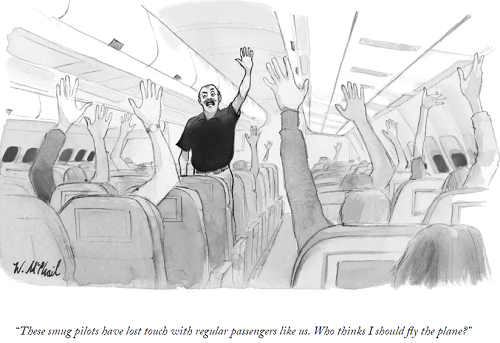
A few weeks before Donald Trump’s inauguration as President, the New Yorker published a cartoon depicting a mustached, mostly bald man, hand raised high, mouth open in a sort of improbable rhombus, tongue flapping wildly within, saying: “These smug pilots have lost touch with regular passengers like us. Who thinks I should fly the plane?” The tableau surely elicited many a self-satisfied chuckle from readers disgusted by the populist energy and establishment distrust that they perceived in Trump’s supporters.
But what exactly is the joke here? Citizens in a democracy are not akin to airline passengers, buckled quietly into their seats and powerless to affect change, their destinations and very lives placed in the hands of professionals guarded by a reinforced door up front. Even brief reflection reveals the cartoonist’s analogy to be comparing like to unlike.
That none of us thinks we know better than a plane’s captain, yet we often think we know better than experts in matters of politics, suggests differences between those domains. And it highlights a vexing problem for modern political discourse and deliberation: We need and value expertise, yet we have no foolproof means for qualifying it. To the contrary, our public square tends to amplify precisely those least worthy of our trust. How should we decide who counts an expert, what topics their expertise properly addresses, and which claims deserve deference?
* * *
We all rely upon experts. When something hurts, we consult a doctor, unless it’s a toothache, in which case we go to a dentist. We trust plumbers, electricians, and roofers to build and repair our homes, and we prefer that our lawyers and accountants be properly accredited. Some people attain expertise through training, others through experience or talent. I defer to someone who’s lived in a city to tell me what to do when I visit, and to a colleague who’s studied a particular topic at length even though we have the same mastery of our field overall. A friend with good fashion sense is an invaluable aid in times of sartorial crisis.
In all these cases, our reliance on expertise means suspending our own judgment and placing our trust in another — that is, giving deference. But we defer in different ways and for different reasons. The pilot we choose not to vote out of the cockpit has skill, what philosophers sometimes call “knowledge how”. We need the pilot to do something for us, but if all goes well we need not alter our own beliefs or behaviors on his say so. At the other extreme, a history teacher might do nothing but express claims, the philosopher’s “knowledge that”, which students are meant to adopt as their own beliefs. Within the medical profession, performing surgery is knowledge-how while diagnosing a headache and recommending two aspirin as the treatment is closer to knowledge-that.
But how are those without expertise to determine who has it? Generally, we leave that determination to each individual. A free society and the free market allow for widely differing judgments about who to trust about what, with credentialing mechanisms in place to facilitate signaling and legal consequences for outright fraud. Speculative bubbles notwithstanding, the market also helps to aggregate countless individual judgments in ways that yield socially valuable outcomes. Two New York City diners may have signs promising the “World’s Best Cup of Coffee”, but the one that actually has good coffee is more likely to be bustling on any given day and to thrive in the long run.
H/T to Ed West’s weekly round-up post for the link.
June 19, 2022
Has anyone checked the “Best Before” date on the federal government lately?
In the free-to-cheapskates abridged edition of The Line‘s weekly dispatch, the editors wonder if the Trudeau government may have inadvertently entered the end-game phase of its life:
Your Line editors have grown wary of making firm predictions. We’ve been burned a few times before, plus, the last two years have been so wild it’s almost impossible to take seriously any prediction with a time horizon longer than a week or two. All that being said, one of your Line editors did have something of a prediction this week. Honestly maybe something more akin to an intuition or a Spidey sense tingling. But as he watched the news over the last 10 days or so, he found himself wondering: is this it for the Liberals? Is this the start of a death spiral? Is this what we will look back to in years to come as the moment they crossed the point of no return?
The Liberals started to look and feel really burnt out and exhausted this week. Of course they’re burnt out and exhausted. It’s been a hellish two years for everyone, and they were dealing with the Trump circus for years before that. They haven’t usually looked exhausted, though. Even when they have no doubt been running on adrenaline, existential terror, caffeine and digestive bile, they kept running. That’s not sustainable forever, though, and sooner or later, a government slips into the terminal phase of democratic politics. We’ve all seen that before, and we recognize the signs when we see it.
Just think about the stories over the last few days. Public Safety Minister Marco Mendicino has come in for widespread criticism, and not just from here at The Line, for his handling of the gun control and Emergencies Act files. Chrystia Freeland, for her part, made a wholly uninspiring appearance before the committee investigating the Emergencies Act, and followed that up with a speech to a Toronto business crowd where she rolled out the Liberal plan to help Canadians cope with inflation. It was nothing but a repackaging of previously announced initiatives, some of which are fine on their merits, but none of which, even in total, will make a dent against inflation. Mélanie Joly’s office, as noted in greater detail in the full, subscribers-only version of the dispatch, has become a complete clown show of absurdity this week. Karina Gould, normally one of Trudeau’s less trouble-making ministers, had to issue a mea culpa over a minor ethics breach. The Liberals rammed Bill C-11, which would regulate internet content, through the House with unseemly speed, and the Senate is pledging to do the thorough review that the House Liberals clearly wished to avoid.
And then there was the sudden evolution of Liberals’ stand on vaccine mandates, and the pandemic more generally. Facing enormous public pressure over delays at the airports, the Liberals first agreed to “suspend” random COVID-19 testing of passengers landing in Canadian airports from international arrivals. This week, they followed that by suspending the vaccine mandate for air and rail travel. In both cases, the government had been overtly defending both of those measures as absolute necessities just hours or days before scrapping — sorry, “suspending” — them. We won’t even try to summarize this better than the National Post‘s Chris Selley did in a recent column, because we won’t do better than his absolute perfection: “By now, the Liberal playbook on untenable pandemic-related policies is clear: They defend each square inch of policy territory like Tony Montana at the top of the staircase until ordered to retreat, at which point they drop their weapons, flee into the night and claim science made them do it.”
Yuuuup.
In a political sense, none of these would amount to all that much in isolation. (Some of them should amount to a whole lot, because they’re legitimate issues, but we know how politics works in this country.) When viewed in their totality, though, all these (and more) stories over the last week or two start to look and feel like a government that has basically exhausted itself and run out of gas. When you consider the fact that, if anything, the situation facing the country is getting worse on many fronts — hello, inflation! — not better, it’s not at all difficult to imagine them struggling to ever really recover from this.
Why Hate Speech Laws Backfire
ReasonTV
Published 26 Feb 2022Here’s a brutal irony about regulating hate speech: Such laws often end up hurting the very people they are supposed to protect.
——————
Follow us on Twitter: https://twitter.com/reasonReason is the planet’s leading source of news, politics, and culture from a libertarian perspective. Go to reason.com for a point of view you won’t get from legacy media and old left-right opinion magazines.
—————-
That’s one of the central lessons in Jacob Mchangama’s important new book, Free Speech: A History from Socrates to Social Media. Mchangama heads up the Danish think tank Justitia. He’s worried about a proposal that would make hate speech a crime under European Union (EU) law and give bureaucrats in Brussels sweeping powers to prosecute people spewing venom at religious and ethnic minorities, members of the LGBT+ community, women, and others.Europe’s history with such laws argues against them. In the 1920s, Germany’s Weimar Republic strictly regulated the press and invoked emergency powers to crack down on Nazi speech. It censored and prosecuted the editor of the anti-Semitic Nazi paper Der Stürmer, Julius Streicher, who used his trial as a platform for spreading his views and his imprisonment as a way of turning himself into a martyr and his cause into a crusade. When the Nazis took power in the early ’30s, Mchangama stresses, they expanded existing laws and precedents to shut down dissent and freedom of assembly.
Contemporary scholarship suggests that there can be a “backlash effect” when governments shut down speech, leading otherwise moderate people to embrace fringe beliefs. Mchangama points to a 2017 study published in the European Journal of Political Research that concluded extremism in Western Europe was fueled in part by “extensive public repression of radical right actors and opinions.”
In 1965, the United Kingdom passed a law banning “incitement to racial hatred,” but one of the very first people prosecuted under it was a black Briton who called whites “vicious and nasty people” in a speech. More recently, Mchangama notes that radical feminists in England “have been charged with offending LGBT+ people because they insist there are biological differences between the sexes. In France, ‘an LGBT+ rights organization was fined for calling an opponent of same-sex marriage a ‘homophobe.'”
“Once the principle of free speech is abandoned,” warns Mchangama, “any minority can end up being targeted rather than protected by laws against hatred and offense.”
That’s what happened in Canada in the 1990s after the Supreme Court there ruled that words and images that “degrade” women should be banned. The decision was based in part on the legal theories of feminist author Andrea Dworkin, whose books on why pornography should be banned were briefly seized by Canadian customs agents under the laws she helped to inspire.
First Amendment rights are still popular in the United States, with 91 percent of us in a recent survey agreeing that “protecting free speech is an important part of American democracy.” But 60 percent of us also said that the government should prohibit people from sharing a racist or bigoted idea.
Hearing hateful words and ideas outrages and discomforts most of us, but Mchangama’s history of free speech underscores that state suppression can grant those words and ideas more power and influence. And that the best antidote to hate in a free and open society is not to hide from it but to openly—and persuasively—confront it.
Listen to my Reason Interview podcast with Jacob Mchangama at https://reason.com/podcast/2022/02/16….
Written by Nick Gillespie. Edited by Regan Taylor.
June 18, 2022
June 14, 2022
June 13, 2022
The idealized EU that British “Remainers” still long for
The Brexit debate was at least as much a cultural as it was an economic or political struggle. Many of the people who wanted the UK to remain within the European Union would be instantly comfortable as members of Canada’s Liberal or New Democratic parties, as our “Laurentian elite” are culturally much more attuned to their European elite counterparts than they are to ordinary Canadians. British “Remainers” similarly have much more in common with their Euro counterparts than with ordinary Brits:
For many in the British cultural establishment, Brexit was (and still is) an incomprehensible, foolish rejection of the unqualified benefits of the European Union. The creative industries, according to one noted poll in the lead-up to the 2016 referendum, were 96 per cent in favour of staying in the EU, and many working in the arts and culture have been raging ever since. Britain’s contemporary artists are some of the most outspoken about Britain leaving the EU, to the point that some of them would rather leave Britain. Last week, speaking at an exhibition opening in the Netherlands, famed sculptor Antony Gormley announced that such were his strong feelings over Brexit that he had applied for German citizenship. “I’m embarrassed about Brexit”, he lamented, “it’s a practical disaster, a betrayal of my parents’ and grandparents’ sacrifice to make a Europe that was not going to be divided again”.
[…]
None of our parents and grandparents who experienced the war, and the postwar reconstruction, would have envisioned the EU in its current form. It is a backroom technocracy of elites, making decisions beyond the reach of popular accountability, increasingly hostile to democracy and the aspirations of its millions of citizens. As many of us have always maintained, it’s possible to be for Europe, for fellow Europeans and for European culture – but against the EU.
The “little Englander” slur is one of the more ingrained prejudices of cultured Remainers. It has always been a way of expressing their contempt for those stuck with the consequences of the European project, those people unable or unwilling to shift from their “little”, provincial world and attitudes. These are the people, moreover, who the cultural establishment spent two decades up until the referendum patronising and cajoling. Arts policies and newbuild art galleries imagined that culture would rehabilitate the left-behind provincials of post-industrial Britain. Until, that is, post-industrial Britain voted the “wrong” way. (Gormley, with haughty disdain, has previously described Brexit as “a stupid moment of collective fibrillation” and “a disease”.)
Prominent Remainers profess their love for EU free movement, but studiously look the other way when it comes to its less romantic reality. Its only real achievement has been to facilitate the flow of cheap labour from poorer to richer EU states. This is the dominant economic reality of the free movement of labour, not the individualist idyll of foot-loose, self-determining bohemianism, or the career mobility of the well-paid creative. The latest Home Office figures for applications to the EU settled-status scheme reveal the stark trends in where Europeans, settling in Britain post-Brexit, are from: while the table is headed by poorer Eastern European Romania and Poland, these are followed by Italy, Portugal and Spain – southern Eurozone countries which were battered by the consequences of the EU’s stubborn and heedless imposition of the single currency.
While Remainers crow about insularity and “little Englanders”, it turns out that Britain is actually becoming more cosmopolitan, not less, since Brexit – just not in the way they mean it. Not only are 3.2million European citizens now fully settled and 2.6million “pre-settled” (meaning they’ll be fully settled after five years of residence), but also the British population is becoming more international. Recent ONS figures show that the number of workers not born in the UK has increased as a share of the labour force, from 17 per cent in June 2016 to 19 per cent in March 2022, with the increase made up of non-EU workers.
Update: Added the link to J.J. Charlesworth’s article at Spiked.
Justin Trudeau’s sadism is visible at Toronto’s Pearson International Airport
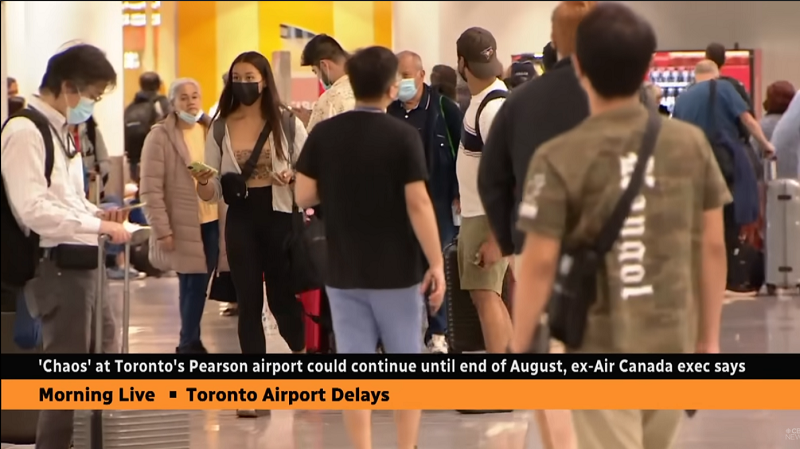
It’s been more than a decade since the last time I had to travel by air … and even then it was still a far worse experience than it was before 9/11. Canada is among the last few countries to loosen Wuhan Coronavirus restrictions on international travel — along with two of Justin Trudeau’s favourite nations, the cuddly North Korean sole proprietorship and the “admirable” “basic dictatorship” in China. In the free-to-cheapskates weekly round-up of The Line, the editors have recent travel experiences at Canadian airports to discuss:

CBC News report on delays at Pearson International Airport in Toronto, 9 June, 2022.
Screencap from https://www.youtube.com/watch?v=pkgmWWY2SDc
… Why couldn’t your Line editor browse the aisle? Well, because duty free is only for international travellers, and hanging around was forbidden due to “COVID protocols,” the clerk explained.
Now, was your Line editor going to stand around and pick a fight with some underpaid store clerk who was just following the rules? Absolutely not.
But she thought about it.
Look, we understand that not being able to browse is, on the list of first-world problems, really far down, but we had to admit that this stupid little non-incident made us angry. Just stupid, irrationally, bug-eyed angry for a solid minute or two.
Why? Because our entire lives have been eaten by a compounding collection of nonsensical COVID rules and restrictions that have added up to make everybody crazy and miserable, and this was just another. Everyone we know now has a story of peaking on COVID hysteria; experiencing a moment so surreal, inhumane and paranoid that it had the effect of fundamentally breaking trust in the judgement of public health and in broader institutional authority. Whether it was the moment they covered the outdoor playgrounds with police tape; the librarian who refused to let the potty-training toddler use the bathroom; the umpteenth school closure; the triple-masked mom screaming hysterically at her ward for touching other kids; to stories of being trapped for hours on end in airplanes or terminals. There was a moment when nearly all of us broke and took someone else’s head off. When we stopped clapping for health-care workers and instead grew quietly resentful, or found ways to silently flout COVID protocols — or abandoned the mainstream altogether and lost ourselves to fringe politics and conspiracy theories.
Upon arrival at one airport, one of your Line editors spotted a kids’ play area containing nothing more than a cartoonish carpet depicting a fun little airport runway. It was still closed. It is, apparently, still too dangerous to let kids burn off steam by pretending to be airplanes for a few minutes.
Even the Liberal backbench has been reported to be demanding that Justin Trudeau make some vague gestures to reduce the arbitrary and unscientific civil liberty restrictions we’ve been living under for what seems like forever … but he seems to like making Canadians miserable where and when he can.
Keeping up unnecessary mandates is not a cost-free political solution. You are teaching your population to distrust you. Yeah, we mean that quite literally: you, Liberals, are also responsible for the declining social cohesion and failing institutional trust that is fuelling populist movements across the country.
We realize that the mandates are small potatoes. But in a way, they’re also really not. Keeping up historic restrictions on Canadians movement, slowing a desperately desired return to normal, purely for political reasons, is only further corroding the social contract between electorate and government. Further, you’re falling into exactly the same trap as the Conservatives — you’re riding the dragon that will eat you, allowing your loudest, fringiest members to dictate policy.
The Liberals seem to be getting this, at least a little bit. Probably because they perceive the political threat this presents to them. On Friday, they announced that random COVID-19 testing of certain arrivals would be suspended, temporarily, until the end of the month. This is intended to reduce backlogs and crowding at our arrival gates, particularly in Toronto. We’ll see how much it helps, but as a political decision, it’s revealing: the Liberals are now alarmed enough to do something, but not to actually just scrap the screening, at least not yet. For now, it’s just a pause.