
The Great War
Published Feb 9, 2024In fall 1914, the British and French armies on the First World War’s Western Front were wrestling with a problem: unseen German riflemen were picking off any man who showed himself above the trench. Something had to be done about it – and the result was the birth of the modern sniper.
(more…)
June 4, 2024
Snipers in World War 1
Comments Off on Snipers in World War 1
June 2, 2024
Japan vows to fight to the end! – WW2 – Week 301 – June 01, 1945
World War Two
Published 1 Jun 2024This week President Truman and his aides meet to discuss the use of the atomic bomb. In Japan, the Imperial government vows to fight on even as Yokohama is turned to ash by firebombing. On Okinawa, Japanese 32nd Army withdraws from the defences of Shuri Castle but there is still plenty of hard fighting left for the Americans. There are US Navy command reshuffles and the stage is set for an Allied conference in Potsdam.
Chapters
01:21 Recap
05:08 The Fight on Okinawa
08:38 The Interim Committee And The Bomb
14:02 Notes
(more…)
Comments Off on Japan vows to fight to the end! – WW2 – Week 301 – June 01, 1945
QotD: The Spartans do not deserve the admiration of the modern US military
The Athenian historian Thucydides once remarked that Sparta was so lacking in impressive temples or monuments that future generations who found the place deserted would struggle to believe it had ever been a great power. But even without physical monuments, the memory of Sparta is very much alive in the modern United States. In popular culture, Spartans star in film and feature as the protagonists of several of the largest video game franchises. The Spartan brand is used to promote obstacle races, fitness equipment, and firearms. Sparta has also become a political rallying cry, including by members of the extreme right who stormed the U.S. Capitol on Jan. 6, 2021. Sparta is gone, but the glorification of Sparta — Spartaganda, as it were — is alive and well.
Even more concerning is the U.S. military’s love of all things Spartan. The U.S. Army, of course, has a Spartan Brigade (Motto: “Sparta Lives”) as well as a Task Force Spartan and Spartan Warrior exercises, while the Marine Corps conducts Spartan Trident littoral exercises — an odd choice given that the Spartans were famously very poor at littoral operations. Beyond this sort of official nomenclature, unofficial media regularly invites comparisons between U.S. service personnel and the Spartans as well.
Much of this tendency to imagine U.S. soldiers as Spartan warriors comes from Steven Pressfield’s historical fiction novel Gates of Fire, still regularly assigned in military reading lists. The book presents the Spartans as superior warriors from an ultra-militarized society bravely defending freedom (against an ethnically foreign “other”, a feature drawn out more explicitly in the comic and later film 300). Sparta in this vision is a radically egalitarian society predicated on the cultivation of manly martial virtues. Yet this image of Sparta is almost entirely wrong. Spartan society was singularly unworthy of emulation or praise, especially in a democratic society.
To start with, the Spartan reputation for military excellence turns out to be, on closer inspection, mostly a mirage. Despite Sparta’s reputation for superior fighting, Spartan armies were as likely to lose battles as to win them, especially against peer opponents such as other Greek city-states. Sparta defeated Athens in the Peloponnesian War — but only by accepting Persian money to do it, reopening the door to Persian influence in the Aegean, which Greek victories at Plataea and Salamis nearly a century early had closed. Famous Spartan victories at Plataea and Mantinea were matched by consequential defeats at Pylos, Arginusae, and ultimately Leuctra. That last defeat at Leuctra, delivered by Thebes a mere 33 years after Sparta’s triumph over Athens, broke the back of Spartan power permanently, reducing Sparta to the status of a second-class power from which it never recovered.
Bret Devereaux, “Spartans Were Losers”, Foreign Policy, 2023-07/22.
Comments Off on QotD: The Spartans do not deserve the admiration of the modern US military
June 1, 2024
I plead the Pith: a History of the Pith Helmet
HatHistorian
Published Jun 1, 2022A symbol of exploration, tropical adventure, and colonialism, the pith helmet has had a long history since its origins as the salakot, a Philippine sun hat. Through many iterations, it had become one of the most famous hats out there, a powerful part of popular imagination.
The helmets I wear in this video come respectively from a gift from a family friend (so I don’t know where it was bought, https://www.historicalemporium.com/, and Amazon.com. The red tunic comes from thehistorybunker.co.uk
Title sequence designed by Alexandre Mahler
am.design@live.comThis video was done for entertainment and educational purposes. No copyright infringement of any sort was intended.
Comments Off on I plead the Pith: a History of the Pith Helmet
May 30, 2024
The Bloody Birth of Socialist Yugoslavia
World War Two
Published May 29, 2024In the final months of the war, Partisan leader Josip Tito and his forces complete their conquest of Yugoslavia. They destroy Draza Mihailovic’s Chetniks and Ante Pavelic’s Croatian Independent State and they outmanoeuvre King Peter. As Tito’s forces take revenge on their vanquished foes, Socialist Yugoslavia is born in a cradle of fire and blood.
02:08 Mihailovic’s Last Roll of the Dice
04:35 Tito Aligns himself with the Soviets
07:06 Albania
08:25 Tito begins state building
10:51 Hoxha purges his enemies
12:00 The Fall of Mihailović
13:08 The End of the Independent State of Croatia
14:54 The Events at Bleiburg
17:08 The Massacres
19:41 The Birth of Socialist Yugoslavia
20:54 Conclusion
(more…)
Comments Off on The Bloody Birth of Socialist Yugoslavia
May 29, 2024
A visit to failure pier
CDR Salamander has some advice for any US congresscritter with a spine (unfortunately, that probably means none of them):

This old operational planner has one bit of advice to Congress in their role of having oversight of the Executive Branch; subpoena the Decision Brief for the Gaza pier operation.
This was on the lowest of low scale of military operations, Humanitarian Assistance/Disaster Response. There is little to nothing classified about any of this rump of a capability. Call in member of the Joint Staff who were involved in this planning — and I would prefer if you could find a few terminal O5/6 to testify as well. You might actually enjoy some candor.
The Commander’s Intent, the Higher Direction and Guidance, the Planning Assumptions, the Constraints and Restraints, the Critical Vulnerability analysis, etc. It is all there. If not, the Chairman of the Joint Chiefs of Staff and the Secretary of Defense should tell the American people to their face.
This is a larger issue than anything happening in that impossible corner of the globe. Over the weekend, we saw yet more indications of an empire in decline deteriorating from bad to pathetic.
From the time the first load came off the pier, the aid barely made it past 300 meters until it disappeared into Hamasistan.
I’ll go ahead and tap the sign;
[…]
Generally this latest act in this other-end-of-the-Med-from-the-Greeks tragedy that has unfolded in front of everyone. As we saw at the top at Ashkelon Beach, first some ancillary bits floated over to Israel as the Eastern Mediterranean reminded everyone it is at the eastern end of a big sea with weather and waves and stuff.
We then found out that three soldiers were injured in a forklift accident. Just to add insult to injury, as the locals laughed, it appears more of the business end decided to try to make it to Haifa on its own.
[…]
I’m not sure how you scatter Army property all over the Eastern Med without a boot getting dry, but maybe I’m wrong. Gaza is lava, and all.
Empires don’t often die in a blaze of glory, no. More often than not they end in simpering apologies and excuses from poor leaders putting the wrong people in positions they have no place being, and when they fail — there is no accountability.

Comments Off on A visit to failure pier
Why Germany Lost the Battle of the Atlantic
Real Time History
Published Feb 2, 2024In March 1943, German U-boats are on the attack – they sink 108 Allied vessels that month alone. Some Allied officials fear a German victory in the Atlantic is imminent. If the Allies lose the Atlantic, Britain loses its lifeline – and maybe even the war. But by May 1943, it will be the U-boats limping home in defeat. So how, in just two months, did the U-boats go from hunters to hunted?
(more…)
Comments Off on Why Germany Lost the Battle of the Atlantic
May 28, 2024
Rishi Sunak’s big-brained election-winning strategy: bring back the draft
Embattled British Conservative leader Rishi Sunak has had another of his patented brainstorms for a policy that will absolutely win his party huge numbers of “gammon” votes in the July 4th general election:
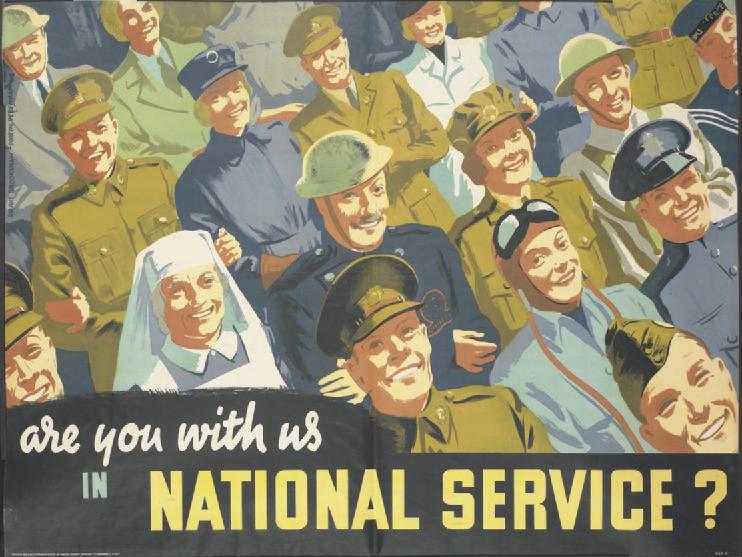
I thought the misty nostalgia for postwar “National Service” had died out long ago …
Here we go: straight off, let’s get the youth to do some indentured servitude, sorry, National Service.
The Sunday Times reports:
Every 18-year-old will be required by law to sign up for a year of National Service under plans unveiled by the Conservatives this weekend.
Rishi Sunak’s first manifesto commitment would see youngsters given the choice between a full-time course (for 12 months) or spending one weekend a month volunteering in their community. There will be sanctions for teenagers who do not take part. Up to 30,000 full-time positions will be created either in the armed forces or in cybersecurity training. The weekend placements could be with the fire or police service, the NHS or charities tackling loneliness and supporting older, isolated people.
The Tories have pledged to set up a royal commission to design the £2.5billion programme and establish details such as how the cybertraining would be delivered. A pilot will start next year and by the end of the parliament legislation will be passed making it mandatory for all 18-year-olds.
[…]
The Prime Minister says: “This new, mandatory National Service will provide life-changing opportunities for our young people, offering them the chance to learn real-world skills, do new things and contribute to their community and our country.” I doubt very much it will do this. The youth could learn real world skills in a weekend job that they’d actually get paid for but under Tory Rule they must become an indentured servant of the State instead.
It was floated that “the weekend placements could be with the fire or police service, the NHS or charities tackling loneliness and supporting older, isolated people”. Really? The fire and police service having to babysit some surly 17-year-old teenager glued to a mobile phone? Is this really what a police officer wants?
No doubt the vast majority of the youth will be dumped in some NHS hospital to do goodness knows what, or indeed a nursing home. And what about all the people who are currently off work and on anti-depressants “because of mental health”. Will they be forced to volunteer, or let off the requirement?
May 27, 2024
The Manda: Croatia’s Minimalist .50 BMG
Forgotten Weapons
Published Feb 21, 2024The Manda is a rifle that was designed for the Croatian Special Police at the beginning of the Homeland War in 1991. At that point, the Special Police (basically the SWAT teams) were basically the only really well-trained fighters in the country with combat experience. They wanted .50 BMG anti-material rifles for the war that was breaking out, and the Croatian Ministry of the Interior developed and produced the Manda for them.
Specifically, the rifle was designed by engineer Petar Vucetic (and named after his sister). Mechanically, it is a very simple rifle, with two large locking lugs, a tubular stock, M70 AK pistol grip, and a barrel made from a turned-down Browning M2 bolt with a large muzzle brake. A total of 84 were made, fitted with Leupold scopes and mounts with integrated BDC cams for use from 300 out to 1000 meters.
(more…)
Comments Off on The Manda: Croatia’s Minimalist .50 BMG
May 26, 2024
The Last Battles in Europe – WW2 – Week 300 – May 25, 1945
World War Two
Published 25 May 2024This week, the fighting in Europe finally comes to an end and the Allies round up more leading Nazis including Heinrich Himmler and Karl Dönitz. In Asia, the fighting continues on Okinawa even as the Japanese start pulling back. The Australians continue fighting on Tarakan, and the Chinese are victorious in western Hunan.
00:00 Intro
01:45 Fighting In Europe Ends
04:30 Notes From Europe
06:57 Japanese Begin To Withdraw On Okinawa
12:41 The Battle Of Tarakan Island
14:35 Chinese Victory In Western Hunan
18:51 Conclusion
(more…)
Comments Off on The Last Battles in Europe – WW2 – Week 300 – May 25, 1945
Evolution of The Churchill Tank | “No Damn Good”?
The Tank Museum
Published Feb 17, 2024Designed by a company that had never built a tank before with the Prime Minister, Winston Churchill, looking over their shoulders and plagued by mechanical teething troubles, the Churchill tank had unpromising beginnings. Despite this, it became one of the most successful British tanks of WW II: heavily armoured, not fast but with superb climbing ability, the Churchill served not only as a gun tank but the basis many of the specialised vehicles that helped the British and Canadian Armies ashore on D-Day.
00:00 | Intro
01:20 | History – What was needed?
03:38 | Design, Weaponry and Armour
08:44 | Up-gunned and Upgraded
13:59 | A Look Inside
17:51 | Combat Performance
20:23 | Multi-use Platform
23:10 | ConclusionThis video features archive footage courtesy of British Pathé.
#tankmuseum
Comments Off on Evolution of The Churchill Tank | “No Damn Good”?
May 25, 2024
Fathers of Light and Darkness – Rockets and Explosives – Sabaton History 126 [Official]
Sabaton History
Published Feb 7, 2024There are many inventors whose creations have been turned into weapons of war. A couple that really stand out are Alfred Nobel and Wernher von Braun. Today we’ll take a deep dive into their stories and the paradox of using destructive weapons for good, or creative weapons for destruction.
(more…)
Comments Off on Fathers of Light and Darkness – Rockets and Explosives – Sabaton History 126 [Official]
May 23, 2024
Where does a former general go to get his reputation back?
The National Post reports on a former Canadian senior officer launching a lawsuit in an attempt to clear his reputation after an abortive court martial brought his career to an end:
Lt.-Gen. Steven Whelan, a three-star general who was accused of sexual misconduct in what he claims was a politically motivated prosecution that was then abandoned before he was able to defend himself, is looking for his day in court.
“I didn’t get a chance to tell my side of the story,” he told me.
Whelan’s lawyer, Phillip Millar of Millars Lawyers, has just filed a bruising statement of claim with the Federal Court in Ottawa, naming a who’s who of Canada’s military establishment as defendants; a litany that makes allegations of abuse of office, negligent investigation, malicious prosecution and involvement in media leaks that destroyed Whelan’s reputation and career.
Defendants named in the lawsuit include His Majesty the King in Right of Canada (the Crown) and top brass in the Department of National Defence (DND) and Canadian Armed Forces (CAF): Jody Thomas, former deputy minister of National Defence and former national security advisor to the Prime Minister; General Wayne Eyre, chief of the defence staff; Lt.-Gen. Frances Allen, vice chief of the defence staff; and Lt.-Gen. Jennie Carignan, CAF’s chief of professional conduct and culture.
The allegations stretch all the way to the Prime Minister’s Office.
Last September, Whelan faced a court martial, accused of sexual misconduct purported to have taken place more than a decade ago.
At the trial’s outset, military prosecutors dropped the more serious allegation of improperly communicating with a female subordinate (flirting, in colloquial terms). A week later — following the testimony of the complainant and minutes before Whelan’s lawyers could cross-examine her or hear from other witnesses — prosecutors dropped the remaining charge accusing Whelan of doctoring the same subordinate’s performance evaluation in 2011, allegedly fearing she would disclose their friendly but not physical relationship to others. The court martial came to an abrupt end. Notwithstanding the technical win for Whelan, the allegations effectively sidelined the three-star general.
Casual observers, seeing just how many Canadian generals’ and admirals’ careers have run aground in scandal of one sort or another, might draw conclusions about the quality of the leadership and the deep culture of the Canadian Armed Forces at both military and political levels.
Comments Off on Where does a former general go to get his reputation back?
May 21, 2024
Patchett Machine Carbine Mk I: Sten Becomes Sterling
Forgotten Weapons
Published Feb 14, 2024The Patchett Machine Carbine Mk I is the predecessor to the Sterling SMG. It was developed by George William Patchett, who was an employee of the Sterling company. At the beginning of the wear, Sterling was making Lanchester SMGs, and Patchett began in 1942 working on a new design that was intended to be simpler, cheaper, and lighter than the Lanchester. He used the receiver tube dimensions from the Sten and the magazine well and barrel shroud from the Lanchester. His first prototypes were ready in 1943, but it wasn’t until early 1944 that the British government actually issued a requirement for a new submachine gun to replace the Stens in service.
The initial Patchett guns worked very well in early 1944 testing, which continued into 1945. It ultimately came out the winner of the trials, but they didn’t conclude until World War Two was over — and nothing was adopted because of the much-reduced need for small arms. Patchett continued to work on the gun, and by 1953 he was able to win adoption of it in the later Sterling form — which is a story for a separate video.
The Patchett was not used in any significant quantity in World War Two. At most, a few of them may have been taken on the parachute drops on Arnhem — there are specifically three trials guns which appear referenced in British documents before Arnhem, but are never mentioned afterwards (numbers 67, 70, and 72). Were they taken into the field? We really don’t know.
(more…)
Comments Off on Patchett Machine Carbine Mk I: Sten Becomes Sterling
QotD: First Nations warfare in eastern North America
Fundamentally, Lee aims in the book to lay out a complete model for Native American warfare in eastern North America (so the East Coast, but also the Great Lakes region and the Appalachian Mountains), covering both the pre-European-contact system of warfare and also how that system changes as a result of contact. In presenting this model of a “cutting-off” way of war, Lee is explicitly looking to supplant the older scholarly model, called the “skulking way of war”, which he argues has been fatally overtaken by developments in history, archaeology and anthropology. As a description of a whole system of war, Lee discusses tactics, the movement of war parties, logistics and also the strategic aims of this kind of warfare. The book also details change within that model, with chapters covering the mechanisms by which European contact seems to have escalated the violence in an already violent system, the impact of European technologies and finally the way that European powers – particularly the English/British – created, maintained and used relationships with Native American nations (as compared, quite interestingly, to similar strategies of use and control in contemporary English/British occupied Ireland).
The overall model of the “cutting-off” way of war (named because it aimed to “cut off” individual enemy settlements, individuals or raiding parties by surprise or ambush; the phrase was used by contemporary English-language sources describing this form of warfare) is, I think, extremely useful. It is, among other things, one of the main mental models I had in mind when thinking about what I call the “First System” of war.1 Crucially it is not “unconventional” warfare: it has its own well-defined conventions which shape, promote or restrict the escalation of violence in the system. At its core, the “cutting-off” way is a system focused on using surprise, raids and ambushes to inflict damage on an enemy, often with the strategic goal of forcing that enemy group to move further away and thus vindicating a nation’s claim to disputed territory (generally hunting grounds) and their resources, though of course as with any warfare among humans, these basic descriptions become immensely more complicated in practice. Ambushes get spotted and become battles, while enmities that may have begun as territorial disputes (and continue to include those disputes) are also motivated by cycles of revenge strikes, internal politics, diplomatic decisions and so on.
The book itself is remarkably accessible and should pose few problems for the non-specialist reader. Lee establishes a helpful pattern of describing a given activity or interaction (say, raids or the logistics system to support them) by leading with a narrative of a single event (often woven from multiple sources), then following that with a description of the system that event exemplifies, which is turn buttressed with more historical examples. The advantage of those leading spots of narrative is that they serve to ground the more theoretical system in the concrete realia of the historical warfare itself, keeping the whole analysis firmly on the ground. At the same time, Lee has made a conscious decision to employ a fair bit of “modernizing” language: strategy, operations, tactics, logistics, ways, ends, means and so on, in order to de-exoticize Native American warfare. In this case, I think the approach is valuable in letting the reader see through differences in language and idiom to the hard calculations being made and perhaps most importantly to see the very human mix of rationalism and emotion motivating those calculations.
The book also comes with a number of maps, all of which are well-designed to be very readable on the page and a few diagrams. Some of these are just remarkably well chosen: an initial diagram of a pair of model Native American polities, with settlements occupying core zones with hunting-ground peripheries and a territorial dispute between them is in turn followed by maps of the distribution of actual Native American settlements, making the connection between the model and the actual pattern of settlement clear. Good use is also made of period-drawings and maps of fortified Native American settlements, in one case paired with the modern excavation plan. For a kind of warfare that is still more often the subject of popular myth-making than history, this book is extremely valuable and I hope it will find a wide readership.
Bret Devereaux, “Fireside Friday, September 29, 2023 (On Academic Hiring)”, A Collection of Unmitigated Pedantry, 2023-09-29.
1. Itself an ultra-broad category with many exceptions and caveats.
Comments Off on QotD: First Nations warfare in eastern North America


