For this week’s book recommendation, I am going with a recent release, Wayne E. Lee, The Cutting-Off Way: Indigenous Warfare in Eastern North America, 1500-1800 (2023). This is one of those books I have been waiting to come out for quite some time, as I studied under the author at UNC Chapel Hill and so had heard parts of this argument laid out for years; it is a delight to see the whole thing altogether now in one place.
Fundamentally, Lee aims in the book to lay out a complete model for Native American warfare in eastern North America (so the East Coast, but also the Great Lakes region and the Appalachian Mountains), covering both the pre-European-contact system of warfare and also how that system changes as a result of contact. In presenting this model of a “cutting-off” way of war, Lee is explicitly looking to supplant the older scholarly model, called the “skulking way of war”, which he argues has been fatally overtaken by developments in history, archaeology and anthropology. As a description of a whole system of war, Lee discusses tactics, the movement of war parties, logistics and also the strategic aims of this kind of warfare. The book also details change within that model, with chapters covering the mechanisms by which European contact seems to have escalated the violence in an already violent system, the impact of European technologies and finally the way that European powers – particularly the English/British – created, maintained and used relationships with Native American nations (as compared, quite interestingly, to similar strategies of use and control in contemporary English/British occupied Ireland).
The overall model of the “cutting-off” way of war (named because it aimed to “cut off” individual enemy settlements, individuals or raiding parties by surprise or ambush; the phrase was used by contemporary English-language sources describing this form of warfare) is, I think, extremely useful. It is, among other things, one of the main mental models I had in mind when thinking about what I call the “First System” of war.1 Crucially it is not “unconventional” warfare: it has its own well-defined conventions which shape, promote or restrict the escalation of violence in the system. At its core, the “cutting-off” way is a system focused on using surprise, raids and ambushes to inflict damage on an enemy, often with the strategic goal of forcing that enemy group to move further away and thus vindicating a nation’s claim to disputed territory (generally hunting grounds) and their resources, though of course as with any warfare among humans, these basic descriptions become immensely more complicated in practice. Ambushes get spotted and become battles, while enmities that may have begun as territorial disputes (and continue to include those disputes) are also motivated by cycles of revenge strikes, internal politics, diplomatic decisions and so on.
The book itself is remarkably accessible and should pose few problems for the non-specialist reader. Lee establishes a helpful pattern of describing a given activity or interaction (say, raids or the logistics system to support them) by leading with a narrative of a single event (often woven from multiple sources), then following that with a description of the system that event exemplifies, which is turn buttressed with more historical examples. The advantage of those leading spots of narrative is that they serve to ground the more theoretical system in the concrete realia of the historical warfare itself, keeping the whole analysis firmly on the ground. At the same time, Lee has made a conscious decision to employ a fair bit of “modernizing” language: strategy, operations, tactics, logistics, ways, ends, means and so on, in order to de-exoticize Native American warfare. In this case, I think the approach is valuable in letting the reader see through differences in language and idiom to the hard calculations being made and perhaps most importantly to see the very human mix of rationalism and emotion motivating those calculations.
The book also comes with a number of maps, all of which are well-designed to be very readable on the page and a few diagrams. Some of these are just remarkably well chosen: an initial diagram of a pair of model Native American polities, with settlements occupying core zones with hunting-ground peripheries and a territorial dispute between them is in turn followed by maps of the distribution of actual Native American settlements, making the connection between the model and the actual pattern of settlement clear. Good use is also made of period-drawings and maps of fortified Native American settlements, in one case paired with the modern excavation plan. For a kind of warfare that is still more often the subject of popular myth-making than history, this book is extremely valuable and I hope it will find a wide readership.
Bret Devereaux, “Fireside Friday, September 29, 2023 (On Academic Hiring)”, A Collection of Unmitigated Pedantry, 2023-09-29.
1. Itself an ultra-broad category with many exceptions and caveats.
May 21, 2024
QotD: First Nations warfare in eastern North America
May 19, 2024
Kamikazes versus Admirals! – WW2 – Week 299 – May 18, 1945
World War Two
Published 18 May 2024The kamikaze menace continues unabated, with suicide flyers hitting not one but two admirals’ flagships. There’s plenty of fighting on land, though, as the Americans advance on Okinawa and take a dam on Luzon to try and solve the Manila water crisis, but even after last week’s German surrender there is also still scattered fighting in Europe.
Chapters
01:34 The Battle of Poljana
06:32 American Advances on Okinawa
10:37 Kamikazes Versus the Admirals
13:58 The Battle for Ipo Dam
19:39 Soldiers Must Go From Europe to the Pacific
23:16 Summary
23:38 Conclusion
25:50 Call to Action
(more…)
May 18, 2024
Glory Days of the Kamikaze! – Operation Kikusui
World War Two
Published 17 May 2024During the Battle of Okinawa, the Japanese see the opportunity to cripple the core of the Allied navies. With their conventional air and naval forces unable to challenge the Allies, the Japanese unleash a wave of mass Kamikaze attacks. Hundreds of suicide pilots smash their aircraft into the Allied fleet. This is Operation Kikusui.
(more…)
HMS Victory: Returning Nelson’s flagship to her former glory
Forces News
Published Feb 10, 2024HMS Victory is undergoing a massive restoration and conservation programme costing around £45m.
Lord Nelson’s flagship at the Battle of Trafalgar is being stripped right back and having all the rotten wood removed.
Forces News was given exclusive access to the ship, preserved for all to enjoy at the National Museum of the Royal Navy in Portsmouth, to see the progress that’s being made.
(more…)
QotD: Academic research and the “phantom cite”
Happens all the time. There are a couple of reasons for this. Being as charitable as I possibly can, I’m going to call one “survivorship bias”. I’m sure you’ve seen this … Since, again, we’re being extremely charitable here, this isn’t actually a case of “just tell ’em what they want to hear”. I’ll illustrate from my own research experience. My dissertation asserts that General Ripper, commander of the 43rd Imaginary Infantry in Au Phuc Dup province, Republic of Vietnam, was convinced that the local provincial governor, Long Duc Dong, was a Communist infiltrator. Now, this is a 100% true fact, that Gen. Ripper believes Long Duc Dong is a Communist. Armies are awash in paperwork, and moreover Gen. Ripper was an obsessive letter-writer and diarist, so you can find hundreds if not thousands of citations stating it directly: “I, Gen. Ripper, believe that Long Duc Dong is a Communist”.
Which explains quite a bit about why Gen. Ripper made the decisions he did, which in turn is why this 100% indisputably true fact — that Gen. Ripper thought Long Duc Dong was a Communist — features so prominently in that study of the dynamics of command in the 43rd Imaginary Infantry.
The problem, though, is that some other historian comes along, looking at something very different — say, the effectiveness of anti-Communist propaganda in the IV Corps operational area — and comes across my dissertation. From this, he writes “So ineffective was the anti-Communist propaganda campaign that even the governor, Long Duc Dong, was strongly suspected of being a Communist infiltrator”. And from that, another historian, looking for the prevalence of pro-Communist sentiment, concludes that “despite the Americans’ best efforts, the extreme south of the RVN was so thoroughly indoctrinated that even the Governor, Long Duc Dong, was a Communist”.
Now, all of that is true except for the last bit. It is not, in fact, proven that Long Duc Dong was a Communist. Gen. Ripper sure thought he was. And Gen. Ripper continued to think so, even after the anti-Communist propaganda campaign, which means that the campaign indisputably failed in Long Duc Dong’s case — he carried on acting like enough of a commie to keep Gen. Ripper’s suspicions up. But thanks to the thicket of citations, it’s the last bit — the assertion that Long Duc Dong was, indisputably, a Communist — that has by far the most footnotes attached to it. Hell, the footnotes probably cite all the same things I did — the truckloads of letters and documents from Gen. Ripper saying “Damn that Long Duc Dong, he’s a Communist!!”
That’s because he lifted them straight from my dissertation, all impeccably footnoted — by which is meant, giving ME full credit — and do you see what I mean? None of the historians involved had any obvious axe to grind, no viewpoint to push. It’s just that everyone’s bibliography is a hundred pages long, and nobody has the time to read every page of every book in those hundred pages. Jones just skimmed Smith’s index, looking for names of commies. Smith did the same thing with my index, of course, in which he found “Dong, Long Duc, Communist sympathies of,” with dozens of page numbers referenced.
Severian, “‘Studies'”, Rotten Chestnuts, 2021-05-22.
May 16, 2024
Search and Destroy: Vietnam War Tactics 1965-1967
Real Time History
Published Jan 5, 2024In 1965, tens of thousands of US troops are heading for war in Vietnam. Backed up by B-52 bombers, helicopters and napalm, many expect the Viet Cong guerillas to crumble in the face of unstoppable US firepower. Instead, in the jungles and swamps of Vietnam, the Americans discover combat is an exhausting slog in which casualties are high and they rarely get to fire first.
(more…)
May 15, 2024
Canada’s Minister of National Defence says new submarines are “inevitable”
Bill Blair regrets earlier comments that some read as weakening the government’s already feeble commitment to re-equipping the Royal Canadian Navy’s submarine branch:
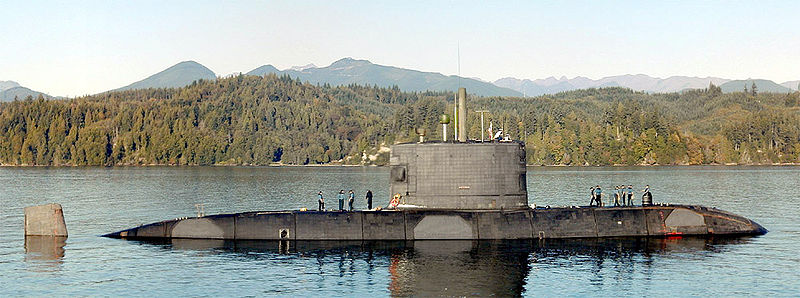
HMCS Victoria, one of the four submarines currently in service with the Royal Canadian Navy. She was originally commisioned into the Royal navy as HMS Unseen in 1991 and re-commissioned as HMCS Victoria in 2000.
Image via Wikimedia Commons.
Bill Blair, the federal defence minister, made a rare admission of Liberal fallibility in Washington on Monday when he said he regrets using the word “explore” when talking about renewing Canada’s submarine fleet.
Ottawa’s recent defence policy update said the government will “explore options for renewing and expanding the submarine fleet”, a form of words that was criticized for lacking urgency.
“It’s certainly not my intention to be wishy-washy. What I’ve tried to articulate very, very clearly and strongly in the document is, we know we have to replace our submarine fleet, and we’re going to do that,” Blair said.
Replacing the four Victoria-class subs is necessary, he said. “It is, I might suggest, inevitable.”
That is absolutely the case, if Canada is committed to maintaining its submarine capability. The Victoria-class subs date back to the late 1980s and are due to be taken out of service at the end of the 2030s.
Submarines are seen as a crucial defence against incursion by hostile powers, as the polar ice melts and opens up northern waterways. The Northwest Passage is forecast to be the most efficient shipping route between Asia and Europe by 2050.
But Blair admits “there is a lot of work to do”, not least convincing his cabinet colleagues of the “business case for the capability”.
“One of the greatest challenges of being a defence minister is to secure funding and the second one is actually spending it”, he said on Monday.
He gave a sense of the struggles around the cabinet table last month in a speech in Ottawa, where he admitted: “I had to sort of keep on pushing my issue forward about the importance and the need to invest in defence”. He made it sound as if he was a lone voice in the wilderness.
[…]
Retired captain Norman Jolin recently wrote an analysis for the Naval Association of Canada that noted if Canada wants to maintain submarine capability, it needs to place a contract with a proven builder by 2027 at the latest. He said the lack of domestic submarine-building capacity means there is neither the time nor resources to even think about a made-in-Canada solution.
The typical procurement process takes 18 years to get from cabinet approval to delivery, which would mean if an order was placed tomorrow, we wouldn’t get new subs until 2042.
Based on that timeline, “it is clear that the decision to replace the submarines is considerably overdue,” Jolin wrote.
There’s little chance that this will move closer to completion during the remaining life of the current government, with an election due before the end of 2025, and Blair is already on the record emphasizing how little the Liberals would relish spending any money on military equipment even in good economic times. Oddly, the fact that there are no domestic shipyards currently capable of building submarines may be a positive — building the RCN’s ships in Canadian yards always means that each ship costs much more than if the hull is built in a foreign shipyard. Canada doesn’t have the facilities and trained workforce to build naval vessels, so every time a new class of ships is needed, the cost of building/refurbishing the shipyards and hiring and training-from-scratch a new workforce balloons the total cost of the program.
Fiji in World War Two: the Momi Bay Gun Battery
Forgotten Weapons
Published Feb 3, 2024When the clouds of World War Two began to loom in the 1930s, Britain decided to begin securing some of its more distant colonial outposts — places that might be of strategic importance in a future conflict. Fiji was once of these outposts — a vital point on the seagoing supply line from Europe and the Americas to Australia and Asia. Construction of coastal defense batteries began in the late 1930s, mostly using 6 inch MkVII naval guns. These batteries were constructed around the capital of Suva and the airfield at Nadi on the west side of the island.
Today we are at the Momi Bay Battery, just south of Nadi. This emplacement has been restored and is maintained as a public museum site by the Fijian government today. It houses two 6 inch guns (the King’s Gun and the Queen’s Gun, colloquially), and originally also included an optical rangefinder and various command and control buildings. It had a range of about 8 miles, and controlled one of the few natural approaches to western Fiji.
The guns here were only fired in anger once, and that was actually at an unidentified sonar contact in the Bay. No evidence of an enemy vessel was ever found, and it ended up just being a brief reconnaissance by fire, so to speak. By later in the war, the threat of Japanese invasion had passed, but Fiji remained an active part of the war effort, as a transportation hub and a site for soldiers to get some R&R outside of combat duties. This led to the creation of the successful tourist economy which remains vibrant today on the island.
(more…)
QotD: Recruiting an army in the Roman Republic
So, on the appointed day(s), Polybius tells us all Romans liable for service of military age assemble in Rome and are called up on the Capitoline Hill for selection. This was a point that raised a lot of skepticism from historians,1 mostly concerning the number of people involved, but those concerns have all pretty much been resolved. While there might have been something like 323,000 Roman citizen males in the third or second century, they’re not all liable for general conscription, which was restricted to the iuniores – Roman citizen men between the ages of 17 and 46, who numbered fewer, probably around 228,000; seniores in theory could be conscripted, but in practice only were in an emergency. In practice the number is probably lower still as unless things were truly dire, men in their late 30s or 40s with several years of service could be pretty confident they wouldn’t be called and might as well stay home and rely on a neighbor of family member to report back in the unlikely event they were called. That’s still, of course, too many to bring up on to the Capitoline or to sort through calling out names, but as Polybius notes they don’t all come up, they’re called up by tribe. The Roman tribes were one of Rome’s two systems of voting units (the other, of centuries, we’ll come to in just a moment) and there were 35 of them, four urban tribes for those living in the city and 31 rural tribes for those living outside the city.
So what is actually happening is that the consul sets the date for the dilectus, then assigns his military tribunes to their legions (this matters because the tribunes will then do a round-robin selection of recruits to ensure each legion is of equivalent equality), then calls up one tribe at a time, with each tribe having perhaps around 6-7,000 iunores in it. Conveniently, the Capitoline is plenty large enough for that number, with estimates of its holding capacity tending to be between 12,000 and 25,000 or so.2 And while Polybius makes it seem like all of this happens on one day, it probably didn’t. Livy notes of one dilectus in 169, conducted in haste, was completed in 11 days; presumably the process was normally longer (though that’s 11 days for all three steps, not just the first one, Livy 43.14.9-10).
Once each tribe is up on the Capitoline, recruits are selected in batches; Polybius says in batches of four, but this probably means in batches equal to the number of legions being enrolled, as Polybius’ entire schema assumes a normal year with four legions being enrolled. Now Polybius doesn’t clarify how selection here would work and here Livy comes in awfully handy because we can glean little details from various points in his narrative (the work of doing this is a big chunk of Pearson (2021), whose reconstruction I follow here because I think it is correct). We know that the censors compile a list not just of Roman senators but of all Roman citizen households, including self-reported wealth and the number of members in the household, updated every five years. That self-reported wealth is used to slot Romans into voting centuries, the other Roman voting unit, the comitia centuriata; those centuries correspond neatly to how Romans serve in the army, with the equites and five classes of pedites (infantry). Because of a quirk of the Roman system, the top slice of the top class of pedites also serve on horseback, and Polybius is conveniently explicit that the censors select and record this too.
So at dilectus time, the consuls, their military tribunes (and their state-supplied clerk, a scriba) have a list of every Roman citizen liable for conscription, with the century and tribe they belong to, the former telling you what kind of soldier they can afford to be when called and the latter what group they’ll be called in. And we know from other sources (Valerius Maximus 6.3.4) that names are being read out, rather than just, say, selecting men at sight out of a crowd. That actually makes a lot of sense as dilectus (“select”) may really be dis-lego, “read apart”, from lego (-ere, legi, lectum) “to read”.3 And that matters because the other thing the Romans clearly have a record of us who has served in the past. We know that because in an episode that is both quite famous but also really important for understanding this process, in 214 – after four of the most demanding years of military activity in Roman history, due to the Second Punic War – the Roman censors identified 2,000 Roman iuniores who had not served in the previous four years (or claimed and been granted an exemption), struck them from the census rolls (in effect, revoking their citizenship) and then packed them off to serve as infantry (regardless of their wealth) in Sicily.4
So what happens as each tribe comes up is that the tribunes can call out the names – in batches – of men with the least amount of service, of the particular wealth categories they are going to need to fill out the combat roles in the legion.5 The tribunes for each legion pick one recruit from each batch that comes up, going round-robin so every legion gets the same number of first-picks. Presumably once the necessary fellows are picked out of one tribe, that tribe is sent down the Capitoline and the next called up.
Once that is done the oath is administered. This oath is the sacramentum militare; we do not have its text in the Republic (we do have the text for the imperial period), but Polybius summarizes its content that soldiers swear to obey the orders of the consuls and to execute them as best they are able. The Romans, being practical, have one soldier swear the full oath and then every other soldier come up and say, “like that guy said” (I’m not even really joking, see Polyb. 6.21.3) to get everyone all sworn in. Of course such an oath is a religious matter and so understood to be quite binding.
Then the tribunes fix a day for all of the new recruits to present themselves again (without arms, Polybius specifies) and dismiss them. Strikingly, Polybius only says they are dismissed at this point – not, as later, dismissed to their homes. This makes me assume that the oath being described is administered tribe by tribe before the tribe is sent down (this also seems likely because fitting the last tribe and four legions worth of recruits on the Capitoline starts to get pretty tight, space-wise). Selecting with the various tribes might, after all, take a couple of days, so the tribunes might be telling the recruits of the first few tribes what day the entire legion will be assembled (that’ll be Phase II) after they’ve worked through all of the tribes. Meanwhile, once your tribe was called, you didn’t have to hang around in Rome any longer, if you weren’t selected you could go home, while the picked recruits might stick around in Rome waiting for Phase II.
That leads to the other logistical question for Phase I: the feasibility of having basically all of the iuniores in Rome for the process. Doubts about this have led to the suggestion that perhaps the dilectus in Rome was mirrored by smaller versions held in other areas of Roman territory in Italy (the ager Romanus) for Roman citizens out there. The problem with that assumption is that the text doesn’t support it. The Romans send out conscription officers (conquisitores) exactly twice that we know of, in 213 and 212 (Livy 23.32.19 and 25.5.5-9) and these are clearly exceptional responses to the failure of the dilectus in the darkest days of the Second Punic War (the latter is empowered to recruit under-age boys if they look strong enough to bear arms, for instance). But I also think it was probably unnecessary: this was a regular occurrence, so people would know to make arrangements for it and the city of Rome could prepare for the sudden influx of young men. This is, after all, also a city with regular “market days”, (the nundinae) which presumably would also cause the population to briefly swell, though not as much. And we’re doing this in an off-time in the agricultural calendar, so the farmhands can be spared.
Moreover, Rome isn’t that far away for most Romans. Strikingly, when the Romans do send out conquisitores, they split them with half working within 50 miles of Rome and half beyond that (Livy 25.5.5-9). The implication – that most of the recruits to be found are going to be within that 50 mile radius – is clear, and it makes a lot of sense given the layout of the ager Romanus. Certainly there were communities of Roman citizens farther out, but evidently not so many. Fifty miles down decent roads is a two-day walk; short enough that Roman iuniores could fill a sack with provisions, walk all the way to Rome, stay a few days for the first phase of the dilectus and walk all the way back home again at the end. We’re not told how communities farther afield might handle it, but they may well have trekked in too, or else perhaps sent a few young men with instructions to bring back a list of everyone who was called.
Meanwhile the other part of this phase is happening: the socii. Polybius reports that “at the same time the consuls send their orders to allied cities in Italy, which they with to contribute troops, stating the numbers required and the day and place at which the men selected must present themselves.”6 Livy gives us more clarity on how this would be done, providing in his description of the muster of 193 the neat detail that representatives of the communities of socii met with the consuls on the Capitoline (Livy 34.36.5). And that makes a ton of sense – this is happening at the same time as the selection, so that’s where the consuls are.
We also know the consuls have another document, the formula togatorum, which spells out the liability of each community of socii for recruits; we know less about this document than we might like. Polybius tells us that the socii were supposed to compile lists of men liable for recruitment (Polyb. 2.23-4) and an inscription of the Lex Agraria of 111 BC refers to, “the allies or members of the Latin name, from whom the Romans are accustomed to demand soldiers in the land of Italy ex formula togatorum“.7 That then supplies us with a name for the document. Finally, we know that in 177, some of the socii complained that many of the households in their territory had migrated into other communities but that they conscription obligations had not been changed (Livy 41.8), which tells us there was a formal system of obligations and it seems to have been written down in something called the formula togatorum, to which Polybius alludes.
What was written down? Really, we don’t know. It has been suggested that it might have been a sliding scale of obligations (“for every X number of Romans, recruit Y number of Paeligni”) or a standard total (“every year, recruit Y Paeligni”) or a maximum (“the total number of Paeligni we can demand is Y, plus one more guy whose job is to throw flags at things”.). In practice, it was clearly flexible,8 which makes me suspect it was perhaps a list of maximum capabilities from which the consuls could easily compute a fair enough distribution of service demands. A pure ratio doesn’t make much sense to me, because the socii come in their own units, which probably had normal sizes to them.
So, while the military tribunes are handling the recruitment of citizens into the legions, the consuls are right there, but probably focused on meeting with representatives of each community of the socii and telling them how many men Rome will need this year. Once told, those representatives are sent back to their communities, who handle recruitment on their own; Rome retains no conscription apparatus among the socii – no conscription offices, no records or census officials, nada. The consuls spell out how many troops they need and the rest of it was the socii‘s elected official’s problem.
Bret Devereaux, “Collections: How To Raise a Roman Army: The Dilectus“, A Collection of Unmitigated Pedantry, 2023-06-16.
1. Particularly in P.A. Brunt, Italian Manpower (1971).
2. Pearson (2021) compiles them; the issue is also discussed in Taylor (2020).
3. The philological argument here is Pearson (2021), 16-17. It is not air-tight because legere has a lot of meanings, including “to pick out” along with “to read”. That said, given that the verb of being recruited into the army is conscribere (“to write together, to conscript”), there really is a strong implication that this is a process with written records, which the rest of the evidence confirms. I think Pearson may or may not be right about the understood meaning of dilectus implying writing, but the process surely involved written records, as she argues.
4. A punishment post, this is also where the survivors of the Battle of Cannae were sent. Both groups remain stuck in Sicily until pulled into Scipio Africanus’ expedition to Africa in 205, so these fellows don’t get to go home and get their citizenship back until the conclusion of the war in 201.
5. In particular, we generally assume the lowest classes of Roman pedites probably could only afford to serve as light troops, the velites, while the wealthy equites had their own selection procedure for the cavalry done first. Of course, rich Romans not selected for the cavalry might serve as infantrymen if registered in the centuries of pedites which is presumably how Marcus Cato, son of the Censor, ends up in the infantry at Pydna (Plut. Aem. 21).
6. Polyb. 6.21.4. Paton’s trans.
7. Crawford, Roman Statutes (1996), 118 for the text of that inscription.
8. Something pointed out by L. de Ligt in his chapter in the Blackwell A Companion to the Roman Army (2007).
May 13, 2024
“Our NATO allies are despairing. Our American friends are frustrated … all the officers are extraordinarily polite in public. But in private, the conversations are quite brutal.”
Former Liberal MP and retired Lt.-General Andrew Leslie has few illusions about the current Liberal government’s approach to military issues:
Lt.-Gen. (ret’d) Andrew Leslie is keen to talk about the embarrassing state of Canadian military preparedness.
“The current prime minister of Canada is not serious about defence. Full stop. A large number of his cabinet members are not serious about defence. Full stop,” the former Liberal MP tells me.
“Our NATO allies are despairing. Our American friends are frustrated. But because NATO and Norad (North American Aerospace Defense Command) are both essentially voluntary organizations, in which other people cannot give Canada orders,” the retired general explains, “all the officers are extraordinarily polite in public. But in private, the conversations are quite brutal.”
I have asked Andrew to explain our federal government’s foot-dragging on military spending — despite significant changes in risk — and what we should expect from our allies. This 35-year veteran of the Canadian Armed Forces (CAF), former chief of staff of the Canadian Army and one-time MP for Orleans is well-placed to decipher what’s really going on and in our frank conversation, he doesn’t pull any punches. I connect with Andrew at his home in Ottawa; behind him, the walls of his spacious office are sheathed in medals and awards, testimony to decades of decorated service in places like Afghanistan and Yugoslavia.
We get to the heart of the matter. Canada’s allies are pressuring Prime Minister Justin Trudeau’s government to get serious about military spending. And with a relentless war in Ukraine, a thawing and more vulnerable Arctic, unrest in the Middle East, and a general shakeup of the world order, Canadians are waking up to the risks of not being ready to defend ourselves.
Recently, U.S. Air Force Gen. Gregory Guillot (who took over leadership of Norad in February) has put his Canadian counterparts on notice that he aims to have U.S. troops training, not just in Alaska, but in the Canadian Arctic. A good idea, or the thin edge of a wedge?
It’s totally sensible, Andrew replies, because Canada has “no permanently stationed combat capability in the Arctic.” After a pause to let that sink in, he repeats that fact and elaborates. “Just in terms of numbers, there’s about 22,000 professional men and women in the U.S. Armed Forces based in the Arctic, mainly in Alaska. There’s about 30,000 to 35,000 Russian armed forces based in the Arctic. Canada has about 300 people.”
Roman Legions – Sometimes found all at sea!
Drachinifel
Published Feb 2, 2024Today we take a quick look at some of the maritime highlights of the new special exhibition at the British Museum about the Roman Legions:
https://www.britishmuseum.org/exhibit…
(more…)
May 12, 2024
The fascinating story of HMS Challenger (K07)
Sir Humphrey pens a long blog post about a late Cold War Royal Navy ship — officially just a “diving support vessel”, but apparently much more capable — most naval fans may never have heard about:

HMS Challenger (K07) at Kiel, West Germany in 1985.
Photo by John Cook via Wikimedia Commons.
The story of HMS Challenger remains one of the most unusual of all post war Royal Navy vessels. Born in the late Cold War, she was in the eyes of the public a “white elephant” commissioned and never operationally used and sold after just a few years’ service at the end of the Cold War. She was to the few public that had heard of her, “the Warship that never was”. But revealing files in the National Archives tell a story of a ship that was designed to fill a range of highly secretive intelligence support functions and clandestine espionage activity that, had she been successful, would have made her perhaps one of the most vital intelligence collection assets in the UK. This article is about the untold story of HMS Challenger and why she deserves far more recognition than enjoyed to date.
The background of the Challenger story can be traced to the mid 1970s when the Royal Navy used the, by then positively venerable, warship HMS Reclaim to conduct diving support work. The Reclaim, commissioned in 1949 was the last warship in the RN to be designed and fitted with sails, that were occasionally used. Employed in diving support and salvage ops for 30 years, she was a vital asset for the recovery of crashed aircraft, support to diving and other assorted duties. But by 1975 she was also very old and out of date and requiring replacement (she paid off as the oldest operational vessel in the Royal Navy in 1979).
To replace her the Royal Navy developed Naval Staff Requirement 7003 and 7741, which were approved in 1976. These requirements set out the need for a replacement and the capabilities that were required. By this stage of the Cold War the world was a very different place both operationally and technologically from when HMS Reclaim entered service. There were significantly more undersea cables laid across the Atlantic, while the SOSUS network (a deep-water network of sonar systems intended to detect Russian submarines) had been delivered and expanded into UK waters in the early 1970s under project BACK SCRATCH. Additionally the Royal Navy had introduced a few years previously the Resolution class SSBN, which by 1976 had four submarines providing a Continuous At Sea Deterrent (CASD) with their Polaris missiles, as well as wider nuclear submarine operations. At the same time new technology was emerging including better diving capability, the rise of miniature submarines capable of both operating at immense depths and also the rise of rescue submarines for stranded nuclear submarines. Additionally technology had improved increasing the ability to recover items from the seabed.
When brought together this provided the RN with the opportunity to think afresh about how to replace Reclaim. The result was a set of requirements that were defined as follows:
The objective of NSR 7003 was to provide the Royal Navy with a Vessel and equipment capable of carrying out seabed operations. The requirement … is to find, inspect, work on and recover items on the seabed at all depths down to 300m with some capability to greater depths.
The specific missions for which the requirement was looking to cater for broke down into three main areas:
- Inspection, neutralisation or recovery of military equipment, including weapons;
- Operations in support of national offshore interests including research;
- Assistance with submarine escape and rescue and with underwater salvage
This represented a significant leap forward compared to Reclaim, which was limited to diving at up to 90m in very limited conditions, and would have provided the Royal Navy with an entirely new level of capabilities.
The decision was taken to proceed with the requirement and Challenger was ordered in 1979 and commissioned in 1983. What then follows is a sorry story of a ship being brought into service and having practically everything that could go wrong, going wrong. This article will not go into any depth on the story of what failed, as to do so would be a lengthy story. Suffice to say that a combination of faulty equipment, manufacturing challenges, fires and other damages and the reality that technical aspirations were not matched by practical delivery in reality meant that Challenger never really became operational.
Used for a series of trials until the late 1980s to prove her systems and see if they would work, she struggled to achieve what was expected of her. She had some success recovering toxic chemicals from the seabed from a sunken merchant ship in the 1980s and then conducting other demonstrations, such as deep diving and supporting submarine rescue trials. But she never lived up to the expectations placed on her, and at a time when the costs required to get her to the level of capability were far too high, and the defence budget was under pressure at a point when the Warsaw Pact threat was rapidly collapsing, the decision was taken to pay her off as a failed experiment even before the wider Options for Change plan was announced. This much is widely known to the public, but what is nowhere near as well known is the missions that Challenger was intended to carry out. Had she been successful, it would have made a very real difference to RN capabilities.
Why did the Royal Navy seem so determined to make a success of Challenger for so many years, to the extent of throwing ever more money at her, given these problems? In short because the missions she was designed to do made it worthwhile. Files in the archives clearly show that beyond the public line of “research” she was designed to carry out exceptionally sensitive missions. Although the original Naval Staff Requirement focused on three areas, by the time she entered service, this had expanded to at least 9 (possibly more). These were:
- Strategic Deterrent Force Security
- Seabed surveillance device support
- Nuclear weapon recovery
- Recovery of security and military sensitive material
- Crashed military aircraft recovery
- Submarine escape and rescue operations
- Salvage operations
- MOD research and data collection for other than intelligence agencies
- Miscellaneous operations in support of other government agencies
It can be seen that far from being just a diving support platform, Challenger was in fact an absolutely central part in providing assurance to the protection of CASD and ensuring the security of the nuclear deterrent and SOSUS. How would she have done this?
The files show that in the 1980s the UK had a different attitude to the US about protection of these routes due to geographic differences.
Germany Surrenders! – WW2 – Week 298 – May 11, 1945
World War Two
Published 11 May 2024Germany signs not one, but two unconditional surrenders and the war in Europe is officially over … although that does not mean that all the fighting in Europe is, for there is fighting and surrenders all over Europe all week. The Japanese launch a counteroffensive on Okinawa; the Chinese launch one in Western Hunan; the Australians advance on Borneo and New Guinea; and the fight continues on Luzon in the Philippines, so there is still an awful lot of the world war to come, even with the end of the war in Europe.
00:00 Intro
00:40 The German Surrender
03:23 Fighting And Surrenders In The East
06:53 The Prague Uprising
15:50 The Last Surrenders In Europe
18:42 The Polish Situation
20:25 The War In China And The South Seas
23:17 Summary
24:44 Conclusion
(more…)
QotD: What is Putin’s endgame in Ukraine?
That was the monarchist critique of representative government that hit closest to home: Foreign policy needs to be supple and responsive; it must be able to move quickly, to make big changes in narrow time windows. In a real crisis, you simply don’t have time to convene a Parliament to debate stuff. N.b. they were saying this in the late 18th century; it’s so much worse now. And another observation from that time that is even truer today: A “democratic” foreign policy can never be consistent. You simply can’t plan long-term when there’s partial to complete governmental overhaul every few years.
That the US managed to muddle through for as long as it did was really a combo of two things: time (as a function of distance), and a near-peer enemy.
Neither of those is integral to the system, and neither is within the system’s control. Until recently, American foreign policy had to take into account the fact that on-the-spot commanders would have to make decisions on their own recognizance. Even with phone communications, the man on the ground in the Fulda Gap has to make decisions basically without reference to Washington. It forced him to be conservative — in other words, it discouraged adventurism.
Same way with the near-peer enemy. The looming shadow of the USSR forced regular reality checks inside the US Apparat. A whole bunch of possibilities were foreclosed by default — our response to any given situation had to take the likely Soviet reaction into account. As with the time/distance factor, this forced a kind of conservatism that looked a lot like sclerosis, but at least it deterred adventurism.
The history of the later 20th century is the history of those constraints being removed. In Vietnam, for instance, you had LBJ and McNamara sitting in a room in the White House, personally directing airstrikes in near-realtime. If “news” reports are to be believed, Obama was on the horn with that SEAL team going after Bin Laden right up to the very moment the chopper landed. Knowing these things are technically possible is catnip to politicians — they already assume they’re omnicompetent, and so now they want to be “advising” the commanding general even as the battle rages.
And if that’s catnip, then the end of the USSR was catnip on steroids. Why not play fuck-fuck games everywhere, all at once? Who’s gonna stop us? China? They chose to pass. They saw what happened to the USSR when it locked itself into an ideological death spiral vis-a-vis the Struggle Against International Capitalism. American policymakers only understand Soviet-style bluff and bluster. The Chinese play the long game.
NOT because they’re Inscrutable Orientals, I hasten to add — they’re as Juggalicious as our Clowns, in their way — but because the generation currently in power came up hard, and so they are adults. That’s all. They are not spoiled, petulant children. The next generation of Chinese leadership — assuming we live to see it — will really be something, and not in a good way.
So, what does Putin want? I dunno, and I’m not sure he knows, because I’m not sure he can know. I’m sure his broadest goal is “to stop getting fucked with by idiots”, but how can that be achieved? There shall be no durable peace in this world until there is Regime Change in [Washington, DC], and I’m not talking about the other half of the Uniparty winning an election or two. I think Putin knows that, but what can he really do about it? I think he’s going to be forced to annex a fair amount of territory and set up a totally demilitarized buffer zone. It won’t work, but it’s the least-worst practical option.
Severian, “Friday Mailbag”, Founding Questions, 2024-02-09.
May 10, 2024
A different take on the Russo-Ukrainian War
Kulak suggests that far from being a model for future wars, the ongoing conflict in Ukraine may not prefigure anything at all about future wars:

Few weeks go by where I don’t read a piece on how Ukraine is the Future of warfare and armies and thinkers need to adjust to the reality that the warfare of the future will involve massive unaccountable amounts of artillery, trenches, conscription and grinding warfare.
While sometimes they point to relevant lessons: Yes the inability of the US to quickly reindustrialize and produce artillery shells at a rate comparable to Russia does speak to a profound rot in American governance, the military industrial complex, and American business regulation more generally,
Often times the conclusions drawn are dangerously delusional: A draft would be more likely to break the American nation than save it. As indeed conscription has resulted in Ukraine’s population collapsing with somewhere between 6 and 10 million Ukrainians (out of a pre-war 36 million) having fled the country, not to escape the mostly static war, but to escape the Totalitarian conditions the Zelensky regime has imposed in response to the war. (1.1 million of whom escaped INTO Russia, for any who deny this [is] largely an ethnic conflict between Western and Russian Ukrainians, as it has been since 2014).
And the thing is all of these discussions rest on a assumption that seems ludicrous the second you stop and think about it: Ukraine is not the future of Warfare, these conditions will be almost impossible to ever create again.
Ukraine had a pre-war Nominal GDP of 199 billion USD. Officially this only declined to 160 billion in 2022 as a result of the war, but there’s good reason to think its actual internal private sector economy collapsed far further [given] it had collapsed from 177 billion in 2013 to 90 billion in 2015 as a result of the US backed Coup/Revolution.
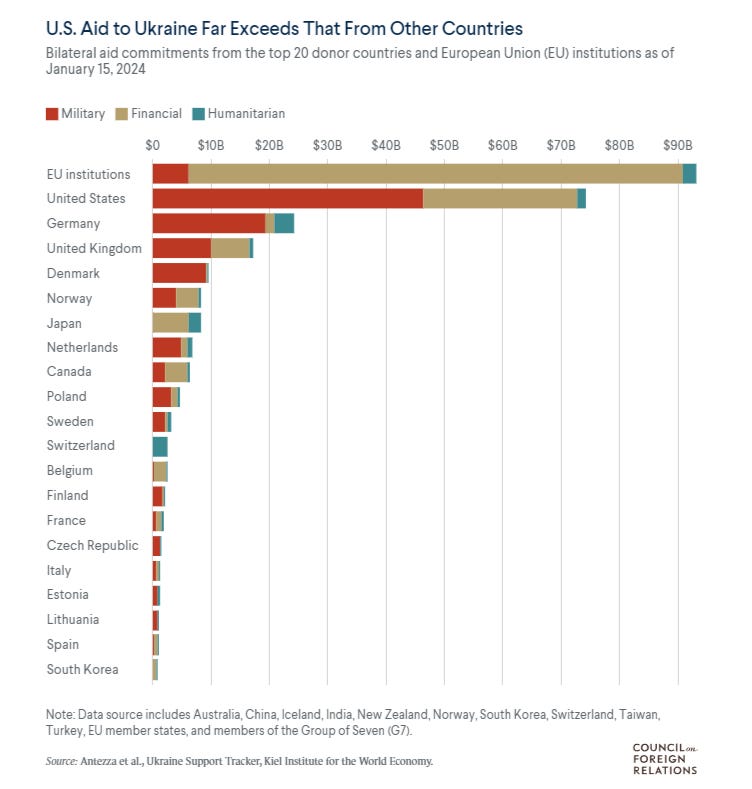
Indeed given the population flight, conscription, and impositions on the populace, it is very likely a SUPER-MAJORITY of that 160 billion GDP in 2022, was actually the result of US and NATO pouring hundreds of billions into the country. Where it was either used or siphoned off as corruption.
Simply put Ukraine has received military, financial and other aid most like in excess of what its entire internal economy produced in the same period, and as of writing it’s still losing territory.
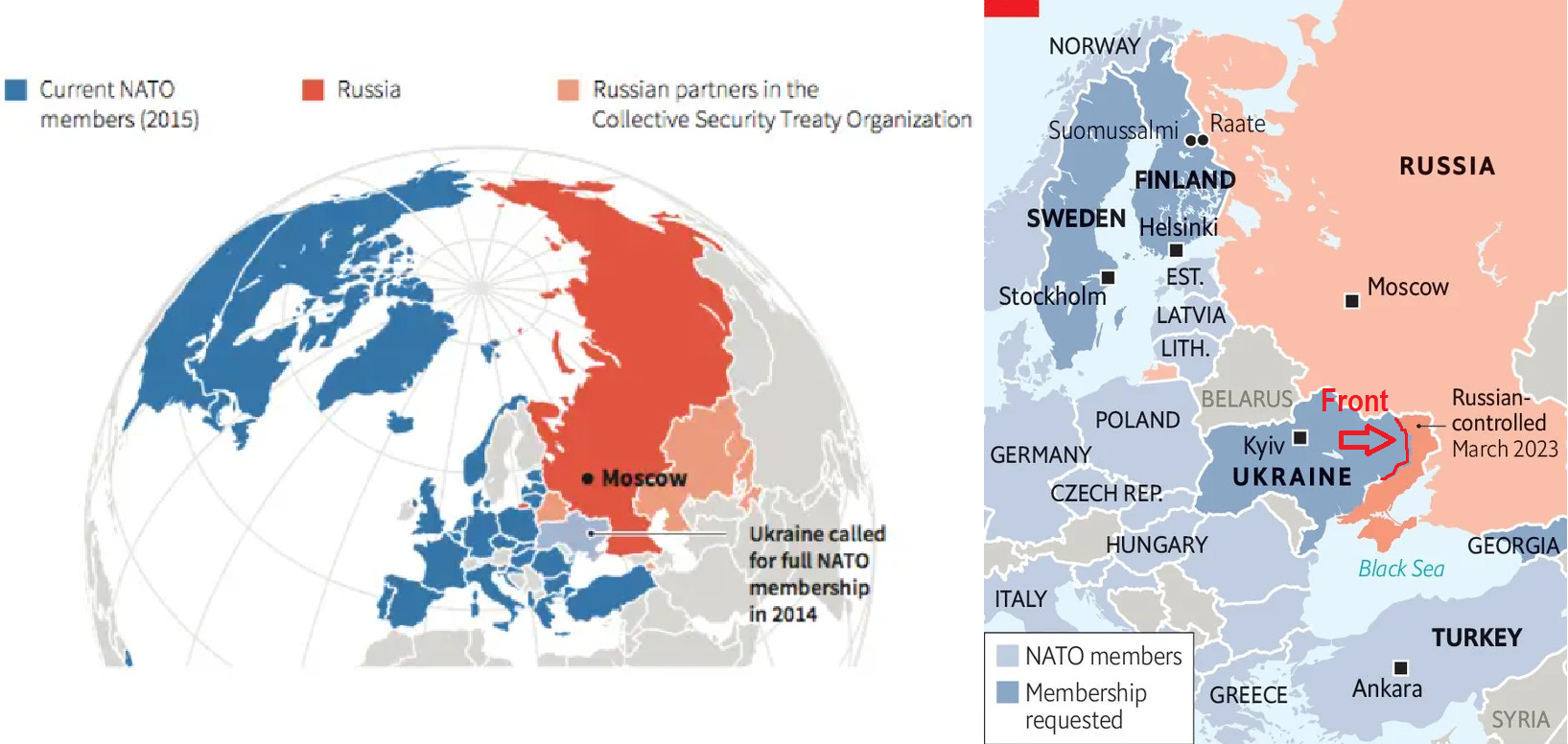
When commentators say this is a war between NATO and Russia they are almost entirely correct. If you combine all the economies that are funding, arming, or fighting on one side or the other of this war you get a majority of the entire global economy.
And they have used all that money to pay off the Ukrainian regime to refuse any peace agreement, even ones their own negotiators had agreed to, and that were clearly in the best interest of the country … you know if you value hundreds of thousands of young men and not having your population collapse more than narrow stretches of land being bought up by Blackrock.