
Published on 5 Apr 2017
Diplomatic tensions after the return of German unrestricted submarine warfare and the aftermath of the Zimmermann telegram lead to the United States declaration of war on Germany this week 100 years ago. Meanwhile the British and French high command are still debating the upcoming offensive, namely the Battle of Arras which includes taking the contested Vimy Ridge and the Nivelle Offensive at the Chemin Des Dames.
April 6, 2017
The United States Declares War on Germany I THE GREAT WAR Week 141
Comments Off on The United States Declares War on Germany I THE GREAT WAR Week 141
April 4, 2017
The Forgotten Ally – Portugal in WW1 I THE GREAT WAR Special
Published on 3 Apr 2017
Portugal’s participation in the First World War 1, especially the service of the Portuguese Expeditionary Corps on the Western Front, is often forgotten. And even when the troops were still fighting, the political situation back home had changed so much that the soldiers were largely forgotten.
Comments Off on The Forgotten Ally – Portugal in WW1 I THE GREAT WAR Special
Tank Chats #4 Vickers Armstrongs Type E
Published on 15 Apr 2015
The fourth in a series of short films about some of the vehicles in our collection presented by The Tank Museum’s historian David Fletcher MBE.
Alongside their work for the British armed forces Vickers-Armstrongs produced military equipment for foreign buyers. Their earliest commercial tank designs failed to sell but in 1928 they produced a masterpiece. Known as the 6-ton or ‘six-tonner’, it was a remarkable design, with a rear-mounted, air-cooled engine driving to a gearbox and track sprockets at the front of the tank. There were two main variants; some tanks were supplied with two machine-gun turrets (Type A) while others carried a larger single turret (Type B) like our exhibit.
Following trials the British Army turned it down but the tank was a major export success. It sold all around the world, from South America to Japan and was even studied by the United States Army. It was built under licence in Russia (see our T-26 exhibit) and influenced tank design in many other countries. Our exhibit is displayed in the fancy camouflage style adopted by Vickers for their commercial offerings; it is seen at a mythical army equipment exhibition some time in the thirties.
Shortly before World War II Vickers built a new version, powered by a Rolls-Royce engine (the Mark F) but this failed to sell. Subsequent to this the government of Siam (Thailand) placed a repeat order but specified the original Armstrong-Siddeley engine. These were completed closer to the Mark F design but few, if any, reached their destination. With the outbreak of war the British Government impounded all commercial tanks still in the factories and the remaining stock of six-tonners, of which this is one, were used by British forces for training.
Comments Off on Tank Chats #4 Vickers Armstrongs Type E
April 3, 2017
William Shatner | Battle of Vimy Ridge #Vimy100 #LestWeForget #VimyRidge
Published on 31 Mar 2017
To commemorate the 100th anniversary of Battle of Vimy Ridge, Legion Magazine, Canada’s Ultimate Story and William Shatner tell the story of this important First World War battle. Our victory at Vimy was a defining event for Canada. On the 100th anniversary, we revisit the Canadian triumph over the German army and explore why the battle has come to signify the birth of our nation. We ask you to share with #Vimy100 #LestWeForget or #VimyRidge
Directed by Adam Tindal
Written by Don Gillmor
Graphics & Animation by Julia Paddick
Produced by Jason Duprau, Jennifer McGill, Eric Harris
Executive Producer: Jennifer Morse
Recorded by William Harp, Media City Sound, LASpecial thank you to Library and Archives Canada
Copyright Canvet Publications Ltd. 2017
Comments Off on William Shatner | Battle of Vimy Ridge #Vimy100 #LestWeForget #VimyRidge
April 2, 2017
Visiting the Meuse-Argonne American Cemetery I THE GREAT WAR Special
Published on 1 Apr 2017
Meuse-Argonne App (iOS): http://bit.ly/CemeteryApp
Meuse-Argonne App (Android): http://bit.ly/MeuseArgonne
Meuse-Argonne American Cemetery Facebook Page: http://bit.ly/MeuseArgonneFBDuring our trip to France we visited the Meuse-Argonne American Cemetery and Monument in Romagne. The cemetery contains the largest number of American military dead in Europe and was already dedicated when the war was still raging in Europe.
Comments Off on Visiting the Meuse-Argonne American Cemetery I THE GREAT WAR Special
The (inevitable) failure of the “Revolution in Military Affairs”
In an article about security incident response automation, Bruce Schneier provides a useful thumbnail sketch of a US Army attempt to dispel the fog of war in real time:
While this is a laudable goal, there’s a fundamental problem with doing this in the short term. You can only automate what you’re certain about, and there is still an enormous amount of uncertainty in cybersecurity. Automation has its place in incident response, but the focus needs to be on making the people effective, not on replacing them security orchestration, not automation.
This isn’t just a choice of words — it’s a difference in philosophy. The US military went through this in the 1990s. What was called the Revolution in Military Affairs (RMA) was supposed to change how warfare was fought. Satellites, drones and battlefield sensors were supposed to give commanders unprecedented information about what was going on, while networked soldiers and weaponry would enable troops to coordinate to a degree never before possible. In short, the traditional fog of war would be replaced by perfect information, providing certainty instead of uncertainty. They, too, believed certainty would fuel automation and, in many circumstances, allow technology to replace people.
Of course, it didn’t work out that way. The US learned in Afghanistan and Iraq that there are a lot of holes in both its collection and coordination systems. Drones have their place, but they can’t replace ground troops. The advances from the RMA brought with them some enormous advantages, especially against militaries that didn’t have access to the same technologies, but never resulted in certainty. Uncertainty still rules the battlefield, and soldiers on the ground are still the only effective way to control a region of territory.
But along the way, we learned a lot about how the feeling of certainty affects military thinking. Last month, I attended a lecture on the topic by H.R. McMaster. This was before he became President Trump’s national security advisor-designate. Then, he was the director of the Army Capabilities Integration Center. His lecture touched on many topics, but at one point he talked about the failure of the RMA. He confirmed that military strategists mistakenly believed that data would give them certainty. But he took this change in thinking further, outlining the ways this belief in certainty had repercussions in how military strategists thought about modern conflict.
McMaster’s observations are directly relevant to Internet security incident response. We too have been led to believe that data will give us certainty, and we are making the same mistakes that the military did in the 1990s. In a world of uncertainty, there’s a premium on understanding, because commanders need to figure out what’s going on. In a world of certainty, knowing what’s going on becomes a simple matter of data collection.
Comments Off on The (inevitable) failure of the “Revolution in Military Affairs”
April 1, 2017
South Korean Thunder for Finland
Last month, Strategy Page reported on a recent deal for Finland to purchase a number of K-9 “Thunder” 155mm self-propelled guns from South Korea:

South Korean K-9 Thunder 155mm self-propelled gun (via Wikimedia)
Finland has ordered 48 South Korean K-9 “Thunder” 155 mm self-propelled howitzers for about $3.3 million each. This price includes training, spare parts, maintenance and howitzer modernization to Finland standards (installation of Finnish made communication equipment and battle management system). The contract also includes an option for additional K-9s. Deliveries begin by the end of 2017 and all 48 vehicles should arrive to Finland till 2024. Nearby Estonia will now be able to get valuable advice from Finland to determine if Estonia should go forward with a similar purchase of twelve K-9s.
In 2016 the Finns began negotiating the K-9 purchase terms with South Korea because the Finns had determined that the K-9 was the least expensive option to obtain modern self-propelled howitzers that could be easily handled by the conscripts Finland still depends on for most of their military manpower. By the end of 2016 the Finns had confirmed this with field trials of the K-9 which as expected, performed better than competitors.
K-9 is a South Korean designed and manufactured self-propelled howitzer which was developed as a replacement for the K55 (license variant of M109). K-9 is a 48 ton self-propelled howitzer operated by a crew of five and using a NATO standard 155mm gun which can take out targets 40 kilometers away. Development of the K-9 began in 1989 and mass production began in 1999.
Comments Off on South Korean Thunder for Finland
March 31, 2017
Lenin Takes The Train – First Battle of Gaza I THE GREAT WAR Week 140
Published on 30 Mar 2017
When the Russian government promises to continue the war and support the Entente with another offensive, the Germans are allowing Vladimir Ilyich Ulyanov aka Lenin to board a train from his exile in Switzerland to Russia. The British Army once again underestimates the Ottoman Empire at the 1st Battle of Gaza and the Toplica Uprising ends.
Comments Off on Lenin Takes The Train – First Battle of Gaza I THE GREAT WAR Week 140
March 30, 2017
Another Japanese “destroyer” joins the fleet
Due to a long-standing aversion to calling certain kinds of vessels by their most appropriate name, the Japanese Maritime Self-Defence Force (because Japan’s constitution prohibits the country having a “navy”, post-1945) commissioned their latest “destroyer” last week:
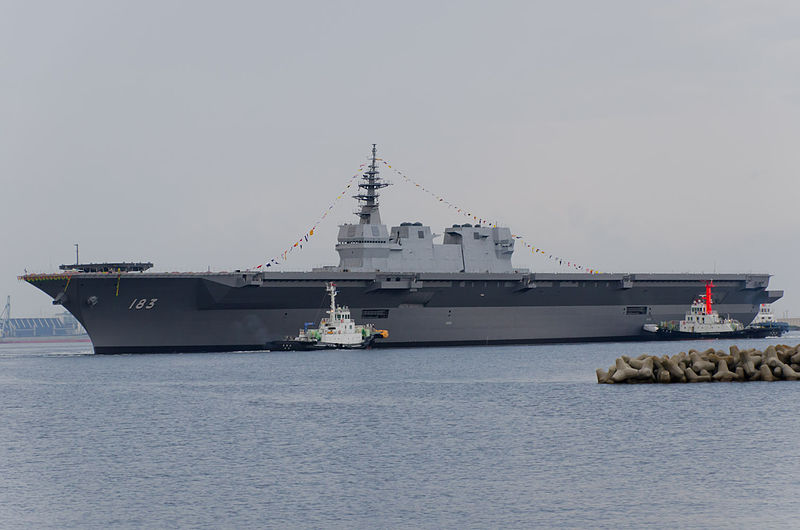
JS Izumo DDH-183, sister-ship of the just-commisioned JS Kaga DDH-184, both helicopter-equipped destroyers, officially.
I know what you’re thinking … “That doesn’t look like a destroyer to me” … but that’s what Japan officially designates ships like this to be, so that’s what they’re called. Strategy Page has more:
On March 22nd Japan put into service a second 27,000 ton “destroyer” (the Kaga, DDH 184) that looks exactly like an aircraft carrier. Actually it looks like an LPH (Landing Platform Helicopter) an amphibious ship type that first appeared in the 1950s. This was noted when Izumo, the first Japanese LPH was launched in 2012 (it entered service in 2015). The Izumos can carry up to 28 aircraft and are armed only with two 20mm Phalanx anti-missile cannon and launcher with sixteen ESSM missiles for anti-missile defense.
LPHs had no (or relatively few) landing craft but did carry a thousand or more troops who were moved ashore using the dozen or more helicopters carried. The first American LPH (the USS Iwo Jima) was an 18,400 ton ship that entered service in 1961, and carried 2,000 troops and twenty-five helicopters. Until Izumo showed up, several nations operated LPHs, and Britain and South Korea still do. The U.S. retired its last LPHs in the 1990s, but still have a dozen similar ships that include landing craft (and a well deck in the rear to float them out of) as well as helicopters. A few other nations have small carriers that mostly operate helicopters but carry few, if any troops.
The Izumos are the largest LPHs to ever to enter service. It differs from previous LPHs in not having accommodations for lots of troops and having more powerful engines (capable of destroyer-like speeds of over fifty-four kilometers an hour). Izumo does have considerable cargo capacity, which is intended for moving disaster relief supplies quickly to where they are needed. Apparently some of these cargo spaces can be converted to berthing spaces for troops, disaster relief personnel, or people rescued from disasters. There are also more medical facilities than one would expect for a ship of this size. More worrisome (to the Chinese) is the fact that the Izumo could carry and operate the vertical take-off F-35B stealth fighter, although Japan has made no mention of buying that aircraft or modifying the LPH flight decks to handle the very high temperatures generated by the F-35B when taking off or landing vertically. The Chinese are also upset with the name of this new destroyer. Izumo was the name of a Japanese cruiser that was a third the size of the new “destroyer” and led the naval portion of a 1937 operation against Shanghai that left over two-hundred-thousand Chinese dead. The Chinese remember all this, especially the war with Japan that began unofficially in 1931 and officially in 1937.
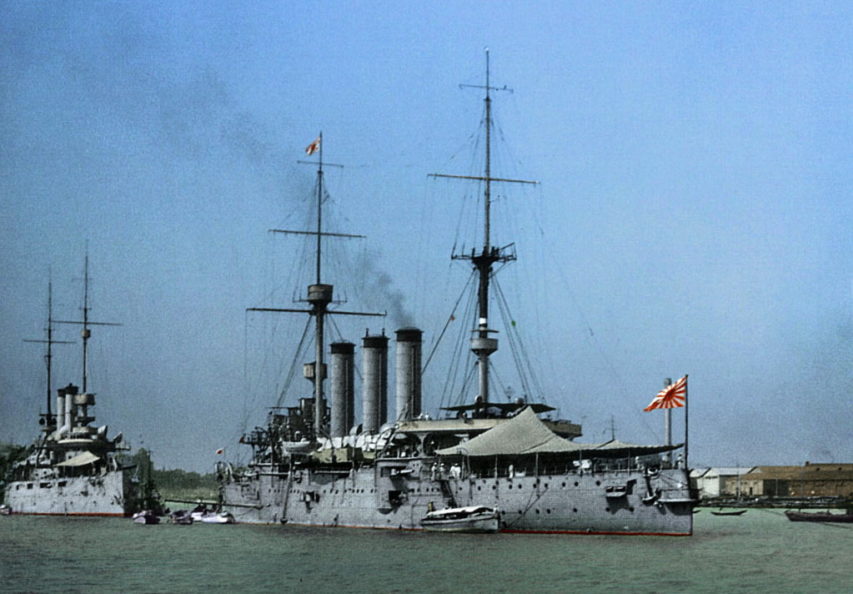
IJNS Izumo at anchor 1932 (Colourized), via Wikimedia
Comments Off on Another Japanese “destroyer” joins the fleet
How Germany’s Victories weakened the Japanese in World War 2
Published on 24 Mar 2017
This video gives you a short glimpse on how the war in Europe had a detrimental effect on the Japanese Economy.
Military History Visualized provides a series of short narrative and visual presentations like documentaries based on academic literature or sometimes primary sources. Videos are intended as introduction to military history, but also contain a lot of details for history buffs. Since the aim is to keep the episodes short and comprehensive some details are often cut.
Comments Off on How Germany’s Victories weakened the Japanese in World War 2
March 28, 2017
Champion for Democracy? – Woodrow Wilson I WHO DID WHAT IN WW1?
Published on 27 Mar 2017
Woodrow Wilson, 28th President of the United States, is one of the most controversial characters of his era. His racial views, his view on peace and the post-war world, his decision to go to war with Germany in 1917 are still being debated to this day. We take a look at the life of Wilson to better understand his motivation.
Comments Off on Champion for Democracy? – Woodrow Wilson I WHO DID WHAT IN WW1?
A long history of US involvement in “regime change”
In the latest Libertarian Enterprise, L. Neil Smith goes over just the “high points” of American interference in the domestic affairs of other nations:
It makes me sick to keep hearing the mostly Democratic assertion that Donald J. Trump is a candidate foisted on us poor, gullible Americans by the Russian government. This is largely a matter of psychological projection by the left, and of mind-boggling hypocrisy. Previous American governments (mostly Democratic) have a long, shameful history of removing foreign leaders they dislike, for one reason or another, and replacing them with more agreeable figures.
It’s hard to know quite where to begin, and absolutely impossible to be exhaustive. General Smedley Darlington Butler (1881- 1940), twice winner of the Congressional Medal of Honor, tells a long, bloody tale in his little book War Is A Racket, in which he demonstrates that the United States Marines were sent on gunboats to various places across our sad, scarred, and war-weary planet — notably to South and Central America — to protect the interests (with rifles and bayonets, if necessary) of corporations like the United Fruit Company. Costa Rica, Honduras, Guatamala have all suffered from this kind of interference. That’s why they’re called “banana republics”.
In 1953, the people of Iran had thrown the Shah off the throne and replaced him with an elected official by the name of Mosaddegh. British and American “intelligence” were alarmed. If the guy was a communist (he was not) he might cut off the supply of oil on which they had become dependent to enforce their will on the world, So they deposed him and set the Shah back on the throne, setting the scene for today’s unholy (and extremely dangerous) mess.
Rafael Leónidas Trujillo Molina was the dictator of the Dominican Republic (which shares the island of Hispaniola with Haiti) for many decades. He was thoroughly brutal and corrupt, but a time came when his government began to break up, threatening the “stability” of the Caribbean region. In 1961. he was assassinated spectacularly by riflemen in ambush. (Oddly, I recall his car body being blown off the frame by a bazooka.) Wikipedia teeters between blaming his dozens of political rivals and the CIA. At the time it happened, everybody I knew (I was growing up in the military — counter insurgency branch) took the latter theory for granted.
And in 1963, in the middle of the War in Vietnam, when a dictator named Diem failed to do America’s bidding, the kindly, humane, genteel, and oh-so-Democratic President John F. Kennedy had him assassinated and replaced.
Comments Off on A long history of US involvement in “regime change”
David Fletcher’s Tank Chats #3 Medium Tank MkII* (Vickers Medium)
Published on 20 Mar 2015
The third in a series of short films about some of the vehicles in our collection presented by The Tank Museum’s historian David Fletcher MBE.
In 1923 Vickers Ltd. of Sheffield and Newcastle, started to manufacture tanks for the British Army. They were the first representatives of a new generation of tanks, designed to fight on the move and restore mobility to the battlefield.
As designed the Medium tanks had a 3 pounder gun in the turret; a Vickers machine-gun in each side of the hull and Hotchkiss light machine-guns in the turret. These last were later eliminated in favour of a single Vickers machine-gun, mounted alongside the main gun and described as co-axial, since it elevates on the same axis as the main gun. This modification altered the design from Mark II to Mark II*. Using these tanks the Royal Tank Corps established standards of gunnery which, in their day, were never equalled.
Comments Off on David Fletcher’s Tank Chats #3 Medium Tank MkII* (Vickers Medium)
March 26, 2017
Comparing WW1 Helmet Designs I OUT OF THE TRENCHES
Published on 25 Mar 2017
Start Your Free Trial For The Great Courses Plus*: https://www.thegreatcoursesplus.com/special-offer?utm_source=US_Influencer&utm_medium=InfluencerYouTube&utm_campaign=143317
It’s time for the Chair of Wisdom again and this week Indy compares World War 1 helmet designs and we talk about the discrimination of Germans in the US during WW1.
Comments Off on Comparing WW1 Helmet Designs I OUT OF THE TRENCHES
March 24, 2017
Kaiser Karl Wants Peace – The Sixtus Affair I THE GREAT WAR Week 139
Published on 23 Mar 2017
The First World War & The Death of the Habsburg Empire: http://www.boehlau-verlag.com/download/163983/978-3-205-79588-9_1_OpenAccess.pdf
Since Kaiser Karl I ascended the throne of the Austro-Hungarian Empire he was not happy with the progression of the war. He felt that his empire was tied to their German ally more than necessary and this week 100 years ago he was starting a process of secret negotiations for a separate peace with the Entente. At the same time the British had increasing problems at the home front and the chaos in Russia continued.
Comments Off on Kaiser Karl Wants Peace – The Sixtus Affair I THE GREAT WAR Week 139


