Forgotten Weapons
Published 29 Dec 2017http://www.patreon.com/ForgottenWeapons
Cool Forgotten Weapons merch! http://shop.bbtv.com/collections/forg…
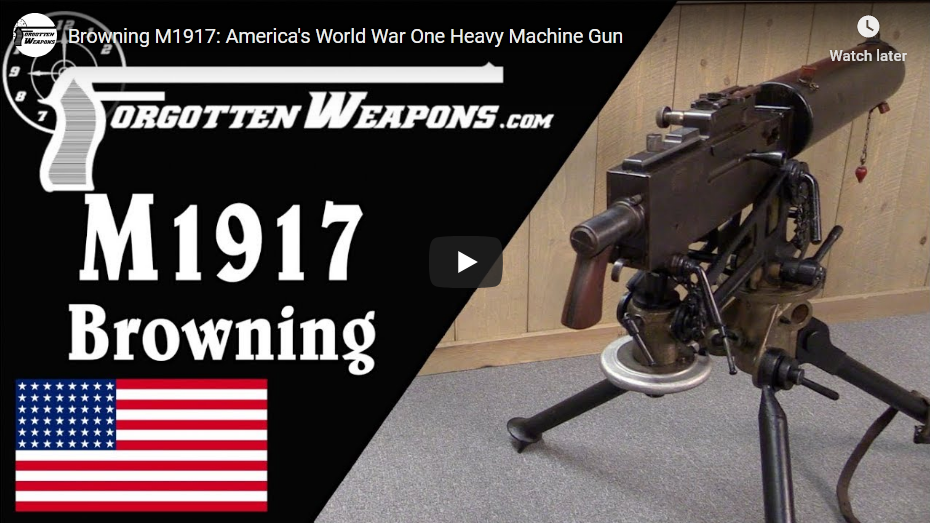
Today we will look at the various different categories of machine guns — what makes them, why they exist, and what their place in military history is. Specifically …
Automatic Rifle: Shoulder or hip fired, limited magazine capacity, minimal sustained fire capacity. Examples: M1918 BAR, Chauchat.
LMG: Magazine fed, rifle caliber, bipod fired. Examples: Bren, Madsen, Lewis.
HMG: Belt fed, usually water cooled, minimal portability, fired from tripod only. Examples: Maxim, Vickers, Hotchkiss 1914. Evolved into guns of caliber 12.7mm – 20mm, like the M2 and DShK.
MMG: Air cooled, tripod fired only, belt fed. Examples: Browning 1919A4, SG-43.
GPMG: Bipod or tripod fired, belt fed, rifle caliber, quick-change barrel. Examples: MG42, PKM, M240.
SAW/LSW: Intermediate caliber, magazine fed, bipod fired. Examples: L86A1, FN Minimi, RPK.
If you enjoy Forgotten Weapons, check out its sister channel, InRangeTV! http://www.youtube.com/InRangeTVShow
December 19, 2019
Machine Gun Terminology – LMG, MMG, SAW, LSW, HMG, GPMG
December 18, 2019
Ballester-Molina Pistols from German Pocket Battleship Armor?
Forgotten Weapons
Published 17 Dec 2019http://www.patreon.com/ForgottenWeapons
Cool Forgotten Weapons merch! http://shop.bbtv.com/collections/forg…
There is an old gun shop tale that Argentine Ballester-Molina pistols were made form the salvaged armor plate of the pocket battleship Admiral Graf Spee. The Graf Spee was scuttled in the Rio de la Plata estuary in December 1939, only a few miles from the HAFDASA factory in Buenos Aires, and Argentina did not have the domestic steel reserves to make enough pistols…
See Michael Parker’s full article on this, including the exact results of his metallurgical analysis, here:
https://www.americanrifleman.org/arti…
Contact:
Forgotten Weapons
6281 N. Oracle #36270
Tucson, AZ 85704
December 16, 2019
Captain Fraser’s Webley-Fosbery: WWI in Microcosm
Forgotten Weapons
Published 23 Dec 2017http://www.patreon.com/ForgottenWeapons
Cool Forgotten Weapons merchandise! http://shop.bbtv.com/collections/forg…
Captain Percy Fraser, DSO was born on January 22, 1879 and died in Ypres on the night of February 23, 1915 while attempting to aid men wounded outside their trench. His unit of the Queen’s Own Cameron Highlanders would suffer horrendous casualties at Ypres, and today we will look at his Webley-Fosbery automatic revolver and his service in the British Army.
Thanks to Mike Carrick of Arms Heritage magazine for sharing Captain Fraser’s story and revolver. See his regular column here: https://armsheritagemagazine.com
If you enjoy Forgotten Weapons, check out its sister channel, InRangeTV! http://www.youtube.com/InRangeTVShow
December 15, 2019
The Empire Strikes Back – Britain’s Operation Compass – WW2 – 068 – December 14, 1940
World War Two
Published 14 Dec 2019The First British offensive of the War begins in North Africa. Meanwhile, the German Knickebein system is designed for bombers to accurately bomb British targets at night. This is what the Brits do to stop them.
Join us on Patreon: https://www.patreon.com/TimeGhostHistory
Or join The TimeGhost Army directly at: https://timeghost.tvFollow WW2 day by day on Instagram @World_war_two_realtime https://www.instagram.com/world_war_t…
Join our Discord Server: https://discord.gg/D6D2aYN.
Between 2 Wars: https://www.youtube.com/playlist?list…
Source list: http://bit.ly/WW2sourcesWritten and Hosted by: Indy Neidell
Produced and Directed by: Spartacus Olsson and Astrid Deinhard
Executive Producers: Bodo Rittenauer, Astrid Deinhard, Indy Neidell, Spartacus Olsson
Creative Producer: Joram Appel
Post-Production Director: Wieke Kapteijns
Research by: Indy Neidell
Edited by: Iryna Dulka
Map animations: Eastory (https://www.youtube.com/c/eastory)Thumbnail Colorization (Archie Wavell) by:
– Julius Jääskeläinen – https://www.facebook.com/JJcolorization/Colorizations by:
– Dememorabilia – https://www.instagram.com/dememorabilia/
– Adrien Fillon – https://www.instagram.com/adrien.colo…Sources:
– IWM: F 4539, B 10600, CM 355, E 6600, E 3720E, E 1416, E 1378, E 4792
– Tropenmuseum, part of the National Museum of World Cultures– Prison icon by FORMGUT. from the Noun Project; Compass by RULI from the Noun Project.
Archive by Screenocean/Reuters https://www.screenocean.com.
A TimeGhost chronological documentary produced by OnLion Entertainment GmbH.
The Nine Situations | The Art of War by Sun Tzu
Eudaimonia
Published 26 Nov 2017Support the channel: https://www.patreon.com/EudaimoniaCha…
Buy the book on Amazon: http://geni.us/xgng
QotD: Naming military actions
I often note with amusement the significant differences in naming conventions for military operations between the US and the rest of the “Anglosphere”. A typical US Army operation might be “Operation Devastating Earthshatterer”, while a British or Canadian equivalent might be “Operation Broken Teaspoon” or “Operation Goalie Glove”. (I’ll pass up on the urge to attribute something mockery-tinged to French codenames … but only because Babelfish didn’t give me a useful translation for “Operation Wet Knickers” or “Operation Big Girl’s Blouse”).
Not that there’s anything wrong with a dose of belligerent overkill in your naming conventions…
Posted on the old blog (no longer online), 2004-09-09.
December 14, 2019
Huot Automatic Rifle: The Ross Goes Full Auto
Forgotten Weapons
Published 13 Dec 2019http://www.patreon.com/ForgottenWeapons
Cool Forgotten Weapons merch! http://shop.bbtv.com/collections/forg…
During World War One, Joseph Alphonse Huot, a Canadian machinist and blacksmith living in Quebec, designed a conversion of the Ross MkIII rifle to become an automatic rifle. The Ross was the standard issue Canadian rifle at the beginning of the war, and Huot wanted to find a way to economically provide Canadian forces with an automatic weapon. His conversion functioned by mounting a gas piston onto the side of the Ross barrel, adding a large action cover and 25-round drum magazine, and a Lewis-style cooling shroud over the barrel.
In initial testing with the Canadian army, the Huot performed well. It was seriously considered for adoption, but had to undergo British testing and approval before that could happen. In British testing (by now near the end of the war), it was found to run well enough and have some positive attributes, but not sufficient to justify replacement of the Lewis Gun. It was rejected, and the Canadian Corps finished the war with the Lewis instead. Huot had spent several years privately developing the weapon and two more working on salary for the Canadian military, and had gone into considerable personal debt for the project. He had secured a deal to receive royalties on production, but that of course came to naught when the design was rejected. Ultimately, he was compensated $25,000 in 1936 (of the $36,000 he claimed to have spent).
Only five of the guns were made in total, with four known to still exist. Two of them are in Ottawa at the Canadian War Museum and one in the Seaforth Highlanders Museum in Vancouver and one in the Army Museum in Halifax.
Thanks to the Canadian War Museum for providing me access to film this Huot for you!
Contact:
Forgotten Weapons
6281 N. Oracle #36270
Tucson, AZ 85704
The English Civil War Explained
Royal Armouries
Published 20 Dec 2017The Royal Armouries’ English Civil War collection boasts an array of infantry and cavalry arms and armour from the 1640s. Delve into this turbulent historical period with our resident Royalist, David.
Where to find us:
⚔Website: https://royalarmouries.org/home
⚔Blog: https://blog.royalarmouries.org/
⚔Twitter: https://twitter.com/Royal_ArmouriesThe Royal Armouries is the United Kingdom’s national collection of arms and armour. On this channel, discover what goes on behind the scenes at the museum and to see our collection come to life. From combat demonstrations to jousting coverage to behind the scenes tours with our curators, we’ve got it covered.
Have a question about arms and armour? Feel free to leave us a comment and we’ll do our best to answer it.
December 13, 2019
Communist Boots Are Made For Walking – Mao‘s Long March | BETWEEN 2 WARS I 1935 Part 3 of 4
TimeGhost History
Published 12 Dec 2019From 1927 to 1934, the Chinese Communists lived in a state within the National Chinese State led by Chiang Kai-Shek. In 1935, the Nationalists strike and the Communists follow their leader Mao Zedong on a Long March Northwards.
Join us on Patreon: https://www.patreon.com/TimeGhostHistory
Hosted by: Indy Neidell
Written by: Joram Appel
Directed by: Spartacus Olsson and Astrid Deinhard
Executive Producers: Bodo Rittenauer, Astrid Deinhard, Indy Neidell, Spartacus Olsson
Creative Producer: Joram Appel
Post-Production Director: Wieke Kapteijns
Research by: Joram Appel
Edited by: Daniel Weiss
Sound design: Marek KaminskiColorizations:
– Klimbim – https://klimbim2014.wordpress.comA TimeGhost chronological documentary produced by OnLion Entertainment GmbH.
“Resist And Bite” – Chasseurs Ardennais – Battle of Belgium – Sabaton History 045 [Official]
Sabaton History
Published 12 Dec 2019As Germany invades France and the Benelux countries in May 1940, the main bulk of their panzers are heading towards the Ardennes and the Meuse River in an effort to cut the Allied forces in half. However, two small units of Belgian infantry are standing in their way. They are the Chasseurs Ardennais and have one objective: To delay the Germans by every means necessary…
Support Sabaton History on Patreon: https://www.patreon.com/sabatonhistory
Listen to Heroes (where “Resist And Bite” is featured):
CD: http://bit.ly/HeroesStore
Spotify: http://bit.ly/HeroesSpotify
Apple Music: http://bit.ly/HeroesAppleMusic
iTunes: http://bit.ly/HeroesiTunes
Amazon: http://bit.ly/HeroesAmz
Google Play: http://bit.ly/HeroesGooglePWatch the official lyric video of “Resist And Bite” here:
https://www.youtube.com/watch?v=iGtEH…Listen to Sabaton on Spotify: http://smarturl.it/SabatonSpotify
Official Sabaton Merchandise Shop: http://bit.ly/SabatonOfficialShopHosted by: Indy Neidell
Written by: Markus Linke and Indy Neidell
Directed by: Astrid Deinhard and Wieke Kapteijns
Produced by: Pär Sundström, Astrid Deinhard and Spartacus Olsson
Creative Producer: Joram Appel
Executive Producers: Pär Sundström, Joakim Broden, Tomas Sunmo, Indy Neidell, Astrid Deinhard, and Spartacus Olsson
Post-Production Director: Wieke Kapteijns
Production Intern: Rune Væver Hartvig
Edited by: Iryna Dulka
Sound Editing by: Marek Kaminski
Maps by: Eastory – https://www.youtube.com/c/eastoryArchive by: Reuters/Screenocean https://www.screenocean.com
Music by Sabaton.Colorizations:
– Julius Jääskeläinen – https://www.facebook.com/JJcolorization/
– Olga Shirnina, a.k.a. Klimbim – https://klimbim2014.wordpress.com/An OnLion Entertainment GmbH and Raging Beaver Publishing AB co-Production.
© Raging Beaver Publishing AB, 2019 – all rights reserved.
From the comments:
Sabaton History
2 days ago (edited)
Today we again turn towards the Second World War — to be more specific the 1940 German invasion of France and the Benelux. Here two small Belgian units bravely attempted to delay the advance of the Wehrmacht. We hope you all appreciate this video! And much like the Chasseur Ardennais supported the war effort of the Belgians, our awesome Patrons support the war effort of us, the Sabaton History team! So if you haven’t, you most certainly should consider supporting us on https://www.patreon.com/sabatonhistory.Oh and if you’re interested in World War Two, you should definitely check out Indy’s World War Two Channel (http://www.youtube.com/c/worldwartwo) where he covers WW2 Week-by-week. Last May, he covered the invasion of the Benelux and France, which you can check out right here: https://youtu.be/DLN8NHXiMy0
Cheers, the Sabaton History team!
Martyr of Verdun: Émile Driant’s Command Post
Forgotten Weapons
Published 22 Oct 2019http://www.patreon.com/ForgottenWeapons
Cool Forgotten Weapons merch! http://shop.bbtv.com/collections/forg…
Émile Driant was a French army officer who served originally as an aide to General Boulanger (and married his daughter). This connection would tarnish his career when politics forced Boulanger to resign (and shortly afterward commit suicide). It became clear that he would never rise much in rank, and in 1905 he resigned his commission. In 1910 he was elected to the French National Assembly, where he was still serving when war erupted in 1914. Driant was focused on French military readiness his entire life, and wrote extensively about potential future wars.
In 1914, he was recalled to military service, although he retained his Assembly position. He was given command of a reserve unit of Chausseurs (infantry) in the quiet backwater Verdun sector, where he couldn’t cause too much trouble to the military establishment. Through 1915 he watched Joffre remove men and guns from the forts around Verdun to reinforce more active areas of the front. He was intensely concerned that this was leaving Verdun a weak point ripe for German attack. As an officer, there was not much he could do about this except complain to his own commander — but as an active member of the National Assembly, he was able to bypass the military chain of command and take his concerns directly to the civilian government. This did nothing to endear him to Joffre, but the attention he brought did result in more defensive preparations being made in and around Verdun.
On February 21st, 1916 Driant’s warnings were proven true when the Germans launched the Battle of Verdun, which would become one of the most significant operations of the war for France. Driant and his 1200 Chausseurs were stationed in the Bois de Caures forest, right in the middle of the German offensive. His men fought valiantly to hold back the attack in their sector, but were reduced to less than 200 men combat-effective by the 22nd. Driant ordered a withdrawal that morning, and was killed by a gunshot while aiding a wounded trooper.
He was buried with military honors by the Germans, but later re-interred by the French where he had fallen. Today his command post remains just a few hundred yards from his gravesite, and a memorial marks the spot. Driant quickly became recognized as one of the heroes of Verdun, for his efforts before the battle and his front-line leadership during the initial attack.
Contact:
Forgotten Weapons
6281 N. Oracle #36270
Tucson, AZ 85704
December 12, 2019
The Few Who Opposed Hitler – German Resistance in 1940 – WW2 – War Against Humanity 006
World War Two
Published 11 Dec 2019Where all German faithful Nazis? Not by a stretch, but a resounding majority approved of the Nazis, especially before the war, and again after the victory in France. Anyone that actively opposed Hitler and his gang were not only risking their life, but faced an uphill battle against public opinion. And yet … some people did.
Join us on Patreon: https://www.patreon.com/TimeGhostHistory
Or join The TimeGhost Army directly at: https://timeghost.tvFollow WW2 day by day on Instagram @World_war_two_realtime https://www.instagram.com/world_war_t…
Join our Discord Server: https://discord.gg/D6D2aYN.
Source list: http://bit.ly/WW2sourcesHosted by: Spartacus Olsson
Written by: Spartacus Olsson and Joram Appel
Produced and Directed by: Spartacus Olsson and Astrid Deinhard
Executive Producers: Bodo Rittenauer, Astrid Deinhard, Indy Neidell, Spartacus Olsson
Creative Producer: Joram Appel
Post-Production Director: Wieke Kapteijns
Research by: Joram Appel and Spartacus Olsson
Edited by: Mikołaj Cackowski
Map animations: Eastory (https://www.youtube.com/c/eastory)Colorizations by:
Cassowary Colorizations – https://www.flickr.com/photos/cassowa…
Julius Jääskeläinen – https://www.facebook.com/JJcolorization/
Dememorabilia – https://www.instagram.com/dememorabilia/
Norman Stewart – https://oldtimesincolor.blogspot.com/Sources:
Archive of I. M. Bondarenko
Archive by Screenocean/Reuters https://www.screenocean.com.A TimeGhost chronological documentary produced by OnLion Entertainment GmbH.
From the comments:
World War Two
5 hours ago
This is the first episode of five War Against Humanity videos that will focus on Resistance in 1940. In this episode we look at Germany, then France, after that the Benelux countries and Scandinavia, then Poland and finally China. The first two episodes will come out before Christmas and the next will follow at the beginning of the new year. These episodes are all introductions to a recurring coverage of the war behind the lines. Resistance and collaboration with the occupying enemy was an essential component of WW2, but because it was clandestine, often private enterprises, the records are less detailed than the ones of the official war machines of the belligerents. Thus, resistance is not always as easy to organize on a weekly time line. Therefore we will return irregularly to the events behind each frontline to look at the developments over a somewhat longer timespan. We will do our best to follow the individuals who played a central part in the events and machinations. We hope that in this way we can give you more insight into WW2 events that are often overlooked, or covered in a less cohesive way.
December 11, 2019
Franco-Prussian War | Animated History
The Armchair Historian
Published 4 Feb 2018What was the Franco Prussian War?
Our Website: https://www.thearmchairhistorian.com/
Our Twitter:
@ArmchairHistOur Discord:
https://discord.gg/Ppb2cUdSources:
https://www.britannica.com/event/Fran…
http://francoprussianwar.com/
http://history-world.org/franco_pruss…
http://www.newworldencyclopedia.org/e…
https://www.warhistoryonline.com/hist…
http://geacron.com/home-en/?v=m&lang=…Music: Music: Antonio Salieri: “Twenty six variations on La Folia de Spagna“
December 10, 2019
“NATO [reminds] me of the pre-reformation medieval church. Their stated objectives sound Godly and noble but their true purpose is to keep a bloated priesthood in luxury”
NATO still exists, decades after the threat it was designed to counter dissolved. Tom Paine wonders why this is so:
The dismal science teaches us to distinguish between peoples’ stated preferences (often virtue-signalling lies) and their revealed preferences (how they spend their money). All NATO members say they believe in the alliance. Only four — the USA, the UK, Poland and Greece — meet their obligation to contribute more than 2% of their GDP. If you’re wondering, Greece has only accidentally met that target because of the catastrophic fall in its GDP.
Opinion polls and my own experience of the bitter, sneering anti-Americanism of my otherwise delightful continental chums suggest that as usual the revealed preference is the truth. The Germans and French would not go to war in defence of America or Britain if we were attacked. Britain was attacked, when the Falklands were invaded, and our “allies” and “friends” sold arms to our enemies and gave them all kinds of moral support. Remember the Welsh Guards (my grandfather’s old regiment) massacred by Exocets fired from Mirages? The USA has often gone to war since the alliance was formed and mostly only British warriors fought, died or were injured alongside theirs.
Germany, France and their freeloading friends have quite simply been taking the piss from the outset. They take the Americans (and us Inselaffen and rosbifs) for mugs. They plot to form an EU Army and regret that Brexit means they won’t be able to continue to rely on English-speakers as their cannon-fodder.
The continued existence of NATO has fuelled the epic paranoia of Russia’s military/intelligence apparatus. Desperate not to be decommissioned the generals and chekists have claimed that “the West” they grew up opposing is intrinsically hostile — rather than, in truth, insultingly indifferent — to Mother Russia. Their only “proof” of this nonsense was NATO.
[…]
NATO is yet another of many examples of the truism that, once a bureaucracy acquires a competence, it will never disband. It continues because it can. The political and economic ills that drove the creation of what is now called the EU have long since faded into history. But the plump parasites of its apparatus have repeatedly repurposed it. Britain is a paradise of social, ethnic and sexual equality compared to the days when the precursors of the Equalities Commission were formed but its staff will find imaginary evils by the thousand before they’ll return to productive labour. Marx would gasp at the generosity of Britain’s welfare state and marvel at the lifestyle of even the poorest Brit and yet trivial micro aggressions are enough to sustain the revolutionary fervour of Marxist academics desperate to live as idly and unproductively as the man himself.
Before the Lewis Gun was the McClean Automatic Rifle
Forgotten Weapons
Published 18 Oct 2019This is Lot 1158 in the upcoming October Morphy Extraordinary auction.
Samuel McClean was a medical doctor from Iowa who began tinkering with firearms designs in 1889, and formed the McClean Arms Company in 1896. He was an intelligent and talented designer, but never quite managed to get a gun good enough for military acceptance. His work included bolt actions rifles, self-loading shoulder rifles, machine guns, and self-loading cannons. By 1910 his company had gone bankrupt twice, and he was forced out by his investors. Isaac Newton Lewis was brought in, and turned McClean’s initial concepts into the ultimately-successful Lewis Machine gun.
However, McClean made one least attempt to produce his own gun after World War One. This is the McClean Automatic Rifle, and it was tested by the US Navy in 1919 – and rejected. This pattern uses an operating system similar to McClean’s early work, and thus also quite similar to the Lewis gun. Instead of two large locking lugs, however, it has several dozen small lugs in two rows on each side of the bolt. The gas piston is also huge by modern standards; over an inch in diameter. The gun is unfortunately missing its magazine Still, it is the only example of the type known to exist, and probably the only one ever manufactured.
http://www.patreon.com/ForgottenWeapons
Cool Forgotten Weapons merch! http://shop.bbtv.com/collections/forg…
Contact:
Forgotten Weapons
6281 N. Oracle #36270
Tucson, AZ 85704