Quotulatiousness

September 20, 2021

Canada was given advance notice of the AUKUS deal … about five minutes notice

Filed under: Australia, Britain, Cancon, Military, USA — Tags: , , , , , — Nicholas @ 03:00

When the news broke about a new western alliance involving Australia, the United Kingdom and the United States, the official line — belatedly — was that our allies had kept Canadian officials “in the loop”, about the negotiations. Now that everyone’s attention is on the vote-counting, it can be safely acknowledged that the Canadian government got a heads-up just a few minutes before the formal announcement, as Ted Campbell discusses:

US President Joe Biden with British Prime Minister Boris Johnson (onscreen) during the AUKUS announcement.
Image from businesstelegraph.co.uk.

So, Steven Chase and Robert Fife say, in the Globe and Mail, that “The Canadian government was surprised this week by the announcement of a new security pact between the United States, Britain and Australia, one that excluded Canada and is aimed at confronting China’s growing military and political influence in the Indo-Pacific region, according to senior government officials [and] Three officials, representing Canada’s foreign affairs, intelligence and defence departments, told The Globe and Mail that Ottawa was not consulted about the pact, and had no idea the trilateral security announcement was coming until it was made on Wednesday by U.S. President Joe Biden, British Prime Minister Boris Johnson and Australian Prime Minister Scott Morrison.”

Not only did our oldest and closest friends and allies kick Canada out of the “inner circle”, they didn’t even bother to tell us that the political and diplomatic kick in the arse was coming, although, the Globe journalists say, the Australian and British defence ministers gave Harjit Sajjan a brief “heads up” just minutes before the announcement. Mr Sajjan’s spokesman said that Canada “had been kept in the loop”, I call BS.

Vice Admiral Mark Norman, someone who knows a lot about what happens at the highest echelons of government in Ottawa said that “if Mr. Trudeau was fully briefed” [on this new AUKUS pact, then] “he doesn’t understand what is going on internationally and he doesn’t understand what the significance of an arrangement like this is as it relates to international security.” I don’t think he had heard a word about this until Minister Sajjan’s senior aids called the PCO and PMO on Wednesday afternoon.

One can easily imagine the conversations on Wednesday and Thursday in some of the corridors of power in Ottawa: “ Biden us!” said one senior official. “No,” said another, even more senior, “this has been coming for a long time. It’s a shock, but it really shouldn’t be a surprise.” “They screwed us,” said a third, “we’ve done nothing to deserve this. It’s just because we aren’t spending as much as Biden and Morrison want on the military and it’s because we’re not sending more ships to Asia, more often.” “No,” the second person said, “it’s because we decided, all of us, you and me, too, to not do whatever it took to arrest the changes in our national strategic outlook.” “How can you say that?” the first speaker said, “We all protested, I wrote a long brief explaining why we needed to step up …” “We’re still here,” the more senior official said. “We didn’t resign and go public as soon as we saw how things were shaping up. Almost no one did.” “No one listens when senior officials or admirals or generals resign,” said the third official, “it wouldn’t have done any good.” “You’re right,” the most senior official answered, “resignations are, normally, not news and they rarely change politicians’ minds … not, anyway, when they’re done one at a time. Back in 2016, when many us started to see, clearly, how things were going we should have resigned en masse ~ and not just we three, but dozens of us from PCO, from Foreign Affairs and from DND and the military. If the senior public service had rebelled, as it should when the government makes destructive policy choice against our advice, then there would have been enormous, even irresistible political pressure. But we didn’t, did we? We all stayed on and wrote a couple of arse-covering briefing notes and went about our business. We are as much to blame for this as are those dimwits in Trudeau’s cabinet and inner circle. We failed Canada.”

Vice Admiral Norman, the article explains, “said the agreement goes far beyond access to U.S. submarine technology [which is Mr Trudeau’s lame excuse for why Canada was kicked out of the inner circle] This is about accessing both current and emerging technologies, from cyber and artificial intelligence, to acoustics and underwater warfare – a whole range of very important strategic capabilities.” Further, “Mr. Norman said Canada has many national interests in the Indo-Pacific – including trade, promoting the rule of law and democracy, and countering China’s aggressive behaviour and posturing – but he suspects close allies do not take Canadian defence commitments seriously [and he added] I don’t think our allies think we are serious when it comes to defence. I think they have concerns not just about our defence expenditures, but also the extent to which our [international] commitments are both lasting and meaningful.” This has been evident since 2015. Justin Trudeau effectively campaigned on doing less in the world. Everyone knew this was coming ~ especially those who voted for the Liberal Party … it is what they wanted. It’s what Canada got.

September 19, 2021

Stalingrad Falls? – WW2 – 160 – September 18, 1942

World War Two
Published 18 Sep 2021

It’s a big week, but by now they all are. The fighting in Stalingrad is intense, the fighting on Guadalcanal is intense, and the US loses a carrier in the Pacific. And the German quest for oil in the Caucasus … how’s that going again?
(more…)

Chassepot: Best of the Needle Rifles

Filed under: France, History, Military, Weapons — Tags: , , , — Nicholas @ 02:00

Forgotten Weapons
Published 3 May 2019

The Model 1866 Chassepot was France’s first military cartridge-firing rifle. It used a self-contained paper cartridge on the same basic principle as the Prussian 1841 Dreyse rifle, but was a substantial improvement on that system. The Chassepot fired an 11mm bullet at about 1350 fps (410 m/s), which was substantially higher velocity than the Dreyse. It was more accurate and had a substantially longer effective range. The French would produce about 1.5 million Chassepot rifles, most of them before the Franco-Prussian War.

Despite the quality of the Chassepot rifle, that war would go tremendously badly for the French, with hundreds of thousands of men and arms captured by the Prussians and the new German state being declared in the palace of Versailles. In the aftermath, many German cavalry units would adopt Chassepots for their own use, until the Gewehr 71 was available in carbine form. The French would resume Chassepot production briefly after the war, but would soon transition to a new rifle, the metallic cartridge firing Gras.

http://www.patreon.com/ForgottenWeapons

Cool Forgotten Weapons merch! http://shop.bbtv.com/collections/forg…

Contact:
Forgotten Weapons
PO Box 87647
Tucson, AZ 85754

September 18, 2021

What if Pearl Harbor Never Happened, Life in Cyprus, and Peasant Armies of China – WW2 – OOTF 024

Filed under: China, Europe, Greece, History, Japan, Middle East, Military, WW2 — Tags: , , , , — Nicholas @ 06:00

World War Two
Published 17 Sep 2021

Ever wonder what would have happened if Japan just never attacked Pearl Harbor but invaded the Indies anyway? Or how the people of Cyprus are faring in the war? Or if the Chinese armies had any specialized combat forces? Find out in this Out of the Foxholes!
(more…)

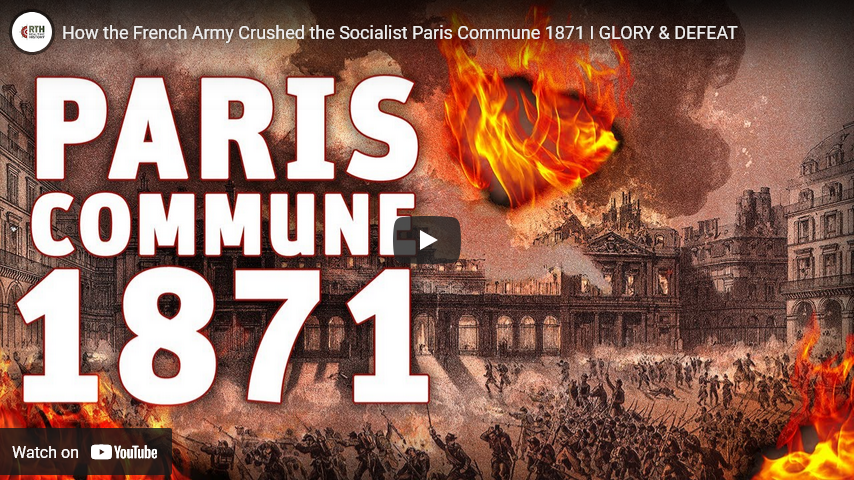
Paris Fights Back – The French Battle Against German Encirclement I Franco-Prussian War 1870

Filed under: France, Germany, History, Military — Tags: , , , , — Nicholas @ 04:00

Real Time History
Published 16 Sep 2021

Support Glory & Defeat: https://realtimehistory.net/gloryandd…

The German armies are on their way to encircle the French capital Paris after their victory at Sedan. The new French government is raising new troops all across the country and in Paris itself to stem the tide. Poorly equipped and poorly trained troops fight the Germans at Sceaux/Chatillon. Meanwhile, the German states start their negotiations for German unification.

» THANK YOU TO OUR CO-PRODUCERS
John Ozment
James Darcangelo
Jacob Carter Landt
Thomas Brendan

» OUR PODCAST
https://realtimehistory.net/podcast – interviews with historians and background info for the show.

» LITERATURE
Arand, Tobias: 1870/71. Die Geschichte des Deutsch-Französischen Krieges erzählt in Einzelschicksalen. Hamburg 2018

Bourguinat, Nicolas/Vogt, Gilles: La guerre franco-allemande de 1870. Une histoire globale. Paris 2020

Gouttman, Alain. La grande défaite de 1870-1871. Paris 2015

Haselhorst, Olaf: Operationen der deutschen Heere im Krieg gegen Frankreich 1870/71, in: Der Deutsch-Französische Krieg 1870/71.

Vorgeschichte, Verlauf, Folgen, hrsg. v. J. Ganschow unter anderem Graz 2009, S. 83–120

Milza, Pierre: L’année terrible. Paris 2009

» SOURCES
Chuquet, Arthur: La Guerre 1870-71. Paris 1895

Busch, Moritz: Bismarck und seine Leute während des Kriegs mit Frankreich Band. 1. Leipzig 1878.

Goncourt, Edmonde de: Memoires de la vie Litteraire. Paris 1890

Kriegsgeschichtliche Abtheilung des Großen Generalstabes (Hrsg.): Der deutsch-französische Krieg 1870-71. II.1 Berlin. 1878

Russell, William Howard: My diary during the last great war. London and New York, 1874

Sternegg, Generalmajor von: Schlachten-Atlas des 19. Jahrhunderts. Band 10. Deutsch-Französischer Krieg1870/71. Leipzig u.a. o.J. [1885]

» OUR STORE
Website: https://realtimehistory.net

»CREDITS
Presented by: Jesse Alexander
Written by: Cathérine Pfauth, Prof. Dr. Tobias Arand, Jesse Alexander
Director: Toni Steller & Florian Wittig
Director of Photography: Toni Steller
Sound: Above Zero
Editing: Toni Steller
Motion Design: Philipp Appelt
Mixing, Mastering & Sound Design: http://above-zero.com
Maps: Battlefield Design
Research by: Cathérine Pfauth, Prof. Dr. Tobias Arand
Fact checking: Cathérine Pfauth, Prof. Dr. Tobias Arand

Channel Design: Battlefield Design

Contains licensed material by getty images
All rights reserved – Real Time History GmbH 2021

September 17, 2021

The Real-Life Nazi Pirates – WW2 Special

Filed under: Australia, Germany, History, Military, WW2 — Tags: , , , , , — Nicholas @ 04:00

World War Two
Published 16 Sep 2021

There is more to war on merchant shipping than U-Boats and the Battle of the Atlantic. Raiders disguised as innocent traders also play the role of privateers; stalking vessels, approaching with a false flag, and then striking before anyone can react. Here’s the story of one: Kormoran.
(more…)

Australia, the UK, and the US join in a military alliance … Canada of course is nowhere in sight

News broke the other day about a new three-nation military arrangement clearly aimed at containing Chinese ambitions in the Pacific, involving Australia, Britain, and the United States, to be known as AUKUS (or AUUKUS, depending on the reporting source). These three countries are already tightly linked in the “Five Eyes” intelligence sharing network which also includes Canada and New Zealand. As more than one wit noted on Twitter after the announcement, it’s a good thing Canada doesn’t have a Pacific coast or any economic interests in that ocean…

Ted Campbell, who recently emerged from a blogging hiatus to comment on the ongoing federal election, felt this new pact cemented the idea that Canada is “no longer a serious country” in military terms:

It is now abundantly clear that the USA, inter alia, puts Justin Trudeau’s Canada in the same league as (anti-nuclear) New Zealand. Canada is no longer one of the most trusted allies … Australia is; Britain is: India is; Japan is … Canada is NOT.

Prime Minister Justin Trudeau has, in six short years, moved Canada from one of America’s best friends to, de facto, a Chinese puppet state. He has done this with his own (and his many advisors’) eyes wide open. Canada, Justin Trudeau’s Canada is no longer a serious nation … perhaps we don’t really deserve to be. After all, we (almost 40% of the almost 70% who bothered to vote at all) elected him … then we did it again. Maybe the world is just concluding that we are not serious people who can be relied upon when the going gets tough.

He followed this up with a bit more concern on the sinking Canadian international profile:

Just take a look at those technologies ~ AI, quantum computing, cyber warfare ~ those are all areas vital to Canada’s security and prosperity and what are we focused on? Climate change and Québec’s latest attempts to make Canada into an illiberal state. China spews out more carbon in a week than Canada does in a year. China is aiming to displace America as the global guarantor of peace, security and trade. Do any of the dimwits in the Liberal government understand that? Why in hell is Prime Minister Trudeau attacking Alberta’s (relatively clean) oil industry rather than, for example, concentrating on making Canadian nuclear energy work for us?

A few days ago I said that Canada needs nuclear powered submarines to assert and protect our sovereignty in the waters we claim as our own. No one contradicted me. No one ever raises any serious, well-founded objections to nuclear submarines for Canada. It’s a no brainer. But, look at the last line in the quote above. Who is getting nuclear submarines? Australia … because it is a serious country with adult political leadership.

Prime Minister Justin Trudeau’s regime has sidelines Canada. Our strongest, most traditional allies have abandoned us. We have been sold out … to China.

I use that term “sold out”, intentionally. I do NOT believe that Justin Trudeau is a traitor … for heaven’s sake, he’s not smart enough to betray anything. He’s barely able to memorize his lines. But a lot of people have invested a lot in China ~ the Desmarais family (of Power Corporation fame) and former Prime Minister Jean Chrétien and Bob Rae, Canada’s Ambassador to the UN, for example, are all closely tied together and even more closely tied to the Canada-China trade file. I assert that the “China lobby” in Canada is very, very powerful, very, very rich and extraordinarily well connected to Canada’s political leadership ~ Liberal and Conservative, alike. I further assert that it, not Justin Trudeau and Marc Garneau and the mandarins in Ottawa, drives Canada’s foreign, trade and fiscal policies. Prime Minister Justin Trudeau is NOT a traitor … but he is puppet and people whose vital interests are centred on China, not Canada, pull the strings.

Why is Canada excluded from the AUKUS pact?

One reason Canada isn’t involved is certainly the distraction of the federal election, and there would have been no way that Justin Trudeau would have wanted to answer questions on the campaign trail about anything geostrategic or military, and he especially doesn’t want Canadians looking closely at his servile deference to the Chinese government. Of course, given that he’s literally bribed the major newspaper chains and TV networks with “subsidies” right before the election was called, he might well have been safe from any hint of an awkward question from his unofficial PR branches in Montreal, Toronto, and Vancouver.

Over at the Thin Pinstriped Line, Sir Humphrey looks at the military and technical implications of the new alliance:

The Royal Australian Navy is likely to become the next nation to join the nuclear submarine operators club. This is the key headline emerging from the surprise tri-lateral announcement on Wed 15 September by the Prime Ministers of Australia and the UK, and the President of the United States.

The move, forming a new “three eyes” club known as AUKUS is a genuinely significant development intended to provide a significant uplift in capability in the Indo-Pacific region. For the first time in nearly 70 years, the US has agreed to share some of its most sensitive technology with a third party, to help Australia become a “naval power underway on nuclear power”.

There are several ramifications of this decision, that will be felt for many years to come. The first is that from an American perspective, this is a good opportunity to take steps to increase burden sharing in the Pacific.

[…]

From a wider diplomatic perspective, there are three distinct groupings to consider. Firstly, the remaining 5-EYES members (Canada and New Zealand). Its unlikely that this will do much damage to 5-EYES – for example New Zealand would never have been approached as the acquisition of a nuclear submarine would be vastly beyond the budget, or needs, of the small but incredibly professional Royal New Zealand Navy.

Canada may be feeling slightly raw about this – particularly those with long memories who recall the 1980s and the doomed plan to acquire nuclear submarines for the RCN. But who knows, in terms of timelines these vessels may be entering service in the same timeframe as Canada seeks to replace the Upholder/Victoria class – it is not beyond the realm of possibility that they may seek to join in later on.

Given 5-EYES is more than just an Indo-Pacific focus, it would be wrong to read much into this as a statement on the future of that Alliance. Rather it is better to see this as a subgrouping of a very successful international alliance.

HMCS Victoria
Image via Wikimedia Commons.

The Battle of Lissa, 1866

Filed under: Europe, History, Italy, Military — Tags: , , , , , — Nicholas @ 02:00

Drachinifel
Published 26 Sep 2018

One of the most unintentionally hilarious battles of the 19th century is the subject of today’s special video.

Bezeuge Mich!” – Admiral Tegethoff 1866 (probably)

September 16, 2021

Tanks Chat #124 | FV4005 Tank Destroyer | The Tank Museum

Filed under: Britain, History, Military, Weapons — Tags: , , , — Nicholas @ 02:00

The Tank Museum
Published 23 Apr 2021

David Fletcher MBE explores the experimental FV4005, with original turret and 183mm gun fitted on a Centurion Mark 12 hull.
(more…)

September 15, 2021

Hansa – Northern Silk Road – Economic History

Kings and Generals
Pubished 14 Sep 2021

Use our code KINGSANDGENERALS10 and link: https://bit.ly/3mACCeg to get 10% off (save up to $47!) your own authentic Japanese subscription box from Bokksu! Don’t miss out on this amazing snack-journey through Japan!

Kings and Generals animated historical documentary series on medieval history and economic history continues with a video on Hansa, also known as the Hanseatic League, which played a crucial role in the European trade in the late medieval, becoming known as the Northern Silk Road and dominating Baltic and North Sea trade for centuries.

Support us on Patreon: http://www.patreon.com/KingsandGenerals or Paypal: http://paypal.me/kingsandgenerals. We are grateful to our patrons and sponsors, who made this video possible: https://docs.google.com/document/d/1o…

The video was made by Michael Merc https://bit.ly/340tcO2 while the script was researched and written by Matt Hollis. 2d art and animation – amicus verus (https://www.artstation.com/amicus_verus). Narration by Officially Devin (https://www.youtube.com/user/OfficiallyDevin)

✔ Merch store ► https://teespring.com/stores/kingsand…
✔ Podcast ► http://www.kingsandgenerals.net/podcast/
✔ Twitter ► https://twitter.com/KingsGenerals
✔ Instagram ► http://www.instagram.com/Kings_Generals

Production Music courtesy of Epidemic Sound: http://www.epidemicsound.com

#Documentary #Hansa #EconomicHistory

This video was sponsored by Bokksu

QotD: The cult of Napoleon

Filed under: Europe, France, History, Military, Quotations — Tags: , , , , , — Nicholas @ 01:00

The worship of Napoleon has always been a French mystery. Is it spontaneous, reflecting nostalgia for empire, or something organized by the state, which has inherited from that period a matchless taste for authority? French schoolchildren are taught only the benefits of the emperor’s reign. According to our textbooks, Napoleon is supposed to have endowed France with a perfect legal system that still governs us today and to have caused the winds of freedom to blow across Europe. Each year, a dozen more books are published in France touting Napoleon’s glory. He has been represented more often than Christ on film, always as a positive hero.

Other Europeans see him very differently. While French historians amplify the myth that Napoleon himself created by dictating his idealized Memoires on St. Helena, English, German, Russian and Spanish authors count up the massacres and the destruction of their cities and their civilization.

Napoleon began shaping his reputation while he was still alive. He commonly wrote reports of his victories before the battles had even begun, which makes him the founding father of fake news. Certain disasters, such as the Battle of Eylau (now in Poland) against the Russians and Prussians, for example, are still inscribed in the walls of the Arc de Triomphe in Paris as if they were victories, since that is how they were first announced.

Since France is now part of Europe — rather than Europe becoming part of France, as Napoleon wished — what should we commemorate? French victories, such as Austerlitz, were defeats for the Russians and Austrians. Waterloo, a day of mourning for the French, is a symbol of liberation for the British, Germans, and Dutch. In any case, since the return of Napoleon’s ashes, our view of history has changed; the fate of people concerns us more than the fate of armies. Napoleon’s stature does not benefit from this change of perspective. To finance his wars, he ruined Europe, banning international commerce (only smugglers got rich), conscripting peasants, ravaging harvests, and confiscating horses. How should we commemorate the Russian and German campaigns of 1812 and 1813, when the Grand Army left in its wake not the liberation of peoples, but famine and epidemic? Worst still, how should we commemorate the restoration of slavery in the French Antilles, Guadeloupe, and Santo Domingo (Haiti), where the deputies of France’s Revolutionary Convention had abolished it in 1794?

Guy Sorman, “Which Napoleon?”, City Journal, 2021-05-14.

September 14, 2021

Stalingrad, Hitler’s Obsession – WW2 – 159B – September 13, 1942

Filed under: Germany, History, Military, Russia, WW2 — Tags: , , , , , — Nicholas @ 04:00

World War Two
Published 13 Sep 2021

Here’s an extra weekly episode for you. The suburbs of Stalingrad have fallen and the fight for the city proper is about to begin, but before it does, three conferences take place that will decide the scope, the tactics, and the strategy of this battle.
(more…)

Sturmgewehr MP-44 Part II: History & Implementation

Filed under: Germany, History, Military, Weapons, WW2 — Tags: , , , , — Nicholas @ 02:00

Forgotten Weapons
Published 27 Sep 2016

Cool Forgotten Weapons Merch! http://shop.bbtv.com/collections/forg…

The Sturmgewehr was the result of a German intermediate cartridge development program that began in the mid-1930s. It was sidelined for a period as the focus of German Ordnance shifted to full-power rifles in 8x57mm with telescopic sights, but as the German fighting in Russia became more desperate, many Ordnance officers realized that the greater firepower offered by the Sturmgewehr concept was one of the few options that might be able to allow depleted German units to effectively hold ground against Russian attacks.

To this end, the guns were issued primarily in the East, with whole companies being equipped in order to focus a maximum amount of firepower, rather than spreading the new rifles piecemeal across all units. Ultimately, of course, this was insufficient to prevent the growing Soviet advance — but for the individual German soldier, an MP-43/44/StG-44 would have been a much more comforting weapon than a Kar98k Mauser!

http://www.patreon.com/ForgottenWeapons

QotD: “In 1918 it was statistically safer for a British soldier to fight in the trenches of the Western Front than be a prisoner in Germany”

Filed under: Books, Britain, Germany, History, Military, Quotations, WW1 — Tags: , , , — Nicholas @ 01:00

… the Kaiser’s armies behaved abysmally on the battlefields of the Great War fighting foreigners. As soon as the Germany Army crossed the border into Belgium, the atrocities began. If the sensational stories of German soldiers eating Belgian babies can be discounted as Allied propaganda, the painstaking research of Alan Kramer and John Horne, in German Atrocities, 1914: A History of Denial (2001), demonstrates beyond reasonable doubt that Germany engaged in a systematic programme of civilian executions with the purpose of striking terror into the heart of the Belgian population. On 23 August, 1914, in the city of Dinant, the German army burned down a thousand buildings and executed some 674 civilians. The oldest among them was in his 90s; the youngest was barely a month old.

On and on the German outrages went: the sinking of the Lusitania, the execution of Nurse Cavell. Of course, the Allies were not saints, but the fashionable fallacy of moral equivalence — that all sides in the Great War were as bad as each other — founders on the rocks of Germany’s treatment of prisoners of war, who became slave labourers.

This was the main substance of the British agenda at Leipzig. Almost 165,000 British soldiers were taken prisoner on the Western Front between 1914-18; by the end of 1916, almost 80% were forced into labour for the Second Reich. Prisoners were literally worked to death in salt mines. And conditions in many camps were inhuman: in Wittenberg, two water taps served 17,000 Allied PoWs. When typhus struck the camp, the German staff abandoned it and left the prisoners to die. Some 13,000 Brits perished in the Kaiser’s camps — the vast majority because of brutality, disease, malnutrition or exhaustion. But 500 British soldiers were summarily shot or beaten to death at the Kaiser’s pleasure during their detention.

Of all the German PoWs held in Britain during the Great War, 3% died; of the British PoWs held in Germany, more than 10% perished. In 1918 it was statistically safer for a British soldier to fight in the trenches of the Western Front than be a prisoner in Germany. That year, 5.8% of British PoWs in Germany died, compared to 4% of British soldiers on the battlefield.

John Lewis Stempel, “Germany’s First World War Guilt”, UnHerd, 2021-05-25.

September 12, 2021

Hitler Finally Fed Up with his Army – WW2 – 159 – September 11, 1942

World War Two
Published 11 Sep 2021

Adolf Hitler sacks Wilhelm List, Army Group Commander in the Caucasus. His replacement does not have military command experience. The fighting there is still successful this week, though, as is the advance through the suburbs of Stalingrad. The Japanese are advancing along the Kokoda Trail and on Guadalcanal, but the Axis attacks in North Africa have failed badly.
(more…)

« Newer PostsOlder Posts »

Powered by WordPress