
The intuitive and a touch clever method is to take normal human walking speed – around 3mph – multiply it by walking hours per day (maybe 8) and go with that. This makes intuitive sense, but if large army logistics made intuitive sense, they wouldn’t be hard, and as Clausewitz says (drink!) “War is very simple, but the simplest thing is very hard.” Logistics is very hard. So why don’t armies move at c. 25 miles per day?
So let’s think about – in very general terms – what needs to happen and in what order for a large body of infantry to march. Everyone wakes up and starts to get moving (probably around 5am). Breakfast needs to happen, which may require making fires. Tents need to be struck and stowed along with all of the gear in the baggage train and individual soldiers need to stow their own equipment. All sorts of small tasks add up to eat away parts of the morning. Then everyone needs to get gathered and ready to march.
And now – because you are a large body of infantry, you wait. Let me explain – let’s take a nominally full strength (c. 3,000 men) American Civil War brigade, marching on a road 13ft or so wide. You can get five men (a little cramped) into a single row on that road, meaning that the infantry itself stretches 600 ranks deep. Unlike in the movies (which love ultra-compact marching formations because it looks cool) you need a few feet of separation between rows for best effect (WW2 US Army guidelines specified 2-5 yards), let’s assume each soldier occupies about 5 feet in the marching order. So the infantry is 3,000ft long (914m; nine football fields). We also need unit separation (between the regiments, it’s important to avoid “accordioning” on the march and facilitate control; WW2 army regs suggested 100 yards between companies, 50 yards between platoons, so these could be quite large), so let’s round up to 4,000 ft (1219m; 13 football fields).
But we also have tents, food supplies, spare ammunition and all sorts of other of what the Romans would have called impedimenta (sidenote: if you are thinking, “well, but a pre-gunpowder army doesn’t need this; 1) arrows take up space and 2) camp entrenching supplies – the Romans marched heavy). How many wagons, pack animals or porters you need varies – the Romans seem to have often moved with a mule for every six-to-eight men, plus the army’s siege train. A good rule-of-thumb I’ve seen for American Civil War estimates is around 20 wagons per thousand, so 60 wagons. Rule of thumb in the ACW is 80 wagons to a mile of road, so our wagon train ought to take up around another 4,000ft.
(Sidenote: you can see why logistics gets complicated fast. Even in explaining a rule of thumb, I have to resort to rules of thumb, or else we have to inventory all of the stuff an infantry brigade needs, and all of the food they need and then parcel it out by wagons (and then figure for the mule-or-horse teams for the wagons) and on and on. Fortunately for the historians, this sort of work was done by the armies at the time and written down, so we tend to use their staff-work.)
So the entire force is probably a bit more than 8,000 ft long – 1.5 miles. In practice, there’s actually a lot more space eaten up in separation (between wagons, between men) so it would be longer, but I don’t want to get lost in the details. And this is for just 3,000 infantry – we have no cavalry with their many spare horses (three per man as a typical minimum) or god forbid a siege train which might involve hundreds of wagons.
Bret Devereaux, “New Acquisitions: How Fast Do Armies Move?”, A Collection of Unmitigated Pedantry, 2019-10-06.
February 19, 2022
QotD: Army marching speed in the pre-industrial era
February 18, 2022
Battle of Iwo Jima 1945 – Day by Day
Real Time History
Published 17 Feb 2022Support Real Time History on Patreon: https://patreon.com/realtimehistory
The battle of Iwo Jima in 1945 was one of the most brutal battles of the WW2 Pacific Campaign. The small volcanic island of Iwo Jima had an important strategic position for the US military. But the Japanese Army had learned how to defend in previous hard fought battles on other islands like Guam, Peleliu or Guadalcanal.
Special thanks to Project’44 co-created by Nathan Kehler and Drew Hannen from the Canadian Research and Mapping Association (CRMA). Check out their Iwo Jima map: http://iwojimamap.com/
» THANK YOU TO OUR CO-PRODUCERS
John Ozment, James Darcangelo, Jacob Carter Landt, Thomas Brendan, Kurt Gillies, Scott Deederly, John Belland, Adam Smith, Taylor Allen, Rustem Sharipov, Christoph Wolf, Simen Røste, Marcus Bondura, Ramon Rijkhoek, Theodore Patrick Shannon, Philip Schoffman, Avi Woolf,» OUR PODCAST
https://realtimehistory.net/podcast – interviews with historians and background info for the show.» BIBLIOGRAPHY
Akikusa Tsuruji, 17-sai no Iōtō (Tokyo: Bungei Shunjū, 2006)
Allen, Robert E, The First Battalion of the 28th Marines on Iwo Jima: A Day-by-Day History from Personal Accounts and Official Reports, with Complete Muster Rolls, (Jefferson, NC: McFarland & Company, Inc. Publishers, 1999)
Leckie, Robert, The Battle of Iwo Jima, (New York: Random House, 1967)
NHK Shuzaihan, Iōjima Gyokusaisen: Seikanshatachi ga kataru shinjitsu, (Tokyo: NHK Shuppan, 2007)
Rottman, Gordon L & Wright, Derrick, Hell in the Pacific: The Battle of Iwo Jima, (Oxford: Osprey Publishing, 2008)
Sandberg, Walter, The Battle of Iwo Jima: A Resource Bibliography and Documentary Anthology, (Jefferson, NC: McFarland & Company, Inc. Publishers, 2005)
United States Fleet, Headquarters of the Commander in Chief, Navy Department, “Amphibious Operations, Capture of Iwo Jima: 16 February to 16 March 1945” COMINCH P-0012, (17 July 1945)» OUR STORE
Website: https://realtimehistory.net» OTHER PROJECTS
16 DAYS IN BERLIN: https://realtimehistory.net/16-days-i…
RHINELAND 45: https://realtimehistory.net/rhineland45
THE GREAT WAR: https://youtube.com/thegreatwar»CREDITS
Presented by: Jesse Alexander
Written by: Mark Newton, Jesse Alexander
Director: Toni Steller & Florian Wittig
Director of Photography: Toni Steller
Sound: Above Zero
Editing: Toni Steller
Motion Design: Toni Steller, Philipp Appelt
Mixing, Mastering & Sound Design: http://above-zero.com
Maps: Project ’44 https://www.project44.ca/
Research by: Mark Newton
Fact checking: Mark NewtonChannel Design: Battlefield Design
Contains licensed material by getty images
All rights reserved – Real Time History GmbH 2022
From the comments:
Real Time History
8 hours ago
Support Real Time History on Patreon: https://patreon.com/realtimehistoryWe hope you liked this surprise episode. Special thanks to Project ’44 and the Canadian Research and Mapping Association for their help with this episode. Their map (http://iwojimamap.com/) was the inspiration for this Iwo Jima documentary. We wanted to try out if we could hook their map data to our motion graphics. Iwo Jima was the perfect test case since it was geographically a limited campaign. As you saw, our idea was a success and we will build on what we learned here for our upcoming Napoleon project.
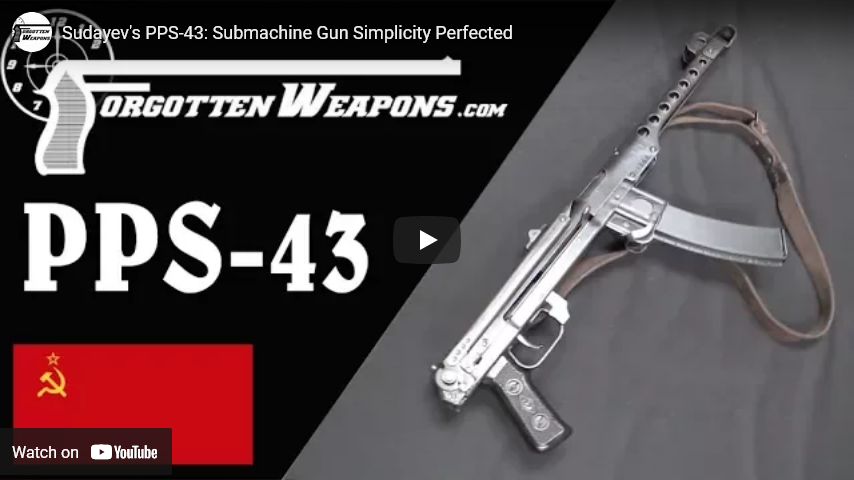
Sudayev’s PPS-43: Submachine Gun Simplicity Perfected
Forgotten Weapons
Published 31 Aug 2017The PPS-43, designed by Alexei Sudayev based on a previous submachine gun design by I.K. Bezruchko-Vysotsky, was the Soviet replacement for the PPSh-41. The Shpagin submachine gun was a very effective combat weapon, but was time-consuming to produce and required specialized manufacturing tools. The Soviet military wanted a weapon that was cheaper and faster to make, and which could be produced at small shops not experienced in firearms production. The Sudayev design fit these criteria extremely well, being made almost entirely of simple bent metal components.
Production of the first prototype Sudayev submachine guns begin in 1942 in the besieged city of Leningrad, where guns were quite literally taken from the factory door to the front lines and put into service. A few minor flaws were discovered and corrected, and by the time the siege was broken the gun was suitable for mass production. It was designated the PPS-43, and while it was theoretically a replacement for the PPSh-41, it never did actually replace the former weapon. It was decided to continue PPSh-41 production in the factories already tooled up for it, while making use of the PPS-43’s simplicity to put it into production as a range of new factories that did not have the technical capacity to make more complex weapons.
Mechanically, the PPS-43 was a simple blowback gun, using basically the same conceptual operating system as the PPSH-41. However, Sudayev resolved the most significant practical problem with the PPSH-41 by abandoning its unreliable drums and developing his own new double-stack, double-feed 35-round box magazine. The PPS-43 magazine is simpler to load, more reliable in use, and much smoother to insert and remove from the weapon than PPSh magazines. The improvement was substantial enough to justify the use of different and incompatible magazines in the two guns. In conjunction with the discarding of the drum magazine, Sudayev also designed his gun to have a lower rate of fire than the PPSh, to better manage ammunition supply. However, the roughly 600 rpm rate of the PPS-43 is actually relatively difficult to control in that light weapon, where the PPSh-41 was substantially smoother shooting despite (or perhaps because of) firing faster.
http://www.patreon.com/ForgottenWeapons
Cool Forgotten Weapons merch! http://shop.bbtv.com/collections/forg…
Русская версия: https://youtu.be/TZxgn4iVMbg
February 17, 2022
Tank Chats #139 | M9 Half Track | The Tank Museum
The Tank Museum
Published 5 Nov 2021Our Patreons have already enjoyed Early Access and AD free viewing of our weekly YouTube video! Consider becoming a Patreon Supporter today: https://www.patreon.com/tankmuseum
Discover how and why this hybrid of a wheeled and tracked vehicle was created during WW2 with Historian David Fletcher.
00:00 – Intro
00:32 – What is the M9 Half Track
05:23 – Features of M9 Half Track
(more…)
February 16, 2022
Roman Republic to Empire 02 The Carthaginian Curse
seangabb
Published 5 Feb 2021[Update 2023-03-02 – Dr. Gabb took down the original posts and re-uploaded them.]
Here is the second lecture, which describes the vindictive treatment of Hannibal and Carthage, and explains this in terms of how the Second Punic War destabilised both Italy and the Roman Constutition. Between January and March 2021, Sean Gabb explored this transformation with his students. Here is one of his lectures. All student contributions have been removed.
(more…)
Germany’s dual economy during WW2 (and why Himmler would have succeeded Hitler if the Nazis had won WW2)
At Founding Questions, Severian looks at the way the Nazi economy was actually two entities — the “wartime” economy and the effectively separate SS economy under the control of Heinrich Himmler:
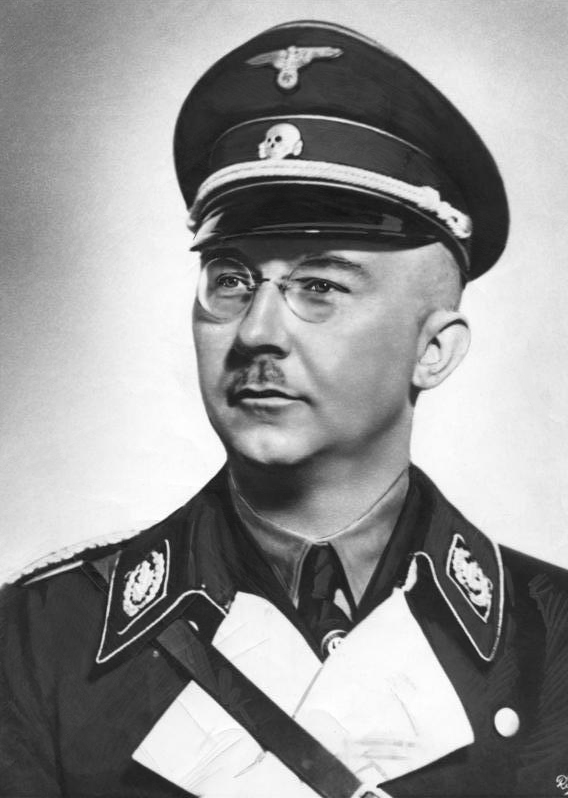
Reichsführer SS Heinrich Himmler, 1938.
German Federa Archive via Wikimedia Commons.
Here’s where the Nazis really blew it. “Nazism” should really be called “Hitlerism”, as it was a true cult of personality; there was no ideology without the specific individual man. That’s the tension at the heart of any collectivist ideology — somebody’s got to be The Boss, however temporarily — but Nazi Germany suffered it worse than most. Had the Nazis won the war, the bloodbath at the top would’ve been as spectacular per capita as the war itself. As thoroughgoing Social Darwinists, they only had one possible principle of succession …
Let’s provisionally call that the first consequence of an ideology in power: The personal is the political and vice versa. That seems trite, I realize, but I’m putting it here to emphasize its literalness – in an ideological state, building your own “affinity”, Bastard Feudalism-style, just IS politics. There’s no other possible political activity. And as much as the Nazis seemed to have screwed it up by going all in on the Fuhrerprinzip at the very top, their out-and-proud Organizational Darwinism (for lack of a better term) made them super-efficient at the lower levels.
Let’s bring Khrushchev back in. In many ways, he’s the Soviet Himmler. He was one of Stalin’s right hand men throughout the war, but somehow didn’t get tagged as a major player in the succession crisis until it was too late for all the other contenders for the purple to take effective countermeasures. In the same way, Hitler did announce a successor, sort of. In fact he did it twice: Before the war, it was Rudolf Hess; during the war, Hermann Goering. Neither of those guys had anything approaching the power Himmler had, but like Khrushchev, his personality was such that the other bigshots couldn’t help overlooking him. Just as the rest of the Politburo couldn’t wrap their heads around the idea of this uncouth quasi-Ukrainian peasant being a major threat, so the rest of the Nazi leaders couldn’t help seeing Himmler as this fussy little file clerk.
It’s a hell of a trick, and I’ll admit, I’m buffaloed. Even if Himmler (Khrushchev) was one hell of an actor, and the egos on the other top Nazis (Soviets) were gravity-defying, they still should’ve been able to see that this fussy little file clerk had some seriously hard boys working for him. Reinhard Heydrich was as ruthless a fuck as was ever born, and Himmler kept him in check. Ditto barbarians like Odilo Globocnik and Erich von dem Bach-Zelewski — they don’t come any nastier than those two, yet Himmler managed them easily. What other conclusion can you possibly draw about Himmler, other than that he was nastier than all of them put together? And yet, apparently, nobody did …
The only explanation for this that I can think of is the Nazis’ ideologization of governmental structures. As opposed to the Soviet experience, where the Party and the Bureaucracy were supposed to be, and often actually were, distinct. After some disastrous experiments with demoting technical experts to field hands, and vice versa, the Russian Communists learned that ideological correctness and “soviet power” does not, in fact, obviate the need for stuff like math. (See also: Mao’s backyard blast furnaces). So the Soviets made sure to separate what they called the “technical intelligentsia” from the Party. The head honcho at Gosplan, Gossnab, etc. would be a Party hack from way back, of course, but the actual brainworkers wouldn’t be. I don’t know just how many of them had Party membership cards, or if any of them did, but nobody I know of rose through the Party’s ranks via Gosplan.
Once a Gosplanner, always a Gosplanner. The technical intelligentsia got all kinds of perks in the Soviet system, but one thing they did not do was get perks inside the Party. You can be a technical expert, or you can be an up-and-coming Party man, but you can’t be both.
The Nazis did the exact opposite of that. The way the Third Reich actually functioned is still opaque in a lot of ways (especially to non-specialists), and of course the pressures of wartime forced a lot of ad hoc measures, but it seems like the SS was supposed to be a sort of All-Purpose Expert Corps. Not only did they have their own army and intelligence service, but they had their own economy — the brief history of the Third Reich makes a lot more sense when you realize that half or more of the official Reich economy was hamstrung by the informal but very real SS economy, operating largely (but far from exclusively) through the labor camps.
Indeed, the SS had their own administration. As incredible as it seems, the Nazis had no grand plan for what to do once they’d conquered Europe. Himmler did, at least as far as the East was concerned, and he tried his damnedest to put it into action in Poland (which is why the General Government was so legendarily brutal). Hitler apparently thought in terms of Germany’s lost late 19th century colonies, when he bothered to think about it at all … which wasn’t often. In his typical Fuhrer-riffic style, he just ignored the problem, trusting to Organizational Darwinism to sort it out …
… which is where the All-Purpose Experts of the SS stepped in. The General Government, for instance, was headed by a civilian lawyer, Hans Frank, but the day to day governance largely fell to the SS, because that’s who stepped up. Poland was an occupied zone, with vital war industries, but it was far behind the front for most of the war; the army couldn’t waste vital manpower garrisoning it. Thus the SSPF (the SS and Police Leader) stepped in, drawing manpower as needed from a wide variety of sources — the camp guards, the Wehrmacht (when garrison troops were available, and when they could wrangle them from the various army commanders), the civilian police, the “General SS”, and so on.
The details aren’t nearly as important as the big picture, which is: Unlike the technical intelligentsia in the Soviet Union, members of the SS could climb to the highest ranks of the Party. Indeed they were expected to: the SS was rapidly becoming a Party-within-the-Party at the outbreak of the war, not least because Himmler awarded a “ceremonial” SS rank to anyone who mattered politically in the various departments. The savvier guys refused the “honor,” of course, because they didn’t want to be subordinate to Himmler, even ceremonially, but many didn’t. Which meant that had the Nazis won the war, not only would Himmler have been the next Fuhrer, but the SS would’ve closed ranks, essentially taking over The Party — they’d be the Inner Party, as opposed to the “mere Nazis” of the Outer Party.
QotD: The fall of Kabul was “a margin call”
Kabul was a margin call. From now on, America may well be obliged to “pay cash”, viz., deploy combat capable formations of sufficient size to engage and win if we want anyone to take us seriously. A token “speedbump” force or a promise of “over the horizon” support — which is the majority of what the U.S. military now does — isn’t going to reassure any friends or deter any adversaries. At least not anyone who is paying attention.
Our adversaries will be emboldened. It is not so much that America’s military reputation has been irretrievably damaged, but the lessons that the Vietnamese, the Hmong, and now the Afghans have learned so painfully cannot fail to be appreciated by us or by the wider world. It appears that America (not the military, but America herself) has lost her stomach for a real fight. Americans taught the world the same lesson about the British Empire during the Revolutionary War (although Britain recovered enough to build her “second empire”), it would be foolish to fail to now see ourselves through that particular historical prism.
Garri Benjamin Hendell, “The Day After Kabul”, The Angry Staff Officer, 2021-11-02.
February 15, 2022
Total War on Valentine’s Day – WW2 – Reading Comments
World War Two
Published 14 Feb 2022Another installment of Across the Airwaves, where we highlight some of the best viewer comments under our videos. It’s Valentine’s Day and we’re feeling pretty romantic, so Indy and Spartacus will be reading comments that are all about love, humanity, and relationships.
(more…)
Krieghoff: Lugers for the Luftwaffe
Forgotten Weapons
Published 20 Oct 2021http://www.patreon.com/ForgottenWeapons
https://www.floatplane.com/channel/Fo…
Cool Forgotten Weapons merch! http://shop.forgottenweapons.com
One of the scarce, small-production manufacturers of the Luger is Krieghoff — Heinrich Krieghoff to be exact. Kreighoff Waffenfabrik was a smallish arms company that wanted to get into major contracts with the rearming German military in the 1930s. They began by bidding on a contract for 10,000 Luger pistols for the Luftwaffe, and won. Krieghoff had previously worked as a subcontractor for the Simson company rebuilding Lugers under the Weimar government. Kreighoff got control of the Simson Luger tooling, and used it to manufacture a new set themselves.
Krieghoff built a total of 13,825 Luger pistols. The first 10,000 were delivered to the Luftwaffe between 1935 and 1937. A further 2,000 were delivered in small batches between 1940 and 1944, with a final 200 in 1945. In addition to these, 1,625 were sold commercially, including a few highly embellished examples. They are renowned for their excellent quality, and have always attracted particular collector interest.
Contact:
Forgotten Weapons
6281 N. Oracle 36270
Tucson, AZ 85740

QotD: Breaking the trench stalemate with tanks
In theory, a good tank ought to be effectively immune to machine-gun fire, able to cross trenches without slowing and physically protect the infantry (who could advance huddled behind the mass of it), all while bringing its own firepower to the battle. Tracked armored vehicles had been an idea considered casually by a number of the pre-war powers but not seriously attempted. The British put the first serious effort into tank development with the Landship Committee, formed in February of 1915; the first real tanks, 49 British Mark I tanks, made their first battlefield appearance during the Battle of the Somme in 1916. Reliability proved to be a problem: of the 49 tanks that stepped off on the attack on September 15th, only three were operational on the 16th, mostly due to mechanical failures and breakdowns.
Nevertheless there was promise in the idea that was clearly recognized and a major effort to show what tanks could do what attempted at Cambrai in November of 1917; this time hundreds of tanks were deployed and they had a real impact, breaking through the barbed wire and scattering the initial German defenses. But then came the inevitable German counter-attacks and most of the ground taken was lost. It was obvious that tanks had great potential; the French had by 1917 already developed their own, the light Renault FT tank, which would end up being the most successful tank of the war despite its small size (it is the first tank to have its main armament in a rotating turret and so in some sense the first “real” tank). This was hardly an under-invested-in technology. So did tanks break the trench stalemate?
No.
It’s understandable that many people have the impression that they did. Interwar armored doctrine, particularly German Maneuver Warfare (bewegungskrieg) and Soviet Deep Battle both aimed to use the mobility and striking power of tanks in concentrated actions to break the trench stalemate in future wars (the two doctrines are not identical, mind you, but in this they share an objective). But these were doctrines constructed around the performance capabilities of interwar tanks, particularly by two countries (Germany and the USSR) who were not saddled with large numbers of WWI era tanks (and so could premise their doctrine entirely on more advanced models). The Panzer II, with a 24.5mph top speed and an operational range of around 100 miles, depending on conditions, was actually in a position to race the train and win; the same of course true of the Soviet interwar T-26 light tank (19.3mph on roads, 81-150 mile operational range). Such tanks could have radios for coordination and communication on the move (something not done with WWI tanks or even French tanks in WWII).
By contrast, that Renault FT had a top speed of 4.3mph and an operational range of just 37 miles. The British Mark V tank, introduced in 1918, moved at only 5mph and had just 45 miles of range. Such tanks struggled to keep up with the infantry; they certainly were not going to win any race the infantry could not. It is little surprise that the French, posed with the doctrinal problem of having to make use of the many thousands of WWI tanks they had, settled on a doctrine whereby most tanks would simply be the armored gauntlet stretched over the infantry’s fist: it was all those tanks could do! The sort of tank that could do more than just dent the trench-lines (the same way a good infiltration assault with infantry could) were a decade or more away when the war ended.
Moreover, of course, the doctrine – briefly the systems of thinking and patterns of training, habit and action – to actually pull off what tanks would do in 1939 and 1940 were also years away. It seems absurd to fault World War I era commanders for not coming up with a novel tactical and operational system in 1918 for using vehicles that wouldn’t exist for another 15 years and yet more so assuming that they would get it right (since there were quite a number of different ideas post-war about how tanks ought to be used and while many of them seemed plausible, not all of them were practical or effective in the field). It is hard to see how any amount of support into R&D or doctrine was going to make tanks capable of breakthroughs even in the late 1920s or early 1930s (honestly, look at the “best” tanks of the early 1930s; they’re still not up to the task in most cases) much less by 1918.
Bret Devereaux, “Collections: No Man’s Land, Part II: Breaking the Stalemate”, A Collection of Unmitigated Pedantry, 2021-09-24.
February 14, 2022
In The Highest Tradition — Episode 2
British Army Documentaries
Published 22 Oct 2021This episode includes the story of Millie the Mule and just why a rose is still eaten, raw, in one battalion’s mess. It also features the “White Helmets”, a team of motorcycle stunt riders. One team of retired soldiers has an average age of 74 years but they still meet up to perform stunts in front of their successors.
© 1989
This production is for viewing purposes only and should not be reproduced without prior consent.
This film is part of a comprehensive collection of contemporary Military Training programmes and supporting documentation including scripts, storyboards and cue sheets.
All material is stored and archived. World War II and post-war material along with all original film material are held by the Imperial War Museum Film and Video Archive.
I have to mention that the primrose hackle, once worn with great pride by the Lancashire Fusiliers is still worn by the Lorne Scots (Peel, Dufferin & Halton Regiment) of the Canadian Army Reserve.
QotD: Canadians and imaginary peacekeeping
Canadians are fixated on peacekeeping. We believe that Mike Pearson invented it, that Canadians are the best in the world at it, and that if we do peacekeeping, ideally for the United Nations, then we will not need large numbers of troops or much expensive equipment. The idea of peacekeeping as our métier has certainly shaped Canadian defence policy, and not for the better. The billions of dollars that Liberals and Conservatives have belatedly pledged to rebuild the Canadian Forces will take years to make a difference and to undo four decades of neglect …
J.L. Granatstein, “Wake up! This is our war, too”, Globe and Mail, 2006-02-28.
February 13, 2022
Victory at Guadalcanal – WW2 – 181 – February 12, 1943
World War Two
Published 12 Feb 2022Operation KE, the Japanese evacuation of Guadalcanal, concludes this week and the campaign has been a big loss for the Japanese. The Axis forces are also withdrawing — and the Red Army advancing — in the Donbas and the Caucasus, closing in on both Kharkov and Rostov. And a front that’s been quiet for a while, the Burma front, begins heating up again with an Allied advance out of India.
(more…)
February 12, 2022
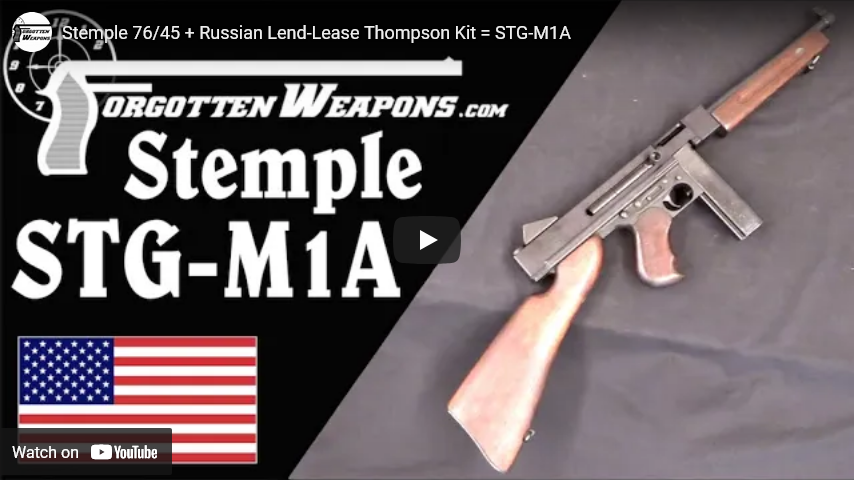
Stemple 76/45 + Russian Lend-Lease Thompson Kit = STG-M1A
Forgotten Weapons
Published 8 Oct 2021http://www.patreon.com/ForgottenWeapons
https://www.floatplane.com/channel/Fo…
Cool Forgotten Weapons merch! http://shop.forgottenweapons.com
The modularity and clever design of the Stemple Takedown Gun is perhaps best illustrated by the STG-M1A and STG-1928 (these are the same gun with either a horizontal or vertical front grip). In the early 2000s a bunch of Thompson parts kits came into the US, WW2 vintage lend-lease guns sent to Russia. They were M1 and M1A1 models, and had intact barrels but torch-cut receivers. BRP, who makes the Stemple, realized that the sear-to-magwell dimensions on the Thompson were almost identical to the Suomi and Stemple — and that he could make a version of the STG that was a nearly perfect clone of the M1 Thompson.
The registered Stemple receiver slides into a square Thompson lookalike housing, and original Thompson grips, stocks, and hand guards are used. It is chambered for .45ACP, using original Thompson stick magazines (naturally). The result is a submachine gun that almost perfectly duplicates the handling of a true Thompson, without the historical value that makes the Thompson so expensive and keeps many owners from wanting to actually take their Thompsons out to the range.
Note that the gun in this video is an early example, and models made today are able to take both stick and drum magazines. Also, due to the design of the disconnector in the original Thompson FCG, the semiauto setting is not functional in the Stemple version — it’s only full automatic.
Contact:
Forgotten Weapons
6281 N. Oracle 36270
Tucson, AZ 85740
February 11, 2022
Eat the Nazis, There’s Nothing Else – WAH 052 – February 1943, Pt. 1
World War Two
Published 10 Feb 2022As the United Nations alliance, and the Resistance in occupied Europe increase their pressure on Nazi Germany, they continue to escalate their war on humanity. Meanwhile, in more and more parts of the world there is little to eat.
(more…)


